The Youth's Instructor, Vol. LII, No. 9

Love and Hope

The Youth's Instructor

March 1, 1904

Review and Herald Publishing Assn. · Washington, D. C. · March 1, 1904

Love and Hope

THE love of my Saviour prevents me From joining the sins of the world, But a glorious prospect contents me, Where the banners of peace are unfurled.
For my heaviest loss it requites me, That prospect of heaven and home; From the cross ’tis the crown that invites me, ‘To be given when Jesus shall come.
O “that home of the soul!” with emotion I dream of the bright jasper walls, With a loving and loyal devotion, Of the Saviour who patiently calls.
And now, in my chamber, while kneeling, What hopes are enshrined in my heart; What visions of beauty are stealing, Of the country where friends never part.
All my heaviest burdens weigh lightly, I am almost in sight of the prize. I’m watching both daily and nightly For the Saviour to come in the skies.
I am free from the world, I can never Engage in its sin and its wrong; For Christ has redeemed me forever, His love is the theme of my song.
L. D. SANTEE.

The Nation's Capital

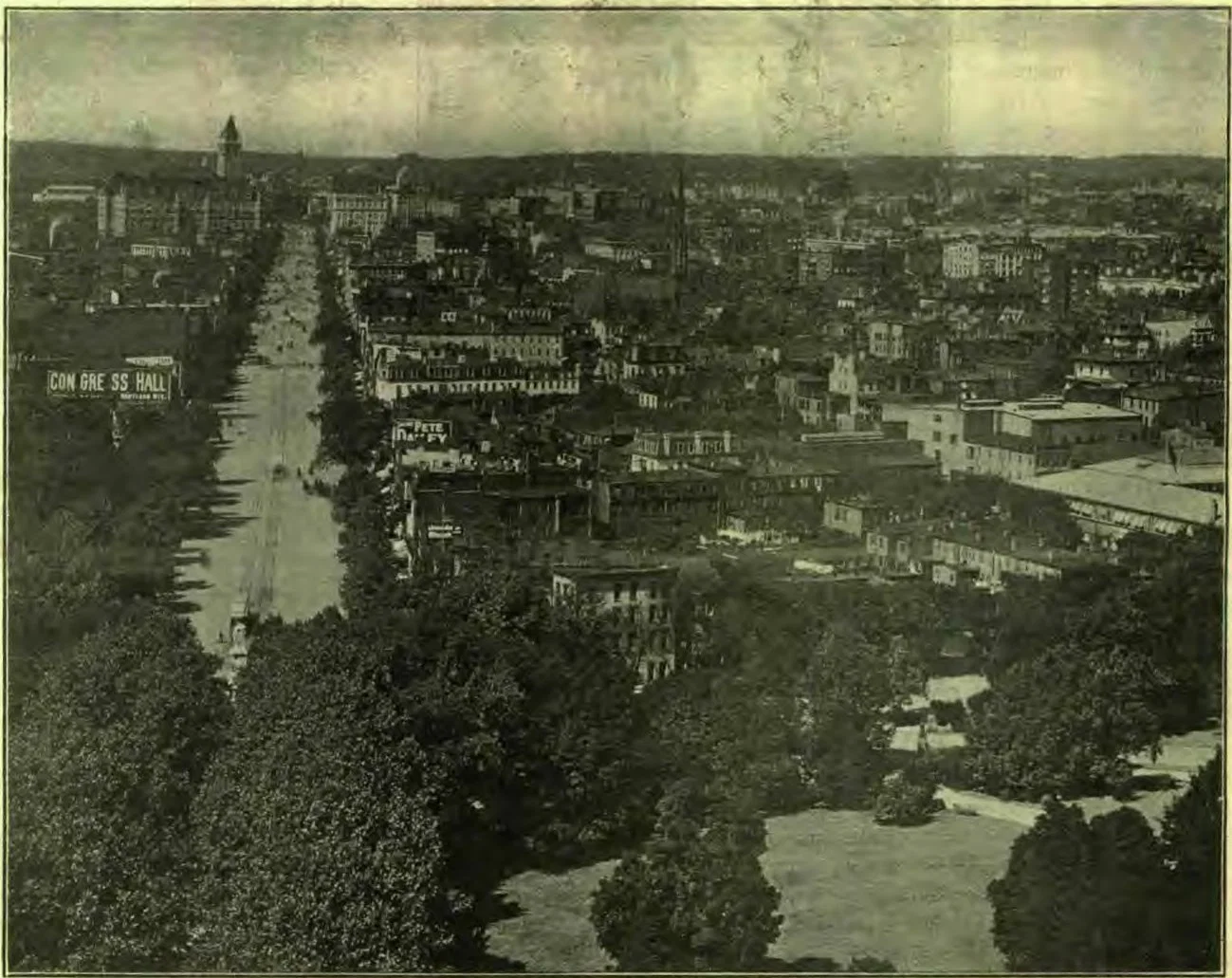
LOOKING WEST FROM THE CAPITOL
WEALTH, learning, art, commerce, and natural scenery have each made various cities famous; but Washington owes its fame to its wise and just laws—“a government by the people and for the people.” Each of the others, however, has had a share in making the capital one of the world's chief cities. So important an event as the choosing of the place for the seat of government, could hardly be expected to take place without quickening the pulse of the laudibly ambitious cities. No sooner, therefore, was the question of a choice of the capital city before the public, than New York, Philadelphia, Baltimore, and other cities presented strong claims for the honors of the Federal City. After much discussion, Congress empowered President Washington to select a location on the Potomac River. It is said that on an early surveying expedition Washington had been attracted by the site he finally chose for the city.
The government was removed from Philadelphia to Washington in the year 1800. Fourteen years after this, it was captured by the British, who set fire to the public buildings and to some of the residences, intending to destroy the town altogether. More kindly disposed was the storm of wind and rain which came that night, and saved the town. The following day the British left in a panic of causeless fear, save a large number who decided to remain, and cast in their lot with the “rebels.”
The city was rebuilt at once, and continued its rapid growth. Its population at the time of the Civil War was sixty thousand; its present population is three hundred thousand. The District of Columbia, which exists for Washington, is located on the north side of the Potomac River about one hundred six miles from the Chesapeake Bay.
Its area is sixty-nine square miles, or forty-four thousand one hundred sixty acres. Originally it was ten miles square; but Virginia's portion, over thirty square miles south of the river was ceded back to her in 1846.
Architecturally, Washington has become one of the most attractive places of the world. Its numerous public buildings—the Capitol, of world-wide fame, the White House, the War and Navy buildings, Patent Office, Treasury, Pension Office, Congressional Library, and the Smithsonian Institution—are the focus of national interest. The Washington Monument, rising majestically more than five hundred feet into the ether blue, adds much to the interest of the city. The cooling, exhilarating breeze that sweeps down the tower constantly from the upper atmosphere on the most excessively warm summer day, fitly suggests the pure political wave that should blow from Washington as a center over all this fair land.
The happy repartee a Boston man made to a gentleman from Philadelphia who was making some rather unpleasant contrasts in regard to the streets of the two cities, is familiar. “When Boston gets to be as dead as Philadelphia, it will be as well laid out,” said the Boston gentleman. Those who had the planning of the capital city determined it should be intelligibly laid out. This determination, carried out wisely, has made the simple, artistic plan of its streets and avenues one of Washington's acknowledged charms. A hill was chosen for the Capitol site. From this radiate, like the spokes of a wheel, the main avenues. The city then is platted into rectangles by streets; those running north and south are numbered, those east and west are lettered. Two long streets at right angles passing, as it were, directly through the Capitol, divide the city into four divisions, —Northeast, Southeast, Northwest, Southwest. The Northwest is the main division. The government buildings and grounds seem arranged for the convenience of the visitor. Passing out of the Capitol at the west entrance, one comes easily to the Botanical Gardens, then just beyond these to the Public Gardens, the Fish Commission and Armory, one on either side of the street, then to the National Museum, the Smithsonian Institution and grounds, Agricultural Grounds, then to the Monument. Beyond the beautiful, extensive grounds of the Monument, on the right-hand side of the street, are the Executive Mansion, President's Park, State, War, and Navy buildings, and the Treasury. From the Public Gardens one has simply to pass down Fourth Street for a short distance to come to the Judiciary Square, Pension and Patent buildings.
Seemingly, lest visitors should be tempted to confine themselves to the places of interest grouped together so near the Capitol, thus failing to get a general view of the city with its broad, paved streets, delightful boulevards, pleasant parks, and costly statues in various parts of the city, some of the points of interest have been placed at the very outskirts of the city, and toward all points of the compass, thus compelling extended observation. On the outlying borders, therefore, the visitor will find the Zoological Park, United States Naval Observatory, Soldiers' Home, United States Navy Yard, and the Congressional Cemetery.
The relations of the District and capital city to the Union are peculiar.
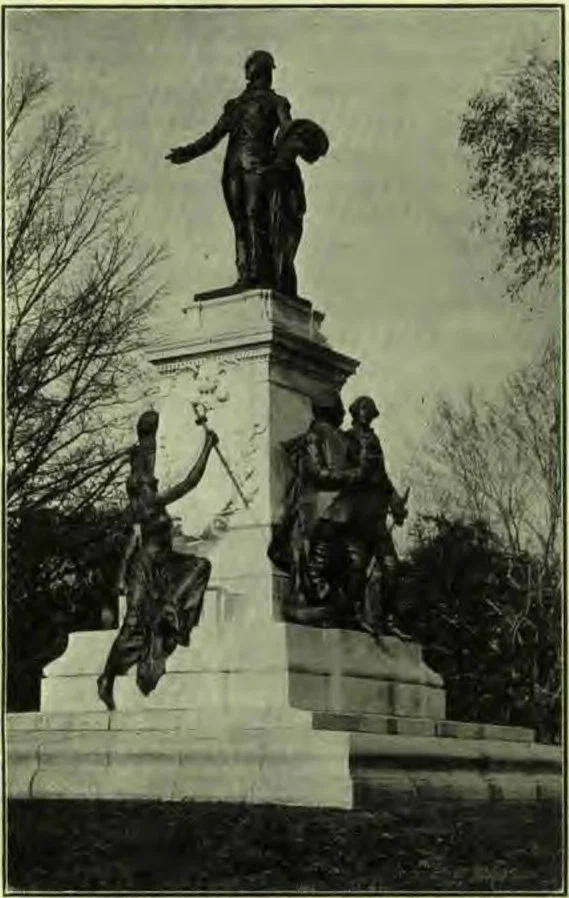
LAFAYETTE MEMORIAL IN LAFAYETTE SQUARE
After several unsatisfactory experiments in municipal government, “Congress created a form of administration of District and city affairs, which consists simply of two civilian commissioners appointed by the President, and confirmed by the Senate, and one army engineer officer detailed by the Secretary of War, the three constituting a Board of Commissioners for three years. They are empowered by Congress to make, and change at will, building, health, and police regulations. They also appoint all subordinate officials and clerks.” The District being under the exclusive legislation of Congress, its citizens have no part in the election of the president or vice-president, nor in the affairs of the District. The people are to take quietly what they get, and be therewith content. All, dutiful submission, however, to rightful authority brings its own reward; so the Federal government contributes one half of all the expenses of the District, and does much besides, in maintaining beautiful parks and boulevards; so that Washington has a larger area devoted to streets, avenues, and parks, in proportion to its size, than any other city in the world. A glimpse of the Capitol will be given in the next article.
Over Washington have blown the winds of political strife and corruption, of bitter jealousies and intrigue; also the refreshing winds of loyalty to principle, devotion to the people's interests, and of strict integrity. These each have swept over the capital city with such force as to carry for a time, seemingly, everything before them. We wish that only the good might blow here, purifying and sweetening the political and social life of Washington, the heart of the fairest country of earth, making it indeed the ideal capital city. But Lucifer's breath poisoned the air of heaven; so it is in vain to hope against hope.
“KNOWLEDGE comes, but wisdom lingers.”

How Stamps Are Made

Few of us ever realize the number of people who are working the world over to supply our needs. It has been estimated that the poorest citizen of the United States has at least one million men and women in his service. All the thousands who prepare the food he eats, the clothes he wears, the house he lives in, the streets he walks on, the places of amusement he visits, and the thousands of his fellow he handles day by day, are as truly in his service as if he paid them. He does pay them, in fact, indirectly, by his labor in his chosen field of work, in which he does something that will be of use to thousands of his fellow citizens.
It is impossible, of course, to give any detailed idea of the work of his million employees, but some idea of their manifold activities may be gained from the statement that it takes the services of about three thousand of them to furnish him with so simple a thing as the stamp he puts on a letter, and the money he uses to pay for it. The bureau of engraving and printing in Washington, where all the stamps and bank-notes are printed, has two thousand eight hundred employees, and the mints of the country, where the coins are made, require five hundred more.
And this is not merely because of the number of stamps and notes that are printed; each separate stamp is handled by more than two hundred people before it comes into the purchaser’s hands. To deliver the letter on which it is pasted to the addressee requires the work, on an average, of nearly a hundred thousand more, including the men who made the letter-box in which you dropped it, built the post-office where it was sorted, laid the rails over which it was carried, made the sack the postman uses, and fashioned the hundreds of other accessories needed. It gives one a realizing sense of his importance in the world of to-day when he considers that he can enlist all these men and all this work for only two cents.
But how are two hundred people required to make a single stamp? Well, let us see. Some day the third assistant postmaster-general decides that our existing set of stamps is behind the times, and that it should be replaced by one more up to date and more appropriate. He calls on the chief of the bureau of engraving and printing to furnish him with designs, and the chief in turn calls upon his artists to make him drawings. These are made very large, and are reduced by photography to the proper sizes, and submitted for approval, every step in the work calling for expert skill. Sometimes half a dozen sets are submitted before one is found acceptable.
Then the chief sends the designs to the engravers, who are paid from two thousand five hundred dollars to six thousand dollars a year. One man does the portraits, another the scroll work, another the letters, and so on. Each works on a separate piece of steel, and takes weeks, and sometimes months, for his work.
At last the separate parts are done. Then they are “assembled,” that is, bound together so as to form one perfect die. But one die, no matter how rapidly it is worked, could not begin to supply the needs of a country which uses fifteen million stamps a year. Nor would it be possible to prepare enough single dies to supply these needs—not unless all the engravers in the world should be employed to work at them all the time.
Fortunately, only one die is needed. From it an imprint is made, in reverse, on a soft steel roller, which is then hardened, and applied four hundred times to a copper plate. Every time it leaves a sunken imprint, until at last we have a plate engraved with twenty rows of twenty stamps each, from which a larger number of sheets can be printed.
But even this is not all. Many such plates of four hundred are made, the exact number depending on the number of stamps of that particular denomination that are needed. With a one-dollar stamp, for instance, only one or two plates are needed; for a two-cent stamp hundreds are required.
It takes one man and two girls to run a stamp printing-press, each having his own duty, such as inking, cleaning, and otherwise preparing the plate, putting in and taking out the paper, and keeping account of the exact number of sheets run through.
Still more workers are required after the stamps are printed. They have to be gummed, with a different sort of gum for each season of the year; to be dried by artificial heat that loses no time in discharging its office; to be examined for breaks, tears, and spots; to be punctured with the familiar pin-hole perforations that make it easy for you to tear them apart, and to be cut into four quarters for convenience in shipment. The various stages of this part of the work require about half the force of the bureau; most of the other half do similar things to the bank-notes.
A stamp as it comes into your hands does not look as if all this work had been done upon it; yet it has—and more too. For instance, every sheet has been counted no less than fifty times. This means that something has been done to it by more than fifty separate workers, for it is counted each time simply because it has passed from one worker to another; because each must know how many sheets he received, and how many he surrendered. Then, if a sheet is lost or stolen, the one responsible can be fixed on instantly.
Altogether, not less than two hundred people have to do with the making of a single stamp, counting from the third assistant postmaster-general down to the clerk who hands it to you through his window. All these are in a way your employees, your servants indeed.
So, when you feel that the world ignores you and doesn’t care whether you live or die, just sit back and think how many thousands of people are working for you, and how many thousands you can call to labor by spending a single cent. Then think how many thousands you are working for, in your turn, and how many thousands depend on the faithful discharge of your duty for their comfort and happiness; such thoughts will cheer you, and send you back to the battle revived and strengthened. For, in these days, even in a temporal sense, “none of us liveth to himself.” — Crittenden Marriott.

Give Love, and Love to Your Life Will Flow

“Give love, and love to your life will flow, A strength in your utmost need; Have faith, and a score of hearts will show Their faith in your word and deed.”

The True Light (Continued)

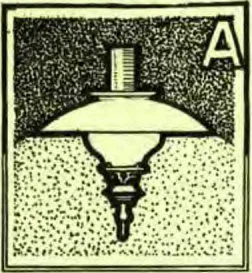
And this element of the changeable was also to teach us that the energy of light, the life of the vine, and the virtue of bread, are due to the power of God. For the salvation which came through the sanctuary service was only by means of, and because of, the true sacrifice, which, though not yet offered, even then redeemed them. And whatever weakness there was then in that service was not because of an insufficiency of the power, but instead, was due to the weakness and unprofitableness of the instrument. The sanctuary service, though ministering the saving power of God, nevertheless depended entirely in the instruction imparted by figures and types, and in the insufficient service of erring, mortal man. Heb. 7:18.
Therefore, we are prepared to understand that the service of nature never can make the comers unto it perfect. And this, too, the sanctuary service could not do. Heb. 10:1-3.
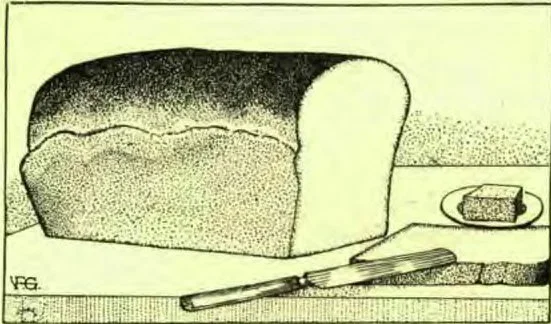
Bread as bread nourishes the body; but it can not preserve from death those who partake of it. “Your fathers did eat manna in the wilderness,” says Jesus, “and are dead.” This (the true Bread, John 6:52) is the bread which came down from heaven, that a man may eat thereof and not die. And that, thank God, is bread to a purpose. All else is bread in only a very inferior and subordinate sense.
And so far as this is concerned, the energy of the bread is but the energy of sunlight which was stored there when the wheat was in process of growing. The delegated power of the bread is but the delegated power of sunlight. And so the sun is called the source of life, but its life is not eternal. God makes it the bearer of life, and the life is from God, but its service is temporary. God is the true light and the true bread. The sunlight and the wheat bring temporal life from God to man; but Christ, the true light and the true bread, brings eternal life from heaven to the sons of men.
So nature, like the earthly sanctuary, being but a shadow of good things to come, and not the very things themselves, can not, as has been said, make the comers thereunto perfect. Heb. 10:1. But we may all thank God that there is a service in heaven that can make the comers to it perfect. There is a bread of which a man may eat and live forever. And there is One who promises to be our everlasting light and our eternal glory.
In the earthly sanctuary all its life and efficiency lay in the antitype to which it pointed. It had no vigor or life of its own; it was but a shadow of the vital things in heaven. “For it is not possible that the blood of bulls and of goats should take away sins.” Heb. 10:4. These were sacrifices which could never take away sins. It was not the blood of bulls and goats, but the blood of Jesus; it was not the ministry of the Levite, but the ministry of Christ, that atoned for sin.
And the power of the bread to sustain life is not the power of the bread in itself; it is not even the power of sunlight stored by the wheat plant in the bread: no, it is neither of these, but rather, it is the power of the Word, manifested in and through the bread and the sunlight, to the sustaining of our bodies.
If Jesus Christ, the Living Word, should withdraw his energy from the food products of this world, they would be as valueless for our sustenance as so much sand or pulverized rock. It is the power of the ever-living Word that makes the earth bring forth the herb yielding seed, and the fruit-tree yielding fruit; and the power of these to sustain life is the power of the Word.
If Jesus Christ should withdraw his sustaining, upholding power (Heb. 1:3) from the sun, it would stumble in its path, and go out in darkness. And then, speedily, in less than a month, all the heat necessary for life would be dissipated from this earth, and we would all lie down in an everlasting sleep.
Therefore, with what significance do the words of Jesus, “I am the light of the world,” flash to our minds! God maketh his sun to rise on the evil and on the good. Not of its own inherent power does it do this—no, no! he maketh his sun to rise. And O, how miserably did the heathen miss the truth of these things when they traced the light and power no farther than to yon shining orb, and then fell down with their faces to the east, and worshiped it! And when we look at its great round face as it rises above the earth, do we at once remember of whose power and light and energy it is but the bearer and emblem? Certainly we should view it thus.
But the Jews came to look upon the sanctuary service as the final and complete atonement. They considered it to be of itself self-sufficient. They forgot that it spoke the power that belonged to a higher and greater work. “For it is not possible that the blood of bulls and goats should take away sins.” Heb. 10:4. And yet the Jews thought of no other service, would not consider any other. The earthly service veiled their eyes to the great work and power of God, of which it was but the type. And “even unto this day, when Moses is read, the veil is upon their heart.”
And to-day men are making the same mistake with reference to nature. It is supposed by many that nature is self-sufficient for her work. By inherent power, by self-constituted energy, she does her work. They see no farther than the appearance of the eyes, and thus nature, instead of teaching God, veils him from the sight. As the service of the sanctuary, considered as the Jews considered it, hides God instead of revealing him; so nature veils him from the mind of man. The mistake men are now making in their views of nature is but the mistake that the Jews made with reference to the earthly sanctuary. For there is no new thing under the sun. They stumble at the same stumbling-stone, Christ Jesus.
For this “veil is done away in Christ.” 2 Cor. 3:14. Christ lifts the veil of the earthly sanctuary, and shows us its real import and efficiency. Sins in that age could not be taken away by the blood of bulls and goats, but the transgressions that were under the first covenant are taken away by the death of Christ. Heb. 9:15. He is the virtue of that service; remove him and there is nothing left but a dead round of ceremony—worthless routine.
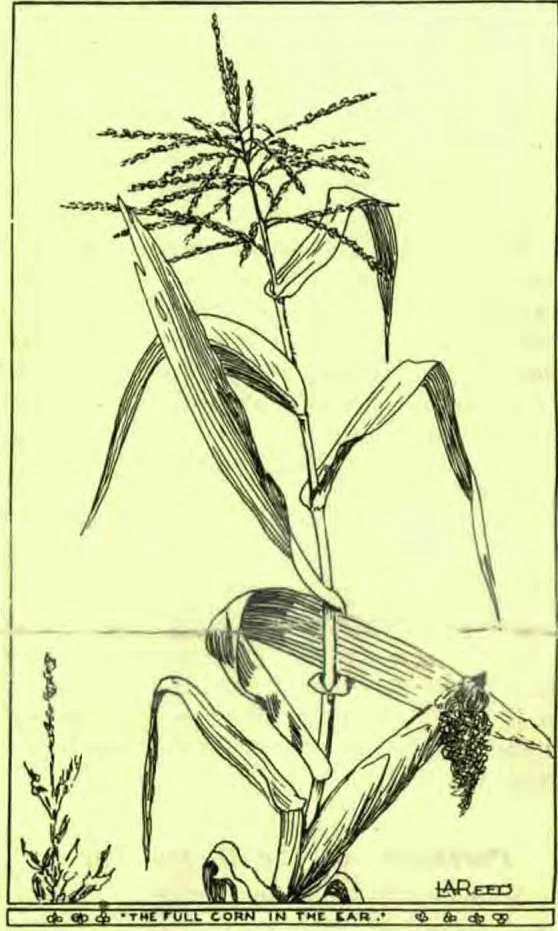
And in the miracles of Christ he lifts the veil also from nature. “In feeding the five thousand, Jesus lifts the veil from the world of nature, and reveals the power that is constantly exercised for our good. In the production of earth’s harvests, God is working a miracle every day. Through natural agencies the same work is accomplished that was wrought in the feeding of the multitude. Men prepare the soil and sow the seed, but it is the life from God that causes the seed to germinate. It is God’s rain and air and sunshine that cause it to put forth, ‘first the blade, then the ear, after that the full corn in the ear.’ It is God who is every day feeding millions from earth’s harvest fields. Men are called upon to co-operate with God in the care of the grain and the preparation of the loaf, and because of this they lose sight of the divine agency. They do not give God the glory due unto his holy name. The working of his power is ascribed to natural causes, or to human instrumentality. Man is glorified in place of God, and his gracious gifts are perverted to selfish uses, and made a curse instead of a blessing. God is seeking to change all this. He desires that our dull senses shall be quickened to discern his merciful kindness, and to glorify him for the working of his power. He desires us to recognize him in his gifts, that they may be, as he intended, a blessing to us. It is to accomplish this purpose that the miracles of Christ were performed.”—Desire of Ages, page 367.
And since they are performed to teach this very truth, it is time we were considering it. Thus nature will teach us of God. And there is no knowledge higher than this. For to know him and Jesus Christ his Son, is life eternal. Shall nature veil him from our sight? or shall it voice his praise to us, his everlasting power, and lead us up to him? L. A. REED.
THE FULL CORN IN THE EAR.

In the Hands of the Potter

In the shop of a potter we once spent a pleasant and profitable hour. His potter's wheel, which he propelled by foot-power, was a horizontally whirling wooden disk, on which he threw the moist, pliable clay as a cook throws kneaded dough on a bread board.
It was interesting to watch his skilful fingers manipulate this dough-like clay. By pressing against the lump on the whirling wheel, he drew it up into the shape of a jug. This he threw down, and then made it into a vase. Throwing this down, he quickly produced a clever imitation of a magnolia bud. After this the clay took the form of a large acorn and of various other objects. At last he drew it up into a barrel money bank for the reception of children's pennies.
Sometimes a potter will be unable to form the clay into the object he desires, because of grit or some foreign substance in the clay. The beautiful vase that he may have sought to fashion is marred and ruined. Then he finds it necessary, if he would do anything further with that clay, to throw it down on the wheel, and carefully knead out of it the grit or other substance which spoiled its usefulness.
Here we may learn a lesson. In God's hands we are as clay in the hands of the potter. The bad habits and sins that we let come into our lives and hearts are like the grit or foreign substances which prevent the potter from making of the clay the beautiful object he designed. Then it is necessary for God to take away from us those things before he can mold us into beautiful and useful characters.
But the clay into which foreign substances have never entered is always the best and most valuable, and we think that the lives that have never been injured by bad habits are the lives that are most pleasing to God, the great Potter. If all our young people would accept this truth and act upon it, how much that is so often allowed to come in which is unfit for God's use, might be kept entirely out!
Another thing. After the clay has been hardened in the fire, it can not be remodeled. When character has hardened, it is not easily changed. The crucial time is the forming time, when the heart is young and pliable, before the hard hand of sin has touched and marred it, how important it is that it should be given to God, the great Potter, that he may make out of it all that is beautiful and good! — Selected.

Partakers of the Divine Nature

To those who are looking for the soon coming of our Lord the subject of greatest importance is, “How may we be ready for that great event?” When we read that without holiness no man shall see the Lord, we realize that a great work must be done for us before we can meet our Saviour in peace.
What is the holiness that God requires? and, How is it to be obtained? are questions vital just now to every believer.
“Ye shall be holy, for I am holy,” is not only a command, but also a promise, a statement of a fact to those who believe. This follows as a result of our relationship to the source of holiness. Consider the sixteenth verse of the eleventh of Romans: “And if the first fruit be holy, the lump is also holy; and if the root be holy, so are the branches.”
Here the true, or spiritual, Israel is compared to a tree, of which Christ is the root. But as the tree partakes of the nature of the root, which is revealed by the fruit it bears; so we, if branches, partake of the root and fatness of the olive tree. Christ calls himself the Root and the Offspring of David,—in his human nature the offspring, and in his divine nature the root. Thus by being connected with the Root, we become partakers of the divine nature. 2 Peter 1:4. Therefore ye shall be holy; for the root, the spring of your life, is holy. That the fruit partakes of the nature of the root is a well-known law of nature. So the Lord tells us in the eighth verse of the fourteenth chapter of Hosea, “From me is thy fruit found.” “But the fruit of the Spirit is love, joy, peace, long-suffering, gentleness, goodness, faith, meekness, temperance.” Are we bearing this fruit? Are we “filled with the fruits of righteousness, which are by Jesus Christ, unto the glory and praise of God”? Let us not be among those who weary the Lord by their words, saying, “Every one that doeth evil is good in the sight of the Lord, and he delighteth in them.” Let us not try to make the spotless garment of Christ’s righteousness a cloak for wrong-doing, thinking that we can go on in sin, and have the righteousness of Jesus imputed to us to cover all our defects of character. Remember that the righteousness of God is not only upon, but unto all that believe. We must not only receive the imputed righteousness of Christ, but the actual righteousness which comes from the same source. This is the perfection we must reach before we can receive the latter rain; for “none can share the refreshing,” unless he obtains the victory over every besetment, over pride, selfishness, love of the world, and over every wrong word and action. This is the character one must have to receive the seal of God; for “those who receive the seal of the living God, and are protected in the time of trouble, must reflect the image of Jesus fully.”
“Blessed are they which do hunger and thirst after righteousness, for they shall be filled.” Do we feel in our inmost souls this longing, this hungering and thirsting, after perfect purity and holiness? Or shall we rest satisfied with our condition until the time of the falling of the plagues, and then perchance find that we needed to be hewed and squared for the building? One of the latest words that has come to us from the spirit of prophecy is that God has nothing to do with the lukewarm professor. Then let us heed the counsel of the True Witness, be zealous and repent, and seek earnestly for that purity of heart and life which will enable us to “stand before the Son of man.” MRS. N. A. HONEYWELL.

MARCH STUDY OF THE FIELD

(March 12)

OPENING EXERCISES:

Scripture Reading. Isa. 52: 1-10.
Prayer.
NINETEEN HUNDRED FOUR — The Mission Year.
By the leader.

FIELD STUDY:

Word from Nyassaland.
God’s Providences in China.
Progress in the River Plate Conference.
In Bonds for Christ.
Two-minute reports from India, Egypt, Jamaica, Brazil, Bulawayo, Spain.

CLOSING EXERCISES:

Material for this study will be found in the Reviews of January 28 and February 4 and 11. It would add to the interest of the meeting if the different subjects were presented in short talks, rather than papers. The letter from Brother Baharian should be read.

Our Father's Power

We scarce could doubt our Father's power, Though his greatness were untold In the sacred record made for us By the prophet-bards of old.
We must have felt his watchfulness About us everywhere, Though we had not learned in the holy Word How he keeps us in his care.
I almost think we should know his love, And dream of his pardoning grace, If we never had read how the Saviour came To die for a sinful race.
—Phoebe Cary.

My Wish

I ASK, O Lord, that from my life may flow Such gladsome music, soothing, sweet, and clear, From a fine-strung harp to reach the weary ear Of struggling men, To bid them pause a while and listen; then With Spirit calmer, stronger than before, Take up their work once more. I only pray that through the common days Of this my life, unceasingly may steal Into some aching heart strains that shall leap to heal Its long-borne pain, To lift the thoughts from self and worldly gain, And fill the life with harmonies divine; O may such power be mine! Thus would I live, and when all working days Are o’er for me, May the rich music of my life ring on eternally.
— Wesleyan Magazine.
Continue reading: Children's Day among the Ozarks