Soon after Elder Daniells’ appeal last spring for “the heart of Africa,” our Sabbath-school organized systematic missionary work in behalf of the home and foreign fields, the special field abroad to be Nyassaland, Central Africa. During the summer our Sabbath-school gave this part of Africa quite a little study. We found it a field of much interest. The undaunted efforts of Dr. Livingstone to conquer the geographical difficulties of the central portion of Africa in order to open a door for the gospel to enter in, and the unparalleled achievement of Henry M. Stanley in following the course of that mysterious river, the Congo, were certainly all in the providence of God to prepare the way for a knowledge of the true God to enter into the depths of darkness. Hence very soon after Mr. Livingstone laid down his life near the head waters of the mighty river he failed to follow throughout its course, missionaries entered into Central Africa; and now the way is open for the third angel’s message to be proclaimed in the very heart of the Dark Continent.
Our mission farm at Cholo, Nyassaland, is not far from the scenes of Dr. Livingstone’s greatest hardships in exploration work.
We started several plans in our school to assist in raising money for Nyassaland,—missionary gardens and hens, self-denial boxes, and fancy work. Our birthday offerings were also devoted to this fund.
We had our children’s day exercises on the fourth Sabbath in January. Our little church had been previously decorated for the church school with pretty autumn leaves, grasses, and mottoes; so the room looked bright and cheery, despite the wintry aspect outside, from our first snow-storm. The songs and recitations were rendered with spirit by the children. This interesting program ended for a time our Sabbath-school missionary work for Nyassaland. We hope, however, to begin this new year of 1904 just where we left off in our missionary work for the year that is just passed.
Our hearts were saddened by the news of the first death, the first grave, in our beloved Nyassaland, even the great loss of our earnest Brother Watson; but this has not lessened, but rather deepened, our burden for the work in that land.
One thing which should be carried along with work for a special field, is a systematic study of the field. One can have but little real interest, if any, if he is ignorant of the country and its needs. While the field is being studied, let the little people be taught to give of their own earnings to the missionary cause. Impress upon them the thought that God has a mission for them, and that he calls them to be earnest missionaries, first, in their homes, and then to respond to the calls from afar. MRS. L. E. LA BONTE.
Adopting a Grandfather
It was Nannie's idea. She told Rosy and the boys about it out under the hickory-tree in the back yard; and after she had told them, the five little Truehearts rushed into the garden, ran along the path, and climbed the steps leading to the spring-house loft.
Then inside the loft sounded these exclamations:—
"It would be splendid!"
"We could put the bed where Uncle Ed used to have it!"
"It isn't damp!"
"No, the doctor says it isn't damp!"
"Go, ask mama!"
To make Nannie's plan intelligible to the general public, it is necessary to explain that a poor boy in the neighborhood had died, and left an old grandfather to the cold charity of the world. The cold charity had decided that the almshouse was the proper destination for "old man Gillet," and old man Gillet was crying out vigorously against the decision.
Then came Nannie's idea.
"All our grandfathers died before we ever saw them," said affectionate little Nannie, "and there are five of us, and Will Gillet took care of his grandfather all by himself, and old man Gillet is real nice, as everybody here knows—and why can't we use the loft room over the spring-house, and adopt old man Gillet to be our grandfather? That's what I say."
She earnestly regarded her brothers and Rosy.
"I say so, too," said Rosy.
"He can make whistles," said Ben.
"He's always been kind and generous to us," said John.
"I never heard of adopting a grandfather," said Jules; "but I'm in for it."
"We would not let him be any trouble to mama," said Nannie. "He could have that old parlor cook-stove out in the wood-shed, doing no good to anybody,—and, when he wanted people to help him cook his meals, we'd help him."
"I never heard of adopting a grandfather," repeated Jules; "but I'm in for it, and I can cook fine."
"Tell us some more," said Rosy.
When they got through with an extensive, though somewhat excitable survey of the spring-house loft, the five young Truehearts made a rush for the house, Rosy and Ben shrilly crying, "Mama!"
"Well," said mama, "what's the matter?"
"Tell her all about it, Nannie," said Jules.
Nannie's round cheeks grew pink, her pretty eyes darkened.
"O mama," she cried, "won't you please say, 'Yes'?"
"Not while I'm in the dark," said mama, laughing.
"We never had any grandfather," said Ben, dismally, "never in all our lives."
"When people don't have children and want them, they adopt them," said Rosy; "and when people don't have grandfathers and want them, why don't they adopt them, too?"
"Nannie wants us to, mama," said John.
"I know something," said Jules; "old man Gillet would work in the garden, and we need somebody bad to work in the garden; it would be worth while adopting a grandfather who would work in the garden."
"If he got tired or wasn't feeling well, we would pull the weeds, wouldn't we?" inquired Ben, in a very soft voice for a little boy.
"I'm mystified," said mama. "I don't see daylight a bit."
"It's old man Gillet, mama," whispered Rosy; "but I'm going to call him Mr. Gillet."
"I am going to call him 'Grandfather,'" said Ben, dutifully.
"Mama," said Nannie, getting very close to her mother, "old man Gillet doesn't want to go to the almshouse, and we all want to adopt him for our grandfather."
"Because we never had any grandfather," said Ben.
"And we won't know how to treat one if we don't get him," said John.
"So poor old man Gillet is rebellious against the almshouse?" said mama.
"He says he would rather die," said Jules.
"And there were tears all over his face," added Rosy.
"We don't want him to be any trouble to you, mama," said Nannie. "We want to adopt him ourselves, and take care of him. We want to fix up the spring-house loft."
"It isn't damp," said John.
"No, it isn't damp," said mama, "but it isn't furnished."
"We can get things out of the garret."
"When are you to do all this?" inquired mama, gravely, though there was a glint of humor in her eyes.
"Now!" cried the five little Truehearts in a breath.
"We've got to hurry," said Jules, "or the almshouse people will be after him."
"Suppose," said mama, "that old man Gillet doesn't care to be adopted. What then?"
"He lives in a shanty," said John. "He'll jump at the spring-house loft."
"His stove isn't nearly as good as the parlor cook-stove out in the wood-shed, is it, Jules?" asked John.
"I should say not!" cried Jules. "Most all the lids are broken, and it hasn't any feet; it's just propped up."
"Can we do it, mama?" pleaded Nannie.
"The plan may not work," said mama; "but it will not hurt to try it; for I, too, am in for keeping the old Frenchman out of the almshouse."
The five little Truehearts were delighted with the things they brought, piece by piece, down from the garret—a bed, a soft mattress, three pillows, a leather couch, a little old-time bureau and washstand, a great armchair, bedclothes, and a pair of dotted muslin curtains.
Then the boys, working hard, got the parlor cook-stove into their wagon, and hauled it to the steps leading to the spring-house loft. It was carried up to the loft at noon by black Sam, grinning from ear to ear.
"Wot all dis rumpus about?" exclaimed Sam. "Wot all dis heah grandfather talk?"
"You needn't laugh, Sam," said John, "because your turn'll come; you've got to respect him, or get off the place."
Sam giggled hysterically.
"He'll keep the garden looking better than you keep it, Sam," said Jules.
"I respects him a'ready," said Sam; "dem weeds dey gits ahead o' me. I respects any man dat wucks in de gawden patch."
"We'll help him if there are many weeds," said Rosy, "for our grandfather must be treated well."
"Let me git 'way from heah wid my disrespecks," said Sam, slapping his hands over his mouth to deaden the sound of his laughter. "When de leetle one talks like dat, it's too much fo' Sambo."
"Sam," said Nannie, "you must promise, really and truly, to respect him."
Sam bowed low.
"I promises wid all my hawt, Miss Nannie; 'deed I does!" he called.
Five grave-faced youthful mortals appeared that afternoon in the poor little house of the old Frenchman. He started when his door was opened, his gray face fierce and hard; he thought the almshouse people were after him, and he was going to make resistance. He sat there morning, noon, and night, and brooded over making resistance.
But the charity shining upon him from five pairs of innocent eyes was soft and warm.
"Ah, children," he said, sitting down and holding out his hands, "I thought it was somebody else."
"Would you like us to be your grandchildren?" asked Rosy, timidly.
"We never had a grandfather in all our life," said Ben.
"So that's why we want one," said John.
"We've fixed up the loft room so you wouldn't know it," said Jules.
"Won't you do what we ask, Mr. Gillet?" inquired Nannie.
"I'm going to call him 'Grandfather,'" said6Rosy. She climbed upon the old man's knee.
Old man Gillet patted the little blonde curly head.
"Mr. Gillet," said Nannie, "we've got something we want to show you."
"Over at your house, dear?" questioned the Frenchman.
"Up above our spring-house," whispered Ben.
"It isn't damp," said Rosy.
"Our uncle used to have it for his room," said Jules.
"Please come, Mr. Gillet," said Nannie.
Old man Gillet arose, and got his hat. In the midst of his little friends he went down the road, turned in at the Truehearts' gate and into the garden.
John sprang up the loft steps, and threw open the door.
"There!" cried Jules, "what do you think of that?"
"Sit down in the rocking-chair, Mr. Gillet," said Nannie, and he obeyed.
"John blacked the stove," said Rosy, "and I found this bureau scarf."
Old man Gillet politely smiled at everything. He understood that he was in the "uncle's" room, and that the uncle was in Alaska.
"It's very pretty," he said.
"Nannie, you ask him now if he'll be it," said John.
"Mr. Gillet," said Nannie, "we never had a grandfather in all our lives, and we want one very much. We'd like to know if you won't let us—"
"Adopt you; there!" cried Jules.
Still he did not understand. "They say I'm fit for the almshouse, that's all," he said; "but I've made up my mind to resist."
"You're going to stay here, aren't you?" cried Rosy, rapturously.
"You're going to be our grandfather?" demanded John.
"If you want to work in the garden, Mr. Gillet, you can do it," said Jules, "and we'll help you."
"Does your mother want me to work in the garden?" inquired the old man, his face lighting up. "Children, I'm a good gardener. Tell your mother that we Gillets can work to the very end. I never knew a Gillet yet who went to an almshouse."
"You sha'n't go to the almshouse!" cried Jules.
"You just make yourself at home, Mr. Gillet," said John.
"And be our grandfather, because we haven't any," said Ben.
"We'll do everything you tell us to," said Nannie; "and now we're going to set the table and get your supper. When it's warm, we'll cook down in the fireplace."
Down in the fireplace, in the chimney running up outside the spring-house, a kettle of water was singing away. Rosy and Ben remained with the bewildered adopted grandparent, while Nannie and Jules and John prepared the supper. It was like playing keep house.
The five little Truehearts ran excitedly to the house.
"I think he'll stay, mama," said Nannie; "but it's awfully hard trying to make him understand about being adopted."
"But I think he'll stay!" cried Ben.
"Papa and I will walk down to see him after he is through with his supper," said mama.
"Yes," said mama, when she and papa returned from the spring-house loft, "Mr. Gillet will stay." Her face was pale, but happy. "We are so glad, papa and I, that our children thought of saving the poor, proud old gentleman from the almshouse."
"Did he say we could adopt him?" questioned John.
"The adopted grandfather thinks that the adoptive grandchildren are the finest girls and boys in the whole wide world," said papa.
A smile of satisfaction settled upon the faces of the five little Truehearts, and Rosy said, with a satisfied sigh, "Then he is 'dopted."
And he was.—Christian Endeavor World.
Sleeping Clover
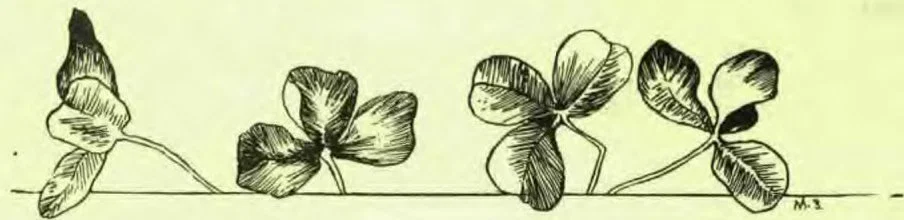
Three little leaves on the clover stalk stand,
The middle, the left, and the right;
The middle’s the face, each other’s a hand,
And always when comes the night,
The hands are folded palm on palm,
The face bent above them sweet and calm,
A restful place in the clover field,
When you lean at night on the gate,
By the lantern light of the moon revealed;
For the coming of dawn they wait
With little hands folded palm on palm,
And the face above them sweet and calm.
Good night, little comrades. Peace to you!
Soft may the breezes play!
And gently, gently fall the dew
As you sleep the hours away,
With little hands folded palm on palm,
And the bending face so sweet and calm.
—Selected.
The Key to the Box
“WHAT would you do,” said the little key
To the teakwood box, “except for me”?
The teakwood box gave a gentle creak
To the little key, but it did not speak.
“I believe,” said the key, “that I will hide
In the crack down there by the chimney side,
“Just so this proud old box may see
How little it’s worth except for me.”
It was long, long afterward in the crack
They found the key, and they brought it back.
And it said, as it chuckled and laughed to itself,
“Now I’ll be good to the box on the shelf.”
But the little key stopped with a shiver and shock,
For there was a bright new key in the lock.
And the old box said, “I am sorry, you see;
But the place is filled, my poor little key.”
—Selected.
Extremes of Life Span and Size in Nature
The longest span of life is that of the elephant, which will survive two centuries.
The shortest span of life is that of the mayfly, which hatches, mates, lays, and dies within a few hours, seeing the sun set but twice, and knowing but one day, followed by one darkness, from which it never awakens.
The longest human life of modern times, 169 years, is believed to have been attained by Henry Jenkins, of Yorkshire, England, born in 1501 and dying in 1670. It was proved by court registers of the chancery that he had appeared in evidence 140 years before his death.
The average human life is thirty-three years. One-fourth of the people of the earth die before they are six years old; one-half before they are sixteen. About one person in every hundred lives to see sixty-five.
The largest fish is the giant shark of the Indo-Pacific region. It is stated to grow to a length of seventy feet.
The smallest milk-giving animal is the sorex, a little shrew, measuring under three inches in length from tip of nose to point of tail.
The largest bird is the ostrich, sometimes standing eight feet, and weighing three hundred pounds. The smallest is one species of humming-bird, but two and a half inches long over all.
The largest reptile is the giant, man-eating, salt-water crocodile of Southern Asia and Australia. It measures thirty feet in length from end of nose to tip of tail. One man makes a comfortable mouthful for this creature.
The coldest place on earth, inhabited by man, is Verkhoyansk, above the arctic circle, in northeastern Siberia. The thermometer there drops to ninety degrees below zero in January, but sometimes rises to eighty-six degrees above zero, in the shade, in July, dropping, however, to the freezing point on the warmest summer nights. The population of this uncomfortable town numbers about one thousand. Heavy rains in autumn subject them to frequent floods. Both animals and vegetables in the region are stunted.
The hottest place in the world is the interior of the Great Sahara Desert, Africa, where the thermometer rises to one hundred twenty-two degrees.
The wettest place is Greytown, Nicaragua, where the mean annual rainfall is two hundred sixty inches.
The place of least rain is Port Nolloth, in South Africa, where less than an inch sometimes falls in a year.
The sunniest place on earth is either the great Sahara or the desert of Arabia. The cloudiest place is in northern Russia, the southwest coast of Peru, or the coast of French Congo, Africa, all being about the same in this respect.
The smallest animal with a backbone is the sinarapan, a little fish recently discovered by our scientists in the Philippine Islands. It measures about half an inch in length.
Our oceans are vast gold-mines. In their sixty-five quintillions of cubic feet of water are restlessly tossing about seventy-five billion tons of gold: enough to give every person on earth $3,382,400. Were all this water to freeze, and be cut into cubes a foot in dimension, a pillar built of the blocks of ice piled one upon another, would penetrate upward more than a quadrillion of miles, or farther than some of the fixed stars.
The deepest abyss in the sea, lately sounded just eastward of our new island of Guam, by our cable ship “Nero,” extends six miles below the surface of the Pacific. Fishes brought from this depth explode at the surface of the sea, as a result of freedom from the enormous pressure to which they are accustomed. Were you to lie at the bottom of this abyss, the pressure upon each square foot of your body would be equal to that of a pillar of lead weighing more than two million pounds.
The highest clouds reach ten miles above our heads. These are the white, feathery forms of fine fibrous texture which we see against the blue sky on a clear day. Although apparently motionless, they travel from seventy-five to ninety miles an hour. They are highest in midsummer and lowest in midwinter, when they sometimes descend to within three miles and a half of us.
The tallest clouds are the thunder heads which we most commonly see on summer afternoons. Our Weather Bureau, which recently co-operated with European countries to survey all forms of clouds, estimates that the largest are seven miles and a half tall from base to summit. Their bases seldom hover nearer than a mile above our heads.
The lowest clouds are within half a mile of us commonly. These are the horizontal sheets of lifted fog which we see in misty weather, and their normal speed is twenty-three miles an hour.
The earth is a magnet, according to discoveries lately made by our Weather Bureau. It receives its magnetism from the sun, which is itself a lodestone.—Ladies’ Home Journal.
A Wise Ant
An interesting demonstration of the prudence of the ant was made by a student in the biological department of the University of Pennsylvania last week.
The young man constructed a railway, two feet in length, of metal, and divided this into two parallel paths, separated by a high partition. One of the paths he painted red and the other blue, and at the end, in plain view, he put a morsel of rich cake. Then he set an ant at the beginning of the roadway.
The ant at once made for the cake over the red path, whereupon the student turned on a lamp under his mechanism, and heated the path to an uncomfortable degree. The ant kept on, and finally secured the cake, but on its return it must have told itself that it had a very uncomfortable journey.
Several hours later the student brought it out again, another morsel of cake being set at the end of the roadway. The ant thought a moment, and started for the cake over the blue path. It remembered that the red one had been hot.
To prove still more conclusively that it remembered, the student next blocked up the blue path, whereupon the ant did without the cake rather than venture after it by the red one.—Selected.