The Youth’s Instructor, Vol. 37, No. 47.

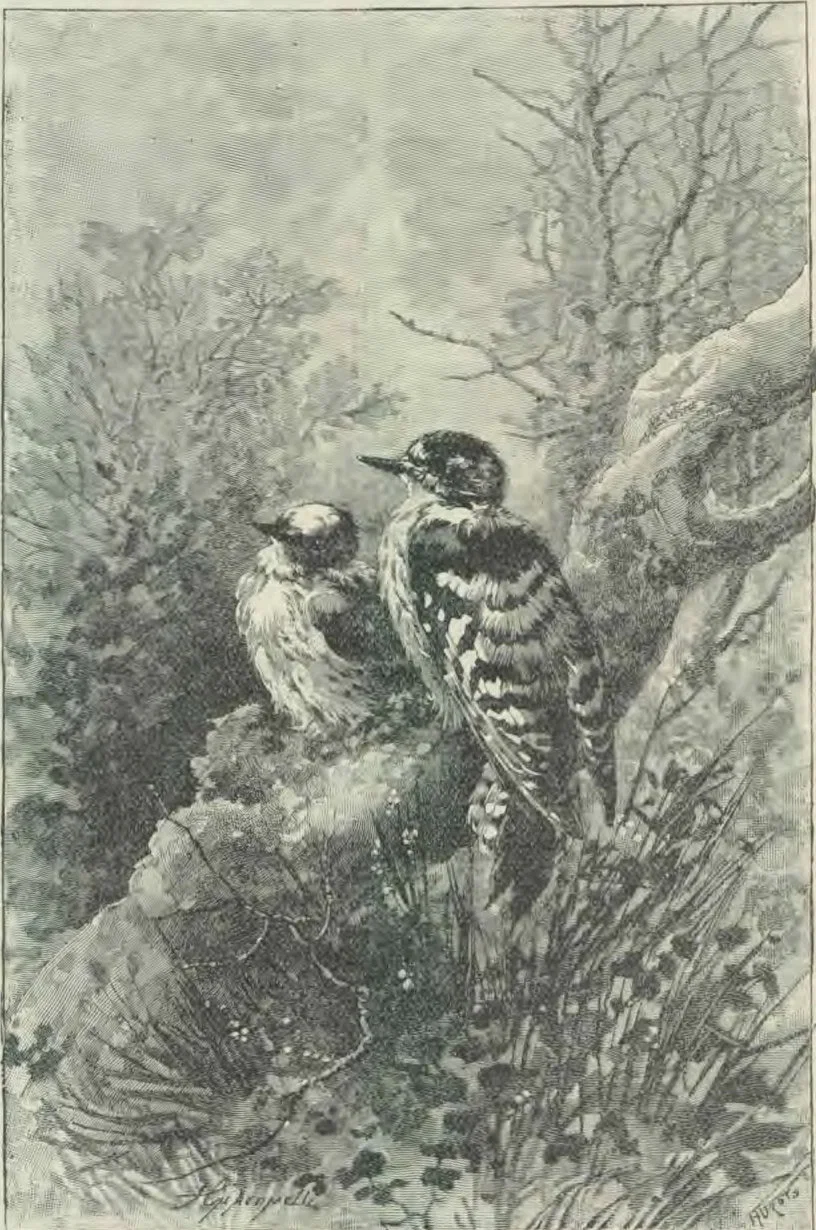
THE NUT-HATCH

The Youth’s Instructor

Nov 20, 1889

S. D. A. Publishing Association · Battle Creek, Mich. · Nov 20, 1889

THE NUT-HATCH.

“COME into the depths of the forest, Alone, alone with me, Under the sweet and swaying boughs Of the honeyed linden-tree.
“Far and wide the green trees wave, Like waters wide and free; Methinks we look up to the lofty sun Through the depths of the clear green sea.
“Tac, tac, tac, tac!—In the stillness How weird those accents seem! They hold us silent and spell-bound, Entranced in a woodland dream.
“Is it a wood-nymph pining In the heart of her hollow tree? Wounding the woods with her fairy hand Because she would fain be free?”
“Tac, tac, tac, tac! ’tis a nut-hatch! Hunting for grubs is he! How he digs and digs, and hammers away, Up in that old sore tree!”
Over the boughs of the trees he runs in every direction, often hanging with his head directly downward. At first glance, he might be mistaken for a woodpecker, but closer observation will reveal many differences between the two. His tail, instead of being stiff and unmovable, is flexible, thus giving the nut-hatch an ease and freedom of movement never seen in the woodpecker.
The nut-hatch has hooked claws, like a woodpecker, enabling him to cling tenaciously to the perpendicular trunk of a tree or to the underside of its branches, while he delves for grubs and larvæ.
His awl-shaped bill, smooth and hard, enables him to pierce through nutshells, whence his name nut-hatch, or in older English, nut-hack. These birds are very clever in wedging nuts in the crevices of bark or wood, where they remain as firm as if fixed in a vise, affording the bird opportunity to pick and chip away at the nut with ease.
According to one naturalist, “the head, back, and tail of the male nut-hatch are of a fine ash-blue color; its throat and cheeks are whitish; its breast and stomach orange colored; its wings brown, with dark gray edges.” Other authorities state that considerable variation of coloring exists between the nut-hatches of northern and southern latitudes.
The nut-hatch builds its nest in a hollow branch; and if the opening is too large, he plasters it up with small pebbles and mud, leaving only sufficient room for entrance and exit. The nest is simply a bed of dry leaves, or the fine inner bark of the fir tree or cedar. The eggs are five or six, grayish, with russet-colored spots. As soon as the young ones become strong enough to shift for themselves, the family, which is always a happy one, breaks up, and meet afterwards as total strangers.
The nut-hatch is distributed over quite an extent of country, being found in the Old World as well as in North America, though it is nowhere a very common bird. W. E. L.

IN A FEW THINGS.

“Can I depend upon you to see to the chores while I am gone, Harvey?” asked his father.
“Yes, sir; to be sure you can.”
Harvey meant exactly what he said, and his father knew it; but the knowing it did not cause him to feel half so sure about it as Harvey did.
“Do not forget about the wood and the coal.”
“No, sir.”
“Or the kindling.”
“No, sir.”
“And if it continues dry, you might begin a little raking in the yard.”
“Yes, sir.”
“I might,” said his father, with a smile, “feel like giving a dollar toward the camera somebody wants if I should chance to come home and find everything in very good order.”
Harvey’s face beamed with pleasure.
“But, really, father,” he said, “I don’t mean that I want you to pay me for doing just what I ought to do.”
“No,” said his father, “it will be because I would like to do it.”
“Well, you expect to be home by Saturday night. You’ll see how things will look on Sunday morning.”
Harvey was full of good intentions; but that fact never seemed to stand in the way of a great deal of trouble to any one who was obliged to depend for comfort on his carrying them out. Susan, the girl, was full of good nature, and did not like to complain of him; but even her patience often came to an end, when not only the kindling with which he was expected to keep her supplied, but the wood to keep her cook-stove going, was wanting, and she was obliged to handle the ax herself.
Half an hour of each day faithfully devoted to his small duties would have saved every one a great deal of annoyance. Himself, too; for it was not at all pleasant to be reminded of neglected duties at a time when he was intent on something else.
“There is a special blessing pronounced upon him who is faithful in a few things,” his mother said, when he put off until after school the errand which he should have done before school, and then forgot it.
“Well, mother, dear, you know I mean to be faithful,” said Harvey.
“But there isn’t a word said about those who mean to be faithful, dear,” she said, with a smile. “No blessing is promised to them.”
“Mother, you see if you ever have to say ‘wood’ or ‘coal’ to me again, or if I put off your errands any more,” protested Harvey, as he ran off to school.
It was Monday morning when his father went away, and for three days Harvey kept things about the place well up. He made Susan’s face shine by cutting two days’ supply of kindling ahead, a thing before unheard of in the family. And he performed every errand “with neatness and dispatch,” as he himself declared.
But on Wednesday morning it began to snow. It was very late in the season, and no more heavy snows had been looked for.
“Hurrah!” cried the boys, as the white flakes came thicker and faster, while they made their way to school. “More coasting! More snow-balling!”
For hours and hours it fell, driven in the wind with an energy which seemed to suggest that old winter, when half way on his journey toward the region of perpetual snow and ice, had been struck by a sudden fear that he had not done his duty by the temperate zone, and had turned back to show his good-will in a vigorous farewell.
Harry rejoiced with the others.
“Let’s have the biggest sort of a snow-ball fight up in the vacant lots,” cried one of the school boys.
“Yes, yes,” shouted others, “we’ll all be there.”
But as Harvey reached home, plowing his way through the snow, his face suddenly fell.
“Pshaw! I didn’t think of that old sidewalk. I wish it hadn’t snowed. I wish we didn’t have such an everlasting long sidewalk to shovel.”
He forgot the pleasure he took in the large yard all through the long summer, as he hunted out the snow-shovel which he had stored away, grumbling at the paths which now were to be dug. Those inside the fence, around the house, had to be done first, and just as he carried his shovel out to the sidewalk, a merry troop of boys came along, on their way out to the vacant lots for the snowball frolic.
“Halloo, Harvey! Come along!”
“I can’t come just yet. I must clear this walk first.”
“Ho! it’ll take you till dark.”
“Yes, I suppose it will,” said Harvey, giving a very discontented glance at its length and width.
“Leave it till to-morrow morning,” suggested one of the boys.
“I can’t. Father always expects me to do it at once.”
The boys moved on, and Harvey could soon hear their shouts as the sport began.
“I declare, it’s too bad for me to miss all the fun. It’s the last big snow we’ll have, and it will be gone soon.”
He dug away for a few minutes, and then leaned on his shovel.
“I believe I’ll just give a little dig through the middle, and let the rest go for to-day. This snow’s heavy, and it will take me hours and hours to clear the whole walk. I’ll get up early in the morning and finish it.”
Hastily making a very poor semblance of a path through the middle of the walk, he stuck his shovel into a snow-drift inside the fence, and with a lively whoop rushed off to join his companions, trying to forget that troublesome little text about being faithful in a few things.
The tussle in the snow was such a grand one, such an enticing demand upon all the powers of active young limbs, that more than one member of the jolly crowd slept late the next morning, Harvey being among the number. Hurrying out after breakfast, he made an attempt at removing the now tightly packed snow, but he had scarcely made more than a good beginning when the first bell rang for school.
“It doesn’t matter much,” he said, “the people are tracking it well enough. The sun’s coming out warm, and it will all be melted off long before father comes home.”
But alas for Harvey’s calculations! With her well-known fickleness, Madam April was about to bring them all to dire confusion.
When he returned home from school in the afternoon, the weather was warm, and it was raining fast. The snow was reduced to a mass of soft slush about six inches deep, and Harvey, as he looked from the window, could not help feeling ashamed as he saw people trying to work their way along the almost impassable walk.
Then came two nights of sharp frost. Many a time during the day which came between, Harvey looked longingly up at the sun, wondering if it were really going to fail him in the clearing of that walk.
But it was with a sinking heart that he took a comprehensive look at it on Saturday morning.
“Two or three inches of solid ice, all honey-combed with foot-tracks. An inch or two of water on top of that. Serves me right, I s’pose. It will be a tug to get it up, I should say. But I wouldn’t have father see it this way if I have to work my hands off to clear it.”
He went and attended to other chores which came on Saturday, and about ten o’clock began work on the walk.
“Hi, Harvey, I was just looking for you.”
He turned around at sound of the voice of one of his friends.
“Mr. Hardy has managed to get that electricity man to give us a little exhibition in the school-room this afternoon. He’s to have no end of queer machines and things there, and it’ll be tip-top. We’re all to be there by two o’clock.”
“Good-by! I’ll be there,” said Harvey. He was keenly interested in such things, and felt sure it would be a rare treat. With vigor he began his work. But it did not take long for him to form a pretty correct idea of the task which lay before him. His shovel made no impression on the ice. It must be broken foot by foot with a crowbar; and in some places along the edge, nothing short of chopping with an ax would move it.
A quarter of the length had not been accomplished by dinner time. At two o’clock the boys passed on their way to the entertainment, but Harvey only shook his head as they spoke to him. As the day grew warmer, the snow melted rapidly, the water splashing upon him with every stroke of the ax. His back ached, and his head swam with stooping, while his hands were cramped and blistered. But he worked bravely on, and two or three hours after gas-light shone upon him, straightened his stiffened back, and looked from one end to the other of the well-cleaned walk.
“Well,” he said to himself, “if every stroke I’ve put on this walk has been hammering a lesson into me, it must be pretty well driven in. I hope it will stick well,—and I guess it will. If any other simpleton ever put in such a lot of work for nothing, I’d like to take a look at him, and see if he looks like me.”
“Things look well,” said father, with an approving glance about the next morning. “Here’s the dollar.”
Harvey had intended to say nothing about the manner in which he had done his work; but he had had time to do a great deal of thinking the day before, and now handed back the dollar, saying,—
“I haven’t fairly earned it, sir,” following with an account of his yesterday’s experience, which made his father laugh.
“Keep the money,” he said. “If you have found out that the blessing upon the faithful performance of small duties works in more than one direction, it will be worth far more than a dollar to all of us.”—Sydney Dayre.

Trusting God Fully

I CAN understand people's losing by trusting too little to God, but I cannot understand any one's losing by trusting too much to him.—Charles Kingsley.

MOTHER SPIDER.

Mother love among spiders is a fleeting passion, but while it lasts, it is terribly strong. One insect, the Olios leucosos, spins no web, but lays her eggs in some out-of-the-way corner, and wraps about them a large cocoon. This she fastens, by a mass of fine threads, to some secure resting-place, but if she is alarmed, holds it close to her body with two of her legs.
A writer in the Scientific American says that he once advanced to examine such a cocoon, which was fastened to a door; but on his approach the mother spider hastened to cut the fastening threads with her mandibles, clasped the precious burden to her body, and hurried away with it. After roaming about for a while, she took refuge on a window curtain, and for fifteen days remained there motionless.
When the eggs were ready to hatch, she cut the edge of the cocoon, and out poured the young, swarming about her. They remained with her only a few days, and not until they disappeared, did she find food and rest.
The Lycosæ are tigers among spiders, and when the eggs are inclosed in their sac, attach the precious parcel to the abdomen, and carry it about with them. During the season of maternity, they are exceedingly fierce, and consider any evidence of curiosity on the part of an observer as a direct challenge to attack.
When the young are hatched, they swarm out over the mother, and she carries them about with her for several days. So voracious is their appetite, that she frequently falls a victim to it; for they have no compunction whatever in devouring her.
One of the Epeiræ hangs her cocoons across her web, and when she has eaten an insect, incases his body in a like cocoon, and suspends it beside her precious eggs. Owing to these deceptive signs, mingled with dust, straw, and other débris, it becomes impossible to distinguish the cocoons containing the eggs from the others.
The mother, having thus fortified her young, retires to a cozy corner of her web, and remains there, watching for insects.
During the summer, if an observer sees a few threads across the top of a thistle, wild carrot, or golden-rod, he has only to separate the blossoms to find within a spider’s nest, containing yellow or white eggs. A small mother spider is in charge of them, and, at any intrusion, she will rise on her hind legs, and advance to the attack, only leaving her eggs when persistently brushed away.—Companion.

TWO CUPS OF LOVE.

BEFORE kings, princes, potentates, Before the multitude, As one who meets with his death fate, The great Reformer stood. Through hours of agony and prayer, His soul was strengthened to be there.
His humble garb could not disguise His kingly heart within; His spirit flashed from out his eyes, And marked his lofty kin. And there, as face to face with death, He spoke for truth with his last breath.
The moment had its strength divine, Uplifting his great soul; He little recked how fierce did shine Foreboding looks of dole. But as a conqueror he broke From off his soul the papal yoke.
But when the Diet’s strife was done, He sat a man apart; He felt he stood for God alone, A target for hell’s dart. Then came a courier to his door, Who high a silver pitcher bore.
“My master begs to bless thee With this refreshing draught.” “Who is your lord?” asked Luther, As he the beverage quaffed; “Who graciously remembers me In my last struggling agony?”
“Duke Eric, sire, of Brunswick, One of the papacy.” “As he in my last struggle In love remembers me, So may my Lord, in his last throe Of agony, give comfort so!”
Not long, and good Duke Eric Came to his dying bed. A page, at his low whisper, From Christ’s sweet gospel read: “Whoever gives a cup to mine Shall have reward of me divine.”
And that sweet word of Heaven Came like a draught divine; It seemed as if an angel Beside his bed did shine; As if his Lord stooped from above, And poured for him a cup of love.
O mighty love! sustaining With everlasting arms, When wild the tempest rages, And shields from earth’s alarms! O tender love! that brings the Lord To give for every cup reward!
FRANCES E. BOLTON.

THE GREAT MASTER.

“I am my own master!” cried a young man, proudly, when a friend tried to dissuade him from an enterprise which he had on hand; “I am my own master!”
“Did you ever consider what a responsible post that is?” asked the friend.
“Responsible—is it?”
“A master must lay out the work he wants done, and see that it is done right. He should try to secure the best ends by the best means. He must keep on the lookout against obstacles and accidents, and watch that everything goes straight, else he will fail.”
“Well!”
“To be master of yourself, you have your conscience to keep clear, your heart to cultivate, your temper to govern, your will to direct, and your judgment to instruct. You are master over a hard lot, and if you don't master them, they will master you.”
“That is so,” said the young man.
“Now, I could undertake no such thing,” said his friend. “I should surely fail if I did. Saul wanted to be his own master, and failed. Herod did. Judas did. No man is fit for it. ‘One is my Master, even Christ.’ I work under God’s direction. When he is master, all goes right.”—Dr. Bacon.

THE TERRIBLE LOCOMOTIVE.

It is well-known that, when Stephenson predicted that his locomotive would draw a train of “wagons” at the rate of twelve miles an hour, there were men of science in England who declared that no passengers could travel at such a rate of speed and “keep their heads.”
A similar prediction, made by the Royal College of Physicians of Bavaria in 1835, is now on record in the archives of the Nuremberg and Fürth railway in that country. When it was proposed to build this line, the physicians of the country met and formally protested against it.
“Locomotion by the aid of any kind of steam machines whatever,” the Bavarian physicians declared, “should be prohibited in the interest of the public health. The rapid movements cannot fail to produce in the passengers the mental ailment called delirium furiosum.
“Even admitting,” the protest went on, “that travelers will consent to run the risk, the State can do no less than protect the by-standers. The sight alone of a locomotive passing at full speed suffices to produce this frightful malady of the brain. It is at any rate indispensable that a barrier at least six feet high should be erected on both sides of the track.”
But even the slow-going Bavarians of the ancient city of Nuremberg became accustomed in a very short time to the terrible rushing of the railway trains; and so far from being afflicted with delirium furiosum, they smoke their pipes as calmly as ever.

Divine Eternity and the Gift of Life

No being has lived as long as God has, but any being may live as long as God will.

A TWENTY MINUTE SOCIETY.

“WHERE are you going, mamma?” said Lulu. “Down to Mrs. Ray’s to give her these embroideries to wash.” “May I go with you?” “Yes, if you wish.”
Lulu skipped along at her mother’s side. She was not old enough to have very much to do, and, during the long vacation, sometimes found it rather hard to know how to keep her little self busy.
Before they reached Mrs. Ray’s cottage, they heard the fretting, wailing sound of a baby’s voice, and inside the door they found the baby himself lying in a cradle, while his mother stood at a wash-tub.
“Is the baby sick?” asked Lulu’s mother, turning toward him after she had spoken about the work. “He doesn’t look well.”
“Well, ma’am, he’s rather weakly, I’m afraid,” said his mother. “He frets and frets all the time to be took up, but there’s no one to take him, so he has to fret on.”
“Poor little fellow!”
Mrs. Bell raised him very tenderly, for she had not long before laid a little one in the grave, and while knowing that he could never more fret or suffer, her heart was very sore with the pain of the parting.
“He ought to be out in the fresh air,” she said.
“Yes, ma’am, I know he ought, but you see there’s nobody to watch him and see that he doesn’t get into harm.”
The air of the little house was heavy and damp with the bad-smelling soap-suds, and Mrs. Bell looked as though she did not like to lay the baby back in his cradle.
“Mamma,” said Lulu, eagerly, “couldn’t I watch him for a while? Couldn’t Mrs. Ray carry the cradle out into a corner of the meadow under the trees? I’ll stay there with him.”
Mrs. Ray was glad enough to do it. She carried the cradle, while Mrs. Bell carried the baby, and he was soon in the pleasant shade of the trees, where the soft wind fanned his hot little cheeks, and the sunshine peeped at him through the branches. He looked a little inclined to cry, as his mother left him to go back to her washing, but no baby of any sense would have cried at being left in the care of such a bright-eyed little lassie as Lulu. Very soon Jamie began to smile as Lulu played bo-peep from behind a tree-trunk, and was soon laughing as merrily as though he had always lived in the sunshine. The birds came and chirped at him, and a squirrel chattered up among the branches. Butterflies came, too, almost alighting on the cradle. Lulu brought daisies and buttercups to Jamie, and played with him until, on coming to him with a fresh handful, she found that the pretty head had sunk back upon the pillow, and the great blue eyes were closed.
As she sat quietly beside him, she saw two little girls, whom she knew, coming into the meadow.
“That’s Elsie and May,” she said. She beckoned for them to come to her, making motions that they were not to awaken the baby.
“What are you doing here?” Elsie asked.
“I came out here to watch Jamie,” said Lulu. “But I’ve thought of a splendid thing, girls. The poor little fellow has to stay all day in the room where his mother washes, and it smells horrid, and mamma says that’s what makes him look so pale. Now I’m going to spend my twenty minutes every day in taking care of Jamie.”
The little girls had formed a twenty-minute society—that is, a little society of which every member promised to spend twenty minutes every day in doing something to help somebody else.
“Twenty minutes isn’t long to take care of a baby,” said Elsie.
“But I can stay longer than that, and I mean to.”
“I tell you what, girls,” said May, after another look at the pale little face on the pillow, “if some more of us should come for twenty minutes every day, it would keep Jamie out a long time.”
“So it would,” said Elsie. “Some of the other girls would like to come, too, I know.”
So it came that on every fine morning Jamie would be carried out to his place under the trees, and little girls came and went, each giving him at least twenty minutes, and many of them more. Mrs. Bell came one morning, and talked to them about the blessed privilege which each little child may enjoy, in being able to show, through loving care for the little ones whom Christ has placed in our midst, love for Christ himself, and the small girls came to look upon all they did for Jamie as being, in very truth, giving to the Lord who gave himself for them.—The Interior.
Continue reading: THE STAR ON THE PONY’S FOREHEAD