“I's dreffully s'eepy!” is what little Robbie said, as he thrust his knuckles into his eyes.
Yes, he was sleepy. It would have been true, too, had he added, “an’ dreffully cross.”
Mamma was away, and Ethel, his little sister, did not know how to keep him quiet that long, long afternoon.
She had promised mamma to sweep the porches, and she wanted to dress her doll, but there was not much chance of her doing either so long as Robbie was fretful. She sighed, and then said, in a kind, patient tone, for she was very fond of him: “Come, sit on Ethel’s lap.”
“Your yap a’n’t like mamma’s,” he said.
“And I’ll tell you a story,” she added.
“All yite,” Robbie said, brightening up a little.
He clambered into her lap by tugging at the sleeves of her dress, not much of her visible after he had fixed himself.
It was quite a comfortable lap, after all, for a very sleepy little boy, and so he nestled his curly head against her shoulder with a satisfied look. She rocked to and fro, and sang softly to him.
“Tell me yat ’tory,” he said impatiently, though hardly able to lift his eyelids.
“Once upon a time, a good many years ago,” began patient little Ethel, but Robbie interrupted her with,—
“Mamma don’t begin her ’tories yat way.”
“Doesn’t she?” asked Ethel, in a low, cooing voice.
“Tell me a ’tory ’bout a pony,” Robbie said.
“There was a little boy had a pony,” began Ethel.
“What was his name?” asked Robbie.
“The boy’s name?”
“No, the pony’s,” Robbie replied, with an impatient kick with both chubby feet.
“Prince,” Ethel promptly said.
“Yat was a nice name,” declared Robbie. “Did he have a ’tar (star) on his forehead?”
“No, Robbie; but the boy put one on.”
“With paste?”
“No; with chalk,” Ethel said. “The pony was black as a coal. The boy got a piece of chalk, and made a star on his forehead. It took some time; for the hair wouldn’t stay down, and the wind blew the chalk away. But he rubbed, and he rubbed, and he rubbed—”
She said it two dozen times over, all the time rubbing Robbie’s forehead in a steady, soothing, round-and-round movement. He closed his eyes, and began to breathe heavily. A smile of triumph came to Ethel’s lips at the success of her trick. But she smiled a little too soon; for Robbie kicked, and opened his eyes.
“And he rubbed, and he rubbed, and he rubbed,” quickly resumed Ethel, in a drawling tone, over which she almost fell asleep herself, her soft fingers again moving over his forehead.
She looked at him after a little time, and found he was sound asleep at last, and then she staggered to his crib with him; for he was heavy, and she wasn’t very strong.
“I hope he’ll sleep until mamma comes,” she thought. “Poor little fellow! I wonder if he’ll ever ask for the rest of that ’tory?”
She felt that she had been rewarded for her patience.
She swept the porches, and swept them well, and still had time to play with her doll.—Frank H. Stauffer.
A LITTLE HELPER.
“Oh, how heavy this bucket is, and only half-full, too, so I must go again. Jenny and Annie can't do anything, it's only poor me. I wish we could take turns being the oldest. Joe's crying; seems to me he's always crying and making his face dirty. Wish we had a brother so small we couldn't be trusted with him, or big enough to bring water. I don't like boys his age. ‘Nettie, Nettie,’ wish my name was something else.”
“Yes, mother,” answered Nettie, setting down the bucket, and brightening a little at her mother's cheery voice.
Four children, indeed were a great care, but little hands could help too. Now Nettie saw how much good even half a bucket of water could do.
Mother filled a kettle, and set it over the bright fire, where it soon began to sing, as if eager to do something for the family. Jenny gave Dick, the bird, fresh water, which he sipped with funny little quirks of head and tail, and then burst into such a song that Joe forgot to cry. Annie brought him a drink, and washed his tear-stained face. She sprinkled the rose geranium in the window. Then the sun shone into the clean kitchen, and all Nettie's dark thoughts flew away.
She laid the table for breakfast, and fed kitty, who was purring for milk.
But she stopped at Joe's cradle to give him a kiss and hug, and tell him he was the dearest baby in the world, if he did cry.188
Mother smiled, and called her a little helper and her dear Nettie. And Nettie thought it just the sweetest name in the world.—Our Little Men and Women.
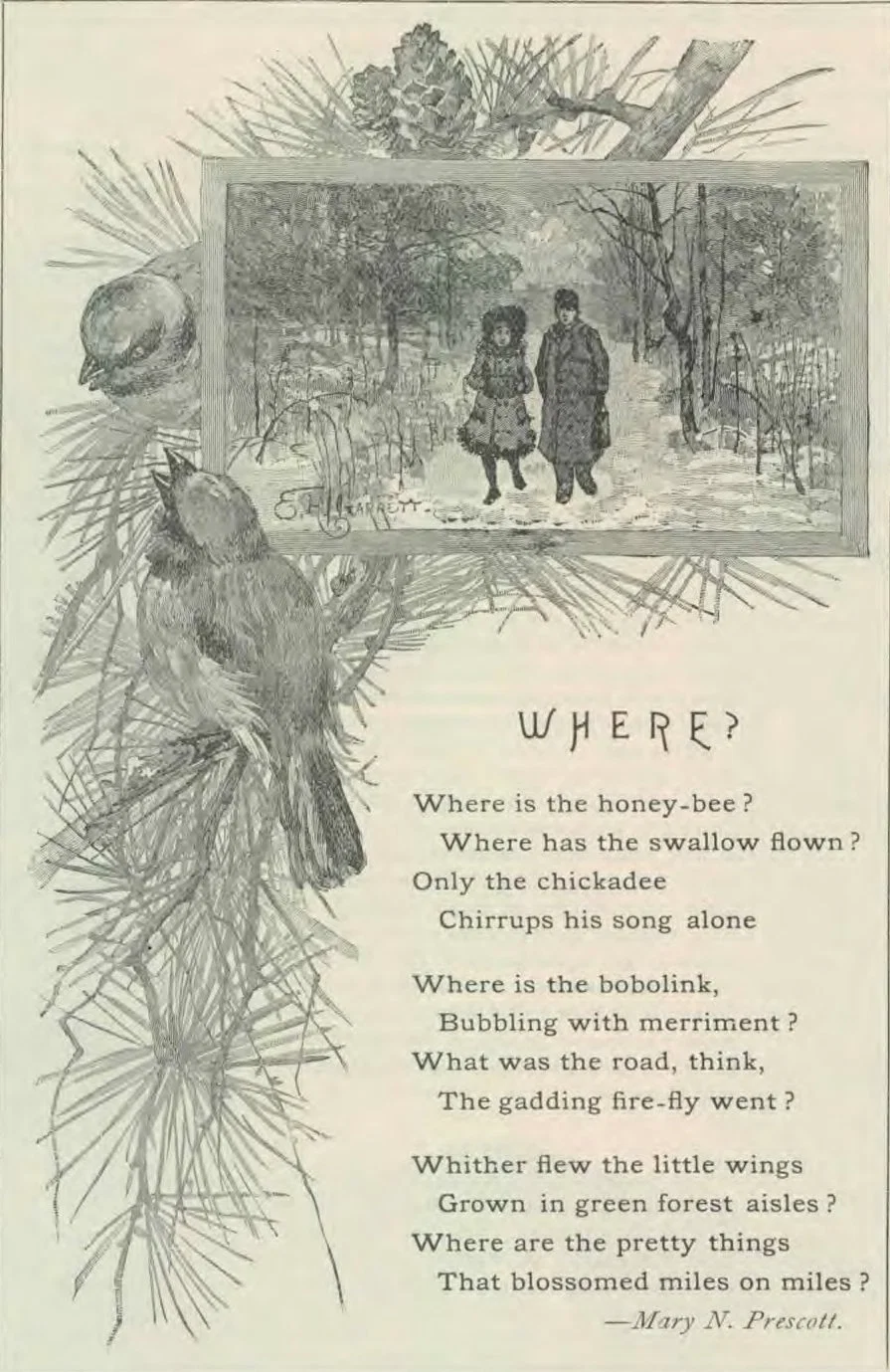
WHERE?
By Mary N. Prescott
Where is the honey-bee?
Where has the swallow flown?
Only the chickadee
Chirrups his song alone
Where is the bobolink,
Bubbling with merriment?
What was the road, think,
The gadding fire-fly went?
Whither flew the little wings
Grown in green forest aisles?
Where are the pretty things
That blossomed miles on miles?
—Mary N. Prescott.
15. Did his seed become as numerous as the dust of the earth?
16. How, then, did he obtain the promise? Ans.—After his long and patient waiting, he received the son in whom the promise was to be fulfilled. His faith embraced the promise in its fullness.
17. By whom do men swear? Verse 16.
18. Why did God swear by himself? Verse 13.
19. Would an oath by an inferior object be solemn, and expressive of obligation?
20. Of what is God willing that we should have full proof? Verse 17. Compare Mal. 3:10.
21. Who proved the Lord, and were still unbelieving? Heb. 3:9, 11, 19.
22. Have we not reason to believe that many are doing the same thing even in this day?
23. What two immutable things are referred to in Heb. 6:18?
24. To whom is this intended to give assurance? Verse 17.
25. Who have the privilege of laying hold of it? Verse 18.
26. Of what do we lay hold? Ib. See note.
27. Where is this hope set? Verse 18.
28. Does hope ever look back to the past? See Rom. 8:24.
NOTES.
Heb. 6:14 is an intensive form of expression not uncommon in the Hebrew. It denotes certainty. Two instances are found in Genesis 3. Verse 16 reads: “Of every tree of the garden, eating thou shalt eat.” It is translated, “Thou mayest freely eat.” Verse 17 reads: “In the day that thou eatest thereof, dying thou shalt die.” Rendered, “Thou shalt surely die.” These translations are literally correct, the words freely and surely representing the certainty contained in the form of the original. Again, in Ex. 3:7, the Lord said: “Seeing I have seen the affliction of my people.” Stephen, quoting this (Acts 7:34), expressed the intensity of the original by a repetition: “I have seen, I have seen the affliction of my people.” And, indeed, duplication is another method of expressing intensiveness in the Hebrew, as “good, good,” for very good. Our version very correctly translates Ex. 1:7, “I have surely seen.”
As faith rests only on the word of God (Rom. 10:17), so hope rests only on the promise of God. Where God has not spoken, there can be no faith. There may be opinion, or conjecture, or strong feeling, and even much confidence, but no faith. So where there is no promise of God, there may be feeling, and strong self-confidence, but no hope. And a promise fulfilled is no longer a promise—it is a matter of the past. Hope can no longer rest upon it; for “hope that is seen is not hope.” Once received, it is no longer hoped for. Losing sight of this evident truth, many have been led to indulge false hopes. They will profess to hope in God, while there is not a promise within their reach. For all the promises of God rest on conditions, and if we neglect the conditions, we cannot rightfully claim the promises. Claiming God’s promises without fulfilling their conditions is not an indication of faith but of presumption. But if indeed we have fled for refuge to Christ, and laid hold upon the hope set before us, what a strong consolation we have in the sure promise of God confirmed by his oath, brought near by the blood and intercession of our high priest in the heavens!
ADDITIONAL NOTES.
Two immutable things are referred to in verse 18; one, the promise of God, and the other, the oath by which he confirmed it. In Num. 14:21, Isa. 49:18, and Eze. 5:11, oaths of this nature are recorded. Such an oath well shows the certainty of the promise. Had God sworn by the heavens and the earth, it might have been said that these would pass away, and with them the oath which he had made; but having sworn by his own great name, which abides forever, God’s confirmation of the promise becomes absolutely immutable.
The same verse affirms that it is “impossible for God to lie.” “This impossibility,” says Barnes, “is a moral impossibility, and the use of the word here explains the sense in which the words ‘impossible,’ ‘cannot,’ etc., are often used in the Scriptures. The meaning here is, that such was the love of God for truth, such his holiness of character, that he could not speak falsely.”
Although God has thus abundantly manifested the immutability of his counsel and purpose toward the heirs of the promise made to Abraham, there are many, who, in the face of all this proof, are still unbelieving. These are admonished to remember the cases of those, who, after having proved God, fell in the wilderness. They tempted God, and manifested their unbelief by saying, Is the Lord among us or not? It is possible to do the same thing to-day, and we have reason to believe that many are, in this age of the world, imitating their example.
PRETTY FACES AND PRETTY HEARTS.
It was recess at the Union school. The boys and girls came pouring out, all intent on enjoying the recess hour.
Some engaged in sports, others clustered around in groups, perhaps to talk over some important plan for the coming days, while still others walked as they talked over something, perhaps, very near to their hearts.
Three or four pretty, bright-eyed little girls came tripping along past my window, chatting merrily. Just then they met two little boys, carrying a bucket of water towards the school-house. As they passed, one of the brightest of the little girls turned quickly after them, and said:—
“Teacher told me if I saw you, to tell you to hurry up. She said, too, she was going to give you the hardest whipping, for staying so long.”
The little fellows, alarmed, took to their heels, and the little miss, with a laugh, turned to her companions, saying:—
“Teacher didn’t say anything about them, I just wanted to see the boys scared.”
And she had told a falsehood, just to have the fun of seeing two of her little schoolmates in trouble. What do you think of such acts in a pretty little girl?
Her face didn’t look so pretty to me after I heard her confess that lie just to make others unhappy. She had made two great sin-stains on her soul.
A beautiful soul is far better than a beautiful face. Little girls and boys with pretty faces should keep their souls pure and sweet. If you would do this, you must be ever true, loving, and kind to every one.
When Jesus lived on earth, he was loving and true, even to his enemies. He spoke kindly, and helped the meanest beggar as well as the finest, richest lord. From his home up in heaven, he still looks down, well pleased to see his children—best of all his little children—acting as he taught them when he lived down here. How sorry he is to see those whom he loved, false and cruel to their fellow beings!
Little words and acts show what kind of souls we have. Then guard these and keep them pure, even more than you watch to keep your hands and face clean and sweet.
Keep your faces beautiful if God has made them so. All pleasant, good-natured boys and girls have pleasant faces. But, most of all, keep your soul beautiful; keep it filled with pure, loving thoughts, then there will be no room for wicked, sinful thoughts to steal in and spoil God’s workmanship within. If we think and feel aright, our words and acts will be pure and loving.—Youth’s Evangelist.
Letter Budget.
CORA M. DANN writes from Blue Earth Co., Minn. She says: “As I have read so many interesting letters in the Budget I thought I would try to write one myself. My parents, brother and sister, and I have been keeping the Sabbath some three years. I attended the camp-meeting at Minneapolis this summer, and we all enjoyed it very much. We live four miles from the church, but have the privilege of attending Sabbath-school when it is not stormy. I have written to the Budget before, but I could not write very well then, so I have tried again.”
ALICE A. VESSEY wrote a letter from Stutzman Co., Dak., in which she says: “I am nine years old. I never tried to write to the Budget before. I go to Sunday-school; we have no Sabbath-school. I have an aunt and two cousins in Tampa, Florida. They keep the Sabbath, and we would like to see them very much, but we do not expect we shall until the earth is made new. My sister Esther, seventeen years old, died, and we are very lonely without her. I like to go to school. I hope to meet you all, with my sister, in the new earth.”
NANNIE MAY JOHNSON sent a letter from Loudoun Co., Va. She said: “I have been keeping the Sabbath with my parents six years. I have four sisters and one brother. Three of my sisters, a brother-in-law, and I were baptized a year ago last April. I am fifteen years old. A Sabbath-school was organized here nearly two years ago. I have not missed attending it any Sabbath, and hope I may not. I study my lessons in the INSTRUCTOR. I do not think we could do without the paper. I want to do better, and I ask an interest in your prayers.”
NELSON J. SHELDON sent a letter from Van Buren Co., Mich. It is so long we will print but a part of it. He says: “I am trying to keep God’s commandments, and to be a good boy. Although I make a good many mistakes, I try not to do so. I am twelve years old. My ma, sister, and myself keep the Sabbath. We all go to Sabbath-school, and I study in Book No. 2. My sister Hattie May studies in Book No. 1. My friend, Earl Woodworth, is dead, and cannot write any more letters to the Budget. He was a nice little boy, and was loved by all who knew him. He was my schoolmate, and so was his little brother Bat. They both died of diphtheria. Bat died the next day after his brother Earl. I got my mother to write my letter for me. Pray for us, that we all can meet in the new earth.”
BIRDIE HEALEY and SUSIE CUMMINS sent letters together from San Diego, Cal. Birdie is twelve years old. She says: “I like to read the stories in the INSTRUCTOR. I go to Sabbath-school every Sabbath, and study in Book No. 7. I belong to the Rivulet Missionary Society. While one of our ministers was speaking in the plaza a few evenings since, the crowds came to hear him. Love to all the INSTRUCTOR family.”
Susie says: “I am a little girl ten years old. I have four brothers and two sisters. I keep the Sabbath with papa, one brother, and two sisters. My mamma has been dead five years. I hope to see her in the new earth. I have a pet pigeon named Snowdrop. A lady who lives in the same house as we do, gives Bible readings. She reads the stories to me. I hope to meet the INSTRUCTOR family in the new earth.”
EDDIE JOHNSON, FLORA JOHNSON, and MABEL HITCHMAN write from Meeker Co., Minn. Eddie is eleven, Flora seven, and Mabel five years old. Eddie says: “I keep the Sabbath with my mother and sister. We have a good Sabbath-school, but there are very few to attend. I study in Book No. 2. I learned about Pharaoh, that he would not let the children of Israel go, and so the plagues fell upon him. I want to be a good boy, so that the last plagues shall not fall upon me.”
Flora says: “As my brother Eddie has been writing, I thought I would write a little. My mamma has to help us; for we cannot write ourselves. I have not missed going to Sabbath-school once this summer. I like to have a good lesson, and to be a good girl.”
Mabel’s letter reads: “I am a little girl five years old, and as I am too small to write myself, I get Flora’s mamma to write for me. We are all living in one house. My mamma has gone to visit grandma. I go to Sabbath-school, and am trying to be a good girl, so I may meet in heaven all the little boys and girls who write for the Budget.”
Work as the Language of the Hands
WORK is the language of the hands,—the outward expression of the bodily activities. Any one who is engaged in Christ’s work, truly for Christ’s sake, expresses his desires by the energies of his hands and feet, as well as by the impulses of his heart. A cause that is worth praying for is worth working for.