HOW TO STUDY THESE LESSONS.—(1) Read the lesson story; (2) try to recall or find scriptures in proof of each statement; (3) study the texts; (4) see how many missing links you can supply; (5) give the lesson to some one else. You will keep only what you give away.
When Jesus comes the second time, everybody will see him. His people will be watching for him, and they will rejoice. His enemies will not be expecting him, and they will mourn and weep.
All the angels of heaven will come with him. He will waken all his people who are sleeping. Those that are awake will be “changed;” in place of weak mortal bodies, they will receive immortality. His people are now scattered all over the earth; but his angels will be sent to gather them.
As the Saviour comes nearer the earth, the brightness of his presence will destroy the wicked.
He will not touch the earth. We shall be caught up to meet him in the air.
Then we go with him to heaven, and stay a thousand years. All the wicked will then be dead. All God’s children will be in heaven. Satan and his angels will be shut up in the desolate earth.
NOTE.—Read in connection with this lesson chapter XL of “Great Controversy,” Vol. IV.
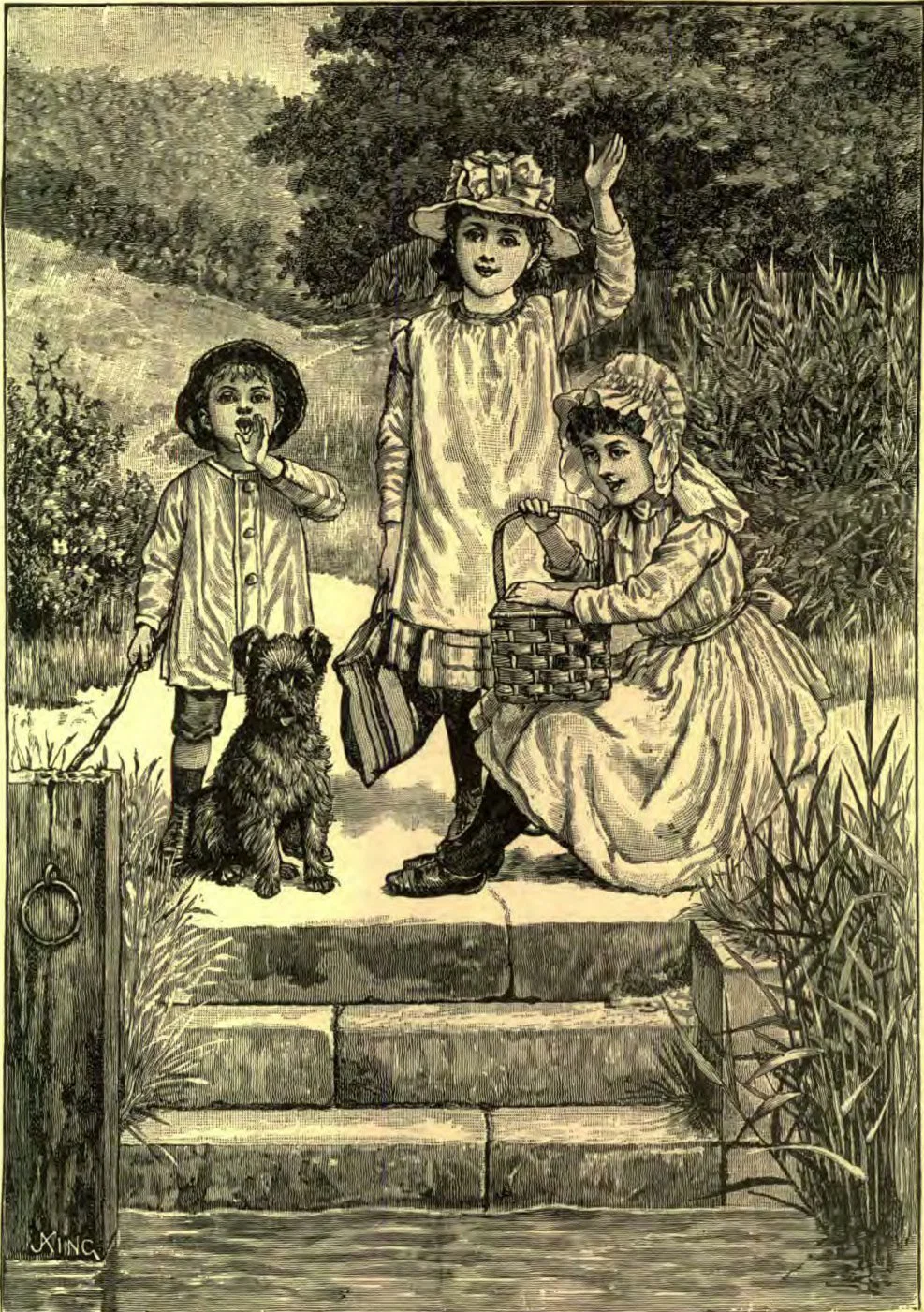
Hailing the Ferryman
By Elizabeth Rosser
I GATHER willow switches in the early days of spring,
And papa makes me whistles of tones most loud and shrill;
And in the April mornings I hear the robin sing;
And I watch the brook trout gleaming where the stream is deep and still;
Sometimes I help my papa take a load of hay to town,
Returning in the evening through the shadows long and cool;
But that’s nothing to the pleasure of the time when I go down
With Gyp to hail the ferryman to take the girls to school.
I gather in the apples, and the pumpkins, golden bright,
And hang the ears of popcorn in the attic, warm and dry;
And I hear the wild geese “honking,” at morning, noon, and night,
As they southward fly, in long, long V’s across the autumn sky.
There is coasting on the hillsides when the world is white with snow,
And sliding when Jack Frost has built a bridge on every pool;
But they can’t compare with mornings in the summer, when I go
With Gyp to hail the ferryman to take the girls to school.
ELIZABETH ROSSER.
My Pastoral Ants
By Floyd Bralliar
Under the cherry tree only a few yards from the house was a patch of red raspberries that were allowed to care for themselves. Among them grew a number of weeds, and in their shade a large colony of ants herded their thousands of cows. The ants were large, black fellows, and had small red ants for their slaves. These were the herdsmen, and well they performed their task.
The cows were small, green plant-lice, such as you may sometimes see on your mother’s plants in the window. They lived on the leaves of the weeds, staying on the under side in the daytime. On each weed were two or three herd ants, that slowly made the rounds, to see that all went well. They were very gentle with their charges, and never did them any harm; but they would attack at sight every worm that tried to climb up a weed, seeming to fear either that the intruders would hurt their cattle or eat all the pasture.
“WITH GYP TO HAIL THE FERRYMAN TO TAKE THE GIRLS TO SCHOOL.”
But what were these cattle for?—One need not watch long to find out. Soon he will see a black ant running up the stem of a weed, and from the deference the herders pay him, it is easy to see that he is one of the lords. He runs up to one bug, hunches it with his head, and the bug gives off a small drop of honey. This he licks up greedily, and then goes to another, and another, till he has had all he desires, when he goes back home. All day long the ants may be seen running to and from this pasture.
Many of you may have noticed black ants marching up and down the trunk of a box-elder or a maple tree, and thought nothing of it. If you look carefully next time you notice ants on such a tree, you will find the little, green bugs on the leaves, and so see just what I have described. Ants, unlike men, do not eat their cows, but are content to raise them for their “milk.”
There are a few very tall weeds near the berry patch; and here another colony of ants had herds so entirely different, and so novel, that I must tell you about them. One could not see them from the outside; but as there were always ants about these weeds, I was interested to know the reason. One day I pulled one of the weeds up, and its roots were covered with a bluish-looking substance,—mold, as I at first thought. I looked at it; and lo! it was alive, thousands of little, bluish, mold-colored insects! They were sucking at every root by hundreds. It is a mystery to me how any plant can grow with so many of these little creatures sucking at its roots.
But I did not realize what they were, for a long time. In fact, I was so stupid that it took several years to learn; for they were not very common, and only grew near the house for one year. I finally learned that these are also a variety of cattle that are carefully cared for by the ants. They have underground passages leading to where these “cattle” live, and they never see the light of day. The bright sunshine kills them. I don’t know just what use the ant makes of them; for, being underground, there is no opportunity to watch, and if they are exposed above ground, both they and the ants know that something is wrong. But I am inclined to think they secret honey, much as the others do.
With all their wisdom, the ants seem to have no rulers nor leaders. The slaves are not “bossed,” and appear to be very devoted to their masters. They undoubtedly communicate ideas to one another, but all seem on an equality. How truly the wise man has said: “Go to the ant, thou sluggard; consider her ways, and be wise: which having no guide, overseer, or ruler, provideth her meat in the summer, and gathereth her food in the harvest.”
FLOYD BRALLIAR.
Prissy and Her Bell
THE house on the corner had been vacant a long time, and now some new tenants were moving in. Elsie Manning from the sitting-room window of the next house watched the furniture as it was carried in, in hopes to see some sign of a little girl in the family.
“If there is one, there’ll be a small chair or a doll-carriage or something,” she told her mother; but no such articles appeared, and Elsie was disappointed. She longed for a little next-door neighbor. Her nearest friend lived three houses away, on another street, and to visit her she had to go around the block or climb fences, either of which was inconvenient when she was in a hurry or in stormy weather. It would be so nice, she thought, to have somebody in the next house.
The day after the new neighbors came, Elsie was attracted to the window by the sound of a bell. She heard it several times, and finally she saw a lady on the porch of the corner house with a dinner-bell in her hand. As days went by, the bell-ringing grew to be a regular sound; but nobody could imagine what it was for. Elsie was especially puzzled, and when her mother went to call on the strangers, she begged her if possible to find out about the bell.
When Mrs. Manning returned, Elsie was ready with questions.286
“Yes,” said her mother, smiling, “the secret is out. The bell is for their cat—Prissy, her name is. They say that whenever they want her, they go to the door and ring the bell, and she always stays within sound of the bell, and comes as soon as she is called. It is strange, isn’t it, that a cat should be so prompt in obedience?”
Elsie said “Yes,” very soberly. She was wondering if her mother was thinking of the many times that she had been called home from Bertha’s, or even from play up-stairs, and she had lingered for “just a minute longer” until the summons had been forgotten. Only the day before, she had missed a pleasant walk with her uncle because she had not started at once when she was called. But Elsie could only guess, as Mrs. Manning went on talking about the new neighbors, and telling many interesting things which she had heard.
The next time that Elsie heard the bell, however, she thought about it again, and running to the window, she saw the handsome Prissy climb the back fence, and scamper across the back yard toward the house, and through the door which the cook held open. It was not fear that made her run so promptly.
“I’m not going to let a cat mind better than I do,” said Elsie to herself; and the day after, when she heard her father calling her from the library, she ran at once to see what was wanted, although she was right in the middle of a most interesting play. If her father was happily surprised, he said nothing at the time.
Perhaps it would not have been so easy for her always to remember if it had not been for Prissy’s reminding bell; but that daily “ding-dong! ding-dong!” never failed to keep the subject in mind, and Elsie came to run so promptly at every summons that Mrs. Manning said, smilingly: “I think Prissy is a pretty good teacher.”
Elsie laughed. “Yes, mama,” she agreed, “I think she is; for I don’t know as I should ever have learned to come quick when I was called if it hadn’t been for Prissy and her bell.”
Elsie did not know that Prissy, like people, had to learn a lesson before she could teach it. She had not lost a walk with her uncle, but the loss was much greater in her opinion. She lost a dinner!—Selected.
A Penholder
By J. Edgar Ross
Cover an ordinary wooden penholder with neatly woven horsehair in a suitable pattern, and you will have converted an article worth five cents to one that should sell for from a dollar to a dollar and a half. It is true that some time will be needed to do the work, for both warp and woof should be made of rather fine thread; but horsehair-weaving is something that can be taken up during spare moments, and left when one has other duties to attend to.
Fig. 25.
For a base procure a penholder that has a hollow metal cylinder enclosing two semi-cylindrical metal plates to receive the pen. This will permit the hair to be woven close to the lower end of the holder, which the old-fashioned kind would not. Most holders of this kind are quite large at the lower end, where they are covered with cork, tapering gradually to a point at the top. Remove the cork, and dress down the remainder of the handle with a piece of broken glass or coarse sandpaper. Remember that twice the thickness of your warp, and four times the thickness of the threads of your woof, will be added to the diameter of the base when the holder is finished, and dress down the handle accordingly.
The woof should be composed of threads containing from four to six hairs each. Four strands of number eight thread will be quite large enough for the warp.
Begin weaving at the bottom of the holder; and as that part is quite apt to get stained with ink when in use, it will be well to make it entirely of black hair. After about an inch and a half of the holder has been covered, a sufficient number of white threads to make whatever pattern you choose may be introduced.
The easiest way to finish is to cover the top with needlework. But that is not the best way; for a knob on the tip gives it rather an ungainly appearance. It will be impossible to draw the threads of woof under the work with a needle, as the base at the top will be so small and of such unyielding material that the threaded needle can not be forced between it and the woven fabric. There is still another way of concealing the ends of the threads, which, though somewhat complicated, can be used on any kind of work.
Fig. 27.
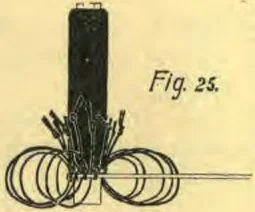
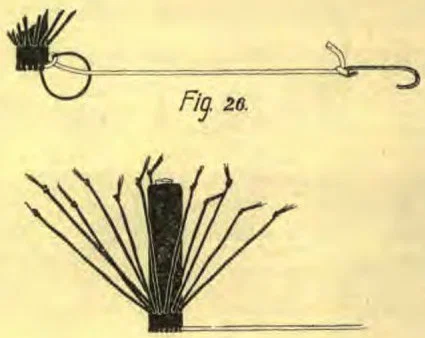
When four more circles of stitches will finish the work, take the end of each thread of woof after a stitch has been made with it, and pass it under the warp, just as you would do in adding a thread with which to splice a short one. This will give you a circle of loops all around the base, as shown in Fig. 25. Now cut off all but about a foot of the warp; and for convenience in handling, fasten a wire hook to the end of it. The object now is to pass the warp through each of the loops in such a manner that, when drawn taut, it will form the regular weaving stitch with the threads of woof. This is shown in Fig. 26.
When the warp has been passed through a loop, it is hooked to some convenient support and drawn taut. Then the thread of woof can be tightened in the regular manner, and the warp unhooked for another stitch. Three or four circles of stitches made in this manner will be sufficient. In order that the work may not end too abruptly, it is well to pass the warp straight through two or three loops. Then take hold of the projecting end of each thread of woof, and draw it through. Now your work will look like Fig. 27, and all that remains to finish it is to cut off the projecting ends of both warp and woof.
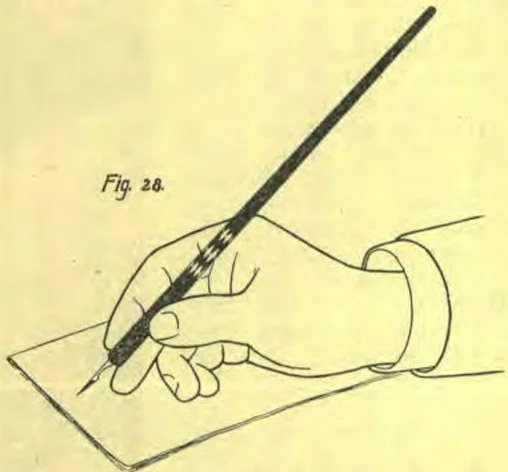
In Fig. 28 a finished penholder is shown.
A Cane
It is no longer good form for a man to carry a cane unless he really needs a walking-stick; so if you wish to cover a cane with woven horsehair, the first thing to do is to secure a stout, serviceable stick, and the next thing is to cover it almost entirely with black hair, allowing just enough white to give it contrast, and show the texture of the fabric, but not enough to make it unduly conspicuous.
If you do not have a cane, do not go to the expense of buying one for this purpose; with no other tool than a plane, or even a pocket-knife and a piece of broken glass, one can be made in a few minutes from a discarded broom handle. The stick should be tapering, and quite small; for the woven work will add quite a little to its diameter. You will have to buy a ferrule, but that will cost very little. The top of the ferrule should be large enough to cover the tip of the cane after the hair has been woven around it. The top of the cane should be a knob just large enough to fit the hollow of the hand comfortably, and a little thicker in proportion to its diameter than a door-knob. This may be made by wrapping twine or narrow strips of cloth around the top of the stick till the desired size and shape are secured, and then fastening in position by driving two or three small nails through the twine ball and into the wood of the cane.
Fig. 28.
Begin to cover the cane at the top, and work downward. An attractive pattern is made of black with the introduction of three or four circles of white, diamond-shaped figures about six inches from the top. When you come to within an inch of the tip of the cane, it will be time to stop the weaving. It will not be necessary, however, to hide the threads of woof under the woven work. Instead of this, the warp may be wrapped closely and tightly around to bind the woof to the base. When it has been wrapped to the very tip of the cane, the warp is tied, or fastened with a very small tack to hold it in position. Then the ends of both warp and woof are cut off, and the ferrule is adjusted and fastened in position.
The knob on the top must be covered with needlework, as horsehair can not be woven with warp and woof around a base whose diameter varies so much in so short a distance. But with needlework any shape of base can be readily covered. Black hair may be used; or, if you prefer, alternate black and white rings.
J. EDGAR ROSS.
The Lord Provides
By Edna French
A FEW days ago mama told me to go to the store. When I came back, I met a little boy, holding a tiny chicken in his hand. He held it so tight I was afraid he would hurt it, so I asked him all about the chicken, and found that he must have taken it from its mother to play with. I coaxed him to let me have the poor, half-dead little thing, and mama gave it to a neighbor who keeps chickens, and would make this little one a good home.
Now who can doubt that the Lord provided for that little chicken? Who can doubt that he provides for us all? If we walk in the parks and fields, we see how beautiful everything is, and remember that the Lord provides these things for our pleasure, and also for homes for many of his creatures.
I am glad that he lets everything grow so beautifully. I love to serve him, and I am going to gather grasses and dry them for Harvest Ingathering, when we can not only thank and praise him for his great love to us, but show in other ways that we love him.
EDNA FRENCH.
Learning Love Through Service and Discipleship
By Hugh Black
It is true that love can not be forced, that it can not be made to order, that we can not love because we ought, or even because we want. But we can bring ourselves into the presence of the lovable. We can enter into friendship through the door of discipleship. We can learn love through service.—Hugh Black.
MEMORY VERSE: “In all thy ways acknowledge him, and he shall direct thy paths.” Prov. 3:6.
(The chapter given as the Lesson Scripture is the lesson to be studied. Read this every day, and think it over until you know just what it teaches. Then the following notes, which should be read several times, will help to a fuller understanding of the lesson. Lastly, go over the questions carefully, and be sure that you can answer each in the words of Scripture.)
Sarah was ninety years old when Isaac was born. She lived for thirty-seven years after this, and died at the age of one hundred and twenty-seven years. Abraham buried her in the cave of Machpelah, that he bought for a burying-ground.
Isaac mourned for his mother, and Abraham’s household was without a mistress. When Isaac was forty years old, his father made arrangements for his marriage. The twenty-fourth chapter of Genesis tells the whole of the beautiful story.
You may think this is rather a long chapter for one lesson; but as you read it carefully, you will see that much of it is the story of what is written in the first part of the chapter, as it was told by Abraham’s servant to the friends of Rebecca.
God had called Abraham out from his country and his kindred and his father’s house, because he wanted to make him the father of a race of good men, who would teach all the nations about the true God. This is why Abraham was so anxious that his son should not go back to the country from which God had called him out.
When God promised the land to Abraham, the promise, we have learned, took in the whole world. Yet he spoke especially of the land of Canaan, saying, “Unto thy seed will I give this land.” The eleventh chapter of Hebrews says of Abraham that “by faith he sojourned in the land of promise, as in a strange country, dwelling in tabernacles with Isaac and Jacob, the heirs with him of the same promise.” He made his servant swear that his son should not be taken away from the land of promise.
But the Canaanites worshiped idols, and an idolatrous woman would not have made a good wife for Isaac. So Eliezer was sent to bring a wife from Abraham’s birthplace. Although he and his seed could not go back to the country from which God had called them out, yet others might come to them to join them in the worship of the true God.
Notice that Isaac did not choose his own wife, neither did his father Abraham choose for him; nor even Eliezer, who was sent to find her. The choice was left to God, and he sent his holy angel to guide Abraham’s servant as he set forth in his search for the one whom God had chosen. This story shows how much easier and better in every way it is to let God choose everything for us, and lead us in his way, than to choose for ourselves, and go in our own ways.
The signs that Eliezer chose by which he might know the woman God had chosen, were the marks of courtesy, energy, kindness of heart, and an obliging nature. Rebecca might have been content with giving him the drink that he asked for; but she thought of the thirsty camels, and ran to get water for them also, and did not rest until they were all satisfied. This was hard work; for ten camels that had come a long journey would drink a great deal of water. Yet she did the work quickly and carefully.
Rebecca’s willingness to go back with Eliezer when she heard the story of how the Lord had guided him to her, showed that she had already begun to trust in the God of Abraham.
Questions
How long did Sarah live after the birth of Isaac? Where did Abraham bury her? Gen. 23:19.
After her death, how did Abraham arrange for the marriage of Isaac? Was Isaac left to choose a wife for himself?
Was Eliezer sent to choose a wife for Isaac? Whom was he to bring? Gen. 24:4.
Whom did God send to guide Eliezer? Verse 7.
Why was Abraham so anxious to keep Isaac from going to Mesopotamia? Verses 6, 7.
Where did Eliezer go? Where did he make his camels rest? Verses 10, 11.
What prayer did he make to God? Verses 12-14. How soon did the answer come?
Tell how God showed him the woman he had chosen.
What good qualities did Rebecca’s conduct show?
Whom did she tell Eliezer that she was? Then what relation was she to Isaac? Verse 24; Gen. 22:20.
What did Eliezer do when he found this out? Gen. 24:26, 27.
What did he give Rebecca as presents? Verse 22.
What did her brother do when he saw the presents and heard her story? Verses 29-31.
What did Eliezer do before he would take anything to eat? Verse 33.
What did Rebecca’s father and brother say when they had heard his story? Verses 50, 51.
How soon did Rebecca return with Eliezer? Verses 54-59.
How did Rebecca’s friends bless her when she left? Verse 60.
What did Rebecca do when she saw Isaac? Verses 64, 65. Where did he take her? Verse 67.
XII — The Basis of the Kingdom of God
(September 20)
LESSON SCRIPTURES: Same as inserted in synopsis.
MEMORY VERSE: “Blessed are they whose iniquities are forgiven, and whose sins are covered.” Rom. 4:7.
Synopsis
God has foreordained that Christ Jesus should declare his righteousness for the remission of our past sins. Rom. 3:25. It is by faith that we accept this returning of good for evil (verse 22); and the exchange is made that God may be just, and we justified. Verse 26.
Every time we sin, we break God’s holy law (1 John 3:4); on the other hand, every time that faith accepts Christ’s righteousness for sin, it establishes the law. Rom. 3:31. This is indeed a mystery, but one that Christ says is given us to know. Matt. 13:11.
Upon this same basis of righteousness is the throne of God also established. Prov. 16:12. His scepter is a scepter of righteousness (Heb. 1:8); and to every one who comes boldly before the throne of grace, the King holds out this righteous scepter, that the suppliant “may obtain mercy, and find grace to help in time of need.” Heb. 4:16.
Upon the right hand of this throne sits our Saviour. Acts 2:30, 33. He is the Lord our Righteousness (Jer. 23:6), and is shedding forth his holy character to all, and upon all them that believe. Rom. 3:22. This is the basis of his kingdom (Rom. 14:17); and because it is an everlasting one (Ps. 119:142), the kingdom itself must be everlasting.
Very clearly did Daniel understand the basis of that fifth kingdom, which should stand forever; and before he died, he prophesied of the Messiah, who should bring in everlasting righteousness. Dan. 9:24-26. His coming was the coming of a kingdom. “The kingdom of God is among you” (marginal reading), said Christ to the Pharisees (Luke 17:21); and when he came into Galilee preaching, he said, “The kingdom of God is at hand.” Mark 1:15.
Thus it is evident that the continuance of God’s kingdom depends upon the righteousness of Christ, our Saviour. He has brought this into human flesh (John 1:14), and upon our acceptance of it we establish God’s throne (Prov. 16:12), his law (Rom. 3:31), and his character. Rom. 3:26.
Questions
What wonderful plan has God foreordained?
How can we accept it?
For what twofold purpose is this exchange made?
Every time we sin, what do we break?
Every time we are forgiven, what do we do?
Although this is such a great mystery, upon what promise concerning it may we lay hold?
What is the basis of God’s throne?
By what kind of scepter does he rule?
To whom does he hold out this scepter?
For what purpose is it offered?
What is Christ shedding forth from this same throne?
To whom is this righteousness given?
What is the nature of it?
How long, therefore, must the kingdom continue?
Who introduced everlasting righteousness into the world?
Who prophesied of this?
When Christ came in the flesh, what did he usher in?
Upon what, therefore, does the continuance of God’s kingdom depend?
When we accept this righteousness, what do we establish?
Cultivating a Good Memory
MEMORY is an essential that can be cultivated. There is no acceptable apology possible for a poor memory, and it is one thing a public will not forgive. A great deal of time is not required to cultivate the memory, since, when on a train, in the street, or anywhere else, in fact, one may be memorizing, and every line or bar intelligently committed to memory is an advance. — Success.
Over 225 Years
Is the total length of time the eight men named below have written shorthand. They are the most widely known, and stand highest in their chosen branches of the profession, of any stenographers in the world; and hence an unusual weight is attached to the unsolicited opinions they have expressed regarding “The Rogers Compendium of the Graham System of Shorthand:” —
“Does away with all useless study.”—Henry L. Dietz, Stenographer and Notary, Chicago, Ill.
“The best condensation of any shorthand system I have ever seen.”—James W. King, Official Stenographer, Three Rivers, Mich.
“More ounces to the pound and pounds to the hundredweight than has hitherto been dreamed possible.”—Thomas I. Daniel, for 32 years Official Stenographer, Jackson, Mich.
“No better text-book could be put into the hands of a pupil.”—James H. Emery, Official Stenographer, Toledo, Ohio.
“A monument of conscientious and intelligent labor.”—David Wolfe Brown (since 1864), Official Reporter of Debates, House of Representatives, Washington, D. C.
“One of the most advanced text-books for the successful teaching of shorthand that I have seen.”—Francis H. Hemperley, editor of “The Stenographer,” Philadelphia, Pa.
“Replete with practical shorthand information, and will fill a long-felt need in the shorthand world.”—Prof. F. B. Cornwall, Shorthand teacher, Columbia Commercial College, Evansville, Ind.
“The best arrangement for the study and acquirement of Graham stenography that I have ever seen.”—Ruel Smith, for twenty years Official Stenographer of the Maine Supreme Judicial Court, Bangor, Me.
Our specially low tuition rates for correspondence instruction based on “The Rogers Compendium” are in effect only until October 15.
FIRESIDE CORRESPONDENCE SCHOOL, Battle Creek, Mich.
SOLID THROUGH TRAINS OF
WIDE VESTIBULE COACHES and PULLMAN SLEEPING CARS BETWEEN Battle Creek and Chicago, Buffalo, New York, Philadelphia, Toronto, Montreal, Boston
For time-tables, descriptive matter, and information, apply to any representative of the company.
Toronto, Montreal, Boston
Thanks for Papers and Sabbath-School in the Woods
By Editor
Mrs. Hattie Sumerix, of Trowbridge, Cheboygan Co., Michigan, wishes to thank, through the INSTRUCTOR, the friends who have supplied her with clean copies of our various publications; also those who have so kindly sent a club of six copies of the INSTRUCTOR to her little “Sabbath-school in the woods.”
We might add that the subscription to this club has expired. All who send used copies of our papers to this address, or to any other, should be careful to see that they are clean, of recent date, carefully wrapped, and that the postage is fully prepaid.
It is to be hoped that all our young people read the Review. From first to last it breathes the spirit of the message, and none who wish to keep informed regarding the progress of the work in the wide world-field will fail to read it carefully. An intelligent reading of the reports from our workers by the members of our Young People’s Societies will make the hour of the monthly field study one of the brightest and most far-reaching, in its influence on the members, in the entire month.