The Youth’s Instructor, Vol. L., No. 36

Educating Young African Cannibals

The Youth’s Instructor

September 11, 1902

Review and Herald Publishing Company · Battle Creek, Michigan · September 11, 1902

Educating Young African Cannibals

An Interesting Experiment
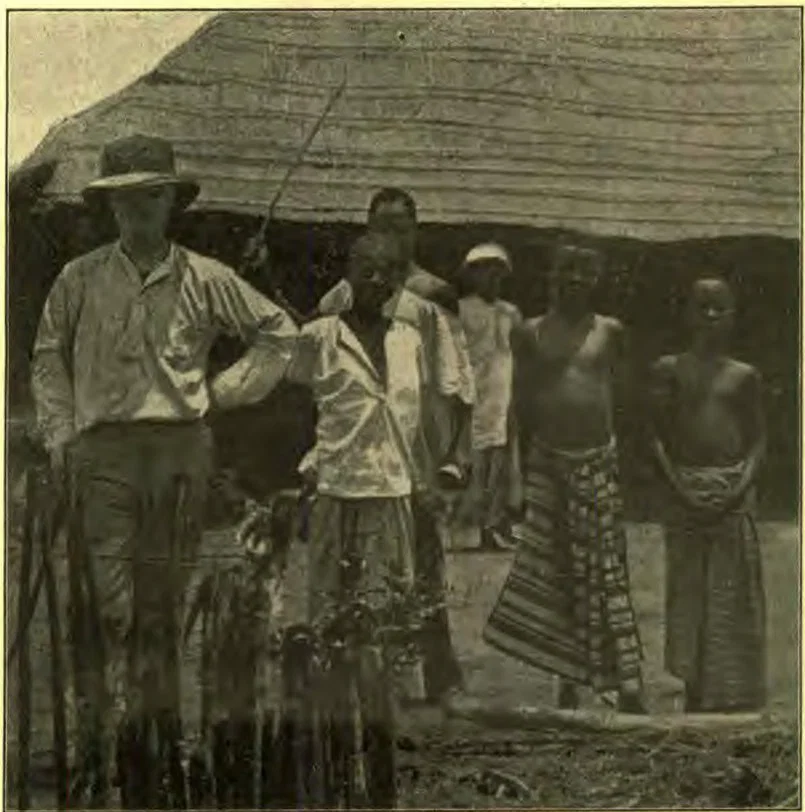
In the July number of the World’s Work, a magazine which, as the name implies, deals with the great practical issues of the day, there appeared a deeply interesting article entitled, “An Educational Experiment with Cannibals.” The writer is Mr. Samuel P. Verner, a professor in Stillman Institute, at Tuscaloosa, Alabama. Through the courtesy of the journal named, the INSTRUCTOR is permitted to reproduce the illustrations, and to make free use of the article accompanying them.
Two African lads came under the charge of Professor Verner over five years ago, when he was in the central part of the Dark Continent. This was at the time of the Belgian expedition against the Arabs. While General Kitchener advanced against the Mahdi from Egypt, Baron Dhanis ascended the Kongo, and then its greatest southern tributary, the River Kasai, at whose sources he recruited allies from the Batetela tribe for the war against the Arabs. Among the Batetela natives were these boys, Kassongo Lusuna and Kondola Mukusa. They accompanied the army with other boys to help carry food and ammunition.
Their ages at that time were fourteen and ten years. The older, Kassongo, is a nephew of the king, and heir to the throne, while Kondola is the son of a fisherman, a common native. The Batetela negroes are famous over a large area of Central Africa for their bravery, intelligence, and industry, but they are the most confirmed cannibals. Kassongo was present at the battle of Nyangwe, when the Arabs were so signally routed, and when, after the engagement, the Batetela soldiers held a banquet over the remains of their foes. The country of this tribe is just south of the equator in the Kongo Free State, and about midway between the eastern and western oceans.
When these two cannibal youth fell to the charge of Professor Verner, their traits of character came into bold prominence, and day after day they became a fascinating study. At that time they would lie, fight, steal, and gamble whenever occasion offered. To break these habits was not an easy nor a short task. The methods used were the Scriptural ones, consisting both of moral suasion and the rod; and before leaving Africa, the writer states that his life and goods were safe in their hands. It was evident that their bad habits were the result of their surroundings, and not of some defect in their moral constitution. While in Africa, both boys learned to read and write in their native dialect, which had been reduced to alphabetical characters for this purpose.
In the article published in the World’s Work several incidents are related which show the devotion and fidelity of these African youth. On one occasion the professor went to the summit of a high mountain to make some geographical observations. While there, he fell into a concealed game-pit ten feet deep, set with sharp, poisoned stakes. Kassongo got him out, and then ran five miles for help, returning in a little more than an hour. He then sucked the poison from the wound, and nursed his master through the almost fatal illness that followed. The writer states positively that he owes his life to this faithful lad.
At another time it was necessary to make a forced journey into a dangerous country to attend to an unpleasant business matter. With Kondola they walked fifty miles the first day, sleeping in jungles infested by leopards and elephants; and though the little lad was only twelve years old, he neither complained nor faltered. When the journey’s end was reached, the professor was so exhausted that he had to be lifted into a boat; but Kondola promptly joined in a game of ball which the youngsters of the town were playing! This shows the remarkable physique of these youth.
On one occasion Mr. Verner was obliged to make a perilous trip by canoe down the cataracts of the River Kasai to meet a steamer coming up from below. Kassongo volunteered for the dangerous place of paddler at the prow, watching for rocks, crocodiles, and hippopotami, and to do a large part of the steering. He maintained his post all day long without complaint, while they passed through what the writer calls one of the worst pieces of water on earth.
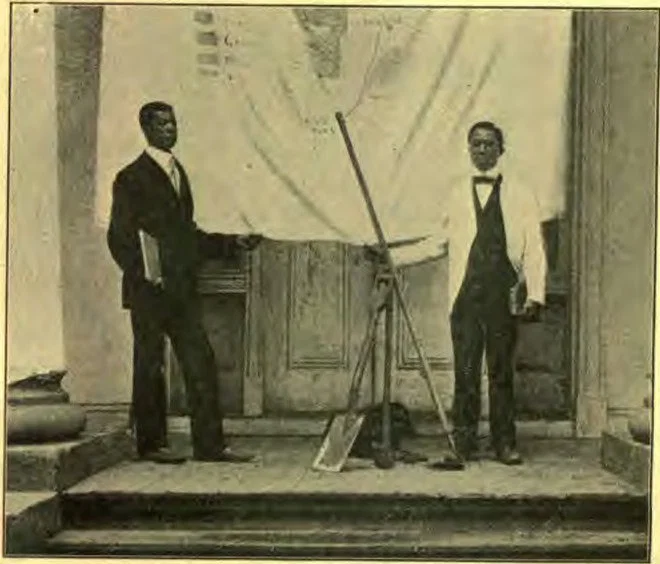
MR. VERNER AND THE BATETELA BOYS
Kassongo Kondola THE BOYS IN ALABAMA, A FEW YEARS LATER
A touching instance of the power of nobler ideas in these late cannibal minds was shown in their treatment of a sick comrade who was being taken down the river to his old home at Stanley Pool on the Kongo. This was Bundu, a Mukongo native who had been the cook of the camp. He was dying of the sleeping sickness, that strange malady which carries off whole villages. The Batetela boys nursed him, fed him, watched over him, and when the poor lad died, they helped bear him to his lonely grave. Then they made their way, weeping, back to the steamer, and solemnly said that “poor Bundu had gone to his own country at last.” Their language has no word for home.
A great surprise waited them at Stanley Pool, where they first saw a locomotive. They promptly named it “steamer on land,” and with wide-opened eyes they said, “What wizards these white men are!” An accident made it necessary to telephone for another engine. When it steamed up, Kondola exclaimed, “See, his brother has come to help him!” Kassongo then observed that even the white man “could not make an animal that would not stop.”
On the passage to Europe the boys had several wild animals that they cared for, and they managed to keep them all alive except some chameleons and a little green monkey. The latter drank sea water and died. The little Africans wept over him sorely, then had a funeral service for him, and consigned his body to the deep.
As the steamer neared Antwerp, the young negroes were observed with much interest. The towers, the spires, the great buildings, the cathedral, bells ringing, whistles sounding, ship after ship lining the quay, and all the roar and bustle of city life,—these strange, new things overwhelmed these lads from the dark recesses of Ethiopia. The passengers crowded around to note the effect. The boys’ eyes grew bigger, and Kondola ventured to exclaim, “Oh, we must be at heaven now!” Kassongo thoughtfully asked, “Master why do the white men leave all this to come to our land?”
The trip across the Atlantic was uneventful, and the steamer reached New York in February, in a raging blizzard. On landing, the boys were left temporarily in the care of the clerk of a lodging-house, the proprietor being absent. Imagine the professor’s dismay when, returning after a half-hour’s absence, he learned that his wards had been put out, and the explanation from the lodging-keeper was, “I don’t want any niggers here; I put ’em out!” The police were called up, and after several hours’ search Mr. Verner found the boys at midnight standing near a fruit-stand in sight of the familiar bananas. Each caught sight of the other at the same time, and Kassongo exclaimed: “Is it not a great city, master? We would not go far away, because we feared we should be lost. In the morning we thought you would find us.”
While absent to deliver a lecture, the Africans were left at the Thornwell Orphanage in South Carolina. On returning, Professor Verner learned that a general pilgrimage had taken place from all over the country to see Kassongo and Kondola; indeed, they had caused a great sensation. In Columbia the little fellows were the recipients of many attentions, and the house where they stayed was a real Mecca for the colored people for a month. Later they were taken to the Stillman Institute at Tuscaloosa, where they are now being educated.
The progress of these youth has been extraordinary. Both can now read and write, and are quite familiar with elementary geography and arithmetic. Both have professed Christianity, and are of sound moral character. They are faithful workmen on the farm, and can use ordinary mechanical tools fairly well. One is leading his class with an average of ninety-three in scholarship, and the other is not far behind.
The gentleman who has taken such a deep interest in these dark-skinned Africans hopes to secure a grant of land for them in the Kongo Free State, from the king of Belgium, that they may return to elevate their people.
Reader, can we not discern the hand of God in this interesting experience?
G. W. AMADON.

Living Water

In the incident of the Samaritan woman at the well, is shown one of the Saviour’s ways of winning souls. While the woman was extolling Jacob’s well, Christ was speaking to her of the water of everlasting life. He who drinks of the water of Jacob’s well “shall thirst again,” he said, but he who drinks “of the water that I shall give him shall never thirst.”
Instead of disparaging Jacob’s well, Christ presented something better. “If thou knewest the gift of God,” he said, “and who it is that saith to thee, Give me to drink; thou wouldst have asked of him, and he would have given thee living water.” He turned the conversation to the treasure he had to bestow, which would satisfy the craving of mind and heart. He offered the woman something better than anything she possessed, even living water, the joy and hope of the gospel of his kingdom.
This is an illustration of the way in which we are to work. It is of little use for us to go to pleasure-lovers, theater-goers, drunkards, and gamblers, and scathingly rebuke them for their sins. We must offer them something better than that which they have, even “the peace of God, which passeth all understanding.” We must make it as plain as possible to them that the law of God is binding upon all human beings, and that this law is a transcript of the divine character, an expression of that which the Creator wishes his children to become.
These poor souls are engaged in a wild chase after worldly pleasure and earthly riches. They have no knowledge of anything more desirable. But pleasure will not satisfy the soul. Show them how infinitely superior to the fleeting joys of the world is the imperishable glory of heaven. Seek to convince them of the freedom and hope and rest and peace to be found in the gospel.
God’s people, young and old, are to lift up Jesus, who alone can satisfy the restless craving of the heart, and give repose to the mind. Wealth can not do this. Intoxicating drink can not do it. Worldly pleasure can not do it. Title, rank, learning, power,—all are worthless unless the name is enrolled in the Lamb’s book of life.
In the prayer which Christ offered to his Father just before the crucifixion, he said, “This is life eternal, that they might know thee the only true God, and Jesus Christ, whom thou hast sent.” Only the religion that comes from God will lead to God. “He that believeth on the Son hath everlasting life.” There is in his heart a well of living water, the influence of which is felt by all with whom he associates.
To the weary and heavy laden Christ says, “Come unto me, . . . and I will give you rest.” Restless, craving, exhausted heart, think of the Saviour’s words, “Whosoever drinketh of this water that I shall give him shall never thirst.” Drink from the wells of worldly pleasure, and you will thirst again. Drink of the water of life, and you will be satisfied and refreshed; for it will be in you “a well of water springing up into everlasting life.” Love and light and truth and life are found in the everlasting gospel. Come, ye who labor and are heavy laden, come to the living water. “Let him that is athirst come. And whosoever will, let him take the water of life freely.”
Mrs. E. G. White.

The Story of Our Matabele Mission

The Last Week

THE days came and went with little change. Occasionally, for fear of lions, a fire was kept up all night. One morning when the brethren were about ready to break camp, they found that the one who had been watching the mules had fallen asleep for a moment or two, and the animals were nowhere to be seen. Several started in search, agreeing that the one who found them should fire his gun, as a signal that would call all back to the wagon. At last the signal was heard. But when they came up to the wagon, Brother Harvey and the oxen could not be found. Brother Wessels came with the mules. He found them about four miles away. All was now anxiety for Brother Harvey. But at last he, too, was found, keeping good watch of the oxen, but not knowing which way to go to find the wagon. It was very easy to get lost, as the wilderness seemed almost like the traceless ocean, and the vast numbers of thorn bushes hid the view for any distance.
One morning a small box of books was found on the road. Some one passing before had evidently lost this. Among the books was a copy of “Thoughts on Daniel and the Revelation.” This, with some tracts, was given to a young Scotch soldier, who seemed to be a real Christian. He was glad to get them, and promised to read the book with care. The result of this seed-sowing only eternity will reveal.
The month of July had come. The travelers were near the point for which they started; so they decided to travel by day until they reached Buluwayo, in order to see the country. On the evening of July 3 they went into camp only eight miles from Buluwayo, where they planned to stay until it was decided where they would settle. During the day they had a talk with a Kafir and his wife. She understood Dutch, and Brother Wessels talked to her in that tongue, she interpreting for her husband what was said. They both seemed glad to hear about the Lord. They never had heard the old, old story, and were ready to welcome the white man if he was coming into their country to help them.
Early the next morning Brethren Druillard, Harvey, and Gopp, the Americans in the company, had to talk of the Fourth. As soon as it was light, the party started to the city for mail. To their surprise, they found the stars and stripes floating to the breeze in this far-off land, and, upon investigating, found about thirty Americans gathered together, bent on doing something to celebrate the day.
One man, when he learned that they had come to establish a mission, offered Brother Druillard one thousand acres of land if he would bring his wife, settle on his farm, and teach the natives to work. The farm had water on two sides of it, and gold had been discovered upon it. It was regarded as a valuable property.
At 2 P. M. the company returned to the wagon with the mail. The tent was up, the wagons were unloaded, and dinner was ready. But the dinner was not tempting to-day, so many, many days had they eaten porridge. However, they were thankful to their Heavenly Father for prospering them thus far on their journey, and they would not now complain.
Their missionary meeting on Wednesday evening was in reality a missionary meeting; for were they not in the mission field of their choice? They could confidently commit themselves to Him who had thus led them, knowing that he would not now fail them in establishing the mission where the most might be accomplished for him.
On Thursday the entire company went into Buluwayo to present their plan to Dr. Jameson. They had a letter of introduction to this gentleman, and they were glad indeed to find him in his office, as he was so frequently out of town. At first he did not seem to care much about their mission. He said that missions had been a curse to the country; that the natives were made no better, while the missionaries grew rich. And, more than that, they had never taught the natives how to work, and did not help them in the least. He said much more that made it appear that he had come in contact with some missionaries who had mistaken their calling.
After the brethren laid their plan before him, he told them that if they would adhere to that, he would be very glad to have them come into the country; that it would pay the Chartered Company to help them. He was willing to aid them, and believed that they would be a real blessing to the country, if they made their mission self-supporting, teaching the natives how to work and be cleanly, to let rum and other harmful things alone, and to build houses and plant gardens for themselves. He offered them twelve thousand acres of land for this purpose, in any direction where the land had not been taken; but recommended them to the very place where the mission was later located, if they truly wished to work for the natives. He also sent four Kafirs with them to show them the way. One was to act as a guide. He was a Natal Kafir, and besides speaking English, could speak several other languages. Dr. Jameson encouraged them to spend plenty of time in choosing their location.
ESTELLA HOUSER.

Your Life as a Singing Sacrifice of Praise

REMEMBER your life is to be a singing life. This world is God's grand cathedral for you. You are to be one of God's choristers, and there is to be a continued sacrifice of praise and thanksgiving going up from your heart, with which God shall be continually well pleased. And there should not be only the offering of the lips, but the surrender of the life with joy. Yes, with joy and not with constraint. Every faculty of our nature should be presented to him in gladsome service; for the Lord Jehovah is my song, as well as my strength.—Hay Aitken.

His Last Message

Ten years ago, in the county of Jackson, Michigan, living on a farm was an apparently happy family. Irving, one of the elder boys of a family of seven, was a kind-hearted lad, but of a daring, impulsive nature. The mother of this family was a Christian, and wished her children to love truth and right. She often remonstrated gently with Irving to curb his restless nature; but the desire for change only strengthened as he grew older, until finally he wished to leave home, and “go for himself,” as he expressed it.
Though only eighteen, he decided to join a gang of well-diggers. These men were rough in their habits. Their conversation was not always upon those things that are lovely, pure, and just.
Irving’s mother knew this, and used her utmost powers to cause him to change his decision; but he only answered, “I am not afraid. They’ll not harm me.” So he went; and as the months passed, and she saw her boy drifting farther from her and God, it seemed as if all her prayers and instructions had been in vain. But not so; the impressions received by the mind in childhood remain as long as reason endures.
One warm summer afternoon the well-diggers were at work in a region where quicksand was found; and after several days of effort, they struck solid rock, and could go no farther. In their vexation their curses rang out freely on the quiet air. But somehow to-day they stung Irving’s ear; and he was glad when only he and a companion were left in charge, while the rest went in search of a drill to pierce the rock. By and by he approached the yawning mouth of the well; and the old, daring spirit again asserted itself. He must go to the bottom of that well, and examine the rock that caused their trouble. His companion urged him not to go, but this only made the desire stronger. “I’m not afraid. Nothing will hurt me,” he said, as he nimbly descended. He was just bending to examine the rock when there was a sudden rush, and instantly a great pressure came upon him. Alas! he realized, too late, that the last eight or ten feet of the sides of the well were of quicksand, and that he was buried fifteen feet under sand and dirt. His companion, anxiously watching at the top, saw the accident, and with a shout for help, quickly forced two pipes down through the sand, and faintly heard Irving say that he was in a terribly bent position, and that one of the pipes was pressing on his shoulder. Then there was silence for a brief space, and his companion began to fear the worst had come, when he heard, in still fainter tones, “Tell mother it is well with my soul.”
Others soon came to the boy’s aid; and after hard work they reached his lifeless form. The pressure had been too great, the air too insufficient.
Just as the evening shadows were gathering, they bore him homeward. Up through the familiar lane they went, where the dewy elderberry blossoms were nodding. Mother was watching for him at the gate, wondering why he was so late to the supper she had kept warm for him. The anguish of his home-coming none but a mother can know. The men could only stand with bowed heads as they witnessed the first terrible moments of her grief; then, in awed tones, one of their number ventured to give her that last message. How it comforted her that in this hour of anguish she could thank God that he had led her to give her boy instruction in truth, and ask his forgiveness for ever doubting his promise that his word will not return to him void. VINA M. SHERWOOD.

The Danger of Talking Too Much

MANY people talk too much. There are scarcely any of us by whom are spoken no words which it were better to have left unspoken. All unkind words belong to this class. We talk too much when we speak angrily, when we say a word that hurts another. Some people seem nearly always to be talking this way. They rarely ever say a truly generous word of any one or to any one, or a word which gives comfort or help. Their speech is full of uncharitable criticism or fretful complaining. If they spoke only when they had really good words to say, they would be silent much of the time. We talk too much whenever we say anything unkind, or anything that needlessly gives pain to a gentle heart.
Another kind of speech that would better not be indulged in, is that condemned by our Lord when he said that we must give account for every idle word. It need not be a hurtful word—if it is only idle it is unfit to fall from a Christian’s lips. Idle words are those that are empty,—empty of love and of good, words of no value. There are many such words spoken. They may appear harmless; yet they are useless, and uselessness always disappoints the Master. They give no comfort, they put no cheer into any heart, they inspire nothing beautiful in any soul. Too much of the conversation of the parlor, of the wayside, of the table, is of this vapid and empty order,—talk about merest nothings, inane, without thought, without sense, without beauty, without meaning. How it must astonish the angels to hear those who have been “bought with a price” using their marvelous gift of speech in such a trivial, idle way! We talk too much when we use idle words.
We talk too much when we speak rash words. It was a wise counsel which the town clerk of Ephesus gave to the people when he said to them: “Ye ought to be quiet, and to do nothing rashly.” No lesson needs to be urged more repeatedly than this. Inconceivable harm comes from rash talking. Many persons are rash in giving their opinions on subjects concerning which they really have no knowledge, of which they have never seriously thought. Many are rash in blaming and condemning others, without taking time to inquire into the circumstances, or to hear explanations. Others are rash in giving way to temper, and saying words that are not only unseemly, but are also cruel and unjust. In some families, the home life is greatly marred by rash words spoken in the common intercourse of the home. Sometimes it is a habit of contradicting and disputing which has been allowed to grow until it has become inveterate. Usually the questions wrangled over are of no importance. The other day there was a serious dispute over the question whether it was two o’clock or a quarter past two when a certain thing occurred; and the contention caused bitter anger and sharp words. There are families in which gentle and kindly speech is the exception—the staple talk is ill-tempered, dictatorial, or unloving. Outside, people dare not speak petulantly or angrily, for their neighbors would resent such language. But in the inner circle of love they remove the restraint, and their words too often cut deep into tender hearts. Though love forgives hasty speech, the wounds remain and bleed. We talk too much when we speak hastily and rashly.
We talk too much, too, when we talk about ourselves. The wisest men scarcely ever speak of themselves. Certainly those who are most highly honored in any community do not. The man who habitually talks about himself and his affairs and his doings declares himself a self-conceited egotist, and this practically neutralizes his influence. The better judgment of good people everywhere approves the man who, if great, is not aware of his own greatness; if a saint, is unconscious of his own saintliness. One of the finest things in the story of Moses is that when he came down from the mountain bathed in heavenly radiance, he “wist not that his face shone.” If he had been aware of the brightness in his features, the glory would have been dimmed. But too many seem to be aware that their faces shine, even though the radiance be not very bright.
It may be set down as a rule, without any exceptions, that the man who talks about himself is talking too much. But who will tell people about our attainments and achievements if we do not?—Ah! we need not trouble ourselves in the least about that. It is not necessary that people should know how great we are or what good things we do. There is nothing either lovely or Christ-like in the desire that the world should know of the fine things we do. On the other hand, our Lord said some very plain things about those who blow trumpets when they do anything good or fine, to call the world’s attention to themselves. Suppose we do our work well; it is no more than it is our duty to do. And are we the only people who have done, and are doing, their work well?
Talking about one’s self is perilous, because when we begin it, we are sure to go on from bad to worse. There is a strange fascination about it. It intoxicates us, and lures us on. We would better not begin. It may rob us of the pleasure of saying some things we would like to say; but it is better we should endure the pain of such self-denial and self-restraint rather than incur the danger into which beginning to talk about ourselves would lead us.—M. C. Hazard, in Well Spring.

“As the Sparks Fly Upward”

I FIRST noticed this tragedy of insect life in Dalhousie Square, a pretty park in front of the Calcutta post-office. It was in the short twilight hour. Thousands of insects were flying up from among the trees, and in the air overhead hundreds of birds and bats were wheeling and darting. These were catching the insects as fast as they rose into the air.
Looking to see where the poor little victims were coming from, I found them rising from numerous holes in the earth. They were white ants of the male species. These males are winged insects, very different in appearance from the working white ant, which is such a pest to the householder in the East.
They were newly hatched, down deep in the ant nest below, and came pouring up in an almost uninterrupted stream, to spread their wings and take their first flight into the world, all unconscious of the enemies waiting above the trees to devour them. It seemed a pitiful fate that the little things should spring up from the darkness below into the free air above, only to perish on the threshold of life. It was a satisfaction to see some of them dodge their pursuers, and apparently get away.
Somehow, the scene always reminded me of the saying of Job’s friend, “Man is born unto trouble as the sparks fly upward.” Eliphaz had seen the sparks leap up from the crackling fire of dry thorns, instantly to go out in the darkness. It would be a mournful world if God were not overruling and restraining the forces of destruction, warding off evil, and sending comfort to men in trouble. As it is, in spite of all the agencies of sin, it is a splendid world in which to live and work.
W. A. SPICER.

Goldenrod

Across the meadow in brooding shadow I walk to drink of the autumn's wine— The charm of story, the artist's glory, To-day on these silvering hills is mine. On height and hollow where'er I follow, By mellow hillside and searing sod, Its plumes uplifting, in light winds drifting, I see the glimmer of goldenrod.
In this latest comer the vanished summer Has left its sunshine the world to cheer, And bid us remember in late September What beauty mates with the passing year. The days that are fleetest are still the sweetest, And life is near to the heart of God, And the peace of heaven to earth is given In these wonderful days of the goldenrod. —Selected.

The Name of Jesus

PREPARATORY to the last great Pentecost, when all the nations and tribes of earth are to hear the wonderful works of God set forth again, each in their own tongue, God has had an army of workmen busy setting the Scriptures into the various languages of earth. The word of God speaks in over four hundred tongues now, and new conquests are continually being made.
We, who work in our expressive English speech, itself having been so largely shaped and molded by early Bible translations, can appreciate but partially the difficulties of the translators working in some of the non-Christian tongues. Christian ideas are so totally different from the heathen conceptions, that many thoughts are put into language only with the greatest difficulty.
The noble army of God’s workmen have labored and toiled, especially during the last century, to search out right words in which to set forth Christ crucified, in the language of Holy Writ. Now, to-day, in the border lands of missionary enterprise, these workmen are still toiling away with a devotion that may well be an inspiration to us. In the Missionary Review of the World, a missionary of the Society of Friends, working in West Central Africa, gives this account of his search for words with which to clothe the thoughts of God:—
“The first word I secured was ‘Nichau,’ meaning ‘What is it?’ Day and night I pestered every man I met with that question. In the brick-yard, muddy hands and pencil added to muddy paper the swelling list of words. In the garden, hoe and spade were dropped for pencil and note-book, as some new word dropped from the lips of the black man at my side. So it went through the day with its varied duties, and then at night, by candle-light, the day’s treasures were gathered up, classified, and made ready for their blessed service.
“For two years and a half I searched for the word ‘Saviour.’ As each day and week and month passed by, it grew bigger with meaning in the light of the frightful need which faced me—a need which I knew I could meet if I could bring that word to bear upon it; but before which I was powerless until that golden key was discovered.
“But it finally came, and the toil of years was recompensed. Around the evening camp-fire I sat with my men, listening to their stories, and watching eagerly for the coveted word. Finally my head man, Kikuvi, launched upon a tale which I hoped would bring it. He told how Mr. Krieger had some months before been attacked by a lion and badly wounded, and how he had been rescued. But to my great disappointment he did not drop the concrete word for which I was looking. Sick at heart, I was about to turn away, when in a modest way he turned to me, saying, ‘Bwana mukuthaniya na Kikuvi’ (The master was saved by Kikuvi). I could have shouted for joy; for, having the verb, I could easily make the noun; but to prove it beyond the shadow of a doubt, I said, ‘Ukuthanie Bwana?’ (You saved the master?); and he replied, ‘Yes.’
“‘Why, Kikuvi,’ I said, ‘this is the word I have been wanting you to give me all these “moons,” because I wanted to tell you that Yesu died to Ku——.’
“‘I got no further. The black face lit up, as in the lurid light of the camp-fire he turned upon me, exclaiming: ‘Master! I see it now! I understand! This is what you have been trying to tell us all these moons,—that Yesu died to save us from the power of sin!’ Never did a sweeter word fall from mortal lips than that word ‘Saviour’ as it fell from the lips of that black savage in Central Africa.
“For four years I dwelt alone, seeing three of my co-workers stricken down by fever; had over thirty attacks of fever myself; was three times attacked by lions, several times by rhinoceroses; ambushed by hostile natives; fourteen months without bread; for two months subsisted on beans and sour milk; have had to eat everything from ants to rhinoceroses; but I rejoice to say that I would be glad to go through the whole program again with my eyes wide open if I could have the joy of flashing that word ‘Saviour’ into the darkness of another tribe in Central Africa.”
Rejoicing with this worker in his joy at finding the long-sought word, do we not see, more plainly than ever, the fullness of the gospel in that one blessed word, that dearest name in earth or heaven, brought by angels to men—the name of JESUS? Strike what we know of the meaning of that name JESUS—SAVIOUR—out of our lives, and how all the lights of heaven would go out in darkness in our souls. Yet the greater part of the peoples of this earth to-day do not know the name, and the glorious message to men that God has infolded within it.
W. A. SPICER.

Early Autumn

THE world puts on its robes of glory now, The very flowers are tinged with deeper dyes, The waves are bluer, and the angels pitch Their shining tents along the sunset skies.
The distant hills are crowned with purple mist, The days are mellow, and the long, calm nights, To wondering eyes, like weird magicians, show The shifting splendors of the Northern Lights.
The generous earth spreads out her fruitful store, And all the fields are decked with ripened sheaves; While in the woods, at Autumn’s rustling step, The maples blush through all their trembling leaves.
— Albert Leighton.

The Gospel in a Barrel

I stood in a large barrel factory the other day, and watched the man who inspects the barrels just before they are started down the inclined plane to the shipping-rooms. He would whirl the barrel around a few times to inspect the outside, and then, rolling it over, thrust a small incandescent light into the hole in the side, and with his eye at the opening, stand quietly gazing inside for a moment, as if looking for something.
“What did you do that for?” I asked.
“To see if inside’s O. K., charred all right, ’nough glue, etc.,” he answered.
I put my eye to the hole in one of the barrels. All was as black as pitch within.
“Here,” he said, pushing me aside, and putting the little electric lamp through the hole, “now look.” I did, and the inside of the barrel was as light as day. Every joint and irregularity was as plain as could be.
How like our lives! We never know our hearts until Jesus holds the light. How we need his inspection, even after we are his!
“That needs a new head and two new hoops,” remarked the inspector, as he made some chalk-marks on the end of a barrel, and rolled it to one side.
Let us not find fault when the Master stops us for repairs, or desires to make us over again.
— Selected.

Go Forward: A Word to the Children of Israel

WHAT was commanded to be said to the children of Israel is said to you—Go forward.— J. A. James.
Continue reading: Battles between Truth and Falsehood