The Youth's Instructor, Vol. LII, No. 31

Things Curious and Interesting

The Youth's Instructor

August 2, 1904

Review and Herald Publishing Assn. · Washington, D. C. · August 2, 1904

Things Curious and Interesting
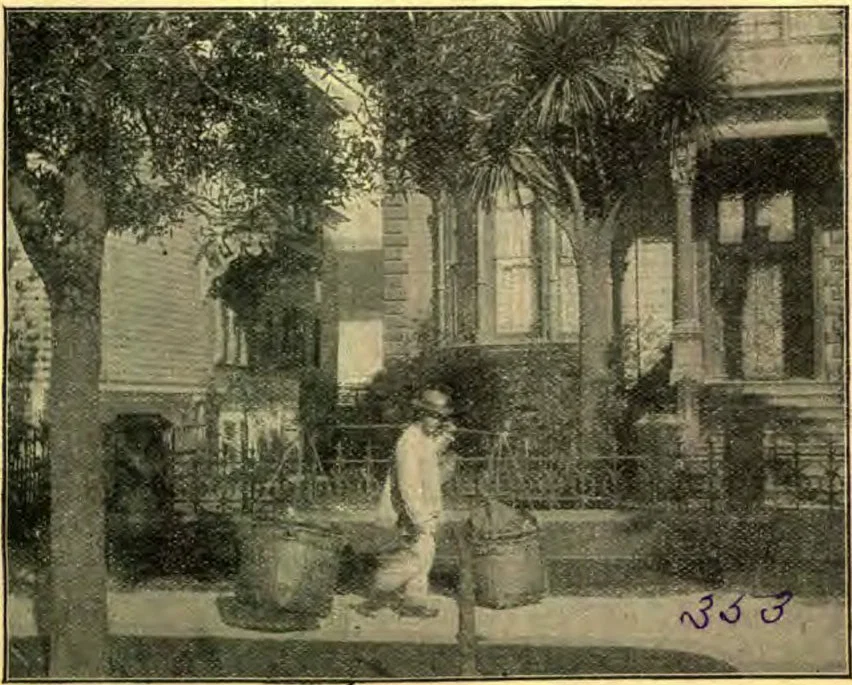
The trip across the country to our station from Sin Iang Cheo usually requires three days; but on account of the size of our party and the delay caused by stopping to hold meetings, four days were consumed. Where the roads are in many places nothing but foot-paths, the problem of transporting our baggage, consisting of boxes too heavy to be carried by coolies, proved a serious one. But the rivers are to China what the railroads are to the United States, so we found that our goods could be carried from here to our station on rafts. There were no rafts to be secured then, and we were told they might come tomorrow or next day, or perhaps not for a week or two. This uncertainty determined us not to wait. Our goods were left in charge of two of our native converts, who were to come as soon as possible with them. The river is one mile from the railroad station, so coolies were secured to take the goods to the rafts. Their method of transferring freight is to tie the burden on a pole, which is carried between two men. Or if it is light, one man carries the load, divided into two parts and suspended from either end of the pole. Produce of every kind is carried in this way. It is not uncommon to see a man passing along the road, having suspended from both ends of his pole a rope, which is tied around the legs of one or two pigs, according to the size of the animals. The Chinese pig has learned to be content with this method of travel, for he seldom makes any noisy remonstrance.
After three weeks of anxious waiting at the mission for our baggage, a messenger, who had cut across the country, arrived and gave the news that our goods were on the road. He explained that the river was much longer now than a few months previous, because the water was very low, and they had to dig channels for their boats in some places. The Chinaman does not measure distance by the actual length of the road, but by the time required to travel it. The trip being so long made it expensive; for the boatman demanded a great deal of “wine money.” The giving of “wine money” is a pernicious custom, to which one must submit in Central China. Even though a laborer is hired to work for you, and the wage stipulated beforehand, yet every day he expects you to give him something extra to pay for his tobacco. He not only expects it, but it must be paid him, or he will not work.
For the first stage of our journey from Sin Iang, the ladies had sedan-chairs, the baggage was hauled on wheelbarrows, and the men of the party walked. The sedan-chairs used here are made like a box, with a straight back and a narrow board for a seat. The chair is suspended between two poles, and carried by coolies. The chairs are neither elegant nor comfortable, and the only safe position the passenger can take in them is to lean forward with arms resting on the knees, bracing himself on either side and in front, to prevent falling headlong when the coolies stumble, step into a hole, or suddenly quicken their pace.
The roads differ in various parts of China, according to the kind of conveyances used. In the district about Sin Iang Cheo, wheelbarrows and sedan-chairs are used, and the roads are little more than foot-paths. The country is rolling. The long and constant travel has cut the roads into the hills to a depth of several feet. For a long period of years the Chinese have taken no pride in public improvements, having made no new roads or bridges, nor do they keep in repair those already in use. If a spot in the road becomes impassable, the road is turned to one side, through some man’s field; if the bridge breaks, the stream is forded thereafter. Although Sin Tsai Hsien is sixty miles northeast from Sin Iang Cheo, it required two hundred and ninety li, or ninety-six miles of travel to reach it, due to the crooked course of the Chinese roads. While in the West much time and energy is spent to make the shortest and straightest roads possible, the Chinaman spends much energy in making the course as crooked as possible. The first day’s journey of sixty li brought up to U-li-tien, a Chinese city where we have an evangelist and a small chapel. The chapel served as our inn for the night.

U-li-tien to Lo-Shan

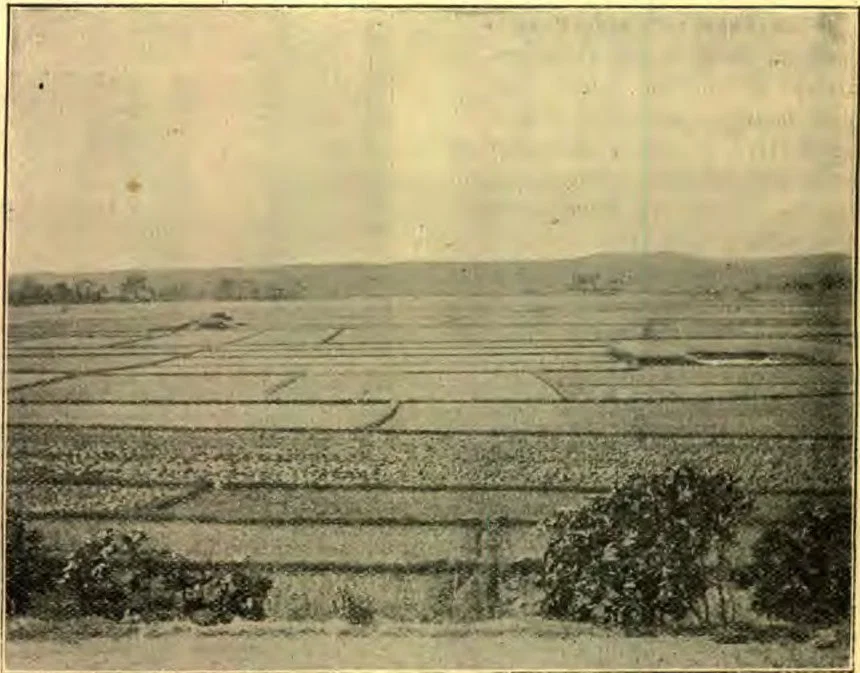
A CHINESE FARM
A CHINESE FARM
Starting on our way at one o’clock the next morning, we came to a river which must be ferried. The rivers of China seldom have bridges, and ferries are furnished by the government to supply their places. The water on the farther side of the river being too shallow for the ferry-boat, some of our party were carried ashore on the backs of the coolies. Our road led us through one of the most fertile farming districts of Central China. The farms are small, but they are most thoroughly tilled. Adjoining farms are separated by a strip of unplowed ground, or a ridge of earth, which, while serving for a fence, also makes a basin of the field for irrigating purposes. All the fields are level as a floor, and so arranged that they are easily irrigated.
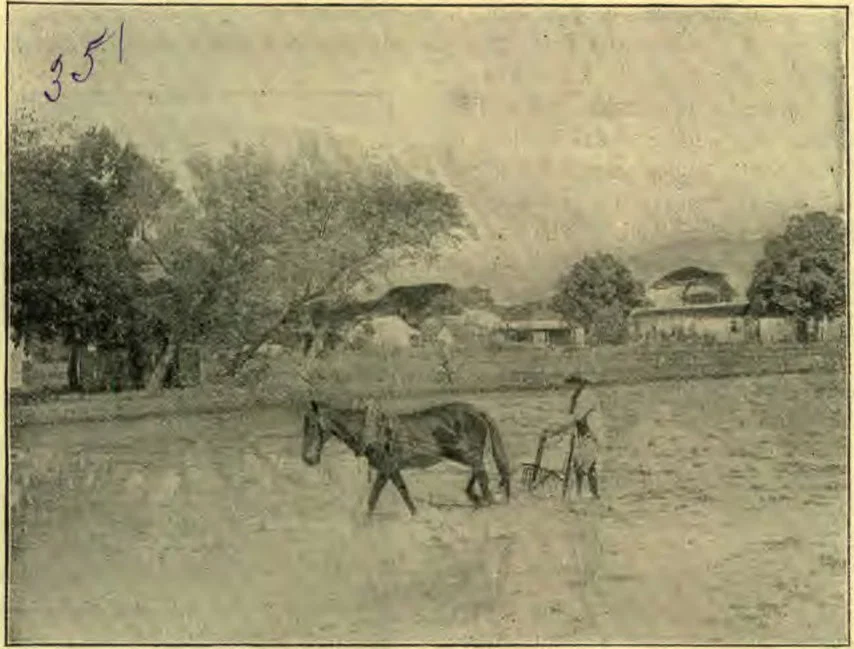
In some parts of the country, and especially near the cities where the farms are very small, the water for irrigating is drawn from a well and poured into the trenches. It is a tedious task to draw water from a well twenty-five feet deep in sufficient quantity to irrigate a field, but it does not try the patience of the Chinese farmer. The farmers take great pains to keep the soil fertile, and every particle of fertilizing material is carefully collected. The boys and old women can be seen out on the streets and along the public highways, collecting everything that will serve to enrich the soil of their little farm. Two crops a year are raised on most of the ground. The soil is largely a black loam, and in many places resembles the black muck found in the lowlands of the Mississippi River valley. As a class, the farmers are very industrious. During the busy season they are out at work as early in the morning as one o’clock; and if the nights are moonlight, they work as late as nine at night. The farming utensils are very crude, and the cultivation is largely done with spade and hoe. Thrashing is done as in the days of Abraham, the thrashing-floor being a level bit of ground, smooth, hard, and clean-swept. In some cases a flail is called into service; in others a stone-roller, drawn by a cow or donkey, is used to thrash out the grain. We called to mind that in such a country, amid similar scenes, our Master worked, traveling on foot from village to village, over a dusty road, wearing such sandals as the people here wear, and stopping at inns such as those which afforded us shelter.
In this district, sheep, hogs, and cattle are also raised, but not to any great extent, for agriculture is the main occupation. The products vary greatly in different localities. Rice and wheat may be said to form the staple product. Six different varieties of beans are grown, and large quantities of vegetables, such as spinach, Chinese cabbage, onions, sweet potatoes, and carrots. Very fine peanuts are produced, and also millet and hemp. Not a single fruit-tree or fruit-bearing shrub is to be seen in the country about our station, but fifty miles north of us a very fine quality of pears is grown.

Lo-Shan to Ching-Yang

About three in the afternoon we arrived at Lo-Shan, which was but sixty li, or twenty miles, from U-li-tien. Here we passed under the city wall, and lodged in another of our chapels, where we have a native evangelist. At this place we changed conveyances, substituting for the wheelbarrow, donkey-carts, drawn by two donkeys hitched one directly in front of the other. To the large carts two donkeys are hitched in front, and one in the shafts. The bed of the cart sits directly on the axle, the two wheels are high, so that one gets the full benefit of the rough roads.
Upon reaching the chapel in Lo-Shan, we were met by the Christian family, and given a hearty welcome, not alone in words, but in deed, as they prepared for us the only warm meal we had in the four days’ journey. After supper the yard was full of women, who came to learn about us. The ladies went out to visit with them, which consisted of smiling at the Chinese, the native women returning the compliment. The ladies were given seats on the little wooden chairs. The visitors took the liberty of examining the dress of our company, which seemed to be a real curiosity to them. Our ladies in turn examined the clothing of the Chinese ladies. One of the women was kind enough to unwind the bandage around her foot. They laughed and talked among themselves, and made signs to the ladies. Brother Pilsquist, acting as interpreter, told them the ladies were very sorry they could not talk with them. The women replied they hoped the missionaries would soon learn the language, so they could tell them of heaven.
After traveling this day a distance of forty miles, we reached Ching-Yang at sunset. As we were all very weary, we retired early. But our friends did not allow us to rest undisturbed, as they were peeping in at every crack, eager to see what kind of people we were. We arose at twelve o’clock, and started on our last day’s journey at 12:30 A. M.

Ching-Yang to Sin Tsai Hsien

This day’s travel was through a very level country. In crossing the river, the wheels ran off the ferry, which delayed us somewhat, as Chinamen are no good in an emergency. They have no idea what to do, and do first everything but the right thing. About sundown we saw the walls of an ancient city across the plain. It made us rejoice, as this was the city we had been traveling toward for five weeks and four days. We found native Christians at the gate, waiting to welcome us. We felt thankful for God’s protecting care during this long and trying journey. Our health was preserved, even while sleeping on the dirt floors of a mud house. God has led us so far; we will trust him the remainder of life’s journey. H. W. Miller, M. D.

Honor Thy Father and Thy Mother

THERE is a touching story told of the famous Dr. Samuel Johnson which has had influence on many a boy who has heard it. Samuel’s father, Michael Johnson, was a poor bookseller in Litchfield, England. On market days he used to carry a package of books to the village of Ottoxeter, and sell them from a stall in the market-place. One day the bookseller was sick, and asked his son to go and sell the books in his place. Samuel, from a silly pride, refused to obey.
A CHINESE FARMER
A CHINESE FARMER
Fifty years afterward Johnson became the celebrated author, the compiler of the English Dictionary, and one of the most distinguished scholars in England; but he never forgot his act of unkindness to his poor hard-toiling father; so when he visited Ottoxeter he determined to show his sorrow and repentance.
He went into the market-place at the time of business, uncovered his head, and stood there for an hour in the pouring rain, on the very spot where the book-stall used to stand.
“This,” he says, “was an act of contrition for my disobedience to my kind father.”
The spectacle of the great Dr. Johnson standing bareheaded in the storm to atone for the wrong done by him fifty years before is a grand and touching one. There is a representation of it in marble on the Doctor’s monument.
Many a man in after life has felt something harder and heavier than a storm of rain beating upon his heart when he remembered his acts of unkindness to a good father or mother now in their grave.
Dr. John Todd, of Pittsfield, the eminent writer, never forgot how, when his old father was very sick, and sent him away for medicine, he, a little lad, had been unwilling to go, and made up a lie, that “the druggist had no such medicine.”
The old man was just dying when little Johnny came in, and he said to him: “My boy, your father suffers great pain for want of that medicine.”
Johnny started in great distress for the medicine, but it was too late. The father on his return was almost gone. He could only say to the weeping boy: “Love God, and always speak the truth, for the eye of God is always upon you. Now kiss me once more, and farewell.”
Through all his after life, Dr. Todd often had a heartache over that act of falsehood and disobedience to his dying father. It takes more than a shower to wash away the memory of such sins. Dr. Todd repented of that sin a thousand times.
The words “honor thy father and thy mother,” mean three things: always do what they bid you, always treat them lovingly, and take care of them when they are sick and grown old. I never yet knew a boy who trampled on the wishes of his parents that turned out well. God never blesses a wilful boy.
When Washington was sixteen years old, he determined to leave home and become a midshipman in the Colonial navy. After he had sent off his trunk, he went to bid his mother good-by. She wept so bitterly because he was going away that he said to his negro servant: “Bring back my trunk. I am not going to make my mother suffer so, by leaving her.”
He remained at home to please his mother.
This decision led to his becoming a surveyor, and afterward a soldier. His whole glorious career in life turned on that simple act of trying to make his mother happy. And happy, too, will be the child who never has occasion to shed bitter tears for any act of unkindness to his parents. Let us not forget that God has said: “Honor thy father and thy mother.”—Theodore L. Cuyler, in Pittsburg Christian Advocate.

India Rubber

IMPORTS of india rubber into the United States, in the fiscal year about to end, will exceed by far those of any earlier year, and will amount to over forty million dollars in value. The demand for this article of exclusively foreign production for use in manufacturing has increased very rapidly in recent years, and the imports in the present year, as shown by the Department of Commerce and Labor through its bureau of statistics, will amount to about sixty million pounds, valued as already indicated, at fully forty million dollars. This rapid increase is apparently due, in a large degree, to the increasing use of this material for tires of vehicles of various classes, though in other lines of manufacture the demand is also very great.
In 1880 the quantity of rubber imported into the United States amounted to seventeen million pounds, valued at nine and one-half million dollars, making the average price about fifty-five cents a pound. In 1890 the quantity imported was thirty-four million pounds, valued at fifteen million dollars, or slightly less than fifty cents a pound. In 1900 the quantity imported was forty-nine million pounds, valued at thirty-one million dollars, or about sixty-three cents a pound; while in 1904 the record of the ten months for which figures are now available shows an average value for rubber imported of sixty-eight cents a pound. In addition to this, however, large quantities of material utilized in conjunction with india rubber are now imported.
Brazil is the most important source of this material. More than one half of the india rubber imported into the United States comes direct from Brazil, the total from that country alone being for the ten months thirty million pounds, valued at twenty and one-third million dollars. The United Kingdom supplied in the same period over seven million pounds, valued at five and one-quarter million dollars; Germany, two million pounds, valued at one and one-quarter million dollars; and “Other Europe,” nearly ten million pounds, valued at over seven and one-half million dollars. These supplies of india rubber which come from the European countries are in practically all cases the product of their various colonies, Germany drawing her supplies from her colonies in Africa; the United Kingdom, from Africa, India, Ceylon, and the Straits Settlements, while the supply from countries designated as “Other Europe” is chiefly that obtained in Africa by Belgium from the Congo country, which it controls.—Farm News.

What Is a Stenographer?

ONE of the most important and indispensable features of modern commercial life is the stenographer. Were this individual to suddenly be removed wholesale, little short of a panic would ensue in the offices of the mercantile world. This state of affairs has grown up in quite recent times, for even yet there are prominent business firms conservative enough to cling to the long-hand letter, and to regard with small favor the use of a writing-machine. However, the number of such cases is daily getting smaller, and will doubtless soon disappear altogether.
Since there is such universal demand for stenographers, the question of supply naturally arises. A large demand is usually met by a correspondingly large supply; and it is generally the case that a large supply embraces varying degrees of efficiency. Any one who is acquainted with the state of the stenographic market will admit that there are very many incompetents attempting to earn a living as stenographers, with more or less success. These inefficient people reflect discredit upon their craft. Surely there is some good reason for the large number of insufficiently qualified stenographers in the world to-day. Perhaps one reason is that it is the prevalent opinion that one who possesses a knowledge of shorthand is a stenographer; but this is not true, except to a certain extent. One might as reasonably say that a man who owns a kit of tools is a blacksmith or a carpenter. Agreed, that a blacksmith can not do his work without his tools, neither can a stenographer work without a knowledge of shorthand; but to attribute the success of a mechanic to the fact that he had tools to work with, would be as unsound as to say that by learning a certain system of shorthand, one becomes a capable stenographer.
Of course a knowledge of shorthand is one of the chief elements for making a stenographer; but merely to be able to write down in shorthand what another says, is simply to act as a shorthand machine. The good stenographer is much more than this. He is an individual who has intelligence which enables him to carry out instructions acceptably. He can grasp an employer’s ideas, and express them correctly and creditably. He can enter sympathetically into the interests and aims of another with whom he is working, and prove himself of the utmost value as a right-hand assistant. Herein lies the real value of a capable stenographer. Many qualifications make up the competent stenographer. He will have a good workable knowledge of his native tongue. Shorthand is a vehicle for conveying language. Then how essential it is that in order to correctly and acceptably reproduce spoken language, the stenographer shall be well acquainted with words in everyday use. The pre-eminent qualification of the stenographer is not necessarily ability to write shorthand readily and accurately; he must also be able to handle the English language with a degree of ease and fluency.
Hence it is evident that a stenographer must know many things besides shorthand and type-writing. These arts are indispensable, but of themselves do not constitute an efficient worker. Every young person aspiring to be a useful stenographer should improve every means to advance his intellectual equipment along the lines of a wide and thorough knowledge of the English tongue. Reading, intelligently and wisely conducted, will be found of great assistance. Space forbids an enumeration of other aids. Shorthand may be compared to a sharp tool. In the hands of a skilled workman, it can do great things; when wielded by an incompetent person, it is only too often the means of exposing a sad amount of inability which otherwise would not have been manifested. R. E. PORTER.

Charles Warren Fairbanks

The power of the senior United States Senator from Indiana, and now Republican nominee for vice-president, to keep others from finding out what he is pleased to keep secret, is a characteristic that is quite as irritating to the curious as it is unique.
“Who Senator Fairbanks is, and what he is, may be gathered from an appreciative article by E. I. Lewis in Leslie’s, from which we learn that in the latter half of 1852, and in the year or two following, a plain countrywoman, the wife of a farmer and wagon maker of little worldly store, rocked a queer-looking cradle in a little log cabin back in the woods of Union County, Ohio. It was one of those modest little cabins, such as those in which were builded the sturdy characters of Lincoln, Grant, and Garfield. The cradle was a queer-looking contrivance—a sugar trough skilfully mounted on home-made rockers.
“The parents were poor, and the boy was put to work early. First it was the chores that he was delegated to do, then he gave assistance in the harvest fields, and was later advanced to work behind the plow, and to serving as an assistant to his father in wagon making. The parents were God-fearing Methodists, who, having endowed their son with massive physical frame and force, sought early to make him mentally and morally sound. The district school and the circuit church were the facilities at hand, and though the term of school was less than five months and the preacher came at irregular intervals, these facilities, supplementing wholesome home training, were effective in laying the foundation of sterling character and a strong, moral backbone.
“Young Fairbanks, by farm work and wagon making, had saved forty-one dollars by the time he reached the age of fifteen years. With it and one suit of clothes he traveled to Delaware, Ohio, where he entered Ohio Wesleyan University. The necessity of closely guarding his forty-one dollars led to a rooming and ‘batching’ alliance with another ambitious young man. Their culinary education was limited to the preparation of baked potatoes, mush, bread, and batter cakes. On this—mainly batter cakes—they lived. He turned to account his knowledge of carpentry by working on Saturdays for a local contractor for one dollar and twenty-five cents a day. His employer was a colored man, and all his co-workers were colored.
“A few weeks after young Fairbanks arrived at college, he fell and split his only trousers beyond immediate repair. It was necessary for him to borrow a pair from a fellow student, and the loan had to be continued because he was denied credit for a new pair at the stores in the town. He had to send home for his mother to make him another pair.
“Working in college during the college year and in harvest fields in vacation, he was graduated from the college and its law course at twenty, and went to Pittsburg, where he began reading law while supporting himself by serving the Associated Press. Later he entered a law school at Cleveland, supporting himself in the same manner. At twenty-two he was admitted to the Supreme Court of Ohio, and later he went to Indianapolis. There he rose steadily until he became one of the best railroad lawyers in the country.
“It was Fairbanks who succeeded Daniel W. Voorhees, ‘the tall Sycamore of the Wabash,’ in the Senate in 1897. Since that time he has been one of the conspicuous members of Congress. He was recognized as one of President McKinley’s closest friends and ablest advisers. He has the reputation of being a millionaire. As a matter of fact he does not come in that classification. Among those who do not know him he has the reputation of being cold. His nature is the opposite. To friends he is a true friend. To enemies he is not treacherous.
“The Senator is of massive but well-proportioned stature, standing over six feet. He is a forcible speaker, but can not be said to be a popular one with the masses, his addresses being far too solid. There are few men who can so clearly define issue, and so ably defend or explain them.”

My Lesson

THE snow came whirling through the April air, And over hills and meadows, brown and bare, A robe of pearly whiteness thickly spread. Upon the bending branches overhead Lay heaps of snow, of every shape and form, Dropped from the wings of the untimely storm. The clouds hung low; the sky looked dark and cold, As hoary winter, worn, and gray, and old, Came back to us that dismal April day, Ere Spring’s bright reign, his last “good-by” to say.
And ah! ’twas winter, too, within my soul; Thick, angry clouds of sin and strife did roll Above me, rising winds raged wild without; My heart was filled with rain, my mind with doubt. The gath’ring storm-clouds filled my soul with fear So dreadful that I listened not to hear That still, small voice that whispers through the storm, Nor looked to see my Lord’s familiar form.
When, near my window, in a tree, I heard The full, rich music of a singing bird,— A sparrow, that, with thoughts of sun and spring, Out in the storm could sit and sweetly sing With snowflakes thickly falling overhead; With perfect faith that he would still be fed, He sang his praises to the Master good, Who gives the little sparrows daily food.
And I,—poor, doubting mortal! could it be That I had weaker faith in God than he? Could I not trust him as this little bird When clouds arise, and boisterous winds are heard? “Behold the fowls neither sow nor reap, Yet He who guides the worlds will ever keep A watchful eye o’er all the birds around, And know if even one falls to the ground.
The lesson I will learn that came to me That morning from the sparrow in the tree,— Whate’er he bids, I’ll answer, “Lord, I will; And when I can not see, I’ll trust thee still.”
EVA A. JENKS.

The Beginning Is Half the Work

“BEGUN is half done.”

Be Thou the True Man Thou Dost Seek

Be thou the true man thou dost seek.— Whittier.

Ignorance as Prolonged Infancy

“IGNORANCE is a prolonged infancy, only deprived of its charm.”

A Man's Brains Can Do More Work

“A MAN’S brains can do more work than both his hands.”

AUGUST FIELD STUDY

(August 13)

OPENING EXERCISES:—

Singing.
Prayer.

FIELD STUDY:—

A Year of Seed-sowing in the West Indies. Review and Herald, June 30.
From Honan to Hankow. Review and Herald, July 7.
The Message in Rome. Review and Herald, July 7.
The Need in the Dark Continent. Review and Herald, July 14.
One-minute Reports from Dr. J. M. Keichline (Review and Herald, July 14); Walter G. Bond (Review and Herald, July 14); Z. G. Baharian (Review and Herald, July 7); J. L. Shaw (Review and Herald, July 7); F. W. Field (Review and Herald, July 7); E. H. Wilbur (Review and Herald, July 7); Dr. A. W. George (Review and Herald, June 30); H. F. Ketting (Review and Herald, June 30).

CLOSING EXERCISES:—

A Most Encouraging Token (Review and Herald, June 30), and Its Significance to Us. By the Leader.
Singing.
Consecration prayer.

Note

It will be interesting this month to present the reports from the workers, rather than from the field. We want to become acquainted with our missionaries, learn their names and the fields in which they are engaged. We can thus give and pray more intelligently. The work of our missionaries, with its needs and its successes, is our work. They are the advance guard. Many of us are to follow them later, and while we tarry here, hold up their hands in the regions beyond. Always make the meeting first spiritual in character, then educational, and, lastly, as entertaining as possible. Encourage all to bear some part in each missionary meeting. Always use the map. An outline map will serve the purpose if no better one is available. E. H.

Growing Daily in Capability and Usefulness

Not one who is not growing daily in capability and usefulness is fulfilling the purpose of life.—“Christ’s Object Lessons.”

Louisiana Sends Good News

THERE were so many interesting things last week on the page of the INSTRUCTOR devoted to the Young People’s work that we would like to tell you of our work here at Welsh. The work of our Society during the last few months has been very interesting, and we believe profitable. In our program, aside from the studies given in the INSTRUCTOR, we have taken up a systematic study of the countries engaged in the war in the East. The studies on Japan, China, Russia, and Tibet were especially instructive, and the great need of their people was deeply impressed on every member of the Society.
It is easy for us to overlook the great need the Eastern people have for the gospel unless we look closely at the conditions that exist among them. They certainly need the blessings of Christianity, but must go unaided unless the knowledge of Christ is carried to them by devoted missionaries. We believe our young people can help in many ways, and if they are interested, they will help.
We have found the book of Proverbs also an excellent source of helpful instruction for young people. There is no lack of material for inspiring, interesting programs; and we all feel that if our Society is a means of helping us to have higher ideals for a true Christian life, to be more useful in the world, and to have more energy in everything we undertake, it is a success. If it does not do this for us, it is not what it should be, and we shall seek to improve the opportunity still given us to make it a success. It takes patient, untiring efforts to accomplish this as well as any other thing, but the results are well worth the trouble. Let us ever remember that character is above all things else.
We have about twenty members, and feel much encouraged for the future of the work in this place. May God’s blessing be with all Societies of this character.
J. W. PEABODY, President.

Won to Christ by a Reluctant Letter

My early life was passed in Stonington, Connecticut. One of my most intimate friends there came out and professed Christ during a revival. Quite a number of other friends took the same step. I was interested in what interested them, and the matter was prominent in my thoughts. Had any one of them or any one else spoken a personal word to me on the subject at that time, I would have welcomed it gladly; but no such word came.
I was indeed somewhat surprised that my friend had no word to say on the subject, then or at some time later, intimate as he and I were. Especially was this the case as we corresponded freely during his college course in Yale. When I was about twenty-two years old, I removed to Hartford, and continued to correspond with my Stonington friend.
In the winter of 1851 there was a widespread religious interest in Hartford, in connection with special meetings led by Mr. Charles Finney, of Oberlin. But as I was boarding at a place where the young men at the table had only words of contempt or ridicule for the whole matter, I attended none of the meetings. In a letter from my old friend at Stonington he mentioned incidentally that there was again a season of special religious interest in our native place; but all this took no special hold of me.
At that time I was engaged in the chief engineer’s office of the Hartford, Providence, and Fishkill Railroad Company. One noon as I was returning from my midday meal, I stopped at the post-office for the noon mail. A letter came from my Stonington friend. This surprised me; for I had not answered his letter of a few days previous. As I read the first few lines, I saw that it was a personal appeal to me. At once crumpling the letter in my hand, I thrust it into my pocket, saying to a friend who was with me, “I think there must be a big revival in Stonington, if it has set my old friend preaching to me.” Then, brushing the subject from my mind, I started down Asylum Street toward my office and work.
But the subject of that letter, and the letter itself, would not stay brushed away. I asked myself how it was that that letter on that subject had been written. In all our years of intimacy since my friend had come out openly for Christ, he had never before said or written a word on this subject. Had it been an easy thing for him to do it now? Was it a desire for his enjoyment, or a desire for my own good, that had prompted this writing? It was worth while to read that letter, and consider its contents, before throwing it aside permanently. These were the thoughts that naturally ran through my mind as I walked toward my office.
The office of the chief engineer, where my work lay, was on the third floor of one of the stone towers of the railroad station. Instead of stopping on that floor, I passed on up the stairs to the fourth floor, and went into a little map closet. Shutting myself in where I could be entirely alone, I took from my pocket that crumpled letter, smoothed it out, and began with real interest to read it. “I have been too long silent,” wrote my friend. “The prevalence of a deep religious feeling has opened my eyes to my former shortcomings, and led me to consider what was my duty in using my influence, small as it may be, to direct the attention of any of my friends to the consideration of eternal things. Often have I felt like speaking to you on this subject, but as often have timidity and fear kept me back.” I noted this statement even as I read.
“We have been companions and intimate friends for years. We have enjoyed the society of each other, and together the society of others. Seldom has a harsh word or an unkind feeling marred the harmony of our intercourse, and it seems to me that thus what you might have considered from another an act of intrusion, you will consider from me an evidence of my sincere regard, and my earnest desire for your good.”
After this half-apology for speaking on this all-important subject, my friend went on to urge me to seek and find peace in Christ. Then in conclusion, he said, “Do be persuaded by me. If I could be the instrument, however humble, and to however small an extent, of leading you to think seriously of this, I should consider that I had more than repaid your kindness and interest in me. Let me beg you by the remembrance of our friendship, but more than all by the regard for your own good, to think of these things. If any impression is produced upon your mind by this appeal, do not attempt to drive it away, but seek light and help from the only source whence they can be derived.” Before I had read the last of this letter, I was on my knees asking forgiveness of God, and committing myself to a long-sighted Saviour. That was a turning-point in my life course; and in a half-century that has passed since then, I have been renewedly more and more grateful for the writing of that letter, and for the loving spirit that prompted it. And I have wished that other friends were as true to their friends.—H. Clay Trumbull.

A Word of Counsel

Love might be termed the mainspring of our lives. A person without love is like a ship without sails. Nothing can make one glide so smoothly over the broad sea of life as a good supply of love for his fellow man. Would that all hearts were so filled with the vital spark that sinful thoughts could find no abiding-place.
Let love be the sentinel to resist the dreaded enemies, anger, deceit, and jealousy, which in an unguarded moment may creep in; for dangers lurk on every side. If evil companions tempt one, he must say, as did our Saviour, “Get thee behind me, Satan;” with thee I have no fellowship. MRS. LOUISE BACHELDOR.
Continue reading: The Land of “Pretty Soon”