I KNOW of a land where the streets are paved
With the things we meant to achieve;
It is walled with the money we meant to have saved,
And the pleasures for which we grieve.
The kind words unspoken, the promises broken,
And many a coveted boon
Are stowed away there in that land somewhere—
The land of “Pretty Soon.”
There are uncut jewels of possible fame,
Lying about in the dust,
And many a noble and lofty aim
Covered with mold and rust.
And, oh, this place, while it seems so near,
Is further away than the moon!
Though our purpose is fair, yet we never get there—
The land of “Pretty Soon.”
It is further at noon than it is at dawn,
Further at night than at noon;
Oh! let us beware of that land down there—
The land of “Pretty Soon.”
— The King’s Own.
A Hero of To-day
By W. R. Shaw
SOME time ago I spent a few months in a Western village. While there, I met a prince and a hero. They were father and son. The father, a prince in disguise, was a tall, spare man, past middle age, with grizzled hair and seamed face. His stooped shoulders and toil-stained hands, his lack of education and culture, were a part of his disguise. But the tones of his quiet voice, his smile, his unfailing patience and kindness, the gentle touch of his rough hand, and even the look of pain that sometimes lay in the depths of his brown eyes,—these all were the insignia of a prince among men.
The son, a hero, was a well-grown boy about seventeen years old, a clear-eyed, brown-haired, manly boy. But he was a helpless, hopeless cripple, having neither use nor control of his body from the waist down.
The first time I saw John,—for his name is John,—he sat in his wheel-chair on the porch of their little home, singing a sweet, old song to a half-score of children gathered around him. At that time I knew nothing of his story; but his calm, cheerful face, and gentle voice won me, and I made his acquaintance then and there. When I came to know him well, and learned the story of his sad condition, I gave him a place in my heart; that shall always hold a memory of him and his brave struggle against fearful odds.
Many years before, the father and mother came from Maine and settled in the central part of Missouri. They were fairly prosperous, owing largely to the discovery of small coal deposits on their land. Three children came to the little, weather-beaten house, but two of them died of scarlet fever. John, the youngest, then a babe in arms, was spared, and they poured out on him the wealth of their loving hearts. When he was ten years old, the mother sickened and died, and the father and son took up their lonely life together. Having only each other, there soon came to be between them a bond of understanding and sympathy that made their busy, quiet life a fruitful, happy time.
John was to be a doctor. They discussed the matter through many a long winter evening, but at last it was decided—John was to be a doctor. And then every dollar that could be spared from their humble living was put aside—“doctor money,” they called it.
The spring that John was sixteen the father contracted to furnish one hundred tons of coal to a dealer in the village twenty miles away. This meant a good addition to the “doctor money,” and already they were planning for autumn and the coming of school days. John was to enter the high-school then; and, as they worked, they talked of examinations and boarding-places, and of that farther-off time when it would be John Ward, M. D., with a new diploma and a little office, waiting for his first patient.
The work was going well, and one half the hundred tons of coal lay on the bank ready for hauling. The father and son were working in the pit a few feet beneath the surface, laughing and chatting, as they dislodged and broke in pieces the dull black lumps.
Suddenly, and without an instant’s warning, the bank gave way, and buried them beneath a mass of rock and earth. Bruised and bleeding, the father dragged himself from the debris, and looked for his son. Frantic with grief and pain, he tore away the earth and rock with the strength of a madman, and soon he came upon the crushed form of the son whom he loved better than life. Tenderly he lifted him and carried him up the rude ladder into the light and warmth of the spring sunshine. A cry brought a neighbor hurrying across the fields, and together they bore the still form to the little home. A horseman went swiftly up the dusty road for the nearest doctor, while rough but gentle hands sought by every means to rouse the unconscious, or, perhaps, the dying boy. The doctor came, and a hasty examination told his practised eye that life still lingered, but that the body was so crushed that there seemed small hope of recovery.
Late that afternoon John opened his eyes and smiled up at his father, who bent above him. He half raised himself, but sank back again unconscious. For days he lingered between life and death, sometimes conscious for an instant, but suddenly lapsing into unconsciousness again. Then he began slowly to mend, and the light of hope came sometimes into the father’s eye. John made little complaint of pain, but told of a strange numbness from his waist down. A great surgeon was sent for. He came and made a careful examination of the white-faced boy, who bore the ordeal so patiently that he won words of praise from this man to whom patient suffering was no new sight.
The father met the grave, kindly man as he came from the room where the injured boy lay, with a question on his face that his lips feared to ask. The firm, white hand was stretched out to meet the calloused brown one, and together they passed out into the spring sunshine. Then the surgeon spoke:—“I think the Father above will give you your son’s life. But he will never walk again. His spine was crushed at the waist line, and below that point there is a complete paralysis. May He who was himself made perfect through suffering, grant your son and you strength for this great trial.” And the gray eyes were wet with tears as they looked into the anguished face of the father.
The sunshine lay warm upon the earth, the wind brought up from the Bottoms the fragrance of early summer flowers. A bird song trilled down from the tall cottonwood, and the piping of a quail came clear and strong from the stubble back of the barn. But the man who sat with bowed head on the doorstep of the little gray house neither heard nor saw nor felt these glad things. Something seemed shouting in his ears until it was burned into his brain: “Never walk again! Never walk again!”
The strength came slowly back to the crushed body, and the constant question was: “Why do I feel so strange? My legs feel as though they were asleep, and I can’t move them. Why do they feel so strange?”
One day the sorrowing father, with a prayer for help, took the thin, white hand in his own, and told him what the great surgeon had said. With a well-nigh breaking heart he saw the light fade out of the boyish face, and the eyes flutter and close, while the great tears slowly forced themselves out upon his cheeks. The weak, clinging hand clutched the big brown one in an agony of despair. Not a word was spoken for many minutes, and then a choking voice cried: “O papa, how can I ever bear it?”
Those were dark days that came now to the little gray house by the road. The anguished father hovered near the bed where lay his only child, with quiet face, but with wild, staring eyes, in which the light of hope had gone out, and with a cry ever upon his lips that he might die. Never to walk again! Never to work or play! The school days were ended almost before they began. Never to be a doctor or to do any great or good thing! Always helpless! Such were the thoughts that thronged his brain every waking hour, and when he slept the fitful sleep of exhaustion, they came in his dreams and mocked him until he woke with bitter cries.
But the Father, who notes even the sparrow’s fall, had not forgotten this child, and he gently led the wandering thoughts upward until they found rest.
Strength was coming back, and soon the father each day lifted him into a chair, and moved him about the house. Then a wheel-chair was procured, and John was able to move himself about. How deep and tender was his father’s love, and what dear, kind friends he had! They brought books and flowers and fruit, and they taught him to knit and sew, and many other useful things that busied fingers and brain, and helped to bring healing to his sore heart. The light of hope slowly kindled in the brown eyes, and the merry laugh sometimes rang out.
Then they began once more to plan for the future. The farm was sold, and they moved into a pleasant cottage on a quiet street in the village where I found them. And there John is facing life bravely and hopefully. Sometimes the pain comes until his lips grow white, and the beads of sweat stand out upon his forehead. But in the months I knew him, I did not hear him utter one word of complaint. When I last saw him, he was learning wood-carving, and his strong, skilful hands promised well for his success. The children love him, and he is never too busy to give them a kind word and a cheerful smile.—W. R. Shaw, in Wellspring.
The Bridge of Bells, and How It Is Made
By Edison Driver
ARE they real bells?—No, they are just small strips of iron, steel, wood, or even glass. They are laid across the tight cables of a tiny bridge, and the feet that dance over them and touch them here and there with nimble step, are only little wooden mallets! But, nevertheless, every touch of those fairy-like feet awakes a silver bell, clear, sweet, pure, and so delightful that I am going to tell you how to make a set for yourself.
What to Get
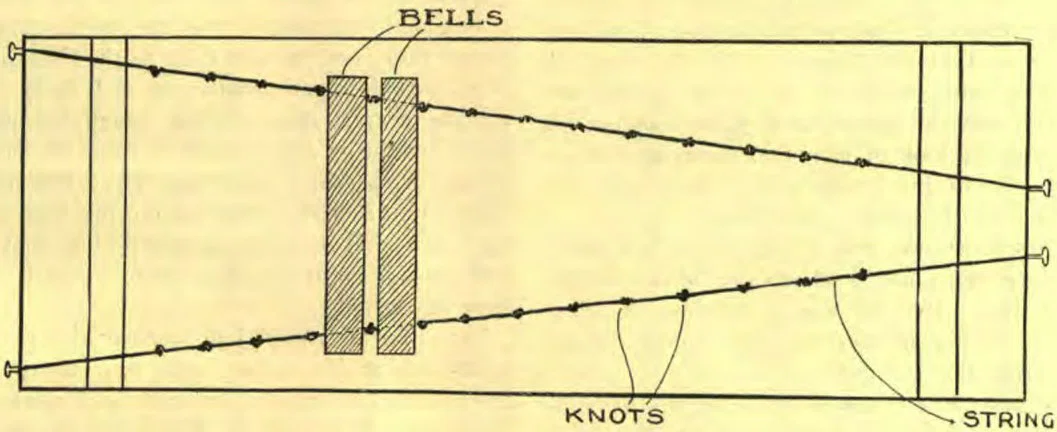
SOME OF THE BARS OR BELLS STRING WITH BIG KNOTS.
Hardware stores get sheet-tin and zinc in bundles. Around these bundles and holding them together, are bent strips of heavy strap-iron. These strips are an inch or more in width, an eighth of an inch or more in thickness, and of various lengths. The hardware men throw most of this strap-iron away. They pay men to haul it off to the dumping ground; so one can generally get all he wants for the taking. It is just the thing to use in making the bars or bells of the bridge. You will need several feet of it. A hacksaw or a sharp file to cut this iron into shorter lengths, and some strong string for the bridge cables, will also be needed. Make the base-board of a piece of inch board, two feet or more long and about eight inches wide.
Instead of strap-iron, any metal an eighth of an inch or a little more in thickness, and of the right width, may be used. Bars of wood much thicker will do, but the tone is not so clear and bell-like. Slabs of glass have a good tone, provided the glass is thick.
The Foundation of the Bridge
The foundation of the bridge has the single purpose of any other bridge foundation, that of supporting the cables. I have used in this foundation three pieces of wood and some nails. The sizes of the pieces of wood depend on the number of bells you are to have in the bridge, and on the width and length of the bells. If you have fifteen bells, each an inch wide, then your foundation should be at least twenty or twenty-four inches long, its width depending on the length of the bells.
THE BEATERS
On each end of the base-board I have nailed a piece of wood about the width of the base-board. This completes the foundation.
The Cables of the Bridge
The cables are strong, soft knotted strings. They must be stretched very tight. The knots are large ones, tied before the cables are stretched, and they are placed there to keep the bells from jarring together and “jangling” when the instrument is played. The bells are just laid upon the cables. Any attempt to fasten them down will destroy their pure, clear ring.
The Bells
The bells are the hardest part of all to make, but the task of making them is not so difficult as you may think. File the strap-iron a third of the way in two; then it can be easily broken. The tone of each piece depends on its length.
How to Tune the Bells
You will need the use of a piano for the tuning. Twenty or twenty-five keys on the extreme right of the piano keyboard will be needed. Cut off some short pieces of the strap-iron 4, 4½, and 5 inches long. Place them on the bridge. Strike one of them with the mallet, and at the same time with the other hand strike the piano keys lightly till one is found that exactly or nearly harmonizes with the metal bell. Now write or scratch on this bell the key letter. Now find which key is represented by another of the bells. Suppose you have found that an inch difference in the length of the bells makes four notes difference on the piano, then you see that it will be an easy matter to cut bars to correspond with the intervening keys. If the pitch of any bar is a bit too low, tune it by filing off a little of the iron till it is just right. If the sound of any bell is too sharp, you will be obliged to use it for the next higher bell on the scale by shortening it still more. With patience you will soon get all the necessary bars made. Fifteen is as few as are desirable in playing ordinary tunes. More are better.
The Mallets
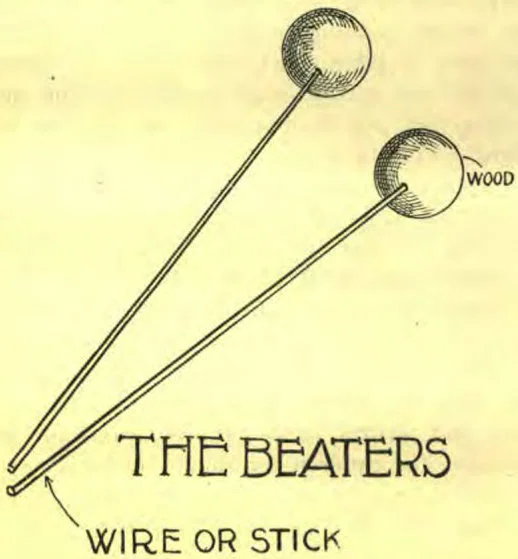
The simplest form of mallet you can make is to force a stiff piece of wire into a soft wood block, and then round the block with a knife. Or you can cut down a stick so as to leave a knob at the end, or you can force a small stick into a spool, and then round the spool with the knife. Two mallets are necessary.
The Music
Having tuned the bells to correspond to the piano keys, you will have no trouble with the music. The bell music is often given in unison with other instruments, and the effect, either alone or in combination, when the bells are skilfully tuned and played, is always pleasing.
EDISON DRIVER.
Honor all Men
By CORNELIA G. SNOW
TRUE love invests the object of regard with dignity. The love of a child for the mother is a good illustration of this. To the true son or daughter there is reverence combined with affection. The mother may be old-fashioned unconventional, ungrammatical in speech, possessed of a hundred little peculiarities of manner, which would provoke smiles of amusement from the worldly wise, and words of ridicule from the vulgar. But how the blood would mount in protest to the cheek of that mother's child if those words of criticism were repeated in his presence. It is the same with brothers and sisters, husbands and wives,—friends of all classes. It is the ideal of friendship to guard and regard the dignity of the one beloved, as he would wish his own honor to be guarded.
Dissection lowers the sense of honor and reverence. Tear the flower ruthlessly to pieces, and the mental picture of its loveliness is lost. It is the same in the dissection of the personality of others; our respect for the individual is largely destroyed in the process of analysis.
Among Christians the highest type of true friendship should exist, “Honor all men,” says the apostle. “Be pitiful, be courteous.”
To hear another needlessly criticize the manner, words, appearance, or habits of our best loved friend would wound our hearts, and cause words of rebuke to spring to the lips. Our brother in Christ is bound to receive the honor and love, equally with all earthly ties. Affection and interest cover the multitude of imperfections in father, mother, and special friends; so should the love of Christ constrain us to treat the most humble child of God, be he stranger or neighbor, educated or ignorant, cultured or uncultured, with the same consideration that we require for our own blood kindred.
This is the secret of winning the confidence of others. Live up to the highest ideal of true friendship, and the sincerity of your love will find a response in the hearts of your associates.
CORNELIA G. SNOW.
Mottoes
Don’t wait for your opportunity; make it.
There is something better than making a living,— making a life.
Happiness is the echo of the pleasant words we speak to others.
The art of pleasing is the art of rising in the world.
Scatter your flowers as you go, you will never go over the road again.
MEMORY VERSE: “The Lord is with you, while ye be with him; and if ye seek him, he will be found of you.” 2 Chron. 15:2.
Asa was the third king of Judah. He took away the altars of the strange gods, and broke their images, and cut down the groves where they were worshiped. For ten years the land rested from war; but at the end of that time, Zerah the Ethiopian came against Asa, “with an host of a thousand thousand, and three hundred chariots.”
“And Asa cried unto the Lord his God, and said, Lord, it is nothing with thee to help, whether with many, or with them that have no power: help us, O Lord our God; for we rest on thee, and in thy name we go against this multitude. O Lord, thou art our God; let not man prevail against thee. So the Lord smote the Ethiopians before Asa, and before Judah; and the Ethiopians fled.”
“And the Spirit of God came upon Azariah the son of Oded: and he went out to meet Asa, and said unto him, Hear ye me, Asa, and all Judah and Benjamin; The Lord is with you, while ye be with him; and if ye seek him, he will be found of you; but if ye forsake him, he will forsake you. . . . Be ye strong therefore, and let not your hands be weak: for your work shall be rewarded.”
Then Asa “took courage, and put away the abominable idols out of all the land.” Many subjects of the kingdom of Israel came and joined themselves to him, and he appointed a great feast to the Lord to be held at Jerusalem. The people offered seven hundred oxen and seven thousand sheep; and they entered into a covenant to seek the Lord with all their heart. “And he was found of them: and the Lord gave them rest round about.”
One thing Asa did that was displeasing to the Lord. Baasha king of Israel came up to make war against him, and instead of asking help from the Lord, Asa took some of the treasures out of the house of the Lord, and hired Ben-hadad king of Syria to help him fight the king of Israel. The Lord sent a prophet to Asa to reprove him for this lack of faith. “Were not the Ethiopians and the Lubims a huge host, with very many chariots and horsemen? yet, because thou didst rely on the Lord, he delivered them into thine hand. For the eyes of the Lord run to and fro throughout the whole earth, to shew himself strong in the behalf of them whose heart is perfect toward him.”
Asa reigned forty-one years in Jerusalem; and at his death his son Jehoshaphat took the kingdom. Jehoshaphat was another good king. He sent priests with the book of the law throughout all the cities to teach the people the way of the Lord. He also sent judges to settle any disputes that might arise. “And the fear of the Lord fell upon all the kingdoms of the lands that were around about Judah, so that they made no war against Jehoshaphat.” The Philistines brought him tribute silver, and the Arabians brought thousands of sheep and goats.
At one time a large army of the Moabites and the Ammonites came up against Jehoshaphat to battle; and the king knew that his soldiers could never drive them away. So he proclaimed a fast throughout all Judah, and the people kept it, and prayed earnestly that the Lord would help them. The Lord spoke to them, through a prophet, and said: “Be not afraid nor dismayed by reason of this great multitude; for the battle is not yours, but God’s.” Then all the people praised the Lord with a loud voice; and when the army went out to battle, there went with them singers, singing, “Praise the Lord, for his mercy endureth forever.” As they sang, the Lord smote their enemies, and gave Judah a great victory.
Jehoshaphat reigned twenty-five years in Jerusalem, “doing that which was right in the sight of the Lord.”
Questions
1. Who was the third king of Judah? What good works did he do? When Asa had reigned ten years, how large an army did the king of the Ethiopians bring against Jerusalem? Of whom did Asa ask help? What did he say to the Lord? What became of the Ethiopian army?
2. Whom did the Spirit of the Lord send to Asa soon after this? What promise was made to the king? See Memory Verse. What will the Lord do for those who seek him? What did the Lord say he would do for Asa if he would be strong to do the Lord’s work?
3. What did Asa do at once? Who came and joined him? What was held at Jerusalem? What did the people make a covenant to do? 2 Chron. 15:8.
4. What one thing did Asa do that was displeasing to the Lord? Who came to talk with the king about this? Of what did he remind him? What did the prophet say that the Lord will do for those whose heart is perfect toward him?
5. How long did Asa reign? Who was the next king of Judah? Whom did he send throughout the cities of Judah to instruct the people? Whom did he send to judge the people?
6. How did the kings who lived around Judea feel? Why? Deut. 11:25. What did some of them bring to the king of Judah? What did this show?
7. At one time who came up to make war with Jehoshaphat? Tell how the king and the people sought for help. What message did the Lord send to them?
8. When the people heard these words, what did they do? As they went out to battle, what was sung? What did the Lord do for them that day?
9. How long was Jehoshaphat king in Jerusalem? What is said about his life?
MEMORY VERSE: “There shall no evil befall thee, neither shall any plague come nigh thy dwelling.” Ps. 91:10.
Questions
1. What is contained in the seven last plagues? Rev. 15:1.
2. Upon what class is the wrath of God to be poured out? Rev. 14:9, 10.
3. How long do the plagues continue? Rev. 18:8; note 1.
4. What shows that probation has closed when these plagues begin to fall? Note 2.
5. What does Christ say, before leaving the temple, which shows that all cases have been decided? Rev. 22:11.
6. Where were the angels told to pour out the plagues? Rev. 16:1.
7. Who were especially affected by the first plague? Describe the plague. Verse 2.
8. Describe the second plague. When did it fall? Verse 3.
9. Where was the third plague poured out? Verse 4.
10. Just at this time what testimony is heard concerning these plagues? Verses 5-7.
11. Describe the fourth and fifth plagues. What spirit do the wicked show during this time? Verses 8-11.
12. Where is the sixth plague poured out? Verse 12. What nation does this river symbolize? Note 3.
13. How are the nations assembled at this time? For what purpose are they brought together? Verses 13, 14.
14. What word is spoken from the throne? Verse 15.
15. What solemn message is announced with the pouring out of the last plague? Verse 17. What accompanies this plague? Verses 18-21.
16. What protection is promised God’s people during the pouring out of the plagues? Ps. 91:5-10.
Notes
1. We have found in our study of prophetic time that each day symbolizes a year. With this in mind, we gather from Rev. 18:8 that one year will be consumed in the pouring out of the plagues after the close of probation.
2. The plagues are made up of God’s unmingled wrath. As long as probation lasts, mercy may be found at the throne of grace. Too, the ministration of Christ has finished at that time, for no one can enter the temple while the plagues are falling. Rev. 15:8. The world will be without an intercessor.
3. The Turkish empire is clearly symbolized by the River Euphrates in Rev. 9:14. There is no reason to believe that the Spirit uses the symbol here with a different meaning. Under this plague apparently the Ottoman power, which for so many years has been crumbling away, will be literally “dried up;” will come to its end with none to help. This fact is stated, though the steps in detail by which this will be brought to pass may not all be clearly given. The Turk, having been driven from the soil of Europe, has established the capital of his kingdom at Jerusalem, and here in the valley of Jehoshaphat the terrible battle of Armageddon will take place. The preliminary steps to bring this to pass are now being seen among the nations. Truly this will be a time of trouble such as never was, a time of “confused noise, and garments rolled in blood.” In the midst of the turmoil the long-suffering God intervenes. The seventh vial is unstopped. He opens the armory of heaven, and brings forth the “weapons of his indignation,” and pours out the reserved treasures of the hail. All the proud and stately nations of earth will be quickly overthrown.
4. “It was impossible for the plagues to be poured out while Jesus officiated in the sanctuary; but as his work there is finished, and his intercession closes, there is nothing to stay the wrath of God, and it breaks with fury upon the shelterless head of the guilty sinner, who has slighted salvation, and hated reproof. In that fearful time, after the close of Jesus’ mediation, the saints were living in the sight of a holy God without an intercessor. . . . The last tear for sinners had been shed, the last agonizing prayer offered, the last burden borne, the last warning given. The sweet voice of mercy was no more to invite them.”—“Early Writings,” page 141.
“When Christ ceases his intercession in the sanctuary, the unmingled wrath threatened against those who worship the beast and his image and receive his mark, will be poured out. . . . These plagues are not universal, or the inhabitants of the earth would be wholly cut off. Yet they will be the most awful scourges that have ever been known to mortals.”—“Great Controversy.”
Revival in New Zealand: Fifty-Four Sign the Covenant
A minister had been preaching to large intelligent audiences in New Zealand. For months he had faithfully presented the message, but the people did not seem especially moved to heed the word of God. They were bound by cords that he seemed powerless to break by as faithful a presentation of the truth as he knew how to make. In this crisis the minister sought the Lord earnestly to cut asunder the bands that held the people, to set the captives free.
He prayed that if the Lord could not use him to do this, he might die; for he wanted to live only to be used to bring deliverance to his fellow men. When a man comes to the place that he is ready to give his life for the sake of the people, the Lord can then bless his efforts to the good of many. That night at the service the Spirit of God was rained down upon the people. Fifty-four came forward and signed the covenant to keep the commandments of God.
A young man who had come to the city for a short visit only was present. The Holy Spirit touched his heart, and he stepped out upon the truth of God. He never returned for his tools, but gave up his work, and entered the canvassing field. He kept growing in usefulness and ability until he was given charge of the West Australian field.
Another man was there who had long held an important official position in India. Because of his habits of dissipation he had been sent home to die, the physicians giving him no hope of recovery. He wanted to relinquish his intemperance, but seemed wholly unable to free himself from its power over his life. He heard the minister tell of the willingness and power of God to set every captive completely free. He went home and prayed—prayed for the first time in his life. He told the Lord what the minister had said, and then besought him if it were true to free him from his tobacco habit that was killing him. The Lord graciously heard, and sent complete and immediate deliverance.
He and his wife took fast hold of the truth, and for twelve years have been going from house to house selling our literature, though he had a competency so that he needed not to work.
“How beautiful are the feet of them that preach the gospel of peace, and bring glad tidings of good things!” Rom. 10:15.
House of Rock Salt
By Harold W. Fairbanks
If you could get upon the back of a great bird and float far away over the southwestern part of our country, you would see many strange and wonderful things. One of the most interesting of these is a vast desert which it would take days to cross if you had to walk. Sandy valleys and low mountain ridges of bare rock extend as far as you can see in every direction.
In this desert a whole year sometimes passes without any rain-drops falling. The sun shines from a sky which is almost always clear, and in summer it beats down so fiercely that it seems as if it would burn up the earth.
Few people live in this desert country, for there are no streams of water, and the springs are so many miles apart that one has always to carry water when a journey is undertaken. Everything needed to eat has to be brought hundreds of miles. Peculiar plants which need very little water grow in the sand, but there are no trees. Animals and birds live there, but most of them seek the shade, and are out of sight during the long, hot days. Some of the animals are very strange creatures, fitted to go for weeks, and even months, without any water other than that within their own bodies.
In the center of one of the most lonesome and dreary portions of this desert there is a cabin standing all alone. From a little distance it seems to be made of blocks of rough stone, but if you will look at these blocks closely, you will find that they are clear and glassy. These are curious rocks with which to build a cabin. What can they be? They are not ice, for there is no water here, and, besides, ice would quickly melt under the hot sun.
Break off a piece and touch it to the tongue, for a taste may tell what you wish to know. You find that there is a taste, and that it is of salt. The cabin is made of pieces of salt — rock salt, we call it, because it is quarried in solid pieces like rock. The walls, the fireplace, and the chimney are of salt. The framework of the roof alone is of wood, and this is hidden upon the outside by a layer of earth. This strange cabin is probably the only one of its kind in the world.
We all know how quickly salt dissolves when it is wet. The cabin has been built many years, but there is so little rain in the region in which it stands that the cabin is in as good condition as when first built. All that the rain has done to the cabin is to dissolve enough of the salt to cement and make one solid mass of the pieces in the walls. This has taken place in much the same way as the freezing together of blocks of ice after being exposed to the warm sun of a winter day.
Years ago some prospectors discovered a bed of salt here, and built the cabin to live in while quarrying the salt. They found at last that it cost too much to ship the salt out of the desert, and so abandoned their work.
If you could scrape off the sand from the broad valley in which the cabin stands, you would find the bed of salt extending perhaps for miles, and looking for all the world like a frozen lake such as you enjoy skating upon. What a quantity of salt there is! It would supply the whole world for thousands of years.
The valley in which the salt lies is a real basin, for the land is higher all about. If the basin were filled with water, the water could not run away.
In other parts of the world there are beds of rock salt buried hundreds of feet below the surface. They have to be reached by deep shafts, which look much like wells.—Harold W. Fairbanks, in St. Nicholas.
The Eyes of the Lord Run to and Fro
THAT beloved promise of the Word, “For the eyes of the Lord run to and fro throughout the whole earth, to show himself strong in the behalf of them whose heart is perfect toward him,” came to me with new meaning as I observed for the first time its beautiful setting.
Asa, the king of Judah, had been wonderfully blessed of the Lord; he had been given remarkable victories over his enemies. At one time, however, when his brother king of Israel thought to make war against him, Asa looked about for human aid. He sent word to Ben-hadad king of Syria to break his league with the king of Israel, and come to his aid. Ben-hadad granted the request, and sent the captains of his armies against the cities of Israel; so that Baasha relinquished his plan of troubling Judah.
God was grieved with Asa because he sought help from a heathen king; so he sent his prophet to him with the message: “Were not the Ethiopians and the Lubims a huge host, with very many chariots and horsemen? yet, because thou didst rely on the Lord, he delivered them into thine hand. For the eyes of the Lord run to and fro throughout the whole earth to show himself strong in the behalf of them whose heart is perfect toward him.” 2 Chron. 16:8, 9. Marvelous were the victories that the Lord gave his servant over these immense armies, and yet he assures us that he is ever looking about for the opportunity thus to serve his trusting people. Let us trust him more.
True Riches Lie in Serving Mankind
He is the richest who enriches mankind the most.
The Good of Encouraging Words
“Do you know it helps others to be good to hear words of encouragement, and it does good to say them?”
God Is Now Here
“THE infidel’s child would not write: ‘God is nowhere,’ as he had tried to teach her; but ‘God is now here’ was the way in which she wrote it.”
Bookkeeping, Penmanship, and Shorthand by Mail
Bookkeeping, Penmanship, or Shorthand successfully taught by mail. A number of persons have been qualified for greater usefulness by taking work with us. You can do the same. Write for particulars. Fireside Accounting Institute, Battle Creek, Mich.