The fact that the government has forbidden the transmission of certain anti-expansion documents to Manila, on the ground that they are treasonable in character, has given rise to the expectation that Mr. Edward Atkinson, the author, would be prosecuted for treason. Inasmuch, however, as the documents are largely compilations from speeches delivered in Congress, it would seem hardly fair to thus discriminate against Mr. Atkinson. Yet it is a question upon what ground a charge of treason could be based, in face of Article III, Section 3, of the Constitution, which says: “Treason against the United States shall consist only in levying war against them, or in adhering to their enemies, giving them aid and comfort.” Still it must not be forgotten that we have reached a time when the Constitution is nothing unless construed, and thus it is merely a lump of clay in the hands of the Supreme Court. From this point of view it might be made to appear that Mr. Atkinson had levied a war of words against the government, using congressional speeches as ammunition. It might also be construed that the people of Manila would be aided and comforted, and life in the jungles under the hail of rapid-fire guns made more endurable, by the knowledge that a number of speeches had been made in their behalf last winter—“ten thousand miles away.” Since the promulgation of the “Christian-nation” dictum by the Supreme Court, and the congressional declaration that the first day of the week is the seventh day set apart in the Decalogue as the Sabbath, it is impossible to tell how far constitutional construction may be made to extend beyond the design of its framers or the logical meaning of its language.
W. N. G.
England’s Attitude Toward Peace Prospects
How England feels over peace prospects is well measured by her attitude toward France as indicated by the following from the London Spectator: "So long as the Channel Fleet is always ready, Englishmen are delighted to welcome even an appearance of cordiality in France." That is about the way that all feel.
SILENT INFLUENCES.
By B. F. DeBow
IT has been said that—
"There are sermons in stones,
Books in running brooks,
And food in every thing."
Of the truth of this I wish to bear testimony, in the relation of an experience, an experience which no time can ever efface from my memory.
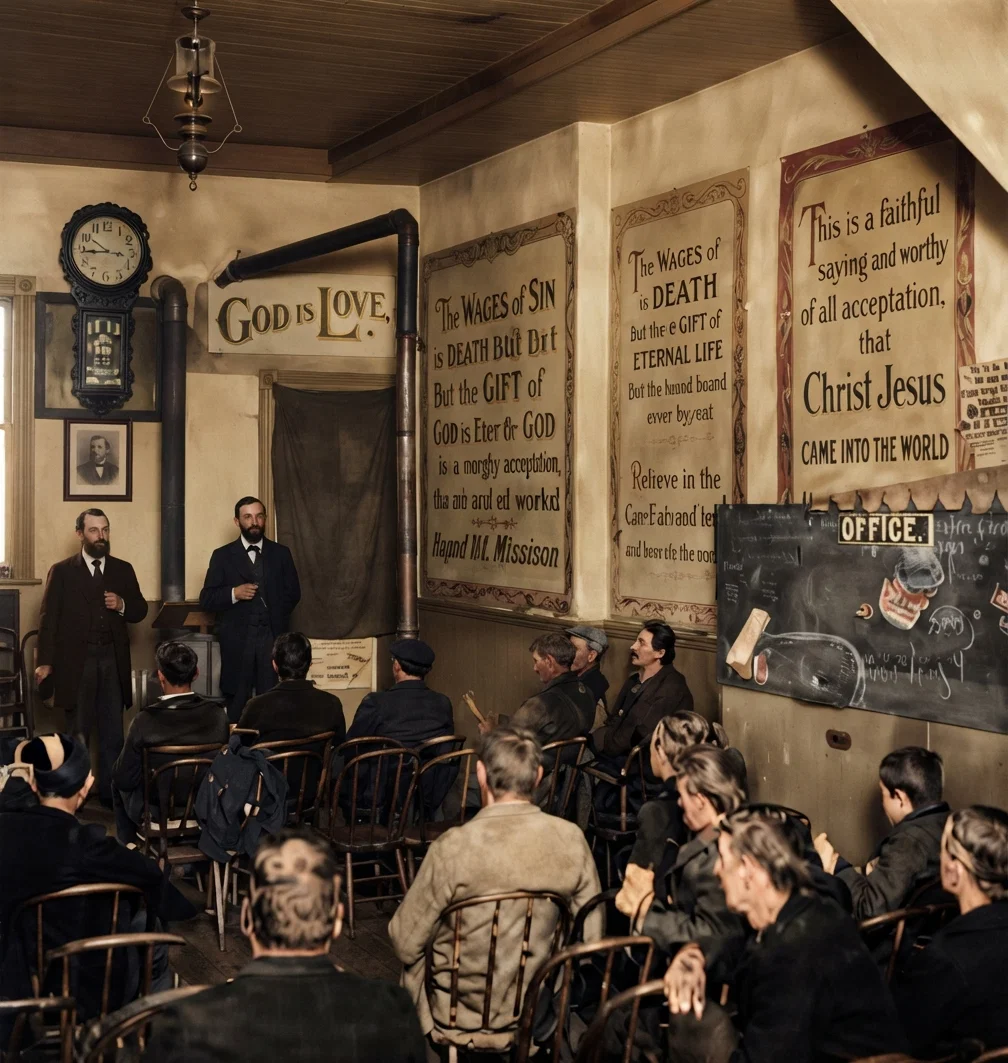
For a period of some four months I have been a constant attendant upon the daily and nightly Gospel meetings held in the chapel of the Helping Hand and Medical Mission of San Francisco. At all times, except those allotted to service and sleep, this little chapel is a quiet retreat, where the thoughtful may sit and meditate and read the Bible or other literature that has a tendency to cause him to seek that higher life, which brings a man in closer relation to his Maker. As an assistant to these thoughts, an air of spirituality is given by the innumerable texts and Scriptural quotations which adorn the wall, inscribed in illuminated letters in every available space.
As often as I came from the beautiful little chapel, where so much was being daily done to direct the mind to those all-important themes, just as often I remained untouched:
"Still with that settled, ceaseless gloom
The fabled Hebrew wanderer bore,
That would not look beyond the tomb,
And can not hope for rest before."
The time came when I was to leave the mission, the place where I had spent so many pleasant hours—hours that were soon to be recalled with most wonderful vividness and regret—regret that I had not profited more from the earnest efforts of the sincere, faithful, Christian workers who conduct the mission. Before the time when I commenced to attend these meetings, my nights and days had been largely passed in wine-rooms, and in the companionship of such characters as usually frequent those places.
This appetite and desire for drink seemed to leave me, and I prided myself that I had put the tempter aside forever.
Scarcely had I gotten away from the influences which surrounded and unconsciously assisted me in the keeping of my good resolutions, when I again became a victim to that chief missionary of hell on earth, the wine cup. That afternoon I lay in the dull stupor of the inebriate. How long I had lain amid my degrading surroundings I can not say, but when I was aroused it was night; inky darkness filled the space around; no sound was heard, when suddenly the stillness was broken by the tolling of a bell in some near-by steeple. With the fumes of alcohol beclouding my brain I was scarcely able to count the strokes, one—two—three—four—five—six—seven. O, it was just seven o'clock! in half an hour more services would commence at the mission. This thought found its way slowly through my darkened brain. For about thirty minutes, with eyes still closed, I saw, or seemed to see, the chapel of the mission as plainly as I ever saw it in my life; the door of the chaplain's office opened, and the workers, to whom I had so often listened with more pleasure than I had before known, filed out. I heard the hymn given out, I saw the organist take his seat and commence the prelude to one of my favorites, "Anywhere with Jesus will be home sweet home!" How I longed to join in that sweet song, but I was dumb.
Mr. Richards talked that night, as I have never heard words fall from mortal lips. Never will I forget them as I seemed to hear them that night. As he looked at me with tears in his eyes, his voice trembled as he said, "O blessed God, do not let this young man go into eternity lost!" Vainly I tried to say, "Amen," but, like the murderer Macbeth, "amen" stuck in my throat. I tried to pray, I could not. I could think of only one thing to say, and that was a prayer I heard Mr. Dolson say he had used on a desperate occasion in early life, "O Lord, have mercy on me a sinner!"
The meeting was over; I turned my eyes to those sermons on the walls; I had never tried to learn them when at the mission, but to my surprise I could repeat them word for word. From the very first verse I seemed to get consolation, "If we confess our sins, He is faithful and just to forgive us our sins, and to cleanse us from all unrighteousness." One after another I ran them through during those long hours of that sleepless night, and then I thought silence had a tongue.
Let me add that it was not long after this experience I had in the jail behind the iron bars, I found myself on bended knees in the mission. Verily the works of God are inscrutable. B. F. DEBOW.
OUR SHIP PITCAIRN.
By E. H. GATES
[Written for the SIGNS OF THE TIMES.]
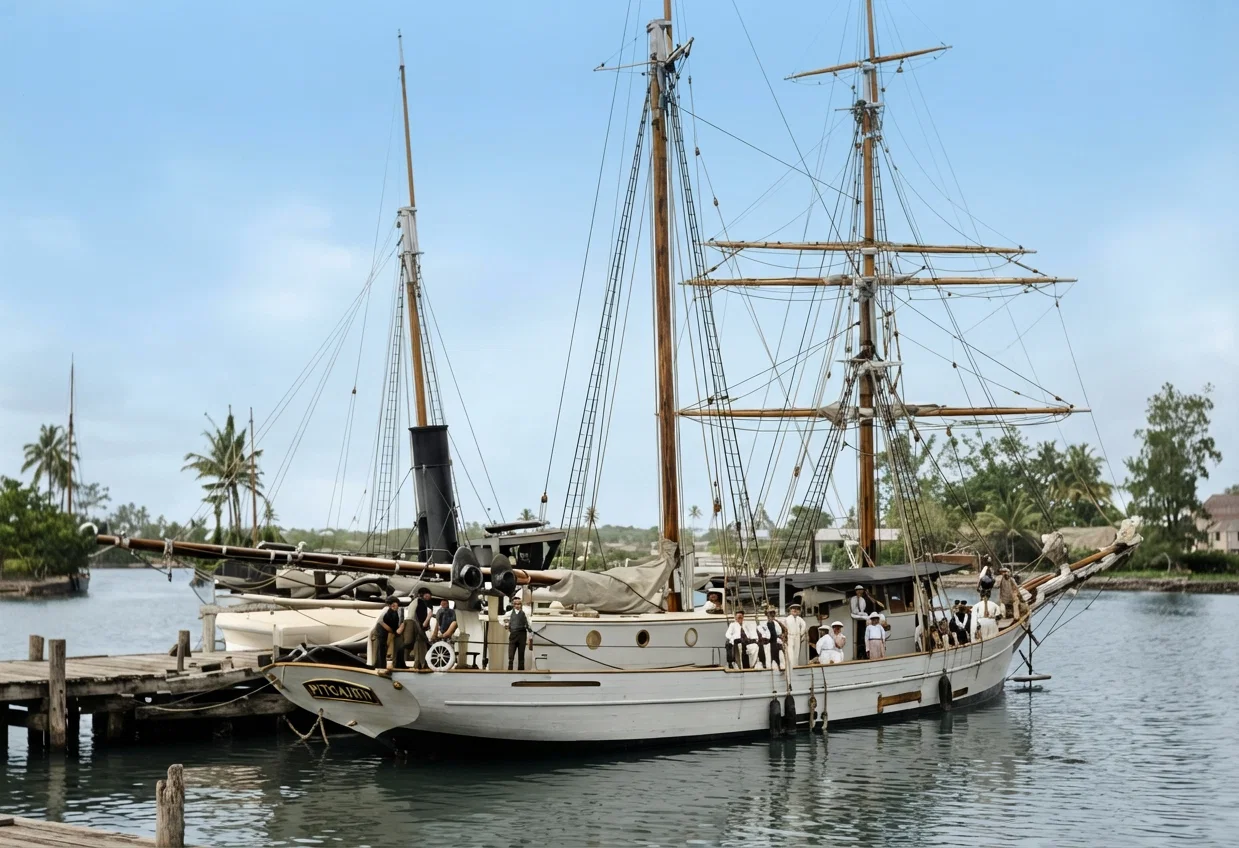
AFTER leaving San Francisco, Jan. 23, we had a very pleasant trip to our first stopping place, Pitcairn Island, which we reached in thirty-two days. There we were warmly received by the people, who had been waiting for the ship for a long time. The island has been having plenty of rain, and the people have plenty of food now. We remained at the island three weeks—much longer than we had at first expected. But the time was all well spent. Nearly every morning at five o'clock I had meetings with the people, as that is the best time of day for comfort. The island is one of the beautiful spots of Polynesia, and as we were surrounded by lovely tropical trees and plants, the ocean in plain sight, and fanned by soft breezes, it seemed that God was specially near to us. The Spirit of God was very near to His children as we sought Him in those early meetings, and many hearts responded to His gentle wooings. Several of the youth found Christ for the first time, and some who had sinned sought Him for pardon and acceptance. At the close of one Sabbath we went down to one of the pools at the foot of the high cliffs, and there buried eight souls in the likeness of Christ's burial. A few days before leaving we repaired again to the same spot at sunrise and baptized five more of the young people.
The Pitcairn Lying at the Wharf.
Brother J. R. McCoy accompanied the ship to Mangareva, one of the Gambier Islands, and remained two weeks during the time I was doing the above-mentioned work. He reports finding a good interest among the natives. He sold several Bibles to them, and said that he could have sold two hundred if he had had them; but, unfortunately, there were but a few on board. Tho the natives are all professed Christians, the priests have kept the Bible from them entirely, resulting in a very low state of morals.
March 16 the ship returned, and the next day we went on board and started for this island—Tahiti. A large number of the brethren and sisters accompanied us to the ship, carrying some very substantial tokens of their love in the shape of oranges, coco-nuts, sweet potatoes, pumpkins, bananas, and some very fine watermelons.
Nine days later we reached this place, after a very pleasant passage. Here we found mail from home, with lots of papers—Reviews, SIGNS OF THE TIMES, General Conference Bulletins, etc., etc.
Tho we have been obliged to suffer some from seasickness, we have been more free from it than on any previous trip. For this we thank God, and take fresh courage. God's presence10has been with us in a marked manner, and our whole desire is to glorify His name with all our powers. Later reports will tell of our visit to this place.
E. H. GATES.
Papeete, Tahiti, April 5, 1899.
IS IT I?
"LABORERS wanted." The ripening grain
Waits to welcome the reaper's cry.
The Lord of the harvest calls again;
Who among us shall first reply:
"Who is wanted, Lord? Is it I?"
The Master calls, but the servants wait;
Fields gleam white 'neath a cloudless sky;
Will none seize the sickles before too late,
Ere the winter's winds come sweeping by?
Who is delaying? Is it I?
—Selected.
THE SITUATION IN SAMOA.
By Editor
UNDER date of April 20, Dr. F. E. Braucht writes as follows from Apia:—
“You will no doubt see accounts of the seriousness of affairs here in Samoa, and thinking you might be interested to know how it is with us, I am glad to say that we are all well and perfectly safe. No harm has come to any of our company, or to the Lord's property of which we are in charge. However, several white people have had to flee for their lives and narrowly escaped. All the stores and houses away from Apia have been plundered and wrecked, and even many of those near the city have suffered the same fate. Our neighbors all around have been cleared out, but we have been spared. The revolutionists have been driven out of their district now; their last stand was at Robert L. Stevenson's old home, and last Monday this place was the scene of a very hard fight. The battle began at 9 o'clock A.M., and continued until 4 P.M. The loyal natives did the fighting against the revolutionists, and succeeded in driving them back out of two stone forts; but the last one was too much for them, and they had to retire and let the men-of-war finish the contest with shells. There were only four killed and seventeen wounded on the side of the loyalists, and no one knows how many were killed and wounded of the revolutionists. It is reported that the first shell burst in the midst of a crowd who were holding a council, killing six chiefs and twenty-two others. The revolutionists left the place in great haste, leaving their food ready cooked in the ovens.
“On the first of April, in a battle on one of the German plantations, seven white men were killed. They were part of a reconnoitering party of about 150 white troops and 75 natives. They fell into an ambush of 500 revolutionists, and were attacked while in the open and the enemy in a thick bush. They had a pretty warm time for a little while, and at a critical moment the rapid-fire gun (Colt's automatic) would not work. Had they not hastily retreated, they would have been surrounded and the whole party killed. Thus far twelve of the white troops have been killed—six American and six British. The officers were beheaded, and each of the mariners had an ear cut off. One of the American marines was killed by a sharpshooter, who must have been a white man, as the Samoans do not fight that way. There is a law here against the importation and sale of arms and ammunition to the natives, but they have had no trouble in getting all they want. The natives will not tell from whom they get such supplies, but it is expected that it will all come to light eventually.”
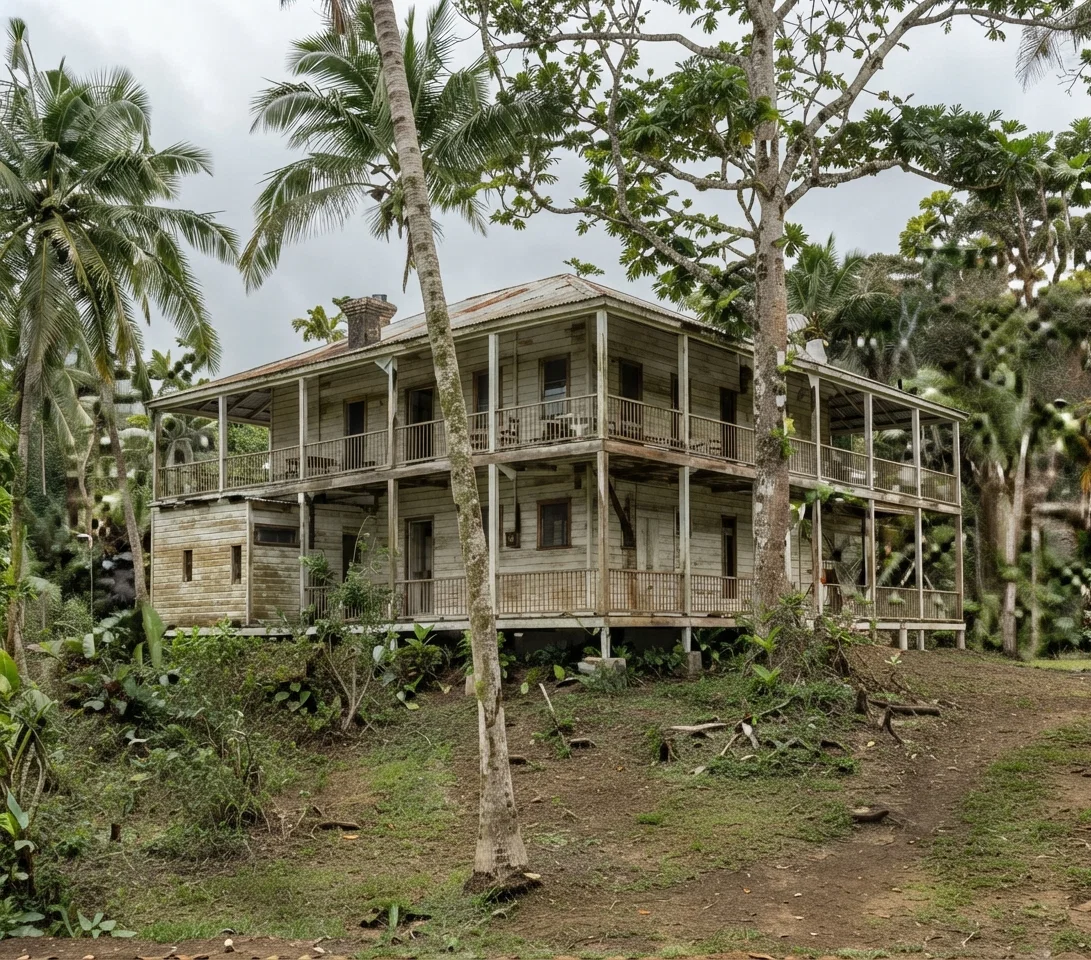
Sanitarium in Samoa.
OUR WORK AND WORKERS.
A CAMP-MEETING will be held at Marshfield, Wis., June 7–19.
A CAMP-MEETING will be held at Ravenna, Neb., June 6–12.
A CAMP-MEETING at Anoka, Minn., is announced for June 6–11.
AT Indianapolis, Ind., April 30, seven persons were baptized by Brother O. S. Hadley.
ABOUT fifty members have been added to the church at Kingston, Jamaica, the past year.
THE addition of nine members to the church at Redwood Falls, Minn., is reported by Brother D. Nettleton.
AFTER some “excellent meetings” held at Milton Junction, Wis., Brother Wm. Covert reports the baptism of twenty-five persons.
IT is encouraging to note that Brother Wm. J. Keele is still selling the Quarter-Centennial issue of the SIGNS with good success in Colorado towns.
A NEW house of worship was dedicated at Cañon City, Colo., on the 14th inst. Brother J. M. Rees, president of the conference, preached the dedicatory sermon.
THE main office of the International Religious Liberty Association has been removed from New York City to Chicago, Room 750 Monon Building, 324 Dearborn Street.
BROTHER J. O. CORLISS and family arrived in Oakland, Cal., on the 19th inst. On the 22nd they left for Stockton, where they will remain until after the State camp-meeting.
A SUMMER training class for the benefit of those who contemplate teaching church schools will be held at Healdsburg (Cal.) College, beginning June 20 and continuing ten weeks.
WORD has been received that an interesting tent effort is being held in Port Elizabeth, Cape Town, South Africa. “A cloud of Kaffirs, Malays, etc., abide by their tent day and night.”
A CHURCH of twenty members was recently organized at Sartoria, and another of twenty-five members at Burwell, Neb. Brethren E. L. Stewart and J. W. Boynton officiated in both instances.
FIFTEEN candidates were baptized at Stockton, Cal., on the 15th inst., by Brother S. Thurston, and after the service two others decided to follow the Lord's example at the next opportunity.
WHILE at the General Conference, Elder F. W. Westphal told of one experience in Buenos Ayres, where he baptized one man and his family in a well. Since coming to the States his wife writes that this brother has already paid $200 tithes.
AN industrial school is soon to be established at Salmar, on the Yazoo River, near Jackson, Miss., for the preparation of workers for the southern field. The site has been approved by Professors Sutherland and Magan, of Battle Creek College.
IN two hours and twenty minutes' labor, Brother J. F. Bahler recently sold ninety copies of the Quarter-Centennial issue of the SIGNS at Galveston, Texas. He aptly remarks that “the truth in a magazine never grows old, if it is dated Jan. 5, 1899.”
BROTHER D. U. HALE recently made a trip to Nickerie, Dutch Guiana, where he found ten persons keeping the Sabbath “according to the commandment.” This is the result of the labor of Brother Henry Beck, who went to that field some time ago as a self-supporting missionary.
THE workers in Honolulu are receiving occasional requests that some provision be made for the education of Chinese girls. Who could contemplate a more noble work, uplifting those who have been so long degraded? Openings are multiplying, workers are volunteering, but where is the means?
ON the 22nd inst., Brother S. N. Curtiss, who has been superintendent of the manufacturing work at the Pacific Press main office, left Oakland for New York City, to take charge of the branch office in that city. Brother T. A. Kilgore, who has been in charge there since the branch was instituted, eleven years ago, will return to the home office.
A LATE issue of the Oklahoma Gleaner has a report from Brother C. Sorenson, who is visiting churches and companies in the Chickasaw and Choctaw nations. He says: “The first place visited was Keller. The brethren there are all pressing together in Christian love, and the Lord is blessing them in imparting the light to others. We enjoyed rich blessings in the study of the Word of God, and in studying how to work for Him both with our periodicals and in the Sabbath-school. Several there will work with the SIGNS.”
A LETTER from Dr. J. E. Caldwell, of Rarotonga, Cook Islands, dated March 29, gives an encouraging report of labor. It is pleasing to know that his two sons, aged 17 and 14, are proving valuable help both in example and in teaching. They can both translate from English into the native tongue, and from the native to the English. The elder of the two is the organist, and makes very good native hymns from our English hymns. Leonard Christian and Mary Ann McCoy, of Pitcairn Island, are now with the company. The doctor's family are now caring for five native children.
THE officers of the new Chesapeake Conference are: President, K. C. Russell; secretary and treasurer, C. D. Zirkle; executive committee, K. C. Russell, H. W. Herrell, A. Kalstrom, John F. Jones, R. M. Rosin. The address of the conference office is 826 N. Mount Street, Baltimore, Md. The secretary and treasurer of the Sabbath-school Association is Miss Emily Kirkwood, 1309 Ninth Street, N. W., Washington, D.C. There is no tract society organization, as in the other conferences, individuals and churches being left to deal directly with the publishing houses. The conference includes Delaware, Md. (excepting the three western counties), and District of Columbia.
1 "And they came to the other side of the sea, into the country of the Gerasenes. And when He was come out of the boat, straightway there met Him out of the tombs a man with 3 an unclean spirit, who had his dwelling in the tombs; and no 4 man could any more bind him, no, not with a chain; because that he had been often bound with fetters and chains, and the chains had been rent asunder by him, and the fetters broken 5 in pieces; and no man had strength to tame him. And always, night and day, in the tombs and in the mountains, he was cry-6 ing out, and cutting himself with stones. And when he saw 7 Jesus from afar, he ran and worshiped Him; and crying out with a loud voice, he saith, What have I to do with Thee, Jesus, Thou Son of the Most High God? I adjure Thee by 8 God, torment me not. For He said unto him, Come out of119 thou unclean spirit, out of the man. And He asked him, What 10 is thy name? And he saith unto Him, My name is Legion; 11 for we are many. And he besought Him much that He would 12 not send them away out of the country. Now there was there 13 on the mountain side a great herd of swine feeding. And they 14 besought Him, saying, Send us into the swine, that we may 15 enter into them. And He gave them leave. And the unclean spirits came out, and entered into the swine; and the herd 16 rushed down the steep into the sea, in number about two 17 thousand; and they were choked in the sea. And they that 18 fed them fled, and told it in the city, and in the country. And 19 they came to see what it was that had come to pass. And 20 they came to Jesus, and behold him that was possessed with 21 devils sitting, clothed and in his right mind, even him that had 22 the legion, and they were afraid. And they that saw it declared 23 unto them how it befell him that was possessed with devils, 24 and concerning the swine. And they began to beseech Him 25 to depart from their borders. And as He was entering into 26 the boat, he that had been possessed with devils besought Him 27 that he might be with Him. And He suffered him not, but 28 saith unto him, Go to thy house unto thy friends, and tell them 29 how great things the Lord hath done for thee, and how He had 30 mercy on thee. And he went his way, and began to pub-31 lish in Decapolis how great things Jesus had done for him; 32 and all men did marvel."
37 "And He suffered no man to follow with Him, save Peter, and James, and John the brother of James."
40 "And they laughed Him to scorn. But He, having put them 41 all forth, taketh the father of the child and her mother and 42 them that were with Him, and goeth in where the child was. 43 And taking the child by the hand, He saith unto her, Talitha 44 cumi; which is, being interpreted, Damsel, I say unto thee, 45 Arise. And straightway the damsel rose up, and walked; 46 for she was twelve years old. And they were amazed straight-47 way with a great amazement. And He charged them much 48 that no man should know this; and He commanded that 49 something should be given her to eat."
40 "And as Jesus returned, the multitude welcomed Him; for 41 they were all waiting for Him. And behold, there came a man 42 named Jairus, and he was a ruler of the synagogue; and he fell 43 down at Jesus' feet, and besought Him to come into his house; 44 for he had an only daughter, about twelve years of age, and 45 she lay a dying. But as He went the multitudes thronged 46 Him.
47 "And a woman having an issue of blood twelve years, which 48 had spent all her living upon physicians, and could not be 49 healed of any, came behind Him, and touched the border 50 of His garment; and immediately the issue of her blood 51 staunched. And Jesus said, Who is it that touched Me? And 52 when all denied, Peter said, and they that were with him, 53 Master, the multitudes press Thee and crush Thee. But Jesus 54 said, Some one did touch Me; for I perceived that power had 55 gone forth from Me. And when the woman saw that she was 56 not hid, she came trembling, and falling down before Him 57 declared in the presence of all the people for what cause she 58 touched Him, and how she was healed immediately. And 59 He said unto her, Daughter, thy faith hath made thee whole; 60 go in peace.
61 "While He yet spake, there cometh one from the ruler of the 62 synagogue's house, saying, Thy daughter is dead; trouble not 63 the Master. But Jesus hearing it, answered him, Fear not; 64 only believe, and she shall be made whole."
SUGGESTIVE QUESTIONS.
NOTE.—The texts inclosed in marks of parentheses, while not essential to the lesson study, will be found to throw much light upon the lesson, and are suggested for those who wish to study further.
Christ having stilled the tempest, where did He and His disciples soon land? Mark 5:1. Note 1. (Luke 8: 26.)
Upon landing from the boat, who met the Saviour? Verses 2-5. Note 2. (Matt. 8: 28.)
How did he approach Jesus? Verses 6, 7. (Matt. 8: 29.)
Why did the demoniac thus address Christ? Verse 8. (Luke 8: 28.)
When asked his name, what reply did the suffering man make? Verse 9.
What request was then asked in behalf of the demons? Verse 10. (Luke 8: 31.)
Where did the demons desire to go? Verses 11, 12.
What was the result of their being permitted to enter the swine? Verses 13, 14.
In consequence of the extended report by the swine-herders, how many came to meet Jesus? Matt. 8: 34. (Luke 8: 37.)
When the people saw what was done, how were they affected? Mark 5: 15-17.
As Jesus was complying with the people's request, what earnest plea was made by the restored man? With what result? Verses 18-20. Note 3.
Upon returning to the other side of the lake, how did the people there receive Jesus? Luke 8: 40. (Mark 5: 21.)
Having put out the noisy throng, what did the Lord then do? Mark 5: 40, 41, 37.
What followed the Lord's words? How were the child's parents touched? Verse 42. (Luke 8: 56.)
What charge was then given them? Verse 43.
Side Lights.—"Desire of Ages," pp. 337-342; "Spirit of Prophecy," vol. 2, pp. 311-324.
NOTES.
Gadara was the fortified capital of Perea, the "country of the Gadarenes" or Gergesenes. It was about eight miles southeast from Tiberias. The present ruins of the city are about two miles in circumference. The tombs were in the sides of the cliffs, round about the city, some of which are still preserved, and used by Arabs for dwellings.
The demoniacs.—Mark and Luke speak of but one demoniac coming to Christ, while Matthew introduces two. The lesson here given follows the two former accounts, simply because they are more complete in detail. While two demoniacs were present, probably one of them made the prominent demonstrations, which would explain why only one is mentioned by the two evangelists.
JESUS readily complied with the selfish request of the Gergesenes to leave their coasts, even tho He was deprived of the needed rest He had sought in crossing the lake; for He knew that, altho He was to be absent in person, the restored demoniac would proclaim the truth instead. The record states that he "began to publish in Decapolis" (meaning ten cities) the things Jesus had done for him. Pliny says that this district reached from Damascus on the north to Philadelphia on the south, and from Scythopolis on the west to Canatha on the east. Six other cities than those here mentioned were included: Hippos, Gadara, Pella, Gerasa, Dion, and Raphana. All of these cities except Scythopolis were on the east side of the Jordan.
THESE "minstrels" were hired mourners, who kept up continual discord on wind instruments, accompanied with wild howls of lamentation. The number of these mourners was in proportion to the wealth of the afflicted family.
HOW SOME PEOPLE LIVE.
By William N. Brewster
HINGHUA is in the province of Fuhkien, of which the well-known tea port of Foochow is the capital. Its latitude is about that of Key West, Fla. It is washed by the waters of the Formosa Channel on the east, and is almost directly opposite the northern extremity of the great island of Formosa. It is almost seventy miles south of Foochow, and about equally distant from the port of Amoy, on the south.
It is not strange that your school atlas does not show it, for it is only about fifty miles across from north to south; and from the eastern side of the island, at the extremity of the long peninsula, to the most western point it is not more than one hundred miles as the crow flies. This, if a full rectangle, would make 5,000 square miles, but owing to the great irregularities of the cost line, there are not probably more than 3,000 square miles of land.
After careful investigation I think that 3,000,000 is a conservative estimate of the population. This makes an average of 1,000 per square mile. The whole population of Ohio concentrated in the Miami Valley, in the southwestern corner of the State, would not average more than that. And yet there is scarcely anything but agriculture to sustain the people; little general commerce and manufactures, and no mining, to give variety of occupation to the people.
"How can such multitudes live in so small a space?"
Well, the fact is that many of them do not live—they simply exist, dragging out a miserable, half-starved subsistence from the cradle to the grave. Fully one-fourth of the people eat little or no rice, because they can not afford to. They eat sweet potatoes and other cheap vegetables. But the marvel is that they are able to live so well.
This is accounted for by the immense industry of the people, their genius for economy, their skill in agriculture, and the natural fertility of the soil, together with the semi-tropical climate, that admits of cultivation the year round. —Rev. Wm. N. Brewster.