Your ShelfYour Projects

Signs of the Times, Vol. 30, No. 33.

BEHOLD THE MAN!
Earlier text: The Gifts of the Spirit to the Church

POLITENESS AND COURTESY IN THE HOME.

BY MRS. L. D. AVERY-STUTTLE.
A GOOD many people are polite everywhere except at home, and courteous to every one except their own family. These are the people who have “company manners.”
If we could only learn to be courteous every day, and toward our own, it would be easy and natural to be so toward our “sometime guest.”
“Well, I don’t see the use of such formality; my children know I love them, and my husband knows I would do anything in reason for him. I think it’s all nonsense, being so particular just to your own folks.”
I am afraid there are a great many who read these lines who will echo this sentiment,—and I am so sorry. Why, I know a little woman who would give more for one real genuine loving word from her husband than she would for a new dress—and it would be much more of a rarity. Too bad, isn’t it?
Now I am not pleading for formality, or for any set form of speech. Formality and genuine courtesy are as far apart as the east from the west. The one is cold, dead, lifeless; the other sweet, genuine, beautiful. Formality is the counterfeit. Why?—Because it expresses in words and actions a kindness which is not felt in the heart. Genuine courtesy is the real thing; it is not a make-believe. The kindness it expresses is heartfelt. It is a kindness that shines from the eyes, and rings in the voice, and is felt in the hearty handshake. Did you never shake the hand of a person whose very touch made you chilly, who gave you a sensation of uneasiness like the “Uriah Heep” Dickens describes? These people, like Uriah Heep, may appear very “’umble,” but their appearance of humility is “put on” like their manners.
There is as much difference between real courtesy and formalism as there is between flattery and appreciation.
“You sang beautifully,” smiles the flatterer, “I have never heard so sweet a voice;” while in his heart he is only laughing at you for a novice. The other—the one who appreciates—only presses your hand, and looks into your eyes, while a tear trickles down his cheek.
There are many books printed now-a-days to teach people good manners. Whether it is best to sit at the banquet with gloves on or off; whether it is “good form” to cut your bread or break it; and how many days should elapse before returning a call.
These are well and good, I dare say, if too much attention be not paid to them. We may all have heard of the young man who refused to rescue a lady from drowning, because he had not been introduced, and the after situation might be awkward!
It is natural to the unregenerate heart to give due honor and courtesy to the man “with the gold ring,” while he of the poor apparel is unnoticed. But I tell you it was something more than a happen-so, when the apostle wrote to his brethren to “be pitiful,” just before admonishing them to “be courteous.”
“Pitiful” means to be full of pity; now then: Whom should we pity most? the man with the fine house and the elegant costume? or should our hearts go out in pity toward the poor, the wretched, the forlorn? Well, then: Ought we to be any more polite toward the rich than toward the poor? “Be pitiful, be courteous.”
One day I was walking down the street, when I saw a tiny child carrying a little pail of water. Suddenly she tripped, and fell upon the sidewalk, while the water, which she was evidently carrying to mama, was dashed from her hand. Of course, the little maid forgot that she was trying to be a big lady, and cried pitifully. Her gown was wet, and the water gone. Women and men hurried by the child, all heedless of her misfortune, and no one caring for her grief. Suddenly a young man appeared from across the street. In a moment he was at her side. Stooping, he tenderly brushed the dust from the little skirt, and handed her the empty pail—
“Too bad! poor little sweetheart; never mind, I wouldn’t cry.”
Perhaps he was the big brother; I never knew; but of this I am sure; he was a gentleman. “O,” I said to myself, “that young man is a good son. His mother will never mourn over his neglect or ill treatment; and I am sure he does not torment his sisters until they dread to see him coming, as much as if he were a young savage. If he has a grandmother, he is kind and loving toward her, and thoughtful for her comfort. To his father he is respectful and kind.” All this I saw in that one courteous act,—and I am reasonably sure I am right in my diagnosis of that young man’s character.
It seems almost incredible that envy and jealousy are sometimes the cause of discourtesy in the home circle. Strange that brothers and sisters are sometimes jealous of each other, and so, of course, discourteous.
We can never forget the story of Eliab and his young brother, against whom he seemed to cherish a bitter hatred, ever since the anointing oil of the prophet was poured upon his youthful head. He became so exasperated at the victory of the boy against the giant of Gath, that he forgot all restraint and all decency in his unreasoning and jealous anger. Eliab was so unaccustomed to treating the stripling with anything but discourtesy while at home with the family, that he quite forgot his “company manners,” and made a spectacle of himself, right before thousands of the chosen men of Israel, the very men over whom he had once fondly hoped to reign as a king,—to say nothing of the Philistines who may have heard his words. O, how he showed his utter unfitness to rule over any people! Why, he could not even govern himself! Yet he was a proud, handsome man,—proud of his splendid proportions and his handsome face. O how polite and courteous Eliab could be—upon occasions! Had he been accustomed at home to treating his youngest brother with loving-kindness and courtesy, we would not have this shameful record left us.
“Company manners” are all well and good, if they are only worn every day—constantly. They will not wear out. The more good manners are worn, the brighter they shine.
“I teach my little girl to wear her good manners at home,” said a lady. Wise mother; fortunate child.
And why not? O, if we could but remember that “we are never alone,” but that the angel scribe is constantly by our side,—writing, writing! We have seen the man of business dictate letter after letter to his stenographer; just so are we dictating our own record to the heavenly stenographer,—the record which pretty soon must decide our fate.
We all know the story of Michal, the princess of Israel, daughter of a great and mighty king. And yet King Saul had woefully neglected to teach his young daughter to be courteous. O, I’d rather be a courteous peasant girl than a discourteous and uncivil princess! So, of course, not being accustomed to speaking kindly in her childhood and youth, she, too, forgot her “company manners,” and spoke insulting words to the Lord’s anointed,—and to her own husband whom she had promised always to love! Too bad. Wouldn’t we dislike to have such a record made of our words and conduct, and know that they would be read ages and ages hence by those who must despise us?
I tell you, courtesy and kindness pay; they pay in the best of coin,—and they pay constantly,—at home as well as abroad. I would that this motto might be framed, and hung up in every home and in every room of every home (kitchen included), and in every store and every hall, and,—yes, in every meeting-house in the land:—
“Be pitiful; be courteous.”

THE HEART OF THE HILLS.

There’s a wonderful country lying Far off from the noisy town, Where the windflower swings, And the veery rings, And the tumbling brooks come down. ’Tis a land of delight and of laughter, Where peace all the woodland fills; ’Tis the land that lies ’Neath the summer skies, In the heart of the happy hills.
The road to that wonderful country Leads out from the gates of care; And the tired feet In the dusty street Are longing to enter there; And a voice from the land is calling, In the rush of a thousand rills, “Come away, away, To the woods to-day, To the heart of the happy hills.”
Far away in that wonderful country, Where the clouds are always blue, In the shadows cool, By the foaming pool, We may put on strength anew; We may drink from the magic fountains Where the wine of life distills: And never a care Shall find us there, In the heart of the happy hills.
—Boston Transcript.

The Snowy Heron.

BY WILLIAM DUTCHER.
(Chairman National Committee of Audubon Societies.)
The recent history of the white herons is pathetic in the extreme, as it is a tale of persecution and rapid extermination. It was a sad day when fashion decreed that the nuptial plumes of these birds should be worn as millinery ornaments. Feathers and scalps, rapine and blood, are the accompaniments of savage life, but better things are expected of civilization.
It is hardly possible that any women of the present day are unacquainted with all the horrible details of the plume-hunting. The following pen picture of the horrors of the plume trade, drawn by Prof. T. Gilbert Pearson, Secretary of the North Carolina Audubon Society, shows the work in all of its bloody reality:—
In the tall bushes, growing in a secluded pond in a swamp, a small colony of herons laid their nesting home. I accompanied a squirrel hunter one day to the spot, and the scene which met our eyes was not a pleasant one. I had expected to see some of the beautiful herons about their nests, or standing on the trees near by, but not a living one could be found, while here and there in the mud lay the lifeless forms of eight of the birds. They had been shot down and the skin bearing the plumes stripped from their backs. Flies were busily at work, and they swarmed up with hideous buzzings as we approached each spot where a victim lay. This was not the worst; in four of the nests young orphan birds could be seen who were clamoring piteously for food which their dead parents could never again bring to them. A little one was discovered lying with its head and neck hanging out of the nest, happily now past suffering. On higher ground the embers of a fire gave evidence of the plume-hunters’ camp.
The next spring I visited this nesting site, but found only the old nests fast falling to decay.
When man comes, slaughters, and exterminates, nature does not restore.
This story of a single Florida colony is the story of what has happened in all of Florida, the Gulf coast of the United States, along the Mexican and Central American coast, both on the Atlantic and Pacific sides, and has extended into South America. From the enormous numbers of herons’ plumes that are annually sold in the London feather market there is no doubt that plume-hunters are at work wherever the white herons are found.
The much-sought-after plumes are worn by the herons only for a very limited period during the year, that is, in the breeding season. Unfortunately, during that time the herons gather in colonies; whether this is for protection or is merely social is not known. During the remainder of the year they are wild and wander over large districts, when it is impossible for plume-hunters to kill them in quantities that would afford pecuniary returns. However, during the breeding season the habits of these unfortunate birds change entirely, and with the growth of the parental instinct they lose all sense of fear or wildness, and the hunter has little trouble in securing his victims. The death of the parent bird entails the destruction of the helpless nestlings by the painful and lingering method of starvation.
Mr. Chapman says, in his “Birds of Eastern North America:” “The destruction of these birds is an unpleasant subject. It is a blot on Florida’s history.” The blood stain is not on Florida alone, but may be found in every part of the world. A few years more of reckless slaughter during the breeding season and the white herons will be classed among the extinct birds, the number of which is far too rapidly increasing.
Dealers often state that “aigrettes” are manufactured, but this is not so; man has never yet been able to imitate successfully these beautiful plumes; all that are offered for sale have been torn from the backs of the smaller white herons. Even the stiff plumes, or “stubs,” are not manufactured, but are the plumes of the larger species of white herons.
Herons’ plumes are often sold as “ospreys;” this is simply another trade name used to disguise the fact that they are herons’ plumes; the “osprey” of science is the fish hawk, which produces no plumes of any kind.
Both “aigrettes” and “stubs” are dyed various colors, especially black; however, no matter what is the tint of the plume, its original color when on the back of the heron was white; the artificial color is merely in response to the dictates of fashion.
It is conceded that the sale of “aigrettes” from American birds is prohibited, but it is claimed that there are no laws that prevent the sale of imported goods. Granting that this may be the case, how is the buyer to tell whether the goods are from American or Old World herons? The most expert ornithologists can not separate the plumes after they are taken from the birds.
The wearing of “aigrettes,” or plumes from the white herons, whether native or foreign, has now become a question of ethics which every woman must decide for herself. It matters not a whit where the plume comes from, the fact remains the same that the woman who wears one is party to a cruel wrong, and the plume itself becomes a badge of inhumanity and is no longer a thing of beauty.
“Mark how the mother lulls to slumber Her new-born babe with tend’rous love And guards her treasure from above!”
The word mother is the most sacred of all names, and motherhood is the closest of all human ties. O, mother! when you nestle your little one to your loving breast and look into the eyes that reflect the mother-love shining from your own, do you not sometimes think with an involuntary shudder of the sorrow and grief it would be were the child to be taken from you? Or, still worse, if your tender care were to be removed from the helpless infant? While this thought is still with you, extend it to the bird-mother, for she surely has for her offspring the same tender love that you have for yours; she has the same affection, the same willingness to face danger to protect what is to all mothers dearer than life itself. O, human mother! will you again wear for personal adornment a plume taken from the dead body of a bird-mother, the plume that is the emblem of her married life as the golden circlet is of your own, the plume that was taken from her bleeding body because her motherhood was so strong that she was willing to give up life itself rather than abandon her helpless infants! Whenever you are tempted in the future to wear a herons’ plume, think for a moment of your own motherhood, and spare the bird-mother and her little ones.

THREAD MOTHER'S NEEDLES.

If your mother's sight has failed so that threading a needle is a task almost beyond her, and you see her difficulty, help her over this little obstacle by threading her needles for her. Simply take the spool of thread and paper of needles, and without breaking the thread, thread the whole paper of needles as one would string beads. When a needleful of thread is desired, all that is necessary is to take the first needle, draw off as long a thread as desired, fasten the outside needle to the spool and leave it ready for next time.

DANCING

MR. SPURGEON was once asked, “What do you think about dancing?” He replied, “Well, I never hear the subject mentioned without having an uncomfortable feeling in my throat, for I remember that the first Baptist minister had his head danced off! I am sure I should have to be off my head before I could indulge in that pastime. The usual associations of the ball-room and dancing parties are of such a character that it is marvelous to me how Christians can ever be found taking pleasure in them.”

The Gift of a Lovely Thought

If, instead of a gem, or even a flower, we would cast the gift of a lovely thought into the heart of a friend, that would be giving as the angels must give. —George Macdonald.

Japanese Health.

The Japanese have taught Europeans and Americans a lesson, and quenched, in some degree, the conceit of the Caucasian in his superior capacity to do all things. Even in the matter of diet, our long-cherished theory that the energy and vitality of the white man is largely due to the amount of animal food consumed, must undergo revision.
The Japanese are allowed to be among the very strongest people on the earth. They are strong mentally and physically, and yet, practically, they eat no meat at all. The diet which enables them to develop such hardy frames and such well-balanced and keen brains, consists almost wholly of rice, steamed or boiled, while the better-to-do add to this Spartan fare fish, eggs, vegetables, and fruit. For beverages they use weak tea without sugar or milk, and pure water, alcoholic stimulants being but rarely indulged in. Water is imbibed in what we should consider prodigious quantities—to an Englishman, indeed, the drinking of so much water would be regarded as madness. The average Japanese individual swallows about a gallon daily in divided doses.
The Japanese recognize the beneficial effects of flushing the system through the medium of the kidneys, and they also cleanse the exterior of their bodies to an extent undreamed of in Europe or in America.
Another—and perhaps this is the usage on which the Japanese lay the greatest stress—is that deep, habitual, forcible inhalation of fresh air as an essential for the acquisition of strength, and this method is sedulously practised until it becomes a part of their nature.
The Japanese have proved that a frugal manner of living is consistent with great bodily strength—indeed, is perhaps more so than the meat diet of the white man. As to the water-drinking habit, which is so distinctive a custom with them, it is probably an aid to keeping the system free from blood impurities, and might be followed with advantage in European countries, to a far greater extent than is at present the case. Hydrotherapy and exercise seem to be the sheet anchors of the Japanese training regimen, and, judging from results, have been eminently satisfactory.—Medical Record.

THE SIGNAL OF ADVANCE.

It is an eternal law of Jehovah that he who accepts the truth that the world needs, is to make it his first work to proclaim this truth. But who is there that makes the burden of perishing sinners his own? As I look upon the professed people of God, and see their unwillingness to serve Him, my heart is filled with a pain that I can not express. How few are heart to heart with God in His solemn, closing work. There are thousands to be warned, yet how few consecrate themselves wholly to the work, willing to be or to do anything if only they may win souls to Christ. Jesus died to save the world. In humility, in lowliness, in unselfishness, He worked and is working for sinners. But many of those who ought to co-operate with Him are self-sufficient and indifferent.
Among God's people to-day there is a fearful lack of the sympathy that should be felt for souls unsaved. We talk of Christian missions. The sound of our voices is heard; but do we feel Christ's tender heart-longing for those outside the fold? And unless our hearts beat in union with the heart of Christ, how can we understand the sacredness and importance of the work to which we are called by the words, “Watch for . . . souls, as they that must give account”? Heb. 13:17.
God is waiting for men and women to awake to their responsibilities. He is waiting for them to link themselves with Him. Let them mark the signal of advance, and no longer be laggards in working out the will of the Lord.
Do we realize how large a number in the world are watching our movements? From quarters where we least expect will come voices urging us forward in the work of giving to the world the last message of mercy. Ministers and people, wake up! Be quick to recognize and seize every opportunity and advantage offered in the turning of the wheel of providence. God and Christ and the heavenly angels are working with intense activity to hold in check the fierceness of Satan's wrath, that God's plans may not be thwarted. God lives and reigns. He is conducting the affairs of the universe. Let His soldiers move forward to victory. Let there be perfect unity in their ranks. Let them press the battle to the gates. As a mighty Conqueror, the Lord will work for them.
Let the Gospel message ring through our churches, summoning them to universal action. Let the members of the church have increased faith, gaining zeal from the unseen, heavenly allies, from a knowledge of their exhaustless resources, from the greatness of the enterprise in which they are engaged, and from the power of their Leader. Those who place themselves under God's control, to be led and guided by Him, will catch the steady trend of events ordained by Him to take place. Inspired with the Spirit of Him who gave His life for the life of the world, they will no longer stand in impotency, pointing to what they can not do. Putting on the armor of heaven, they will go forth to the warfare, willing to do and dare for God, knowing that His omnipotence will supply their need.—Ellen G. White.
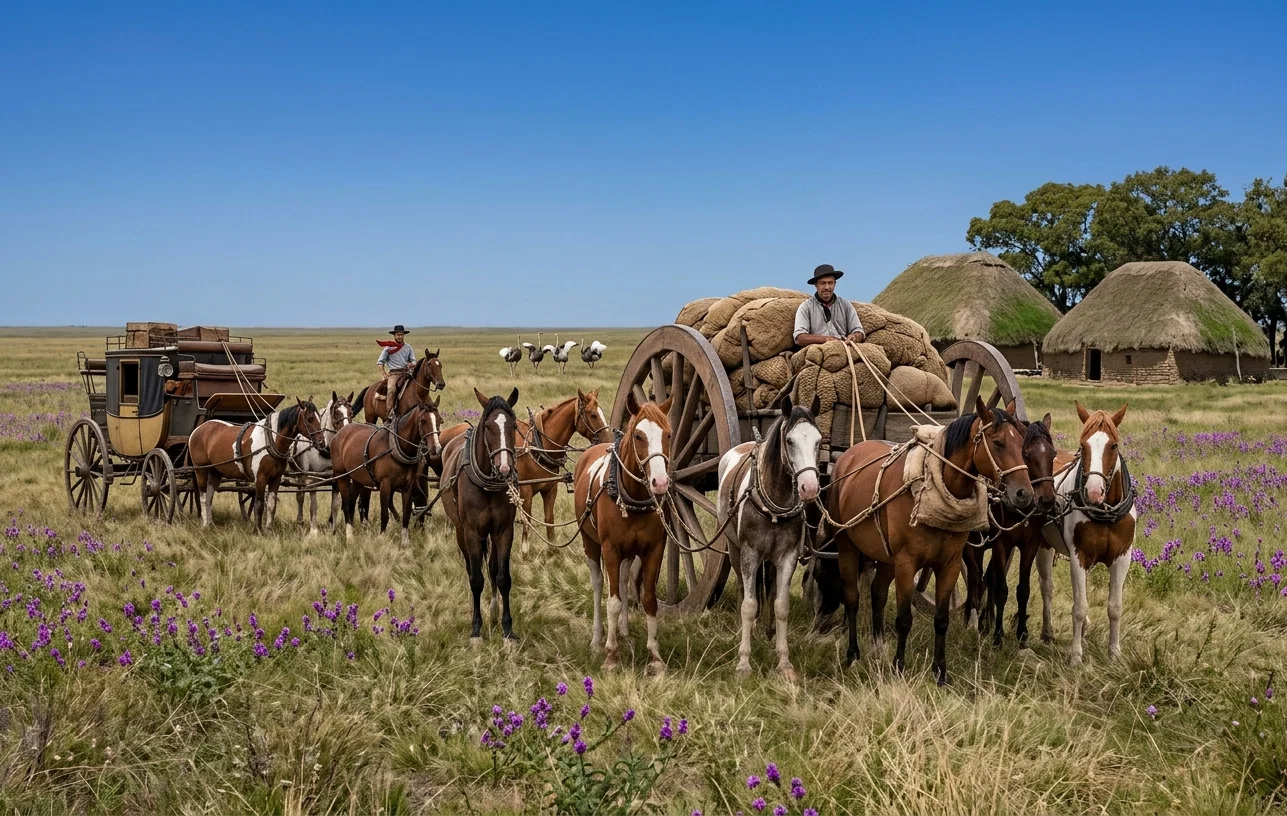
Country Scene in Argentina.

LETTER FROM ARGENTINA.

Going to the City.

BY SADIE R. TOWN.
Imagine yourself upon boundless plains with the bluest of skies over your head, coarse grass and wild verbenas under your feet, red-breasted birds rising to greet the morning sun, and an occasional owl circling over your head with protesting scream. The coach rocks from side to side in a manner alarming to the uninitiated, as the horses plunge on at full gallop over the uneven roads. For a while the motion, the pure air of the camp, and the gladness of nature are exhilarating, but after a time one wearies. Reading is impossible. Of scenery there is little change. The few horsemen one meets rock along on their ponies jauntily enough, the never-failing neck-cloth fluttering after them in the breeze, and the ostriches, surprised into flight by our approach, display a white plumage underneath the lifted wings, which transforms them, in our eyes, in spite of ourselves, to women picking their way through the tall grass with white under-skirt exposed to view. This is riding through the camps in Argentina. The country is very thinly settled, being new, and our coach stops only twice, for change of horses, in making twenty-five miles to the nearest railway station. As we draw nearer the town we pass loaded teams going in the same direction. The accompanying cut will give an idea of their appearance. Quantity, not quality, in horse-flesh seems to be regarded here. It is amusing to see the number of horses, large and small, old and young, of all colors and conditions, which are ingeniously attached to a cart designed to be drawn by one. One poor horse has an old sack fastened round the neck, and draws by means of a rope fastened to the same. Another is saddled, and attached by a strap from the saddle, etc., but all are abreast. The ox-carts, however, are really picturesque. Being raised up into the world on wheels ten feet in diameter, they are rendered so conspicuous as to justify the fanciful coat of paint nearly always bestowed upon them.
Iguasu Falls, Misiones, Argentina.
At last we arrive in the village and take lodgings in a hotel to await the next morning’s train. Our room is very plainly furnished, but does not lack the soap and water so grateful after a dusty ride.
In other parts of the world we should wonder at having to repair to town for fruit, fresh butter, eggs, and vegetables, but such is the case here. In the camp towns, meat, maté, and hard biscuit are all that can be depended upon, altho other things garnish the board at times. So, after lunching lightly on what is set before us, and taking a short stroll, we retire for the night.
And right here let me say that the traveler who finds his bed entirely unoccupied, and is able to rest all night in it, and get up refreshed in the morning, is fortunate indeed.
The journey by train presents the variation of wayside stops where the arrival and departure of the train is the event of the day, so that the town is pretty well represented on the platform. The predominating element, until one nears the larger towns, is the top-booted, slouch-hatted camp man, riding-whip in hand, but there is an intersprinkling of ordinarily-dressed men, bare-headed women, and dogs. This reminds me of the salutation one invariably receives upon riding up to a country house. Such a stampede of large, ferocious, vociferating canines makes one very glad that he is high enough to be out of reach.
The pace of the train inclines one to walk a while to economize time. On some lines the trains make but fifteen miles an hour, and it is no uncommon thing for them to slacken this speed (!) that the grazing herds may escape from the track, warned by the engine’s whistle.
We are glad of a change when the time comes to transfer to a river steamer; and altho the craft suffers in comparison with our luxurious appointments at home, the rest of the journey is much pleasanter. Here are clean, comfortable cabins, room to roam about, ten-course dinners, awn-covered decks, and large, comfortable salons with tables and chairs, and musical instruments.
Our fellow passengers are bent on business or pleasure. The ladies are stout, stylishly dressed, but with too much evident consciousness of their personal appearance, and satisfaction therein.
Several families are on their way from Paraguay, having spent the colder months (June, July, and August) in that favorite winter resort. They can not say too much of the beautiful, wooded hills and dales where swarms of gorgeous butterflies precede the forest rider, and animal and vegetable life abound in greater variety. They have also visited the Iguazú Falls in Misiones, of which we have heard so much, and which are said to be “finer than Niagara.” The river is about three miles in width, but the falls are divided into three parts by small islands. Their exact height does not seem to have been determined, as in descriptions of the Falls, it varies from 150 to 200 feet. Of course, they will become more popular as they become better known and easier of access.
We are not alone upon the water now, and the farther down the Paraná we proceed, the more animation and life is displayed until we begin to feel that we are getting into the current of the world’s stir and bustle.
Upon attempting to rise the next morning, a feeling akin to sea-sickness takes possession of us, and looking from the cabin window we see that our river of the day before has widened into an apparent sea, upon which the wind is raising waves of sufficient size to account for our feelings. We lie down again to wait until we get a little nearer shore before attempting to dress, for it is nearly time for us to round into the port of Buenos Aires. Having passed the point where the waters of the Paraná unite with those of the Uruguay during the night, we are now on the broad bosom of the River Plata which is here thirty miles wide.
When we go on deck, the water is alive with craft, small and large; the white buildings and murky atmosphere of a city are plainly visible; and in half an hour’s time we are swinging into dock.

THE HARVEST.

BY L. D. SANTEE.
I see afar, the gleam of ripening harvests, Where strong, brown arms bind up the golden grain; But in life's harvest that is ever ripening How few toil on in weariness and pain!
Beyond the azure, heaven's fair fields are gleaming, In that bright day where shadows never fall; And yet, how many hours in idle dreaming, Pass by unheeded, lost beyond recall!
The changing seasons to the past are drifting, And souls are gathered for the judgment day; Between the bud and blossom, snows are sifting, And earth-life passes rapidly away.
But O, how few the lamp of life are holding To light the darkness of unseeing eyes! How few point upward to that blest unfolding That opes the pearly gates of Paradise!
I see the gleaming of the harvest golden Where sinewy hands bind up the ripened grain; But grander, sweeter is the story olden Of Christ, His life of sacrifice and pain.
And life's great harvest on each side is bending, Whitening and waiting for the reaper's hand; But few are laboring with a love unending, To garner treasures for the shining land.
Across the skies the evening shades are stealing, The mists are gone, that crowned the hills with haze, O'er all the landscape, vesper sounds are pealing, And soon will end for aye our pilgrim days.

A CORAL CHURCH.

The illustration on this page represents our first church in the Cook Islands. It is located in Rarotonga. The illustration and a brief description was sent to the Union Conference Record, Sydney, N. S. W., by Bro. A. H. Piper, who labored for some time as a missionary in Rarotonga. There was considerable opposition to our work there at one time, especially when it was known that a church was to be built; but of this Brother Piper says: “We are thankful to state that towards the completion of the building, many who at one time opposed us came in and helped us finish the house. It is often so with God’s work in the earth.”
By way of description and other information, he adds: “The walls of the church are built of coral rock which our natives procured from the sea, and the roof is of iron. Its measurements are forty feet by twenty-two. The cost of the building was £95 [about $475]. Of this amount, £55 was sent to us from Australia and New Zealand, chiefly from the Sabbath-schools in these fields. The balance was raised by the workers of Rarotonga, past and present, and by the native brethren. No money was paid out as wages, for the brethren did all the labor. Without a penny of debt on it, it now stands, finished and furnished.”
Continue reading: Our Work and Workers