The annual week of prayer season has never failed to bring blessing and uplift. Never yet have we turned aside to seek the Lord's face but we have found his favor. This year the conditions in the world, we know, have appealed to our brethren as never before to seek God in prayer in behalf of the suffering peoples of earth who need to know his salvation, and for our own brethren and sisters in regions desolated by war. Many have had to forsake their homes and flee in distress, and churches have been so scattered that it would seem the members can never hope to meet together again in this world. Our prayers shall meet with theirs at the mercy seat in their time of trial. Events are moving rapidly, and the great day of God is hastening visibly.
And the calls that have come in God's providence for much greater activity in home and foreign missionary work, lay upon our hearts this year a heavier burden of prayer than ever before.
Plan to make the week as fully as possible a week of prayer and of revival and of rededication to service. Let church officers meet for counsel, and carefully plan all the services, led wherever possible by conference laborers. Work and pray for the revival of all and for the conversion of those who have not fully surrendered to God. Labor for the young people and the children, and encourage them in working for others.
On the first Sabbath, December 11, announcement should be made of the annual offering for missions to be taken up the next Sabbath, December 18, at the close of the morning service. Make sure that all have offering envelopes, so that the gifts may be made up during the week. There is call for the usual enlargement in all the mission fields. On all the stations missionaries will be praying that the home churches may authorize an advance where the doors swing widely open. But from populous Asia comes just now the most serious appeal we have ever had from mission fields. There has been such encouraging growth, such a springing up of believers, and such a breaking over of all bounds, that much larger resources of missionaries and means must be forthcoming. It is not man's call, or the call of the missionaries who find themselves overwhelmed, but it is the call of God's own wonderful providence. He is looking to us. Explain these things again and again in the meetings before the week of prayer, and encourage all to plan to meet this annual offering occasion as faithful stewards, doing business for God in his closing work.
May the rich blessing of the Lord be with every believer and every company as we unite in seeking God.
THE COMMITTEE.
Readings for the Week of Prayer
By Ellen G. White
To Be Read in the Churches December 11-18, 1915
(Reading for Sabbath, December 11)
Victory Over Sin Through Faith in Christ
SELECTIONS FROM THE WRITINGS OF MRS. E. G. WHITE
“The condition of eternal life is now just what it always has been,—just what it was in Paradise before the fall of our first parents,—perfect obedience to the law of God, perfect righteousness. If eternal life were granted on any condition short of this, then the happiness of the whole universe would be imperiled. The way would be open for sin, with all its train of woe and misery, to be immortalized.
“It was possible for Adam, before the fall, to form a righteous character by obedience to God’s law. But he failed to do this, and because of his sin our natures are fallen, and we cannot make ourselves righteous. Since we are sinful, unholy, we cannot perfectly obey a holy law. We have no righteousness of our own with which to meet the claims of the law of God. But Christ has made a way of escape for us. He lived on earth amid trials and temptations such as we have to meet. He lived a sinless life. He died for us, and now he offers to take our sins and give us his righteousness. If you give yourself to him, and accept him as your Saviour, then, sinful as your life may have been, for his sake you are accounted righteous. Christ’s character stands in place of your character, and you are accepted before God just as if you had not sinned.
“More than this, Christ changes the heart. He abides in your heart by faith. You are to maintain this connection with Christ by faith and the continual surrender of your will to him; and so long as you do this, he will work in you to will and to do according to his good pleasure. So you may say, ‘The life which I now live in the flesh I live by the faith of the Son of God, who loved me, and gave himself for me.’ So Jesus said to his disciples, ‘It is not ye that speak, but the Spirit of your Father which speaketh in you.’ Then with Christ working in you, you will manifest the same spirit and do the same works,—works of righteousness, obedience.’”—“Steps to Christ,” pages 67, 68.
“The faith essential for salvation is not mere nominal faith, but an abiding principle, deriving vital power from Christ. It will lead the soul to feel the love of Christ to such a degree that the character will be refined, purified, ennobled. This faith in Christ is not merely an impulse, but a power that works by love and purifies the soul. It accomplishes something, bringing the soul under discipline, elevating it from defilement, and bringing it into connection with Christ, till it appropriates his virtue to the soul’s need. This is saving faith.”—Review and Herald, Aug. 18, 1891.
“Where there is not only a belief in God’s word, but a submission of the will to him, where the heart is yielded to him, the affections fixed upon him, there is8faith,—faith that works by love, and purifies the soul. Through this faith the heart is renewed in the image of God. And the heart that in its unrenewed state is not subject to the law of God, neither indeed can be, now delights in its holy precepts, exclaiming with the psalmist, ‘O how love I thy law! it is my meditation all the day.’ And the righteousness of the law is fulfilled in us, ‘who walk not after the flesh, but after the Spirit.’”—“Steps to Christ,” pages 68, 69.
“Many hold faith as an opinion. Saving faith is a transaction, by which those who receive Christ join themselves in covenant relation with God. A living faith means an increase of vigor, a confiding trust, by which, through the grace of Christ, the soul becomes a conquering power.”—“The Ministry of Healing,” page 62.
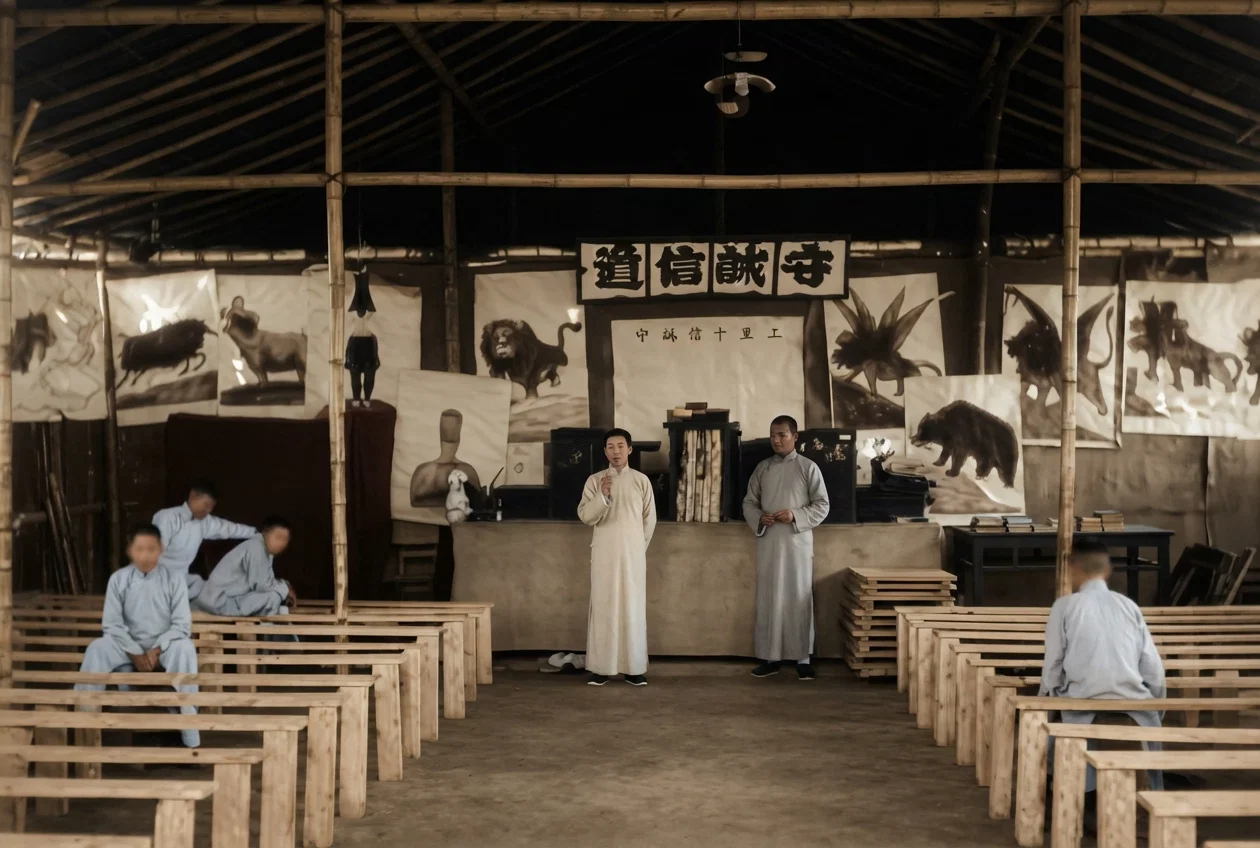
Photo by F. E. Stafford
INTERIOR OF BAMBOO TABERNACLE AT NANZIANG, CHINA, WHERE THE MESSAGE IS BEING PREACHED
“How often those who trusted the word of God, though in themselves utterly helpless, have withstood the power of the whole world,—Enoch, pure in heart, holy in life, holding fast his faith in the triumph of righteousness against a corrupt and scoffing generation; Noah and his household against the men of his time, men of the greatest physical and mental strength and the most debased in morals; the children of Israel at the Red Sea, a helpless, terrified multitude of slaves, against the mightiest army of the mightiest nation on the globe; David, a shepherd lad, having God’s promise of the throne, against Saul, the established monarch, bent on holding fast his power; Shadrach and his companions in the fire, and Nebuchadnezzar on the throne; Daniel among the lions, his enemies in the high places of the kingdom; Jesus on the cross, and the Jewish priests and rulers forcing even the Roman governor to work their will; Paul in chains led to a criminal’s death, Nero the despot of a world empire.
“Such examples are not found in the Bible only. They abound in every record of human progress. The Vaudois and the Huguenots, Wyclif and Huss, Jerome and Luther, Tyndale and Knox, Zinzendorf and Wesley, with multitudes of others, have witnessed to the power of God’s word against human power and policy in support of evil. These are the world’s true nobility. This is its royal line. In this line the youth of today are called to take their places.
“Faith is needed in the smaller no less than in the greater affairs of life. In all our daily interests and occupations, the sustaining strength of God becomes real to us through an abiding trust. . . .
“As a shield from temptation and an inspiration to purity and truth, no other influence can equal the sense of God’s presence. ‘All things are naked and opened unto the eyes of him with whom we have to do.’ He is ‘of purer eyes than to behold evil,’ and cannot look on iniquity. This thought was Joseph’s shield amidst the corruptions of Egypt. To the allurements of temptation his answer was steadfast: ‘How can I do this great wickedness, and sin against God?’ Such a shield, faith, if cherished, will bring to every soul. . . .
“Through faith in Christ, every deficiency of character may be supplied, every defilement cleansed, every fault corrected, every excellence developed.
“‘Ye are complete in him.’
“Prayer and faith are closely allied, and they need to be studied together. In the prayer of faith there is a divine science; it is a science that every one who would make his life work a success must understand. Christ says, ‘What things soever ye desire, when ye pray, believe that ye receive them, and ye shall have them.’ He makes it plain that our asking must be according to God’s will; we must ask for the things that he has promised, and whatever we receive must be used in doing his will. The conditions met, the promise is unequivocal.
“For the pardon of sin, for the Holy Spirit, for a Christlike temper, for wisdom and strength to do his work, for any gift he has promised, we may ask: then we are to believe that we receive, and return thanks to God that we have received.
“We need look for no outward evidence of the blessing. The gift is in the promise, and we may go about our work assured that what God has promised he is able to perform, and that the gift, which we already possess, will be realized when we need it most.”—“Education,” pages 254-258.
“We do not value the power and efficacy of prayer as we should. Prayer and faith will do what no power on earth can accomplish. We are seldom, in all respects, placed in the same position twice. We continually have new scenes and new trials to pass through, where past experience cannot be a sufficient guide. . . .
“The temptations to which we are daily exposed make prayer a necessity. Dangers beset every path.”
“As workers for God, we must reach men where they are, surrounded with darkness, sunken in vice, and stained with corruption. But while we stay our minds upon him who is our sun and our shield, the evil that surrounds us will not bring one stain upon our garments. As we work to save the souls that are ready to perish, we shall not be put to shame if we make God our trust. Christ in the heart, Christ in the life, this is our safety. The atmosphere of his presence will fill the soul with abhorrence of all that is evil. Our spirit may be so identified with his that in thought and aim we shall be one with him.”
“He whose trust is in God will with Paul be able to say, ‘I can do all things through Christ which strengtheneth me.’ Whatever the mistakes or failures of the past, we may, with the help of God, rise above them. With the apostle we may say:—
“‘This one thing I do, forgetting those things which are behind, and reaching forth unto those things which are before, I press toward the mark for the prize of the high calling of God in Christ Jesus.’”—“The Ministry of Healing,” pages 509, 511, 516.
What Lies Close at Hand
“WE often fail by searching far and wide for what lies close at hand.”
“Children First”
By VESTA J. FARNSWORTH
VESTA J. FARNSWORTH
Again the week of prayer! In every time of danger it is an unwritten law that children have first claim, and other lives are sacrificed, if necessary, that they may be rescued.
No argument is needed to show that Seventh-day Adventist children are in peril. The world, the flesh, and the devil seek their eternal destruction. It seems fitting, therefore, that during this week of humiliation and seeking God the younger members of the Lord’s family should receive special care and labor.
This work may be most effectively done in each home where there are children. The time has come when the hearts of fathers and mothers should turn to their own children. Set apart some portion of each day to study with them the lessons prepared for them. After secret prayer in their behalf, lovingly and faithfully study and pray with them. Be not discouraged if they seem hard and impenitent. Confess to them your own impatience and faults in dealing with them, and ask their forgiveness. This will melt the heart as nothing else can.
Leaders should be appointed in the churches to work for the children, and time set apart for their meetings. Our space forbids giving long lessons or illustrations, so the outlines prepared are simply suggestive.
Do not hold long meetings. Sing the songs the children love. Let every exercise be short, spirited, spiritual. Encourage all the children to take part in the meetings, especially in prayer. This week should begin a real revival in their hearts, and lead to earnest seeking for a new and better Christian experience.
The children now living must meet and overcome temptations and tests such as those of no other age have experienced. If they learn to gain victories now, they will be better prepared to stand the greater trials of the future.
Name special objects for prayer each day for which prayer may be offered at home, then let all unite in the meetings in seeking God for the same things. Let all not simply talk about praying, but earnestly pray.
He That Overcometh
Lesson for the Children — No. 1
“He That Overcometh”
MEMORY TEXT: “To him that overcometh will I grant to sit with me in my throne, even as I also overcame, and am set down with my Father in his throne.” Rev. 3:21.
Talk about the week of prayer for a few moments, and tell how it should be different to us from other weeks. Ask the children what they would most like to have the Lord give them. Permit them to name some of the things they desire, and then quote one or two of the promises given to those who seek the Lord with all the heart.
Give opportunity in all the meetings for the children to pray. On this first occasion let all ask that this week may be a great blessing to all, and that they may be helped in getting ready to meet Jesus.9
We all wish to overcome sin. Some try to do so by punishing themselves and doing penance. Others think they must overcome in their own strength.
You have read the story of how the walls of Jericho fell. If you should go out today to a tall building with heavy brick walls, and blow a horn and shout, you would not expect it to fall down. But the strong, high walls of Jericho fell. Why?—The people were obeying God. They believed what he said would be done, and they were willing to do their part. Their faith and obedience gave them the victory.
So when we have sins as hard to overcome as were the walls of Jericho to throw down, there are two things for us to do: First, we should believe what God says; second, we must obey what God says. Believing will enable us to obey.
Read this text: “If we confess our sins, he is faithful and just to forgive us our sins, and to cleanse us from all unrighteousness.” 1 John 1:9. The Lord says if we confess he will forgive. Do you believe that? Think what you have done that you ought to confess. “But I don’t like to confess,” you say. Do you want forgiveness enough to do something hard? Will you obey what God says?
A little girl went to children’s meetings, where she was taught what she should do to be a Christian. She knew that she had been a naughty girl, and had done many things to grieve Jesus. She wanted him to forgive her. She knew he had promised to forgive if she would confess her sins, so she told him how sorry she was because she had done wrong, and she mentioned things she had done and said. She believed she was forgiven, because Jesus had promised to forgive.
Then the Saviour helped her to remember that she ought to confess to others as well as to him. She went to her mamma, and threw her arms around her, saying, “O mamma, I have been so cross to you sometimes, and did not want to do what you said! I know you have felt grieved because I was such a bad girl. Will you forgive me?” The mother kissed her and told her that she herself had not always done as she should, that she forgave all, and that from that time they would try to help each other live as Jesus did.
Then the little girl remembered that she had not always done right at school, so she confessed to her teachers, and asked them and others to forgive her. She went away alone very often to talk with Jesus, to tell him that she loved him, and of what she had done to make everything right. She knew that he heard her pray, and she asked him to help her in many ways. She began to ask him for things that she wanted very much, and he sent them to her, and her prayers were answered. The strong walls of sin were broken down, and victory came because she believed and obeyed God.
We are all prisoners of Satan, but we need not remain his captives. Illustrate by the pilgrims in Doubting Castle, and how they obtained their liberty by using the key of promise.
Show a photograph of a child. Read from “The Desire of Ages,” in the chapter “Go Teach All Nations,” these words: “Christ is sitting for his portrait in every disciple. . . . In every one Christ’s long-suffering love, his holiness, meekness, mercy, and truth, are to be manifested to the world.” Jesus wishes to see a photograph of his life in ours. When people look at our life they should see Jesus. We may reflect his image.
Show how Jesus overcame sin by perfect trust in God’s word and earnest prayer. Even so may we overcome.
Give time in this meeting for all to pray for victory over their sins, to confess their wrongs, and to bear testimony. This should be a time of thorough heart work for both leaders and children.
The Church as an Evangelizing Agency
By I. H. EVANS
(Reading for Sunday, December 12)
The Church as an Evangelizing Agency
I. H. EVANS
The Saviour gave a forecast of the position his church on earth should occupy when he said, “Ye are the light of the world.” As we look backward through the ages to see the fulfillment of this statement, we find the true church of God standing forth in great prominence. Nor does it matter whether it be in the days of tribulation and persecution, or in the years of her expansion and prosperity, still the church has been the “light of the world.”
Sometimes this light has been dimmed by apostasy and sin; then the wheels of progress have been turned backward, a pall of dense spiritual darkness has enveloped the earth, and the world has groped as a blind man seeking the way. Sometimes a little company would seek God, and by renewed consecration separate from sin and apostasy; and at once light would break forth and reformation follow. Whenever and wherever Christ has dwelt within the hearts of his children, then their light has shone forth. When the Holy Spirit withdraws, its light gives place to darkness and confusion.
Christ proclaimed himself the light of the world. In the church Christ dwells,—not simply in the organization, but in the hearts of his true followers. He is the One who illuminates; he kindles the flame of zeal, and sends forth the light of life through those who believe on his name.
The psalmist says, “Light is sown for the righteous, and gladness for the upright in heart.” Here we are taught that light is sown for God’s people. As seed sown in the earth bears fruit, so light is sown for the righteous, that it may multiply and increase in the lives of the believers.
The apostle, writing to the church in Thessalonica, used this language, “Ye are all the children of light, and the children of the day.” Again we read, “For ye were sometimes darkness, but now are ye light in the Lord: walk as children of light.” Thus the Lord identifies himself with his children. They have no light of themselves, but by the indwelling of the Holy Spirit they become light bearers, and share with Christ the honor of being the Light of the world.
Light radiates. It cannot do otherwise than shine. It dispels darkness. It illuminates and makes manifest. Thus when Christ said of his followers, “Ye are the light of the world,” he only declared the position they held as his ambassadors in the earth, and indicated the work he would have them do. None would expect the church could be the light of the world by inaction and idleness. The gospel in the heart is compared to leaven, which knows no rest till the whole lump is leavened. Light is active. It always shines. Its very nature is to enlighten, and so it must be with any people of whom it can be truly said, “Ye are the light of the world.”
The Responsibility of the Church
That Christ holds his followers responsible for giving the gospel to the world is evident from the Scriptures wherever the question is under discussion. “Ye are the light of the world,” is a statement involving every follower of Christ. It is not limited in its application to the apostles or the clergy; it includes the church. And not only does it include the church as an organization; it extends to the individual members of the church, and makes each in his place “the light of the world.” It could thus be read by each of us, “I am the light of the world in Christ Jesus.”
It means much to be responsible to God for enlightening the world and making known to the unsaved the power of the gospel. This responsibility cannot be shunned nor shifted. When God relieves his followers of the duty of enlightening the world, he also will deny them their heirship in his coming kingdom. Responsibility and service go with salvation; they cannot be separated. In the judgment scene pictured by Christ, in which the sheep are separated from the goats, we read:—
“And he shall set the sheep on his right hand, but the goats on the left. Then shall the King say unto them on his right hand, Come, ye blessed of my Father, inherit the kingdom prepared for you from the foundation of the world: for I was an hungered, and ye gave me meat: I was thirsty, and ye gave me drink: I was a stranger, and ye took me in: naked, and ye clothed me: I was sick, and ye visited me: I was in prison, and ye came unto me. Then shall the righteous answer him, saying, Lord, when saw we thee an hungered, and fed thee? or thirsty, and gave thee drink? When saw we thee a stranger, and took thee in? or naked, and clothed thee? Or when saw we thee sick, or in prison, and came unto thee? And the King shall answer and say unto them, Verily I say unto you, Inasmuch as ye have done it unto one of the least of these my brethren, ye have done it unto me.”
Surely here is individual responsibility.10
This helpful, Christlike work cannot be delegated to another; it must be done by the person himself. The reward is personal; it would be inconceivable that when the time of reward comes, the rewards would be given to a denomination or an organization, or a church. If we desire to receive an individual reward, a personal blessing, then there must be individual service; for the reward is given to the one who works.
This earth is in rebellion against its Maker. A mighty, constant, fearful, hand-to-hand and soul-to-soul struggle is being waged between the followers of Satan on the one hand and Christ and his church on the other. It is a struggle for soul supremacy. Christ is trying to win the lost world back to God by every means known to divine love. It is not the material world God wants; it is not the gold or silver or earthly territory: rather, it is the hearts of men. He yearns for their love; he desires their obedience; he longs to have men believe in him and in his Son, Jesus Christ. He wants men to live. He sees his own creation plunging heedlessly, persistently, into eternal ruin. He sees man maddened by sin rushing beyond the boundaries of hope and mercy. He sees a lost world gone to ruin and going down to destruction. He knows the final result of sin and sinning, and he longs to save man from this fate.
When Jesus ascended up on high, he gave his followers the charge to go into all the world, and make Christians of all nations. Never were the nations of earth engaged in a more fierce conflict between themselves than are Christ and his church in this war against the devil and his host. Christ tries by every holy and righteous means to win the followers of the enemy to enter his service, and the church is the agent used by God and the Holy Spirit to carry on this soul-winning campaign.
The church is to be filled with the Holy Ghost. No one is sent to the front to fight alone. Just as far as the command to go is obeyed, so far may the promise be claimed, “Lo, I am with you alway, even unto the end of the world.”
Soul Winning the Work of the Church
There is a double duty resting upon every church member: first, to get himself ready for his Master’s coming; second, to win souls to the kingdom of God.
The first duty must not be ignored. On it our own salvation is dependent. Everything must be sacrificed that this salvation may be secured. The most awful mistake a man can ever make is to lose his own soul.
In these days of stress and trial, we have great need to read our Bibles, and to spend much time daily in prayer. The soul cannot live and make a healthy growth without this daily communion with God. Without Bible study and prayer we are easily overcome by temptation, and become the prey of the enemy. The believer is like some of the timbers in the tropics, from which the heart has been eaten by the ants and only a hollow shell remains; outwardly he passes for a Christian, but inwardly he is dead in trespasses and sin.
Our first and chief duty must be to gain the victory over temptation in our own lives. Our next great duty is to win souls to Christ. The church must ever be a missionary, evangelizing instrument used by the Holy Spirit to extend the kingdom of God.
Some will say, “Could I go to China or India, gladly would I give my life to this soul-winning work.” But all cannot go to these distant lands. Only the young, the strong, and generally the educated, can succeed in these hard heathen fields; but about us on every hand we have the lost and perishing.
Our Own Families
Is your own heart right with God? Is your family saved? To you there are no questions more vital than these. No call from distant lands will excuse you from bringing your own to Christ. This homeland needs the attention of the church; it demands the prayers, the tears, and the labors of consecrated parents. Hear this warning to our people:—
“Oh, that parents would look carefully and prayerfully after their children’s eternal welfare! Let them ask themselves: Have we been careless? Have we neglected this solemn work? Have we allowed our children to become the sport of Satan’s temptations? Have we a solemn account to settle with God because we have permitted our children to use their talents, their time, and influence in working against the truth, against Jesus Christ? Have we neglected our duty as parents, and increased the subjects of Satan’s kingdom?”
Neither the church as a whole nor the church members as individuals should ever lay down the burden while there is one unsaved soul in the families of its members.
Our Neighbors
Since the days of Cain, men and women have been asking, “Am I my brother’s keeper?” Surely God has made it so. The answer is, “Thy brother’s blood crieth unto me from the ground.” Christ said: “Why stand ye here all the day idle? . . . Go ye also into the vineyard.” “Work . . . while it is day: the night cometh, when no man can work.”
Who will warn your neighbors of the coming doom of this lost world if you hold your peace? You are the light of the world. God has commanded you to “arise, shine,” for your light has come. It matters not how poor and ignorant you are, these are not reasons for your idleness. God will be with you in your endeavors.
“No matter what may have been their occupation,—farmers, mechanics, teachers, or pastors,—if they had wholly consecrated themselves to God, they would have been efficient agents to work for the heavenly Master.”
Personal Work
There is no work so strong and persuasive as personal work for souls. More and more the personal touch is counted as the strong means in helping the halting to yield to the pleadings of the Holy Spirit. A personal invitation, a quiet talk, a prayer offered in behalf of the sinner, is oftentimes used by God to win a soul to Christ.
Then there are the tracts, books, and periodicals coming from our presses, laden with the living message for these times. God has put his Spirit into much of this literature, and it is a living, burning message for these times. Thousands of believers in the third angel’s message have accepted present truth by reading. The church has a mighty work to do if it meets the divine requirements in circulating this literature. The light of the world is not to be hidden; it is to be revealed.
“His lamps are we,
To shine where he shall say.
And lamps are not for sunny rooms,
Nor for the light of day,
But for dark places of the earth,
Where shame and wrong and crime have birth;
Or for the murky twilight gray,
Where wandering sheep have gone astray;
Or where the light of faith grows dim,
And souls are groping after him.
“And as sometimes a flame we find,
Clear shining through the night,
So bright we do not see the lamp,
But only see the light,
So may we shine—his light the flame—
That men may glorify his name!”
Then, too, we must not forget the nations of the East. Their doors are open and the Macedonian cry is sounding as never before since sin entered the world. This call for help must not be answered with a deaf ear and by inaction. Since the death of Christ till now there has been no such call to the church for help as is now sounding forth from the lands of heathenism. Their cries for help will not go unanswered. Already a good work has been started, and every year sees growth and progress. Even converted heathen are entering the work and preaching the gospel. More leaders and teachers must be sent; but there is hardly a man in our ranks today who is not willing to go anywhere for Christ. We must give our children and our means to the finishing of this work. All must go on the altar for service as God sees fit.
The world is fast preparing for the loud cry of the third angel’s message. Now is our day of opportunity to give the trumpet a certain sound and to work for souls with that earnestness and zeal that will command attention. God’s hand can be clearly seen in directing and extending his work in the earth. Every Seventh-day Adventist should be a soul winner. Soon the night cometh when no man can work.
“Toil on, faint not, keep watch and pray;
Be wise the erring soul to win;
Go forth into the world’s highway,
Compel the wanderer to come in.”
Serve the Lord With Gladness
“Serve the Lord with gladness: come before his presence with singing.”
His Witnesses
Lesson for the Children — No. 2
His Witnesses
MEMORY TEXT: “Ye shall be witnesses unto me both in Jerusalem, and in all Judea, and in Samaria, and unto the uttermost part of the earth.” Acts 1:8.
A witness tells what he knows. Describe how testimony is given in court. One cannot guess or state what he has not experienced or known, for such testimony is worthless.
There was a great battle fought while David was king. His enemies were defeated. A young man wanted to run and tell the news to the king, for there were no telephones or telegraphs to carry it. General Joab thought the young man unfit to go, and sent another to tell the story. (Give main points of narrative found in 2 Sam. 18:19-32.) Ahimaaz did not know what to say, even though he could run faster than Cushi. This shows that we should get ready before we start as witnesses for Jesus. We must learn what he says, and become well acquainted with him, so that we can tell what we ourselves know.
It was so with James and John. When they spoke of Jesus they told what they knew. They had lived with him and learned to follow him before they began to bear witness. Long before they were sent out to preach, they were sitting in a boat one day with their father. Jesus came down to the beach. For a while he watched the men working, then he called James and John. He asked them to follow him. These men knew that meant a different life for them. Here were their nets, boats, a lovely lake full of fish, their home, and comforts. But the young men answered the call to go with Jesus, leaving their father behind with the nets. The sons suffered with the Saviour, but they brought thousands to love him by telling what they knew and had seen. They lost their home and the fishing business. They “forsook their nets and followed him,” but they gained immortal crowns, and their names will forever be in the foundation wall of the New Jerusalem.
At one time Paul was preaching in Philippi. A girl possessed of an evil spirit kept following him and the other workers, saying, “These men are the servants of the most high God, which show unto us the way of salvation.” What the girl said was true, but the Lord did not wish that kind of person to witness for his workers, and Paul told the wicked spirit to come out. When brought before the Jewish council, Peter said, “We are his witnesses of these things; and so is also the Holy Ghost, whom God hath given to them that obey him.” Acts 5:32. The Lord does not wish those who are disobedient and unholy to give his message.
Where were the disciples to witness? — First at Jerusalem, where Jesus had suffered, and where it would be hardest for them to labor. Sometimes it is harder for us to work right at home than in any other place, but that is where we should begin. From Jerusalem they were to go to the country near, then to Samaria, and after that to places far off. Bible examples may be given to show how faithfully this instruction was carried out by the apostles. In our homes, in school, and in Sabbath school we may now witness for Jesus, all the time preparing for work in any place the Lord would have us go.
In this meeting let special prayer be offered for us to be made true witnesses, and willing to go wherever Jesus may call; also that those who have already gone as missionaries may be faithful witnesses for the truth.