The word of God is the highest authority to which we can appeal in matters pertaining to the Christian life. “To the law and to the testimony; if they speak not according to this word, it is because there is no light in them.” Isa. 8:20. The commendation of the apostle to the church at Thessalonica was that they received the word of God as divine: “Ye received it not as the word of men, but as it is in truth, the word of God, which effectually worketh also in you that believe.”51 Thess. 2:13. To this same church he said, “Ye are the children of light, and not of darkness.” What is this light?—“Thy word is a lamp unto my feet, and a light unto my path.” Ps. 119:105. “The entrance of thy words giveth light.” Verse 130.
Not only is the word of God a light, but it is pure. “The words of the Lord are pure words, as silver tried in a furnace of earth, purified seven times.” Its purity consists in its unerring counsel. When God speaks there need not be any question in regard to what he says. When darkness was upon the face of the deep and there was not one single ray of light to pierce the inky darkness, God said, “Let there be light, and light was.” His word has power to bring to pass whatever he says, therefore it is infallible. It is exempt from error in judgment or in expression.
There need be no trouble in regard to the will of God, if we understand what he says. Then the only question that we need to settle is, How can we know what he says? We have the Scriptures, and of them it is said: “All Scripture is given by inspiration of God, and is profitable for doctrine, for reproof, for correction, for instruction in righteousness; that the man of God may be perfect, thoroughly furnished unto all good works.” The Scriptures seem to be all that is needed to make man wise unto salvation. It is not some man’s interpretation of the Scriptures that will save men and women. It is the Scriptures.
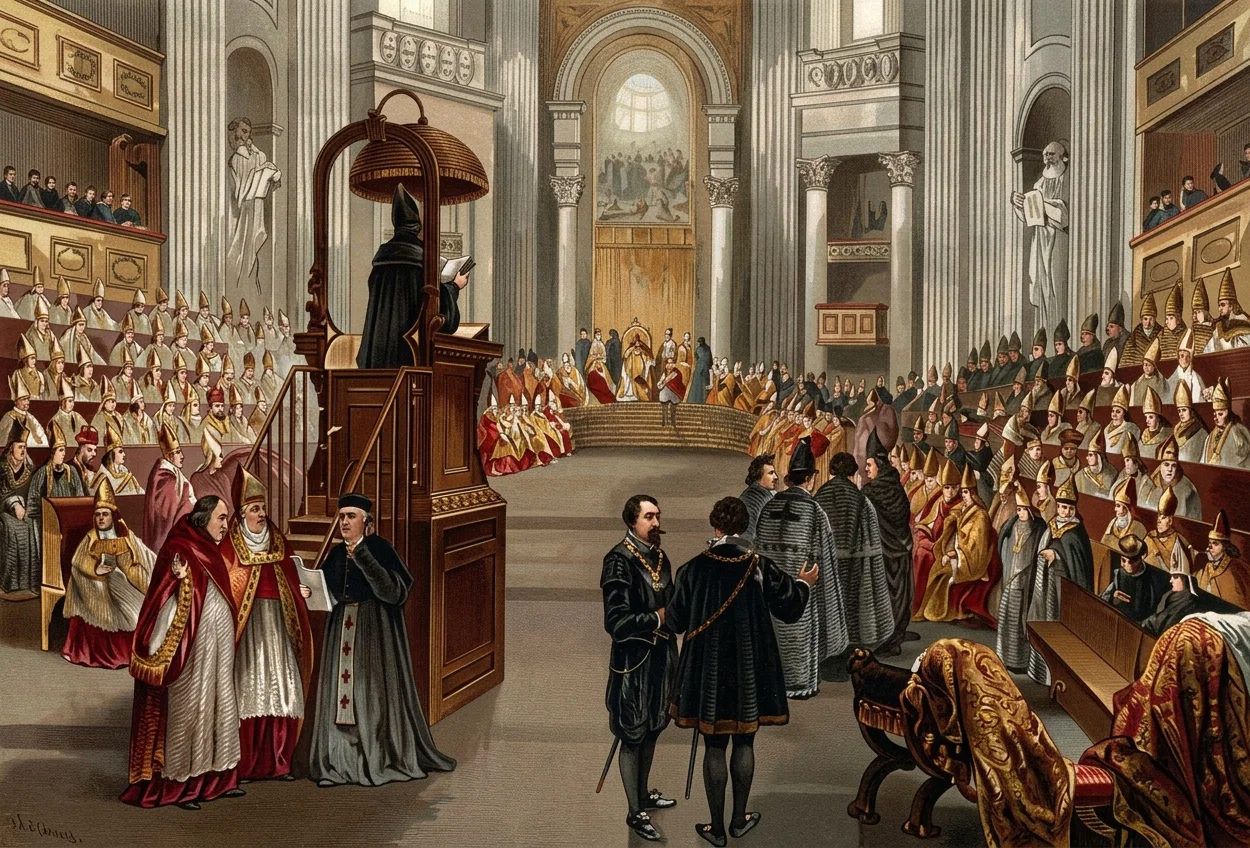
Proclaiming the Dogma of Papal Infallibility.
Does Man Need an Interpreter?
This is an important question. Can man understand the Scriptures sufficiently to save him, without an interpreter? Or is there one class of men that can understand the word of God, and another class that cannot understand it? Did the Lord choose one class of his creatures to understand his word, and another class, who must depend entirely upon the former class for a knowledge of what he says? It does not look reasonable that such is the case. God gave his Son to save the world, and he is no respecter of persons. One person may understand the teaching of the Scriptures better than another, because he has studied it more. But the person in ignorance could have understood it just as well if he had had the same opportunities and had improved them.
The word of God is spiritual in its nature. “The words that I speak unto you, they are spirit, and they are life.” But it is also said: “The natural man receiveth not the things of the Spirit of God; for they are foolishness unto him; neither can he know them, because they are spiritually discerned. But he that is spiritual judgeth all things, yet he himself is judged of no man.” 1 Cor. 2:14, 15. Then, it is evident that the human can not be the interpreter of the divine. The natural man, whatever his position, can never occupy the place of God, or the Holy Spirit, to his fellow man. Whenever, and wherever, man has made an effort to be an interpreter of the Scriptures to his fellow man, persecution has followed. In the early apostasy, when men drew others after themselves, one class of men presumed to act as conscience for others, becoming interpreters of the Scriptures for them. Those who received this so-called priestly service, soon became worshipers of men. Those who decided to think for themselves were denounced as heretics, and sentenced to severe punishment for their refusal to accept these human interpreters. It has been clearly proved that the persecution of those days was not of God. But it grew out of the claim of a class of individuals to become the interpreters of the Scriptures for the masses. If it was not in harmony with God’s plan then, it can not be so now.
“But ye have an unction from the Holy One, and ye know all things.” 1 John 2:20. The unction here mentioned is the same as the anointing in verse 27: “But the anointing which ye have received of him abideth in you, and ye need not that any man teach you; but as the same anointing teacheth you of all things, and is truth, and is no lie, and even as it hath taught you, ye shall abide in him.” This anointing must be the same anointing that Jesus received when he came to this world. “The Spirit of the Lord is upon me, because he hath anointed me to preach the Gospel to the poor.”
The Pharisees and Scribes thought themselves the expositors of God’s word to the people. But when Jesus met them in the temple, they could not teach him, but were led to ask him questions, thus acknowledging his superior knowledge of the Scriptures. As his anointing, or the reception of the Holy Spirit, led him to understand what was revealed in the Scriptures of truth, so will the believer’s anointing give him the true meaning of God’s written word. “Howbeit, when he, the Spirit of truth, is come, he will guide you into all truth.” It matters not how weak the believer is, if he has the presence of the Holy Spirit, and will follow its leadings in the study of the word, he can understand the Lord’s message to him. The Holy Spirit is the Divine Interpreter of the Infallible Word.
THE CHURCH OF GOD.
By Horatius Bonar
CHURCH of the ever-living God,
The Father's gracious choice,
Amid the voices of this earth
How feeble is thy voice!
A little flock!—so called by Him
Who bought thee with his blood—
A little flock, disowned of men,
But owned and loved of God.
Not many rich or noble ones,
Not many great or wise;
They whom God makes his kings and priests
Are poor in human eyes.
But the Chief Shepherd comes at length,
Their feeble days are o'er,
No more a handful in the earth,
A little flock no more.
No more a lily among thorns,
Weary and faint and few,
But countless as the stars of heaven,
Or as the early dew.
Then entering the eternal halls
In robes of victory,
That mighty multitude shall keep
The joyous jubilee.
—Horatius Bonar.
UNITY, TRUE AND FALSE.
By G. E. Fifield
BY G. E. FIFIELD.
“SANCTIFY them through thy truth; thy word is truth. . . . That they all may be ONE, as thou, Father, art in me, and I in thee, that they also may be ONE in us; that the world may believe that thou hast sent me.” John 17:17-21.
These words occur in that last prayer of Christ, before he went forth to his betrayal and his crucifixion,—that prayer in which, more than in any other on record, he seemed to pour out his whole soul before God, on behalf of his disciples and his church.
It was on this same evening after the last Passover, that Jesus gave this splendid promise: “I will pray the Father, and he shall give to you another Comforter, that he may abide with you forever; even the Spirit of truth; whom the world can not receive. . . . When he, the Spirit of truth, is come, he will guide you into all truth.”
It was through the fulfilment of this promise that the prayer for unity was to be answered. The Spirit of truth was to be given to guide the church into all truth, that they, being sanctified through this truth, might be one, as Christ and the Father are one. Here is brought to view the only true unity, and the only unity that is in accord with liberty.
It is one of the first principles of logic that all truth is in perfect harmony and agreement. There can be no two truths in the universe that contradict each other.
Two lies may contradict, and a truth and a lie may contradict, but two truths never. Error, therefore, and falsehood, are at the bottom of all conflict.
Two men are fighting in the street. They represent two opposing ideas, one of which must be false, else they could not oppose each other.
Two armies are fighting in the field. They, too, represent two conflicting principles, and the very conflict is a demonstration that one, at least, of the principles is false.
Two churches, or a hundred churches, are contending on the battle-field of ideas,—that battle-field whereon is proved the truth of the saying that the pen is mightier than the sword. The missiles that are hurled at each other are books, not bullets; pamphlets and periodicals, not cold lead and steel. The din is tremendous. There are all shades of varying and conflicting opinions, and the engines that hurl them forth in the horrid fratricidal strife, are printing presses, not mortars and cannon. Every contradiction of opinion here, too, is a demonstration that falsehood exists in the contending creeds, an absolute proof that the prayer of Jesus is not yet answered.
Now suppose that all these contending parties6instead of in pride and arrogance each worshiping his own opinion and his own creed, should all, in humility, worship God, the All-truth, who is still infinitely beyond any man's thought of him. Suppose they should all, as individuals and organizations, submit themselves to the Spirit of truth, to be guided, according to the promise, unto the all-truth. One man would, to-day, be led to give up an error for a truth, and, in so doing, he would give up a point of conflict for a point of harmony. Another man, or another party, on the other side of the controversy, would to-morrow be led to exchange a point of conflict for a point of harmony, by giving up another error for truth. This glorious work would go on day by day. The din of discord would be hushed; and the war of words would soon be over. The angry blows would cease, and the cannon’s mouth be silenced. The waters whereon the woman sitteth (Rev. 17:1), instead of being as now, a wild, storm-tossed, chaotic ocean, whereon many a fragile bark is hopelessly wrecked before it finds the firm anchor of faith, would be as those of a peaceful lake reflecting the smile of an over-arching heaven. The world itself would be at peace, and forever more.
What constitutes a man’s identity? Is it the flesh and bones which compose his person? Most certainly not. He may gain or lose fifty or a hundred pounds of weight in these, and still he is the same man. He may, by accident, lose an arm or a limb, or both, and still he is the same man. But if he changes his ideas and opinions radically, every one says, “He is a changed man, a different man.” A man, therefore, is a bundle of opinions, tied up with a string of living flesh. Unfortunately and generally some of these opinions are false mingled with the true, but they are the basis of his actions, and, such as they are, they constitute his identity. But God is the truth,—the All-truth of the universe, and no error; the truth not in theory merely, but also in action,—action of love.
He is the All-truth of the universe, living and personal, and touched with tender, throbbing love. This, too, is the mind of Christ. Each consists of the all-truth and no error, and, therefore, the Father and Son are different personalities, they are absolutely of one mind.
Moreover, as God is the Truth, and Christ is the Truth, and the Spirit which proceedeth from them is the Spirit of Truth, when that Spirit, according to the promise, guides us into truth, we are guided into God, so that we are not only one, but as Jesus prayed, one in them, even as they are one in each other.
Speaking of this very time when the Spirit of truth should have wrought its work, Jesus said, “At that day ye shall know,” not merely that “I am in the Father, and the Father in me,” but “that I am in the Father, and ye in me and I in you,” so that ye also are “one in us.”
Blessed unity, wherein all divisions and all creeds are swept away; wherein all are lost, or rather saved in the infinite fulness of Christ, as he is in the Father, so that there are no more Methodist, or Baptist, or Presbyterian, or Adventist, or Protestant or Catholic, or Jew or gentile, barbarian, Scythian, bond, or free, but Christ is all and in all! Blessed liberty, too, wherein each loving the truth and only the truth, and pleasing to do only those acts of love which proceed from the thoughts of truth, can do precisely what they please, and without any limitations forever more! This is the only perfect liberty, as it is the only true unity; for it is the liberty of God, as it is the unity of the Father and the Son.
The Counterfeit.
But there is a kind of unity which is as directly opposed to liberty as this unity is necessarily the parent of it. Of this false unity the historian Draper speaks thus:—
The predestined issue of sectarian differences and dissensions is individual liberty of thought. So long as there was one vast overshadowing, intolerant corporation, every man must bring his understanding to its measure, and think only as it instructed him to do. As soon as dissenting confessions gathered sufficient military power to maintain their right of existence,—as soon as from them, in turn, incessant offshoots were put forth, toleration became not only possible but inevitable. . . . Sectarian decomposition, passing forward to its last extreme, is the process by which individual mental liberty is engendered and maintained. A grand and imposing religious unity implies tyranny to the individual. The increasing emergence of sects gives him increasing latitude of thought—with their utmost multiplication he gains his utmost liberty. In this respect unity and liberty are in opposition; as the one diminishes the other increases.—Draper’s Intellectual Development of Europe, vol. 2, pp. 226, 227.
It will be seen that this is true historically and philosophically, but it is not speaking of the kind of unity for which Christ prayed—the unity of truth. On the contrary, this is speaking of the unity of an inferred creed, which can be maintained only by denying individual rights, and outlawing human thought.
But this is not the true unity. It is the liberty that comes from the decomposition of a false unity, and, though infinitely better than the unity itself, is not the best,—is not the true liberty of which we have spoken. It is only the liberty to contend for one’s own opinions, and to proclaim what one believes. It is the highest liberty which the state can guarantee to its subject, and, as such, it is good; but it is not the perfect liberty of truth and love, which God guarantees to his sincere worshiper.
Now to-day, among the popular churches, we hear much about unity and alliance and confederation. We have the Evangelical Alliance, and the Christian Alliance, and the Young Men’s Christian Association, and the Young People’s Society of Christian Endeavor, etc., etc. All these seek to do non-sectarian work, and bring the churches together in some sort of unity. Then we have the Catholic Church, speaking through its mouthpiece, the pope, in the recent encyclicals,—and speaking more emphatically than ever in favor of unity.
We have the National Reform Protestants declaring they are ready to unite with Rome in maintaining their idea of a National Christianity, and the Baltimore Convention of Catholic Laymen replying that they are ready to enter, to some degree, into this alliance to enforcing Christian(?) laws. Finally, we have the Parliament of Religions, in which not only all forms of the Christian religion, Catholic and Protestant, came together on one common platform, to talk of common aims and hopes, but also there came with them tacitly recognized equals, all forms of pagan religion,—Jew and gentile, Christian and Buddhist, and Confucian, all meeting together to talk of what they have in common, and see upon what principles they can unite.
Now the great, grave question is, If the spirit which expresses itself in all these movements and propositions was carried forward to a successful issue, would it result in the true unity which brings perfect liberty? or in the false unity which can only bring intolerable and spiritual slavery? We are sorry to be compelled to answer that the result would only be that false unity which means slavery. The case is so clear, however, that all must be able to see that this is true.
Present Prospects.
Is there any thought among all these sects of humbly throwing aside their creeds, which are the real barriers to true unity, and humbly casting their souls on the great ocean of truth, to be led by the Spirit of truth into all truth? Far from this. Each, as of old, worships the creed far more than the Christ,—that is, their present thought of truth, far more than the infinite All-truth. Magnificent church edifices, and splendid music, and eloquent preaching, are all dedicated to the making permanent the present thought of God, received, it may be, from some man centuries ago, instead of being made to minister to the nobler work of leading the humbly seeking soul ever more and more into the infinite mystery of the All-truth. The importance of truth is minified rather than magnified by the effort of this unity; for, however solemnly truth may be proclaimed by the inspired word, or however sacredly it may hitherto have been held by some denomination, the tendency is now to consider it of small importance, or nonessential, if it can not be made to enter into, and minister to, the splendor of this imposing unity.
The idea is to combine on what they can, working together to compel all to accept these common aims and ends, while all truth upon which they can not agree is cast into the background. Those who fall in readily with this scheme are called liberal,—and let the scheme but once be realized, and every man who dared speak for the sacredness and importance of some outlawed truth, would soon be called a bigot, and be persecuted for attempting to break down the unity of the church.
It was just such liberal talk as this we hear to-day, and just such a movement in favor of unity, which led to the formation of the Papacy, and to the putting to death of millions of the saints of God.
Unity of Apostasy.
First, there arose in the second century the Eclectics, who decried all narrow sectarianism, and who said that the truth was not to be found in any one sect or religion, but that it lay in fragments, scattered among all sects, and must be sought everywhere by those who would possess it. This was very liberal talk, but at the close of the second century of the Christian era, another sect arose called the New Platonic, and this outdid even the Eclectics in liberality of thought. The Eclectics had taught that the truth was dispersed in fragments among all creeds and sects and7religions, but the new school taught that all religions were really teaching the same thing, only through a little different form of symbolism, and that they were all reaching out after the same God, and so ought to come together in harmony.
Not even a world’s Parliament of Religions could outdo this in liberality. The one grand object of this school was to bring all sects and systems into harmony and unity, and to this end all conflicting opinions were either interpreted allegorically, and thus explained away, or relegated to the background as non-essential. Says Mosheim:—
From Egypt this philosophy spread in a short time over nearly the whole Roman Empire.
And who is able to enumerate all the evils and injurious effects which arose from this new philosophy, or, if you please, from this syncretism, this attempt to reconcile true and false religion?—See Mosheim, book 1, cent. 2, part 2, chap. 1, par. 4, 12.
It was out of all this so-called liberal talk, and out of this movement to combine and reconcile the various religions, that the imposing unity of the church of the Roman Empire grew up, a unity which persecuted and put to death all dissenters, and suppressed and outlawed the truth, maintaining itself by force until the Reformation. It is not difficult to understand the philosophy of such liberality(?) as this.
What This False Unity Means.
Priests and leaders want power, and to have power they must have men, and so will not cut men off from their communion for any slight difference of opinion or practice. No; but for the sake of men and power they will be so broad and so liberal as to let almost anyone in. But as the organization grows, and the power comes, the splendid unity of all these at one time conflicting sects looks so broad and so grand to them that they think that anyone who can not come into a unity so broad and so liberal as this, is too narrow and bigoted to be fit to live. Besides, if he speaks out some forgotten or suppressed truth, he is probing our unity in a tender place, and threatening our power, and endangering the harmony and happiness of the world. He must be put to death. As of old they say, “It is expedient that one man die, and that the whole nation perish not.”
Thus they begin to exercise arbitrary powers on some individual or some small sect that will not come into their imposing unity, and gradually, as they feel the consciousness of power, the lines are tightened until all independent thought, and all religious freedom, are outlawed. This is the inevitable tendency of all religious unity other than the unity for which Christ prayed,—the unity of truth. God says to his church in the last days: “Say ye not, A confederacy, to all them to whom this people shall say, A confederacy; neither fear ye their fear, nor be afraid.” He says to all those who seek to form this religious confederacy, “Associate yourselves, O ye people, and ye shall be broken in pieces.”
O that men would submit to God, and let him unite them in his own way! O that in humility all professed Christians would let their creeds go to the winds, and instead of holding the creed, they would submit their undivided hearts to the Spirit of truth, to be guided into all truth! Then would the prayer of Jesus be answered. Then would the church be sanctified through the truth until it should be one, as Christ and the Father are one.
Should such a spiritual unity of love and truth and perfect liberty exist, surely then the world would see and recognize the divine indwelling Spirit of love and truth and power which produced and maintained it; and seeing this, they too would believe that God had sent Christ into the world in the person of his followers.
THE TRUE CHURCH.
By H. P. H.
Its Attitude towards Heresy and Heretics.
BY H. P. H.
The true church is the body of Christ. “Now ye are the body of Christ, and members in particular.” 1 Cor. 12: 27. See also Rom. 12: 5 and Eph. 5: 30. While we are the members of the body of Christ, who is the head? This is made very plain in many passages, thus: “Christ is the head of the church,” Eph. 5: 23. “And hath put all things under his feet; and gave him to be the head over all things to the church, which is his body,” Eph. 1: 22, 23. See also chap. 4. 15. As all members of the body are directed by the head, so all members in the true church are directed by Christ, the head. The members of the physical body are connected with the head by certain mediums called nerves. So the members of the body of Christ are connected with Christ, the head, by the Spirit. Sever the nerve connecting the arm with the head, and the arm drops helpless and can do nothing. The muscles may be strong and perfect, but independent of the head, they are powerless. Even so, any member of the church, if ever so perfect in outward appearance, is helpless if severed from Christ; for he says, “Without me ye can do nothing.” John 15: 5.
The church of Christ is his representative in the world. It is to continue the work which he began. “And all things are of God, who hath reconciled us to himself by Jesus Christ, and hath given to us the ministry of reconciliation; to wit, that God was in Christ, reconciling the world unto himself, not imputing their trespasses unto them; and hath committed unto us the word of reconciliation. Now then we are ambassadors for Christ, as the God did beseech you by us; we pray you in Christ’s stead, be ye reconciled to God.” 2 Cor. 5: 18-20. Christ’s only mission to the world was to reconcile sinners unto God. As he was sent by the Father, so we, his members, are sent into the world. John 17: 18. Hence in his work, we can see our work; as he suffered, so are we to suffer; and as he treated sinners, so are we to treat them.
The principle upon which Christ acted is best expressed in these words: “And if any man hear my words, and believe not, I judge him not; for I came not to judge the world, but to save the world.” John 12: 47. Christ’s words were spirit and life, and would have brought salvation to all that accepted them. He died for all, tasted death for every man, for the express purpose of saving him; and then having paid the infinite price, he offered eternal life as a free gift to all. But if man rejected the perfect gift, Christ did not denounce him as an ungrateful wretch, and pronounce upon him the sentence of condemnation. He could not do this, for he loved the sinner. As a sinner, man is already condemned, and will surely die if he does not accept the proffered pardon. John 3: 18. He does not need any more condemnation. What would be the nature of the being that would heap more condemnation on him in this condition? It would be like torturing and adding agony to one already sentenced to death. The Saviour’s heart of love never could do this. He could but weep over those that rejected the proffered mercy. Luke 19: 41, 42.
Christ’s attitude towards the sinner is expressed in his treatment of the woman taken in sin. It was man’s nature to condemn her, to stone her. But Christ laid down the principle: “He that is without sin among you, let him first cast a stone at her.” John 8: 7. Accordingly, those that are sinners, can not condemn a fellow man for sin; and as all are sinners, no man can ever condemn another. But, when our sins are forgiven, and we are made righteous, then can we condemn the sinner? Here again Christ is our example. When left alone with the woman, he said: “Neither do I condemn thee. Go, and sin no more.” John 8: 11. That the woman had grievously sinned was never questioned; yet Christ, who was sinless, would not condemn her. But how many of his professed followers feel justified in condemning, and even punishing, those that have sinned. And how many that do not openly express it, carry condemnation in the heart, and that sometimes before they are sure of the person’s guilt.
When the Samaritans would not receive Christ, the disciples desired to destroy them by fire from heaven; but Christ promptly rebuked them, saying: “Ye know not what manner of spirit ye are of. For the Son of man is not come to destroy men’s lives, but to save them.” Luke 9: 55, 56. Christ came to save, not to destroy. There is one that is the destroyer; and he is called “the accuser of our brethren.” Rev. 12: 10. Those that desire to accuse and destroy are of his spirit.
The members of the true church can have no other mind or disposition than that of Christ, for he is the head, and in one body there can be but one mind. “Let this mind be in you, which was also in Christ Jesus.” Phil. 2: 5. The mind or disposition of Christ was not to accuse the sinner; no, not even Satan himself. Jude 9. Christ might have brought many hard accusations against Satan, for he was the author of all sin, and had caused all woe, while man is but the instrument of sin. But it was not the mission of Christ to accuse; and his mind rules the true church.
The mission of Christ was to seek and save that which was lost. This work is beautifully illustrated by the parables of the prodigal son, the lost sheep, etc. He does not harshly treat those that stray from the fold, but follows them and in tenderness seeks to bring them back. He is love, and hence can treat the erring only in love. The nature of man is to destroy those that will not be corrected. This spirit is what led to the many martyrdoms. But nothing of this is found in the life of Christ; and he being the head of the true church, nothing of this kind will be found in it.
Many that heard the words of Christ not only rejected them, but they persecuted him, hired false witnesses against him, accused him of having the spirit of the devil, and finally put him to death. All this time Christ had power to bring upon them the speedy destruction which their extreme cruelty and hypocrisy deserved; but he never used this power; he did not have the disposition to; he did not come to condemn or destroy,8but to save; and if men would not be saved, he had no other mission to them. “Who, when he was reviled, reviled not again; when he suffered, he threatened not.” 1 Peter. 2: 23.
Therefore, as Christ’s representatives go forth preaching the Gospel, “holding forth the word of life,” if people do not accept it, they will not condemn them, and even seek to punish them as heretics. The natural man can not endure contradiction. He at once condemns those that do not agree with him; and if it is within his power he compels the opposers to submission, or destroys them. And if he is ashamed or too hypocritical to do this openly, he does it indirectly, most commonly through the state or civil laws, so that it may seem that they are not punished for their religion, but as civil offenders; and thus the real motive and true character of the act are covered up under the state mantle. The spirit to thus treat those who do not agree with us is especially true in cases of difference in religious opinions, as is illustrated by the adherents of every false religion. They have continually accused and condemned one another; and, when circumstances admitted, have engaged in wars of extermination.
The religion of Jesus Christ alone is tolerant. Every false church is intolerant; but the true church is ever tolerant, not only to members but to non-members; to progressive spirits and backsliders, to those that agree with her, and to those that oppose her; she has condemnation for none, but love for all; she can treat all, enemies and friends, only in love, for Christ, her head, is love.
Are you a member of the true church? Is there condemnation in your heart for the brother that is weak, and has been taken in the subtle snare of sin? for those that do not agree with you in religious belief and oppose you? for those that despitefully use you, and say all manner of evil against you falsely? Or do you really love all such? Your answer will determine whether you are a member of the true church of Christ or not. Every one by looking into his own heart may know this for himself.