We trust that many of the readers of the SIGNS OF THE TIMES are following our course of systematic Bible study. Those who began with us the first of the year, are following the plan of reading three chapters each week-day, and five on the Sabbath. By persisting in this way, we read the Bible through during the year—and every Christian should form the strong and resolute purpose to do at least that much reading in the sacred volume.
Commercial and Industrial Growth and Activities of the Hawaiian Islands
Great and Varied Resources — Well-Nigh Perfect Climate
Missionary Activities and Work for Moral Uplift
By
ARTHUR G. DANIELLS
[[FIGURE]]
[[FIGURE]]
IN harmony with the plans of our Foreign Mission Board, I sailed from San Francisco June 3 to visit important centers of our work in the southern Pacific, the Orient, India, the Levant, and Europe. My first stop was at the Hawaiian Islands, 2,100 miles southwest from San Francisco. Here I spent a pleasant and profitable week with our missionaries and our church in Honolulu, the capital of this group of islands.
MANY INTERESTING FEATURES
The Hawaiian Islands present many features of interest to mission boards, as well as to traders and tourists. Ever since they were discovered and made known to the civilized world by Captain Cook in 1778, these islands have been looked upon as the “Paradise of the Pacific.” They have been visited by navigators, scientists, writers, and tourists from every continent. The bibliography presented in a single small volume recently issued gives the names of 127 books, besides reports of various kinds, that have been published to tell the world about the Hawaiian Islands.
COMMERCIAL AND NATIONAL VIEW-POINT
From a national and commercial point of view, these islands are of far greater value and importance to-day than at any previous time in their history.
They stand at the crossroads of travel in the north Pacific. Ten steamship lines, five of which connect Canada, the United States, and Mexico, with Japan, China, the Philippines, Australia, New Zealand, and the islands of the southern Pacific, call and cross at Honolulu. Nearly a million tons of goods passed through the cargo sheds of that port alone during 1913. It is believed that when the traffic of the Panama Canal is in full swing, these islands will become a still greater center of the world’s travel and commerce.
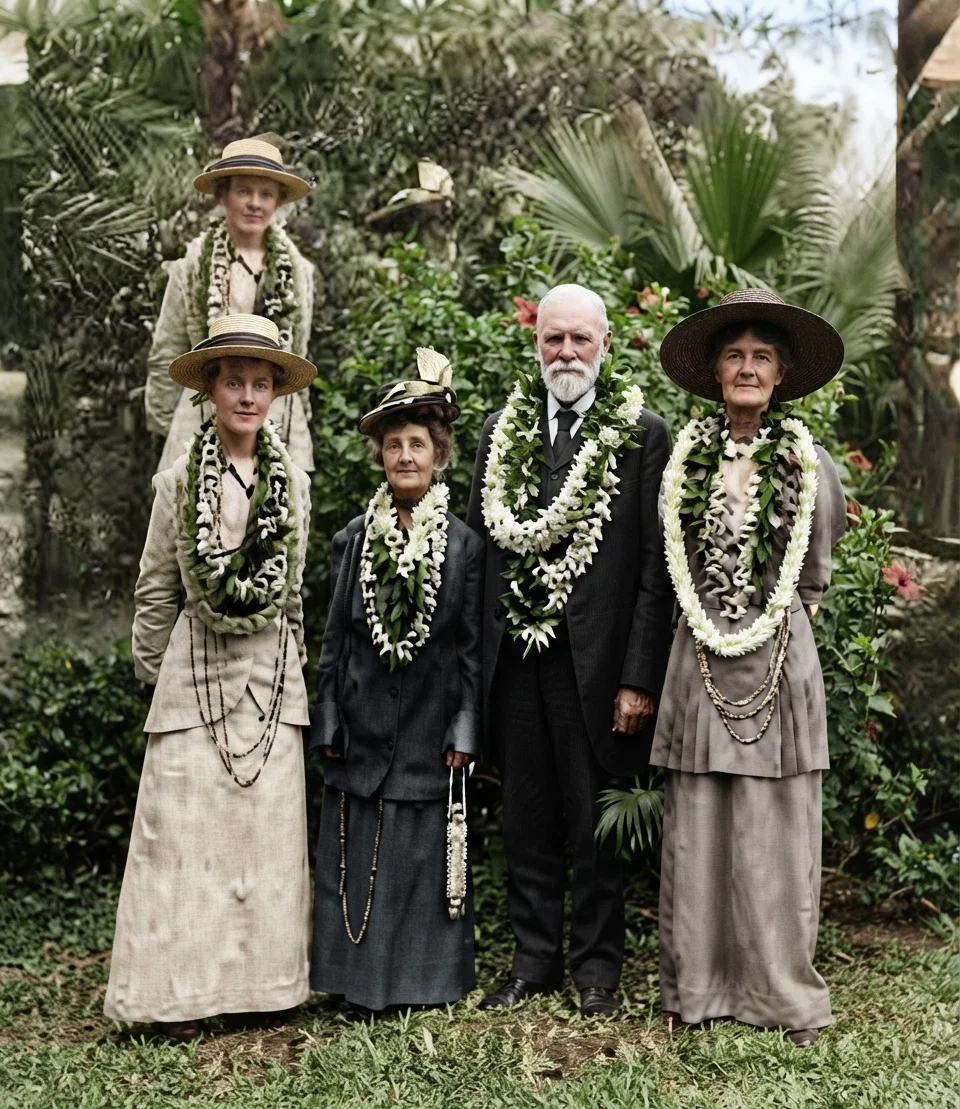
Group of our workers, Honolulu, Elder and Mrs. Conway at right
IMPROVEMENT SINCE ANNEXATION
Conditions have materially improved in many respects since the islands were annexed by the United States, in 1898. At that time the population was about 150,000. It is now close to 220,000, an increase of 70,000, nearly fifty per cent; and it is steadily growing. This population is divided approximately as follows: pure Hawaiians, 25,000; half Hawaiians, 13,000; Portuguese, 23,000; Spanish, 5,000; Porto Ricans, 5,000; other Caucasians, principally Americans, 27,000; Japanese, 83,000; Chinese, 21,000; Filipinos, 12,000; and Koreans, 5,000. Besides this growing resident population, there is a constant stream of tourists going and coming the year around.
DEVELOPMENT OF INDUSTRIES
The commercial aspect of the Hawaiian territory has been very greatly improved since annexation. Laws have been passed encouraging land settlement and cultivation, and much is being done to develop such industries as are suitable to the soil, climate, and other conditions of the islands. It is claimed that the territory of Hawaii is “capable of developing an almost absolute independence, so far as food supplies, materials for wearing apparel, and woods for fuel and building are concerned.”
AGRICULTURE
An agricultural experiment station is operated at large expense, to demonstrate what can be done in the cultivation of the soil, and to aid and instruct the people who settle on the lands in the different islands. A widely circulated report says that “because of the range of altitude on the different islands, it is easy to find conditions suitable for the growth of almost every agricultural crop of the world. At present sugar is the main agricultural product; but there are besides large plantations of coffee, rice, sisal, rubber-trees, fruits, forage plants, etc. Various kinds of grasses that cure well for hay, alfalfa, matting-fiber plants, tobacco, Indian corn, cotton, wheat, and other cereals, sorghum, manila hemp, sansevieria (the bowstring hemp of India), and other field crops are to be seen in various parts of the archipelago, and all are in thriving condition.”
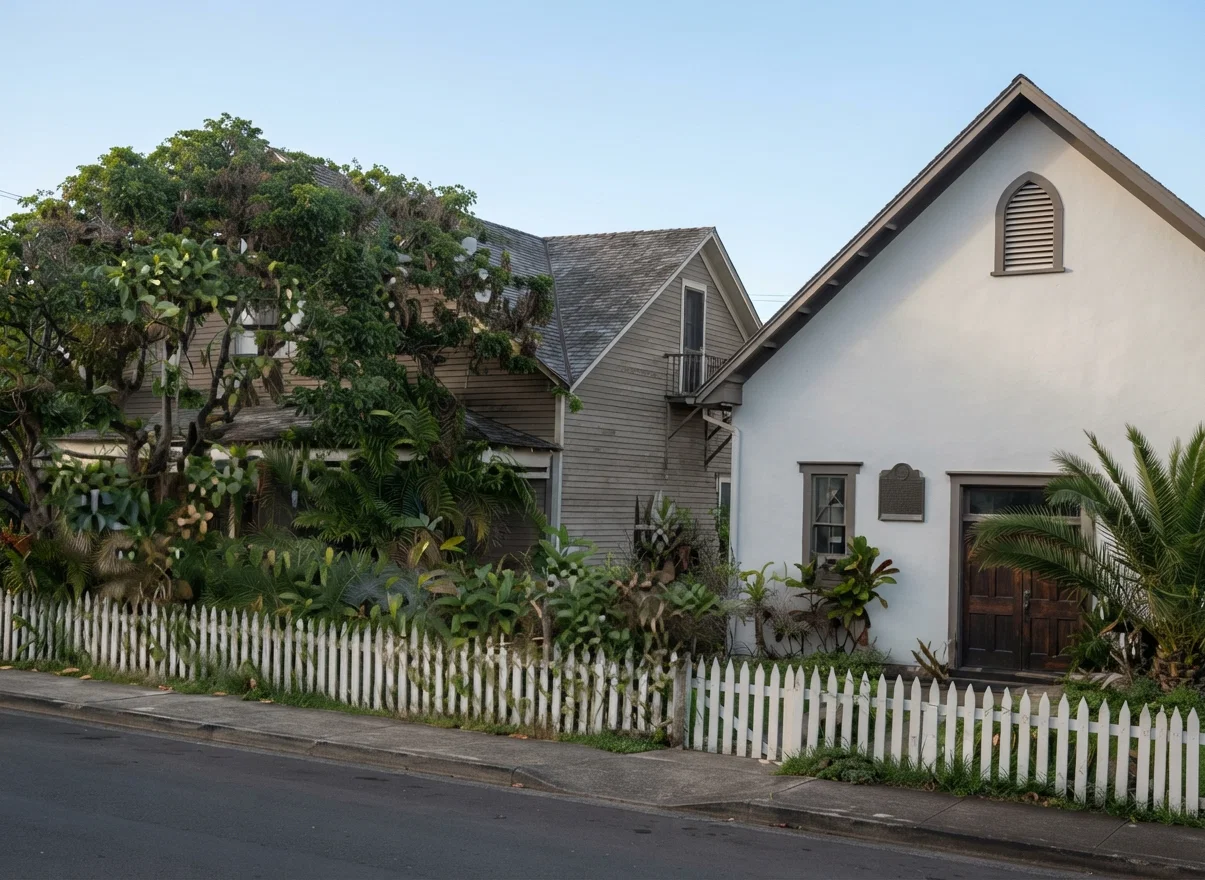
Seventh-day Adventist church and mission home, Honolulu
FRUITS AND VEGETABLES
A list of the fruits that are successfully grown would include the following: pineapple, banana, mango, orange, citron, lemon, mandarin orange, lime, grapefruit, alligator pear, papaya, fig, coconut, strawberry, date, guava, peach, apple, cherry, apricot, breadfruit, and nearly all the known palms.
It has been demonstrated that nearly all varieties of kitchen garden vegetables can be produced in great abundance. These include the Irish and the sweet potato, tomato, cabbage, onion, beet, radish, lettuce, asparagus, beans, peas, turnip, carrot, melons, squash, pumpkin, eggplant, celery, cauliflower, and spinach.
THE EXPORT PRODUCTS
The main products grown on a large scale for export purposes are sugar-cane, pineapples, and rice. The sugar industry holds the largest and most important place in the islands. Over two million acres of land are devoted to this product, forty-five thousand laborers are employed on the plantations, and the quantity of sugar annually amounts to five hundred and fifty thousand tons. The value of the sugar sent away from the islands each year is about forty million dollars.
The pineapple industry has only recently been fully launched. Now six or seven thousand acres are given to this plant. The largest pineapple canning factory in the world is located in Honolulu. Last year over three hundred thousand cases of13canned pineapples, valued at four million dollars, were shipped to other countries.
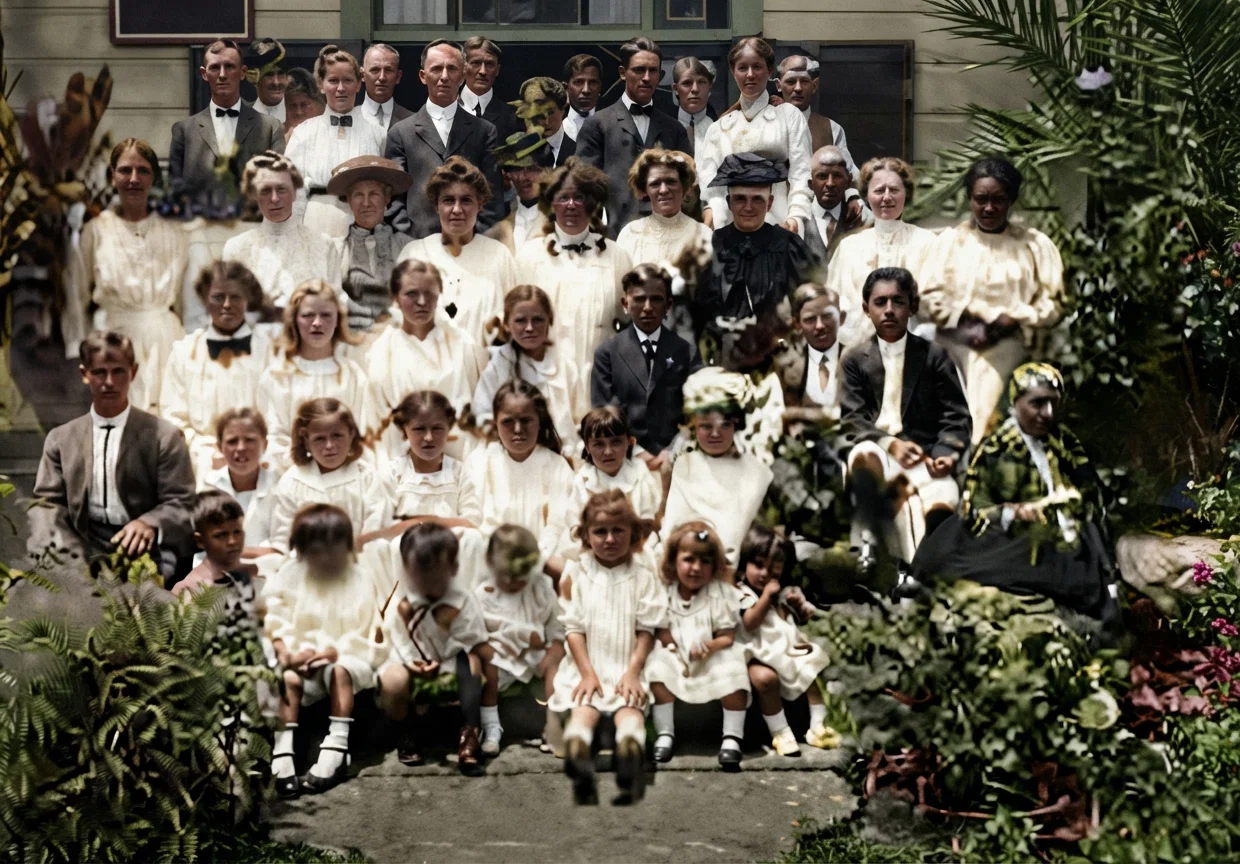
A group of the members of our church in Honolulu
THE ATTRACTIVE CLIMATE
One of the most attractive features of Hawaii is the climate. The morning after my arrival, I fell in with an old Scotchman; and in the course of our conversation, like all newcomers, I expressed my appreciation of the beautiful weather. "Yes," he replied, "this is like all the weather in this country, — never too hot nor too cold, never too wet nor too dry, always just right. I know, for I have lived here thirty years." That I found to be the opinion of all people who have lived in Hawaii for any length of time.
The report of the United States Weather Bureau at Honolulu for the year 1912 gave the following temperatures: highest in August, 87° Fahrenheit; lowest in February, 60°—a variation of 27° during the year. But this change was made so gradually that "the actual daily change in temperature for the twelve months was 1 1-10°."
In such a climate, vegetation flourishes the year around. The country is "evergreen," presenting at all times a bright, attractive appearance. The stately palms and the delicate ferns, the flowering trees, the trailing vines, and the blooming flowers of every variety, summer and winter, certainly give these islands good claim to the title of "Paradise of the Pacific."
CHARACTER OF THE ORIGINAL NATIVES
But the missionary features and problems of these islands interested me more than climate, foliage, commerce, governmental administration, or anything else.
The history of Christian missions in Hawaii has been deeply interesting from the day of Captain Cook's arrival among the people. He found very little approaching either European civilization or the Christian religion. The Hawaiians were not cannibals; they were not fierce and savage as some of the South Sea Islanders. Like all uncivilized heathen people, they carried on tribal wars, and showed little mercy to the defeated; yet on the whole they were docile, friendly natives.
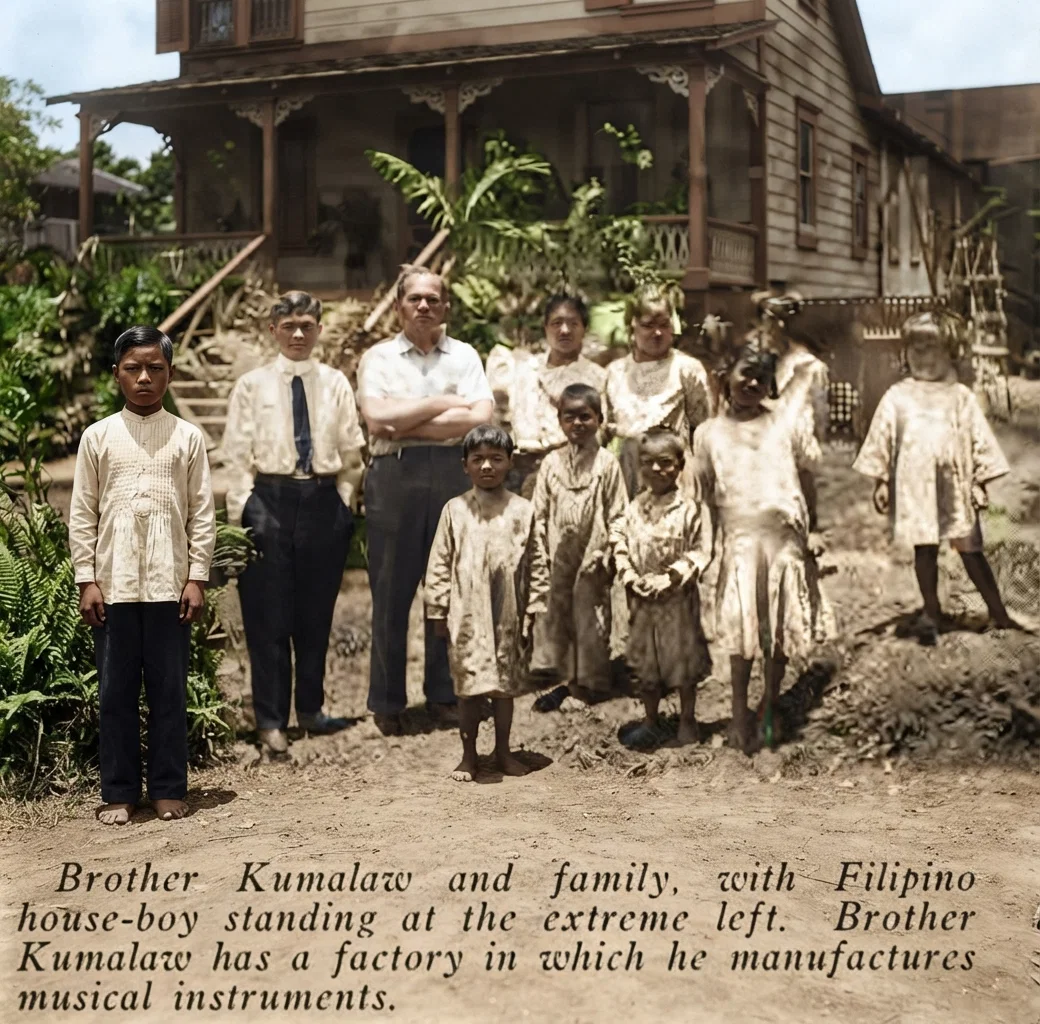
Brother Kumalaw and family, with Filipino house-boy standing at the extreme left. Brother Kumalaw has a factory in which he manufactures musical instruments.
Cook's announcement of his discovery, and his description of the people and their condition and needs, at once awakened an interest among mission boards in their behalf. This interest was deepened in America by the arrival in 1808 of two Hawaiian boys in a sailing vessel. These lads were landed in New York, and left to the demoralizing influences of the worst elements of the city; but they soon fell into the hands of Christian people, and yielding to the religious influences with which they were surrounded, they embraced Christianity. Their story of the intellectual, moral, and spiritual condition of their people led the American Board of Foreign Missions to send a band of missionaries to Hawaii.
FIRST CHRISTIAN MISSIONS
These missionaries sailed from Boston on the brig Thaddeus, October 3, 1819. There were seven in this company under appointment by the board — two ordained ministers, a physician, two school-teachers, a printer, and a farmer. These were accompanied by their wives and children, and three native Hawaiians who had embraced Christianity in America. In those days there was opposition, on the part of many, to the arrangement for the women and children of these missionaries to be taken among the heathen of those far-off islands.
As their course was around Cape Horn, the voyage was a long, hard, and dangerous one; but they weathered the storms, and after five and a half months, they dropped anchor on the west coast of the island of Hawaii, April 4, 1820. Before landing, the missionaries had communication with the king and his counselors, in which they explained the purpose of their mission,—to "teach Christianity, impart general education, and to give instruction in some of the useful arts of America." Permission was given them to land and to establish mission stations.
To these missionaries we are indebted for true, unbiased, and extended accounts of the Hawaiian people at the time of the arrival, and the marvelous changes that swept over the islands in the course of a few years. They also preserved in writing the origin, history, and religion of the people, as far as these could be gathered from stories, legends, and myths current at the time.
ENTHUSIASM CREATED BY THE PRESS
The missionaries entered upon their work with great earnestness and assurance of success. They learned the language and reduced it to writing. In due time they began to operate their printing-press. This created the greatest enthusiasm; and immediately the king, with members of his cabinet and court officials, became students in the mission school.
This example of the king and the most influential men and women of the islands was followed by the whole people. "In less than forty years, the missionaries taught practically the whole people to read and write, to cipher, to sew. They gave them an alphabet, a grammar, and a dictionary, thus preserving the language from extinction. They gave the Hawaiians a literature, and translated into it the Bible and works of devotion, as well as those of science, entertainment, etc. They established schools, trained native teachers, and so prosecuted the work that the proportion of those who could read and write soon exceeded that of our own14New England States. In community and home circles, they uplifted the people to a plane of morality justly comparable with that of any other land."
THE MORAL TRANSFORMATIONS
But that which the missionaries considered the greatest triumph of their work was the religious and moral transformation that was effected. Nearly the whole population of the islands accepted the gospel as taught by the missionaries. A great awakening of the conscience took place. Heathenism was renounced, the idols were destroyed, temples were demolished, polygamy was abandoned, and human sacrifices were prohibited. Churches were erected, Christian institutions were adopted, and religious services were held. The Bible was accepted as God's inspired word, to guide them in all the affairs of life. This change was not brought about by the slow, laborious process of evolution. It was wrought by the power of the living God, in a few brief years.
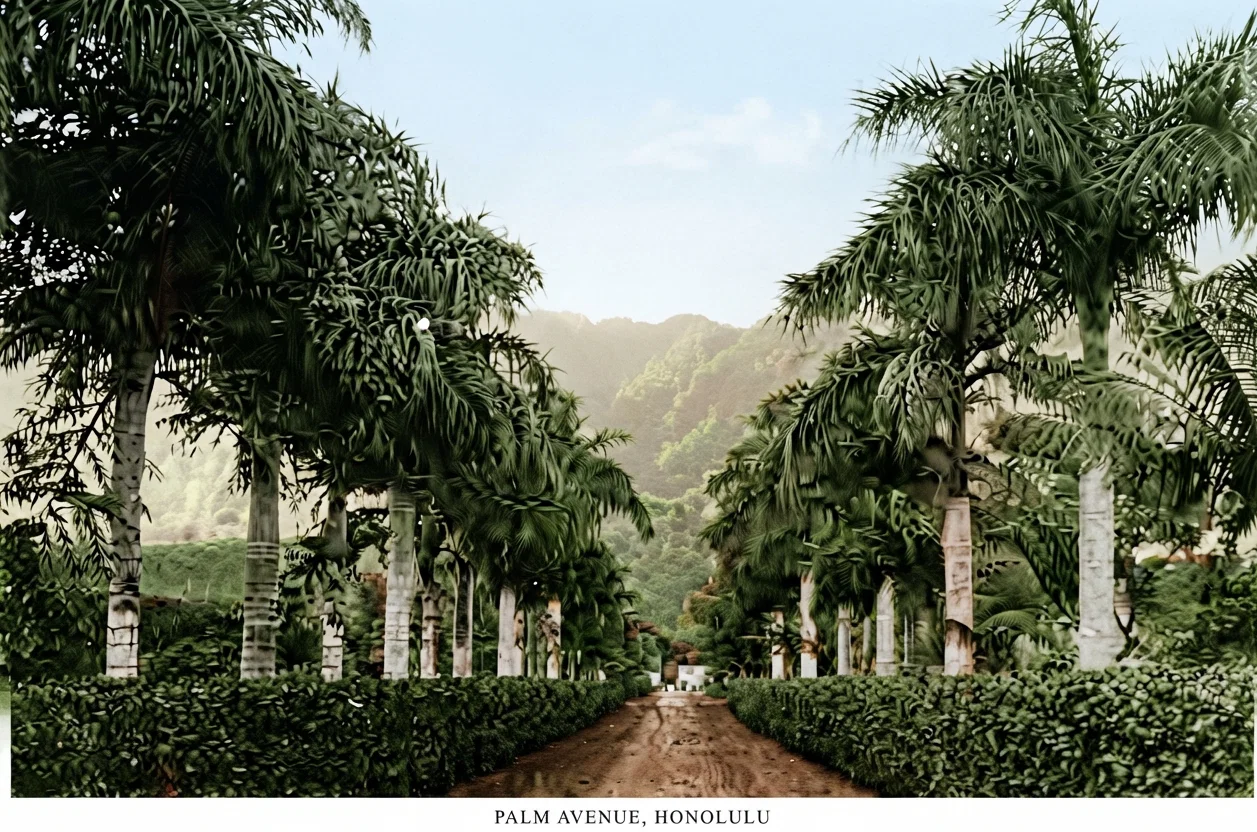
PALM AVENUE, HONOLULU
HAVOC OF EUROPEAN VICES
The evidence of the genuineness of this work was an amended and uplifted life everywhere seen among the people. But there is a sad and humiliating side to the story of the coming of Europeans to the Hawaiian people. Many of the sailors, traders, and visitors brought vices with them to which the Hawaiians had been strangers. Dishonesty, profanity, intoxicating liquors, tobacco, venereal diseases, tuberculosis, and other evils introduced among this simple people by Europeans have proved a desolating scourge.
The physical havoc wrought can be comprehended to some extent when it is understood that the number of these strong, sturdy people has been reduced from one hundred fifty thousand at the time they were discovered by Cook to twenty-five thousand pure Hawaiians at the present time. They are still going down, and it is only a matter of a short time when they will be extinct — wiped off the map of nations.
SAILORS AND TRADERS OPPOSED REFORMS
The earliest missionaries among these people realized the gravity of the situation they faced, and assisted by the chiefs, sought to remedy it; but the violent and infamous opposition of sailors and traders succeeded in keeping the flood-gates of vice open, with the terrible results already stated.
THE URGENT CALL FOR HELP
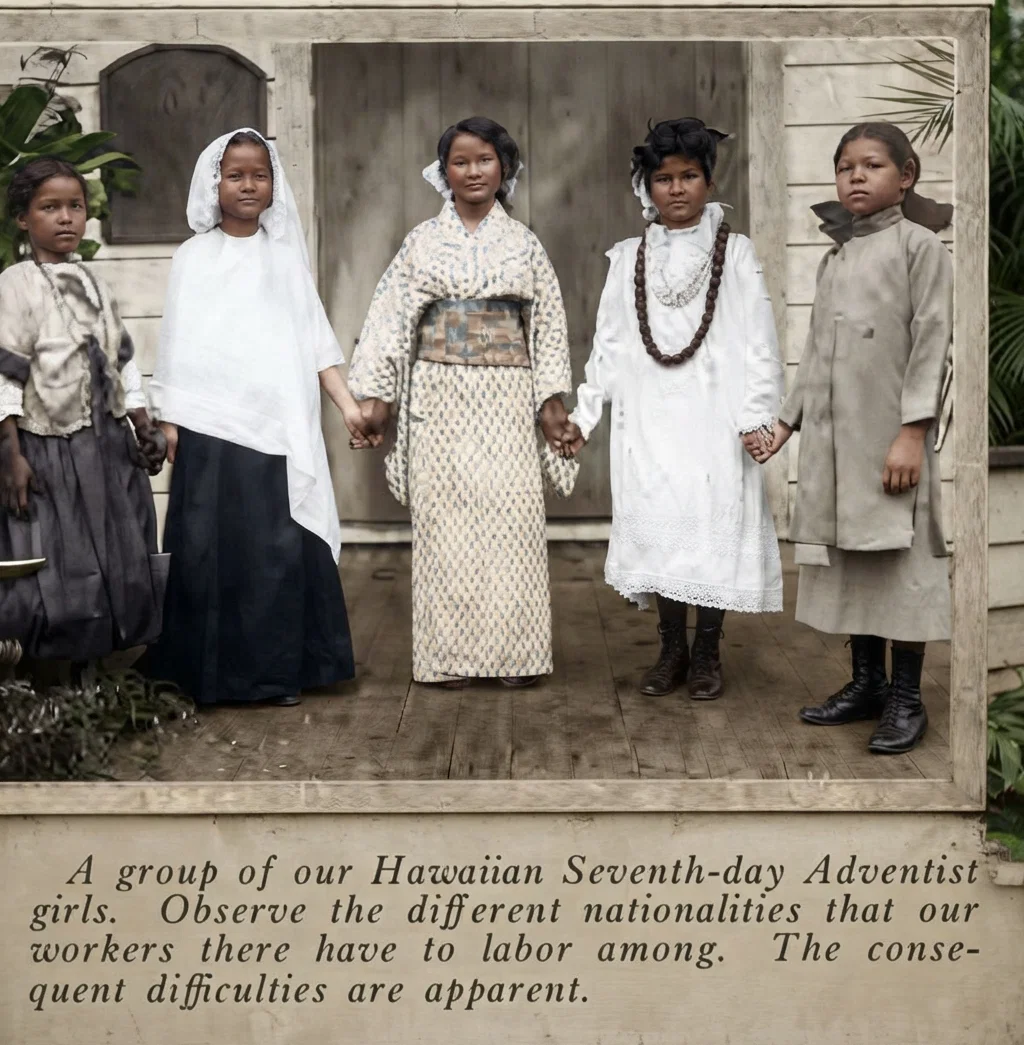
And now, after the splendid work of regeneration that took place nearly a century ago, Hawaii is in great need of the moral uplift that it is the aim of Christian missionary endeavor to give. It is not the Hawaiians alone that call for this uplift. That mixed aggregation of Japanese, Chinese, Koreans, and Filipinos presents a call for missionary service fully as urgent as that of the Hawaiians a century ago.
To assist in meeting this condition, we are maintaining a mission in the Hawaiian Islands at the present time. Three of our workers are located in the city of Honolulu, and two in Hilo, on the island of Hawaii. In Honolulu we have a book and tract depository, which carries a variety of religious literature in all the principal languages spoken in the islands. Our church-membership is composed of Europeans, Hawaiians, Chinese, Portuguese, etc. These believers join our missionaries in earnest, systematic efforts to place this Christian literature in the homes of the different nationalities to which they belong. It cheers our workers to find the people generally so ready to purchase and read our publications.
BIBLE STUDIES AND COTTAGE MEETINGS
As a result of this line of effort, homes are opened to our Bible workers to conduct Bible studies and cottage meetings. Later some who attend these, become interested enough to venture to the public services in the church. Thus patient, continuous effort leads one and another to accept the salvation that the death of our Lord and Saviour on the cross of Calvary made possible to all men.
MEDICAL MISSIONARY WORK
In addition to this direct house-to-house effort along evangelical lines, we are also carrying on medical missionary work. Our workers at Hilo are both trained nurses. In their home they operate a small dispensary, where they are able to treat various kinds of ailments. Here the poor of all classes may obtain help without charge. At the same time, these workers are prepared to give electric light baths, massages, and other advanced treatments for remuneration to those who are well able to pay. This enables them to do more for the unfortunate needy classes.
In the city of Honolulu, one of our representatives conducts a first-class hydropathic institution. This is a self-supporting enterprise, but it is called upon to do a great deal for the unfortunate classes. During the last two years, work amounting to over four thousand dollars has been done for those needing help but unable to pay. This kind of work is greatly appreciated by all classes in the islands.
Thus we are endeavoring to render all the help we can just where people need help, praying that Jesus, the lover of mankind, will bless our efforts to the saving of souls, which is our great purpose in all this service.
A group of our Hawaiian Seventh-day Adventist girls. Observe the different nationalities that our workers there have to labor among. The consequent difficulties are apparent.
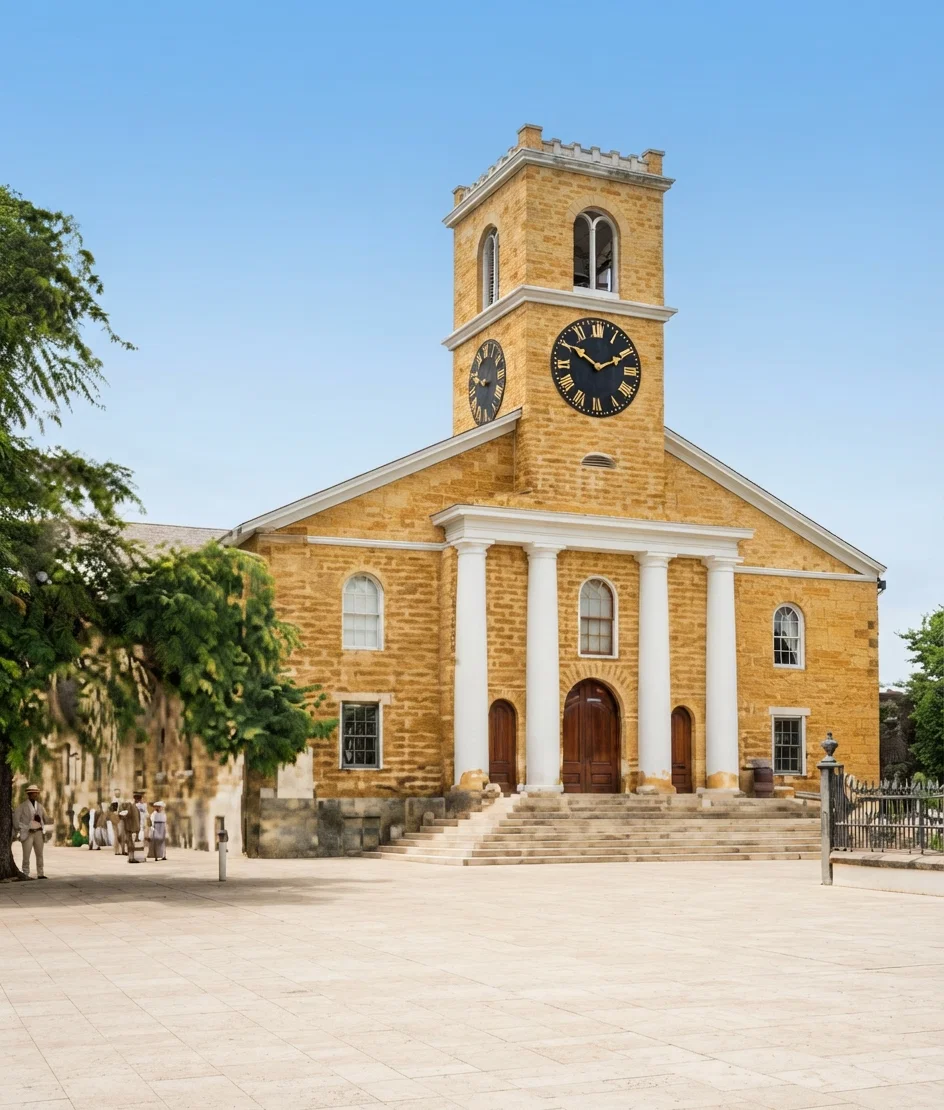
THE OLDEST HAWAIIAN CHURCH BUILDING, MADE OF CORAL ROCK
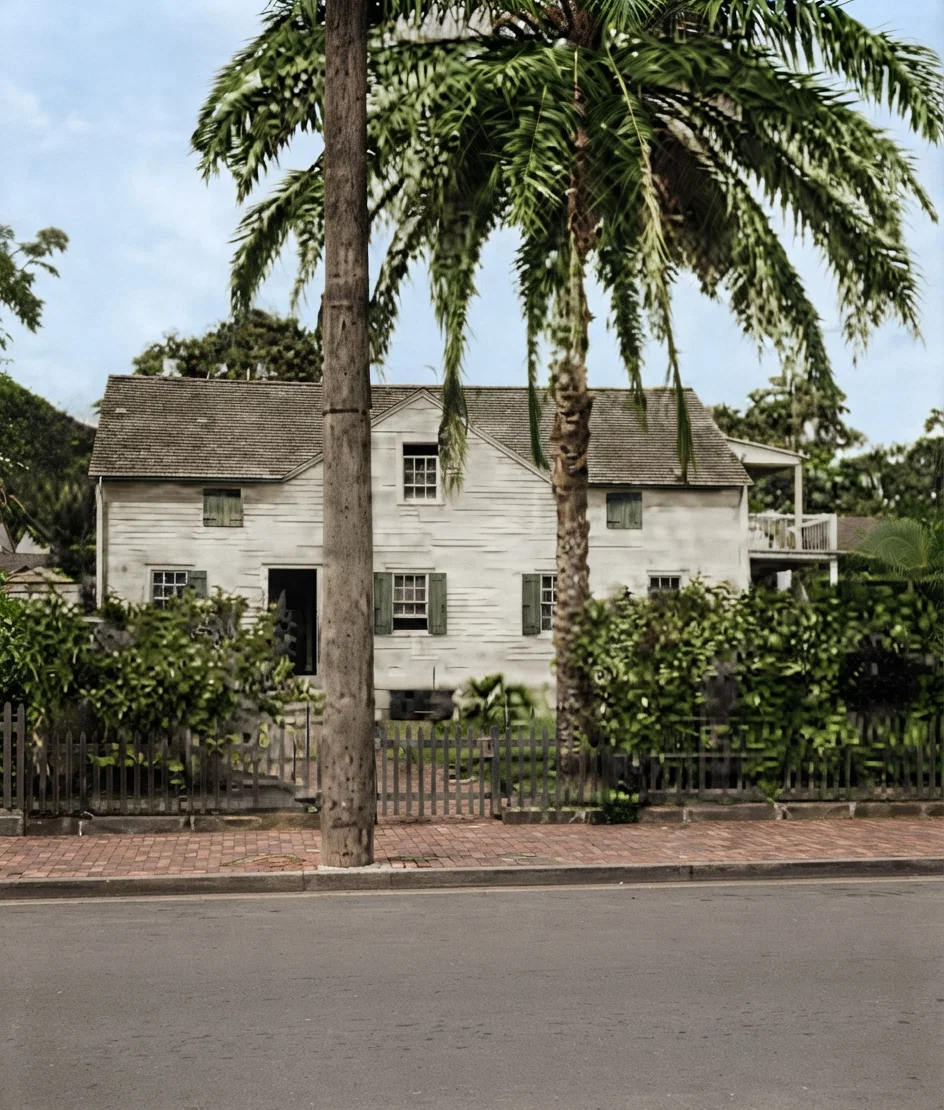
OLDEST WOODEN STRUCTURE ON THE ISLAND, BUILT IN 1830
Think Before You Speak
"THINK twice before you speak; then perhaps you will not speak."
The Cords of Love
By T. E. B.
IN drawing men to Himself while lifted up on the cross, Jesus still used the human cords of love and tenderness of those already won, to reach out for those perishing in their sins.
"TWO BOYS"—A STORY WITHOUT WORDS
By Editor
CENTER OPENING ILLUSTRATION OF THE
# Temperance Campaign Number
of the
# Signs of the Times
Dated September 1, 1914
Every reader of the SIGNS ought to circulate at least fifty copies of this great number
NOW READY TO MAIL
Single copies, 5 cents each; five to thirty copies, 3 cents each; forty or more copies, 2½ cents each
ORDER OF OUR DEPOSITORIES OR THIS OFFICE
Pocket Tract Package
By Editor
Number 2
Pocket Package No. 2
PROPHECY and the coming of the Lord are the two closely related subjects treated in our popular Pocket Package No. 2. Its assortment provides the six leading tracts published on these subjects, which during the first seven months of this year have had a sale of 263,000 copies.
There are twenty-two copies of these tracts in this strong manila envelope, giving you sixteen copies to pass on to friends, and a set for your personal study.
Address your tract society or
PACIFIC PRESS PUBLISHING ASSN.
MOUNTAIN VIEW, CALIFORNIA
Portland, Oregon Kansas City, Mo.
Calgary, Alberta, Canada
Daniel and the Revelation
MANY of the great world movements of the past and of the future were foretold in the two leading prophetic books of Scripture, Daniel and the Revelation. These prophecies are of vital import, and should be understood. "Daniel and the Revelation," a work written by Pastor Uriah Smith, a most able Bible writer, furnishes a verse-by-verse exposition of these two great books, giving consideration to every line of prophecy they present, and grouping historical facts relating to them. Some of its chapter titles are:
DANIEL
The Great Image
Belshazzar's Feast
The Four Beasts
The Seventy Weeks
Daniel's Last Vision
Closing Scenes
REVELATION
The Opening Vision
The Seven Churches
The Heavenly Sanctuary
The Seven Seals
The Sealing
The Seven Trumpets
Proclamation of the Advent
The Two Witnesses
Persecuting Powers Professedly Christian
The Three Messages
The Seven Last Plagues
Babylon
Triumph of the Saints
The First and Second Resurrections
The New Jerusalem
The bound work, containing 900 pages and more than 75 illustrations, is bound in durable cloth, half morocco, and morocco, and ranges in price from $3.00 upward.
A two-volume paper-covered edition in convenient form for study is furnished for the small price of 50 cents, post-paid.
Prices 10 per cent higher in Canada.
PACIFIC PRESS PUBLISHING ASSN.
MOUNTAIN VIEW, CALIFORNIA
Portland, Oregon Kansas City, Mo.
Calgary, Alberta, Canada
For Sale
Five-room cottage, with large sleeping porch, bath, hot and cold water, fireplace, two acres of land, with plenty of wood for fuel. Ten-minute walk from Pacific Union College, St. Helena, California. Would like to sell at an early date. For further information address Mrs. C. L. Taylor, St. Helena, California.
THE THREE BEST WAYS
BETWEEN
California and the East
The CENTRAL ROUTE
Less than three days to Chicago
The SOUTHERN ROUTE
All rail or via the palatial Southern Pacific
steamers between New Orleans
and New York
The SHASTA ROUTE
Via Portland or the North
The best of equipment and service
Protected throughout by automatic block signals
INQUIRE OF ANY AGENT, OR
MR. C. S. FEE
General Passenger Agent
San Francisco, California
SOUTHERN PACIFIC
SMALL WORKS ON
Christ's Second Coming
Matthew 24 — pamphlet — 96 pages . . . . 10 cents
Presents Christ's own prophecy, and cites
conditions which fulfil
His Glorious Appearing, 114 pages, cloth . . 50 cents
A careful study of the signs of the times
in the light of Scripture
TRACTS
The Great Day of the Lord . . (B.S.L., 65) .02
Manner of Christ's Coming . . (B.S.L., 124) .01
The Gospel Message for To-Day (B.S.L., 188) .01
Signs of the End . . . . . . . . (B.S.L., 194) .01
Add 2 cents for postage with order for less than
10 cents. Prices 10 per cent higher in Canada.
ADDRESS YOUR TRACT SOCIETY, OR
PACIFIC PRESS PUBLISHING ASSN.
MOUNTAIN VIEW, CALIFORNIA
Sanitarium Cooking Oil
"THE OIL OF QUALITY"
Pure Cotton Seed Oil direct from refinery. Sweet, wholesome, and delicious. 4 1-gallon cans, $3.60; 5-gallon can, $3.90; 2 5-gallon cans, $7.70; 30-gallon barrel, $20.80; 50-gallon barrel, $32.75. Cash with order. Sanitarium Cooking Oil Co., Louisville, Kentucky.
"Tormented Forever and Ever"
One of the most fearful utterances in the whole Bible regarding the wicked, a wrong conception of which has made men infidels. This tract presents an exposition of the text which is reasonable and just—a vindication of God's character. B. S. L. No. 111. Price $1.00 per hundred; single copies, 2 cents.