The Youth’s Instructor, Vol. LI, No. 43

A Trip Through Egypt — V

The Youth’s Instructor

Oct 27, 1903

Review and Herald Publishing Assn. · Washington, D. C. · Oct 27, 1903

A Trip Through Egypt — V

Luxor and Karnak
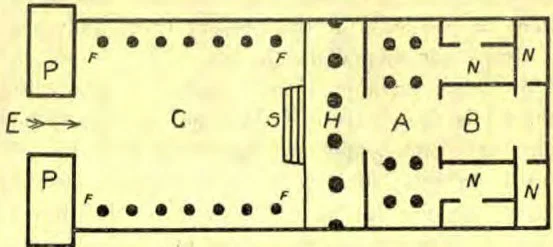
BEFORE visiting the ruins of Upper Egypt, we will notice the general plan of Egyptian temples, and some of the terms that are used in describing them, so that the reader may more intelligently follow us. Taking the small temple of Rameses III at Karnak as a typical example, we notice first in the diagram the pylons (PP), two large rectangular towers, tapering toward the top. Between these is the portal (E), or gateway, above which the pylons meet. This gateway leads into a large court (C), open above, but usually surrounded with a colonnade (FF), or row of columns. Traversing this court, and ascending a short, broad flight of wide steps (S), we reach the terrace (H), a broad porch, the roof of which is supported by large columns. Back of this we find the hypostyle hall (A), a large and often imposing hall of massive columns. Still beyond is the sanctuary (B), or holy place, often perfectly dark, surrounded by the private chambers of the priests (N). This, with various modifications and embellishments (some of the parts often being repeated) is the general plan of all the ancient Egyptian temples.
Even a slight knowledge of the hieroglyphics of the cuneiform writing and the religion of the ancient Egyptians adds greatly to the interest in exploring these ruins. A few hours’ occasional study, combined with careful observation of the reliefs one encounters, will soon give some knowledge of the alphabet; and a little practise will enable the traveler to recognize at once the representations and symbols of the more common deities; while, if persistent, he will soon find himself searching with feverish interest, and often successfully, for the cartouche (seal) of some king mentioned in his guide-book. Of course a knowledge of Egyptian history is essential to maintaining or even producing an interest in this kind of work.
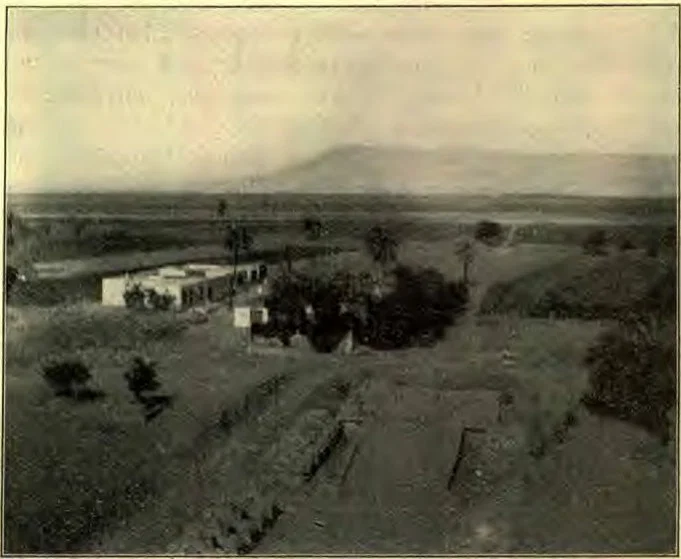
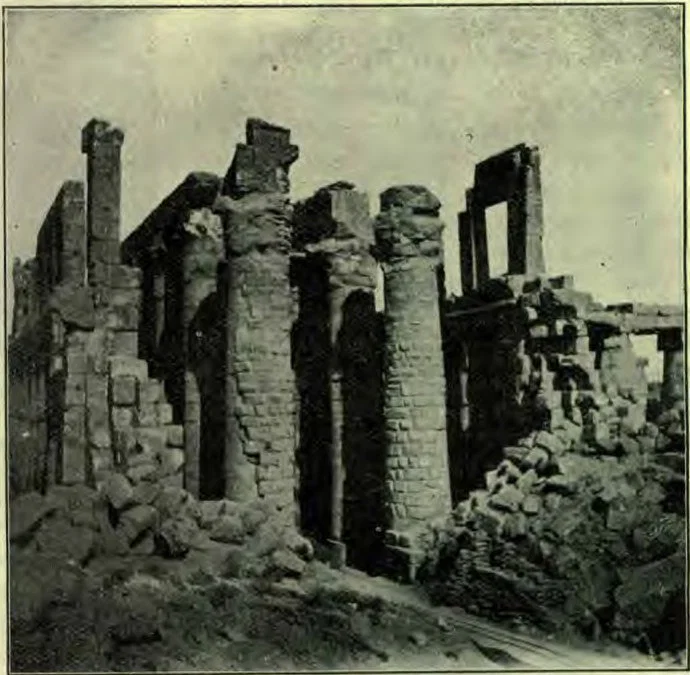
VIEW FROM FIRST PYLON AT KARNAK
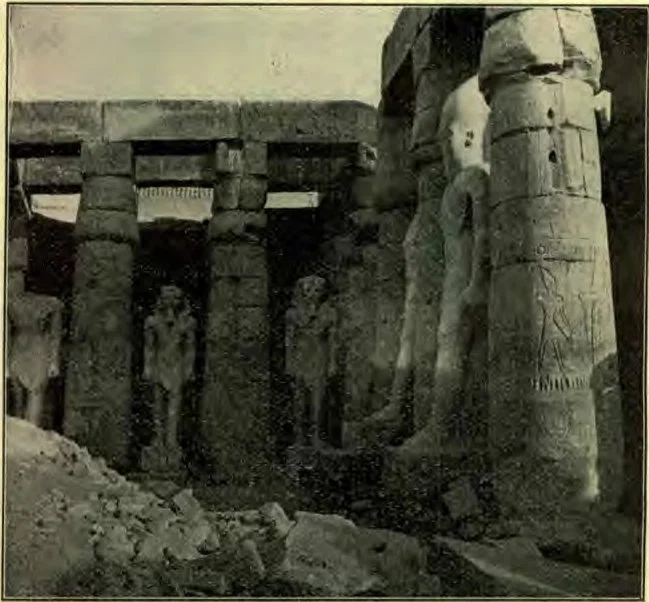
With this introduction, then, we will visit first the large temple of Amenophis III at Luxor. In front of the ruined pylons are six large colossi of Rameses II. Entering the large court, we find one corner of it embellished by a small mosque, while just opposite is another fine black granite statue of Rameses II, who has left his mark on most of the temples, having built as many as all the other monarchs of Egypt combined. Leaving this court, we pass between two stately rows of massive columns (see illustration) into a second court, less pretentious but better preserved than the first, beyond which is the comparatively small hypostyle hall. The sanctuary back of this hall is divided into two sections, reminding one of the Holy Place and Holy of Holies in the Jewish tabernacle, and abounds in interesting inscriptions.
COLOSSI OF RAMESES II IN THE FIRST COURT, LUXOR
Having completed the exploration of the Luxor temple, we hire donkeys, and start with eager expectancy for Karnak. The principal temple here, dedicated to Ammon (the national Theban sun-god), was probably founded during the twelfth dynasty; but nearly all the later kings took a part in its construction, many of them erecting smaller private shrines within the temple grounds. Especially did the mighty monarchs of the eighteenth and nineteenth dynasties vie with one another in the magnitude of their designs, adding pylon after pylon, colonnade after colonnade, lavishing the enormous spoils of their numerous campaigns on the shrine of Ammon, until it became the most extensive and magnificent temple in existence, the “throne of the world:” and to-day its stupendous ruins are ranked in the mind of the traveler with the pyramids of Gizeh as the mightiest of all the monuments of antiquity.
The temple grounds are approached by four avenues of sphinxes, one of which was originally nearly a mile long. Entering the great court through the first pylon, which is one hundred yards long and fifty yards high, we ascend at once to its summit, from which a good general view is obtained. West of us flows the Nile, while beneath is the avenue of sphinxes we have just traversed. To the south are various pylons and small temples, the columns of the Luxor ruins rising above the town. To the northeast, among the chaotic ruins of the great temple of the middle empire, stand two great obelisks.
Plan of the temple of Rameses III
at Karnak.
(Scale one inch=48 feet.)
Plan of the temple of Rameses III at Karnak. (Scale one inch=48 feet.)
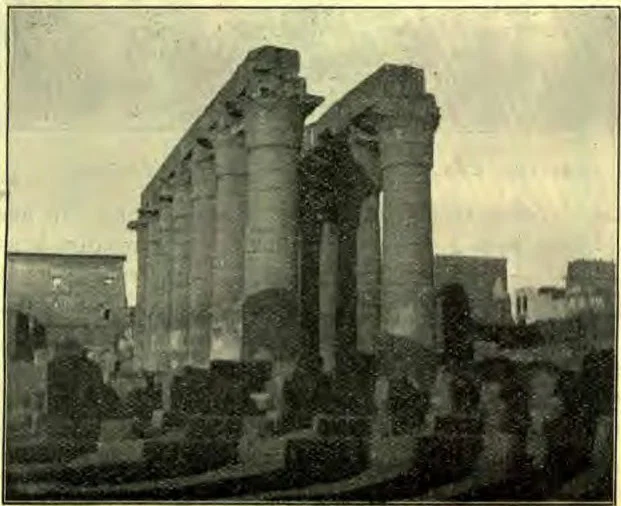
Descending, we traverse the court, passing the temple of Rameses III, which opens onto it; and entering a portico, we find the interesting monument of Sheshonk, commemorating his triumph over Rehoboam, king of Judah. See 1 Kings 14: 25, 26, and 2 Chron. 12: 2-9. We next pass beneath the large second pylon of Rameses I, and enter the hall of columns, the crowning wonder of Karnak. The roof of this imposing hall is supported by one hundred and thirty-four columns, arranged in sixteen rows. Many have fallen, and others are leaning; yet still the effect is indescribably wonderful. Especially by moonlight, when the inky shadows of the columns fall one upon another, the charm of the place is almost intoxicating. Perhaps some idea of the magnificent proportions of this grand hall may be conveyed by the statement that each of the columns that line the central aisle is eighty feet high and over thirty-five feet in circumference. The entire hypostyle hall covers about two acres.
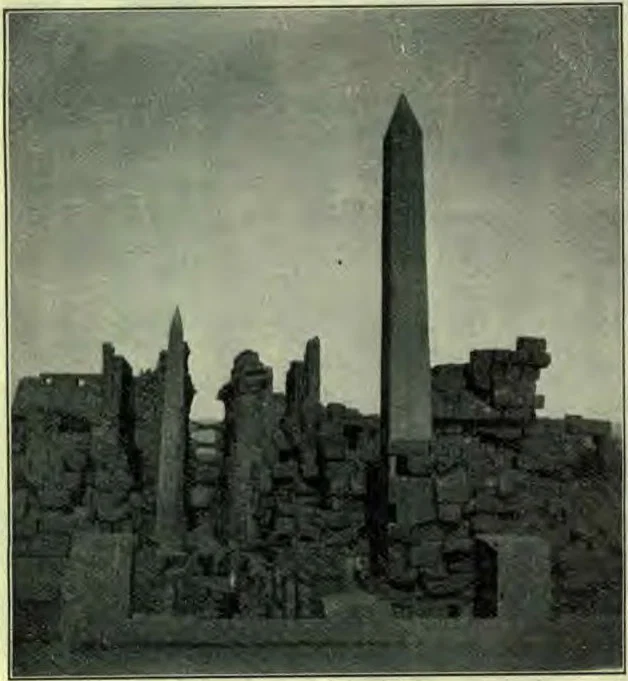
LARGE OBELISK AND RUINS, KARNAK
We pass from this hall into the hopeless ruins of the earlier temple. Conspicuous are the two great obelisks of Queen Makare, which were cut from a solid piece of the finest Assuan granite, and brought one hundred and forty miles down the Nile. One has fallen, but the other, which is nearly one hundred feet high, and nine feet square at the base, stands as the largest obelisk in the world, save one in Rome. The upper part of this obelisk is plated with a gold and silver electrum. Farther on, is another obelisk of smaller size and less interest.
Time forbids us to visit the many smaller temples and monuments that crowd this interesting place; so we depart, but only with the determination soon to visit again these magnificent ruins.
GLEN WAKEHAM.

A Cuban Type

She was a swarthy Cuban woman, accompanied by her daughter and little grandson. They were waiting for the train among the hills of western Santiago. She puffed away at an unusually large cigar. Her strong features were set and stern. “Here,” I thought, “is a feminine type of the hard and unfeeling side of Cuban peasant life.” But when train time came, I saw that the stern features were all along repressing the pain of parting. With a good-by caress to the daughter, the grandmother held the little grandson long to her breast, smothering his face with kisses. As the train drew out, she sat staring to the front, the tears rolling down her furrowed cheeks. Her face had lost its sternness. Poor soul; she was no longer a type, but just a simple grandmother. Nobody had ever told her the evil of the tobacco habit, or that it is out of character for women to smoke. She had a motherly heart all the same. One can never tell how tender a heart may beat beneath an unpromising exterior. Once let the light of the gospel in, and evil and ungraceful habits, born of ignorance, may drop away, and lives will be transformed and beautified. The old Cuban woman helped me to a more sympathetic appreciation of the rougher types of Cuban peasantry.
W. A. Spicer.

Rambles in Bermuda—VI

The Churches of Bermuda

No doubt INSTRUCTOR readers would like to know something of the religious conditions prevalent in Bermuda at the present time, and especially of our own work there.
As stated in a previous article, the prevailing church is the Church of England, or Established Church. The people are nearly all churchgoers, but have little idea of religion in the sense in which we use the word. The English Church, like the Roman, caters to the innate tendencies of the human heart toward formality and attention to externals, without the inward work of grace that must mark every true follower of Christ. The children grow up knowing little of the Scriptures,—that little mostly comprised in the catechisms. It is not unusual to find an intelligent and well-to-do family without a copy of the Bible.
According to the usages of the church, the children are baptized when only a few days old, and are confirmed usually between the ages of thirteen and fifteen, often not knowing the intrinsic difference between right and wrong, nor experiencing any change of heart. This is not to be wondered at; for the life of the church-member differs little from that of a man entirely without religious belief. Cards, dancing, theatricals, every amusement that appeals to a worldly heart, may be enjoyed by him without let or hindrance.
The earliest Wesleyan missionaries who found their way here were persecuted and imprisoned; but eventually they succeeded in bringing out a small number of followers. We are still shown the wide-spreading tamarind beneath whose shade Whitefield addressed those who could be found willing to listen to his stirring exhortations. At present the Wesleyan Methodist is second to the Established Church in numbers, having a large congregation in Hamilton, besides several smaller ones in various parts of the islands. Like Methodism in our own country, the present church, neglecting to follow advancing rays of light, has backslidden to the conditions prior to the revivals of John Wesley; and the difference between it and the English Church is little more than a matter of form.
Knowing by experience that the chief hope of the church is in the rising generation, the Catholics have established a convent school in Bermuda. This has greatly strengthened its foothold in the islands. The school building, a handsome structure, was finished less than ten years ago, and furnished with several teachers. A beginning was made with two pupils; but the attendance has steadily increased, until now it is second, in standing and patronage, only to the government high school.
There are, in addition, an African Methodist Episcopal church in Hamilton, and a Reformed Episcopal church in St. George’s. There are a few other religious organizations which, like the Salvation Army, work almost entirely among the lower classes.
It is some time since the first seeds of present truth were sown in Bermuda by a canvasser. A colored man, Read by name, had spent a few years in Battle Creek, and accepted the Sabbath. On his return he scattered reading-matter throughout the islands, and sold copies of “Great Controversy.” At least one family came to a knowledge of the truth through this literature. Later, Brother Marshall Enoch and his wife came from Nova Scotia, and began to work as self-supporting missionaries. In connection with his business, Brother Enoch found many opportunities to present the truth to many different classes of people, while his wife carried on a private school until failing health compelled her to give it up.
It was in response to her call for a teacher that I went to Bermuda. I was agreeably surprised, on the opening day, to find before me a company of as bright-faced, well-dressed little folks as could be found anywhere in our own land. Teaching everywhere has its trials as well as its joys; but as I look back over the two years spent there, the joys far exceed the trials. While it was thought best that I should be careful not to arouse prejudice by too radical a presentation of doctrinal points in the school, I enjoyed many hours of precious Bible study with the children, and it was indeed a pleasure to see their little minds awakened to an understanding of Bible truths. Such exclamations as the following were not infrequent: “I told papa what we read about yesterday, and he says that Saturday is the Sabbath;” or, “I want to be good, so as to be ready to meet Jesus when he comes.” One little girl had quite fully made up her mind to be a missionary. While my interest has always been in Spanish-speaking countries, and the coming of the minister appointed to Bermuda released me to take up my chosen work, yet it was with feelings of real regret that I said good-by to my pupils. I hear from some of them occasionally; and it is my hope that the seed sown may yet spring up and bear fruit to the glory of God. Brother and Sister Bartlett, who took up the work after my departure, found their health unequal to the strain and the somewhat peculiar climatic conditions.
Since coming to Mexico, I have been gladdened by the reports in the Review from Brother Morrow, who has been working there for some months. Only those who have lived in Bermuda know just how difficult are the conditions and how determined the opposition; but in spite of it all, a few faithful souls are holding up the torch of present truth. Surely the shining of their light will dissipate, to some extent at least, the surrounding darkness. The leaven of the printed page has been scattered by faithful canvassers, and God will surely call out his children. Will not the readers of the INSTRUCTOR remember in their prayers this little corner of God’s great harvest-field?
WINIFRED M. PEEBLES.

A Sister's Influence in the Home

No household is complete without a sister. She gives the finish to the family. A sister’s love, a sister’s influence—what can be more hallowed? A sister’s watchful care—can anything be more tender? Who would live without a sister? A sister—that is, a sister in fidelity, in help, in love—is almost an angel in the home circle.
EASTERN END OF HALL OF COLUMNS, KARNAK
To every brother she is a light and life. Her heart is the treasure-house of confidence. In her he finds a vast friend—a charitable, forgiving, tender, though often severe, one. In her he finds a ready companion. Her sympathy is as open as day, and sweet as the fragrance of flowers. We pity the brother who has no sister, no sister’s love. We feel sorry for the home circle that is not enlivened by a sister’s presence. A sister’s office is a noble one. It is hers to persuade to virtue, to point wisdom’s ways, and gently to lead the way.—Classmate.

The Second Coming of Christ

THE most sublime event in the history of this earth is that of the second coming of our Lord in glory. Around it cluster all the most interesting scenes portrayed by the divine pen. Many occurrences in human history have emblazoned themselves in the annals of time. The accession of kings upon earthly thrones have been attended by majestic splendor. Immense processions, equipped with gorgeous paraphernalia, have been formed in their honor, and kingdoms have done themselves proud.
But all these fade like the stars before the rising sun in comparison with the matchless glory of that triumphant hour when Jesus comes, crowned “King of kings, and Lord of lords,” to gather to himself the faithful and true of every age and every clime.
This coming is spoken of in the Bible as the time of the harvest. “The harvest is the end of the world.” Matt. 13: 39. It is at the time of the harvest that the tares, or the wicked, are gathered and cast into the fire, and the righteous “shine forth as the sun in the kingdom of their Father.” Verses 40-43. When Jesus comes to reap the harvest of the earth, all the angels in glory will come with him. They are interested in this great event. They love poor, lost sinners, and would have been willing to give their lives to save man from the ruin of sin. All through life we have one of the shining visitors from the celestial world with us. “The angel of the Lord encampeth round about them that fear him, and delivereth them.” All through life, in the dark hours of sorrow, in trial and anguish of spirit which no tongue can utter, in the hour of death, when we stand in brokenness of spirit by the cold grave, the angel who through life watched over our loved one, is also standing by the grave. When Jesus comes, these reaper angels will all come with him, and will be sent by him to gather in from the tomb his loved ones.
It is when our Saviour returns, and not at death, that the righteous receive their reward. It is at this glad hour that they come forth with a triumphant shout from the tomb. “For the Lord himself shall descend from heaven with a shout, with the voice of the Archangel, and with the trump of God: and the dead in Christ shall rise first: then we which are alive and remain, shall be caught up together with them in the clouds, to meet the Lord in the air: and so shall we ever be with the Lord. Wherefore comfort one another with these words.” 1 Thess. 4: 16-18. It is when the chief Shepherd appears that we receive the crown of life. 1 Peter 5: 4. “And, behold, I come quickly; and my reward is with me, to give to every man according as his work shall be.” Rev. 22: 12.
To comfort the hearts of the sorrowing disciples, the Saviour told them he was only going away to prepare a place for them, and that he would come again, and receive them unto himself, where instead of beholding sin and sorrow they would see the glory which he had from the eternal ages. John 14: 1-3; 17: 24. Everything centers in the promise of the second advent of our Lord. Without it our faith is vain, and our hope is lost. It has been an anchor to the soul of many a storm-tossed pilgrim. It has buoyed up the faltering footsteps of an unnumbered host of toiling saints while bivouacked on the battlefields of life. The promise left by the Saviour to return again has revived their drooping spirits, and encouraged them to struggle on and win the reward. It is not a new doctrine. It is as old as the Bible. Enoch, the seventh from Adam prophesied of it before his translation. Job in the midst of his affliction was comforted, and said, “For I know that my Redeemer liveth, and that he shall stand at the latter day upon the earth.” Job 19: 25. David, the sweet singer of Israel, spoke of it as the time of reward. Ps. 50: 3-5. Isaiah exhorted the weak and discouraged to be strong with the thought that the Lord will come with a recompense. Isaiah 35. And the great apostle Paul in his old age, writing from a Roman dungeon, says: “For I am now ready to be offered, and the time of my departure is at hand. I have fought a good fight, I have finished my course, I have kept the faith: henceforth there is laid up for me a crown of righteousness, which the Lord, the righteous Judge, shall give me at that day: and not to me only, but unto all them also that love his appearing.”
The crown was “laid up” for him. He did not expect to receive it at death, but at “that day,” the day when Jesus comes. What a glorious crown is this! It is worth far more than any jewel-studded emblem of sovereignty that ever rested upon the brow of any earthly monarch. Though a prisoner, Paul was rich. Though trials and persecutions had overtaken him because of his faith in Christ, he was not discouraged; he called it a “good fight,” looking beyond the present to the day of reward. And I think I can hear him place special emphasis on the word “righteous.” When he wrote, the edict of an unrighteous judge had sentenced him to prison and to death. But when the “righteous Judge” shall come, the verdict will be changed, and justice rendered, and instead of a felon’s cell, a crown of life will be given him. No man stood by Paul to plead his cause in the hour of need. Shivering in his cold, damp cell, he writes to Timothy to hasten to him before winter and bring his cloak. But his courage was undaunted. He was “ready to be offered.” His blood was not chilled with the thought of the nearness of his “departure.” In a little from this the aged hero was led from his dungeon to the place of his execution. But the block and gleaming sword of the executioner did not frighten him. There was no friend to attend him to the place where he was to lay down his life. There were none to shed a tear or speak a word of courage. But the blessed hope of soon seeing his Lord anchored his soul. And one writer tells us that the last words he ever spoke as he lifted his eyes to the heavens, were, “O Lord, when shall I embrace thee? When shall I behold thee for myself without a dimming veil between?” When the Life-giver speaks Paul back to life in the resurrection, he will not be conscious of a moment intervening since he fell beneath the blow of the Roman executioner, and he will behold his Lord in joy.
“In expectation sweet, We’ll wait, and sing, and pray, Till Christ’s triumphal car we meet, And see an endless day.”
G. B. Thompson.

Victory at Last

RING out, O bells of heaven! Ring out your joyous peal; Let the happy hearts of angels An untold rapture feel; Make ready the many mansions, And white robes of the blest, While dazzling crowns of glory On the victors’ brows shall rest. Oh, welcome the tried and faithful To the love and joy of home,— Welcome the glorious morning When the Lord shall claim his own!
Ring out your music tender, Ring through the happy hours, In that home of matchless splendor, In the land of fadeless flowers. Let the pulse of your joyous echoes Throb through the courts of heaven, Sound a welcome to the ransomed, The white-robed throng forgiven, Peal anthems of rejoicing, Send far your thrilling tone, All hail that glorious morning When the Lord shall claim his own!
O glad, immortal city, Where sin has never trod! O home of love and pity! O dwelling-place of God! How shall your bright streets golden Be filled with joyous throngs, How oft the story olden Be sung in victors’ songs? Long shall their notes of gladness Be heard ’neath heaven’s dome,— Welcome that glorious morning When the Lord shall claim his own!
The litany of nations Shall rise before the Lamb, From all the new creation One glad thanksgiving psalm, That the grave’s dark bands are broken, And the spoiler is laid low; That the years no longer carry Their tide of sin and woe; That life’s weary toils are ended, And the children all at home,— All hail the glorious morning When the King shall claim his own!
The rush of rapid rivers But hastens to the sea, And time’s swift years, fast rolling, Bring near eternity. Oh, our hearts with deep emotions Of gladness throb and thrill, As we think of the coming glory, Free from all earthly ill. Never a shade of sadness, Never a sigh or moan,— Welcome the glorious morning When the Lord shall claim his own!
O lovely vale of Eden! O pastures green and sweet! O river of life’s water! How we’ll soothe the weary feet; How lonely hearts so dreary Shall find in thee a balm, And hands with labor weary Shall bear the victors’ palm; How they’ll clasp the hands once perished, How they’ll list the sweet, lost tones,— Hasten, thou glorious morning, When the Lord shall claim his own!
L. D. SANTEE.

Building Lasting Service on Firm Foundations

The older one grows, the greater the hunger of his heart to do things worth while, that will be permanent and enduring. This is not the feeling of only a few people, but is shared by many of the world’s toilers. It is a beautiful thing, this desire to do abiding things, to build into the eternal structure. But if the longing comes only with increasing years, there are many who will see their life-building sink away at the last, and they will die broken-hearted. For this reason you can not build strongly in the later years upon the sand foundations of earlier years. If he is foolish who builds with wood and hay and stubble, just as foolish is he who builds upon the sands of a shifting and uncertain youth; the fall of his building will be greater than the destruction of the other. The abiding service of the later years will depend largely upon the faithfulness and stability of the earlier years.— Young People.

The Young People's Conference at Peru, Indiana

THE following report of an interesting meeting of the young people of Indiana is reprinted from the State paper:—
Thursday, August 6, was set apart for the Young People's work at the Peru camp-meeting. The forenoon was devoted to the Young People's Societies, and the afternoon and evening to the educational work.
I wish to speak especially of the Young People's part in the work of the day. Fathers and mothers, and others in the congregation who have not before been keeping pace with the Young People's work, listened with attention while the various phases of the movement were presented and discussed by the young people themselves. The plan and aim of the organization, the needs of our young people, and the various lines of missionary work in which they can engage, were set forth as fully as the time would permit. Many realized for the first time that there is indeed a definite call to our young people to have a definite part in preparing the way for the soon-coming Saviour, and that “the movement truly is of God at this time, and to meet the call of the hour.”
A very practical demonstration of what the young people can do was shown in their work of distributing tracts. The city was districted, and companies formed who went out in twos, carrying to each home a package of the late tracts. Many of these were sold, and many persons interested. One company reported sixteen families in their territory desirous of knowing more of the truth. Through their efforts nearly every home in the city was reached.
As our young people consecrate their lives to the service of God, and go forth to work for the salvation of souls, they have the assurance that “they are co-workers with the angels;” rather, they are the human agencies through whom the angels accomplish their mission. Angels speak through their voices, and work by their hands. And the human workers, co-operating with heavenly agencies, have the benefit of their education and experience. As a means of education, what university course can equal this?

THE WEEKLY STUDY

Luther’s Early Experiences

SCRIPTURE STUDY:—
Review the Bible lesson for last week, and develop the same line of thought still further by looking up additional scriptures.
PARALLEL READING:—
Read again Chapter Seven in “Great Controversy,” and study the early experiences of Luther under the following divisions, so as to be able to tell the story briefly in your own words:—
  1. Luther’s parentage and childhood.
  2. His education at Erfurt.
  3. His discovery of a Latin Bible in the monastery, and his experience in reading it.
  4. His first visit to Rome.
  5. Pilot’s staircase, and Luther’s experience in his first attempt to climb it upon his knees.
  6. Luther as a teacher of the Scriptures and as a minister of the gospel in the University of Wittenberg.
  7. The sale of indulgences by Tetzel in Germany. What were these indulgences? How were they sold? What was Luther’s attitude toward them?
  8. Luther’s protest against the sale of indulgences by his famous ninety-five theses. Where were these theses made public?
  9. Luther’s trial before a Roman prelate at Augsburg.
  10. Burning the pope’s bull.

To the Leader

This outline may seem a trifle long and heavy; but with careful management it can be covered easily in forty-five or fifty minutes. It may be well for the leader to introduce the exercise by giving the review Bible study. This should occupy from ten to fifteen minutes.
One week before the meeting is held, ten persons should be selected, and one of the topics assigned to each. Arrangements should also be made for each one to look up his topic carefully, and prepare to present it either verbally or in writing, occupying not more than three or four minutes. If a longer time is allowed, the exercise will become monotonous and tiresome.
As leader, you should make yourself thoroughly familiar with these topics, so you can assist if necessary those who present them. Improve every opportunity to impress important lessons. This history of the Reformation is replete with suggestions and striking experiences which ought to prove a great blessing to our young people.
Our hope and prayer is that these studies shall stir the hearts of many of the young among us, and lead them to throw themselves into the last great reformation just as Luther threw himself into the Reformation of the sixteenth century. May the Lord bless the leaders, and help them to be leaders indeed.

Mancelona Young People's Convention

At the camp-meeting held at Mancelona, Michigan, it was voted to hold a Young People's convention at the close of the camp-meeting, and the tents were left standing for that purpose. Although the weather was quite bad all through the convention, it is estimated that about one third of the young people in the North Michigan Conference attended the convention.
The thought held prominently before them was that the one object in life is the saving of souls. Elder Luther Warren was present throughout the meeting, and rendered valuable assistance. Members of the Conference committee and Conference workers were also present.
In the opening meeting the direct call of God to the young people of this remnant church was given, and the thought was emphasized that God would have an army of well-disciplined workers who will be willing to obey their Commander. An executive committee was appointed, also a committee to consider plans, and another to arrange programs for the meetings.
At later meetings, the following recommendations were passed:—
  1. That a Young People's Society be formed where there are two or more young people who love Jesus, and desire to associate together for prayer and the service of God.
  2. That our young people take up the studies given in the YOUTH'S INSTRUCTOR for Young People's Societies.
  3. That the Young People's Societies of the North Michigan Conference undertake the raising of necessary money to establish an industrial school in the Conference.
  4. That the offerings of the Young People's Societies be paid to the Conference treasurer once a month, and by him kept separate for the special work mentioned in the preceding resolution.
  5. That Conference workers use their influence for the establishment of Societies throughout the Conference.
The consideration of these resolutions brought out much valuable discussion. The value of organization, the qualifications for membership, and the work that the Societies should do were especially emphasized. The benefit of having a specific object to which financial aid should be given was recognized by all, and a very hearty vote was taken in favor of Recommendation 3. The young people were especially urged to make use of the INSTRUCTOR studies for the Societies. Valuable experiences were related which demonstrated the practical value of these studies. The need of applying the principles set forth in the studies to our daily lives was presented.
The convention was a success. The young people who were there realize the importance of the work, and the work is onward.
J. J. IRWIN, Chairman.
Continue reading: Martin Luther