One of the watchwords of the day in political, religious, and religio-political circles is “reform.” The very welkin rings with the word. Societies, guilds, leagues—organizations of all sorts—are springing into existence to further the cause of “reform” in nation, state, municipality, church, or somewhere else.
Much is said of reform on the Sabbath question in various ways. It is preached from pulpit and platform, by legislators and prelates. The Sabbath question is coming to be THE QUESTION in both political and religious circles in all the civilized countries of the world.
What is the true basis of this reform? As the Sabbath question is in its origin purely Biblical and religious, what does the Lord have to say of this reform in his holy word?
A Striking Parallel.
“History repeats itself.” God warns men and peoples by the examples left on record before. God’s prophets spoke to his people in the generations in which they lived, but they wrote for all time to come. The history of the past was “written for our learning” (Rom. 15:4), and “for our admonition, upon whom the ends of the ages are come” (1 Cor. 10:11, R.V.). Note the following striking parallel between the church in the Levitical age and the church in the Christian era:—
3. Backsliding, persecution, division, partial reforms, following heathen customs, and departing from the Lord. Constantine usurps by consent of a backslidden church the place of Christ.
4. Great worldly prosperity under Constantine and succeeding rulers, and consequent apostasy, union of church and state, and a paganized, sun-worshiping Christianity.
5. The Dark Ages. The apostate church a persecutor; the conscientious persecuted and slain. Dan. 7:25.
6. Partial reformation under Wycliffe, Luther, Zwingle, and others.
7. Degenerating into empty forms, multiplying of creeds, union of church and state, exaltation of tradition of fathers above the word of God.
8. Last apostasy, persecution of Christ again in his followers, and the calling out of a remnant who will by faith in Christ Jesus keep all the commandments of God and bear the stamp of the Creator’s authority, his Sabbath. Isa. 58:13; Rev. 12:17; 14:12.10
The condition of the Jewish Church at the time of the first advent was that of division in respect to many of the fundamentals in religion. The one point on which they finally united was the condemnation of the one Voice and Life which condemned their lives. The great professed Christian church is divided to-day upon almost every phase of religion, and especially are they divided as to the proper theological basis for the Sunday sabbath. Upon the one point only are they uniting—namely, that of demanding a universal Sunday law, and the silencing of all opposition by force. But God is not the author of this division and confusion. Certainly a reform is demanded; a remedy is needed. This all good people in the churches will admit. Where shall such a remedy be sought? Is there balm in Gilead?
The Healing Message.
God has given just such a message as this to heal the divisions, and to correct the confusion which exists. It is because of this that he calls the church Babylon; and the causes of her divisions are the errors, “the wine of fornication,” which she has quaffed from Babylon the Great. See Rev. 14:8; 17:4–8. This message of healing is as follows:—
“And I saw another angel fly in the midst of heaven, having the everlasting Gospel to preach unto them that dwell on the earth, and to every nation, and kindred, and tongue, and people, saying with a loud voice, Fear God, and give glory to him; for the hour of his judgment is come; and worship him that made heaven and earth
and the sea, and the fountains of waters.”
“And there followed another angel, saying, Babylon is fallen, is fallen, that great city, because she made all nations drink of the wine of the wrath of her fornication.”
“And the third angel followed them, saying with a loud voice, If any man worship the beast and his image, and receive his mark in his forehead, or in his hand, the same shall drink of the wine of the wrath of God, which is poured out without mixture into the cup of his indignation; . . . and they have no rest day nor night, who worship the beast and his image, and whosoever receiveth the mark of his name. Here is the patience of the saints; here are they that keep the commandments of God, and the faith of Jesus.” Rev. 14:6–12.
Note (1) that the message is threefold: (a) A message bearing the positive truth of the everlasting Gospel of Christ, which “is the power of God unto salvation to every one that believeth.” Rom. 1:16. It is the blessed message of healing for Babylon. (b) A sad announcement immediately follows, that Babylon would not be healed (see Jer. 51:9); that she had chosen error,—the wine of fornication, the errors of paganism and union with the state,—instead of this Gospel of healing. (c) A most solemn, world-wide message of protest and warning to each individual soul against worshiping or obeying this union of church and state, symbolized by the beast and his image, and against receiving the mark of its power.
(2) The message is emphatically a message of the last days. It announces that God’s judgment “is come,” and ushers in the second coming of Christ to reap the harvest of the earth, ripened by this world-wide, threefold message. Rev. 14:14.
How Much the Message Implies.
The Gospel of Christ is the word of his salvation, which, when received, places Christ within the heart and life, “the hope of glory,” and forms in the receiver a character like his own. The first part of this message has a twofold burden: (a) “Fear God, and give glory to him,” in view of the judgment; and (b) “worship him that made heaven and earth. The fear [reverence] of the Lord is the beginning of wisdom; a good understanding have all they that do his commandments.” Ps. 111:10. The proper fear of God leads to obedience, to the observance of his commandments. This is shown also by the following:—
“And unto man he said, Behold, the fear of the Lord, that is wisdom; and to depart from evil is understanding.”
“Let us hear the conclusion of the whole matter: Fear God, and keep his commandments; for this is the whole duty of man.” Job 28:28; Eccl. 12:13.
Give glory to God; give unto him “the glory due unto his name.” The expression shows that the people to whom the words are addressed are giving glory to man, exalting man, the creature instead of God, the Creator. God’s name indicates his character, his goodness, his glory. See Ex. 33:18, 19; 34:6, 7. To give the glory due to God is to confess him to be right, to turn from transgression, and to yield to him and to him alone, acknowledging him as he is, Creator, King, Redeemer. See Isa. 42:5–8; Joshua 7:19; 1 Sam. 6:6; Jer. 13:16. But this means to “fear God, and keep his commandments,” through the grace of the Lord Jesus Christ.
“Worship him,” the great Creator. But the memorial of God’s creative work is his Sabbath (Ex. 20:8–11), the sign between him and his people that they may know that he is God, that he is the God who sanctifies them. See Eze. 20:20, 12. The highest worship is obedience. When Satan demanded of Christ, “Worship me,” Jesus replied, “Thou shalt worship the Lord thy God,
He who serves does as his Lord commands: “Ye are my friends, if ye do whatsoever I command you.” John 15:14. To worship God, therefore, is to turn from all obedience to every opposing law of every earthly power, and to keep all of God’s commandments.
Those who do not do this choose instead the wine of Babylon’s fornication. The only legitimate union for the church to hold is with Jesus Christ. To have or hold communion with another power is spiritual fornication. Compare 2 Cor. 11:3; Rom. 7:4, 5; Jeremiah, chapters 2, 3. Babylon’s fornication is departure from God and union with kings of the earth, with their idolatry, their errors, their power, and from these come, as from all union of church and state, persecution of the people of God. The widespread efforts of both Catholics and Protestants to secure “effective” Sunday laws, not only in this country, but the world, is the beginning of the fulfillment of the prophecy of Revelation 13.
The Seal of God.
Opposed to the work of the beast and his image in the demand for worship and the enforcement of the mark of the beast, is God’s great message of Sabbath reform, a part of which we have already considered. This work of God in the earth is set forth in the sealing of the servants of God, as found in Rev. 7:1–3 and Isa. 8:16, 17:—
“And after these things I saw four angels standing on the four corners of the earth, holding the four winds of the earth, that the wind should not blow on the earth, nor on the sea, nor on any tree. And I saw another angel ascending from the east, having the seal of the living God; and he cried with a loud
voice to the four angels, to whom it was given to hurt the earth and the sea, saying, Hurt not the earth, neither the sea, nor the trees, till we have sealed the servants of our God in their foreheads.”
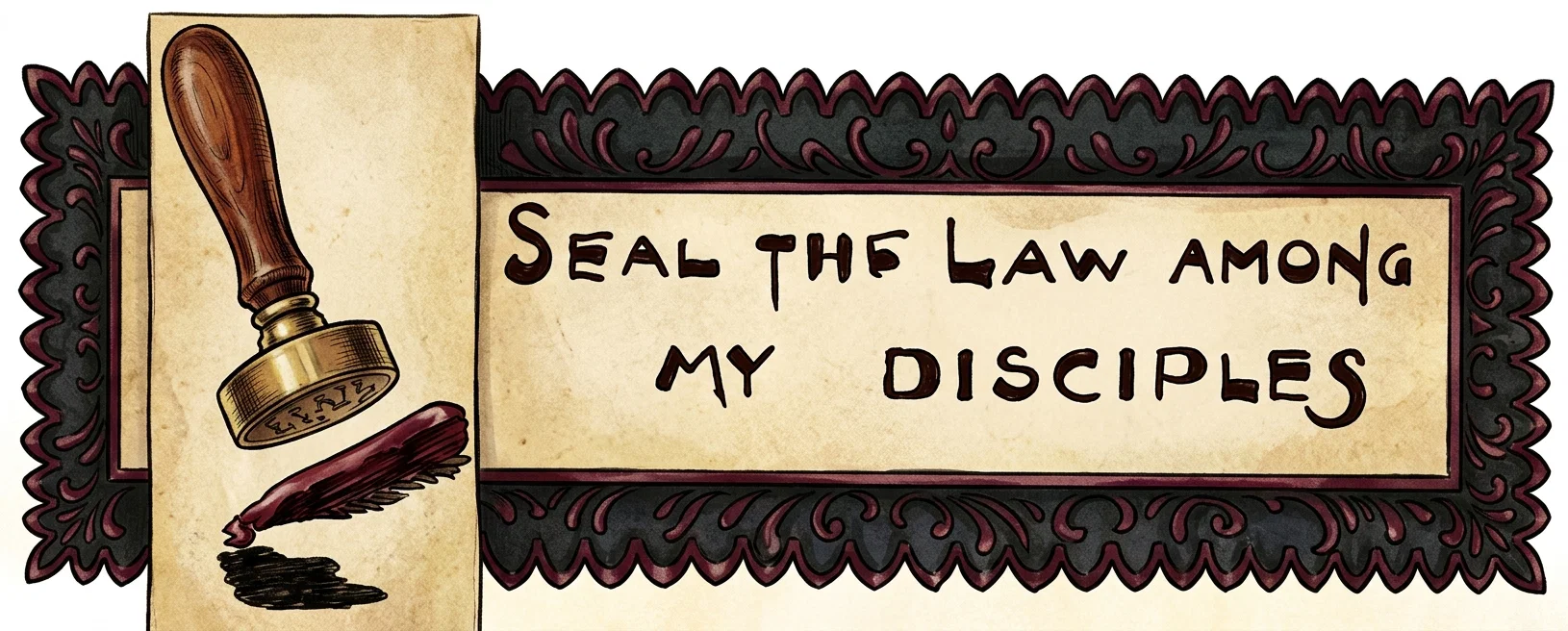
“Bind up the testimony, seal the law among my disciples. And I will wait upon the Lord, that hideth his face from the house of Jacob, and I will look for him.” See also Eze. 9:1–6.
Note the following: (1) Universal strife and war on earth (represented by the four winds) will not come till the servants of God are sealed; then will come the great battle of the day of God. (2) By examination of the context of the two passages it will be seen that both have reference to the Christian dispensation, and the work is among the disciples of Christ, near the time of his second coming, when his people are waiting for him. Compare Isa. 8:16, 17 with Heb. 9:28; 1 Thess. 1:10; Isa. 25:9. (3) They are sealed with the seal of the living God, in contradistinction to false gods. (4) A seal is that which stamps an article as genuine, which gives validity to, which authenticates. God’s seal would stamp them as God’s servants. It was anciently used by kings and those in authority. See 1 Kings 21:8; Esther 8:8. (5) It is always used in connection with law. See texts above referred to. (6) It must of necessity show three things,—the name, the authority, and the realm or territory indicating right of authority of the lawgiver, thus: Victoria, Queen of Great Britain and Ireland. The name is Victoria; the authority, queen; the territory, Great Britain and Ireland. God’s law, the only document he has ever spoken or written to men, is found in Ex. 20:1–17, in ten different precepts. In six of these precepts, the first, sixth, seventh, eighth, ninth, and tenth, not one of the necessary features of the seal is given. In the second, third, and fifth, only the name and authority are given, “Jehovah thy God.” But in the fourth commandment we have every characteristic of the seal,—the name, “Jehovah;” the authority, “thy God;” the extent of authority and right to command, “the Creator of the heavens and the earth”:—
“Remember the Sabbath day, to keep it holy. Six days shalt thou labor, and do all thy work; but the seventh day is the Sabbath of Jehovah thy God; in it thou shalt not do any work; . . . for in six days JEHOVAH MADE HEAVEN AND EARTH, . . . and rested the seventh day; wherefore JEHOVAH blessed the Sabbath day, and hallowed it.”
A law without its seal is void. In no other part of God’s law, written with his own hand, are the characteristics of a seal given; but in the fourth, or Sabbath, commandment are all these characteristics. God there subscribed himself and authenticated his law as the only genuine code of morals; and he will not give his glory to another. Isa. 42:8. The Sabbath is, therefore, the seal of God’s law.
The Sabbath His Memorial.
As God’s creative power is that which distinguishes him from all false gods, so has he given us a perpetual memorial, the observance of which will distinguish his servants from the servants of every opposing power. The psalmist says:—
“He hath made his wonderful works [of power, righteousness, and mercy, see context] to be remembered.” Ps. 111:4. Young translates, “A memorial hath he made.”
Again the psalmist couples God’s name with his memorial, and tells us that they are perpetual in their continuance:—
“Thy name, O Lord, endureth forever; and thy memorial, O Lord, throughout all generations.” Ps. 135:13.
This memorial, as has been clearly shown, is the Sabbath as commanded by God, the memorial of his creative and redeeming power, a sign between him and his people that he is the true and only God, the seal of God’s law.11And this memorial will be especially dear to the last generation of Christians who know his creative power in regenerated hearts. In speaking of the great day of God, when his children who keep the truth shall enter the eternal gates, the prophet thus speaks for the people who are waiting for his coming:—
“Yea, in the way of thy judgments, O Lord, have we waited for thee; to thy name and to thy memorial is the desire of our soul.” Isa. 26:8, R.V.
They have heeded God’s great reform message; they fear and give glory to him, and, hence, find delight in his worship, and in his day, even as they have found deliverance in his name.
The Deacon’s Experience.
By Rose Terry Cooke
BY ROSE TERRY COOKE.
The communion service of January was just over in the church at Sugar Hollow, and people were waiting for Mr. Parkes to give out the hymn, but he did not give it out; he laid his book down on the table and looked about on his church.
He was a man of simplicity and sincerity, fully in earnest to do his Lord’s work, and do it with all his might, but he did sometimes feel discouraged. His congregation was a mixture of farmers and mechanics, for Sugar Hollow was cut in two by Sugar Brook, a brawling, noisy stream that turned the wheel of many a mill and factory; yet on the hills around it there was a scattered population eating their bread in the full perception of the primeval curse.
It seemed sometimes to Mr. Parkes that nothing but the trump of Gabriel could arouse people from their sins, and make them believe on the Lord and follow his footsteps. To-day, no, a long time before to-day, he had mused and prayed till an idea took shape in his thought, and now he was to put it in practice; yet he felt peculiarly responsible and solemnized, as he looked about him and foreboded the success of his experiment.
But with the sense of strength, the minister spoke. “My dear friends,” he said, “you all know, though I did not give any notice to that effect, that this week is the week of prayer. I have a mind to ask you to make it for this once a week of practise instead. I think we may discover some of the things of God in this manner that a succession of prayer meetings would not, perhaps, so thoroughly reveal to us. Now, when I say this I don’t mean to have you go home and vaguely endeavor to walk straight in the old way; I want you to take ‘topics,’ as they are called, for the prayer meetings. For instance, Monday is prayer for the temperance work. Try all that day to be temperate in speech, in act, in indulgence of any kind that is hurtful to you. Tuesday is for Sunday schools. Go and visit your scholars, such of you as are teachers, to try to feel that they have living souls to save. Wednesday is a day for fellowship meeting. We are cordially invited to attend a meeting of this sort at Bantam. Few of us can go twenty-five miles to be with our brethren there; let us spend that day cultivating our brethren here; let us go and see those who have promoted breaches of friendship, confess our shortcomings one to another, and act as if, in our Master’s words, ‘All ye are brethren.’”
“Thursday is the day to pray for the family relation; let us each try to be to our families on that day, in our measure, what the Lord is to his family, the church, remembering the words, ‘Fathers, provoke not your children to anger;’ ‘Husbands, love your wives, and be not bitter against them.’ These are texts rarely commented upon, I have noticed, in our conference meetings; we are more apt to speak of the obedience due from children, and the meekness our wives owe us, forgetting that duties are always reciprocal.”
“Friday the church is to be prayed for. Let us then, each for himself, try to act that day just as we think Christ, our great Example, would have acted in our places. Let us try to prove to ourselves and the world about us that we have not taken upon us his name lightly or in vain. Saturday is prayer day for the heathen and foreign missions. Brethren, you know and I know that there are heathen at our doors here; let every one who will take that day to preach the Gospel to some one who does not hear it anywhere else. Perhaps you will find work that you know not lying in your midst. And let all on Saturday evening meet here again and choose one brother to relate his experience of the week. You who are willing to try this method, please rise.”
Everybody rose except old Amos Tucker, who never stirred, though his wife pulled at him, and whispered to him imploringly. He shook his grizzled head and sat immovable.
“Let us sing the Doxology,” said Mr. Parkes, and it was sung with full fervor.
The new idea had roused the church fully; it was something fixed and positive to do; it was the lever point that Archimedes longed for, and each one felt ready and strong enough to move a world.
Saturday night the church assembled again. The cheerful eagerness was gone from their faces; they looked downcast, troubled, weary—as the pastor expected. When the box for ballots was passed about, each one tore a bit of paper from the sheet placed in the hymn-books for the purpose, and wrote on it a name.
The pastor said, after he had counted them, “Deacon Emmons, the lot has fallen on you.”
“I’m sorry for it,” said the deacon, rising and taking off his overcoat. “I ha’n’t got the best of records, Mr. Parkes, now I tell ye.”
“That isn’t what we want,” said Mr. Parkes. “We want to know the whole experience of some one among us, and we know you will not tell us either more or less than what you did experience.”
Deacon Emmons was a short, thick-set man, with a shrewd, kindly face, and gray hair, who kept the village store, and had a well-earned reputation for honesty.
“Well, brethren,” he said, “I do’no why I shouldn’t tell it. I am pretty well ashamed of myself, no doubt, but I ought to be, and12maybe I shall profit by what I’ve found out these six days back. I’ll tell you just as it come. Monday I looked about me to begin with. I am amazing fond of coffee, and it ain’t good for me; the doctor says it ain’t; but, dear me, it does set a man up good, cold mornings, to have a cup of hot, sweet, tasty drink, and I haven’t had the grit to refuse. I knew it made me what other folks call nervous, but I call cross, before night comes; and I knew it fetched on spells of low spirits, when our folks couldn’t get a word out of me—not a good one, anyway—so I thought I’d try on that to begin with. I tell you it come hard. I hankered after that drink of coffee dreadful. Seemed as though I could not eat my breakfast without it. I know how to pity a man that loves liquor more’n ever I did in my life before; but I feel sure they can stop it if they’ll try, for I’ve stopped, and I’m a goin’ to stay stopped.”
“Well, come to dinner, there was another fight. I do set by pie the most of anything. I was fetched up on pie, as you might say. Our folks always had it three times a day, and the doctor he’s been talkin’ and talkin’ to me about eatin’ pie. I have the dyspepsy like everything, and it makes me useless by spells, and unreliable as a weathercock. An’ Doctor Drake he says there won’t nothing help me but to diet. I was readin’ the Bible that morning while I was waiting for breakfast, for ’twas Monday, and wife was kind of set back with washin’ and all, and I come across that part where it says that the bodies of Christians are temples of the Holy Ghost. Well, thinks I, we’d ought to take care of ’em if they be, and see that they’re kept clean and pleasant, like the church; and nobody can be clean nor pleasant that has dyspepsy.”
“But, come to pie, I felt as though I couldn’t, and, look ye, I didn’t. I eat a piece right against my conscience; facin’ what I knew I ought to do, I went out and did what I ought not to. I tell ye my conscience made music of me considerable, and I said then I wouldn’t never sneer at a drinkin’ man no more when he slipped up. I’d feel for him and help him, for I see how it was. So that day’s practice give out, but it learnt me a good deal more than I knew before.”
“I started out next day to look up my Bible class. They haven’t really tended up to Sunday school as they ought, along back, but I was busy here and there, and there didn’t seem to be a real chance to get to it.”
“Well, ’twould take the evenin’ to tell it all, but I found one real sick, been abed for three weeks, and was so glad to see me that I felt fairly ’shamed of myself. Seemed as though I heard the Lord for the first time, sayin’, ‘Inasmuch as ye did it not to one of the least of these, ye did it not unto me.’”
“Then another man’s old mother says to me, before he came in from the shed, says she:—
“He’s been a-sayin’ that if folks practiced what they preached, you’d ha’ come around to look him up afore now, but he reckoned you kinder looked down on the mill hands. I’m awful glad you come.”
“Brethren, so was I. I tell you that day’s work done me good. I got a poor opinion of Josiah Emmons, now, I tell ye, but I learned more about the Lord’s ways than a month of Sundays ever showed me.”
A smile he could not repress passed over Mr. Parkes’ earnest face. The deacon had forgotten all external issues in coming so close to the heart of things, but the smile passed away as he said:—
“Brother Emmons, do you remember what the Master said, ‘If any man will do his will, he shall know of the doctrine, whether it be of God or whether I speak of myself’?”
“Well, it’s so,” answered the deacon, “it’s so, right along. Why, I never thought so much of my Bible class nor took such interest in ’em as I do to-day—not since I begun to teach. I b’lieve they’ll come more reg’lar now, too.”
“Now come fellowship day. I thought that would be all plain sailin’; seemed as tho’ I’d got warmed up till I felt pleasant towards everybody; so I went around seein’ folks that was neighbors, and ’twas easy, but when I come home at noon spell, Philury says, says she:—
“Square Tucker’s black bull is into th’ orchard a tearin’ round, and he’s knocked two lengths o’ fence flat.”
“Well, the old Adam riz up then, you’d better b’lieve. That black bull had been a breakin’ into my lots ever since we got in th’ aftermath, and it’s Square Tucker’s fence, and he won’t make it bull-strong as he’d oughter, and that orchard was a young one just comin’ to bear, and all the new wood crisp as cracklin’s with frost. You’d better b’lieve I didn’t have much feller-feeling with Amos Tucker. I jest put over to his house and spoke up pretty free to him, when he looked up and says, says he:—
“‘Fellowship meetin’ day, ain’t it, deacon?’”
“I’d rather he’d ha’ slapped my face. I felt as tho’ I should like to slip behind the door. I see pretty distinct what sort of life I’d been livin’ all the years I’d been a professor, when I couldn’t hold onto my tongue and temper one day.”
“‘Breth-e-ren,’” interrupted a slow, harsh voice, somewhat broken with emotion, “I’ll tell rest on’t. Josiah Emmons came around like a man an’ a Christian right there. He asked me to forgive him, and not to think ’twas the fault of his religion, because ’twas his’n, and nothin’ else. I think more of him to-day than I ever done before. I was one that wouldn’t say I’d practise with the rest of ye. I thought ’twas everlastin’ nonsense. I’d rather go to forty-nine prayer meetin’s than work at bein’ good a week. I b’lieve my hope has been one of them that perish; it hain’t worked, and I leave it behind to-day. I mean to begin honest, and it was seein’ one honest Christian man fetched me round to’t.”
Amos Tucker sat down, and buried his grizzled head in his rough hands.
“Bless the Lord!” said the quavering tones of a still older man from a far corner of the house, and many a glistening eye gave a silent response.
“Go on, Brother Emmons,” said the minister.
“Well, when next day come, I got up to make the fire, and my boy Joe had forgot the kindlin’s. I’d opened my mouth to give him ‘Jesse,’ when it came over me suddin that this was the day of prayer for the family relation. I thought I would say nothin’, so I jest fetched in the kindlin’s myself, and when the fire burnt up good, I called my wife.”
“‘Dear me,’ said she, ‘I’ve got such a headache, ’Siah, but I’ll come in a minit.’”
“I didn’t mind that, for women are always havin’ aches, and I was just a goin’ to say so, when I remembered the tex’ about not bein’ bitter against ’em, so I says:—
“‘Philury, you lay abed. I expect Emmy and me can get the vittles to-day.’”
“I declare she turned over and give me such a look; why, it struck right in! There was my wife, that had worked for an’ waited on me twenty odd years, ’most scar’t because I spoke kind of feelin’ to her. I went and fetched the pail o’ water she’d always drawn herself, and then milked the cow. When I came in, Philury was up frying the potatoes, and the tears a shinin’ on her white face. She didn’t say nothin’—she’s kinder still—but she hadn’t no need to. I felt a leetle meaner’n I did the day before. But ’twan’t nothing to my condition when I was goin’, towards night, down the suller stairs for some apples, so’s the children could have a roast, and I heard Joe up in the kitchen say to Emmy:—
“‘I do b’lieve, Em, pa’s goin’ to die.’”
“‘Why, Josiah Emmons, how you talk!’”
“‘Well, I do; he’s so everlastin’ pleasant and good-natured, I can’t but think he’s struck with death.’”
“I tell ye, brethren, I set right down on them suller stairs and cried. I did reely. Seemed as though the Lord had turned and looked at me just as he did at Peter. Why, there was my own children never see me act real fatherly and pretty in all their lives. I’d growled and scolded and prayed at ’em, and tried to fetch ’em up jest as the twig is bent the tree’s inclined, ye know, but I had never thought they’d got right an’ reason to expect I’d do my part as well as their’n. Seemed as though I was findin’ out more about Josiah Emmons’ shortcomings than was real agreeable.”
“Come around Friday I got back to the store. I’d kind of left it to the boys the early part of the week, and things was a little cluttering, but I did have sense not to tear around and use sharp words so much as common. I began to think ’twas getting easy to practise after five days, when in come Judge Herrick’s wife after some curt’n calico. I had a han’some piece, all done off with roses and things, but there was a fault in the weavin’, every now and then a thin streak. She didn’t notice it, but she was pleased with the figures on’t, and said she’d take the whole piece. Well, just as I was wrappin’ of it up, what Mr. Parkes here said about tryin’ to act just as the Lord would in our place come across me. Why, I turned as red as a beet, I knew I did. It made me all of a tremble. There was I, a doorkeeper in the tents of my God, as David says, really cheatin’, and cheatin’ a woman. I tell ye, brethren, I was all a sweat.”
“‘Mis’ Herrick,’ says I, ‘I don’t believe you’ve looked real close at this goods; ’tain’t thorough work,’ says I. So she didn’t take it; but what fetched me was to think how many times before I’d done sech mean, unreliable little things to turn a penny, and then all the time sayin’ and prayin’ that I wanted to be like Christ. I kep’ a trippin’ of myself up all day jest in the ordinary business, and I was a peg lower down when night come than I was a Thursday. I’d rather, as far as the hard work is concerned, lay a mile of four-foot stone wall than undertake to do a man’s livin’ Christian duty for twelve hours; and the heft of that is, it’s because I ain’t used to it, and I ought to be.”
“So this mornin’ came around, and I felt a mite more cherk. ’Twas missionary mornin’, and seemed as if ’twas a sight easier to preach than to practice. I thought I’d begin to old Mis’ Vedder’s. So I put a Testament in my pocket and knocked to her door. Says I, ‘Good-mornin’, ma’am,’ and then I stopped. Words seemed to hang somehow. I didn’t want to pop right out that I’d come to try’n to convert her folks. I hemmed and swallowed a little, and fin’ly I said, says I, ‘We don’t see you to meetin’ very frequent, Mis’ Vedder.’”
“‘No, you don’t,’ ses she, as quick as a wink; ‘I stay to home and mind my business.’”
“‘Well, we should like to hev you come along with us and do ye good,’ says I, sort of conciliatory.”
“‘Look a here, deacon,’ she snapped, ‘I’ve lived alongside of you fifteen years, and you knowed I never went to meetin’; we ain’t a pious lot, and you knowed it; we’re poorer’n death and uglier’n sin. Jim he drinks and swears and Malviny do’no her letters. She knows a heap she hadn’t ought to besides. Now what are you comin’ here to-day for, I’d like to know, and talkin’ so glib about meetin’. Go to meetin’! I’ll go and come just when I please, for all you. Now get out o’ this!’”
“Why, she comes at me with a broomstick. There wasn’t no need on’t; what she said was enough. I hadn’t never asked her13nor her’n to so much as think of goodness before.”
“Then I went to another place just like that—I won’t call no more names—and sure enough there was ten children in rags, the hull on ’em, and the man half drunk. He give it to me, too, and I don’t wonder. I’d never lifted a hand to serve nor save ’em before in all these years. I’d said considerable about the heathen in foreign parts, and give some little for to convert ’em, and I had looked right over the heads of them that was next door. Seemed as if I could hear Him say, ‘These ye ought to have done, and not have left the other undone.’ I couldn’t face another soul to-day, my brethren; I come, and here I be. I’ve been searched through and through and found wantin’. ‘God be merciful to me a sinner.’”—Examiner.
THE LAW OF THE SABBATH.
HERE is the divine law of the Sabbath of the Lord:—
“Remember the Sabbath day, to keep it holy. Six days shalt thou labor, and do all thy work; but the seventh day is the Sabbath of the Lord thy God: in it thou shalt not do any work, thou, nor thy son, nor thy daughter, thy manservant, nor thy maidservant, nor thy cattle, nor thy stranger that is within thy gates; for in six days the Lord made heaven and earth, the sea, and all that in them is, and rested the seventh day; wherefore the Lord blessed the Sabbath day, and hallowed it.” Ex. 20: 8-11.
The following are recognized principles in the interpretation of law, as all jurists will admit; let us apply them to God’s law:—
In the case of all law, it is THE INTENT OF THE LAW-GIVER that is to be enforced.
When words are plain in a written law, there is an end to all construction; they must be followed.
When the intent is plain, nothing is left to construction.
Certainly the words of the fourth commandment of the Decalogue are plain. If language means anything, that law means that the intent of the Lawgiver was that the seventh day should be regarded by his subjects as the Sabbath. And this law God based upon reasons,—his resting on the day, blessing the day, and the sanctification or setting apart of the day,—which can apply to no other day of the seven; for God rested on no other day, blessed no other day, set apart no other day.
But God did not leave his intent to be declared by words alone. He showed by the threefold weekly miracle of the manna for forty years that the seventh day was the Sabbath, thereby precluding any construction of the plain words of the law.—Sentinel Library No. 61.
THE SEVENTH DAY OF THE WEEK.
The seventh-day Sabbath is the seventh day of the week. The week exists because of the Sabbath. God’s rest is the origin of the septenary cycle. The commandment expressly declares that “the seventh day is the Sabbath of the Lord thy God.” This does not mean any seventh day, but the seventh day of the cycle, or week. For proof of this take the following scripture:—
“In the end of the Sabbath, as it began to dawn toward the first day of the week.” Matt. 28: 1.
“And when the Sabbath was past, Mary Magdalene, and Mary the mother of James, and Salome, had brought sweet spices, that they might come and anoint him. And very early in the morning the first day of the week, they came unto the sepulcher at the rising of the sun.” Mark 16: 1, 2.
“And they returned, and prepared spices and ointments; and rested the Sabbath day according to the commandment. Now upon the first day of the week, very early in the morning, they came unto the sepulcher.” Luke 23: 56; 24: 1.
It will be seen by the above that the first day of the week came immediately after the Sabbath; and therefore the Sabbath day is the day just before the first day of the week; but the day just before the first day of the week is the seventh day of the week. Therefore the Sabbath of the Lord is the seventh day of the week. That day now is the time between Friday evening at sunset and Saturday evening at sunset. It was the day hallowed by Christ, the Creator, in Eden, kept by patriarchs and prophets, and magnified and made honorable by the holy obedience of Jesus Christ, our Example. God asks nothing of man that he is not anxious to clearly reveal.
REBECCA'S HYMN.
By Sir Walter Scott
When Israel, of the Lord beloved,
Out from the land of bondage came,
Her father's God before her moved,
An awful Guide in smoke and flame.
By day along the astonished lands
The cloudy pillar glided slow;
By night Arabia's crimsoned sands
Return'd the fiery column's glow.
There rose the choral hymn of praise,
And trump and timbrel answered keen;
And Zion's daughters poured their lays,
With priest's and warrior's voice between.
No portents now our foes amaze;
Forsaken Israel wanders lone;
Our fathers would not know Thy ways,
And Thou hast left them to their own.
But present still, though now unseen!
When brightly shines the prosperous day,
Be thoughts of Thee a cloudy screen
To temper the deceitful ray.
And, O, when stoops on Judah's path
In shade and storm the frequent night,
Be Thou, long-suffering, slow to wrath,
A burning and a shining light!
Our harps we left by Babel's streams,
The tyrant's jest, the gentile's scorn;
No censer round our altar beams,
And mute are timbrel, harp, and horn.
And Thou hast said: “The blood of goat,
The flesh of rams, I will not prize;
A contrite heart, a humble thought,
Are Mine accepted sacrifice.”
—Sir Walter Scott.