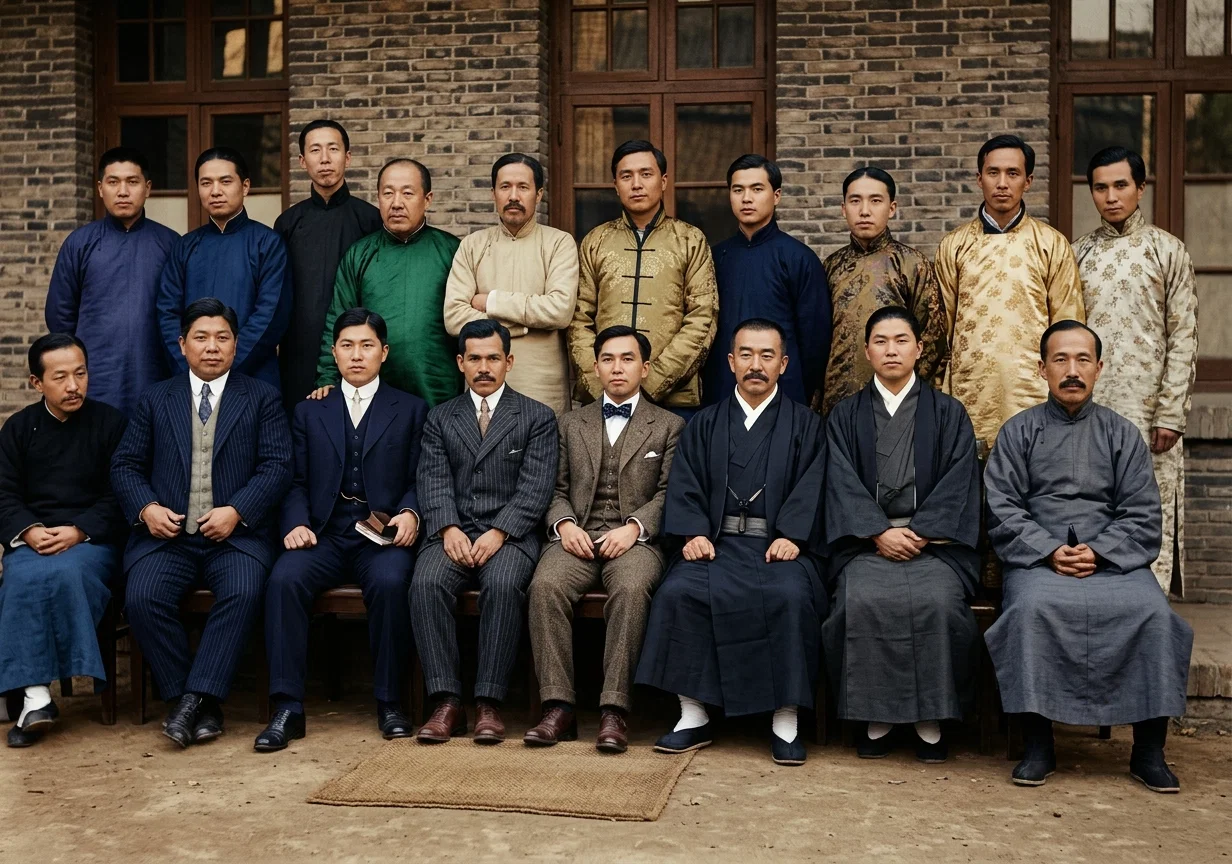
The Asiatic Division Conference was organized at the General Conference held in Washington, D. C., in 1913. The first session of this new conference was held in Shanghai, China, May 1-14, 1915. Our people in the homeland will be glad to know that we had an attendance of two hundred strong. Of this number one hundred and forty were actively engaged in some department of our work. The remaining sixty were students attending the China Missions Training School, at Shanghai, for the purpose of securing a preparation for work in the Lord’s cause.
The delegates came from widely separated parts of a great field, as the following will show: From the United States, 2; Australia, 2; Asiatic Division general workers, 8; Japan, 20; Korea, 12; Manchuria, 4; East China, 15; West China, 1; South China, 22; Philippine Islands, 14; Malaysia, 3; Shanghai printing office, 20; Shanghai training school, 60. Thus it will be seen that we had come from the borders of Siberia on the north to Australia in the south, and from Japan in the east to the borders of Tibet on the west.
This was by far the largest gathering of workers we have ever held in the Far East. Among the delegates were6Chinese, Koreans, Japanese, and Filipinos. All were happy and of good courage in the Lord. Somehow this meeting seemed a much greater event to the workers there than such a conference does in the homeland. Perhaps it was because they do not have many such gatherings. Possibly it was because they are so far from native land, relatives, and old friends. It may be that their isolation and long separation from one another makes their gathering a greater pleasure.
But the meeting was more than one of pleasure. It was one of blessing to us individually, and it will result in giving a new impetus to the cause in the Far East. We studied how to render more efficient service in our work for the Master, how to surrender to the Holy Spirit’s guidance and power, and how to work together in the fullest measure of union and cooperation throughout the great field.
The reports from the president of the division and the superintendents of the different mission fields and departments of work were deeply interesting and most encouraging. They told of victory and progress in every part of the field and in every line of work. They recounted the special providences of God which have been so manifest in the endeavors to establish the cause in new places. It is a wonderful story these workers tell of triumphs over all sorts of obstacles along the far-flung battle line.
The statistical and financial reports showed encouraging progress during the year 1914. The church membership has increased from 1,773 to 2,743, a gain of nearly a thousand, or more than 50 per cent. The number of unbaptized believers in companies has increased from 785 to 1,563, a gain of 778, lacking only seven of being 100 per cent increase. The isolated believers have increased from 385 to 1,054, a gain of nearly 175 per cent. The tithe has increased from $8,665 to $12,395, an increase of $3,730, nearly 45 per cent. The offerings to missions have advanced from $3,367 to $5,923, a gain of $2,556, or over 75 per cent. The book sales have increased from $8,208 to $12,767, a gain of $4,559, or more than 55 per cent.
NATIVE WORKERS IN ATTENDANCE AT THE ASIATIC DIVISION CONFERENCE
Some people think figures are like dry sticks, but surely figures that show such an ingathering of souls from among the heathen in one short year, cannot be uninteresting to those who are working for the salvation of the lost. Of course, these numbers are as nothing when compared with the millions among whom we are working. But they are large by the side of the reports we were able to give during the first decade of our work in this field. They are large when compared with the visible results of Morrison, Carey, and Judson’s pioneer work in the Far East. They are encouraging as an indication of the great progress that is sure to attend our work from now on if we keep pace with the Lord’s opening providences.
These reports show that throughout this entire field the doors of opportunity and service are thrown wide open to us. Nothing worth mentioning stands in the way of carrying on evangelistic, educational, publishing, and medical missionary work in every part of this vast field. Marvelous changes have taken place in the Far East since the early missionaries came this way. Now great steamship lines ply these Eastern waters, bringing the East and the West close together. Railways, autocars, and electric street cars greatly facilitate travel on land. The printing press and the telegraph lines have greatly stimulated the activities of the people of the East. A new value has been placed upon the West.
The amazing changes that have taken place in educational affairs in the Far East are all calculated to aid in the evangelization of those peoples. The thirst for education and information opens the way for the circulation of gospel literature, and the readiness with which the people accept the Bible and purchase religious papers and books, shows the open mind and receptive attitude of these nations. They are now in a state of transition and formation. They are absorbing what comes to them, whether it is good or bad. This is the hour of opportunity for the Christian church to do a great work for these lost souls. It is surely the hour for Seventh-day Adventists to act. Much will be gained by decisive action now, and much will be lost by delay. We must not stand still at this critical hour. This is the conviction expressed in all the reports presented at the conference.
Along with the encouraging reports of progress come recommendations from the committee for the adoption of measures which it was hoped and believed would cause a more rapid advance all along the line. Here is one of the recommendations:—
ELDER AND MRS. A. G. DANIELLS AND ELDER AND MRS. R. C. PORTER, ON THE PORCH
OF ELDER PORTER'S HOUSE
Resolved, That for the accomplishment of this great work, we separate ourselves from every entanglement, and that our first effort be the salvation of souls for whom Christ died.
This resolution expressed in some measure the surrender and consecration that pervaded the entire conference. Our missionaries feel that the end is drawing near, that our time and opportunities for saving lost men and women are closing, and that all should now be freely and fully given to the work.
The following resolution adopted with enthusiasm shows the courageous, self-reliant spirit of our people in the Far East:—
Resolved, That we strive greatly to increase our offerings in this field, and that we aim during the ensuing period to reach the five-cent-a-week standard for every baptized believer.
As the offerings already amount to about three cents a week per member, there is good reason for believing that the five-cent-a-week standard will soon be reached.
Perhaps nothing will more clearly convey to our people in the homeland the earnest, practical, serious realization the missionaries they have sent to this field have of the responsibilities resting upon them than the following voluntary action:—
Whereas, Conditions of life in these Eastern fields are continually improving, the evidence of which is found in the good homes provided for our missionaries, the improved facilities for transporting foodstuffs, the better knowledge of how to preserve health in these countries, and the opportunities afforded to secure rest and recuperation in the hill stations available; and in view of the tremendous demands now being made upon the workers for the finishing of the work; therefore,—
Resolved, That we request the General Conference Committee to discontinue the seven-year-furlough period, leaving the matter of furloughs in this field an open question to be determined by the individuals concerned, in consultation with the local, union, and Asiatic Division Committees; and that we encourage our workers to remain by their work, utilizing the opportunities presented in the field to obtain rest and recuperation.
It took courage and the spirit of self-denial to vote for this resolution. The majority who are there went out with the understanding that they could return home on a furlough in seven years if they desired to do so. Their relatives and friends are expecting that they will return. The furloughs of some are already due, and others will be due next year. Of course, it will cause disappointment all around if they do not go home. But when the vote was taken, every foreign worker in the room except two, stood in favor of the recommendation. It should be understood that this action is not intended to work hardship upon any one. It does not make furloughs impossible. But it does emphasize that hereafter people who go to this field should go with no plans for returning home at any definite time. It expresses the conviction that they should go for life. It leaves the question of returning to be decided by conditions. If one’s health keeps good, and he is blessed in his work, and there is no special reason why he should return, then let him stay in the field, pushing the work forward with all zeal.
We endeavored to conduct a ministerial institute during the conference, but the time of our meeting was so short, and there were so many reports to be made, and so much important administrative work to attend to that it was impossible to have an ideal institute. Elder J. E. Fulton conducted a series of very helpful studies on the place of the Holy Spirit in the gospel work, Elder R. C. Porter gave good instruction regarding church organization and discipline, while I gave studies on various features of the gospel ministry. The workers manifested a deep interest in these studies. They entered most earnestly into the spiritual features of the meeting. We had solemn, earnest hours of seeking the Lord and renewing the consecration of our lives to him and his work, and we were conscious of his presence and approval. I believe the workers returned to their fields with fresh courage, and with strong determination to render the cause of their Master better service.
This conference and institute were attended by eighteen native delegates from Japan, Korea, the Philippines, and the different parts of China. It was a great pleasure to our native workers to be present at this large gathering, and it was just as great a pleasure to the American brethren to have the native workers present. None could show greater interest in all that was done—the Bible studies, the reports of progress, the discussion of recommendations, and the spiritual meetings—than was shown by our native brethren.
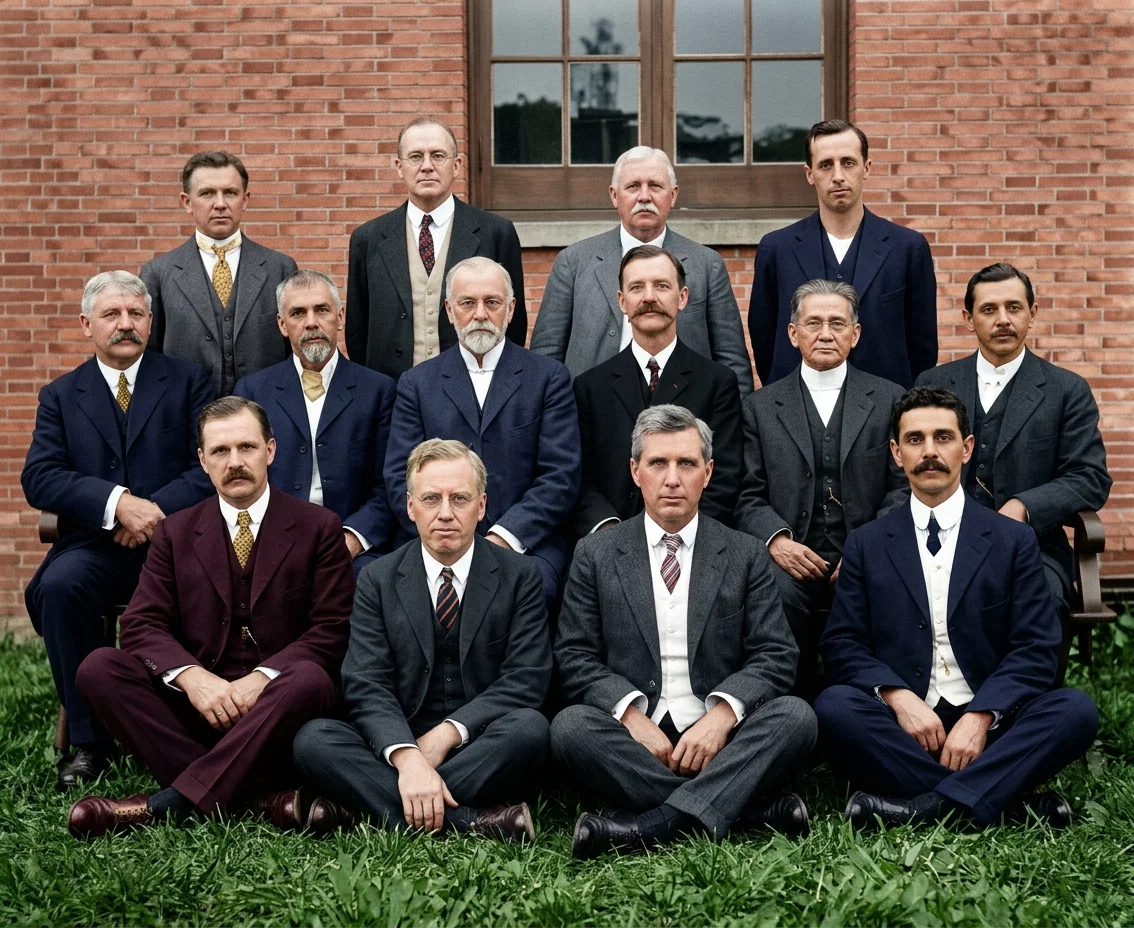
MISSION SUPERINTENDENTS IN THE ASIATIC DIVISION
To them the conference was an occasion of instruction and inspiration, a great uplift in every way. We shall all look forward with deep interest to the next conference in the Far East. A. G. DANIELLS.
Plans for Luther Anniversary Celebration
ON Oct. 31, 1917, it will be four hundred years since the parish priest in the Roman Catholic Church at Wittenberg nailed his ninety theses to the door of his church, from which event the beginning of the Reformation movement is commonly traced. The Luther Society of New York is taking the lead in a plan to celebrate this anniversary in a manner which will put Luther forward as the pioneer not merely of a religious movement, but of a new era in higher education, in morals, in civic and social life. One proposition is to erect in Washington a memorial Luther arch, commemorating him as a great epoch maker in Christian education, in the application of Christian morality, and in the promotion of the influence of the Bible.
God’s Care for His People
By S. N. HASKELL
S. N. HASKELL
A CAREFUL student of the Bible will observe that in each time of crisis in the history of the church, God has had a prophet, a mouthpiece, through whom he could instruct and direct his people, and each prophet possessed those characteristics that fitted him for the work which God placed in his hands to do.
When the time came for Israel to go out of Egypt, Moses was raised up to deliver God’s special instruction to his people, that they might escape the pitfalls of the enemy and enter the Promised Land. When Jezebel had introduced sun worship, with its train of evils, into Israel, Elijah was raised up to stand in the gap and deliver God’s direct messages to his people, that they might be saved from the delusions of the devil.
When the sins of Judah had become so great that their enemies were surrounding them on every side, God through his faithful prophet, Jeremiah, sent them counsel and instruction, which, if they had received it, would have delivered them from their enemies; “but they mocked the messengers of God, and despised his words, and misused his prophets, until the wrath of the Lord arose against his people, till there was no remedy.” 2 Chron. 36: 16. Israel went into Babylonian captivity because they would not accept the messages sent direct from the Lord through his prophet. When Israel came out of Babylonian captivity, the Lord again spoke directly to them through Haggai and Zechariah.
It was in perfect accord with God’s dealings through all the ages that, when the remnant church was being gathered out and prepared to meet the Lord, God should place a prophet in the church, through whom he could send direct counsel and instruction to his people. None of the crises in the past can compare with the crisis during the last generation.
As the church approaches her final deliverance, Satan works with greater power, for he knows that he has but a short time. “For six thousand years that master mind that once was highest among the angels of God, has been wholly bent to the work of deception and ruin. And all the depths of satanic skill and subtlety acquired, all the cruelty developed during these struggles of ages, will be brought to bear against God’s people in the final conflict.”
In each crisis during the past ages the Lord raised up a leading prophet who faithfully delivered the special instruction which God gave to meet attacks of the enemy in that particular period. Those who heeded the instruction given by the prophet were victors in the conflict. Think you that he would choose an inferior mouthpiece through whom to instruct the remnant church? On the other hand, as it is the greatest crisis of all ages, we should naturally expect that the mouthpiece God would use for this period would be inferior to none in the ages past.
Through Moses the Lord gave Israel instruction that would lead them into the Promised Land; but Moses died as they neared the borders of Canaan. There were many perplexing battles to fight, and much wisdom was needed in establishing Israel in the land, after the godly seer was laid to rest; but instruction had been given, which, if heeded, would enable them to gain the victory in every conflict.
Joshua’s success depended upon his following the instruction which had been given through Moses. The Lord said to him, “Only be thou strong and very courageous, that thou mayest observe to do according to all the law, which Moses my servant commanded thee: turn not from it to the right hand or to the left, that thou mayest prosper whithersoever thou goest.” All who faithfully heeded the instruction given by the Lord through Moses had good success. Joshua 1: 1-9.
It was the message given through Moses that contained the power, and not Moses. Moses was the instrument used by the Lord in giving his people all the instruction needed to take them safely over that period of danger and perplexity. We are nearing the end of this world’s history, and Sister White has been laid to rest. She is dead; but the instruction God gave her to guide his people through the perils of the last days is not dead.
When the Saviour was on earth, the minds of his followers were often directed to his person rather than to the words which he spoke. He said, “It is expedient for you that I go away.” When he was taken from them, they then gave more heed to the instruction which he had given. God has laid his tried and faithful messenger to rest, that the attention of his people may be taken from the instrument to the work accomplished by the instrument.
Many were constantly looking for some new revelation, and failed to study prayerfully the abundance of instruction already given. In the nine volumes of “Testimonies for the Church,” there is instruction for every emergency that may arise. The indexes in the back of the volumes group the different subjects so that one can readily find information and instruction on any subject treated.
“Early Writings” and “The Great Controversy” portray plainly the perils and conflicts of the last days, and give very definite instruction, which, if heeded, will enable God’s people to be victors in every conflict.
“The Desire of Ages,” “Steps to Christ,” and in fact all the writings of the servant of the Lord, are full of spiritual food which enables those who feed upon it to be more than conquerors in the conflicts of life.
As in the days of Isaiah, so at the present time, the Lord can truly say: “Judge, I pray you, betwixt me and my vineyard. What could have been done more to my vineyard, that I have not done in it?” May the Lord help us individually to form characters in accord with his Holy Word, to walk in the counsel given us, and to enter finally the inheritance prepared for his people.
A Short Sermon
By H. A. ST. JOHN
The New Covenant
H. A. ST. JOHN
TEXT: “For this is the covenant that I will make with the house of Israel after those days, saith the Lord; I will put my laws into their mind, and write them in their hearts: and I will be to them a God, and they shall be to me a people: and they shall not teach every man his neighbor, and every man his brother, saying, Know the Lord: for all shall know me, from the least to the greatest. For I will be merciful to their unrighteousness, and their sins and their iniquities will I remember no more.” Heb. 8:10-12.
In the text we find five blessings to be secured by all who enter into this covenant with the Lord. Let us briefly consider these blessings in the order of their fulfillment:—
1. He will forgive their iniquities. This is the invaluable blessing promised by the Lord to all who will, with godly sorrow, repent and confess their sins, and in faith look to Jesus. O how sad that many refuse pardon on conditions so manifestly reasonable!
2. “I will put my laws into their mind, and write them in their hearts.” O, what a rich blessing to have such a just, good, and holy law written in our minds and hearts by the Spirit of God! Then, like Jesus, we shall surely delight to do our Heavenly Father’s will, and he will be well pleased with us.
3. “I will be to them a God, and they shall be to me a people.” Who can measure the value of this great blessing? All who enter into this covenant with our Heavenly Father become at once the sons and daughters of the Almighty, children of the heavenly household. What an honor! one for which we ought to praise the Lord continually. A relation, too, which our Heavenly Father would be pleased to have us maintain to all eternity.
4. “Their sins and their iniquities will I remember no more.” What a blessed and glorious thought that our loving Heavenly Father will not only forgive our sins, and in the judgment blot them from his book of remembrance, but he will blot them from his memory. He will regard us with the same love as he does the angels that never sinned.9
5. “They shall not teach every man his neighbor, and every man his brother, saying, Know the Lord: for all will know me, from the least to the greatest.” To know God is to keep his commandments; hence this promise relates to the kingdom of glory, where his children will have an eternal home, and where there will be no sin, but all will be lovingly and eternally obedient to God’s holy law of love. O what will it be to be there!
Dear reader, consider the many new things this precious new covenant embraces. First, we receive a new heart, a new spirit, a new mind, and a new song; then when Jesus comes, we shall get new bodies, and go with him to the New Jerusalem, and at last have an eternal home in the new heavens and new earth. Here is a list of new things, every one of inestimable and eternal value, placed within our grasp; and the best of all is, not one of them will ever grow old.
What Earthquakes, Cyclones, Fires, and Floods Mean to the Student of Prophecy
By E. HILLIARD
E. HILLIARD
The Lord has not left us in darkness concerning the times in which we are living, nor in perplexity relative to impending events. Through ancient and modern seers he has informed us that we are, even now, in perilous times, and that perils will increase until they culminate in that great earthquake, foretold by the seer of Patmos, in which the cities of the nations will be shaken down and the earth made desolate at the presence of the Lord. “For thus hath the Lord said, The whole land shall be desolate.” Rev. 16: 18, 19; Jer. 4: 26, 27.
An excerpt taken from an article by the late Mrs. E. G. White, published in the Signs of the Times, April 21, 1890, sheds light on the terrible disasters that are now taking place. It appears that in view of coming events a great burden for our young people rested at that time upon God’s humble messenger, as it did also in her last illness. The statement referred to reads as follows:—
“The Christian’s hope is an anchor to the soul, both sure and steadfast, and entereth into that which is within the veil, whither Christ the forerunner is for us entered. We have an individual work to do to prepare for the great events that are before us.
“The youth should seek God more earnestly. The tempest is coming, and we must get ready for its fury, by having repentance toward God, and faith toward our Lord Jesus Christ. The Lord will arise to shake terribly the earth. We shall see troubles on all sides. Thousands of ships will be hurled into the depths of the sea. Navies will go down, and human lives will be sacrificed by millions. Fires will break out unexpectedly, and no human effort will be able to quench them. The palaces of earth will be swept away in the fury of the flames. Disasters by rail will become more and more frequent; confusion, collision, and death without a moment’s warning will occur on the great lines of travel. The end is near, probation is closing. Oh, let us seek God while he may be found, call upon him while he is near! The prophet says, ‘Seek ye the Lord, all ye meek of the earth, which have wrought his judgment; seek righteousness, seek meekness: it may be ye shall be hid in the day of the Lord’s anger.’”
The year 1902 was designated by the Chicago Tribune of December 29 of that year, as the volcanic and earthquake year. This was twelve years after the preceding quotation was published. The eruption of Mt. Pelee and Mt. Suffriere laid the country for miles around in ashes, and destroyed 45,600 lives. During this noted year, 53,225 were victims of volcanic fury. To this number must be added 27,624 who perished in cyclones, typhoons, floods, and fires, and in other disturbances of nature, which increases the death list to 80,849. This is the number reported, but the real number must have been greater.
There has been a steady increase in the loss of life and the destruction of property from the notable year 1902 to the present year. On June 15, 1904, the steamer “General Slocum” caught fire in the East River, and before she could be beached on North Brother Island, upward of 1,000 excursionists lost their lives. While making her maiden voyage across the Atlantic, the “Titanic,” at that time the largest ship in the world, struck an iceberg off the Newfoundland Banks on April 14, 1912. Of her crew and passengers 1,595 found a watery grave. On May 29, 1914, the “Empress of Ireland” sank in twenty minutes, off Father Point, in the St. Lawrence River, after colliding with the collier “Storstad.” In this wreck 1,024 persons perished. When the steamship “Lusitania” was torpedoed and sunk by a German submarine, on May 7, 1915, 1,100 lost their lives. And now the terrible disaster to the “Eastland,” in Chicago River, adds more than 1,000 victims to the death list who perished “without a moment’s warning.”
We need not look for a decrease of these calamities. “Disasters by rail, will become more and more frequent; confusion, collision, and death without a moment’s warning will occur on the great lines of travel.” Let us, young and old, heed the warning to seek the Lord earnestly while he may be found.
What Doth God Require?
By T. GODFREY
T. GODFREY
“And now, Israel, what doth the Lord thy God require of thee, but to fear the Lord thy God, to walk in all his ways, and to love him, and to serve the Lord thy God with all thy heart and with all thy soul.” Deut. 10: 12.
“The eyes of the Lord run to and fro throughout the whole earth to show himself strong in the behalf of those whose hearts are perfect toward him.” It is evident that God requires of every one of his children a perfect character. Therefore he has extended to each a period of probation in which to develop a character that he can accept.
It will require every moment of the allotted time to perform the task. To lose or idle away any part of the allotted time would be disastrous to our election. “Wherefore the rather, brethren, give diligence to make your calling and election sure.” God elects the character that shall inhabit eternity.
The inhabitants of the kingdom of God have sinless characters. To every one will be given a robe of righteousness; pure and white, free from every taint of sin; and there will be no more death. Death hath no more dominion over them. They shall sing “the song of Moses and the Lamb,” a song of deliverance, forever.
Olympia, Wash.
The Two Conceptions, or the Lesson of the Ascension
By M. G. CONGER
M. G. CONGER
ONE of the most important parts of our Lord’s earthly work was the educating of his twelve disciples. These he taught that they in turn might teach others. By personal acquaintance and association, Jesus trained them for their future work. They were daily instructed by his words of counsel and admonition, to which they gave earnest attention.
Christ often spoke of the “kingdom of heaven,” “kingdom of God,” etc. His forerunner, John the Baptist, came with the message, “Repent: for the kingdom of heaven is at hand.” Jesus bore the same message, and the disciples proclaimed this truth. Inasmuch as the twelve were the constant companions of our Lord and so often heard this phrase, we should suppose that they had the true conception of the kingdom of God. Did they?—At first, no; ultimately, yes. In teaching many truths and principles of heaven, the Saviour had to overcome the traditional, erroneous views of his hearers. The disciples, like others of their nation, often misinterpreted the import of the divine themes because of their preconceived ideas. They measured everything according to the traditions and teachings of the elders.
From of old the Jewish people had looked forward to the coming Messiah. Now that they were under a foreign power, the Israelites looked to his coming with great hope that he would liberate them. Had not the prophets prophesied of his glorious reign? So they expected him to come as an earthly conqueror at the head of armies, to establish the Jews in their kingdom, and to make of them the leading nation. Rome’s bondage was exacting, and the Jews loved to think of the Messiah as their deliverer.
The influence of this early training, the teaching of the rabbis, and the grip of tradition had a strong influence on the disciples. So much did they expect Christ to reign as a temporal king that they argued with one another as to who would be the greatest in the kingdom, and10the mother of James and John came personally to ask Jesus to give to her sons the highest places. The idea that their master was to be betrayed, tried as a criminal, and crucified, seems not to have found a place in their thoughts. Their minds were set on the immediate establishment of the material kingdom and of the reign of Christ. There were teachings of the Master which the twelve could not harmonize with this view, yet they held tenaciously to it. Then, when Jesus permitted the homage that was rendered to him on his triumphal entry into Jerusalem, these ideas were strengthened.
But it was only a short time until all the disciples’ visions of earthly power and authority vanished. Instead of placing their Lord on the kingly throne, in a few days they placed him in Joseph’s new tomb. The disciples were overcome with discouragement. Their Master had been rejected, condemned, and crucified. They had heard the mocking statement of the rulers, “If he be the King of Israel, let him now come down from the cross, and we will believe him,” and they sadly repeated, “We trusted that it had been he which should have redeemed Israel.” Their hopes crushed, grief and despair nearly overwhelmed them.
God had decreed that his Son should rise the third day. This he did, and sent a message to the disciples by Mary, later visiting them personally. During the walk to Emmaus with two of his followers, he told them, and later he told the twelve, that their expectations of a Messiah who was to be an earthly ruler were false, not being founded on the Scriptures. From Moses, the Psalms, and all the prophets he proved to them that he was the great sacrifice, and by dying he became a ransom for all. Furthermore, he taught them that his life and death were not a defeat, but an eternal victory. He pointed them to his coming in glory, not with the glory of earthly power, but with the power and glory of the King of kings and Lord of lords. He distinguished two advents, and reminded them that his next coming, his second advent, like the first, was based on the prophetic word.
The disciples were gaining the true conception of the spiritual kingdom which should reign in the hearts of believers, and which will ultimately usher in the eternal reign of righteousness. But in the joy of seeing their resurrected Lord they forgot the lesson that they had learned, and expected him now to set up the long-looked-for kingdom. See Acts 1:6. They were disillusioned, however, for the last time, when their Lord was suddenly taken from them on the mount of Olives. Here their conception was finally made perfect. Two angels, sent to complete the lesson, asked, “Ye men of Galilee, why stand ye gazing up into heaven? this same Jesus, which is taken up from you into heaven, shall so come in like manner as ye have seen him go into heaven.”
With joyous hearts they then turned to the work of proclaiming the truths which had been intrusted to them, among which was the blessed hope of the second advent of our Lord, who will come the “second time without sin unto salvation,” and will then set up the material kingdom which “shall never be destroyed.”
The Jews misinterpreted and misconstrued the scripture; and Christ declared of them that they knew not the time of their visitation. The closing years of grace to them as a nation they spent in scoffing at Heaven’s messages. Temporal power, earthly glory and ambitions, obscured their vision, and the gift of the spiritual kingdom was offered to them in vain.
Today the tendency is to confuse the spiritual and material kingdoms of Christ, and to regard the material kingdom of peace and prosperity as a gradual development of the kingdom of grace. The world absorbs men’s thoughts and attention, and many fail to realize that the setting up of the kingdom of glory requires another personal advent of Christ as truly as the setting up of the kingdom of grace required the first. And many fail to see in the increasing signs of the times the sure omens of that swift-coming kingdom of God. “But ye, brethren, are not in darkness, that that day should overtake you as a thief. . . . Therefore let us not sleep, as do others; but let us watch and be sober.”
Result of National Idolatry
By B. M. HEALD
B. M. HEALD
FOR some years the war cloud of Europe has been gathering blackness; a few months ago the storm broke in all its mad fury. Morning after morning we read the headlines of the daily news, and learn that the war hopper is steadily crushing out lives with no decisive battle reported from either front.
Jehovah being the God of love, many are at a loss for the reason of this bloody carnage, and are tempted to consider him the “war god” of the twentieth century. But God, knowing the degenerating effects of idolatry, knew that the human heart in the latter end of earth’s history would be more idolatrous than at the beginning of the world, and, as would be most natural, the idolatrous nations would fight for that which they covet, the possession of the earth; and through his Word he proclaims to this century that there will be an awakening of the nations, and that general war will obtain supremacy on earth.
That they might have “a name” and “a city,” idolatry caused the people to attempt to build a tower that would “reach unto heaven.” To the exclusion of God, they sought to establish themselves on the earth as its possessor. It was idolatry in the heart of Nebuchadnezzar that prompted him to say, “Is not this great Babylon, that I have built for the house of the kingdom by the might of my power, and for the honor of my majesty?”
Though but a young lad when news of his father’s victories came to Alexander he complainingly said, “My father will possess himself of everything, and leave nothing for me to do.” Hannibal, when a child of nine years, was led by his father to the altar, and there dedicated to the war god. “Hannibal,” exclaimed Napoleon, “crossed the Alps; as for us, there shall be no Alps.” What was the all-absorbing characteristic principle in the lives of these men of the past? They were inspired by idolatrous ambition to control the world, to build up a kingdom for the honor of their majesty.
However, it must be remembered that “the earth is the Lord’s,” and God intends that his Son, “whose right it is,” shall be “King of kings and Lord of Lords.” It is his government that God intends shall fill the whole earth. No empire of the earth has the legitimate right to the earth, nor can expect to be supreme. The day of the Lord is near upon the nations. The kingdom of God and of his Christ is soon to be set up, a kingdom which shall never be destroyed; and all people, nations, and languages shall serve him. His dominion is an everlasting dominion.
Egypt, Babylon, Medo-Persia, and pagan Rome have all passed into oblivion. God’s plan is not that the wicked should inherit the earth for an eternal possession. Papal Rome has thought to “possess the primacy over the whole world;” but its dominion shall be taken away and destroyed without human power in the final consummation. “The nations raged, the kingdoms were moved: he uttered his voice, the earth melted. . . . Come, behold the works of Jehovah, what desolations he hath made in the earth.” God showed his servant David the end of the struggle.
In expecting to be absolute rulers of this earth, the nations have been imagining a vain thing, and it is this warring, raging, taking counsel together against the Lord, that results in the battle of Armageddon, the battle of God Almighty.
We must reconcile our plans to God’s plans, and wait upon him. The warring nations are reaping what they have sown. God alone is to be exalted among the nations. He alone is to be exalted in the earth. Let us, then, be still and know that he is God.