The Youth’s Instructor, Vol. 35, No. 35.

Letter Budget

The Youth’s Instructor

Aug 31, 1887

S. D. A. Publishing Association · Battle Creek, Mich. · Aug 31, 1887

Letter Budget.

FRANK ROLLINS, of Oceana Co., Mich., writes: “I am five years old. I have been to school quite steady this term. The school house is just a little way from my house. Last Friday was the last day, and the teacher gave us each a pretty card. I get my Sabbath-school lessons in Book No. 1, and recite them to mamma. I have a pet kittie, and she is black. I have three chickens, and I mean to help mamma get a Bible Atlas.”
MRS. EMMA ROLLINS, Frankie’s mother, writes a few lines for the Budget. She says: “Having written Frankie’s letter, I would like to write one to the little folks who welcome the INSTRUCTOR to their homes each week. I well remember how pleased I used to be when the paper came, though it was only once a month. Perhaps some of you read in the Review of the death of Eld. J. Byington. I used to go to meeting with my parents at his house, when I was a child. The first time I sat in a Sabbath-school class, his wife, Mrs. C. Byington, was my teacher. There were not papers enough to go around that Sabbath, so she tore one in two, and gave me half of it. I treasured that piece of a paper a long time, and even now remember a story that was in it, although my mother had to help me read the hard words. I often wish the readers of the INSTRUCTOR could see the paper as it was more than twenty years ago. May you all try to profit by the good reading it contains.”
FRANK M. BARKER, of St. Croix Co., Wis., writes: “I have never written a letter before. I am nine years old. I go to day school. We had an exposition, and each scholar had something of his own make. My mother and sister belong to the River Falls church, thirteen miles from here. We have a nice Sabbath-school, but only ten members. We all keep the Sabbath but father, and we all went to camp-meeting last year. Our city is on the beautiful banks of St. Croix Lake, where a doctor is building a hospital on the same plan on which the Sanitarium of Battle Creek, Mich., is built. I am trying to be a good boy.”
IDA McFARLAN writes from Washington, D. C. She says: “I thought you would all like to hear from this city, so I write. I am a little girl ten years old. I love the INSTRUCTOR and think the Budget is real interesting. I attend Sabbath-school at the mission. I have never missed but once or twice. My parents keep the Sabbath. We did not know anything about the Sabbath until the mission was started here. Papa works in one of the Government offices. I have four sisters. I am trying to be a good girl, and want a home in the new earth.”
EDDIE A. ROWE writes from Caldwell Co., Mo. He says: “Dear Budget, I thought I would write to you. I go to Sabbath-school regularly. I am ten years old. I feed the chickens, carry wood for the heating stove and coal for the cook stove. I go to school every week. I live just one block from the Sabbath-school, and five and a half blocks from day school. I have a sister, six years old. I send my love to all. I have never seen a letter in the INSTRUCTOR from this town. I want this put in the Budget. I will write again next summer.”

BURDEN BEARERS.

“Florence, come and feed the chickens, and then go to the barn and get me some eggs.”
Now Miss Florence did not look as if she enjoyed mamma’s request one bit; on the contrary, she laid down the “lovely” story-book that she was reading, and went out to the kitchen with a puckered-up mouth and a scowling forehead. The dear little chicks peeped and shook their yellow down, but this morning Flossie did not pet them.
On her way through the kitchen she had seen a great pile of dishes, and she knew for whom they were waiting. She knew, too, that to-day was sweeping day, and, of course, she must do the dusting. And then would come time to set the table for dinner, and then the dinner dishes, and then, probably, mamma would want her to care for Willie while she sewed.
Just think of all the duties that Flossie had waiting for her! It seemed to her that the dear old story-book was a long way off, and as she went back into the kitchen, she thought it was the hottest kitchen that a poor little girl ever went into. Flossie banged through with the dishes, and made mamma’s head ache so badly that she sent her upstairs to do the dusting, and finished the dishes herself.
Flossie went to her dusting in the same fretful, noisy way. She broke a vase, made a dent in the piano, and tipped over the little round table. Poor mamma was almost wild with the noise.
“What makes you so noisy, Flossie? I should think you might be careful when my head aches so.”
Flossie kept on, pouting and slamming, until poor mamma could stand it no longer.
“You may leave all the work, and I will do it, Flossie; only go away where I cannot hear any noise.”
Now Flossie was not really a bad girl, but somehow her heart gave a happy little bound, because now she could read in her story-book.
Off came the long-sleeved apron, and on went the jaunty little hat. With her story-book under her arm and an apple in her hand, she started for the big cherry-tree down in the orchard. Once there and settled, all her little troubles were for a time forgotten.
Just across from where Flossie was sitting was another hot kitchen, and another little girl was tripping back and forth from sink to pantry, singing. Flossie listened as she heard her speak to her mamma.
“Now, mamma, you just go right away and get a little rest before dinner, and I will see how much I can do before you get back.”
How Flossie’s big, brown eyes did open. Just to think of a little girl’s being so glad to work in the kitchen! Soon she heard her little friend’s voice again. “Mamma, don’t dust, please, I can do it in just a minute, and you are so tired.”
And this is the answer Flossie heard: “Thank you, dear; you are my little burden bearer.”
Down on the grass went Flossie’s head, and the brown eyes were dimmed with tears, as she thought of that other poor, tired mamma, working away in the hot kitchen, and her own little girl not willing to help her.
Away went the story-book, and away to the house went Flossie, and on went the long apron.
“Now, mamma-kin, I’m just ashamed of myself! And I’ve come back, and I’m going to get dinner all myself. I’ll be just as quiet; and you can go and rest, will you mamma?”
Mamma needed no further urging, for by this time her head pained her terribly.
From that day Flossie continued to improve. It is true that she sometimes mamma’s “little errands” seemed to have no end. But one thought of the morning down by the cherry-tree would scatter the clouds, and send Flossie off singing merrily. A few months later, Flossie’s mamma said to her one night, “What could have happened to you, Flossie, that day you were so cross, to make you such a good girl?”
Flossie laughed as she answered shyly, “Oh, the birds tell funny secrets sometimes, mamma.”
“Well, Flossie, whatever it was, you are now my own little helper; and I don’t know what in the world I could ever do without you.”
Don’t you believe Flossie was happy? How many other mammas can say the same to-night about their little girls?—Aunt Mary, in The Myrtle.

CHILDHOOD HOURS.

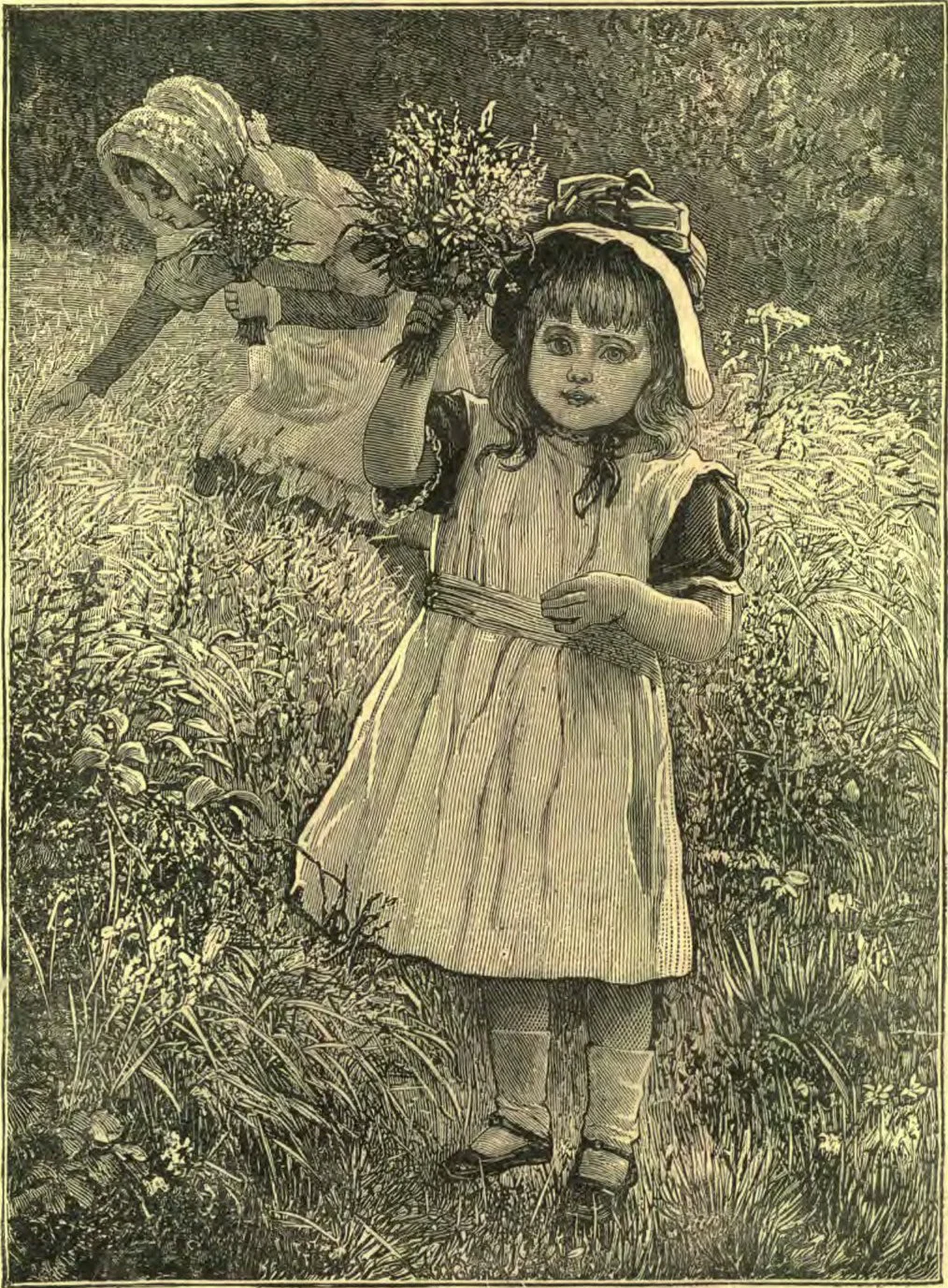
GATH'RING buds and blossoms fair, Little girls with golden hair; Neither clouds nor storms appear; Skies are sunny, bright and clear.
Years may pass and seasons fly; Storm and tempests cloud the sky; Buds and blossoms quick decay, All things earthly pass away.
But for those who live the truth There abides perpetual youth; Children of the God of heaven, Kindly crowns to them are given.
“Little children,”—they receive All a Father's hand can give; And in endless youth shall rise, To inherit Paradise. —Little Christian, adapted.

OUR FATHER MADE THEM ALL

I would not hurt a living thing, However weak and small; The beasts that graze, the birds that sing, Our Father made them all; Without his notice, I have read, A sparrow cannot fall.

PAINTING THE BROOKLYN BRIDGE.

The famous Brooklyn bridge, which was described for you not long ago, is now receiving a coat of paint. To accomplish this work at the same time that trains and passengers are making their usual trips, exposes some of the workmen to great peril, yet these painters are apparently so cool-headed and daring one would judge they were not susceptible of an emotion of fear. Of the amount of work to be accomplished, and the risks to be run in performing it, one may gain some idea from the following paragraphs clipped from the New York Mail:—
“The painting of this immense structure is no light job. Millions of superficial feet have to be covered with paint to preserve it from oxidization by the elements. The recently constructed extension in Brooklyn, about thirty-five feet in length, contains over 6,000 superficial feet. By comparison, some idea can be had of the extent of the whole bridge. To keep this immense area in good order requires the constant vigilance of a score of workmen, who are on the regular list of salaried employees. In busy seasons like the present, extra men have to be engaged. About twenty tons, or 40,000 pounds, of paint are necessary to cover all the exposed portions of the bridge, even with the most rigid economy. The bridge trustees purchase the dry paint in ten or twenty barrel lots from a number of manufacturers, and afterwards mix it as found necessary for use. It is then distributed to the workmen by the boss painter.”
Persons crossing the bridge may have noticed the perilous positions of some of the painters. They seem in many cases to hang to the structure like flies. When painting the river span, they have to avoid the constantly moving trains, less than two minutes apart, be careful not to fall into the river, and yet keep on with their work. It is often necessary to cling close to the guard rails which they are painting, so as to escape the cars. At other times they have to stand on swinging scaffolds suspended under the structure. Painting the cables is equally dangerous. Yet the painters seem to disregard the danger, and can now be seen at their perilous work, apparently regardless of everything except their employment.”

ROPE-MAKING

ROPE-MAKING is not what it used to be. Nowadays a girl at a spinning machine can do more work than eight men could do in the old-fashioned way; and where one man could comb one bale of hemp, one machine can now comb seventy-five bales. The product of the largest rope-walk in the United States is 150 tons of rope and twine a week, as compared with sixteen tons when it was built, fifty-six years ago. This rope-walk is in Bushwick, and in the half century it has made the fortunes of five men. Bushwick was fifty years ago a small Long Island hamlet. To-day its boundaries are merged into the Eastern District of Brooklyn. Not many years ago a grove surrounded the rope-walk. To-day it is surrounded by dwelling houses. Fifty-five years ago four horses furnished the motive power. To-day a 550-horse power engine is taxed to do the work. The long, weather-beaten structure, 1,700 feet in length, has had the same appearance for forty years or more.
Twelve kinds of hemp are used in rope-making, Russian hemp being the best. The hanks are bound into bales that can be readily handled. Separating the hanks is the first process in rope-making. Men do it. The hanks are unbound and tossed on one side where men stand ready to pick them up and oil them. The oiling machines are large revolving drums of wood that absorb and hold the oil kept in the troughs below. They are inclosed in wooden boxes, each with a hole about as large as half an ordinary window. Taking a hank, an oiler spreads it out and dashes it through a hole and against the oily surface of the drum. It clings and is drawn upward; but before the end is reached, the man draws it back and repeats the motion until the fiber has been oiled. From the oiling machines the hemp goes to the combing machines of different sizes and capacities. Five combings are necessary. The combing machines are very ingenious, and room after room is filled with them. Endless bands with cross rows of long fine teeth seize the fibers and carry them along until other teeth on a band moving faster comb through them and straighten and draw them. After the combing the fibers become roping, and endless yellow streams of it flow from upper stories to stories below for the spinning machines. Women and girls operate the spinning machines.
Many machines are used in spinning and balling harvest twine, which is extensively used in the West. Hundred-ton orders for it are frequently filled.
In a low addition is the tar shop, where spun yarn for tarred rope goes through a process as old as the hills. Those who like the smell of tar, can get it here the year round in all its purity. Through long troughs nearly filled with hot tar the yarn is drawn until it is thoroughly saturated. On coming out it passes through squeezers, and any excess of tar is squeezed out. Then it passes through the air for a considerable distance to dry, and finally is wound on bobbins. Tar protects cordage from injury by exposure and immersion, but makes it more rigid and weakens it. Many efforts have been made to find a substitute, and there is a patent process which, it is asserted, renders rope waterproof, adds to its durability by preventing mildew or decay, increases its strength, and keeps it pliable in the coldest weather.
In the machinery for making large ropes or cables, very little change has been made in the half century. The machinery is crude but substantial, the stanchions, beams, and braces being of roughly hewn wood. Ninety-eight threads make a six-inch cable; and with all these threads to attend to at the gauge-plate, a rope-maker is kept busy. About 100 sizes of rope are made, running from one-sixteenth of an inch to twenty-four inches in diameter. The length of large rope is generally 1,000 feet, and the largest rope made nowadays is fifteen to eighteen inches, and no larger rope is made except to order. Cordage of all sizes is stored awaiting shipment, and the big cables are coiled and bound as neatly as thread on a spool.—Sun.

PRAYER

LESSON 4.—CONDITIONS OF PREVAILING PRAYER.

1. WHEN we would pray to be forgiven, what must we first do?—Confess our sins. Num. 5:6, 7.
2. Show how this practice of confessing was exemplified by a prophet who was greatly beloved of God. Dan. 9:3–21.
3. What warning, and what promise, may be found in Proverbs 28:13?
4. How was this promise verified unto David the king? Ps. 32:5.
5. To whom should prayer be addressed? Ps. 5:1, 2; Phil. 4:6.
6. Through what means are we to approach unto God?—Through Christ our Mediator. John 14:6.
7. In whose name, then, should our petitions be presented? John 16:23.
8. What must be exercised in order to please God, and secure an answer to prayer? Heb. 11:6.
9. What strong assurance is given to those who thus pray in faith? Mark 11:24.
10. What condition accompanies this promise? John 15:7.
11. In what state of mind must we come to God in prayer?—We must be humble. 2 Chron. 7:14.
12. How is this principle illustrated by example? Luke 18:9–14.
13. In the time of his greatest need, in what terms of humility and submission did Jesus Christ, the Son of God, address the Father? Luke 22:42.
14. What degree of earnestness is demanded in prayer? Deut. 4:29.
15. What promise is made to those who thus seek God? Jer. 29:12, 13.
16. What does David say about his manner of seeking the Lord? Ps. 119:10, 145.
17. How must we feel toward our enemies if we would have our prayers answered? Mark 11:25.
18. What warning is given to those who cherish an unforgiving spirit? Verse 26.
19. What passage seems to teach that the Lord favors the prayers of those who are truly kind and generous? Acts 10:4, 31; Matt. 6:12.
20. By what parable is the principle illustrated? Matt. 18:23–35.
21. How are we taught to be persistent and persevering in prayer? Luke 18:1–7.
22. By what remarkable example is this principle illustrated? Gen. 32:9–12, 24–26.
23. How did David show his confidence that God would answer his prayers? Ps. 40:1.
24. How long did Daniel persevere in prayer? Dan. 10:2, 4, 5.
25. When the angel appeared to him, what assurance did he give him? Verse 12.
26. Having tried in every way to fulfill the conditions of acceptable prayer, how should we come before God? Heb. 4:16.
27. Why may we have confidence to do so? V. 15.

SHADOW-TEACHING

This learned I from the shadow of a tree, That to and fro did sway upon a wall: Our shadow-selves—our influence—may fall Where we ourselves can never be.

PRESERVATION OF FOOD IN SIBERIA.

To appreciate the severity of the climate in Northern Siberia, it is only necessary to understand the practical purposes it is made to serve. The entire country is used as a vast refrigerator in preserving articles of food.
One day a traveler, dining at Tomsk on a plump fowl, asked how long the bird had been killed. The landlord evidently softened his reply as much as possible, knowing the repugnance of most foreigners to any food not quite fresh.
“Two months only,” he said. “Not a day more.”
No precautions are required for the preservation of beef, for it takes care of itself. Nearly all butchers kill, at the beginning of the cold weather, a sufficient number of animals to furnish provisions for the entire winter, and allow the meat to freeze. There is no fear of any food changing in such a temperature. The fish become so solid and stiff that they are set up on their tails against the walls of the markets, be the tail ever so long, and the fish ever so heavy.
Often fruits preserved in ice are placed upon the table of the Siberian evening-meal, the method of keeping them being similar to that employed with meats. As soon as the severe cold sets in, they are exposed to the air, if possible toward the north, where there is no sun to reach them; they thus become completely frozen.
When eaten, they are found to have retained their flavor marvelously, notwithstanding their change from a frozen rigidity to the thawed state necessary for use. At the moment of being served they are usually as hard as wood, and, if they chance to fall, rattle like stones upon the floor. The heat of the room gradually softens them, and they assume their original form.
Such a convenient climate ought certainly to simplify the labors of marketmen and housekeepers.—Youth’s Companion.

THE GOPHER.

THE exigencies of climate form the habits of wild animals and birds. When winter is announced, the birds migrate to a warmer climate. As soon as it becomes very cold, the bears go into winter quarters. But the gopher, as a Montana correspondent of Chambers's Journal says, “holes up” about the 20th of August, when the weather is warm and pleasant. Hundreds of them are seen on the 15th of August, but on the 20th but few can be seen, and by the 25th not one. The writer mentions a singular fact associated with the hibernation of the gopher:—
“The gopher appears to freeze perfectly solid in our severe winters. Miners drifting through gravel in winter have several times, to my knowledge, dug them out curled like a ball, but solid and cold as though dead. It is impossible to open them out when in this condition; they are like a block of wood.
“But place one near a hot log fire, and soon he will straighten himself. First one hind-leg and then the other will kick a little, and the gopher sits up and looks around with a bewildered air.
“Our fish act in a similar manner in winter. In fishing through the ice—sometimes the latter four feet thick—the temperature is usually low, say from twenty to forty-five degrees below zero—the fish, whether trout, grayling, or whitefish, when released from the hook and thrown on the ice, almost immediately stiffen and cease jumping about.
“Many of them stiffen or freeze in a curved form, as though stricken with the intense cold as they struggled on the ice.
“Take these same fish home to a warm kitchen, and they will, when thawed, kick and flop about as though newly caught. I have seen this occur five hours after being out of water, and have been told they will live for twenty-four hours.”—Selected.

A PNEUMATIC TUBE TO EUROPE.

COLONEL J. F. PIERCE, of Southington, who has been studying the use of pneumatic tubes, has reached a point at which he hopes to show that a tube across the Atlantic can be used. The tubes will always be in couples, with the currents of air in one tube always moving in an opposite direction from the other. The heaviest cannon will serve to illustrate the tube. A car takes the place of the charge, the tube to be indefinitely continuous and the speed of the car to be governed by the rapidity with which air can be forced through. Time is required to establish a current of air flowing with great swiftness through a tube perhaps thousands of miles in length, but when once created, the motion will be nearly uniform. The speed of the current may be made as great as may be desired by using the steam driven fans employed in blast furnaces. Niagara Falls could drive blast fans and furnish motive power to keep in motion the trains to connect this continent with the Old World. The temperature within the tube may be regulated by passing blasts of air entering the tube through furnaces or over ice. The speed attainable may reach 1,000 miles an hour. The tube lining and car exterior would be of polished steel, with corrugated sides matching with wheels provided with anti-friction bearings. The speed, owing to the curvature of the earth's surface, will tend to overcome all weight, and the pressure will be upon the upper part of the tube; thus there is scarcely any limit to the speed attainable.—Hartford Courant.

Asparagus: A Lily Known as a Vegetable

ASPARAGUS is really a kind of lily, but was known as a vegetable as far back as the time of the Romans. Pliny mentions the asparagus of Ravenna with especial praise. In the South of Africa it is a weed.

“SEARCH THE SCRIPTURES.” JOHN 5:39.

This injunction is from the eternal Son of God. Neglect of the study of God’s word leads many to neglect the great salvation, and proves the ruin of thousands. When this command was given, reference was had to the Old-Testament Scriptures only, but we now have the New-Testament Scriptures besides. If God has done for us the utmost that Deity could do; if all the divine attributes, unlimited as they are, have combined and even exhausted themselves in the great plan of redemption, then every child and youth should make the Scriptures their study, that they may not be ignorant of this wonderful scheme. You should open the Scriptures with a solemn interest to hear what the voice of God bids you do and be in order to be saved.
The subject of redemption is plainly revealed in the Scriptures. Nature and the Bible agree perfectly; but the minds of finite beings are not agreed in their suppositions as to what these teach, and hence there are many erroneous theories concerning religion. We see God in nature; he is speaking to our senses continually. The heavens declare his glory; and if our faculties of observation were awake, we could see the impress of God everywhere.
When you open the Guide Book, and there hear God’s voice speaking to your senses, it is then you should open the understanding to take in his instruction. You read there the plan for saving a lost world. You can but tax your mind to the utmost to become acquainted with this greatest of subjects. It is wonderful! The mystery of godliness is unsearchable as well to angels as to men.
The world’s Redeemer has said, “Search the Scriptures.” In them is laid open the bounteous provisions for human necessities, and the strongest motives are set forth to influence to repentance and obedience. Here the seeker for truth may read, contemplate, and be stirred to the very depths of his being by that which a good and gracious God has done and is continually doing for him. He will be amazed that he should ever have treated with indifference the marvelous love and pardon proffered; for in redeeming man, God gave the greatest that he could offer. And if the objects of so great a love neglect salvation, there is nothing that Heaven can do more in their behalf.
If you neglect so great salvation, is it not certain that the magnitude of that which you turn away from and are indifferent to is a sure proof that the one who neglects so great salvation must be lost? You need to study, to contemplate these great themes, lest you cherish indifference and become too hardened to yield to the conditions of the wonderful plan of salvation, and too proud to be humbled by a realization of your own fallen conditions.
There are many who are easily amused with story books. The mind is filled with a cheap kind of food for meditation, so that it becomes powerless to search and comprehend the very things which concern eternal interests. The Lord enjoins upon children and youth to search for truth as for hidden treasure, and to be attracted and fascinated by that which unites the human with the divine. Story books are read with assiduity; fictitious tales are eagerly devoured; and a large class, not only of children and youth, but of men and women of mature age, are mental inebriates. They seem more or less indifferent upon religious matters, for their moral taste is perverted; and as they give their mind cheap food, it becomes enfeebled, just as the body becomes weak when deprived of healthful nourishment. As the mind becomes habituated to contemplate subjects which do not draw upon its powers, the sensibilities of the mind become dwarfed, and grow cold and unimpressible. The mind then has no appetite for serious and divine contemplation, and takes no interest in the study of the deep, hidden truths of God’s word. There is need for penetrating minds to dig for the truth as for hidden treasure. The mind that is allowed to read story books and novels, will not be interested in searching the Scriptures. The heart will be too cold to burn with the compassion of Him who loved us and gave his life for us that we might be saved.
My heart is sad when I think how many will miss the way to heaven because they did not study the guide God has given them. There is no possible arrangement whereby these souls can be saved who, having the voice of God speaking to them in his word, have not interest sufficient to search and become acquainted with the directions God has given them, pointing out the only path that leads heavenward. Well may the apostle ask, “How shall we escape if we neglect so great salvation?” Our youth should be presented with a pledge to sign that they will not touch idle tales, but that they will make diligent search of the Scriptures, that they will give their minds the most nourishing, wholesome food, in order to become strong in contemplating the works of Christ who became surety for the fallen race.
The power of an angel could not make an atonement for our sins. The angelic nature united to the human could not be as costly, as elevated, as the law of God. It was the Son of God alone who could present an acceptable sacrifice. God himself became man, and bore all the wrath that sin had provoked. This problem, How could God be just and yet the justifier of sinners? baffled all finite intelligence. A divine person alone could mediate between God and man. Human redemption is a theme which may well tax the faculties of the mind to the utmost. The reason that Christianity is not more elevated is because there is so little effort put forth in the great, grand, holy work of struggling for immortality. Satan is constantly trying to make the salvation of the soul an indifferent matter,—that man has but little to do to secure this priceless treasure. This is why eternal things are not discerned; this is why there is a cheap, spurious article passed off as religion. There are many who say, “I am saved; I am sanctified; I have nothing to do, Jesus has done it all,” and they care not to search the Scriptures or to hear the voice of God in his word, or to be doers of the word. This belief is like a building erected on sliding sand. It is a refuge of lies, and the storm and tempest sweep it away, and “great,” says Christ, “is the fall of it;” because the false hopes were built so high, and the builder felt so perfectly secure. It was a delusive hope. Our faith, the hope we claim of one day obtaining immortality, calls for the stretch of every muscle, and the strain of every nerve. We cannot be saved in sin and in transgression of God’s law. We cannot be saved in indolence and inactivity. We must search the Scriptures if we would have spiritual enlightenment. We have to wrestle against pride and against the human passions, which the light of God’s word reveals. Every soul saved will present unwearied petitions for the assistance of Jesus Christ, and will use thankfully and appreciate all the helps which God has provided for them.
There can no such evil as idleness exist in the heart, mind, or character of the champion of faith who is actuated by the consciousness that he cannot repent or be pardoned without Christ. But the task, to the soul seeking for heaven, is prescribed, that he go under all and every circumstance to Christ for help. And though the path is obstructed through existing inclination, he must press, he must urge his way; he must abase his will, his desires; he must feel his helplessness, his nothingness, and look alone to the Author and finisher of his faith. It is noble to seek repentance and salvation through the merits of Jesus Christ. We cannot say to the youth or those of mature age, You have nothing to do yourself in this great work. We urge to constant effort. You must be diligent to make your calling and election sure, else you will be found without God and without hope. The youth must become intelligent in the Scriptures; they may, if sanctified through the truth, become living channels of light, and they must strive for the mastery. There will be a work done in the hearts by the Spirit of God, a change wrought in the character. “I thought on my ways, and turned my feet to Thy testimonies.” The great danger with many of our youth is, they do not study the Scriptures and meditate, like David, upon His testimonies. So far as eternity is concerned, they seldom think of it. If they will make the Scriptures the subject of careful study, they will make it a subject of meditation. Once make them anxious for their souls, and they will labor to be saved; and when this point is reached, angels in heaven sweep their harps in exultation that a soul is saved.
MRS. E. G. WHITE.

A SURE REFUGE.

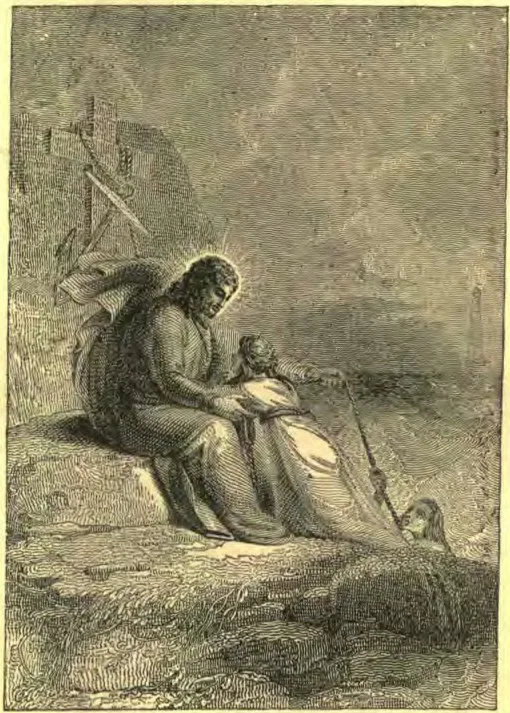
Though the tossing surges frighten, And the mighty thunders roar, Yet the omens cheer and brighten, As I look tow'rd yonder shore! Lord, I fix my hopes upon thee, By thy grace I'll breast the shock! There's a resting just before me, And I'll try to reach the rock!
Through the mists I see the anchor, O'er the spray the lifted cross! Joys await that will not canker, There are gains for every loss! Courage, heart! a light is gleaming! Strive again, and thou art free! Loving eyes are on me beaming! There!—a hand did beckon me!
Hark!—a voice so gentle greets me! 'Tis my Master!—Christ divine! Tender arms, in love enfold me, Bending o'er me now, benign! Here, before the Lord, I'm kneeling! Thou hast saved and made me free! I will praise thee for the healing Thou didst grant unworthy me!
M. B. DUFFIE.

“HALLOWED BE THY NAME.”

CHARLIE ELLIS woke up one morning with the pleasant consciousness that something new was going to happen that day, and as soon as his eyes were fairly opened he remembered all about it. He was going to Sabbath-school for the first time in his life, with a kind lady for whom his mother sometimes did a little cleaning and scrubbing.
She had sent him a suit of clothes which her own little boy had outgrown, and Charlie took a much longer time to put on these clean, neat garments than he usually did in donning the ragged pants and jacket that were his every-day attire.
He went down to the pump and dashed the clear, cold water over his face until it fairly shone, and brushed his brown curls vigorously; then his toilet was completed and he looked admiringly at his altered appearance in the three-cornered bit of looking-glass which stood on the shelf.
He expected to have such a happy time at Sabbath-school, and he was at Mrs. Lee’s door fully ten minutes before the time when she had told him to come.
When at last they reached the church and Mrs. Lee ushered him into a class where five boys of his own age were seated, Charlie smiled brightly at them, expecting that they would welcome him to their number; but his happy face clouded over when he found that they drew themselves away and refused to have anything to do with him.
Charlie had a slight acquaintance with Walter Foster, and when he saw him whispering to the boys as he came up the aisle, he guessed at once that it was something he had said which made the class treat him so unkindly. Mrs. Lee was sorry when she saw the reason of Charlie’s clouded face, and she tried to atone for his classmates’ unkindness by sharing her own book with him and trying to interest him in the lesson as much as possible.
When school was dismissed she said good-bye to Charlie, but asked the others to wait a moment.
“Boys, I want to know why you were so unkind to the little boy I brought with me to-day?” she asked gravely when Charlie had gone.
Some of the boys fidgeted about uneasily with red faces, but as their teacher was waiting for an answer, one of them stammered,—
“Walter told us he was an awful wicked boy, and we oughtn’t to speak to him.”
It was Walter’s turn to flush, but as Mrs. Lee looked toward him, he answered her inquiring glance by saying,—
“Well, he is wicked; indeed he is. One day some boys took some marbles away from him, and he said awful bad words. I wouldn’t speak to such a wicked boy, and I wouldn’t say swear words for anything,” and Walter drew himself up virtuously.
Mrs. Lee’s face wore a sorrowful expression as she listened to the little boy’s self-righteous speech.
“I am glad you do not say wicked words, Walter,” she said gravely, “but you must remember that you have been carefully taught, and know how wrong it is to do so. I am afraid, however, that you do not hallow God’s name in every way, even though you may not dishonor it by using it as Charlie does.”
“Me?” and Walter opened his eyes in amazement. “Why, how, Mrs. Lee?”
“A little boy who whispers when the superintendent is praying, is not hallowing God’s name, for he is taking the time that is set apart for us to speak to God, to talk about his own affairs,” answered the teacher; and an added tinge of color crept into Walter’s rosy cheeks, for he remembered that only last Sabbath he had been so restless and whispered so much that he had disturbed the whole class.
“Hurrying through one’s morning devotions, and reading a verse in the Bible hastily, so that more time may be given to play or lessons is another way of dishonoring God,” continued Mrs. Lee, gravely. “Before you treat a little classmate as unkindly as you treated Charlie to-day, I want you to stop and consider whether you have not been guilty of the same sin of which you condemn him so severely.”
Five faces were rosy with blushes now, and the boys were ashamed as they remembered how they had refused to have anything to do with Charlie in spite of his wistful looks and evident disappointment. And after all they had not been so much better than the little boy they looked down upon, for each one of them had been carefully taught all their lives, both at home and in Sabbath-school.
There was silence for a moment, then Walter looked up bravely.
“It was all my fault we acted so, and we’ll be good to him next Sabbath, Mrs. Lee. I didn’t think about my doing the same thing in a different way, and I just thought how wicked he was, without thinking about myself too.”
“Try to help each other instead of condemning each other’s faults,” said Mrs. Lee, smiling kindly at the flushed, boyish face. “Remember, too, that there are more ways of dishonoring God than by taking his holy name in vain, and try to pay reverent attention whenever his word is read, or petitions are uttered, that we may always hallow his name, and not take lightly and unthinkingly upon our lips the words in the Lord’s prayer which we repeat so often, ‘Hallowed by thy name.’”—Youth’s Evangelist.
Continue reading: HE CARETH