The Youth’s Instructor, Vol. 47, No. 18.

BURIAL-PLACES IN NEW ORLEANS

The Youth’s Instructor

May 4, 1899

Review and Herald Publishing Company · Battle Creek, Mich. · May 4, 1899

BURIAL-PLACES IN NEW ORLEANS.
CHALMETTE MONUMENT
CHALMETTE MONUMENT
THE cemeteries of New Orleans are among the most interesting features of this interesting old city. A half-dozen of these burial-places are to be found grouped together on Metairie Ridge, about halfway out to West End and Lake Pontchartrain.
Because of the dampness of the soil, it has been thought impracticable and unsanitary to bury the dead beneath the earth. Therefore these cemeteries, the most unique burial-places in this country, abound with tombs of brick or marble. These tombs usually consist of two vaults, carefully cemented together, with a crypt below for the bones. Sometimes they are built in tiers, like a wall of more than ordinary thickness. After a year or two, if the tomb is needed for another body, the slab is removed, the wooden coffin destroyed, and the remains deposited in the crypt. Thus a long series of burials may take place in a single tomb.
The decorating of tombs on All Saints’ day is generally observed in New Orleans. Flowers, wreaths, lighted candles, and draperies are placed on the tombs; and in the Catholic cemeteries, services are held in the afternoon. The celebration of All Saints’ has been traced back to the year 998, when Abbot Odilo, of Cluny, instituted it for the monasteries of his congregations. It is an ancient French and Spanish custom in New Orleans, and has been taken up by nearly all the Protestant denominations.
VAULT OF THE CONFEDERATE BENEVOLENT ASSOCIATION.
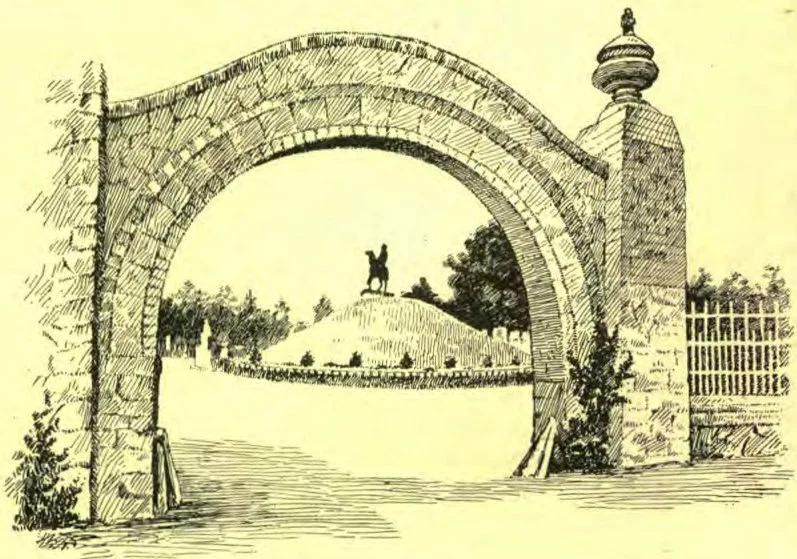
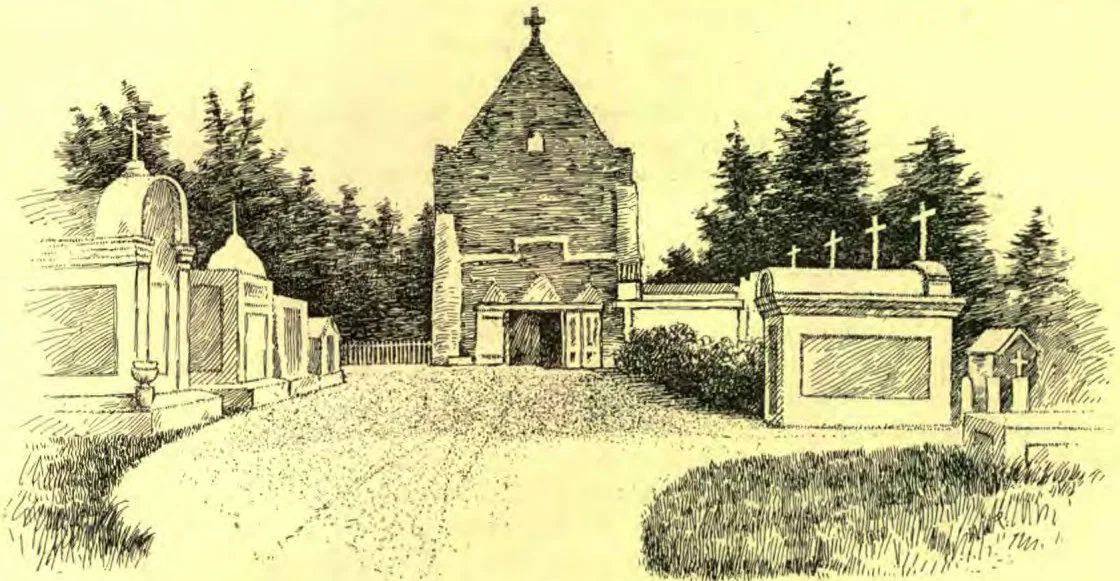
On visiting the cemeteries, the first, on approaching the Ridge, is the Jewish, called “Tememe Direch.” Across from this is another Jewish cemetery, belonging to the “dispersed of Judah.” St. Patrick’s cemetery is the next. The Charity Hospital burial-grounds are on the left-hand, and on the right is Cypress Grove cemetery. Just beyond the Charity Hospital cemetery is the Firemen’s cemetery, conspicuous for the massive Egyptian columns at its entrance. Greenwood is just opposite. Metairie cemetery, which is large and well-kept, is probably the most interesting of the burial-places of New Orleans. It has been beautified by lawns and a system of lagoons, at a cost of thirty thousand dollars. There are many fine tombs in this cemetery. Near the entrance is the mound-shaped vault of the Confederate Benevolent Association of the Army of Tennessee, surmounted by Doyle’s famous equestrian statue of General Albert Sidney Johnston. The burial-vault in the heart of the mound contains a tablet to the memory of General Johnston, on which is inscribed Dimitry’s famous epitaph, said to be one of the finest mortuary inscriptions in the English language. At the entrance to the vault stands a marble statue of an orderly sergeant, “calling the roll.” The tomb of the Association Army of Northern Virginia is surmounted by a shaft, crowned by a statue of General Stonewall Jackson. Near the entrance is the large receiving vault, built in the form of a chapel.
ST. ROCH’S SHRINE.
ST. ROCH’S SHRINE.
There are three St. Louis cemeteries. St. Louis, No. 1, is the oldest in the city. Many of the tombs belong to old creole families, and others are owned by various societies. On some of the tombs in this cemetery may be seen the phrase, “Mort sur le champ d’honneur,” or “Victime de l’honneur,” indicating that here lies one who fell in a duel. Some of the old graves date back to the beginning of the century, and are almost wholly in decay. One old stone bears the inscription, “Mammy, aged 84, a faithful servant, who lived and died a Christian.”
The Campo Santo of St. Roch is one of the most notable burial-places of New Orleans. It is the burying ground of several of the religious orders of the Catholic Church, and its mortuary chapel is a shrine to which many a pilgrimage is made to implore divine blessing.
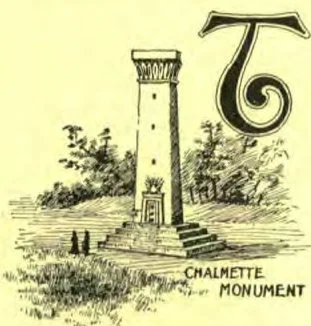
Of the many places of interest in and about New Orleans, none is more interesting, historically, than the battle-field of Chalmette. The battle took place, Jan. 8, 1815. The American troops were drawn up within five miles of the city, and numbered about thirty-two hundred men. It is said that these men made an esplanade of cotton bales to support their guns, which would otherwise have sunk hub-deep into the oozy earth. The British army, under General Packenham, numbered about twelve thousand men. The attack was made at dawn, and lasted till eight o’clock, when the enemy was finally repulsed, having lost nearly three thousand men. The American army was led by General Jackson, and its loss was six men killed and seven wounded. A large monument marks the battle-field.
Just beyond this monument is the Chalmette cemetery, the burial-place of over twelve thousand soldiers who fell during the Civil War.
How precious to the Christian visiting these silent cities is the assurance that very soon all those who have been in this world “faithful servants” indeed, no matter how humble their service, will arise, at the call of God, clothed with the garments of immortality, singing the song of victory over death: “O death, where is thy sting? O grave, where is thy victory?”
LESLIE J. WEESE.

Nay, Not Too Low: A Poem by Madeline S. Bridges

NAY, not too low! Pale, tender flower, half hidden in the grass; The sun, and dew, and kindly winds that blow Will find you as they pass.
NAY, not too low! Pure, humble life, whose wayside graces meet Few friendly eyes. God's watchful angels know How fair you are, how sweet.
— Madeline S. Bridges.

THE RESURRECTION OF LAZARUS.

VI.

When the Lord is about to do a work, Satan moves upon some one to object. “Take ye away the stone,” Christ said. As far as possible, prepare the way for my work. But Martha’s positive and ambitious nature asserted itself. Thinking that he wished only to look upon the body of her brother, she said, Lord, the work of corruption has made this impossible. She thought that it would be terrible to reveal the decomposing body to the beholders. Thus she expressed her unbelief. She did not realize that Jesus had tarried for two days where he was when he received the message, permitting Lazarus to die, that he might manifest the greatness of his power by raising him, thus giving all who should witness the miracle an evidence that could not be excelled.
Christ reproved Martha for her unbelief, but his words were spoken with the utmost gentleness. “Said I not unto thee, that, if thou wouldest believe, thou shouldest see the glory of God?” Why should you doubt my power? You have my word. If you will believe, you shall see the glory of God. Skepticism and unbelief are not humility. Implicit belief in Christ’s word is true humility, true self-surrender.
Christ’s every word is full of meaning; his every lesson is important. Was not his word sufficient for Martha, even in her sorrow? Why did she reason in opposition to his requirements? Natural impossibilities can not prevent the work of the Omnipotent One. Christ would not be hindered in taking the prey from the enemy, and giving his disciples another trophy of victory. But the human heart is slow to understand Christ’s words, and Martha’s faith had not grasped the true meaning of his promise.
“Take ye away the stone.” Christ could have commanded the stone to remove, and it would have obeyed his voice. He could have bidden the angels who were close at his side to do this. At his bidding, invisible hands would have removed the stone. But the stone was to be taken away by human hands. Thus Christ would show that humanity is to co-operate with divinity. What human power can do, divine power is not summoned to do. God does not dispense with man’s aid. He strengthens him, co-operating with him as he uses the powers and capabilities given him.
The order was obeyed. The stone was rolled away. Everything was done openly and deliberately. All were given opportunity to see that no deception was being practised. There lay the body of Lazarus in its rock grave, cold and silent in death. The cries of the mourners were hushed. Surprised and expectant, the company stood around the sepulcher, waiting to see what next would happen.
Calmly Christ stands before the grave. No hurried movements are made. A sacred solemnity exerts its influence upon all present. Christ steps closer to the sepulcher. Lifting his eyes to heaven, he says, “Father, I thank thee that thou hast heard me.” Not long before this, Christ’s enemies had taken up stones to cast at him because he claimed to be the Son of God. They had accused him of blasphemy, of performing his miracles by the power of Satan, thus blaspheming God themselves. But here Christ claims God as his Father, and with perfect confidence declares that he is the Son of God.
In all that he did, Christ was co-operating with his Father. Ever he had been careful to have it understood that he did not work independently, but that it was by faith and prayer that he wrought his miracles. Christ desired all to know his relationship with his Father. “Father,” he said, “I thank thee that thou hast heard me. And I know that thou hearest me always: but because of the people which stand by I said it, that they may believe that thou hast sent me.” Here the disciples and the people were to be given the most convincing evidence in regard to the relationship existing between Christ and God.
“And when he had thus spoken, he cried with a loud voice, Lazarus, come forth.” His voice, clear and penetrating, falls with solemn power on the people, and pierces the ear of the dead. As he speaks, divinity flashes through humanity. The people see in his face, which is lighted up by the glory of God, the assurance of his power. Every eye is fastened on the entrance to the cave. Every ear is quickened to hear each word. With intense and painful interest, all wait for the test of Christ’s claim, the evidence that is to substantiate the fact that he is the Son of God, or to extinguish the hope forever.
There is a stir in the silent tomb. He who was dead stands at the door of the sepulcher. His movements are impeded by the grave-clothes in which he was laid away, and Christ says to the astonished spectators, “Loose him, and let him go.” Again they are shown that what human hands can do, divine power does not attempt to perform. The human worker is to co-operate with God. In God’s order, humanity is to work for humanity. There is a work that God alone can do. He alone can heal the sick. But the physician can co-operate with him by supplying right conditions. God alone can restore the diseased frame, but if man fails to do his part, he has no right to expect God to do his part.
This miracle exerted a powerful influence. “Many of the Jews which came to Mary, and had seen the things which Jesus did, believed on him.” They received Christ, and in them the words were fulfilled, “As many as received him, to them gave he power to become the sons of God.” “But some of them went their ways to the Pharisees, and told them what things Jesus had done.” They had just witnessed the most wonderful evidence ever given to men that Jesus was the Messiah; but in spite of this, they surrounded their souls with darkness so dense that the divine light could not reach their souls.
MRS. E. G. WHITE.

MAKING HOME PEACEFUL.

XXII.
Ah, James Beardsley is not alone in his sorrow. Thousands all over the land share his loneliness. Husbands and wives walk the path of life together many a year, and are yet only strangers to each other,—one acquainted with the peace of God; the other an alien to the Father's house: the one cruising about on an unknown sea, without chart or compass; the other led on by angel hands.
The evident lack of sympathy from his wife, and her complete blindness to the true state of affairs, together with his son's rebellious spirit, were a sore trial to James Beardsley. Then, too, it seemed that Grandmother Sharpe grew continually more querulous and jealous-hearted as the weeks went by. The contrast between her life and the beautiful and peaceful one which his godly father had lived, seemed even greater than when Deacon Beardsley was with them. But all these things only gave him a clearer sense of his dependence upon God. Especially had he felt blessed in taking up the one duty which, above all others, his beloved father had urged him not to neglect,—that of erecting the family altar, which so long had been broken down. These seasons of Bible reading and family prayer, though seemingly only a trouble to the older members of the family,—a meaningless ceremony, to be hurried over morning and evening,—were to little Flossie seasons of special delight; for then she could hear her father read the beautiful stories of Joseph and Benjamin and David and Samuel, with which Grandpa Beardsley used to beguile the tedious hours when she was so tired. Particularly did she enjoy the sweet story of Jacob's dream of the angels; and that of the mountains that were full of horses and chariots of fire round about Elisha; and she always listened to the story of the birth of the Christ Child, and of the angels’ song, “On earth peace, good will to men,” with ever-increasing interest. In fact, any story in which the angels bore a prominent part was sure to be regarded with favor by this “strange child,” as every one called her. It seemed as if the little heart was growing daily more patient and tender, and that these lessons of divine truth were sinking deeper and deeper into it.
Fathers, are you neglecting this means of grace in your family? Are you more anxious to settle down with the evening paper in your hands than to read the message God has for you in his Book? Ah, why do we welcome with such gladness, letters from our absent loved ones, while the grand old Letter from heaven is neglected day after day? Children, you have a message from the skies to-day,—a message from heaven directly to you. Have you read it, or have you neglected reading the message of your best Friend, which tells you he is coming again,—yes, and coming soon,—and teaches you what you may do to get ready to meet him?
Little Flossie surprised everybody with whom she came in contact—and none more than her wayward brother, Reginald—by her quaint, womanly conduct, and strange fancies. One day when her “big brother,” as she called him, was wilful and unkind, Flossie looked at him pleadingly, and said, softly, “Please don’t, Regie; you hurt Flossie. See! the angels are crying!” and the impulsive lad turned suddenly, and giving the pale little cheek a kiss, seized his hat, and dashed out of the house, saying, “O puss! you do make a fellow feel so mean!”
The death of little Tim, her never-to-be-forgotten playmate, made an impression on the sensitive mind of the child, which had never been effaced. Later, when her beloved grandfather died, was the first time she had looked upon death; and for months she was so lonely and heart-broken that nothing less than “angel stories,” as she called them, would comfort her. But her playmates—little Tim Mallory and Grandpa Beardsley—were gone; and, as if their places could never be filled again, she seemed to care less and less for the companionship of other children, playing her quaint little games either entirely alone, as she sat in her wheel-chair, or with little Bessie. But Bessie generally soon wearied of Flossie’s quiet plays, and trotted off to find some noisier sport. At such times, perhaps because she more keenly missed her grandpa than at others, she loved to close her eyes tight, and wheel softly across the floor, back and forth, “playing blind,” like “poor grandpa.”
It was the next week after the events recorded in the last chapter,—a dismal snowy afternoon. Great gusts of wind howled and moaned around the house, like the evil spirit in the parable, seeking rest and finding none.
Mrs. Beardsley and Janet were unusually busy, and Grandmother Sharpe had gone to make an afternoon call. Little Bessie had not been very well all day, and was asleep in her crib; and Flossie was quite lonely. She had played all her simple games, with an imaginary playfellow; had looked at the pictures, one by one, in her latest new book; and at last had taken her basket of calicoes, and spread the gaudily colored pieces down carefully, patting out every wrinkle with the delicate little hand again and again. At last a bright thought struck her,—she would ask mama to cut dolly a new frock from one of her largest pieces.
“Please, mama,” she called, as she slowly wheeled her chair out into the kitchen, where Mrs. Beardsley was busy making cookies, “won’t you cut dolly a nice new dress?”
At that moment Mrs. Beardsley was irritated; for she had burned a large tin of cookies. For that simple reason, and that alone, she answered the child harshly, and with an impatient frown: “Oh, go away, Flossie, do! here I’ve burned all these cookies,—just ruined them,—and I’m in such a hurry!”
Mrs. Beardsley did not often speak unkindly to this little daughter, whom she dearly loved; but we all understand well enough,—aye, too well,—by our own experience, how sometimes under slight provocation, we speak harsh words, the memory of which is afterward gall and bitterness, because of some trifling circumstance that has irritated us, and caused us to lose for the moment our self-control. Oh, those moments of thoughtlessness, those moments when we forget ourselves, and let go the hand of our good angel! how many days and years of regret and sorrow of heart they have cost!
Flossie was quite stunned for the moment; she could hardly believe that her mother had been speaking to her. But she turned away sadly, with a little ache in her heart, and, choking down a sob, wheeled slowly back through the hall, saying to herself: “Mama’s busy; poor mama.” Just then Mrs. Beardsley opened the heavy trap-door in the kitchen floor, and hastily went down cellar. She intended to be gone only a moment, and knowing that Bessie was asleep, and thinking Flossie had returned to the sitting-room, she had no thought of fear from the open door. But, failing to gain the attention of her mother, Flossie had determined to fall back upon her old source of amusement—“playing blind.”
“I’ll play I’m grandpa,—blind,—so—so; now I’ll walk,”—she always called it “walking” when she turned the wheels of her little chair. Then she begins her journey back through the hall; with some difficulty she passes through the door of the kitchen. She has done the same thing—played the same way—many times before. The open trap-door is just in front, not a yard distant. Still Mrs. Beardsley tarries in the cellar, unmindful of the danger to her child. Slowly the small wheels revolve; the little chair pauses a second with its precious freight, as if dreading to make the fearful leap; and then it goes plunging downward.
MRS. L. D. AVERY-STUTTLE.
(To be continued.)

The True Nobility Is Being Superior to Your Previous Self

“THERE is nothing noble in being superior to some other man. The true nobility is in being superior to your previous self.”

LIFE'S HARMONY.

They tell me that in Pisa's old cathedral All noises harsh and loud— Grating of ponderous doors, shrill tones, the tramping And murmur of the crowd— Are caught up, softened, harmonized, and blended Within the lofty dome, Then echoed back in one great wave of music, Sweet as a dream of home.
So all the harsh notes in life's mingled music,— The burden and the woe, The stroke that almost snaps the quivering heart-strings, The loss that grieves us so,— In heaven's o'er-arching dome of perfect wisdom, Power, and love, shall be Gathered, and blended in divinest marvel Of matchless melody.
—M. L. Upton.

TWO LITTLE BOYS.

A BAD little boy with a cross little face Came slowly down-stairs in the morning; Of fun or good nature he showed not a trace; He fretted and cried without warning. He'd not touch his breakfast, he'd not go and play; If you spoke, he just answered by snarling; He teased the pet kitty; and all the long day He really was "nobody's darling."
A good little boy with a bright little face Came down in the morning-time, singing; And indoors and out, and all over the place, His laughter and music went ringing. He ran grandpa's errands; his orange he shared With Sue; and he found mama's thimble; To do what was asked he seemed always prepared, And in doing it equally nimble.
These two little boys, who are wholly unlike, Though they live in one house, are not brothers; That good little lad and that bad little tyke Have not two kind fathers and mothers. But there are two tempers to only one boy, And one is indeed such a sad one That when with the good one he brings us all joy, We ask, "Has he really a bad one?"
— The Outlook.

IT WILL HOLD MORE.

“THAT measure’s full,” said Rob, holding the wooden measure even, and noticing the rounded top as his father poured the stream of yellow grain from the meal-bag.
“Not quite,” said the farmer. “It will hold a little more, if you shake it down well.”
“Does, doesn’t it?” answered Rob, thoughtfully, as a gentle shaking left a half-inch of the sides of the measure visible. “Now, it’s full, though.”
“It will hold a little more,” repeated his father, steadily. “Set it down hard, once—there! A pint more will go in easily. Things look full long before they really are, sometimes. Some folks round up their time that way. Day’s packed full; can’t possibly get in another chore; no time to do an errand; dreadfully busy. Worst of it is, they really think so. What they need is a good shaking up and setting down hard. Never was a day so full it couldn’t hold a little more. Hold that a minute, will you, while I go and lead old Billy out?”
“I believe father heard me telling mother I was so busy I hadn’t a minute to go to the store for her,” mused Rob, standing stock-still, holding the measure. “And I thought I was. I’m pretty close on time, with that physics examination coming to-morrow; but I might have done the errand. I could have studied all the way over and back if I’d wanted to. I believe I’ll shake up my days a little. They’ll hold a little more, if they do look full.”—Forward.

BLIND DOVETAILING.

As you have lately had one lesson in dovetailing (see INSTRUCTOR, No. 14), I will now give you a second lesson, in which I will finish the instruction on this subject. In Fig. 4 of that article is shown what I called “blind dovetailing.” However, in the true sense of the word, this is not blind dovetailing, but drawer dovetailing. Regular blind dovetailing does not show the work anywhere, whereas drawer dovetailing shows it at the end of the drawer, but not in front.
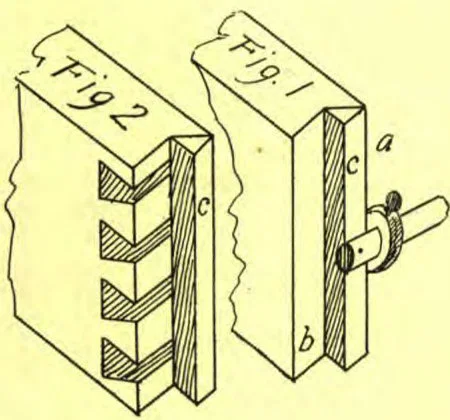
In Fig. 1 you will see a piece of the side, or end, of a box. To make this of a board three eighths or one half an inch thick, set your gauge, after the board is squared up, one eighth of an inch, and gauge on from the side, a; then turn and gauge on the end one eighth of an inch, so that when the corner is sawed out, as you will see at b, it will leave the end at c projecting one eighth of an inch square.
Fig. 5
Fig. 5
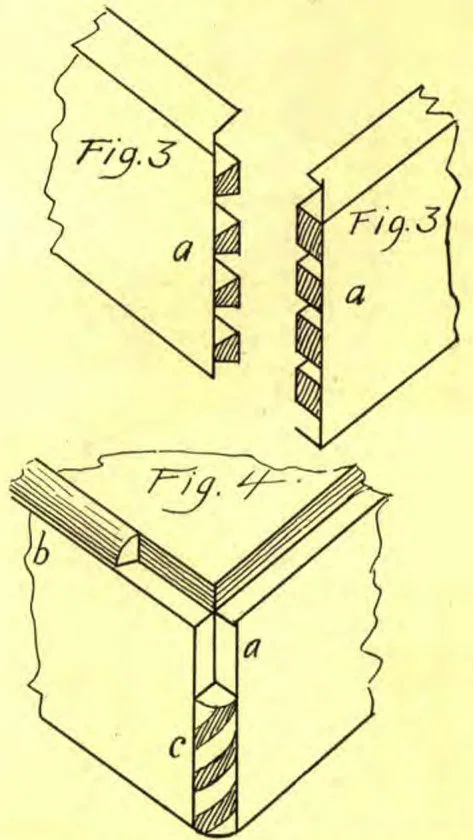
Now proceed to lay out your dovetails, as directed in the first lesson, and as shown here in Fig. 2. Observe that you do not cut through, but only up to, the projection, c. When one piece is cut out, lay it on the other piece, which has the end projecting, as at c, Fig. 1, and mark with your knife. When you have your mortises and tenons all made, take a sharp chisel and cut off the corner of c, in order to miter them, as shown in Fig. 3, a.
Be careful not to take off too much, as that would leave an open joint. As you proceed, it would be well to try the pieces together once or twice. With care and patience, you can, after you have had a little practise, succeed in doing a good job.
When a box is put together in this way, and the joints are tight, the corners of the box can be rounded off without showing the dovetail, thus giving it a nice finish.
Sometimes it is desirable to put a round corner of some other kind of wood in the box. For instance, if you were making a box veneered with maple, and wanted a dark border, such as black walnut or rosewood, you would gauge on from the inside of your lumber, and up on the ends about one half the thickness of your lumber, and dovetail as in the box described above, except that you would not allow the end to project. On the contrary, there would be a corner without anything in it, as seen in Fig. 4, at a. To fill this corner, you could get out a piece of wood about one fourth of an inch square, fit it in nicely, and glue it to the box. Wind a piece of cord or strong twine around the box, to hold the pieces in place until the glue is set, when the corners can be rounded up.
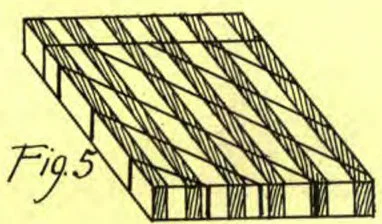
At b, Fig. 4, you will see a plain piece of wood inserted and rounded. At c, Fig. 4, a fancy corner is shown. In making a box of this description, the top and bottom should project the same as the corners. To make the fancy corners, use two or more kinds of wood, as you like. Dress them out one fourth of an inch wide, one eighth of an inch thick, and about a foot long, and glue them together in alternate layers, as shown in Fig. 5. When the glue is set, saw them into strips, either square or diagonal, as shown in Fig. 5, and glue them in, the same as you would the plain strip. Afterward round off, file, and sandpaper smooth. This makes a pretty finish. See c, Fig. 4.
Next week I will give you some instruction in veneering. W. K. LOUGHBOROUGH.

Verse on Endurance and the Victor's Garland

“Pass the countersign, Endure! Not to him who rashly dares, But to him who nobly bears, Is the victor’s garland sure.”
Continue reading: MAN'S PLACE IN NATURE