The Youth’s Instructor, Vol. 47, No. 18.

BURIAL-PLACES IN NEW ORLEANS
Earlier text: BURIAL-PLACES IN NEW ORLEANS

MAN'S PLACE IN NATURE.

Man’s Relation to Light.
In our study this week we will consider man in his relation to light. We have already seen that light bears important relations to the air, the water, the plants, and the lower animals; it also has its relation to man. When God made light, on the first day of the week, he had in mind the man Adam, whom he was to create on the sixth day. The light was to be a means by which man could recognize the wonderful creations that God had made on the six days; so God made the eye, the window which allows light to pass into the human soul. Not only can we see, by means of the sense of sight, the objects that are about us; but “truly the light is sweet, and a pleasant thing it is to behold the sun.”
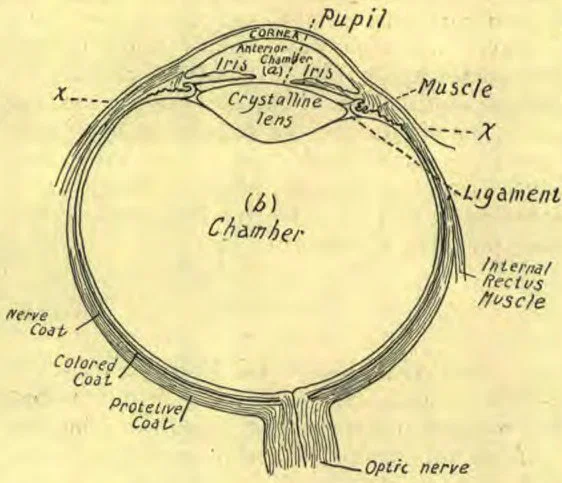
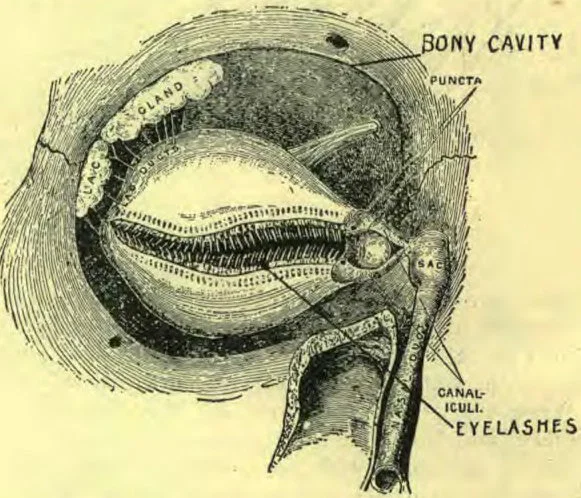
The eye is set into a socket, or bony cavity, thus being protected against accidents which might otherwise result from external objects striking it. The eye is surrounded with a dark coating, which absorbs the light; inside of this is a lighter coating; and inside of the second coating is a third, consisting of an expansion of the optic nerve. This third coating is called the retina. The part of the eye which first admits light is a transparent, horny layer; and just inside of this is a watery fluid. Back of this fluid is a crystallin lens. Back of the lens is another fluid, which is glassy in appearance. You will remember that in the study of light, we studied the lens,—the instrument used to magnify the fly and other objects. It is used in microscopes and telescopes for magnifying very small objects. The Creator has placed in the eye a lens made of living tissue, which focuses the light in the same way that the glass lens does in the microscope and telescope. You will remember that the object appears magnified when we look through the lens, because the rays of light are bent. As the rays of light pass into the eye, through the crystallin lens, they are brought to a focus on the retina. The image thus produced is carried through the optic nerve to the brain; and thus it is that we behold the objects about us. By studying the eye, we see that the Lord constructed a lens before lenses were invented by man. I will now name the different parts of the eye, and you may see if you can find them in the illustrations given.
The rays of light enter the cornea, pass through the aqueous humor, pupil, crystallin lens, vitreous humor, and finally reach the retina. The cornea is somewhat rounding, and bends the rays even before they pass through the crystallin lens. The choroid coating of the eye is black, and allows no light to pass through it into the interior of the eye. The sclerotic coating is light in color, and forms a background upon which the retina is spread out in a very thin layer.
We should be careful how we treat our eyes, which the Lord has given us to use in obtaining a knowledge of his ways and works. Many spoil their eyes by studying where the light shines directly into the eye. They should sit with the back to the light, and let the direct rays of light strike the page instead of the eye.
Human beings and many of the lower animals have two eyes; but there are many creatures, especially among the insects, which have anywhere from a hundred eyes to a thousand or more. This enables them to see all about them, without turning the head. A few animals have but one eye.
Next time we will take up the study of man as related to heat. M. E. CADY.

THE CHLOROPHYL CELL.

IV.

The chlorophyl cell, then, is the “food creator;” all other cells are food consumers. In one respect the office of all cells is alike,—their action is destructive. Because of this, it will be necessary to make the difference in the result of cell action clear to you.
The green cell abstracts gases from both air and water, and substances out of the earth, by destroying, or disarranging, the connection between the gases and substances and their natural surroundings. Out of all this separated material, the cell reconstructs a substance which it alone can create,—protein, the foundation of all living tissue. Bear in mind that the office of the chlorophyl cell is to produce food by destroying the natural condition, and surrounding associations, of certain elements.
The white cells, which include those whose office is in any way to perpetuate life, can only take that which has been produced by the chlorophyl cell, and out of it manufacture tissue, or the parts of its own organization. In other words, the white cells consume the protein created by the green cells, and out of it manufacture other cells, similar to themselves,—their children,—which, clustering around the parent cells, form little communities, called “tissue.” For instance, the fibers of meat are tissue; and a number of these fibers, grouped together, make a larger tissue, called “muscle.” Tissue, therefore, is simply a collection of cells of one kind.
White cells may be called “manufacturers.” They destroy the natural condition of the elements they operate upon, but for the purpose of sustaining life. While both green and white cells are destructive, each destroys to perpetuate life.
The other forms of cell life, such as bacteria, infusoria, microbes, germs, etc., all invisible micro-organisms, or cells too small to be seen without a microscope, are found in air, water, etc., and are all destructive, but with a far different purpose. They destroy to reduce living tissue, or that which has had life, back to the inorganic material from which the chlorophyl and white cells raised it, first to protein, and then to tissue. The office of these cells is destructive, never constructive.
This is the distinction in the three forms of cell life and cell action,—the first produces the material; the second manufactures the material into tissue; and the third disintegrates, or takes apart, the material, and reduces it again to its original elements. Now read Gen. 3:19; Job 34:15; Eccl. 3:20; 12:7. Is there not to you a greater depth of meaning in these verses than formerly? W. S. CHAPMAN.

BE NATURAL.

In studying the natural way of breathing, as seen in animals and young children, we notice that absolute freedom is imperative. It seems almost too bad, in these days of general reform, to take time to dwell upon this matter; but it is necessary to impress on every mind the fact that ignorance regarding the laws of health is a crime, and disobedience to them is a sin; and “the wages of sin is death.” The early mandate against transgression was, “Dying, thou shalt die;” and it is amazing how indifferent women have been to this truth, as applied to the care of their bodies. How sadly lacking in an appreciation of the beautiful are those who admire the deformities of Satan rather than the noble work of God! Our ideas of true beauty and symmetry need to be cultivated up to God’s standard.
I have been greatly grieved to see promising young girls, just ripening into womanhood, doing, often in ignorance, a very terrible thing. Their bodies, which God had given that he might be glorified therein, were being slowly deprived of life. By tight clothing their waists were being compressed so the lungs could take in but little oxygen. How pale and weak is the girl who breathes in short, panting breaths, the lungs struggling for action, the body starving for the vitality in the air.
A large waist indicates large lungs and vital organs, and these, in turn, betoken the likelihood of long life; while a small waist bespeaks exactly the opposite. True, there are some who, because of an unusual constitution, survive in spite of abuse; but such are the exception to the rule. Who would not admire a full-blown rose, blooming in health and vigor, more than a sickly, half-developed, faded attempt at a rose? Who, likewise, would not rather see a natural waist, growing as God intended it to grow? A natural waist is really an ellipse, but fashion has decreed it to be a circle. Let students in geometry and anatomy find how the natural waist is an ellipse.
We do not wish to study the Greeks as our examples in all things, but they certainly did set a commendable example in their sensible ideas regarding the human form. But while they had no higher motive for caring for their bodies than present, selfish interests, surely we should have the highest motives for studying and obeying health principles; for our bodies are to be temples of the indwelling Christ. Then, too, a little in the future, in the time of trouble, disease will greatly increase, and in those days we shall need every bit of vitality God has given us.
In our next talk we will consider some facts concerning the relation of dressing to breathing and to exercise in general.
MRS. M. D. McKEE.

THE PERMANENT ACRE-GARDEN.

Last week we gave directions for making a small, temporary garden. Now let us who live on the farm see what we can do for the Lord with a permanent acre-garden. Where should the garden be situated?—If possible, it should be near the house, as it can then be given more attention. The way many gardens have been neglected is a good reason for hiding them in the corn-field. A well-cultivated garden is an ornament, and something that its possessor can justly take pride in. If it is neglected, and the weeds are allowed to grow, and hide the crooked rows, it is an eyesore to the owner and a byword among the neighbors.
Acre plan
Acre plan
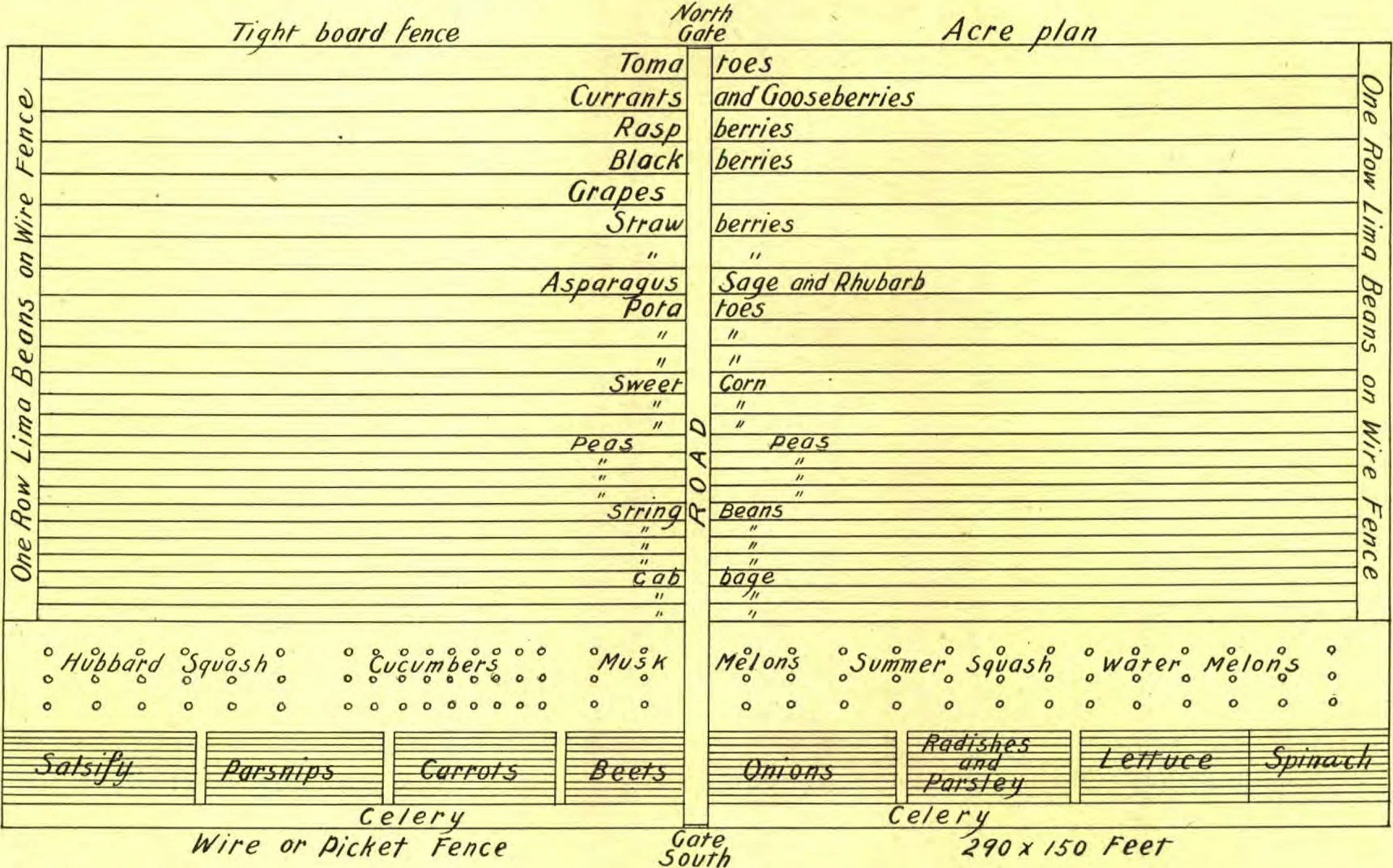
Concerning the nature of the soil and the slope of the ground, but little need be said. The richer the soil, the better. A sandy loam and a southern slope are to be preferred. Have a tight board fence on the north side, if possible, to protect the garden from the cold winds. The other sides may be surrounded either with picket or close wire fence. The fence should be made tight enough to keep out chickens. This acre is to be for the Lord; therefore it should be a pleasure to keep it free from weeds, and in the best condition.
The methods of gardening have advanced during the last fifty years. Horse-power has taken the place of the spade, hand-rake, and hoe; and garden-drills are rapidly taking the place of hand-sowing.
For a modern garden of one acre, make the rows longer one way than the other, so it can be easily cultivated with horse and plow. If a horse is used, the tomatoes, currants, gooseberries, blackberries, raspberries, grapes, strawberries, asparagus, rhubarb, and sage may be planted in rows about four feet apart. Sweet corn, potatoes, cabbages, and beans may be planted in rows three and one-half feet apart. If you do not have a horse, and wish to cultivate your garden by hand, all these may be planted one foot nearer together, thus saving considerable land. Melons, squashes, and cucumbers require the same distance under any kind of culture. The narrow rows to the south will have to be tilled by hand. If farm animals are running loose, the Lima beans on the north and south should be changed to some other place; corn should not be planted close to the fence. Celery needs some shade, so it would be well to plant it near the south fence. This arrangement of the garden is not arbitrary, but may be varied to suit the taste.
Many small gardeners raise all their plants; and as it is not yet too late to plant tomatoes and cabbages, let us see what we can do. Fill an open box, about twelve by eighteen inches in size, three fourths full of mellow soil. With the finger or a small stick, make small trenches half an inch deep, and two inches apart. Into these trenches drop ten or more seeds to the inch. Cover and “firm” (press the soil over the seed) with the palm of the hand. The boxes may be carried out-doors during sunny days. Never plant seed of any kind without firming the soil. This is absolutely necessary. Many persons carelessly drop seeds into the ground; and when they do not come up, they begin to accuse the seedsman of selling worthless seed. Much poor seed is sold; but in many cases the real fault is with the careless planter, and not with the seed. If buying seed in small quantities of your grocer, ask him to supply you from some well-known firm, that takes back all unsold seed in the fall, and brings fresh seed every spring. Next week I will tell you how we can set out tomatoes and cabbage plants in the field. This week we will mention only those that ought to be planted early.
Beets may be planted in rows from twelve to eighteen inches apart. Into trenches about one inch deep drop the seed one fourth of an inch apart. Draw the soil over the seed, and firm with the feet. Carrots, parsnips, salsify (vegetable oyster), and turnips may be planted the same as beets. Spinach may be planted according to the directions given last week for planting lettuce.
Almost every person has a way of his own for planting potatoes. Some cut the potato, leaving but one eye to the piece; others leave more; while some of the largest potato-growers claim an increase of thirty bushels an acre by planting the whole tuber. Drop the pieces, or whole tubers if you wish to experiment, in a trench previously prepared, sixteen inches apart, cover with the hoe two inches deep, and firm the soil with the feet. If you wish to fertilize the soil before planting, scatter well-decomposed stable manure in the trench; a wagon-load would not be too much for four rows of this length.
If you wish, you can have a succession of such vegetables as radishes, lettuce, beets, spinach, etc., by planting every two or three weeks until the middle of July. In like manner you can have a succession of sweet corn, beans, and peas.
The following amount of seed and plants will be required for this acre-garden, to keep it cropped as it should be:— Four qts. extra smooth peas; 4 qts. early dwarf wrinkled peas; 1 pkt. later wrinkled peas; ½ lb. spinach; 1 oz. celery; 4 qts. onion-sets; 1 oz. early cabbage; 1 oz. late cabbage; 4 ozs. early beets; 4 ozs. Blood Turnip Beet; 1 oz. carrot, Early Scarlet Horn; 1 oz. carrot, Chantenay or Danvers; 1 oz. tomatoes, early; 1 oz. tomatoes, late, Ponderosa; ¼ lb. radish, Early Turnip; ¼ lb. radish, Long-rooted; ¼ lb. lettuce; 4 qts. beans, Green String; 4 qts. beans, Wax String; 4 qts. beans, Bush Lima; 4 qts. sweet corn, Extra Early Cory; 4 qts. sweet corn, medium; 4 qts. sweet corn, late; 4 qts. cucumbers; 3 ozs. muskmelons; 3 ozs. watermelons; 3 ozs. squash, summer; 3 ozs. Hubbard squash; 1 pkt. sage; 1 bu. early potatoes; 800 strawberry plants; 100 asparagus roots; 20 rhubarb roots; 45 gooseberry bushes; 45 currant bushes; 90 raspberries; 35 grapevines.
Buy your seed in bulk for a garden of this size, or, in fact, for a smaller garden, if you are sure the seed is as good as that in sealed packages. There is usually about half an ounce in the small packets, and the seed so bought costs two or three times as much as if purchased by the ounce or pound.
I have avoided naming the varieties, except such as are known and planted almost the world over, as some varieties that do well in one section would not do well at all if grown in another.
ARTHUR F. HUGHES.

Lost Time Is Never Found Again

“LOST time is never found again.”

THE GARDEN OF LIFE.

The garden of life—it beareth well, It will repay our care; But the blossoms must always and ever be Like the seed we’re planting there; For beautiful thoughts make beautiful lives; And every word and deed Lies in the thought that prompted it, As the flower lies in the seed.

HEALING THE MAN WITH THE WITHERED HAND

SABBATH-SCHOOL LESSON.—NO. 7.

(May 13, 1899.)

HEALING THE MAN WITH THE WITHERED HAND.

Lesson Scriptures.—Matt. 12:9-21; Mark 3:1-12; Luke 6:6-12.
Memory Verse.—Matt. 12:20.
TIME: A. D. 31. PLACE: Capernaum. PERSONS: Christ and his disciples, the man with the withered hand, Pharisees.

QUESTIONS.

Where did Jesus go upon another Sabbath? Matt. 12:9. Who is especially mentioned as being in the synagogue? V. 10. Who were on hand to watch Jesus? Luke 6:7. What did he say to the afflicted man?—“Arise, stand forth in the midst.” Mark 3:3, margin, Greek. How did he address his would-be accusers? V. 4. Did they reply to his question? How did their hardness of heart affect the Saviour? V. 5. What did he say to the crippled man? With what result? Mention other cases of immediate healing that have been referred to in the lessons thus far. What did the Pharisees now do? V. 6. Knowing their designs, where did Jesus go? V. 7. Who followed him? Matt. 12:15. What did he do for them? What charge did he give these people? V. 16. What prophecy was thus fulfilled? Vs. 17-21. Where did Jesus go to pray? Luke 6:12. How long did he continue his devotions? Why did he choose this late hour for communion with the Father?—Because the people thronged him during the day.

NOTES.

1. Upon another Sabbath, as Jesus entered a synagogue, he saw there a man who had a withered hand. The Pharisees watched him, eager to see what he would do. The Saviour well knew that in healing on the Sabbath he would be regarded as a transgressor, but he did not hesitate to break down the wall of traditional requirements that barricaded the Sabbath. Jesus bade the afflicted man stand forth.—“The Desire of Ages,” page 286.
2. While Jesus manifested great tact, and sought in every right way to win the favor of his enemies, yet when it was opportune to reveal a right principle, he never compromised to save himself. The Pharisees must have been impressed with the brave course of him whom they hated, as, in the face of their malignity, he bade the afflicted man “stand forth.” The same unflinching courage has characterized reformers and martyrs for Christ. A conviction that a certain course is right, and a determination to stand by the right at any cost, bring into the soul the strength of the Master.
3. Thus greater care was shown for a dumb animal than for man, who is made in the image of God. This illustrates the working of all false religions. They originate in man's desire to exalt himself above God, but they result in degrading man below the brute. . . . Every false religion teaches its adherents to be careless of human needs, sufferings, and rights. The gospel places a high value upon humanity as the purchase of the blood of Christ.—Id., pages 286, 287.
4. The Pharisees were continually charging Christ with Sabbath-breaking, because he healed on the Sabbath. With a great show of outward zeal for God's law, they continually violated its spirit, and, by so doing, misrepresented the author of the law. Christ healed, set men free, consoled and comforted, on the Sabbath, and by so doing, manifested the true significance of the Sabbath law. Instead of being a Sabbath-breaker, he was the true Sabbath-keeper. Filled with rest in the manifestation of God's love, he shed the rest of God upon all who would receive it, and convinced the unprejudiced that it is “lawful to do good on the Sabbath.” Are we Sabbath-keepers of the same order? or are we heaping man-made exactions about God's law of love, obliterating its meaning and misrepresenting its author?
5. Jesus withdrew from those who had withdrawn from him. Those who had not withdrawn from him, he drew after him; for “a great multitude followed him.” They came from all parts of Palestine, as well as from Idumea and Tyre and Sidon. Those who were responsive to the drawing of his love were richly rewarded; for he healed them all. The people pressed upon him, desiring deliverance from their plagues. Unclean spirits cried out, acknowledging him as the Son of God. The glorious work wrought by him was in fulfilment of the very scriptures that the Pharisees professed to believe. Isaiah had foreseen his gracious ministry, and God had spoken of him as “my beloved Son, in whom my soul is well pleased.” The God of love, who delights in mercy, rejoiced in the very work the Pharisees hated, and loved him whom they sought to destroy.
6. Of Christ this sublimely tender prophecy was written: “A bruised reed shall he not break, and smoking flax shall he not quench, till he send forth judgment unto victory. And in his name shall the Gentiles trust.” The figure employed is that of a man walking through a garden. Some plant has been bruised and laid prostrate. He does not pass it by; he does not break its bleeding fibers; but he lifts it up, heals its wound, pours upon it his own life, waters it every moment, and fits it for the celestial garden. This tender love is for the bruised, helpless soul. The cruel, ruthless foot of the Pharisee, the professed follower of God, may have crushed it, and left it to die. Jesus will heal and restore, and make it flourish. Why should we not trust in his name?

CHRIST BETRAYED AND ARRESTED

INTERNATIONAL LESSON.—NO. 7.

  • (May 14, 1899.)*

CHRIST BETRAYED AND ARRESTED.

Lesson Scriptures.— John 18: 1-14.
Memory Verses.— John 18: 3-5.
TIME: Night before the crucifixion, April, A. D. 30. PLACE: Gethsemane. PERSONS: Jesus, his disciples, Judas, priests, soldiers.

QUESTIONS.

Where did Jesus go from the temple? Who went with him? By what name is the garden known? Matt. 26: 36. Who also knew of this place of meeting? How? Whom did Judas lead to the garden? What did these men bring with them? What did Jesus ask the officers? Why did he ask this favor? Who came forward to defend Jesus, and what did he do? What did Jesus say and do? What did the officers do to Jesus? To whom did they take him? To whom did Annas send Jesus? V. 24. Why did the priests and Pharisees desire Christ’s death?

NOTES.

1. “Over the brook Cedron.” The name means “the black torrent.” In the rainy season it rushed through a ravine east of Jerusalem, between the city and the Mount of Olives. Gethsemane means the “oil-press,” because it contained a press for extracting the oil of the olive-trees. The spot now known as Gethsemane contains eight olive-trees, whose gnarled, knotted, and twisted trunks speak great antiquity.
2. It was not the intention to arrest Christ during the feast, lest there should be a popular tumult (Matt. 26: 5); but now that an opportunity offered of seizing him secretly at the dead of night, . . . his enemies could not hesitate. . . . Judas knew the place. . . . No hallowed associations . . . deterred his treason for one moment.—“New Testament Commentary.”
3. How vast is the contrast between the picture of Christ in Gethsemane and that of his enemies plotting his death! Behold him contemplating the price to be paid for the human soul. “The history of the human race comes up before the world’s Redeemer. . . . He sees the helplessness of man. He sees the power of sin. The woes and lamentations of a doomed world rise before him. He beholds its impending fate, and his decision is made. He will save man at any cost to himself. He accepts his baptism of blood, that through him perishing millions may gain everlasting life.—“The Desire of Ages,” pages 690, 693.
4. The multitude guided by Judas is described by Mark as “great.” It consisted (1) of the band (John 18: 3, 12), or Roman cohort, numbering three or four hundred men; (2) the captains of the temple (Luke 22: 52), with their men, who guarded the temple and kept order; (3) some of the chief priests and elders (Luke 22: 52); (4) and finally, their servants, such as Malchus. The lanterns and torches show that they expected escape, as the moon was at the full.
5. No traces of his recent agony were visible as Jesus stepped forth to meet his betrayer. Standing in advance of his disciples, he said, “Whom seek ye?” They answered, “Jesus of Nazareth.” Jesus replied, “I am he.” As these words were spoken, the angel who had lately ministered to Jesus, moved between him and the mob. A divine light illuminated the Saviour’s face, and a dove-like form overshadowed him. In the presence of this divine glory, the murderous throng could not stand for a moment. They staggered back. Priests, elders, soldiers, and even Judas, fell as dead men to the ground.—Id., page 694.
6. “Let these go their way.” The divine courage with which Christ met, single-handed, the hosts of his enemies, is not more sublime than his tender, unfailing consideration for his faltering followers. Divine love, while making the soul utterly self-forgetful, quickens into life intense, unfailing remembrance of others. “Abnegation of self and devotion to others” is the true test of Christlikeness.
7. “Put up thy sword into the sheath.” Peter, in defending Christ, was defending truth; yet Christ forbade the use of the sword. . . . Truth sits, not on a throne that is bristling with bayonets, but on one established on the immovable basis of eternal right and love.—Parker.
8. The disciples were terrified as they saw Jesus permit himself to be taken and bound. They were offended that he should suffer this humiliation to himself and them. They could not understand his conduct, and they blamed him for submitting to the mob. In their indignation and fear, Peter proposed that they save themselves. Following this suggestion, “they all forsook him, and fled.”—“The Desire of Ages,” page 697.

NOTE AND COMMENT

More Money Wanted.— T. B. Reed, of Maine, ex-speaker of the Senate, has announced his intention to retire from political life, and engage in the practise of law in New York City. The natural desire to increase his income is the reason given for the change. As a senator he received $5,000 a year; as a member of the law firm with which he is to connect, it is supposed he will receive $50,000 a year,—a salary equal to that of the President of the United States.
Russia and Persia.— The imperialistic ambition of Russian statesmen, not satisfied with the appropriations made in Turkey, China, and Finland, is now seeking additional territory in northern Persia. No objection to this appropriation has as yet been made, but some are in favor of intervention on the part of the United States, on account of Russia's well-known opposition to missions, of which there are several supported by churches in this country in and near the section in question.
Too Late.— Some good people in Massachusetts are trying to prevail upon the State legislature to revoke the sentence of banishment passed on Roger Williams in 1635. This would accomplish no more than a supreme court decision to reverse the sentences of the persons executed for witchcraft at Salem. The best thing the Bay State people can do now is to act upon the words of the historian: “The past has taught its lessons; the present has its duty, and the future its hope.”
Liquor-Selling in the Army.— The construction now given to the attorney-general's interpretation of the new law prohibiting this traffic with the soldiers, is that only beer and light wines shall be sold in the canteens. Harper's Weekly says: “The canteen ought not to be abolished to please reformers, nor retained to gratify rumsellers. It ought to get absolute justice on its merits.” If “justice” in this connection means a proper reward for previous responsibilities, we can only conceive of total oblivion as the proper future of the canteen.
Wireless Telegraphy.— Experiments in this newly discovered process are continually being made. The sending of a message thirty-two miles across the English Channel to France has been successfully accomplished. At Notre Dame, Ind., scientific men have been making daily trials of the wonder, independent of others, and have now successfully telegraphed two and one-half miles without a connecting wire. At the Ann Arbor State University, attention is also being given to this invention; and additional apparatus, already ordered, is now awaited further to prosecute its study. The principles involved are now being applied to telephones, with promise of success.
“Uncle Sam’s Philippine Puzzle.”— What will happen next in these troublesome islands seems as far from settlement as at any time since the “Raleigh” fired her first gun in Manila harbor last May. The Spaniards are becoming importunate in asking for the return of their countrymen now held by the Filipinos,—a consideration named in the peace treaty between this country and Spain. So far the United States forces have been unable to fulfil this part of their contract, but they have offered to turn over to Spain sixteen hundred Filipino prisoners in exchange for her men. Later comes the news of the capture of Lieutenant Gilmore, with fifteen men, by the Filipinos, and the proposal to exchange these sixteen hundred prisoners for them. What next?

THE LONGEST DAY.

It is important, when speaking of the longest day in the year, to say what part of the world we are talking about, as will be seen by reading the following list, which tells the length of the longest day in several places:—
At Stockholm, Sweden, it is eighteen and one-half hours in length.
In Spitzbergen, the longest day is three and one-half months.
At London, England, and Bremen, Prussia, the longest day has sixteen and one-half hours.
At Hamburg, in Germany, and at Dantzig, in Prussia, the longest day has seventeen hours.
At Wardbury, Norway, the longest day lasts from May 21 to July 22 without interruption.
At St. Petersburg, Russia, and Tobolsk, Siberia, the longest day is nineteen hours, and the shortest five hours.
At Tornea, Finland, June 21 brings a day twenty-two hours long, and Christmas day is less than three hours in length.—Selected.

FAMOUS TREES.

WASHINGTON elm. Under the shade of this grand old elm, General Washington first took command of the colonial army in 1775.
The “Burgoyne elm” at Albany, N. Y. This tree was planted on the day the British general, Burgoyne, was brought a prisoner to Albany, the day after he surrendered to our army in the Revolutionary War.
The weeping-willow in Copp’s burying-ground, near Bunker Hill, was grown from a branch taken from the grave of Napoleon Bonaparte, at St. Helena.
The ash-trees planted by General Washington at Mt. Vernon, Va. This is a beautiful row of immense trees, which everybody admires who visits the home of the Father of his country.
Old “Liberty elm.” This famous tree used to stand on Boston Common, but was blown down in a storm. It was planted by a schoolmaster long before the Revolutionary War, and dedicated to the liberty of the colonies.
The William Penn tree in Philadelphia. In that city stands a monument which marks the spot where once stood a tree under which William Penn made his famous treaty with the Indians.
The Charter Oak. It was in an old hollow oak that the early colonists hid their charter to prevent its being taken from them by the British governor, Andros.—Selected.

Missionary Gardeners: One Day at a Time

EVERY missionary gardener, whether his garden is on the splendid plan outlined in this week’s paper, or is just a single bed of a single variety, must remember that it is not the beginning of a work, but its ending, that tells the story. “One day at a time”—thus the little brown seeds hidden in the soft earth push their way up to the light; one day at a time, the fresh young plants develop and mature; and one day at a time, too, they will need your watchful, patient attention. Remember that a little work, thoroughly done every day, will bring much greater results than that sort of effort that goes at any new enterprise with a rush, makes large plans, and straightway goes off and forgets all about it. “As unto the Lord,”—if that motto is adopted, and lived up to, by the missionary gardeners, their work will be a bright success.

A GOOD IDEA.

Many boys who live on a farm think themselves shut out from all opportunities to earn money, such as the wide-awake, willing city lad finds everywhere. Some one has suggested that boys who can have a strip of land, raise popcorn, dry it thoroughly, shell it, and put it up in cartons holding one pint. These may be bought by the hundred or in five-hundred lots. For a small additional cost an attractive label will be printed on the carton, giving the name of the contents, the price, and by whom it is put up.
If the business will not at first warrant the purchase of the ready-made boxes, you can, by the exercise of a little ingenuity, make them yourself; and you or some one in your family may be able to letter them artistically. Examine the packages in which various soap-powders, crackers, etc., are sold; then with stiff paper, good mucilage, and sharp scissors, you will soon be able to make a suitable model. The making of these cartons will be pleasant rainy-day work; and by spending a few afternoons in this way, you can easily make all you will need. Give painstaking attention to details, avoid everything “fussy,” and the result will be packages so attractive they will almost sell themselves. Perhaps your sister would like to be a partner in the business, and would be glad to use her nimble fingers in making and lettering the boxes.
This idea is very practical. There are many persons living in cities and towns who would gladly pay the slight additional cost of shelled popcorn put up in this way. If you take pains to sell only first-class corn, thoroughly dry, you will not have any trouble in disposing of it: those who buy it once will ask for it again, and thus the business will grow year by year.

IMMEDIATE

PLEASE write us your encouraging experiences while canvassing for “PATRIARCHS AND PROPHETS,” stating your opinion of the book, and why you are or are not now engaged in the ministry of the Word through that most eloquent of preachers on early Bible history. How many have you sold? In what length of time? Do you know of any book on the gospel in the Old Testament, as good as “PATRIARCHS AND PROPHETS”?

RESULTS.

We also want interesting facts concerning the good accomplished by circulating this book. If you have secured or can secure any written recommendations for it, please send them along now to Review and Herald, Battle Creek, Mich.

Grand Trunk Railway System

Time Card in Effect February 5, 1899.

C. & G. T. DIVISION.

WEST-BOUND FROM BATTLE CREEK.

Train Leave
No. 11, Mail and Express, to Chicago 12.00 M.
No. 1, Chicago Express, to Chicago 9.00 A. M.
No. 3, Lehigh Valley Express, to Chicago 3.40 P. M.
No. 5, Pacific Express, to Chicago, with sleeper 12.55 A. M.
No. 75, Mixed, to South Bend 7.30 A. M.
Nos. 11 and 75, daily, except Sunday.     Nos. 1, 3, and 5, daily.

EAST-BOUND FROM BATTLE CREEK.

Train Leave
No. 10, Mail and Express, to Pt. Huron, East, and Detroit 3.45 P. M.
No. 4, Lehigh Express, to Pt. Huron and East 8.27 P. M.
No. 6, Atlantic Express, to Pt. Huron, East, and Detroit 2.25 A. M.
No. 8, Lehigh Exp. to Saginaw, Bay City, Pt. Huron, and East 6.50 A. M.
No. 74, Mixed, to Durand (Starts at Nichols) 7.35 A. M.
Nos. 10 and 74, daily, except Sunday.     Nos. 4, 6, and 8, daily.
E. H. HUGHES,              A. S. PARKER, A. G. P. & T. Agt., Chicago, Ill.     Ticket Agent, Battle Creek.

TAKE THE Canadian Pacific Railway

for . . . CHATHAM, OTTAWA, MONTREAL, LONDON, GALT, QUEBEC, WOODSTOCK, TORONTO, BOSTON, PORTLAND, and
All points in New England, the Maritime Provinces, Great Britain, and the Continent.
Illustrated literature, time-tables, and full particulars, upon application to—
J. FRANCIS LEE, GEN. AGENT,
Passenger Dep't. 228 SOUTH CLARK ST., CHICAGO.
Branch Offices: 76 Ottawa St., Grand Rapids, Mich. Room D, Chamber of Commerce, Cincinnati, Ohio. 315 Chestnut St., St. Louis, Mo.
Continue reading: FREE BOOKLET