Signs of the Times, Vol. 42, No. 18.

In Touch with the War

Signs of the Times

May 4, 1915

Pacific Press Publishing Association · Mountain View, California · May 4, 1915

In Touch with the War

A Stern Military Order—All Our Papers Taken—A Troop Fleet on the High Seas—In Danger from the Emden—Arrival in India, and Conditions There
By ARTHUR G. DANIELLS
We announced some months ago the departure of Elder A. G. Daniells, the president of our General Conference, for an extended visit among our conferences and mission stations throughout the Orient. It was arranged for him to give us frequent accounts of the progress of his trip; but owing to the confusion created by the war, the mails have been very uncertain, and some of the matter reported to have been sent has not reached us. We are still hoping for it, even though belated. His article herewith gives an interesting glimpse of what it means to be in the war zone. EDITOR.
Among the conditions and events that have given me serious impressions since leaving Australia for India have been those connected with the terrible war in Europe. It is doubtful if any one knows or can possibly conceive how far-reaching and calamitous this desperate contest could easily and may yet become. Referring to the dreadful possibilities of a European war, Lord Salisbury, when prime minister of England, said, “The danger would be that the fire there lit should involve all that is most powerful and civilized in Europe in a dangerous and calamitous contest.” Three years ago, Sir Edward Grey, secretary for foreign affairs, addressing the House of Commons, said: “It is really as if, in the atmosphere of the world, there were some mischievous influence at work which troubles and excites every part of it. We are passing, this year, through a period of excitement. It is so still. Some countries are in revolution, others are at war; and in several countries which are neither in revolution nor at war, there are people who seem to delight in discussing how near they have been, or are, or are likely to be, either to revolution or to war in the past, the present, or the future. Really it is as if the world were indulging in a fit of political alcoholism, and the best that can be done by those of us who are in positions of responsibility is to keep cool and sober.”

Such a Far-Stretching Landscape of Battle

And now that the war has come, it is proving to be all that was feared. “Was there ever before such a far-stretching landscape of battle? It is not merely that central Europe is in flames; the fire extends to Asia and Africa. . . . It may easily prove to be a literal Armageddon; a war such as history has never yet seen, and which may inflict injuries on civilization itself which will take centuries to heal.”

Took All Our Papers

Before we left the West Australian port for Colombo, events began to happen that told us we were facing the war zone. As soon as the gang planks of the Orient liner Osterly were raised, before we cut loose from the pier, all passengers were ordered to the dining saloon. What this meant, none but those who gave the orders knew. It was rumored that the doctor wanted to see us. This raised the suspicion of smallpox or plague.
But we were not left in suspense very long. One of the officers of our ship stepped in and told us that orders had been received from the admiralty to collect and destroy all Australasian newspapers before leaving port, and we were directed to bring all our papers to the dining saloon.
This was a shocking order to many, who had gathered papers and magazines of all sorts to read during the voyage.
Of course everybody began to beg off, but the hard reply came back that any one found on the ship disobeying this order would be subject to such punishment as might be decided when we reached Colombo.
This was enough. We must part with our papers or the ship. There was a scurry to the cabins, and in a short time there was a stack of papers in the dining saloon that must have made even our stern officer feel sorry for us.

Danger of Being Captured

As soon as we had rallied from this shock, and had waved good-by to our friends on the pier, everybody began to ask, “Why did the naval authorities want these papers destroyed?”
Of course many conjectures were offered. We could get no explanation from the officers of our ship.
The general conclusion reached was that it was to allow as little news as possible to fall into the hands of the enemy in the event of our ship’s being captured. Not a very pleasant theme to contemplate for a whole week, with the knowledge that the Emden was somewhere along our route!
It was easy to imagine that the admiralty must be in possession of secret intelligence of a serious nature to take such drastic steps. This foreboding was not relieved by the orders passed along, when we were fairly well to sea, that all the lights of the ship be turned off at eight o’clock each evening. Not a light could be seen about the ship—not even in the masthead. Of course it was dangerous for a great vessel containing hundreds of people to drive along at the rate of fifteen or twenty miles an hour in total darkness. In a little confidential chat with an officer, I suggested the danger to which this exposed us. He replied that it was “mighty dangerous,” but that it was one of the accompaniments of war.

Overhauling a Fleet of Troops

When about three days out to sea, we saw in the distance what seemed like a forest of smokestacks, from which clouds of smoke were rolling upward, and then lazily drifting away with the currents of air.
We soon learned that this was a convoy of forty-four steamships. Thirty-six were transports loaded with thirty thousand or more Australasian soldiers for the battle fields of Europe. Eight were warships guarding the transports.
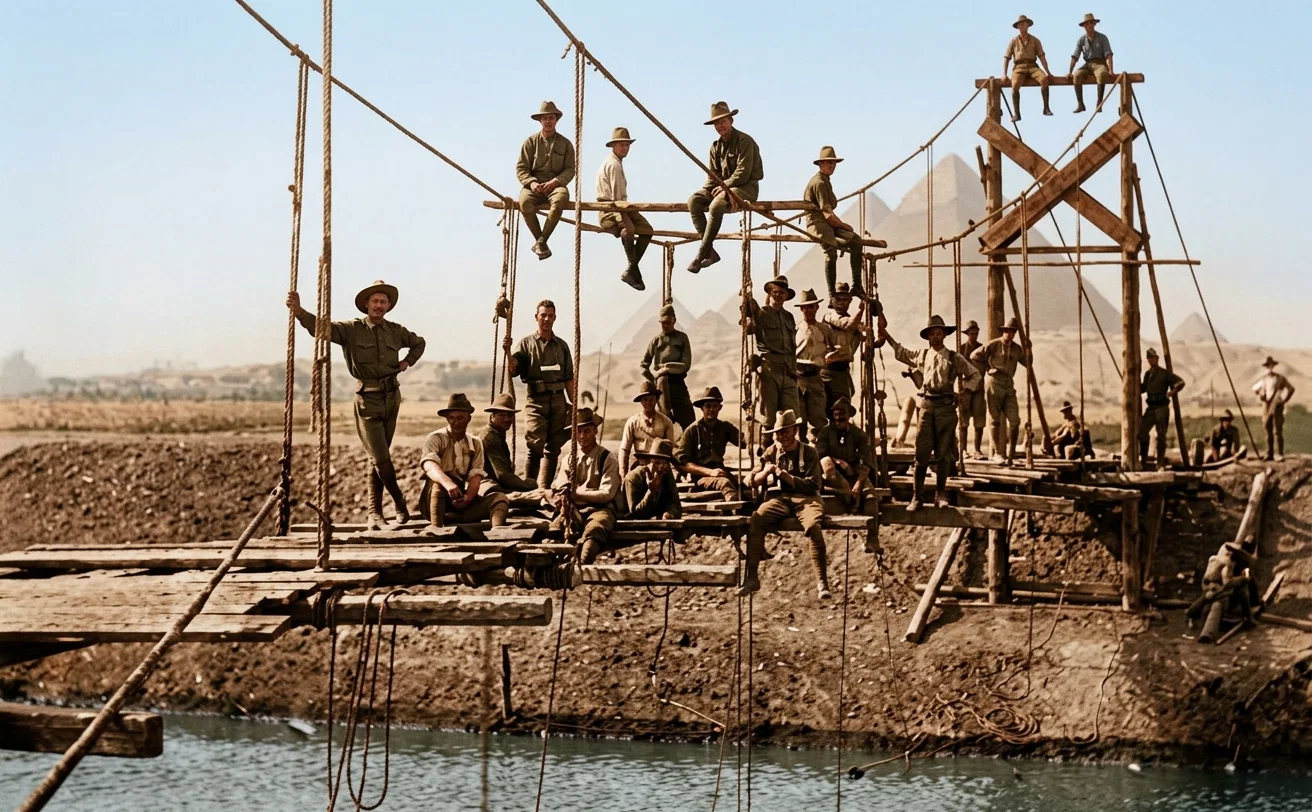
BRITISH FORCES IN EGYPT
As our vessel overtook the convoy, our captain drew near enough to the line of twelve ships nearest us to exchange friendly greetings. There were parents on our ship whose boys were on the transports, and there were women whose husbands were officers among these troops.
This was the strangest, most impressive sight of my life on the high seas. They formed a square, as nearly as we could judge, twelve miles wide and fifteen long. They were traveling in three lines of twelve ships each. Four men-of-war kept near—one leading, one guarding the rear, one protecting the right, and another the left. Two were scouting some distance to the front and left, while the remaining two kept vigilant watch to the front and right.
I have never seen anything that more impressively pictured “grim death” than those forty-four great ships, with bows all pointing toward the battle field, sailing in perfect order, but with steady progress toward the conflict.

A Lecture and an Order for the Captain

The commodore of the convoy flagged our captain a lecture for approaching so near to his ships, and gave orders that no letters telling of the convoy should be posted within fourteen days, and that all photographs that might have been taken should be destroyed or at least kept secret for a fortnight, by which time it was supposed the convoy would have reached its destination.
The fear our passengers had of meeting the Emden, which had become famous in its raids in the Indian Ocean and the Bay of Bengal, made them wish that our ship might be slipped in among the transports and receive the protection of the warships guarding them, but we were obliged to steam on ahead.

Barely Missed by the Emden

Our regular course lay along the Cocos Islands. This was the route followed on the last voyage out to Australia. But on this occasion, our captain altered his course a little, leaving the Cocos Islands about fifty or sixty miles to the north.
It was fortunate for us that he did this; for on our arrival at Colombo, three or four days later, we learned of the fate of the Emden at the Cocos. It is believed that she was waiting there for our boat, in order to get food and coal. Her attempt to put the wireless station on the island out of commission led the operator to send out the call for help that brought the warship Sydney, which ended the raids of the Emden. I understand the Sydney was one of the two scouts guarding the convoy on its right.
Taken all together, the events of this voyage gave us a fuller realization of the reality and the meaning of war. And this has been deepened, while traveling about India, by the manifestations of loyalty to the government, and by the outbreakings of sedition and rebellion. The war spirit certainly runs high on both sides, and this creates a very delicate situation to be handled.
As one writer of acknowledged authority in India says, “India flamed with an amazing burst of feeling in support of the empire. The swords of Indian princes leaped from their scabbards, and one and all immediately offered their forces, their funds, and themselves for the service of the raj.”

The Forces of Anarchy and Sedition

On the other hand, there were forces both in and out of India that were looking for an opportunity to fan the fires of anarchy, sedition, and rebellion into a devouring flame. This I saw while traveling in the northwest, along the borders of Afghanistan, where trainloads of troops were hurried to suppress the uprising; and again in Burma, where hill tribes were being put down; and later in Singapore, where a part of a regiment mutinied, and started war on innocent, unprotected civilians.
All these exhibitions of the fighting spirit are expressions of the thirst for carnage and bloodshed that possesses humanity the whole world over. They show the folly of crying, “Peace, peace,” when there is no peace. They are a sad commentary on the present state of civilization and religions of all names.

Conditions in India

India is undoubtedly the most religious country on the face of the earth. Gods, temples, shrines, images, and worshiping devotees are to be seen everywhere one turns. And the very presence of these gods and worshiping millions, coupled with the illiteracy, superstition, and wickedness that everywhere abound, overwhelms one with unutterable sadness and depression. Of the 315,000,000 of India, 313,000,000 are reported by statisticians to be religious. Of this number, only 4,000,000 profess the Christian religion, and these include Roman Catholics and Protestants. The Protestants number nearly 1,000,000.
The 309,000,000 are composed of Hindus, 217,000,000; Mohammedans, 66,000,000; Buddhists, 11,000,000; animists, 10,000,000; and various other heathen divisions, 5,000,000. Of all these 309,000,000 heathen, only 20,000,000 can read and write in any language, 289,000,000 knowing only what they hear. They are surrounded by a great wall of ignorance cemented by superstition, which it is very difficult either to break through or to scale.
To the ignorance and superstition of centuries must be added the degradation, the sin, the moral pollution of body, mind, and heart, that naturally go with them. As I have gone about all India seeing and reflecting, I have been made sad and sick at heart. Yet I have been drawn to the country and to the task, stupendous as it is. And I have been amazed at the courage manifested by our missionaries in the field who are grappling with this great problem. In further reports, I shall endeavor to give a little clearer statement in detail of these different religions and their influence, and also to tell of the encouraging results of the self-sacrificing labors of devoted missionaries.

The Wreck of the Emden

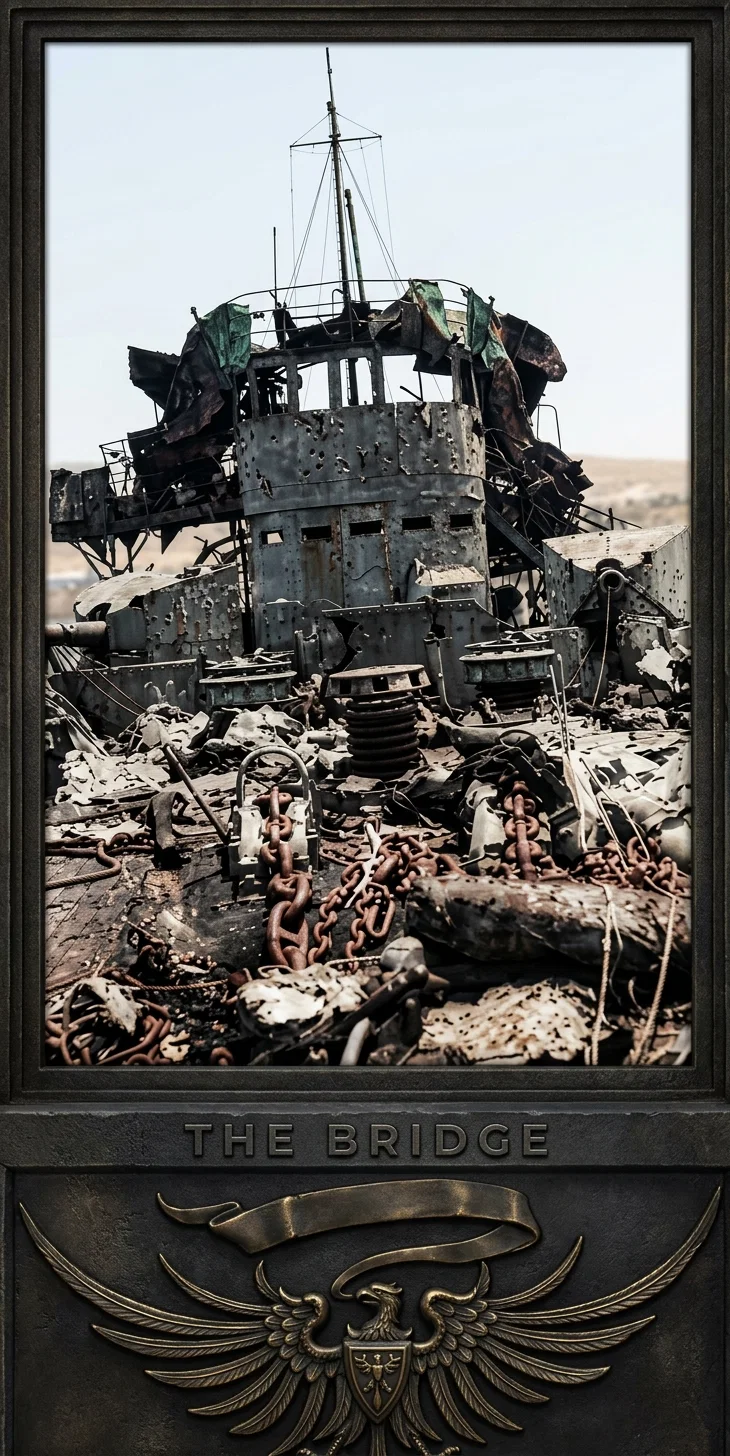
THE BRIDGE
THE BRIDGE
LOOKING FORWARD
LOOKING FORWARD
AFTER THE FIRE
AFTER THE FIRE
The three views on this page of the wreck of the Emden show graphically the destructive work of the modern battleship. The Sydney, which destroyed the Emden, was a more modern cruiser, had greater speed and more powerful guns, so she kept out of range of the Emden while she broke her to pieces with her shells. Viewing this wreckage, it is no surprise that the dispatches should have said, at the time, that “the decks of the Emden were veritable shambles.” Think of what it would mean to be on a ship at such a time.

THE COMPELLING MESSAGE

The Invitation Is Urgent—Both the Low and the High Are Called—Love for the Work Is Imparted
By Mrs. E. G. White
Behold, I Stand at the Door, and Knock
The Saviour was a guest at the feast of a Pharisee. He accepted invitations from the rich as well as the poor, and, according to His custom, He linked the scene before Him with His lessons of truth.
Among the Jews, the sacred feast was connected with all their seasons of national and religious rejoicing. It was to them a type of the blessings of eternal life. The great feast at which they were to sit down with Abraham, Isaac, and Jacob, while the gentiles stood without, and looked on with longing eyes, was a theme on which they delighted to dwell. The lesson of warning and instruction which Christ desired to give, He now illustrated by the parable of a great supper.

All Asked to Be Excused

“A certain man,” He said, “made a great supper, and bade many.” When the time of the feast arrived, the host sent his servant to the expected guests with a second message, “Come, for all things are now ready.” But a strange indifference was shown. “All with one consent began to make excuse. The first said unto him, I have bought a piece of ground, and I must needs go and see it: I pray thee have me excused. And another said, I have bought five yoke of oxen, and I go to prove them: I pray thee have me excused. And another said, I have married a wife, and therefore I cannot come.” Luke 14:16-20.

No Excuse Was Valid

None of the excuses were founded on a real necessity. The man who “must needs go and see” his piece of ground had already purchased it. His haste to go and see it was due to the fact that his interest was absorbed in his purchase.
The oxen, too, had been bought. The proving of them was only to satisfy the interest of the buyer.
The third excuse had no more semblance of reason. The fact that the intended guest had married a wife need not have prevented his presence at the feast. His wife also would have been made welcome. But he had his own plans for enjoyment, and these seemed to him more desirable than the feast he had promised to attend. He had learned to find pleasure in other society than that of the host. He did not ask to be excused, made not even a pretense of courtesy in his request. The “I cannot” was only a veil for the truth,—“I do not care to come.”
All the excuses betray a preoccupied mind. To these intended guests, other interests had become all-absorbing. The invitation they had pledged themselves to accept was put aside, and the generous friend was insulted by their indifference.

Inexhaustible Resources Provided

By the great supper, Christ represents the blessings offered through the gospel. The provision is nothing less than Christ Himself. He is the bread that comes down from heaven, and from Him the streams of salvation flow. The Lord’s messengers had proclaimed to the Jews the advent of the Saviour; they had pointed to Christ as “the Lamb of God, which taketh away the sin of the world.” John 1:29. In the feast He had provided, God offered to men the greatest gift that Heaven can bestow,—a gift that is beyond computation. The love of God had furnished the costly banquet, and had provided inexhaustible resources . “If any man eat of this bread,” Christ said, “he shall live forever.” John 6:51.

Gives All and Asks All

But in order to accept the invitation to the gospel feast, they must make their worldly interests subordinate to the one purpose of receiving Christ and His righteousness. God gave all for man, and He asks him to place His service above every earthly and selfish consideration. He cannot accept a divided heart. The heart that is absorbed in earthly affections cannot be given up to God.

Hard to Find Guests

Around the family board, when breaking their daily bread, many in Christ’s day repeated the words, “Blessed is he that shall eat bread in the kingdom of God.” But Christ showed how difficult it was to find guests for the table provided at infinite cost. Those who listened to His words knew that they had slighted the invitation of mercy. To them worldly possessions, riches, and pleasures were all-absorbing. With one consent they had made excuse.
So it is now. The excuses urged for refusing the invitation to the feast cover the whole ground of excuses for refusing the gospel invitation. Men declare that they cannot imperil their worldly prospects by giving attention to the claims of the gospel. They count their temporal interests as of more value than the things of eternity. The very blessings they have received from God become a barrier to separate their souls from their Creator and Redeemer. They will not be interrupted in their worldly pursuits, and they say to the messenger of mercy, “Go thy way for this time; when I have a convenient season, I will call for thee.” Acts 24:25.

Contempt for His Invitation

Others urge the difficulties that would arise in their social relations should they obey the call of God. They say they cannot afford to be out of harmony with their relatives and acquaintances. Thus they prove themselves to be the very actors described in the parable. The Master of the feast regards their flimsy excuses as showing contempt for His invitation.
In the parable, the giver of the feast learned how his invitation had been treated, and “being angry said to his servant, Go out quickly into the streets and lanes of the city, and bring in hither the poor, and the maimed, and the halt, and the blind.” Luke 14:21.
The host turned from those who despised his bounty, and invited a class who were not full, who were not in possession of houses and lands. He invited those who were poor and hungry, and who would appreciate the bounties provided.

Tenderness for the Lowest

“The publicans and the harlots,” Christ said, “go into the kingdom of God before you.” Matt. 21:31. However wretched may be the specimens of humanity that men spurn and turn aside from, they are not too low, too wretched, for the notice and love of God. Christ longs to have careworn, weary, oppressed human beings come to Him. He longs to give them the light and joy and peace that are to be found nowhere else. The veriest sinners are the objects of His deep, earnest pity and love. He sends His Holy Spirit to yearn over them with tenderness, seeking to draw them to Himself.

Compel Them to Come In

The servant who brought in the poor and the blind reported to his master, “It is done as thou hast commanded, and yet there is room. And the lord said unto the servant, Go out into the highways and hedges, and compel them to come in, that my house may be filled.” Luke 14:22, 23. Here Christ pointed to the work of the gospel outside the pale of Judaism, in the highways and byways of the world.
In obedience to this command, Paul and Barnabas declared to the Jews: “It was necessary that the word of God should first have been spoken to you: but seeing ye put it from you, and judge yourselves unworthy of everlasting life, lo, we turn to the gentiles. For so hath the Lord commanded us, saying, I have set thee to be a light of the gentiles, that thou shouldest be for salvation unto the ends of the earth. And when the gentiles heard this, they were glad, and glorified the word of the Lord; and as many as were ordained to eternal life believed.” Acts 13:46-48.

Approach Them with the Tender Christ Love

The invitation to the feast was first given to the Jewish people, the people who had been called to stand as teachers and leaders among men, the people in whose hands were the prophetic scrolls foretelling Christ’s advent, and to whom was committed the symbolic service foreshadowing His mission. When the gospel call is sent to the gentiles, there is the same plan of working. The message is first to be given “in the highways,”—to men who have an active part in the world’s work, to the teachers and leaders of the people.
None should be neglected because of their apparent devotion to worldly things. Many in high social positions are heartsore, and sick of vanity. They are longing for a peace which they have not. In the very highest ranks of society are those who are hungering and thirsting for salvation. Many would receive help if the Lord’s workers would approach them personally, with a kind manner, a heart made tender by the love of Christ.

Learned Speech Not Essential

The success of the gospel message does not depend upon learned speeches, eloquent testimonies, or deep arguments. It depends upon the simplicity of the message and its adaptation to the souls that are hungering for the bread of life. “What shall I do to be saved?”—this is the want of the soul.
If the leaders and teachers at Jerusalem had received the truth Christ brought, what a missionary center their city would have been! Backslidden Israel would have been converted. A vast army would have been gathered for the Lord. And how rapidly they could have carried the gospel to all parts of the world! So now, if men of influence and large capacity for usefulness could be won for Christ, then through them what a work could be accomplished in lifting up the fallen, gathering in the outcasts, and spreading far and wide the tidings of salvation! Rapidly the invitation might be given, and the guests be gathered for the Lord’s table.
But we are not to think only of great and gifted men, to the neglect of the poorer classes. Christ instructs His messengers to go also to those in the byways and hedges, to the poor and lowly of the earth. In the courts and lanes of the great cities, in the lonely byways of the country, are families and individuals—perhaps strangers in a strange land—who are without church relations, and who, in their loneliness, come to feel that God has forgotten them. They do not understand what they must do to be saved. Many are sunken in sin. Many are in distress. They are pressed with suffering, want, unbelief, despondency. Disease of every type afflicts them, both in body and in soul. They long to find a solace for their troubles, and Satan tempts them to seek it in lusts and pleasures that lead to ruin and death. He is offering them the apples of Sodom, that will turn to ashes upon their lips. They are spending their money for that which is not bread, and their labor for that which satisfieth not.
In these suffering ones we are to see those whom Christ came to save.

Urgency of the Invitation

The command given in the parable, to “compel them to come in,” denotes the urgency of the invitation, and the effectiveness of the inducements presented. The gospel never employs force in bringing men to Christ. Its message is, “Ho, every one that thirsteth, come ye to the waters.” “The Spirit and the bride say, Come. . . . And whosoever will, let him take the water of life freely.” Isa. 55:1; Rev. 22:17. The power of God’s love and grace constrains us to come.
The Saviour says: “Behold, I stand at the door, and knock: if any man hear My voice, and open the door, I will come in to him, and will sup with him, and he with Me.” Rev. 3:20. He is not repulsed by scorn or turned aside by threatening, but continually seeks the lost ones, saying, “How shall I give thee up?” Hosea 11:8. Although His love is driven back by the stubborn heart, He returns to plead with greater force, “Behold, I stand at the door, and knock.”

Christ Will Impart

Christ will impart to His messengers the same yearning love that He Himself has in seeking for the lost. We are not merely to say, “Come.” There are those who hear the call, but their ears are too dull to take in its meaning. Their eyes are too blind to see anything good in store for them. Many realize their great degradation. They say: “I am not fit to be helped. Leave me alone.” But the workers must not desist. In tender, pitying love, lay hold of the discouraged and helpless ones. Give them your courage, your hope, your strength. By kindness compel them to come.

The Meek and Their Prospects

The Rewards of a Teachable Spirit—The Man Who Walked with God and Did Not Die—Sin to Meet Its Doom
By Rufus A. Underwood
This is the third of Elder Underwood’s articles on the fundamentals of the gospel as taught by Christ in the Sermon on the Mount. Each article is complete in itself, and may profitably be read and will be clearly understood whether you have seen the previous ones or not. Editor.
IN previous issues of this paper, we have considered briefly the first two necessary steps in Christian conversion, as set forth in Christ’s Sermon on the Mount.
The second step is a godly sorrow for sin, which works repentance, a repentance that brings forgiveness of sin and the imputing of Christ’s righteousness to all who surrender their lives to God and pledge loyalty to the government of heaven.
These two primary steps introduce the follower of Christ into the kingdom-school of Christian growth. To be born is well. But the child who ceases to grow after birth, soon must die. The real test of discipleship, or the fellowship of “walking with God,” follows the new birth in its natural order of advancement.

“Blessed Are the Meek”

We will notice the third step in the process of growth. “Blessed are the meek: for they shall inherit the earth.” Matt. 5:5. In the last days, the people of God are admonished by the prophet Zephaniah in these words to seek meekness: “Gather yourselves together, yea, gather together, O nation not desired; before the decree bring forth, before the day pass as the chaff, before the fierce anger of the Lord come upon you, before the day of the Lord’s anger come upon you. Seek ye the Lord, all ye meek of the earth, which have wrought His judgment; seek righteousness, seek meekness: it may be ye shall be hid in the day of the Lord’s anger.” Zeph. 2:1-3.

It Means to Be Teachable

We must look to the inspired definition to learn the meaning of meekness, in order to appreciate our Lord’s instruction. In Ps. 18:35 we find this statement: “Thou hast also given me the shield of Thy salvation: and Thy right hand hath holden me up, and Thy gentleness hath made me great.” (Margin, “Meekness hath multiplied me.”) Again we read, in Ps. 25:9, “The meek will He guide in judgment: and the meek will He teach His way.”
These scriptures show that meekness is the quality of being teachable, and that greatness in its true sense belongs only to those who are willing to be taught. This grace is the essential qualification to admit any person into the school of Christ; for without a teachable mind, and a desire to be led into all truth, no person can long remain under the tutorship of Jesus Christ. This most-to-be-coveted of all graces is offered to all, but at the cost of the surrender of our own will, and placing our own hand in the hand of God, to be led as He wills.

The Greatest of Adornments

The apostle Peter presents the grace of a teachable spirit as the greatest adornment that we can deck the human soul with, in these words: “Whose adorning let it not be that outward adorning of plaiting the hair, and of wearing of gold, or of putting on of apparel; but let it be the hidden man of the heart, in that which is not corruptible, even the ornament of a meek and quiet spirit, which is in the sight of God of great price.” 1 Peter 3:3, 4.

It Made Him Great

The secret of Moses’ power as a leader of Israel is found in his ambition to be taught by God. It is written of him, “Now the man Moses was very meek, above all the men which were upon the face of the earth.” Num. 12:3. Moses prayed, “If Thy presence go not with me, carry us not up hence.” Ex. 33:15. This man, the meekest of earth, was honored by God above all other men, by being permitted to speak face to face with God. Deut. 34:10. He also was raised from the dead, and is set forth as a type of all those who are blessed by having a part in the first general resurrection of the dead. See Deut. 34:5, 6; Jude 9; Luke 9:29-31; Rev. 20:6.

He “Walked with God”

Enoch is a Bible character set forth as an example of humility and meekness. Because of his willingness to be taught, he is presented as a type, not of those who have fallen asleep in Christ, but of those who are translated at the second coming of Christ, without seeing death. Of him it is said: “And all the days of Enoch were three hundred sixty and five years: and Enoch walked with God; and he was not; for God took him.” Gen. 5:23, 24.
Very little is recorded of Enoch’s life. However, there is enough brought to view to give us the secret of his success, and why the Lord translated him without seeing death. He “walked with God” for three hundred years. The prophet asks this question: “Can two walk together, except they be agreed?” Enoch had early learned the great truth which lies at the foundation of meekness; namely, that “it is not in man that walketh to direct his steps.” The Lord had invited Enoch to walk with Him in sweet counsel.
Christ said to His disciples, “I have yet many things to say unto you, but ye cannot bear them now.” John 16:12. The Lord in substance said to Enoch: “If you will be teachable, and follow on to know My ways, I will give you precept upon precept, line upon line, here a little and there a little, in correcting your ways, until you reach the perfect standard of My law, and then I will take you to Myself in glory.”
Enoch’s answer to the Lord was, “I will walk in the light as You may reveal it to me.” See 1 John 1:7. He had learned what all Christians must learn, that “the path of the just is as the shining light, that shineth more and more unto the perfect day.” Prov. 4:18.

Did Not See Death

While the Lord led Enoch on, sometimes amid trials and persecution, he ever accepted his daily experience as meted out to him by a loving God, who held him by the hand, to comfort, cheer, and sustain in the darkness as well as in the light. All these years, Enoch walked by faith, as the Lord pointed out the perfect way. After a life of three hundred years of labor, correction, and many tests, God could say of him: “By faith Enoch was translated that he should not see death; and was not found, because God had translated him; for before his translation he had this testimony, that he pleased God.” Heb. 11:5.
Reader, remember that the teachable will He guide in judgment, the meek will He teach His way. “If any man willeth to do His will, he shall know of the teaching.” John 7:17, A. R. V. They shall inherit the earth. See Revelation 21. In this promise, Christ has given the pledge that vice and hate shall not continue forever. The malaria of sin, that has robbed life of its sweetness, cannot always continue. Injustice, fraud, oppression, war, and the grave, cannot always mock man’s hopes. The whisperings of conscience are the premonitions of a great assize, when every wrong shall be righted, innocence vindicated, and virtue and righteousness exalted.
“As truly as I live, all the earth shall be filled with the glory of the Lord.” Num. 14:21. Then “the meek shall inherit the earth.”
Reader, make this inheritance yours, by accepting the conditions upon which Christ offers it to you.
Continue reading: Hearts Failing for Fear