What Protestants Admit and Affirm Concerning the Sabbath
The Historian Concurs
This is the second of three articles by Elder Porter on the change of the Sabbath. Last week he made plain what Christ's attitude was to the Sabbath. He also quoted the prophecy that foretold the human attempt to change God's sacred rest day, and gave some of the history that shows the fulfillment of the prophetic forecast. Next week will be presented the claims made by Catholics that their church has designedly attempted to change the Sabbath of the Bible. Editor.
The Baptist Watchman says: “The Scripture nowhere calls the first day of the week the Sabbath. . . . There is no Scriptural authority for so doing, nor of course any Scriptural obligation.”
Congregational: “There is no command in the Bible requiring us to observe the first day of the week as the Christian Sabbath.”—The Rev. Mr. Fowler.
Church of England: “The reason why we keep the first day of the week holy instead of the seventh is for the same reason that we observe many other things, not because the Bible, but the church, has enjoined it.”—“Plain Sermons on the Catechism,” by Isaac Williams, D. D.
Methodist: “It is true, there is no positive command for infant baptism, . . . nor is there any for keeping holy the first day of the week.”—Methodist Episcopal “Theological Compendium,” page 103.
Presbyterian: “The observation of the seventh-day Sabbath did not cease till it was abolished after the empire became Christian.”—American Presbyterian Board of Publication, tract No. 118.
R. W. Dale: “It is quite clear that however rigidly or devoutly we may spend Sunday, we are not keeping the Sabbath.”
“The Sabbath was founded on a specific, divine command. We can plead no such command for the observance of Sunday.”
“There is not a single sentence in the New Testament to suggest that we incur any penalty by violating the supposed sanctity of Sunday.”—“The Ten Commandments,” Hodder and Stoughton.
The Belfast Witness, Presbyterian: “The dropping of the seventh-day Sabbath, and the substitution of the Lord’s day, was an innovation accomplished by the church, with sufficient reason, but without any Scriptural command.”
Canon Knox-Little, speaking of those who quote the example of Christ against ritualism, says: “It is certain that our Lord when on earth did observe Saturday, and did not observe Sunday.” “If they are consistent, as I have said, they must keep Saturday, and not Sunday, as the day of rest.”—“Sacerdotalism,” Longmans & Co.
When Was the Sabbath Changed?
History is clear in its verdict. Before its certain testimony all must bow.
Webster defines “Sunday,” “So called because it was anciently dedicated to the sun or its worship.”
Sir William Domville says: “Centuries of the Christian era passed away before Sunday was observed as the Sabbath. History does not furnish us with a single proof or indication that it was at any time so observed previous to the Sabbatical edict of Constantine in A. D. 321.”—“Examination of Six Texts,” page 291.
Constantine’s Sunday law was made 321 A. D., while he was a worshiper of heathen divinities. It reads: “Let all the judges and town people, and the occupation of all trades, rest on the venerable day of the sun: but let those who are situated in the country, freely and at full liberty attend to the business of agriculture; because it often so happens that no other day is so fit for sowing corn or planting vines; lest, the critical moment being let slip, men should lose the commodities granted them of heaven.”
The First Sunday Law
Commenting upon this law, the “Encyclopædia Britannica,” article “Sunday,” says: “It was Constantine the Great who first made a law for the proper observance of Sunday and who, according to Eusebius, appointed it should be regularly celebrated throughout the Roman Empire.”
The “Encyclopædia Americana,” article “Sabbath,” says: “Constantine the Great made a law for the whole empire (A. D. 321), that Sunday should be kept as a day of rest in all cities and towns, but he allowed the country people to follow their work.”
Alexander Campbell, in a lecture in Bethany College, 1848, said: “Was the first day set apart by public authority in the apostolic age?—No. By whom was it set apart, and when?—By Constantine, who lived about the fourth century.”
How and by Whom Was the Sabbath Changed?
The revision of the Sabbath statute began under paganism. The change first took the form of positive law in the days of Constantine, A. D. 321, as we have seen. Constantine’s edict required the observance of the day as a heathen institution in honor of the sun. “Let all the judges and town people, and the occupation of all trades, rest on the venerable day of the sun.”
Mosheim says: “Two years later Constantine professed conversion to Christianity. He then became bishop of the Catholic Church.” The words of the historian follow: “After well considering the subject, I have come to the conclusion that subsequent to the death of Licinius, in the year 323, when Constantine found himself sole emperor, he became an absolute Christian, or one who believes no religion but the Christian religion to be acceptable to God.”—Mosheim, “Historical Commentaries,” century 4, section 7.
From a work by Groombridge and sons, the following is taken: “At a later period, carried away by the current of opinion, he [Constantine] declared himself a convert to the church. Christianity, then, or what he was pleased to call by that name, became the law of the land, and the edict of 321, being unrevoked, was enforced as a Christian ordinance.”—“Sunday and the Mosaic Sabbath,” page 4.
Introduced by a Sun Worshiper
Having found that the change was introduced in the form of law by Constantine, a sun worshiper, in A. D. 321, the inquiry will be raised. How long did it take to accomplish the change, and how and by whom was the work of accomplishing it brought about?
Coleman says: “The observance of the Lord’s day was ordered while yet the Sabbath of the Jews was continued; nor was the latter superseded until the former had acquired the same solemnity and importance which belonged, at first, to that great day which God originally ordained and blessed. . . . But in time, after the Lord’s day had been fully established, the observance of the Sabbath of the Jews was gradually discontinued, and was finally denounced as heretical.”—“Ancient Christianity Exemplified,” chapter 26, section 2.
Sabbath as Well as Sunday Observed
John Ley says: “From the apostles’ time until the council of Laodicea, which was about the year 364, the holy observation of the Jews’ Sabbath continued, as may be proved out of many authors; yea, notwithstanding the decree of that council against it.”—“Sunday and Sabbath,” pages 163, 164.
Prynne says: “The seventh-day Sabbath was solemnized by Christ, the apostles, and primitive Christians, till the Laodicean council did in a manner quite abolish the observation of it. . . . The council of Laodicea, A. D. 364, first settled the observation of the Lord’s day, and prohibited the keeping of the Jewish283Sabbath under an anathema.”—“Dissertation on the Lord’s Day Sabbath,” 1623, pages 33, 34, 44.
Papal Edicts Concerning Sunday
The emperor Leo, A. D. 469, issued the following decree: “The Lord’s day we decree to be a venerable day, and therefore free of all citations, executions, pleadings, and the like avocations. Let not the circus or theater be opened, nor combating with wild beasts be seen on it. . . . If any will presume to offend in the premises, if he be a military man, let him lose his commission; or if other, let his estate or goods be confiscated.”—“Dialogues on the Lord’s Day,” pages 259, 260.
Hengstenberg, in his notice of the council of Orleans, gives us an insight into the then existing state of the Sunday festival: “The third council of Orleans, A. D. 538, says in its twenty-ninth canon: ‘The opinion is spreading amongst the people, that it is wrong to ride, or drive, or cook food, or do anything to the house, or to the person, on the Sunday. But since such opinions are more Jewish than Christian, that shall be lawful in future, which has been so to the present time. On the other hand, agricultural labor ought to be laid aside, in order that the people may not be prevented from attending church.’”
Further legislation being necessary, we are told: “About a year forward, there was a council at Narbon, which forbid all persons of what country or quality soever to do any servile work on the Lord’s day. But if any man presumed to disobey this canon, he was to be fined if a freeman, and if a servant, severely lashed. Or, as Surius represents the penalty in the edict of King Ricaredus, which he put out, near the same time, to strengthen the decrees of the council, ‘rich men were to be punished with the loss of a moiety of their estates, and the poorer sort with perpetual banishment.’”—“Dialogues on the Lord’s Day,” page 265.
“At Chalons in Burgundy, about the year A. D. 654, there was a provincial synod which decreed that ‘none shall plow or reap on the Lord’s day, or do any other thing belonging to husbandry, on pain of the censures of the church’; which was the more needed, because backed with the secular power, and by an edict menacing such as offended herein; who if bondmen, were to be soundly beaten, but if free had three admonitions, and then if faulty, lost the third part of their patrimony, and if still obstinate, were made slaves for the future. . . . The twelfth council of Toledo in Spain, A. D. 681, forbid the Jews to keep their own festivals.”—Ibid., page 267.
The Eastern Church and Sunday
Of Sunday labor in the Eastern Church, Heylyn says: “It was near nine hundred years from our Saviour’s birth before restraint of husbandry on this day had been first thought of in the east; and probably being thus restrained did find no more obedience then than it had done before in the western parts.”—“History of the Sabbath,” part 2, section 2, chapter 12.
From these statements by the most reliable historians, there can be no question that the change of the Sabbath observance from the seventh to the first day of the week was no easy task in the face of the divine law to the contrary. It took centuries to accomplish it. Although Constantine’s edict was issued A. D. 321, that was but the first apostate legal step toward changing the custom of observing the Sabbath according to the command of God. A number of centuries, and numerous edicts of the Church of Rome, were necessary to complete the work.
R. C. P.
The World Undeceived Too Late
By M. C. W.
A Deceived and Blinded World — Brief Triumph of Apostasy — Its Final Overthrow — The Victory for the Lamb and His Followers
RECALL the chief features of Revelation, chapter 17.
1. John, standing as the representative of God’s people in the last days — these times — is, by one of the plague-bearing angels, made to see the character and judgment of the great harlot, the great system of apostasy called Babylon, the very center of which, in the Christian dispensation, is found in the Roman Catholic Church, and in churches molded by the same principles, called her daughters. These are intolerant churches, whose object is to enforce perverted aims by civil power.
2. The “beast” of seven heads and ten horns, a symbol of the great church-and-state system that has controlled the nations from Babylon to the present. Each successive head is a symbol of some phase of that beast system of government. These are: (1) Babylon; (2) Medo-Persia; (3) Grecia; (4) pagan Rome; (5) papal Rome; (6) apostate, professedly Protestant church-and-state powers now in existence in Europe; and (7) the papacy, the fifth head restored.
3. The prophecy of Revelation 17 deals with the papal head, or phase, of government almost exclusively, and designates it “the beast.” This beast is not Babylon, but it is controlled at times by Babylon, the harlot.
4. The “wilderness” period is marked by the 1,260 years of persecution in chapter 12:6, 14. During this time, the true church is a fugitive from her persecuting oppressors; the false church is riding on the back of a depraved civil power; she is drunken with the blood of the saints of God. Compare Rev. 12:6, 13-15 with Rev. 17:3-6. God shows us the apostate church in this period, that the world may know what her character is when she is restored.
5. The ten horns symbolize ten confederate powers yet to arise, which will help to restore the papacy, or the beast of the fifth head. These ten horns are not Babylon, but at one time help to exalt her, and at a later date to destroy her. Verse 16. The union of the ten horns with the restored beast constitutes the seventh head of chapters 12 and 13. Reckoned separately, they number eight. Blended, they combine to make the seventh. When the papal phase of the beast is restored, then the “image” is made by the two-horned beast of the Western Continent; for that “image” is made to that head or phase of the beast “which had the wound by a sword, and did live.” Rev. 13:12, 14.
We studied the two messages of peace in our last. The one, based on the righteousness of God in Christ, unites with the Lamb of God, and is victorious forever; the other, a false peace, ends with the close of probation and the beginning of the outpouring of the plagues of the just wrath of God.
Unjust Blame
It has ever been true, among the apostate and obdurate peoples, that when the consequences of their own sins come upon them, they lay the blame upon the prophets and faithful teachers who reproved them.
Ahab called the prophet Elijah, who pointed out his sins, the troubler of Israel, when it was Ahab’s own sins that brought trouble.
Caiaphas, the high priest of Judah, said in reference to Christ, the blameless reprover, “It is expedient for us, that one man should die for the people, and that the whole nation perish not.”
Deceived and Blinded World
And we may well believe that when the nations of earth have rejected God’s final message of warning, and the long deferred and divinely just judgments begin to materialize in the seven last plagues, the deceived and blinded world will lay the consequences and penalties of their own sins to the people of the Lamb who have been suffered to live. And the war against the Lamb will be continued by decrees against His people till the ultimate decree of death is promulgated. Rev. 13:15.
The promised peace to the nations, however, passes with probation. The prosperity has departed. The power of the harlot to deceive as the plagues near their culmination passes away forever. And the very nations, the confederation of ten powers, that helped to reinstate her, shall, as the heathen turns and breaks his idol, turn against the harlot that deceived them. They will use their powers severally and unitedly to destroy the harlot. The confederation, the beast, and the ten kings individually, will seek to destroy the deceiver. “And the ten horns which thou sawest [individually], and the beast [the confederation], these shall hate the harlot, and shall make her desolate and naked, and shall eat her flesh, and shall burn her utterly with fire.” Rev. 17:16, A. R. V. The beast has again become anti-religious, anti-papal. But this is in the closing part of the plague period.
These strong terms will be clear if we bear in mind the figures of beasts and harlots and of kings and city.
The Time of Triumph
The time or period of this world triumph of the papacy, previous to the plagues, is set forth as “a little while,” as “one hour.” Rev. 17:10, 12. If the one hour is prophetic time, as it doubtless is, it is an aliquot part of a day. The whole day — day and night — is twenty-four hours long. This, however, is never so mentioned in the Bible. But in John 11:9, Jesus says, “Are there not twelve hours in the day?” The fact that our Lord284Himself mentions twelve hours, and that, too, recorded by John, who also wrote the Revelation, is certainly worthy of consideration.
It is true there are twenty-four hours in a day, and it is also true that there are 365 days in the year; but we reckon the prophetic year at 360 days because Inspiration so designates it. Would not the same rule hold as to the day?
Applying it to Rev. 8:1, it would give a little over two weeks for the angels of God to come from heaven and return at the second coming of our Lord. In the text under examination, it would symbolize thirty days, one twelfth of a year, a common period used regularly in law.
For one month, then,—possibly fifteen days,—the world would enjoy this peace, and the apostate church her triumph. At the end of that time fall the plagues, the judgments of God. And carrying out still further the figure of the city, men of different classes are represented as saying three times over at the close of that period, “In one hour is thy judgment come;” “In one hour so great riches is made desolate;” “In one hour is she made desolate.” Rev. 18:10, 17, 19. And the judgment passes on through the plagues to her utter destruction. Rev. 18:21-24.
Not Men, but Principles
We would like once more to say, We believe that the center of that apostasy now is found in the Roman Catholic Church and in the papal system. But in saying this, we do not pass judgment upon Roman Catholics. We have no enmity toward them. “We war with principles, not with men.”
The system with which they are connected we believe to be evil. It is contrary to Christ and His truth. It puts man in the place of God. But the Roman Catholic may be a Christian, a saved man, in spite of his adherence to his outward belief. He may look past priest, and prelate, and penances, and works of supererogation, and humanity exalted, and see in Jesus alone his salvation from sin. We pray God that so it may be.
We should praise God to see, in that last fearful conflict, the men that are now pope and cardinals standing on the right side and against the system. There is where God wants them to stand. At that time it is possible that many who are now opposed to Roman Catholicism and Roman Catholics may stand with them in the war against the Lamb. Our prayer is that all may then stand with the Lamb, and even now with Him, in telling the story of the gospel of His love for the salvation of men, and in warning men against the worship of the “beast” and his “image” and the reception of his “mark.” Rev. 14:6-12.
Of those who heed that warning and accept of that everlasting gospel of His grace, it is said, “Here is the patience of the saints: here are they that keep the commandments of God, and the faith of Jesus.” Rev. 14:12.
Reader, join the phalanxes of the Lamb; for “the Lamb shall overcome them, for He is Lord of lords, and King of kings; and they also shall overcome that are with Him, called and chosen and faithful.” Rev. 17:14.
The earth army of the Lamb may be small, poor, despised, and like the Master on earth, of no beauty that men should desire them; but He is with them as truly as He was with His mighty invisible armies who with the desert-worn Israel marched around Jericho; as truly as the chariots and angels of God were with the aged Elisha when the Syrian host went to capture him. All heaven is with those who serve God. The Lamb is strong in the strength of the lion. He shall overcome all the powers of earth, and the “called and chosen and faithful” shall overcome with Him. Rev. 17:14. Theirs is the victory over the beast and his image, and they at last stand triumphant on the crystal sea, “having harps of God. And they sing the song of Moses the servant of God [victory over all earthly foes], and the song of the Lamb [victory over all inward foes].” Rev. 15:2-4. They are triumphant forever.
But they are militant now. They have God’s message to give, God’s cause to fight; and thus God entreats them.
“Gather yourselves together, yea, gather together, O nation not desired; before the decree bring forth, before the day pass as the chaff, before the fierce anger of the Lord come upon you, before the day of the Lord’s anger come upon you. Seek ye the Lord, all ye meek of the earth, which have wrought His judgment; seek righteousness, seek meekness: it may be ye shall be hid in the day of the Lord’s anger.” Zeph. 2:1-3.
The danger lies not in God’s lack of willingness or power. Both are sufficient. Man must be correspondingly earnest. Through God, then, is victory, not with the weapons of earth’s warfare, not with howitzers or machine guns or aeroplane bombs or mines or submarines. Our weapons are not carnal, but mighty through God in the breaking of the strongholds of sin, which no earthly weapon could destroy.
Panoplied from the armory of God, the heralds of the cross go forth to proclaim to the world the last threefold gospel message of Rev. 14:6-14. There is no other. All the opposing forces are under the banner of the dragon, the beast, the false prophet. By the devil’s influence, all Christendom has been deceived, all her teaching has been corrupted. All the world is paying homage, often unconsciously, to the beast system of apostasy. In the final struggle before probation closes, there will be only two classes — the worshipers of the beast, and the worshipers of God. The one class will bear the mark of the beast system of apostasy. The other class will bear the seal of eternal character. For the one class there waits the doom of all identified with sin, destruction. For the other class there waits eternal triumph and everlasting life.
God’s great message warns against the world-wide apostasy, and it offers to the world the everlasting hope of His gospel of life and character.
There is no other message. This is all-comprehensive, all-sufficient. Within its heart, acceptance is safety. Without its salvation-embracing folds is death eternal. Rejecting God’s message is warring against the Lamb. Accepting it is eternal victory; for “they also shall overcome that are with Him, called and chosen and faithful.” He is Lord of lords, and King of kings.” M. C. W.
Question Corner
By M. C. Wilcox
Conducted by M. C. Wilcox
119—EATING AND DRINKING
Please explain Deut. 14: 22-29, especially the twenty-sixth verse, and also the three years of verse 28, the tithing of the tithe, the widows, and the stranger.
S. and E. and also M. C. W.
Deut. 14: 22-29 contains instruction quite similar to what is given in Deuteronomy 12. There were two tithes given by the Jews. First of all, the tithe was given to the Levites. That was regular. The law for this is found in Num. 18: 21-32. The Levites were to tithe what they received, for the benefit of the priests. Then there was a second tithe, which the children of Israel were to use in connection with the three great feasts of the Lord. Three times a year they were to go to Jerusalem for the offering of sacrifices, and this tithe should be spent for that purpose. The “Bible Commentary” has this note on Deut. 14: 22:
“These words recall, in general terms, the command of the earlier legislation respecting tithes (compare Lev. 27: 30; Num. 18: 27), but refer more particularly to the second or festival tithe, which was an exclusively vegetable one. So Keil, Schultz, Lange, etc., and the Jewish authorities generally. One computation of the increase of the field would of course serve for both the Levitical tithe of Leviticus 27, so far as it consisted of that increase, and for the other tithe, to be applied to the feasts at the sanctuary, or in each third year at home, as directed in this passage. One tenth would belong to the Levites. The second tenth would remain at the disposal of the landowner, for the purposes so earnestly commended to him in Deut. 12: 6, 7, 17-20, and in this passage. These purposes are minutely classified and regulated in the Mishna. Thus all together one fifth part of the annual produce would be claimed for religious, hospitable, and charitable employments; and this, considering the various charges met out of it, would not be an unreasonably burdensome impost.”
The second tithe of the third year was dispensed in charity at home. It was not paid in addition to that in other years bestowed on the sacred meals, but was substituted for it, which seems to be plainly implied in the text. The expression “all the tithe” in verse 28 refers to all of the second tithe.
Secondly, the permission to eat “whatsoever thy soul lusteth after” could not include animals forbidden by the law. No general permission would set aside specific legislation. The law of clean and unclean animals permitted some animals for food which were not offered for sacrifice, as the various deer kinds, like the hart, the roebuck, etc. The permission intimates that if they were faithful to God, their souls would not lust after things contrary to what God had expressly enjoined. This would be true of wine or strong drink. These permitted drinks were not alcoholic; that is, they were not distilled liquors. Those were a later discovery. They may have included fermented liquors; but if one's soul lusted after that which was wrong, and led him to wrongdoing, he of course would be responsible. God gives liberty to His people, with the supposition that they will not abuse that liberty. The rule for eating and drinking in the Christian dispensation, or the great general principle, rather, which should control, is “Whether therefore ye eat, or drink, or whatsoever ye do, do all to the glory of God.” I Cor. 10: 31. The Lord does not imply that we should indulge the flesh in that which would lead to sickness, disease, aberration of mind, or any other evil result. If we do so, we are responsible.
Marvels at Eighty and Ninety
By D. H. Kress
Some Remarkable Old Men—Were Broken Down in Middle Life—How They Became Strong and Lived Long and Happily
By D. H. Kress, M. D.
Farmers expect their calves and colts to live their allotted period, and they are seldom disappointed. Why should not man live out the full measure of his days?
Premature deaths are preventable. By exercising more care in the selection of their food and drink, it is possible for men and women to live nobler, more serviceable, and longer lives than they do.
Best Material and Best Results
The automobile dealer takes great pains in describing to a prospective buyer the superiority of the machine he sells, calling special attention to the material used in its construction. Machines made of inferior material wear out prematurely. It is so with man. He is composed of what he eats. Longer and better service should be expected from a body in which the very choicest building material was employed, than from one that was built up of inferior food and drink. A poor machine, if it has good care, may last longer than one that is better but is used recklessly.
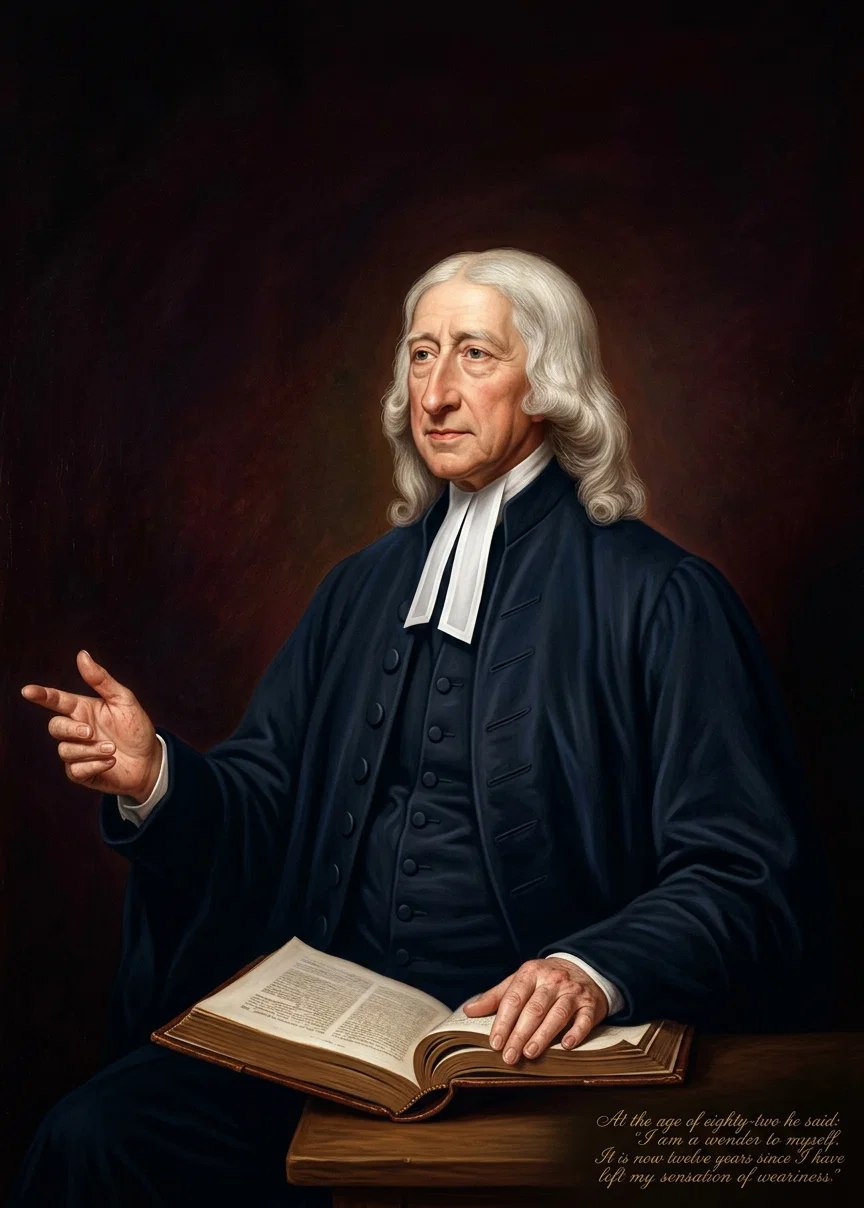
JOHN WESLEY
Many a man who has inherited a robust constitution dies early in life, because of intemperate habits in eating or drinking; while another who has been less fortunate in heredity, by greater carefulness lives to an advanced age.
The Robust Man in Gravest Danger
The robust who say, “Nothing hurts me,” are the ones who as a rule die early in life. Oliver Wendell Holmes said, “One of the necessary requisites for attaining to a good old age, is to be rejected for life insurance by a first-class company.”
I have observed that many of those who in the past have been blessed with a useful old age, were at some time in life, owing to a physical breakdown, compelled to make reforms in their habits of life.
Louis Cornaro, an Italian nobleman who at the age of forty found it necessary to consult his physician, and received little hope of living more than a year or two, made changes so radical in his diet that his friends predicted he would die of starvation, but he managed to outlive them all. He lived to the advanced age of one hundred years, during the latter part of which time he was kept free from pain or sickness, with all his senses continued perfect.
At the age of eighty-six he said: “I now find myself sound and hearty at the age of eighty-six, forty-six years beyond the time I expected, and during this long respite all my senses have continued perfect. What is still more, my brain is clearer now than it ever was. Nor do any of my powers abate as I advance in life. I expect to die without any pain or sickness.”
The Real Joy of Life in Old Age
At the age of ninety-five he wrote: “I really never knew, until I grew old, that this world was so beautiful; for in my younger years I was debauched by irregularities, and therefore could not perceive and enjoy, as I do now, its beauties. O, truly happy life, which, over and above all these favors conferred on me, has so improved and perfected my body that now I have a better relish for plain bread than formerly I had for the most exquisite dainties!”
Edison Follows the Plan
It was the story of Cornaro that impressed and influenced the great grandfather of Mr. Thomas A. Edison, and led him to live in the same simple manner; and as a result, he attained to the age of one hundred two years. His son, who followed the same teaching, lived to the age of one hundred three. Seven sons were born to him, who all adopted Cornaro’s plan, and all seven lived to be more than ninety years of age. One of them, Samuel, the father of Thomas Edison, lived to the age of ninety-four, and then passed away in a natural way, without pain or illness. Thomas Edison ascribes his splendid health and usefulness at the age of sixty-five to the abstemious habits of his ancestors, which he himself in a measure espoused.
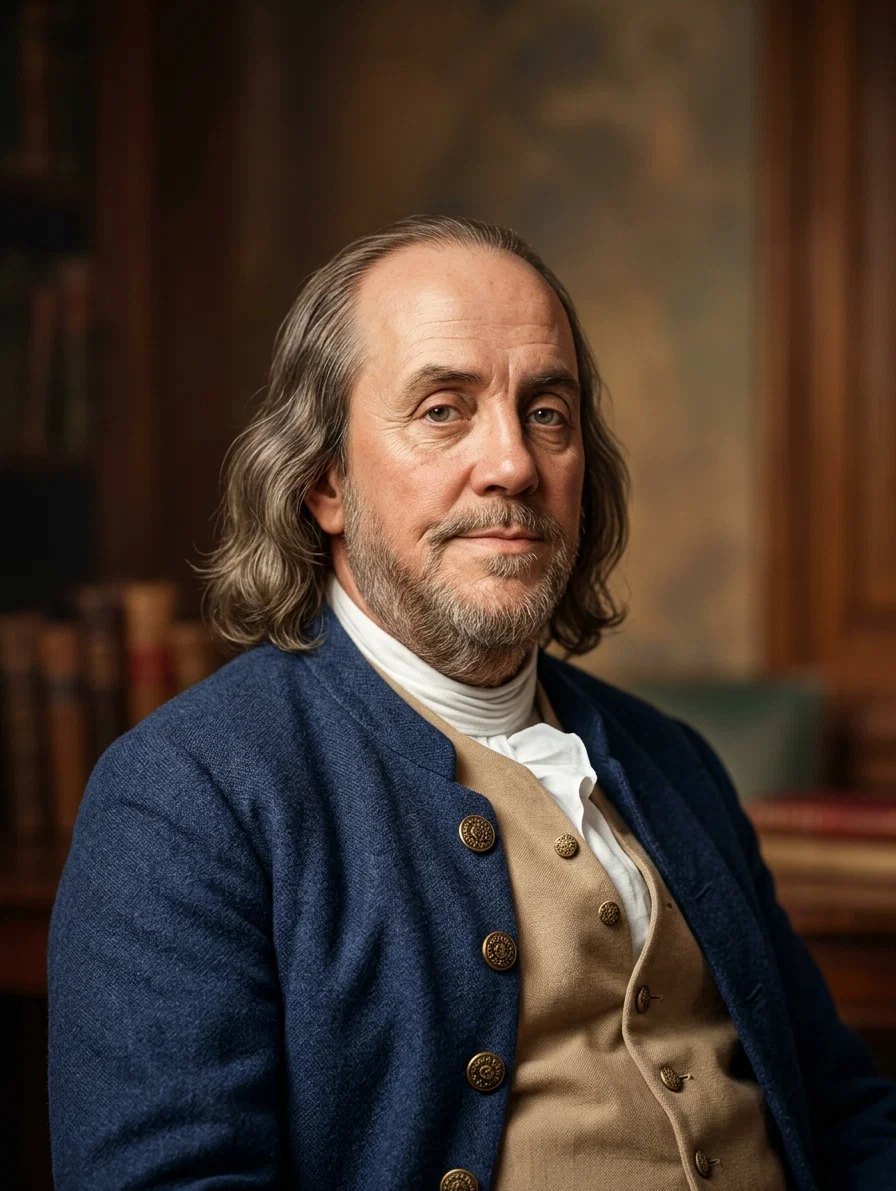
Europe as well as America has been filled with the fame of Franklin the philosopher. Early in life he adopted a fleshless diet, and chose to drink water. Thus he says, “I made the greater progress from that greater clearness of head and apprehension which generally attend temperance in eating and drinking.” Aside from temperance, there were other virtues that he aimed to weave into his character, among which were order, frugality, moderation, cleanliness, tranquillity, humility, etc.
As he neared his eightieth year of life, in writing of himself he said: “It may be well my posterity should be informed that to this little artifice, with the blessing of God, their ancestor owes the constant felicity of his life down to his seventy-ninth year, in which this is written. What reverses may attend the remainder is in the hand of Providence; but if they arrive, the reflection on past happiness enjoyed ought to help his bearing them with more resignation. To temperance he ascribes his long continued health, and what is still left to him of a good constitution.”
Well and Strong at Eighty-Two
In the fragrant and useful life of John Wesley, we have another illustration of the reward that is held in store for those who espouse the truly temperate life.
Although Wesley inherited a weakly constitution, at the age of eighty-one he was able to say, “To-day I entered my eighty-second year, and find myself just as strong to labor and as fit for exercise of body and mind as I was forty years ago.” A year later he said: “I am a wonder to myself. It is now twelve years since I have felt any sensation of weariness.” In writing of his early life, he says: “From ten to thirteen or fourteen I had little but bread to eat, and not a great plenty of that. I believe that this was so far from hurting me that it laid the foundation of lasting health. When I grew up, I chose to eat sparingly and drink water.”
BENJAMIN FRANKLIN
In the year 1747, in writing to the bishop of London, he said: “Thanks be to God, since the time I gave up the use of flesh meat and wine, I have been delivered from all physical ills.”
Dyspeptic at Forty, Strong at Eighty
Isaac Pitman, the inventor of the system of stenography, when nearing his eightieth year, wrote: “Forty years ago, dyspepsia was carrying me to the grave. Doctors advised meat three times a day, and also wine. On these I grew worse. I then avoided meat and wine, and gradually recovered my digestive powers. These forty years have been spent in arduous labor in connection with shorthand and editorial duties. I was at my desk fourteen hours daily, summer and winter, from six in the morning to ten at night.”
Intellectual Marvel at Ninety
Daniel, the Hebrew captive, at the age of ninety, instead of being an object of charity,286was at his best intellectually. As prime minister of the Medo-Persian empire, he did his work so accurately and well that even his enemies had to confess, “We shall not find any occasion against this Daniel, except we find it against him concerning the law of his God.”
When but a youth, he was brought a captive to Babylon; and when commanded to sit at the king’s table, “Daniel purposed in his heart that he would not defile himself with the portion of the king’s meat, nor with the wine which he drank.” He requested that he might have “pulse to eat, and water to drink.”
Daniel’s simple diet, combined with his unfailing trust in God, enabled him to attain to this advanced age with an intellect unimpaired.
In order to fulfill to Israel the promise, “I will put none of the diseases upon thee, which I have brought upon the Egyptians,” and to enable them to live long and well, God withheld from them their Egyptian foods and drinks, and instead gave them manna to eat, and water to drink. He was unable to do for them what He desired, because of a failure on their part to cooperate with Him.
Simple living, high thinking, and long life are intimately associated.