When one looks over Christendom, he sees a wild confusion of bars and fences, division walls and lines of separation, herding together churches and sects, great companies and little squads, almost without number. He listens, and lo! a jargon of voices greets his ears. Contention and contradiction everywhere reign; confessions of faith jostle against each other, creed smites creed, and every one anathematizes every other. He notices further, and to his surprise, they all claim to be teaching from the same Bible and bowing to the same authority. As the confusion does not seem to arise from any difference in the ability of the men of the different divisions, either natural or acquired, he very naturally concludes that it lies in the book, and that the Bible is like the old fiddle from which one can draw any tune he pleases.
But such a charge is not to be laid upon the Bible. Its testimony is not yea and nay, but yea and amen, in beautiful harmony from Genesis to Revelation. Whence, then, says the skeptic, comes all this confusion? Friend, give us your ear, till we can state two points, and then we will leave you to draw your own conclusion. We charge all the confusion in the religious world, not to the Bible, but to the fact that men have wilfully and perversely departed from the Bible. And the Bible predicted that just this state of things would arise from the unsanctified ambition of the hearts of unconverted men. Moses told the Hebrew church: “I know that after my death ye will utterly corrupt yourselves, and turn aside from the way which I have commanded you.” Deut. 31:29. And Paul warned the Christian church of the same thing in their case; “For I know this, that after my departing shall grievous wolves enter in among you, not sparing the flock. Also of your own selves shall men arise, speaking perverse things, to draw away disciples after them.” Acts 20:29, 30.
This was the beginning of the whole difficulty. Unsanctified men crept into the church; and they would be content with nothing only to lead and be worshiped. Instead of being willing meekly to follow Christ, with the rest of the flock, they wanted men to follow them. To do this they would formulate a new doctrine; and to secure the doctrine, they would pervert the teaching of the Bible. And thus religion became corrupted and confused; and that more and more as time went on, for the “perverse men,” who wished to elevate themselves on novel and startling views, were not all confined to one generation.
But we wished to state two points. There are many particulars in which it could be shown that men have departed from the Bible, but we will take only two original and simple truths, and note what the result would have been, if men had always been true to them. These are, the doctrine of the Sabbath and the doctrine of the soul. These were given to man before he left Eden. The seventh day was instituted as the Sabbath, as the great memorial of the Creator, to keep in the minds of men himself and his creative work. Twenty-five hundred years afterward God embosomed it in the very heart of his moral law (Ex. 20:8–11), Christ affirmed its perpetuity while the earth should endure (Matt. 5:17, 18), and the prophet Isaiah takes it through eternity. Isa. 66:22, 23. In respect to the other doctrine, God instructed Adam that he was not immortal, but that if he sinned he should surely die. The devil came along, and told him that he should not die, and, alas! gained the verdict in his favor, and set the doctrine of the immortality of the soul afloat in the world, in opposition to the Bible doctrine that the dead know not anything; that they have no part in anything under the sun, and no reward nor future life, till the resurrection.
Now here are two truths perfectly simple and plain, and directly stated. If any one thinks it can be more clearly stated than it is, that the seventh day is the Sabbath, and that the dead are dead, will he please tell us how? Was there any reason for men to depart from these truths?—They had not the most attenuated shred of the shadow of an excuse for so doing. In the beginning it was the most wilful and perverse apostasy.
Now what would have been the effect if just these two doctrines had always been believed and practised as God designed? There could have been no idolatry in the world, with the Sabbath; and 800,000,000 pagans changed over to believers in the true God, would alter the complexion of this world considerably, would it not? Imagine all the world now keeping the true Sabbath; there would at least be no Sunday laws nor Sunday persecutions.
And on the other point, suppose all men held the truth on the immortality of the soul; that again would destroy idolatry, which is founded upon it. But more, it would destroy Mohammedanism and Greek and Roman Catholicism, by taking away the fraud and abomination of purgatory and the mass, Mariolatry, saint worship, and a hundred other superstitions. It would destroy the doctrine of eternal torment, overturn the stronghold of infidelity, and banish Spiritualism from the world. And with all these gone, with all men Sabbath-keepers and believers in life only through Christ, would there be any other differences worth speaking of? No; the Bible is not the author of the theological confusion of the world.
O that all men, or at least all Christendom, or even all true Christians in the world, would believe the simplest truths of God’s word!
U. S.
The Cause Advancing in Europe.
By Ludwig Richard Conradi
During the past few months we have again experienced quite a gathering of souls. From the extreme west we learn that Brother Klingbeil has gained now a good foothold in the largest city of Holland, and that some sixteen are already keeping the Sabbath at Amsterdam, and are awaiting baptism to unite with us. December 14 Elder Wagner baptized two converts at Magdeburg, from the city of Halle, and the prospects are that soon a company will be gathered at Halle. He then celebrated the ordinances at Berlin, when ten united who had lately embraced the truth under Brother Perk’s labor. From here he went to Bohemia, and spent a week with Brother Simon at Prague and some places nearby, and found a number of persons interested here. Then he visited Klausemburg and Kronstadt in Hungary, and also here the prospects are quite good. Arriving at Constanta, Rumania, his present home, he found a number of interested persons awaiting his return, and he had the privilege of baptizing two persons in the Black Sea. Brother Skubovius is able to sell and distribute a good deal of our literature in Rumania, among it considerable Russian. Brother Tentesch and Benecke labor in Hungary. “Steps to Christ” is now under way in the Rumanian Language, also a number of Bible readings.
In the extreme east of Germany the truth is fast gaining ground. Our churches are steadily growing, and we shall soon dedicate our first meeting-hall at Gumbinnen. Brother Pieper has of late visited several new places, and found a number of Sabbath-keepers ready to unite with us. He labored also among several of the companies already established, and the Lord blessed his efforts so that some twenty took a stand. Several churches are to be organized in this section, and about fifty more are to unite with us soon. We have three hundred Sabbath-keepers in this one province. In Posen several have embraced the truth of late, and await baptism. Brother Jeschke and Krumm are conducting a course of meetings at Stargard, Pomerania, and are having a good attendance. About twelve expect baptism soon at Stettin and Köslin. Elder Frauchiger writes also very encouragingly from Stuttgart in the south. After New-year’s he began a course of lectures in another part of the city, but had to bring the Sabbath meetings there, as the number attending increased to about thirty. He is having a good interest.
The work at Hamburg has also been greatly strengthened during the last two months. January 4 it was my privilege to baptize nine willing souls, several of these from Harburg. Some ninety took part in the ordinances. At the same time we commenced a six months’ institute for our workers, thirty taking part. Professor Schuberth, Mrs. Conradi, and the writer gave instruction in the Bible, English, German, etc., and during the last two weeks we had Brother Spies with us to help the canvassers. At the same time we began a course of lectures in a good hall in the old city, and after a while our attendance increased to from one hundred and fifty to two hundred. Our students represented all parts, almost, of both missions,—Germany, Russia, Lithuania, Holland, Poland, and even Persia, were represented here,—and they all enjoyed the benefits of the instruction and the blessings of a public course of lectures.
After the institute Brother Spies took quite a number of new workers with him to central Germany, others went to Rhenish Prussia, others to eastern Prussia and to Bremen, and we are glad that also the force in southern Germany is increasing. I continued the lectures till the last of February, bringing the interested ones gradually to the chapel, and we were glad to see it fill up during the Sabbath and Sunday services. We held twenty-one lectures in the city, our collections being sixty dollars. We found our hands full with Bible work and visiting, and were only sorry that there were so many other things to need attention. February 29 was another good day for the Hamburg church. After a sermon on baptism, five souls followed their Saviour, and united with the church, and201twelve others handed in their names for baptism at the next opportunity. An excellent ordinance meeting followed. We are grateful for the many blessings from God’s hand. Brother Madsen has interesting experiences in his ship mission-work, one captain ordering lately some thirteen dollars’ worth of books at one time. The circulation of the Herold is steadily growing, and has reached now 8000. We receive encouraging letters as to the effect which is thus produced. We know the seed is not sown in vain. Of late the same professor who wrote for the Lutheran paper has also written not less than eight pages for the Herzog’s-Real Encyclopedia of Protestant theology about Adventists, and the most of it is devoted to our people. On the whole, the article is very fair, considering his standpoint, and will serve as a means of enlightenment to many who have not heard of us thus far, or who know but little of us. We are of good courage in the Lord, as we leave home for several months to attend to baptisms in perhaps twenty different places from the Atlantic to the Russian border and to the Black Sea, and shall report as we go. L. R. C.
THE FREDERIKSHAVN HIGH SCHOOL.
By O. A. O.
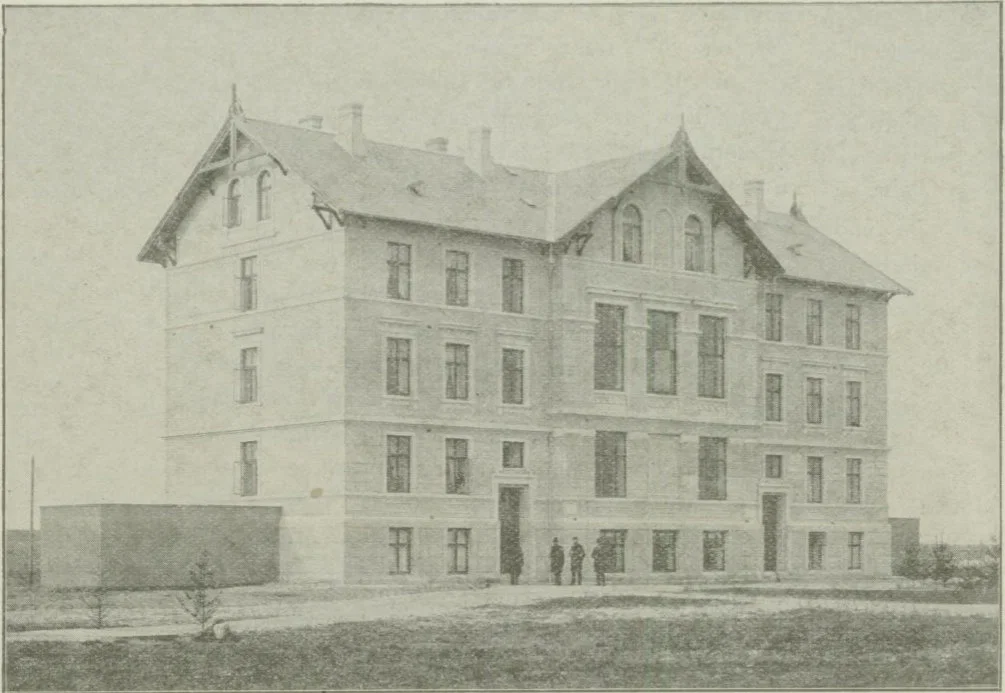
The readers of the Review will no doubt be pleased to see a picture of the High School located in Frederikshavn, Denmark. This institution, which was founded a year ago last summer, has been running nearly two years, in which time it has done an excellent work in preparing laborers for the mission-field.
FREDERIKSHAVN HIGH SCHOOL.
Frederikshavn is situated on the northern point of Denmark, and has good steamer connections with both Norway and Sweden. This makes it a favorable point for the location of a school which looks for its patronage to all three Scandinavian countries. Of the five thousand or more inhabitants of Frederikshavn, the largest number look to the sea for their living, and the harbor usually presents a scene of considerable activity. However, the outlying district forms a good farming community, and along the smooth, hard roads, which branch out in various directions as they leave the city, are many well-tilled farms and substantial farm buildings.
A brisk walk of ten or twelve minutes from the post-office brings one to the High School, which is built on the seashore, only a few rods from the waters of the Cattegat. There is a garden and grove of small trees in the rear of the school, and tastefully-laid-out grounds in front.
The building is of brick, three stories high above the basement, and contains, aside from chapel and recitation rooms, ample accommodations for about sixty students, besides the members of the faculty. The students’ rooms are well warmed and lighted, water is provided on each floor, and in the basement are well-arranged bathing-rooms.
The faculty is composed largely of persons who have studied at the University of Copenhagen, and who are thus well qualified to do thorough work in their respective branches. Considerable stress is laid upon Bible and history, and the courses in the Scandinavian languages are very thorough and satisfactory, particular attention being given to training the students to use their mother tongue with ease and accuracy, both in writing and in speaking. Interesting courses are also provided in mathematics and the natural sciences.
The school contains three departments,—the Danish-Norwegian, the Swedish, and the Primary. Most of the students belonging to the first two, board and room in the school home, which is arranged on the same plan as in our American schools, the ladies occupying one end of the building and the gentlemen the other. The primary pupils are the children of parents living in Frederikshavn, and they live, of course, at their own homes. While the school is located in Denmark, careful attention is given to providing good facilities for the Swedish students, who pursue the study of their own language under competent instructors.
About fifty students are in attendance at the present time, aside from the pupils in the primary department; and the school, with a generally good patronage, is filling a deeply-felt want. It offers excellent advantages to Scandinavians who wish to gain a thorough knowledge of their own language, at the same time that they are studying the Bible, history, literature, and the sciences.
If there are young people in this country who desire to fit themselves for laboring in the Scandinavian tongue, whether in Europe or elsewhere, it might be worth their while to consider the advisability of spending a few years at the High School. As steamship rates are quite reasonable, the cost of the trip need not stand in the way. Besides, the charges for board and tuition in the school at Frederikshavn are lower than in our schools generally. Ten dollars a month pays for everything except school-books and articles of clothing. About fifteen dollars a month is the sum charged in our schools in the United States. The amount saved in this way will in the course of a year or two meet the cost of transportation both ways.
I have on hand a limited number of catalogues which give full information in regard to the work done at the Frederikshavn school. Interested persons may obtain copies by applying for them to the secretary of the General Conference, Elder L. T. Nicola.
O. A. O.
TO CORRESPONDENTS.
By G. C. T.
64.—Will you please explain what is meant by the expression in Jer. 10 : 7, “Who would not fear for thee, O King of nations?” and Ps. 22 : 27, 28, where similar language is used? C. H.
There are many passages of Scripture that show that God exercises control over the affairs of the nations, and that all have a part in his sovereign will and plan, and within certain limits he overrules their affairs. In this sense God is king, and “his kingdom ruleth over all.” But it is in the sense of a moral ruler rather than as a civil ruler that God controls in the affairs of nations. Earthly rulers are allowed to work out their own inclinations and characters, and to follow their own course of action. God does not engage in the administration of civil government, because civil government is not administered on God’s plan. He cannot consistently employ divine force in enforcing his law, which he would need to do if he were the civil ruler; hence, while God’s kingdom is over all the earth, and “the Most High ruleth in the kingdom of men, and giveth it to whomsoever he will,” it is still true that like the formation of individual character, God leaves the administration of civil affairs to the human agent.
65.—Are there any circumstances justifying a divorced person marrying the second time, while the other party lives? In connection with this question, please explain Matt. 19 : 9 ; Rom. 7 : 1-4 ; 1 Cor. 7 : 11, 39. V. O. C.
We are frequently called upon to answer questions similar to the above, and according to the best light I have there is one cause, according to Scripture, for which a divorce may be obtained. The Scriptural divorce annuls the marriage relation, so that those who were husband and wife before, are no longer so. To such parties the last two scriptures named would not apply. The woman is bound to her husband as long as her husband lives, but if he ceases to be her husband, then of course the law which binds her to him is no longer binding. A person who is thus divorced by the law of God and the law of the land is, I understand, at liberty to marry again. But we are fully persuaded that the matter of divorce should be strictly confined to the rule laid down by our Saviour himself, and that divorces obtained on any other ground are not obtained on Scriptural ground.
66.—(1) Whom did Jesus mean when he said, “If another shall come in his own name, him ye will receive”? John 5 : 43. (2) Did Moses write the commandments on the second tables of stone, after the breaking of the first? (3) In speaking of the water and the Spirit (John 3:5), does our Saviour mean baptism? J. B.
(1) I do not think that the Saviour had any person in mind, but that he stated a principle. Had Christ come with personal pretensions to establish the throne in his own name, the Jews would have received him. They were anxiously watching for such a person, and were frequently deluded by impostors. Christ came making no pretensions of personal greatness, ascribed all his works to the Father, and humbly did his Father’s will. Him they rejected. (2) The language of Ex. 34 : 28 is a little ambiguous, as202it is not clear to whom the pronoun “he” refers, either to the Lord or Moses, although we would most naturally conclude that it was Moses. But by reference to Deut. 10 : 4, the question is clearly settled, for there Moses states that “he [the Lord] wrote on the tables, according to the first writing, the ten commandments.” Deut. 10 : 2 and Ex. 34 : 1 furnish additional evidence that the Lord wrote the second as well as the first tables of the law. (3) It is probable that the Lord did have reference to baptism in the use of the word “water” in connection with the Spirit.
67.—Did Noah keep the time during the days of the flood? I was told that the Bible says he forgot to worship God, and also forgot the days of the week. S. H. L.
It is best not to believe all that people tell us about the Bible; for if we did, we would be in hot water all the time. When an individual makes a doubtful statement in reference to the Scriptures, it is but fair that he should refer to the passage, and it is not worth while putting any confidence in him if he does not. The Bible does not tell us that Noah lost his reckoning of the time,—in fact, we know he did not, for the exact time of the flood is given; besides, if he had, it would not make any difference about the Sabbath, for the ten commandments were given far this side of the flood, and the Sabbath was located by God himself at the time of the exode and the giving of the law; so there can be no confusion about it.
68.—Is it proper for a minister to invite into the pulpit a lay member or an officer of the church, for the purpose of reading hymns, praying, and dismissing the congregation? L. F. M.
I know of no law against such a practise, unless it be that of custom. Well-established custom is good authority, however, and should not be ignored, especially when it rests upon a basis that is vitally important. But there is no good reason why a member of the church should not be called upon to assist in the services if it be desirable, though there may be an objection in the minds of some about seeing him invited into the pulpit. With many, the pulpit is regarded with a degree of reverence, to be reserved for those who have by special action been consecrated to the work of the ministry. It is not in harmony with our best sense of propriety that a member of the congregation should be called upon to pronounce a benediction. In this case we use the word “benediction” as distinct from a brief prayer with which a meeting may be dismissed, and which we observe is quite a common practise in our meetings. A benediction is a blessing pronounced upon the congregation. In doing this the minister usually raises his hands, and blesses the congregation in the name of the Lord, pronouncing grace, mercy, and peace upon them. This function, it would seem, ought to be confined to the ministers of the gospel.
69.—Do Seventh-day Adventists believe that they are the Elijah that is to come before the second coming of Christ? Mal. 4:5. N. V. D.
The Seventh-day Adventists believe that as Christ at his first advent had a forerunner in the message of John the Baptist, so at his second advent he will have a forerunner in the three angels’ messages of Revelation 14. In the first instance it was a message preached by one individual; in the second instance, a message preached by a large company of individuals. G. C. T.
Proceedings of the General Conference Committee.
By L. T. Nicola
During the recent Council at this place, the General Conference Committee held a number of meetings. Many important matters relating to the interests of the general field received consideration. Among these were camp-meetings and camp-meeting laborers, arrangements for the next General Conference, the week of prayer, our educational work, the supplying of needy fields, the distribution of labor, and providing for the financial needs of our work.
An unusual amount of time during the Council was spent in devotional work, and some of the meetings held were exceedingly solemn and impressive. It is perhaps not saying too much to state that this Council was one of the most important ever held by the denomination.
The following actions of the Committee we deem of general interest, and not liable to change on account of future arrangements:—
Distribution of Labor.
We are prepared at the present time to report only the following recommendations on the distribution of labor; others will be given at a later date:—
That S. M. Jacobs, of Iowa, be invited to take the superintendency of the Oakwood Industrial School now being established near Huntsville, Ala.
That Elder F. D. Starr and M. C. Guild, of Michigan, make the Tennessee River Conference their field of labor.
That M. S. Babcock, of Alabama, change field of labor with J. R. Buster, of the Ohio Conference.
That Elder G. G. Rupert make northwestern Oklahoma and the Panhandle of Texas his field of labor.
That Elder Ole Nelsen, of Sweden, who is about to return to America, be requested to make Utah his field of labor, engaging in the Scandinavian work.
That Elder W. A. Hennig, of Nebraska, make Manitoba his field of labor.
That Miss M. M. Osborn make Atlanta, Ga., her field of labor, engaging in work for the colored people.
That G. W. Wells connect with Elder W. T. Drummond in labor at Montgomery, Ala.
The removal of Elder F. M. Wilcox to Colorado being made necessary on account of his wife's health, it was recommended that his resignation as secretary of the Foreign Mission Board be accepted, and that he be recommended to connect with the Sanitarium and church work at Boulder, his resignation on the Board of Foreign Missions to take place upon the appointment of his successor.
That M. E. Olsen act as secretary of the Book Committee, in place of Elder F. D. Starr, recommended to labor in the Tennessee River Conference.
That L. Dyo Chambers, of Chattanooga, Tenn., be appointed tithe sub-treasurer of the Southern mission field.
That the General Conference furnish one or two Christian Help workers for New York City.
That the Wyoming mission field embrace the northern part of Wyoming and the southeastern part of Montana, and that the Wyoming mission field be considered a part of District 4, and that Elder O. S. Ferren and H. F. Ketring continue their labor in that field.
That the Medical Missionary Board be asked to furnish health and temperance workers for the camp-meetings of 1896, on the plan followed last year.203
Credentials, Licenses, Etc.
That Grant Adkins, of Alabama; B. F. Purdham, of North Carolina; and J. D. Rice, of Cook Islands, Polynesia, receive ministerial credentials; and that A. Barry, of Kentucky, and J. C. Foster, of Manitoba, be ordained to the gospel ministry, and receive ministerial credentials from the General Conference.
That Harry Champness, of London, England, receive ministerial license.
That John Mc Carthy and Mrs. Estella Snyder, both of Argentina, South America; Mrs. H. H. Brand, of Honolulu, H. I.; Mrs. J. D. Rice, of Cook Islands, Polynesia; Mrs. L. M. Sisley and Miss M. M. Osborn, of Georgia; Frank Lyndon, of North Carolina; G. W. Wells, of Alabama; Maggie M. Kesler, of Tennessee; Miss Worthie Harris, of New York City; and Miss Lula Joseph, of Utah, receive missionary credentials.
That the General Conference Committee authorize the local committees in the mission fields of Europe, in connection with the superintendent of these fields, to issue licenses and credentials to persons properly qualified to receive such papers.
That the Australasian Union Conference Committee be instructed to issue licenses and credentials to local laborers working under their direction in General Conference territory.
The Next Session of the General Conference.
(a) Time: That the next session of the General Conference be held February 19 to March 8, 1897, and that a Bible institute precede the Conference, beginning February 9 and closing February 18, the same to be continued throughout the Conference, devoting only one hour daily to institute work during the Conference proper.
(b) Place: The Nebraska Conference and the College View (Neb.) church having extended a generous invitation for the General Conference to be held at Lincoln, Neb., the Committee, while not deciding definitely the place where the meeting should be held, considered the invitation favorably, being disposed to accept the same, provided upon further consideration it should be thought best to do so.
That a cordial invitation be extended to Elder W. C. White and Mrs. E. G. White to attend the next session of the General Conference.
Annual Camp-Meetings.
That the following be the schedule of dates for the camp-meetings for 1896:—
District 1.
| Place | Date |
|---|---|
| Pennsylvania | June 4–14 |
| Quebec | “ 17–29 |
| Atlantic (suggested) | May 20 to June 1 |
| Virginia | Aug. 7–17 |
| New York | Sept. 3–17 |
| West Virginia | “ 17–27 |
| New England | |
| Maine | |
| Vermont | |
District 2.
| Place | Date |
|---|---|
| District camp-meeting (Chattanooga) | July 17–26 |
| Tennessee River | |
| Florida | |
District 3.
| Place | Date |
|---|---|
| Ohio | Aug. 6–17 |
| Indiana | “ 20–30 |
| Illinois | |
| Michigan | |
District 4.
| Place | Date |
|---|---|
| *Iowa | May 26 to June 1 |
| *Minnesota | June 2–8 |
| *Wisconsin | “ 9–15 |
| North Dakota | “ 5–14 |
| *South Dakota | “ 22–29 |
| Manitoba | July 1–6 (?) |
| *Nebraska | After Aug. 15 |
District 5.
| Place | Date |
|---|---|
| Texas | July 23 to Aug. 3 |
| Oklahoma | “ 30 to “ 10 |
| Arkansas | Aug. 5–17 |
| Colorado | “ 19–31 |
| Kansas | “ 26 to Sept. 7 |
| Missouri | Sept. 9–21 |
District 6.
| Place | Date |
|---|---|
| North Pacific | May 21–31 |
| California | “ 28 to June 7 |
| Upper Columbia | June 18–28 |
| Utah | July 7–12 |
| Montana | “ 16–26 |
District 8.
| Place | Date |
|---|---|
| Russia | May 11–21 |
| Finland | “ 22–31 |
| Sweden | June 9–21 |
| Norway | “ 23 to July 5 |
| Denmark | July 7–19 |
| Germany | “ 21 to Aug. 2 |
| Switzerland | Aug. 6–16 |
| Switzerland, institute for | “ 16–30 |
| Turkey | Sept. 29 to Oct. 31 |
Educational Matters.
The question of certain text-books for use in our schools received some attention, and Elder A. T. Jones was requested to prepare something on the line of Bible history, and Professor G. H. Bell was requested to prepare for publication a series of graded language books suitable for use in our schools.
That instead of conducting Bible schools as formerly, it be recommended that, in the future, efforts be put forth by our several schools and colleges to make special provision to meet the needs of the class of workers heretofore accommodated by our Bible schools.
That Elder G. A. Irwin, Elder O. A. Olsen, and S. M. Jacobs act as a Board of Managers for the Oakwood Industrial School at Huntsville, Ala., the last-named to act as business manager of the school.
The Seventh-day Adventist Educational Society having recommended that a committee be appointed by the General Conference Committee to take into consideration the improvement of our educational work and the best methods for the improvement of the workers, and to report at the next annual session of the society, it was recommended that the following-named persons be appointed to act on said committee: Professor W. W. Prescott, Elder O. A. Olsen, Dr. J. H. Kellogg, Elder W. C. White, Elder R. C. Porter, Elder H. P. Holser, the President of the Battle Creek College, the President of Union College, the President of Walla Walla College, the President of Healdsburg College, and the President of the Keene Industrial School.
Special Season of Fasting and Prayer.
In view of the fast-developing events of prophecy, and the remarkable manner in which the Lord is opening the way for the proclamation of the message, indicating most clearly the near approach of the end; and in view of the great responsibility resting upon us as a people in consequence of the light and the truth which God has committed to us to give to the world, the Committee thought it proper to appoint a general season of fasting and prayer in behalf of a more energetic extension and liberal support of our work throughout the world, a suitable address relating to the matter being prepared for general circulation; and that this special season be held May 16, 17, 1896.
Miscellaneous.
That a sixty-foot tent with a twenty-foot splice, making a tent sixty feet by eighty feet, be provided for tent-meetings in the Cumberland mission field and for camp-meetings in District 2, donations being secured for meeting the expense of such purchase.
A recommendation having been made by the Board of the International Religious Liberty Association favoring the removal of the Religious Liberty office from Battle Creek to New York City, it was voted that the General Conference Committee favor the action, and suggest the removal of the office when proper arrangements can be made for so doing.
L. T. Nicola,
Secretary of the Committee.
THE RECENT COUNCIL.
By Ole A. Olsen
This Council convened according to appointment the 20th of February. These meetings cannot be compared in importance to the sessions of our General Conference; still, at a time when our work is making such rapid advancement, and such interesting developments are taking place all around us, our brethren can well appreciate the fact that they are very important occasions.
The whole time occupied by the Council was nearly four weeks. During this time the General Conference Association held many meetings, in which were discussed the needs of our various institutions, and our financial operations generally. Then there were the meetings of the Foreign Mission Board, at which were considered the progress of our missions in foreign lands and the calls for missionary labor. The General Conference Committee, at its meetings, took under consideration the needs of the home fields and the general interests of the work as a whole. Meetings were also held by the Publishing Association, the Educational Society, and the Medical Missionary Board.
Considerable time was taken by the Auditing Committee in settling the accounts of the General Conference laborers, a work which is of great importance. At this audit we had over three hundred cases to consider, which is about one hundred more than we had a year ago. This comparison alone will give some idea of the increase of the work during the past year.
The question of means with which to carry forward the work, has become a serious one. Our brethren are aware of the fact that during the year 1895 the contributions to the various funds fell off to quite an extent. With a lack of properly qualified laborers and a scarcity of means in the treasury, the difficulty which the Committee met in trying to reply to urgent calls for help can be readily appreciated; but this situation becomes especially serious in view of the fact that our time for carrying the message to the world is growing very short, and the end of all things is close at hand. Surely every believer in the third angel’s message should make this a subject of earnest thought and prayer.
The General Conference Committee, in studying the needs of the home field, found it advisable to suggest a number of changes in fields of labor; but we are not prepared to make them public at present, because we have not as yet had opportunity to confer with all the persons concerned, the carrying out of such recommendations being usually contingent on obtaining the free consent of all the persons interested. Nevertheless, we would emphasize the fact that every move in this line has received most earnest and prayerful consideration; and we hope that as our brethren receive notice of these recommendations from the corresponding secretary, they will let no trifling matter hinder them from carrying them into effect.
The prospects for the work the coming season are unusually encouraging. Indeed, the only thing that can hinder the progress of the Lord’s work is indifference and worldliness among his people. May God grant that, from the least to the greatest, all may sense the responsibility of this time, and cheerfully come up to the help of the Lord against the mighty forces of the enemy. The final triumph of the truth is near; the song of victory will soon be sung.