MOST people are familiar with the old story of the man who neglected to have a nail driven in the shoe of the horse he was riding, and how, “for want of a nail the shoe was lost, for want of a shoe the horse was lost, for want of a horse the rider was lost, and all for the want of a horse-shoe nail.” A very small beginning, true enough, but most disastrous in its ending.
This lesson comes home to us to-day with striking force in view of the indifference with which so many regard the present Sunday movement. “It is only a little temporary craze which will soon die out,” they say, and so dismiss it from their minds. The time was, perhaps, when such an opinion might have been advanced with some degree of plausibility, but in view of the rapid developments of recent years, it can readily be seen that a conflict of stupendous magnitude lies before us in regard to this question. This becomes doubly apparent when we stop to consider that some of the very ones who, at the first, pooh-poohed at the “idle fears,” so-called, of those who opposed it, have turned in with the very movement that they declared would amount to nothing, and are now using their utmost endeavors to make it effective. And this tendency becomes more marked, almost with each successive day, in political circles. The average politician, generally speaking, has an eye to the “main chance,” and as he sees petitions being circulated, public meetings being held, and all manner of expedients being used to bring Sunday prominently before the public, he soon reaches the conclusion that if he expects to maintain his hold upon public opinion, it will be about the correct thing for him to express his belief in the universal sacredness of the “American” Sunday, however little religious regard he may have for the day, or for the sacredness of anything else.
And it is this very political agitation which furnishes such grave cause for apprehension. If the advocates of Sunday sacredness simply desired to observe the day themselves, or even if they only wished to call the attention of others to the need of a better observance of the day, no reasonable objection could be urged. This would be nothing more than their lawful right. But when they endeavor to secure legal sanction of the sacredness of that day or of any other, they not only go contrary to the most vital principles of Christianity, but they attempt something, which, if carried out, will subvert the very foundation of our national greatness, and transform the “best Government the sun ever shone on,” into a despotism more tyrannical than that of the Russian Empire.
Any such attempt is contrary to Christianity because the teaching of Christ was, and is, to do unto others as we would have them do unto us. This gives the fullest possible liberty of religious thought and action; unless, indeed, our Sunday-law friends are prepared to admit that they would like to be compelled to acquiesce in some religious observance which was utterly contrary to their own desires,—a conclusion whose self-contradiction is so evident that it needs no refutation.
Our national greatness arises not so much from our favored position and immense resources as from the just and equal protection which our laws offer to all who come within our boundaries. Here the oppressed of all the earth have found a welcome, and the very name America has almost become a synonym for civil and religious freedom. But to seek legislative aid in behalf of any religious institution, is not only a confession of weakness, but is also an attempt to coerce the religious opinions of men, and to stifle all the convictions of conscience, thus despotically depriving them of the liberty of individual thought, and making mere machines of them, or at the best, making them act as though they believed something which they do not believe; which is nothing less, in fact, than making hypocrites out of otherwise honest men.
It may be said by way of objection to the foregoing that this movement is not a religious but a civil one. But if so, why is so much enthusiasm manifested by the Church over the question? and why is it that the prime movers are found chiefly among the ministry and membership of the great religious bodies of the land? There are reforms which would properly come within the jurisdiction of civil law. Why do they not take more interest in these things if it is from motives of pure patriotism that they are working? The fact simply is that the prominent agitators of this Sunday-law movement have time and again acknowledged that it was the religious character of the day that they desired to have recognized. In proof of this it is only necessary to cite the reader to any of the attempts made of late years to secure congressional action upon this very matter. It is the religious and sacred phase of the subject that continually crops out, and it is the religious, not civil, aspect to which they are looking in the future, and which they hope to eventually succeed in enforcing upon the public.
But, if it is within the province of this government to dictate what day shall be observed, it is also its privilege to specify how it shall be kept; and as the great complaint against Sunday violation, at present, seems to be on account of people staying away from church, the only logical conclusion that can be drawn is, that if a national Sunday law is once secured, the next step will be enforced attendance upon religious services. And, of course, if individuals can be lawfully compelled to attend church it is nothing unlawful if they shall be obliged to financially keep up and support the various church establishments of the land. Not only so, but it follows, as naturally as night follows day, that the civil power shall have the right to dictate what church each individual shall support, what congregation he shall unite with, and what particular form of belief or profession of faith shall be required of him. Thus the civil power will be but a tool in the hands of the religious element, to execute its autocratic behests, and the two will be as completely united as they ever were in the palmiest days of the Roman hierarchy. By parity of reasoning, the State will then have power to declare what shall not be believed, so that what is now simply a difference of religious opinion will then be heresy, and will be punishable as a70crime under the laws of the State, the same as murder, felony, etc.
Let no one say the picture is overdrawn; for instead of being exaggerated, it is not fully filled out. Let the precedent once be established for the Church to dictate to the civil power, and the tyranny of religious persecution will just as surely throttle liberty of conscience as it did during the Dark Ages.
The boon of religious liberty and freedom of thought is too priceless a heritage to be squandered for a mess of political pottage. The advocates of the present movement in favor of Sunday legislation had better ponder deeply upon these questions. The measures contemplated by them will lead onto dangerous ground, and their inevitable end, if carried into effect will be to revive the bigotry, cruelty and religious persecutions of the past.
When the United States shall have prostituted her law-making powers to such base ends, “Ichabod” may well be written over the portals of her legislative temples, for her glory will have departed. Let the people beware of the first step.
J. W. SCOLES.
THE Christian Advocate notes the approach of the centennial anniversary of the constitutional establishment of religious freedom in this country, and says: “The Executive Committee of the American Baptist Home Mission Society has decided to call a celebration of the centennial of the incorporation into the Constitution of the United States of the clause forbidding Congress to make any law establishing or forbidding the free exercise of religion, as a triumph of Baptist principles. The ratification of the amendment was declared during the congressional session of 1791-92, so that we are now in its centennial year. Arrangements are on foot to make the celebration a marked feature of the Baptist anniversaries, in May next, in Philadelphia.” At the same time they would do well to consider whether, in attending this anniversary, they are celebrating the birthday of a living principle in this Government, or have gathered to measure how much more than a word and a name that same amendment is after the lapse of one hundred years.
THE lower house of the Prussian Landtag has been excitedly debating a new Educational Bill, which is practically a measure to make a State religion of which the German Emperor should be the Pope. The avowed object of the measure is to put the Prussian schools into the hands of the clergy, to make what is called religious instruction obligatory, and to exact from all students a full measure of conformity. In the language of the Imperial Chancellor, who is the chief advocate of the measure, “it is a bill against atheism.” It would force doctrinal teaching upon children whose parents are opposed to such teaching; it would force Jews to accept Christianity,—such Christianity as the priests of the State religion might choose to teach. It sets up as supreme what is called in Prussia the “Confessions.” The Emperor and his Lord Chancellor appear to believe that matters of faith can be easily regulated by statute, and that the people of Prussia are quite ready to put their consciences and their relations to God in the hands of the king. The opposition to the measure declares that it is an attempt to set up a political religion, which would practically result in the domination of an organized priesthood. The promoters of the bill admit the truth of the criticism, and attempt to justify it on the express ground that the real, vital question is whether Prussians are to be Christians or atheists. The discussion has been very warm, not a few of the government party being in the opposition. The Minister of Finance sees in it a menace to some of his plans for managing the monetary affairs of the empire, and has resigned. This is a singular comment upon the practical working of a religion made by law. We suggest that the advocates of legislation in behalf of religion and religious institutions in our own country make a study of this extraordinary Prussian movement.—Sabbath Recorder.
The Pittsburg Dispatch again chronicles the results of the Sunday sessions of the police courts of that city,—fifty-six cases in all, before five magistrates. It seems the Law and Order League of Pittsburg has its own machinery oiled to run seven days in the week.
An act was introduced in the Missouri Legislature, February 3, to prohibit the sale of any vinous or spirituous liquors within two and one-half miles of the Methodist and Christian churches at Marietta, Prentiss County, Mississippi. Why favor these two denominations above all others?
A CABLE dispatch reports that a Chinese General, Tcheu Kitong, has been executed for treason in having become a Christian and for having furthered the cause of missions. It seems that they are practical “National Reformers” in China, and logically follow the doctrine to its ultimate conclusions.
AN association, to be known as the “Milwaukee Sabbath League,” has been lately established in Milwaukee, Wisconsin. In the resolutions adopted at its organization the aid of all citizens is invoked to secure the enforcement of Sunday laws, and it is “demanded” that the Wisconsin exhibit at the World’s Fair be closed on Sunday.
THE petition list of the New Jersey Legislature, for one day, protesting against the opening of the World's Fair, on Sunday according to the record, was quite large,—petitions being presented by Senators Rue, McMickle, Rogers, Perkins, Adrain, Miller, Cornish, and Hinckliffe, signed by “numerous of their constituents.” The New Jersey Sabbath Union is making every effort to have the Legislature, commit itself on the question of Sunday closing of the Fair.
AN evidence of how rapidly the idea of establishing national feast days, fast days, and religious and semi-religious holidays, is gaining ground, is the presentation in the Legislature of Minnesota, of a memorial asking for the passage of a law appointing October 12, the anniversary of the discovery of America, by Columbus, as “a day of national thanksgiving.” Of this the Christian at Work says: “We, together with the Lutheran Observer, have recommended the observance of Discovery Day for years.”
IN Minneapolis, “Mayor Winston has signed the amended liquor ordinance giving only the police of the city authority to make complaints against saloon keepers. It is stated that Superintendent Henderson has ordered the police to keep their hands off, and that saloons will open Sunday, beginning February 21. The whole matter will be carried to the Supreme Court, by a citizens’ committee, on the plea that a person has the right to file information against another who is alleged to be breaking the laws of the State.”
THE World's Fair bill, appropriating $300,000 for the exhibit of the State of New York, has been amended in the Assembly by the addition of a provision that the State exhibit should be kept closed on Sunday. The amendment was adopted by a vote of forty-nine to forty-seven. On motion of Mr. Bush the resolution was then laid aside, in order as the mover said, "to give the Republicans, who were trying to make political capital out of a religious question, time to think over the matter." The bill can be called up at any time, and if passed in this form by the Assembly will necessarily return to the Senate for its concurrence upon the amendment.
THE “Pearl of Days,” says “the security or disaster of our American institutions depends upon the issue of this Sabbatic contest and the proper enforcement by civil enactment of all divine law that inures to the well being of the State.”
that relates to the well being of the State. To determine what portion of divine law inures to the well being of the State, and then to construe that portion and decide as to its application to the State, the proper terms by which to enact it into civil law, and fix the methods of its enforcement, has always involved those legislators who have attempted it in such a maze of evident error, contradiction, inconsistency and injustice, as ought in itself to prove to any intelligent being the impropriety of attempting to enforce the divine law by the civil.
AN exchange reports Rev. J. H. Willey, of Syracuse, New York, as teaching in a sermon, lately delivered in that city, that in order to preserve the religious observance of Sunday the Government must legislate to that effect, and then enforce its laws,—and saying, “When the law is made then I appeal to you as a church; I appeal to you as Christians, stand by the ship of State and if any one dares to desecrate the day—over the roll with the wretch!”
desecrate the day—over the rail with the wretch!
To have carried out the nautical figure of speech to an exactitude he should have said, “Let him walk the plank!” It has been evident for some time that there are pirates on board this ship of State, who intend to mutiny, capture the ship, and do their best to send all who oppose them to Davy Jones’ locker. They must be very sure of success, to appeal so openly to their co-conspirators.
NATIONAL
Religious Liberty Association
DECLARATION OF PRINCIPLES.
We believe in the religion taught by Jesus Christ.
We believe in temperance, and regard the liquor traffic as a curse to society.
We believe in supporting the civil government, and submitting to its authority.
We deny the right of any civil government to legislate on religious questions.
We believe it is the right, and should be the privilege, of every man to worship according to the dictates of his own conscience.
We also believe it to be our duty to use every lawful and honorable means to prevent religious legislation by the civil government; that we and our fellow-citizens may enjoy the inestimable blessings of both religious and civil liberty.
OFFICES:
43 BOND ST., NEW YORK CITY.
1225 F ST., N. W., WASHINGTON, D. C.
28 COLLEGE PLACE, CHICAGO, ILL.
17TH AND CASTRO STS., OAKLAND, CAL.
267 WEST MAIN ST., BATTLE CREEK, MICH.
R. C. PORTER . . . PRESIDENT.
A. F. BALLENGER . . . SECRETARY.
One of the Very Best Popular Religious Books Ever Published is
—STEPS TO CHRIST—
BY
Mrs. E. G. White.
—o—
The rare ability of the author in the presentation of Scripture truth has never been used to better advantage than in this little work. “Steps to Christ” is not alone suitable as a guide to the inquirer and young convert, but is rich in thought and suggestion for the most mature Christian. Some idea of its scope and practical character may be gathered from the following table of
CONTENTS.
—
The Sinner's Need of Christ. 7. Growing up into Christ.
Repentance. 8. The Work and the Life.
Confession. 9. A Knowledge of God.
Consecration. 10. The Privilege of Prayer.
Faith and Acceptance. 11. What to do with Doubt.
The Test of Discipleship. 12. Rejoicing in the Lord.
STEPS TO CHRIST is issued in a rich, neat cloth binding, gold and ink dies, at 75 cents per copy.
The above named books will be sent post-paid on receipt of price.
PACIFIC PRESS PUBLISHING CO.
Or Oakland, Cal 45 Bond St., New York City.
REVELL'S IMPERIAL GLOBE ATLAS
Of modern and ancient geography. Containing 33 imperial quarto maps, with an index of 20,000 names. Size of page, 12 x 14. Full cloth, $1.00.
FOUND AT LAST!
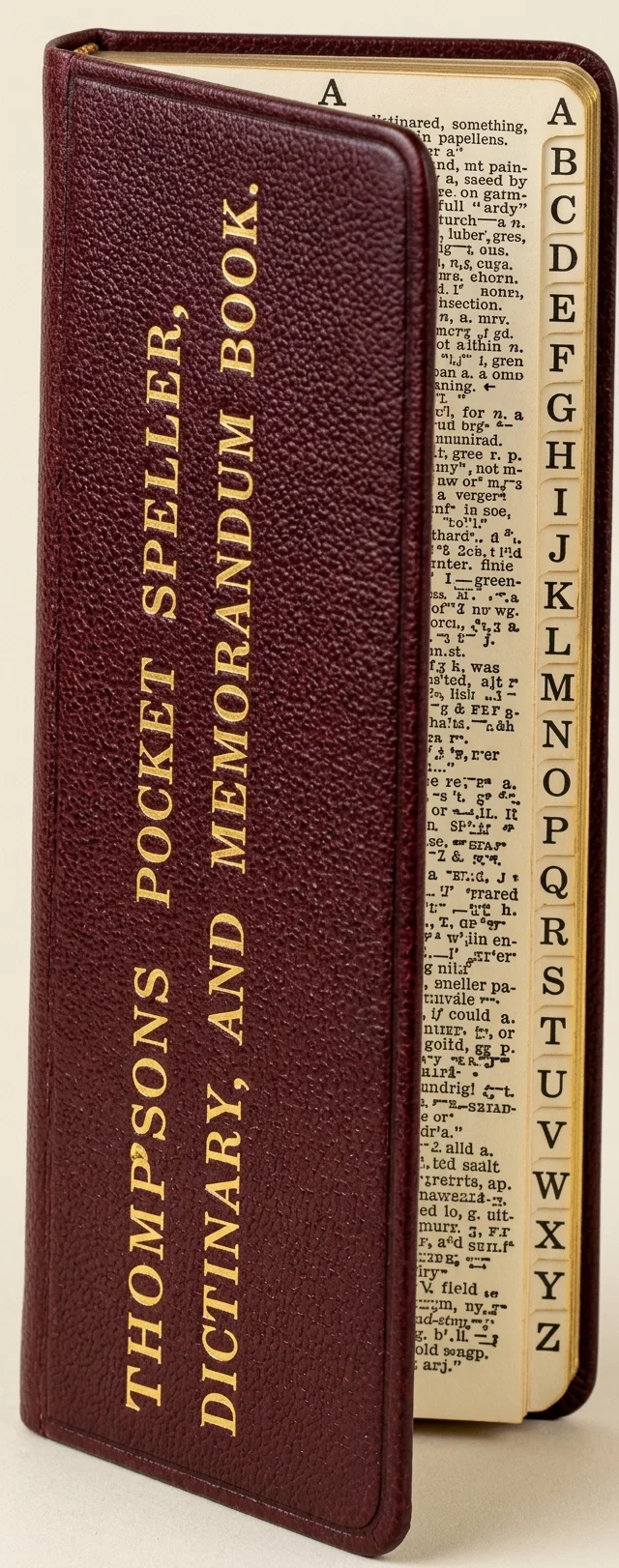
A POCKET SPELLER, DICTIONARY, AND MEMORANDUM BOOK COMBINED.
It gives the right orthography of all words (over 22,800) in common use, and in nearly every instance their definition. It also gives rules for the use of capitals and punctuation marks, abbreviations of names of States and Territories, letters of introduction and recommendation, definitions of commercial terms, forms of notes, due bills, receipts, letters of credit, orders for money, merchandise and goods stored, principal holidays, marriage anniversaries, combination of shades, and carefully selected laws of etiquette in social and business life, also a silicate slate for memorandums.
This Speller gives the most complete list of words in common use; it is a Speller, Dictionary, Handy Companion, and Memorandum Book combined; it is indexed; it prints all words pronounced alike but spelled differently, so they can be distinguished at a glance; it shows where the letter e at the end of a word is to be dropped when adding ed or ing; it gives a complete list of the most practical business forms; it gives the laws of etiquette in social and business life; these rules alone are worth the price of the Speller.
This Speller is bound in leather, is of convenient size to be carried in vest pocket, and its price brings it within the reach of all. American Russia leather, gilt edge, 50 cents. Sent post-paid to any address on receipt of price.
Address all orders to PACIFIC PRESS,
45 BOND ST., NEW YORK.
“McMASTER'S History of the United States” says of the code under which the French and Spanish city of New Orleans was governed before the cession of Louisiana to the United States in 1803,—“Wretched indeed was the plight of the friendless offender, or even an accused person, who was brought before one of these perambulatory judges. If he had reviled the Saviour or the Blessed Virgin, his property was confiscated and his tongue cut out.” Although such penalties would not now be imposed because of being “cruel and unusual,” neither would the reviling of the “Blessed Virgin” be treated as a penal offense, yet the spirit of this very criminal procedure is still retained, only modified out of respect to public feeling and to correspond with Protestant instead of Catholic creed.
The Citrograph, Redlands, California, publishes this, credited to the Grocer and Country Merchant, and heads it, “Absurd Laws.”
“Commercial travelers, or others who carry accident insurance policies, should be careful when business or pleasure takes them to some of the eastern States, having Sunday laws, that they do not go shooting or fishing on the first day of the week. By a recent decision of the Vermont Supreme Court it was held in the case of Duran vs. Standard Life and Accident Insurance Company, that a person who walked from one town to another on Sunday for the purpose of hunting violated the laws of Vermont, which forbid hunting on Sunday, or traveling on that day, except from necessity or charity; that an injury occasioned by his slipping on frozen ground while returning home from hunting on Sunday was not covered by an accident insurance policy exempting the company from liability where a ‘violation of law’ was the act, cause, or condition, ‘wholly or partly, directly or indirectly, producing the injury, or where the injury was affected by any such act, cause, or condition, or under its influence.’ Residents on this coast, where the law is indifferent as to whether one attends church or goes fishing on Sunday, will find it hard to realize that such enactments as the Vermont Sunday law exist in any American commonwealth. It may be perhaps that to the existence of the narrow views, as expressed in the Vermont statute, is to some extent due the steady decline in the population of a State which has produced so many men of distinguished ability.”
IN Pittsburgh, where the Law and Order League is very active in trying to put down the Sunday paper as well as all forms of Sunday work, the Printers’ Assembly, a branch of the Knights of Labor, has passed the following resolutions:—
Whereas, There are many laws on the statute books of Pennsylvania, notably the conspiracy and Blue Laws, which militate against the rights and liberties of the laboring class, and
Whereas, An association styled the Law and Order League, mainly composed of disreputable persons, not citizens of the United States, has taken it on itself to enforce the obnoxious Blue Laws of 1794 to the detriment of workingmen and their families, in an attempt to deprive them of their Sunday papers, thus denying them the only means they have to educate themselves; therefore, be it
Resolved, That Printers’ Assembly 1630, Knights of Labor, hereby emphatically denounces the conspiracy and Blue Laws as blots upon the statute books of the State, and insists upon the repeal of laws which permit foreigners to levy blackmail upon American citizens and allow capital to grind down workingmen through the medium of the courts; and further, be it
Resolved, That we call upon all citizens who have the interest of labor at heart, and also on all workingmen, to cast their ballots for only those candidates for the Legislature who will pledge themselves to vote for the repeal of the conspiracy and Blue Laws and all other acts on the statute books of Pennsylvania which are to the detriment of labor and the benefit of capital.
It may be an extravagance to style the members of the Law and Order League “disreputable characters,” yet at the same time all such leagues are a menace to civil freedom. However, one can but see, from these resolutions, that the laboring men are not as anxious for Sunday-laws as the American Sabbath Union and other Sunday-law advocates would have it thought.
THE PROGRESS OF RELIGIOUS FREEDOM,
By Philip Schaff
AS SHOWN IN THE HISTORY OF TOLERATION ACTS,
BY PHILIP SCHAFF, D. D.
This most excellent treatise traces the progress of Christianity in its relation to the State from persecution to toleration, and from toleration to freedom. It is a companion to the treatise on “CHURCH AND STATE IN THE UNITED STATES,” and properly precedes it, and ends where the other begins. Both together form a brief history of
RELIGIOUS LIBERTY IN EUROPE AND AMERICA.
This history can best be written from an American standpoint, because America reaps the benefit of all the preceding toleration acts, and has successfully tested, by the experience of a century, the system of religious freedom on the basis of legal equality and a peaceful separation of Church and State. Price, $1.50.
SMITH'S COMPREHENSIVE DICTIONARY
OF THE BIBLE
WITH MANY IMPORTANT ADDITIONS AND IMPROVEMENTS.
Designed to be a complete guide in regard to the pronunciation and signification of Scriptural names;
THE SOLUTION OF DIFFICULTIES
respecting the interpretation, authority, and harmony of the Old and New Testaments; the history and description of Biblical customs, events, places, persons, animals, plants, minerals, and other things concerning which information is needed by an intelligent and thorough student of the Holy Scriptures, and of the books of the Apocrypha. Over 1,200 royal 8vo. pages. Cloth, $5.00; library, $6.00
POLISHED STONES AND SHARPENED ARROWS,
By C. W. HIBB
BY C. W. HIBB.
SCRIPTURE TEXTS AND ILLUSTRATIONS FOR THE CHRISTIAN WORKER AND THE HOME.
This volume was prepared to serve as a hand-book of illustrations for the preacher, the teacher, and the Christian worker, that they may abound more and more in every good word and work. An apt illustration will often touch the secret spring of the heart so that its door will swing open to receive the truth. The book is divided into twenty-three chapters, and contains an index to scripture texts to which the reader can quickly refer and find the illustration which accompanies the Bible text. The book contains 274 pages, bound in brown cloth, price $1.25.
CRUDEN'S CONCORDANCE—A dictionary, and alphabetical index to the Bible. Cloth, $1.25. Sheep, $2.50.
CHURCH AND STATE IN THE UNITED STATES.
By Philip Schaff
OR THE AMERICAN IDEA OF RELIGIOUS LIBERTY AND ITS PRACTICAL EFFECTS, WITH OFFICIAL DOCUMENTS,
BY PHILIP SCHAFF, D. D.
This is a companion volume to “Religious Freedom,” and discusses that part of the Constitution which protects us against the despotism of a State Church, and guarantees to us the free exercise and enjoyment of religion, as an inherent, inviolable, and inalienable right of every man. A most excellent treatise. Price, $1.50.
ANALYTICAL CONCORDANCE
TO THE BIBLE.
On an Entirely New Plan.
Containing every word in alphabetical order, arranged under its Hebrew or Greek original, with the literal meaning of each and its pronunciation. Exhibiting about 311,000 references, marking 30,000 VARIOUS READINGS in the New Testament. Designed for the simplest reader of the English Bible. By Robert Young, LL.D. Fourth revised authorized edition, printed on heavy paper. One large volume, 4to, cloth, $5.00; sheep, $6.00
The above named books will be sent, post-paid, on receipt of price.
Address, PACIFIC PRESS PUB. CO.,
43 Bond St., New York City.
Or, Oakland, Cal.
THERE are in use in Belgium special postage stamps for those who do not wish their mail handled on Sunday. The object of the Government is to ascertain what proportion of the people of that country are practically opposed to Sunday mails. Remarking upon this fact an obscure National Reform organ, published in this city, says:—
Why not agitate for such stamps in this country?
Why not write letters to Hon. John Wanamaker, P. O. Department, Washington, D. C., requesting that such stamps be prepared and put on sale? Surely the Superintendent of Bethany Sabbath school will do as much to give letter writers a chance to express their convictions as the Belgian Government.
Certainly; why not let those who want their letters delayed over Sunday have it so? The number however would be small, especially of those who are consumed by a desire to dictate to others what they shall and shall not do on that day. National Reform is not like charity; it does not begin at home: it seeks to reform the other fellow.
The World expresses itself upon the Sunday law of the State of New York thus:—
It is time for the Legislature to sweep away this relic of Puritanical intolerance. Its existence is not only a violation of the principle of our American system of government, and therefore a wrong to the individual; it is a direct incentive to evil.
Certainly, all religious laws in the State statutes are not only incentives to evil, but they are in themselves evil and only evil; they should be repealed; and if this “Nation” were only sufficiently “Christian” to understand the Bible and practice its teachings, they would be repealed before this present session of the Legislature closes.
IN Switzerland, as well as in Belgium, “Sunday postage stamps” are advertised for sale, that thus, by their use, the authorities may obtain an expression as to the sentiment of the people in reference to Sunday mails. In comment upon this the Northwestern Christian Advocate, remarks:— It seems that the Government has not the courage to meet that question in a square and manly way. Oh, for more moral courage!
By this the Northwestern means, why did not the Swiss Government act despotically upon this question and do away with Sunday mails without consulting the wishes of the people in any manner. It would seem that in the eyes of that paper a religious despotism is the only moral and manly government.
In 1890 the friends of the “poor laboring man” in New Jersey made an effort to prevent his being “compelled” to work on Sunday; and this is what the New Jersey Agriculturist for July of that year said of it:—
An attempt was made to prevent berry-picking on Sunday in certain districts of New Jersey, but fortunately failed. The loss of a single day means the loss of thousands of dollars in the berry business. If the Lord saw fit to ripen berries on Sunday it is a crime against common sense and the goodness of the Giver to allow the berries to perish. A work of necessity done on Sunday need not fear censure from sensible Christian people.
THE SENTINEL does not believe that berry-picking is a work of necessity in any such sense as that claimed by the Agriculturist; nevertheless the note shows that Sunday-keeping is not insisted upon in the interests of the toiling masses, but in the interests of those who regard Sunday as a sacred day.
CERTAIN clergymen of Buffalo have requested the Superintendent of the public schools, of that city, to furnish for publication in the daily press the names, together with the religious belief, of all of the teachers employed. The request was doubtless due to the charge that a number of Catholic teachers had been appointed by the superintendent. The superintendent’s reply is respectful, as it should be, but it contains nevertheless a well-merited rebuke. He reminds the preachers that the laws and regulations governing the public schools of Buffalo do not require him to examine into the religious creeds of those who are employed, and further that for him to have attempted such an examination would have been impertinent and detrimental to the cause of education.
SIXTY-NINE professors of the University of Berlin, including two of the theological faculty, have, it is stated, petitioned the Prussian Diet not to pass the Primary Education Bill, on the ground that the bill restricts the right of the State. It should be opposed on the ground that it restricts the right of the individual.
THE Catholic Review claims that the Roman Catholic population of the United States is at least 20,000,000. Of these, 8,000,000 are “good Catholics,” and the remainder, persons who believe the doctrines of the Catholic Church but who neglect confession and communion; the Review calls them “bad” or “indifferent” Catholics.
A WESTERN paper says that “at a recent special meeting of the Burlington, Iowa, branch of the Sunday Observance Union, resolutions were adopted strongly urging all persons interested in the proposed organization of a baseball club in Burlington, for the coming season, to insure that no games be played on Sunday, and pledging the Union to the enforcement of the Sunday observance law.”
ATTENTION has been called recently, perhaps more emphatically than ever before, to some of the defects in the United States postal laws, by the exclusion of Printers' Ink, published in this city, from the privileges of second-class mail matter. That the decision is unjust and arbitrary must be clear to the average American mind; and that the law should be repealed or amended, which places such power in the hands of a single man, from whose decision it permits no appeal, is equally clear. On what principle the Post-office Department holds that Printers' Ink is third-class matter while it admits Book News as second-class, is hard to understand, unless indeed it is that the publisher of the latter publication is the Postmaster General. Mr. Wanamaker should spare time enough from political wire-pulling, or if needs be, from his Sunday school, to see that his subordinates deal a little more justly with the people.
COMMENTING upon these facts, the Washington Post well says that “the school teachers of Buffalo are employed for the same reason that school teachers are engaged in other cities, and for this reason Superintendent Crooker’s reply will interest the whole country. If any teacher is incompetent, he or she, as the case may be, should be promptly removed. But if one religious denomination is to be denied the privileges of the common school system it would be unjust to expect those of that belief to contribute to the support of the schools. This is an old question; the people are opposed to sectarianism in the schools, and the inquiring ministers of Buffalo are not altogether wise.”
“WENDELL PHILLIPS, the Agitator,” by Carlos Martyn, published by the Funk and Wagnalls Company, New York, 600 pages, price $1, is a very interesting and valuable addition to the historic literature of the anti-slavery agitation.
Vick's Magazine for February is fully up to the high standard of that excellent publication. The price, 50 cents per year, is exceedingly low, and should, together with the intrinsic merit of the monthly, secure it a welcome in every home.