Your ShelfYour Projects

Review and Herald, Vol. 85, No. 7.

Publishers’ Page
Earlier text: One Hundred and Fifty Thousand Dollar Fund

Aids for Bible Readers

Historical quotations and extracts from various writers which may assist the thoughtful student of the Scriptures.

The Catholic Reformation and the Authority of the Vatican

MORE important than the views which the Vatican may espouse or denounce is the motive principle of this new crusade against heresy,—the assumption that the Vatican has authority to declare, through the “Holy Inquisition,” what shall or shall not be held true, whether in criticism, history, or science,—the claim of the Vatican to exercise, by divine right, a despotic power over men’s intellects, forbidding to the faithful all true liberty of thought. Are we, or are we not, prepared to grant this claim? The whole question turns on that.
The Vatican is wise in forbidding genuine research into the meaning of the Scriptures, and in laying down an “orthodox” view of the early history of Christendom. For nothing is more certain than that a candid study of the Scriptures, a sincere examination of early history, will cut at the root of the Vatican’s assumptions. The claim of intellectual despotism is wholly unwarranted by the words of Jesus himself, and by the whole spirit of his teachings; it is wholly unwarranted by the words and conduct of the apostles; it is unwarranted by the early practise of the church. This claim grew up, I am entirely convinced, as a part of that process by which the Bishop of Rome assumed the title of Sovereign Pontiff, till then worn by the Roman Cæsars, and with that title assumed much of the Cæsars’ power. And this claim of intellectual despotism has always gone hand in hand with civil persecution, and with the assertion of political suzerainty over Christendom.
Let us begin with the heart of the matter. Where do we find Jesus claiming despotic authority over men’s intellects, and demanding that they shall renounce their convictions? Where do we find Jesus countenancing civil persecution? Can we imagine Jesus, in the black robe of the inquisitor, dragging forth “heretics” by the hundred, and burning them at the stake? Can we think of Jesus organizing a bloody crusade against the Waldenses, and hurling “mother with infant down the rocks”? If Jesus would have authorized these things, why did he not do them himself? Why did he not summon the twelve legions of angels and drive Herod from Jerusalem, setting up the “temporal power” in the City of David?
Has he not given the answer himself: “My kingdom is not of this world.” Jesus does not say: “Whoever dares to think otherwise than I, let him be anathema;” he does say: “Come unto me, all ye that labor and are heavy laden, and I will give you rest. Take my yoke upon you, and learn of me; for I am meek and lowly in heart: and ye shall find rest unto your souls.” Jesus does say: “He that hath my commandments and keepeth them, he it is that loveth me: and he that loveth me shall be loved of my Father, . . . and we will come unto him, and make our abode with him.” And does not Jesus specifically command his disciples to be subject to the political power of the state, even though that power was pagan and idolatrous: Reddite ergo quæ sunt Cæsaris Cæsari: et quæ sunt Dei, Deo?”},{

A Prayer

E. B. MELENDY
LORD, wilt thou forgive my erring way, And lead me safely over into day? Let me feel the morning’s bracing air, And let my thoughts be early winged in prayer.

Novel Reading and Theatrical Plays

M. M. MARTINSON, M. D.
THE quality of literature read by our youth determines their mental and moral growth or their mental and moral decay and ruin. Everything that does not elevate our minds and increase our capacity for pure thoughts, leaves disease spots on our delicate brain cells. When we stimulate the physiological processes of the brain in a certain direction, we must expect it to work in the capacity for which it was trained. The thoughts, even though they are not uttered, are able to leave a path over which other brain impressions can travel.
Novels and story papers lying about our homes where our children can get them, are making mental inebriates of them. Such reading is enticing their minds from higher thoughts, and is taking away the love for reading the Bible. Of what use to us is the gossip of our daily papers with their scandals, murders, and drunkenness? They are parasites of evil that gnaw at the lives of our youth. These rehearsals of evil are making lasting impressions upon the plastic minds of our developing youth, and wear rather than strengthen the resisting powers of maturity.
The moral sensibilities are paralyzed by the sensational writings inspired by Satan. They fill the heart with corruption, so that it is easy to yield to temptation. When Satan induces young men and women to spend their hours in novel reading, he has them in the game of life, and he is almost sure to win; for it soon becomes a disease that only the power of God can cure. The youth who burns the midnight oil, and perhaps even spends the sacred hours of the Sabbath, reading the dross of the twentieth century, is on the road to ruin, as such a course weakens him physically, mentally, and spiritually. We have enough to do in training ourselves to resist the temptations of this present evil age without boldly venturing on Satan's ground.
All these fanciful thoughts that please the natural mind are of satanic origin. So are the fascinating theatrical plays. One may ask, Is there not some good in these plays and this fanciful reading? Whatever good may be there is there as a lure only. The foundation of the whole undertaking is corrupt. The source is evil, and God will not go with us to such places. The angels of heaven are not at your side when you are voluntarily on Satan's ground.
The youth who worships at the shrine of a perverted appetite of body and mind, is an idolater. He disregards nature's laws, and reaps a confused brain and an irritable temper. He does not and can not enjoy the pure food that will give health and life to the body and mind. The poison of fiction is a poison that does not kill at once, but weans the soul from prayer and the love of God. The great bulk of the fiction of to-day is unholy in its inspiration, and only evil in its results. The fascinating plays that excite the imaginations and arouse unholy passions, are also dictated by the unholy one.
To-day, it is impossible to please the entertainment-hungry public with the real rational amusements. They are satisfied with nothing but the artificial, the far fetched, the speculative, the unreal. It is easier to build air-castles than real castles. Our imaginations can readily frame something that is more magnificent, fanciful, and more enticing than the real. The imagination can supply all sorts of attractions when there is no knowledge of the facts to keep the imagination in check. If we can not read that which is real and points us to God, we ought to keep our minds silent. Satan is attracting us in new and untrodden ways, and if he can leave imprints on our delicate minds that will live and bear seed and yield a crop later, he is pleased. If you have a desire to do right, shut the windows of your mind against that which is evil. The life will be a march and a battle, but remember that transgression has almost reached its limit; the end is very near.
Do you realize that God wishes to give you his Spirit that your mind may be free from this unreal and evil age? The Lord is calling for self-denying workers, whom he can use as examples to stand in this evil day. Do you realize there is evil in the land? Are you associating with those whose minds are benumbed by evil? Do you know that you are standing on the very border of the eternal world? So long as the mind is “doped” with fanciful stories of the present evil world, we must not think that we are being fitted to enter heaven.
If you have spent the past in imaginations, begin now and place yourself where you can succeed. Study that which is real. Let others help you. Burn everything that will tempt you, and do not associate yourself with those whose minds are evil.
Graysville, Tenn.

A Pathetic Incident

POLICE courts are often the scenes of tragic incidents, but never did a court witness one more pathetic than that which occurred in Judge Newcomer’s court in Chicago.
Edward Wells, forty-five years old, was arrested, charged with stealing three brass journals from the Illinois Central Railroad. Wells pleaded guilty. “No work,” he said, “and a wife and two children.” The judge was about to pass sentence, when, from the back of the room, a little girl, nine years old, arose and walked steadily down the aisle between the rows of benches, past attorneys and blue-coated policemen, and stopped in front of the judge. “This man is my father. You are not going to send him to jail, are you?” she asked in firm tones, staring wide-eyed at the court.
Judge Newcomer did not reply to her question, and the State’s attorney, who had pleaded for the man’s imprisonment, turned away. The girl and her father were left standing alone before the fount of justice.
“My father will never steal again,” the child continued, “I will promise you that. I will take care of him and help him to get work, if you will let him go. I will go all over the city with him, and we will find something for him to do. My mama is sick at home, so I had to come to tell you why it was my father stole.”
Judge Newcomer fumbled nervously with a penholder on his desk. “If I let your papa go this time, do you think you could keep him from ever stealing again?” he asked.
“Why, I know I could,” said the child, in quick surprise. “I will teach him that it is wrong to steal. I will tell him that he can not be my father if he steals.”
“Little one,” said the judge, after a moment, “I believe you can do your father more good than the penitentiary. I shall parole him to you, and you must be responsible for his conduct. He should be proud of having such a daughter, and I hope he will never forget this day.”
The two went out together, the little girl of nine the official guardian of her father. The next day she wrote Judge Newcomer the following touching letter:—
“Dear Mr. Judge: O, how glad I was when you said, ‘Well, Essie, you can take your papa home, and take care of him.’ Mr. Judge, I am so happy that you let him go, ’cause you know, judge, if your father was behind the bars and had to live on bread and water, with your mama sick, you would not be very happy. I am going with him to see if Mr. Handley will not take him back to work. I hope all of your New-year days will be as happy as mine. I know they will, for you are such a good man. Good-by; from a friend to a friend.”
“Essie Wells.”
—Northwestern Christian Advocate.

The House by the Side of the Road

THERE are hermit souls that live withdrawn In the peace of their self-content; There are souls, like stars, that dwell apart, In a fellowless firmament; There are pioneer souls that blaze their paths Where highways never ran; But let me live by the side of the road, And be a friend to man.
Let me live in a house by the side of the road, Where the race of men go by— The men who are good, and the men who are bad, As good and as bad as I. I would not sit in the scorner’s seat, Or hurl the cynic’s ban; Let me live in a house by the side of the road, And be a friend to man.
I see from my house by the side of the road, By the side of the highway of life, The men who press with the ardor of hope, The men who are faint with strife. But I turn not away from their smiles nor their tears— Both parts of an infinite plan— Let me live in my house by the side of the road, And be a friend to man.
I know there are brook-gladdened meadows ahead, And mountains of wearisome height; That the road passes on through the long afternoon And stretches away to the night. But still I rejoice when the travelers rejoice And weep with the strangers that moan, Nor live in my house by the side of the road Like a man who dwells alone.
Let me live in my house by the side of the road Where the race of men go by— They are good, they are bad, they are weak, they are strong, Wise, foolish—so am I. Then why should I sit in the scorner’s seat Or hurl the cynic’s ban?— Let me live in my house by the side of the road, And be a friend to man. —S. W. Foss.

Our Java Mission

G. E. TEASDALE
WE have now been in Java about one year. Every month of the year has been full of interesting experiences, pleasant and otherwise.
The feeling of strangeness which possesses one when trying to settle in a new country has long since left us, and now we look upon scenes with a familiar eye, which at first excited either our admiration or our disgust. The days and weeks go by, also the months, and the times when the seasons should recur, with but little change in the climatic conditions. Every day is hot, and if nature does vary in her routine a little, it is to sandwich in occasionally a day or two still hotter. At first our physical systems, which had been accustomed to the sudden and great changes of temperature in other countries, refused to notice slight variations; but now if the thermometer stands at seventy-six degrees (summer heat) in the early morning, we feel quite cold. For several months there has been but little rain. The sun’s rays have been a little more intense than usual; but the disagreeable feeling of stickiness characteristic of hot, humid climates has not been so evident. The greetings so common in the colonies, such as, “Nice day this,” or “Unpleasant weather we are having,” are unknown here. The Dutch Indian makes no comment about the weather; he knows but one kind. Java is an ideal country for the person who longs for continual summer; and, indeed, the climate is beautiful, if the human system would only be satisfied to have everything pleasant in the way of weather, and did not pine for the cold and wind and disagreeable winters which obtain in other less favored countries. Long centuries have accustomed our frames to severe climatic aberrations, and they resent a change in the habits of the year, although that change may be for their own comfort.
The cities of Java are its great drawback from a health standpoint. For several months fever has been raging here, and is still carrying its victims to the grave by the score, and will continue to do so until the rains come and soak the malarial germs so that they can not be wafted about by every gust of wind. Because of the unsanitary condition of the city, the portion of the year which would otherwise be the most healthful and enjoyable witnesses the untimely death of hundreds of persons. We thought that by careful living and attention to the laws of health we surely should escape the fever, and were feeling quite pleased because the season was nearly gone, and not one of our family had been attacked. In this we were doomed to disappointment, for in the course of two or three days, three of the strongest members of our home were down with it, and the attack is by no means a light one. The disease is no respecter of persons, neither does it pay much attention to the modes of living of its victims so long as they choose to reside in localities where the germ has its native vigor. All it requires is a weak spot in the internal organism where it can find a lodgment for a few hours, and an opportunity to propagate its species.
The Dutch are in many respects wise rulers, and they provide in Java a degree of safety to life and property which is far in advance of many of the more civilized countries of Europe. The natives are generally satisfied and respectful, and there is but little apparent suffering among them. Of course in a country less than half the size of New Zealand, with the enormous population of thirty millions dependent upon the products of the soil for their sustenance, one can readily understand that there is but a small margin between millions of them and starvation. Ten cents a day is all that many of them get to sustain life, and a slight shortage of crops would easily deprive them of that; but such is the fertility of the soil and the reliability of the rainfall that but seldom are there famines of serious magnitude.
Like most of the Old World countries, the Dutch still retain some of their religio-political principles in the government, which are detrimental to both pure religion and good politics, besides placing the government in very foolish positions at times. When a missionary comes to this country to work for the moral good of the millions of inhabitants who know nothing of the principles of Christianity, he is compelled by the law to make requests and go through a form which takes at least six months to consummate, during which time he is supposed to be doing nothing, or at most perfecting his stock of patience. After considerable writing, and having undergone careful examinations, he is tardily supplied with a permit to work in some particular locality, and also permission is given to reside permanently in the “Insulinde.” Each letter written or received has to be paid for at the rate of two shillings and sixpence, and at least four have to be exchanged for each worker. Of course this is but an incident, and is not to be considered in comparison with the innumerable benefits which we enjoy under a strong and just government. On the other hand, the Japanese, ever on the alert, stock the cities with hundreds of women for immoral purposes without any inconvenient question from the government. The state also supports a church; but, like a pet that is always carried by an unnatural nurse, it lacks that vitality which it would have had had it remained dependent upon its natural Father, who alone can breathe into the church the breath of life. The Catholic Church has taken advantage of this, and having appealed to the sense of fairness characteristic of the Dutch, has succeeded in burdening the state with another parasite.
One of the many evidences we have that our work is of the Lord, and that it is his will the message of the coming kingdom be proclaimed in every place, is the marvelous way in which he has “gone before.” Even in this country we find isolated persons keeping the true Sabbath, and waiting for the establishment of the kingdom of glory. That they should be doing this as the result of a careful study of God’s Word alone, should not surprise us. The wonder is that many others, undoubtedly sincere and devout, are not doing the same. Why they are not doing so is because the majority of Christians approach the Word with a mind already warped and prejudiced by preconceived ideas.
Miss Jansz, of whom you have already heard, has an interesting mission among the Javanese, quite a number of whom keep the Sabbath with her, and look for the second coming of Christ. She is undoubtedly doing a noble and self-sacrificing work among the poorer class of natives in the community where her mission is established. Our work, until now, has been chiefly of a preparatory nature, becoming acquainted with the people and endeavoring to learn the languages. We have also several Dutch pupils who are learning the English language, and a class of Chinese young men. Wherever we go, there are many young Chinamen earnestly trying to acquire a knowledge of English, and they are willing to pay a good price to any one who can teach them. But few of these have learned Dutch, although it is the official language of their adopted country. They have a premonition that sometime soon the Dutch possessions in the East will fall into the hands of either the Japanese or the English. In either case a knowledge of the English language will be of more use to them than Dutch, for even now a Dutchman will not speak to a Chinaman or to a native in the Dutch language. The Dutch have adopted a short-sighted policy in not cementing to themselves the good-will of the influential Chinese population by offering them liberal educational advantages, and encouraging them to learn and speak the language. Instead of this they place upon them many irksome and humiliating governmental restrictions. Since the metamorphosis of Japan and its advent as a world-power, the Chinese in Java have been manifesting some discontent with their lot, and it is thought, or feared, that this is fomented and encouraged by secret emissaries from Japan. However this may be, there is a general feeling, almost prophetic, that the East is to act an important part in a bitter international struggle, for which the great nations are feverishly preparing.
Sourabaya.

Happiness Is a Shy Plant

HAPPINESS is a shy plant. For the one who nurses and watches it, devotes time and thought to its culture, and who tries to remove all hindrances from the soil, and shelter it from every rough wind, it never reaches anything but a puny and uncertain development. But he who is too busy with other things to bestow much attention upon it; whose heart and hands are too full of weightier matters to heed its vagaries, will usually be rewarded with a hardy and plentiful growth. There is nothing better than a little wholesome letting alone in the matter of watering and petting so far as one’s own happiness is concerned. It will not live under a glass.—Selected.

Selling the Bible

THE report of colportage for 1907 in Bohemia, Moravia, Vienna, and Russia, as made by our missionary, Rev. A. W. Clark, to the National Bible Society of Scotland, recites briefly the experiences of each of the thirty and more men who have traversed to the regions indicated, selling the Scriptures to whoever would buy. There is a general similarity to the stories which these men report. The record is too long and much of the detail too repetitious to be repeated in full here; but to one who thinks upon what it means, it is a moving tale of heroism in lowly service for Christ. As Mr. Clark says: “To be hated, persecuted, and ridiculed, and brought face to face with temptation, unbelief, fanaticism, and bigotry—who is sufficient for these things?—No one in his own strength. Brave men, earnest men, men of self-denial, men who love souls more than anything else, only such can endure the difficult life of a colporteur in this land.”
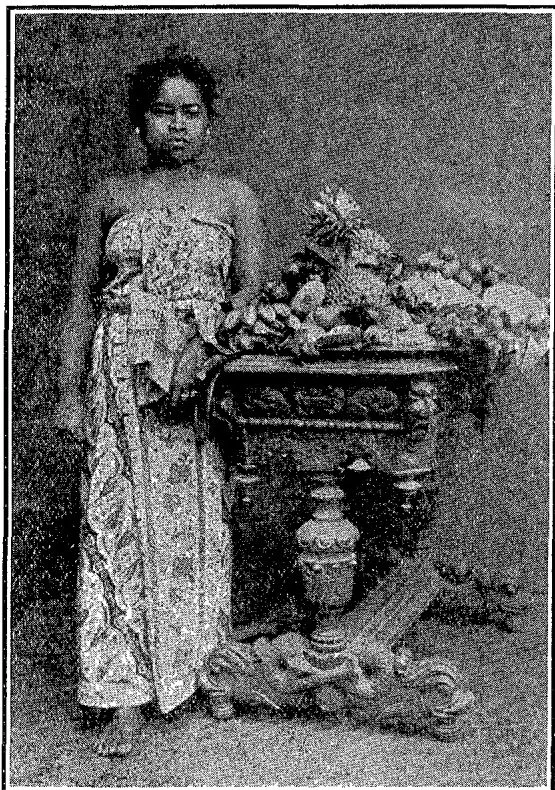
JAVANESE GIRL WITH FRUITS
Many interesting incidents appear on the pages of this report. A colporteur in southern Moravia had some pleasant experiences in visiting factories. One Jewish owner was kind to him, granting him free entrance at any time to sell the Bible to his workmen. He was astonished at the cheapness of the New Testament, and now is himself reading the word of Christ. A young soldier saw, in the little trunk of a comrade, a Bible, to him an unknown book. He wished to get a copy, but as his pay was less than three cents a day, he had no money to spare. Interested friends got him a Bible, and now he is asking to be received into the little church. An atheist painter employed to put on the wall of the meeting-room the motto, “We preach Christ crucified,” was greatly impressed by the words, and is now reading the Scriptures faithfully. The quiet ministry of these heralds of the Word is to be counted among the forces that make for the kingdom over such wide and needy fields.—The Missionary Herald.

South Africa

W. H. ANDERSON
THE night of November 25 my wife was taken with blackwater fever. For two hours she continued to shake in a chill, although we put all the blankets on the bed, and bags of hot water around her. Her whole body then turned yellow. Taking my English medical book, I carefully carried out the instructions for treatment. Fortunately, I had all the remedies called for. The next day I wired to the doctor at Kaloma, asking for advice. He wired back, and advised me to do just what I had been doing for her.
The third day she was very weak. I had no hopes for her recovery. I did everything I could for her, and she revived, and then slept. On Friday I made a mashila, and carried her to the nearest point on the railway, about two and one-half miles distant. Sabbath morning I had her in the hospital at Livingstone. The nurse told me that she thought she was dying when I carried her in and laid her on the bed. During the day she revived, and during the week she grew a little stronger. The next week, on the advice of the doctor, I started for the coast with her. As she was too weak to make the whole journey, I took her to Brother Willson’s place in Kimberley, and left her there. The doctor says that if she does not have a relapse, she has a chance to recover. If she has a relapse, she can not live two days. He has ordered her home as soon as she is able to travel.
As help for this mission, we need a man who can acquire the native language. A man who does not know the language and can not sit down and have heart-to-heart talks with the native can never understand him.
The work here is growing far beyond my power to look after it. I succeeded in getting the two out-stations, and have them going. The last time I visited one of them, there were fully five hundred natives at the Sabbath services in the kraals. I have just heard from the other, and they report an attendance of forty-eight at the Sabbath-school which I organized when there last. We have given them plows and oxen, and they are now busy planting their crops. I will visit them again soon. I have made application for three more stations, and hope to open them as soon as the rains are over. The teachers are here, and we must get them to work.
We are now busy with the planting. We have about sixty acres plowed, and two plows are going all the time. As I had to be away during my wife’s illness, the planting is delayed; but we hope to finish it by the end of the year. Our older trees have made a remarkable growth since I was away. We shall have an abundance of lemons this year, also guavas. I will plant the pineapple plants soon. Everything else is progressing nicely. I have just planted fifteen bushels of potatoes. These are always high here. I received $2.50 a bushel for all I raised last year. I am now selling new potatoes at the same price.
The cattle are doing well. Our entire herd numbers nearly one hundred. The grass is good, and the cows are fat. We now sell about twenty pounds of butter a week, and receive thirty-five cents a pound for it.
Our workers will now have comfortable homes, and should have good health. We have plenty of cattle, fruit, and vegetables, so we can live well.
Pemba, N. W. Rhodesia.

Bahia, Brazil

F. W. SPIES
In a recent article I related how the Sabbath truth had gained its first adherent in Bahia. Though for some time supposing himself the only one in all the world who was obeying the fourth commandment, this brother stood firmly for the light, and tried to teach it to his neighbors and to his brothers and sisters. Then, even after he knew that there were those who kept the Sabbath in other places, three years passed ere he had the pleasure of meeting any one of these of like precious faith. Still he continued faithful. No doubt he, like many others newly come to a knowledge of the truth, saw it all so clearly that he thought all others must see it as easily and accept it as willingly as he had done, and being surprised that people as a rule would not do this, he perhaps at times urged the truth with more zeal than it was best to do, still, when I arrived there, he had gained two other young men to the truth, and his two sisters were somewhat interested in the Sabbath question.
But this brother's life exerted a great influence in that section of Bahia where he lived. Between two and three years ago the Sabbath question was discussed in a lively manner by the members of several Baptist churches, about one hundred miles from where he lived, as a consequence of his having told one member of the Baptist church of the Sabbath. For a time a goodly number seemed favorably inclined toward the Sabbath. One of these—a Baptist—who passed through this experience, and who himself kept the Sabbath for eight months, told me that with their hands the Sabbath question was discussed and studied many a night, sometimes nearly the entire night. But as many of those, like the man just referred to, were not yet strong in the Scriptures, and many could not even read very well, a strong influence exerted in favor of Sunday by the Baptist leaders finally brought all but a few of these back to the observance of Sunday.
Those of the Baptists, only a few of whom, as I was told, were still observing the Sabbath, were so far distant, and the information I could get concerning them was so uncertain, that it seemed wise to enter into correspondence with them, and plan for more definite work among them later, rather than try to visit them at once.
COCOANUT GROVE, BAHIA
As I was told of this Sabbath movement in Bahia, and as I saw the great success a certain denomination is having among the people here, and realized how the people are accepting their antinomian (“no-law”) doctrine, I deeply felt the force of the Testimonies that say we are “years behind” in our work.
What a wonderful victory might have been gained for the truth, if, at that critical moment, an able worker could have helped the honest seekers after truth to find their bearings and to take their stand firmly upon the side of God's holy Sabbath! It would then have been comparatively easy, as then the obligation to obey the commandments was not denied as it is to-day. I could but feel sad that such an opportunity for the truth to gain sheaves for the heavenly garner had been lost, practically lost, for a lack of reapers.
If the burden of the needs of this work could only rest upon all our brethren as heavily as it does upon those who in the far-away mission fields daily see and feel its needs, how different many things would then be! What a consecration of talent to the work of saving souls would we then see—talent that now too often is dedicated to gathering treasures that must soon perish when Jesus shall be revealed in his glory! And what a consecration there would be of means to carry on the work!
At Santo Antonio de Jesus, where Brother Antonio Leoncio, the brother above referred to, lives, I spent about sixteen days endeavoring to instruct these new converts, who needed, and even now still need, much instruction. After being there a few days, the sisters of Brother Antonio fully surrendered to the Lord and his truth, and so on Wednesday, October 2, we repaired to a small river near by, and there buried with their Saviour, in a solemn and impressive service, five willing souls in the watery grave, the first-fruits of this field. May the Lord in his mercy lead them on to perfection, and make them a light whose beams will yet cause many a wandering and sin-sick soul to find the sure haven of rest.
Rio de Janeiro.

Mission Notes

TRAINING leaders has become the watchword of some of the best missionary boards operating in distant lands. It has become a recognized fact that no one is so well fitted to reach the different peoples and tribes as trained preachers and teachers out of these peoples and tribes themselves. Therefore, the investment of our means and best talent to train and educate leaders out of the different tongues to be reached with the truth, will be effort wisely expended. That man who can train ten other men to effectively work for God, is accomplishing much more than the one who undertakes to do himself the work that ten can and should do. The example of Jesus is given us upon this point. He chose out twelve men, whom he trained to become fishers of men. Shall we not pattern after him who accomplished such a stupendous task in the short space of three and one-half brief years?
Of the missionary situation in the Philippines, a bishop laboring there said: “No such opportunity is presented in any foreign mission land to win thousands of the natural leaders of the people as is now before us in Luzon. I am not a zealot, I am not naturally an enthusiast. I think I know fairly accurately the main outlines of every large missionary situation in Asia, Africa, and South America, and I deliberately repeat that the world nowhere presents a parallel to the present situation in Luzon. Korea is nearest it, with the difference that if we had similar conditions with Korea, . . . I think we could easily double her results. This is not a siege, it is not a campaign; it is a harvest-field peculiarly committed to American reapers.” This is the view of one not knowing the blessed truths of the third angel’s message. Ought not such conditions stir to action, and lead some to volunteer, even to a band, to go there and sow and reap for God; teaching these natural leaders of this people the ten commandments, that they in turn may teach others how to become true servants of the Most High?

Mission Report from the South German Conference

Bavaria

NÜRNBERG.— Since my last report to the REVIEW I have changed my field of labor from the Silesian Conference in the German Union to the South German, where I have now labored since the eighteenth of August.
The territorial extent of this conference includes the kingdoms of Bavaria and Württemberg, the grand dukedoms of Baden, Luxemburg, and part of Hesse, and the provinces Alsace and Lorraine, with a population of over thirteen million. The Catholic faith is the dominant faith here, especially in the first- and last-named countries.
These states comprise by far the most picturesque part of the German empire; especially is this so of the Rhein, and upper (Ober) Pfalz in the northern part of Bavaria, and the Alps in the southern, where the highlands of Bavaria, of the Tyrol, and of Switzerland meet. The mountain peaks, covered with eternal snow, are mirrored in many a crystal lake, and these snow-clad giant peaks, in the midday sun, so sparkling and so glittering; often change their snowy white to a rose pink, or even a fiery red, as the eventide advances.
From the first to the fifth of January we had our annual conference session in Nürnberg. Our thirty-three churches and companies were all well represented. The ministering brethren present imparted the word with power and spirit, so that all left the conference refreshed and strengthened, to live better lives for the Lord, and to do more toward the salvation of precious souls than ever before. The conference workers also went back to their respective fields of labor with a greater determination than ever to press the battle to the gates, and to a glorious victory in the Lord.
During the last year the Lord has done wonders for his work in this part of his great harvest-field. Last year at this time we could not have gathered with such liberty as we did during this conference session. Hence our people had special reasons for rejoicing in the Lord, and in the liberty which he gave them. The gospel door is now open in Bavaria. The services held last year in this country had to be held in seclusion or at night, or if allowed at all, could be conducted only under the aspect of a lecture. This year, however, we dare preach as freely as a pastor of the state church.
During August and November of last year I had the opportunity of delivering a series of lectures here in Nürnberg. We had a hall with a seating capacity of one thousand, which was sometimes nearly filled. How pleasant it was to speak to so many eager listeners, without any fear of being apprehended. The Lord was with us, and blessed our humble efforts with a good harvest of souls. We had the pleasure of baptizing twenty-seven, and have hopes of having a goodly number more to baptize during this quarter.
It is really wonderful that the church in Nürnberg stood so steadfast amid all the trials and persecutions which she had to endure. One could almost expect that she would have weakened and dispersed, but instead she kept together, so that when I came here last fall, I found a church of sixty-one members. As the persecution of early Christians could not destroy the churches then, but rather spurred them on to greater zeal and enthusiasm to spread their precious faith, so that the membership increased astonishingly, and soon spread over the entire Roman empire, so it was with our church in Nürnberg, and the churches in Bavaria. The persecution helped rather than hindered; may it always be so. “If God be for us, who can be against us?”
We are now working at seven different places in Bavaria, and have the brightest prospects. Last year we had two hundred seventy additions in the entire conference. With God’s help we shall gain many more this year.
J. H. SCHILLING.
Continue reading: The Manitoba Meeting