WHAT can be more unkind than to communicate our low spirits to others, to go about the world like demons, poisoning the fountains of joy? Have I more light because I have managed to involve those I love in the same gloom as myself? Is it not pleasant to see the sun shining on the mountains, even though we have none of it down in our valley? O, the littleness and the meanness of that sickly appetite for sympathy, which will not let us keep our sorrows to ourselves! Let us hide our pains and sorrows. But, while we hide them, let them also be spurs within us to urge us on to all manner of overflowing kindness and sunny humor to those around us. When the very darkness within us creates a sunshine around us, then has the spirit of Jesus taken possession of our souls.—Frederick Wm. Faber.
Prayer
The daylight breaks! Awake to praise
The Lord thy God with heart and soul,
Nor backward glance,—thy yesterdays
Are gone, and forward lies the goal;
Again for Christ thy banner raise,
As soldier true thy name enroll.
Fierce noonday heat! Discouraged
thou?
Dost falter ere the race be won?
Before the throne still humbly bow,
And pray no good to leave undone;
Then, strengthened, rise to conquer now,
For love of the eternal Son.
At set of sun, ’mid shadows deep,
In earnest prayer to him draw near,
For he his chosen ones doth keep,
His guiding light makes duty clear;
So, take his blessed gift of sleep,
For peace shall soothe thine every fear.
Unceasing pray, so shalt thou learn
The joy all other joys beside;
Then will thy heart within thee burn,
And life in him be sanctified.
If thou shouldst stray, to him return,
In his great love once more abide.
—Selected.
“The Rod of Correction”
By Mrs. M. A. Loper
MRS. M. A. LOPER
DURING recent years there has been much discussion concerning the rod, pro and con, some advocating its necessity, and others its uselessness in establishing the principle of implicit obedience in the heart of the wayward child. But the words of inspiration quoted as the heading of this article, are an expression of one whose wisdom was a special gift of God, and, if rightly understood, need not be the occasion of any controversy. The “rod of correction” is the rod which corrects. It is plucked from the tree of life by the hand of wisdom, and its every stroke is a new manifestation of sympathy and love. It is very different from the rod of destruction so commonly used at the present time. This is a branch from the thorny tree of selfishness, wielded by the hand of tyranny, the result being increased impatience and anger on the part of the parent, and greater stubbornness and rebellion on the part of the child.
“God is love.” And “whom the Lord loveth he chasteneth.” But he chastens in love, and only that we may be enabled to see and to correct our mistakes, and thus be drawn closer and closer to him.
What a difference there is between the “rod of correction,” which tends to bind the child closer to the parent, and the rod of destruction, which separates them farther and farther. The practice of using the rod in anger has become so widespread that there is little wonder that those who see the wickedness of such a carnal weapon should also see the imperative necessity of its discontinuance. Since God chastens us only in love, the Christian will follow the divine principle in dealing with the lambs of the flock.
But God does not chasten all his children alike, nor does he deal alike with the same offense in different individuals. He gives just the experience needed in every case, that the best opportunity possible may be afforded to perfect the soul for heaven. So the Christian will seek for wisdom from above to know just how to deal with every mistake on the part of the child, so that it may be properly realized and finally overcome. This will require communion with God through the study of his Word, and through frequent and earnest prayer. Every trace of anger, impatience, and retaliation must be put away, while sympathy and pitying love so fill the heart of the parent that whatever mode of correction he may be impelled by the Spirit of God to administer, will wound his own heart deeper than that of the child. He will never seize upon the rod when a few loving words of counsel will better accomplish the purpose. On the other hand, he will not refuse to take the rod of correction in his hand when the Holy Spirit impresses him that it is for the salvation of the child. But, O how many needless whippings are administered by those who have never yet learned to govern themselves, but who seem to find comfort in resorting to this extreme measure upon the slightest provocation?
How many children are compelled to dwell in an atmosphere that from morning till night reverberates with muttering tones of impatience and thunderclaps of impending punishment! They become so accustomed to such expressions as, “I’ll whip you,” or, “I’ll punish you,” that they live in constant fear, and may obey outwardly for a time, simply to escape the consequences of doing otherwise; or, perhaps they may be driven to resort to falsehood, to avoid the inevitable whipping.
The incorrigibility of many a child whose parents “have whipped him and whipped him,” is not such a puzzling problem after all, as is the conduct of the parents in wielding the rod of destruction. It is so productive of evil consequences that it only establishes the child more firmly in his downward tendencies. Therefore, if you are not positive that the rod which you have been accustomed to wield is the “rod of correction” of which the Bible speaks, you may well expect that your efforts will prove futile; that “the remedy will be worse than the disease.” O that the hand of impatience and anger might be turned away forever from Christ’s little ones! “Inasmuch as ye have done it unto one of the least of these my brethren, ye have done it unto me.”
Let us as parents look well to ourselves, lest our administration of punishment be a greater sin in the sight of heaven than is the offense on the part of the child. The needless whipping done in an impetuous moment is in direct opposition to the divine command, “Provoke not your children to wrath: but bring them up in the nurture and admonition of the Lord.”
If we as parents will only permit Christ to live his life in us before our children, we may be happily surprised at the infrequency of the need of even the “rod of correction,” and at the little punishment of any kind that will be found necessary to the salvation of the precious souls intrusted to our care.
Who Healeth All Thy Diseases
By D. H. KRESS, M. D.
D. H. KRESS, M. D.
“If any man speak, let him speak as the oracles of God; if any man minister, let him do it as of the ability which God giveth: that God in all things may be glorified through Jesus Christ.” There is a most wonderful and intimate relation between God and man, between the visible and the invisible.
God works through human instrumentalities. Human tongues, trained and tamed by the Spirit of God, speak forth his praises, and are used by him in proclaiming the good news of man’s redemption, and in making known God’s love. Human hands are employed by heavenly agencies in ministering to the sick, in supplying the needs of the fatherless and widows. Human agents stand as visible instruments to confer God’s blessings upon men. Human tongues bring comfort to those who are cast down. Hands that can be seen and felt are laid upon the sick, and are otherwise employed in the work of the ministry.
To the impotent man who was laid daily at the gate of the temple to ask alms, Peter said, “Silver and gold have I none; but such as I have give I thee: In the name of Jesus Christ of Nazareth rise up and walk. And he took him by the right hand, and lifted him up: and immediately his feet and ankle bones received strength.” A human tongue was needed to speak the life-giving word, and human hands were employed in lifting the impotent to his feet.
At Joppa, Dorcas, a woman “full of good works and almsdeeds,” had died. Peter was notified. When he arrived, he entered the upper chamber, and after putting them all forth, “kneeled down, and prayed; and turning him to the body said, Tabitha, arise. And she opened her eyes: and when she saw Peter, she sat up. And he gave her his hand, and lifted her up, and when he had called the saints and widows, presented her alive.”
“Yield yourselves unto God, as those that are alive from the dead, and your members as instruments of righteousness unto God.” “For we are laborers together13with God.” “Now then we are ambassadors for Christ, as though God did beseech you by us: we pray you in Christ’s stead, be ye reconciled to God.” The tongue that God employs to beseech people to be reconciled to him, is my tongue. The hand he stretches forth in blessing, is my hand. The man who recognizes and acknowledges this in his daily life has true faith—a saving faith.
There is a faith that has become quite popular. It acts as an opiate to those who possess it. It does not lead them to stretch forth their hands to satisfy humanity’s needs. The one who possesses it does not acknowledge that the silver and gold are God’s, neither does he consider himself God’s steward, and his hands, God’s hands.
James, in speaking of this delusion, says: “If a brother or sister be naked, and destitute of daily food, and one of you say unto them, Depart in peace, be ye warmed and filled; notwithstanding ye give them not those things which are needful to the body; what doth it profit? . . . Thou believest that there is one God; thou doest well: the devils also believe, and tremble.”
God supplies the needs of the poor. Abundant provision has been made for all, that suffering need not exist. But he says to those who have food, “Give ye them to eat.” “Deal thy bread to the hungry.” To those who have no homes he says, “Bring the poor that are cast out to thy house,” “let mine outcasts dwell with thee; . . . be thou a covert to them from the face of the spoiler.” “A father of the fatherless, and a judge of the widows, is God in his holy habitation. God setteth the solitary in families.” Ps. 68:5, 6. “When thou seest the naked, . . . cover him; and . . . hide not thyself from thine own flesh.” A blessing is in it. “Then shall thy light break forth as the morning, and thine health shall spring forth speedily.” “In blessing I will bless thee.”
In order to receive the benefit of electricity in the treatment of disease, it is necessary to form a circuit; it is necessary to be in touch with both electrodes. With the positive electrode in one hand and the negative in the other, the current flows through the body. Simply taking hold with one hand on the throne of grace, delighting to approach unto God in prayer, will not bring his blessing. Let the other hand take hold of some poor suffering one, and at once the circuit is formed, God’s blessing flows to the needy one. Thus in stretching forth the hand to bless, we are blessed. While we are unconsciously engaged in restoring others, God’s vital, life-giving current flows through the diseased body and mind, restoring them to health.
Thousands who are perishing physically and spiritually would have physical and spiritual health if they would only put forth an effort to help some one who is in need of the help they could give. Thinking of our ills will never help us. “Is it not to deal thy bread to the hungry, and that thou bring the poor that are cast out to thy house? when thou seest the naked, that thou cover him? . . . Then shall thy light break forth as the morning, and thine health shall spring forth speedily.” “For I am the Lord that healeth thee.” This is God’s way of healing. “In blessing [others] I will bless thee.”
Many a church that is apparently dead would receive new life should its members follow out the directions given in Isaiah 58.
The Causes of Colds
By C. H. Shepard, M. D.
In looking for the cause of colds, or of any other disease, it is well to consider the first cause, rather than the merely exciting or secondary one, which is only incidental to the disturbance. By doing this we can so shape our life as to avoid most of the disasters common to modern civilization. Ignorance of the laws of life, and of man’s relation thereto, makes of him a slave, while knowledge of these laws gives him freedom instantly to accept and enjoy the fruits of obedience.
The invariable cause of colds comes from within, not without. No one takes cold when in a vigorous state of health, with pure blood coursing through his body; and there is no good reason why any one in ordinary health should have a cold. It may come from insufficient exercise, breathing of foul air, want of wholesome food, excess of food, lack of bathing, etc., but always from some violation of the plain laws of health.
There can be no more prolific cause of colds than highly seasoned foods, as well as frequent eating. These give no time for the digestive organs to rest, and incite an increased flow of the digestive secretions. Thus larger quantities of nourishment are absorbed than can be properly utilized, and the result is an obstruction, commonly called a “cold,” which is simply an effort of the system to expel the useless material. Properly speaking, it is self-poisoning, due to an incapability of the organism to regulate and compensate for the disturbance.
A deficient supply of pure air to the lungs is not only a strong predisposing cause of colds, but a prolific source of much graver conditions. Pure air and exercise are necessary to prepare the system for the assimilation of nutriment; for without them there can be no vigorous health. The oxygen of the air we breathe regulates the appetite as well as the nutriment that is built up in the system.
The safest and best way to avoid colds is to sleep in a room with the windows wide open, and to remain out of doors every day, no matter what may be the weather, for at least two hours, preferably with some kind of exercise, if no more than walking. One should not sit down to rest while the feet are wet or the clothing damp. A person may go with the clothing wet through to the skin, all day, if he but keep moving. Exercise keeps up the circulation, and that prevents taking cold.
The physiological cure of colds is the prevention of their occurrence. The person who does not carry about an over-supply of alimentation in his system, and furthermore secures a purified circulation by strict sanitary cleanliness, thus placing himself in a positive condition, is immune to colds. A starving man cannot take cold.
A careful diet would exclude the use of all narcotics, and of all food that is not thoroughly appropriated. An overfed person is worse off than one who is underfed, because the overfed body is taxed to dispose of what cannot be appropriated, and when not properly disposed of, remains only to be an element of danger.
The primary cause of all disease is internal. No disease develops in the body from any accidental or secondary cause without the co-operation of the fundamental one. Health is the harmonious action of all the functions. There is no doubt that the larger amount of disease comes from unsuitable food, producing abnormal conditions of the blood. Too frequently there is a wrong selection of food, and often an imperfect preparation of that which of itself is good.
Inasmuch as people are more inclined to cater to the taste and fancy than to consider the hygienic value of their foods, the result of their feeding is sure to produce a state of inharmony. The blood cannot thus be furnished with the proper elements for forming healthy tissue. Man does not live by what he eats, but by what he digests and appropriates. Health is man’s normal condition. No ache or pain should trouble any human being until death comes naturally at the end of a long life. If this desideratum is not secured, there is evidently some mistake in the dietetic habits.
Frequently the body is pickled with common salt, which is equivalent to saying it is poisoned by it. The salt dissolved in the blood passes into all the tissues. Osmosis takes place. Through the cell membranes the salt enters the cells, and the cell contents pass out. These constituents, freed from the tissues, must be excreted through the kidneys as waste material. Thus degeneration takes place, through the abuse of common salt, and the system is made more susceptible to colds.
The practice of administering quinine to break up a cold is to be condemned, because it debilitates the nervous system and weakens the action of the heart. The same may be said of any alcoholic medicament, because the nervous system is first irritated and afterward depressed by its use. In fact, when the system is laboring in an effort to free itself from any obstruction, the presentation of a powerful agent that interferes with elimination is not only uncalled for, but decidedly injurious, because it prevents the natural forces from doing their perfect work.
When people understand that disease is a vital struggle, an effort to protect and defend the organism, that it is not a thing, or entity, foreign to the system, but an action of the system itself, which seeks its preservation, not its destruction, they will cease to fear it; they will fear only its cause.—C. H. Shepard, M. D.
I. D. RICHARDSON
By I. D. Richardson
Kashmir
I. D. RICHARDSON
KASHMIR is a beautiful country far to the northwest of the Indian peninsula. One hundred miles beyond the Indian border is the attractive city of Srinagar, which lies at the eastern extremity of a beautiful table-land, thirty-two miles long and twenty miles wide, through which flows the Jhelam River. This table-land is five thousand feet in elevation, and surrounded by mountains from six thousand to nine thousand feet high.
To reach the plains of Kashmir we pass over a range of mountains having an altitude of nine thousand feet, down into the valley of the Jhelam River, then across the line into Kashmir; there we follow the river over the cascades toward its source, which is beyond the table-land in another range.
THE BEAUTIFUL VALE OF KASHMIR
At the entrance of the Kashmir plains we come out from behind a mountain, and a most charming scene lies before us. A row of beautiful poplar trees, tall and stately, stands horizontal to the road. Four or five trees are missing where the road passes through, which gives the appearance of entering through a wall into the country beyond. After passing this, as far as the eye can reach we see the trees on either side of the road only four or five feet apart. These extend thirty-two miles, to the city of Srinagar, which is the seat of the Kashmir government. In the city itself these trees are in perfect rows, forming avenues. There is another variety which adds greatly to the attractiveness of the place—the beautiful chinar trees. These trees very closely resemble our maple, only the leaves are much larger and the foliage more dense, while the trunk is from five to seven feet in diameter.
The dwellings in Srinagar are not numerous, as the city is located on the Jhelam River, and is surrounded by a number of beautiful lakes, so that visitors usually prefer to live in house-boats or tents rather than in houses. Each house-boat has a small rowboat, which is generally propelled by three or four men, and thus one can go about the place by water, or out on the lakes when he chooses. When a boat dweller gets tired of one place and its scenery, he can float away to another.
Goolmerg is another station, about thirty miles away, in a much higher altitude, having an elevation of eight thousand feet. To this place visitors resort when it becomes too warm in Srinagar, living in tents, and spending much of their time in hunting such wild game as is found in these mountains.
The country of Kashmir is famous for its beautiful scenery. Many of the officials of the British Indian government spend the hot months of June, July, and August in this delightful climate, to get out of the “oven,” as the plains of India are called, where, about the middle of June, the mercury often rises to one hundred and fifty degrees in the sun.
The country is governed by a maharaja (native king) and his brother, who is also a rajah, or chief. A British resident in Srinagar represents the British Indian government. Besides other visitors, those among the missionaries who can afford it, retire to this delightful place where the temperature seldom exceeds ninety degrees, to gain a little relief from the hot plains below.
Having learned that there were many Europeans in Kashmir during the hot season, as well as a few who made it their home, I thought it might be a good place in which to spend a few weeks selling our publications. So, as the hot season on the plains advanced, and my territory there was pretty well canvassed and books delivered, I secured the cheapest tonga passage, and set out for Kashmir, a distance of two hundred miles from Rawalpindi, where I was then stopping. Over the rocky steeps we rode for two long days.
The conveyance called a tonga is a two-wheeled, two-seated cart-like vehicle, with a strong canvas top, to protect from sun and rain. The seats are cushioned, and have comfortable backs, or rather, a comfortable back, as the seats are joined, one facing forward and the other backward, one back serving for both. This carries three passengers and the driver. It is drawn by two small horses, which are exchanged for a fresh team every four or six miles. In this way we travel quite rapidly all day.
Upon landing in Srinagar, I found a crowd of men awaiting the arrival of the tonga, and each one wanted me to hire his boat. After some discussion, I took a small house-boat, or donga, with four men, giving them six dollars for one month. One of the men did my cooking and looked after things in general, while the other three rowed me about wherever I wished to go. However, I did not spend much time at first looking around, as I was anxious to visit the people with the books, “Great Controversy,” “Patriarchs and Prophets,” “Ladies’ Guide,” and “Man the Masterpiece.” I soon discovered that there were fewer Europeans in the city than I had supposed, so it was not long until I had visited them all. Then, while waiting a few days for the arrival of the books for which orders had been taken, I thought it would be well to look about and see what the prospects were for doing work among the natives.
Upon inquiry I found that they were quite a sturdy class of people, firmly settled in their own religion, and desiring no other; yet occasionally one is brought to acknowledge and obey the true God as fully as he is taught by the missionary. These people are of a reflective nature, and desire a clear and complete reason that Christianity is the true religion. Who is better able to give this reason than the people who believe in the soon return of the Christian’s Prophet? There is nothing more convincing that Jesus is the true Prophet and Saviour of the world than are the prophecies of Christ relative to the things which are occurring in the world to-day. The people of this far-away land see what is taking place, and wonder what it all means. Now is the time to sow the seed in Kashmir, before the great calamity of war reaches that place, as well as other Eastern countries.
This is a good field for many all-round workers, especially medical workers, since about the only way we can reach the hearts of the people is by ministering to their physical needs. While in this place I was invited by Dr. Neaves to visit a hospital which he and his brother, also a physician, had established, solely for the natives. The hospital is quite extensive, and many hundreds have been15treated, and some converted. These physicians are Church of England missionaries, and they told me that their hospital was the only one for many miles around, and probably the only one in the country, as the people came scores of miles to receive treatment. So there is room for more workers here. The climate being very temperate, and the needs very great in this place, there surely should be some one whom God is calling to Kashmir, for the sake of those for whom Jesus died who are willing to obey when taught.
May the Lord of the harvest send forth more laborers into the far East. As God calls for volunteers, may he hear many say, “Here am I; send me.”
The German Union Conference
The Friedensau meeting was the largest of any held in Europe during this season. About six hundred were present, representing twenty-two nationalities. The meeting convened July 18–28. The second Sabbath was a day that will long be remembered by those who were present from abroad. A social meeting was held, during which the brethren and sisters from the different countries were given an opportunity to express themselves either in sacred song or by bearing testimony. The effect was truly encouraging and inspiring.
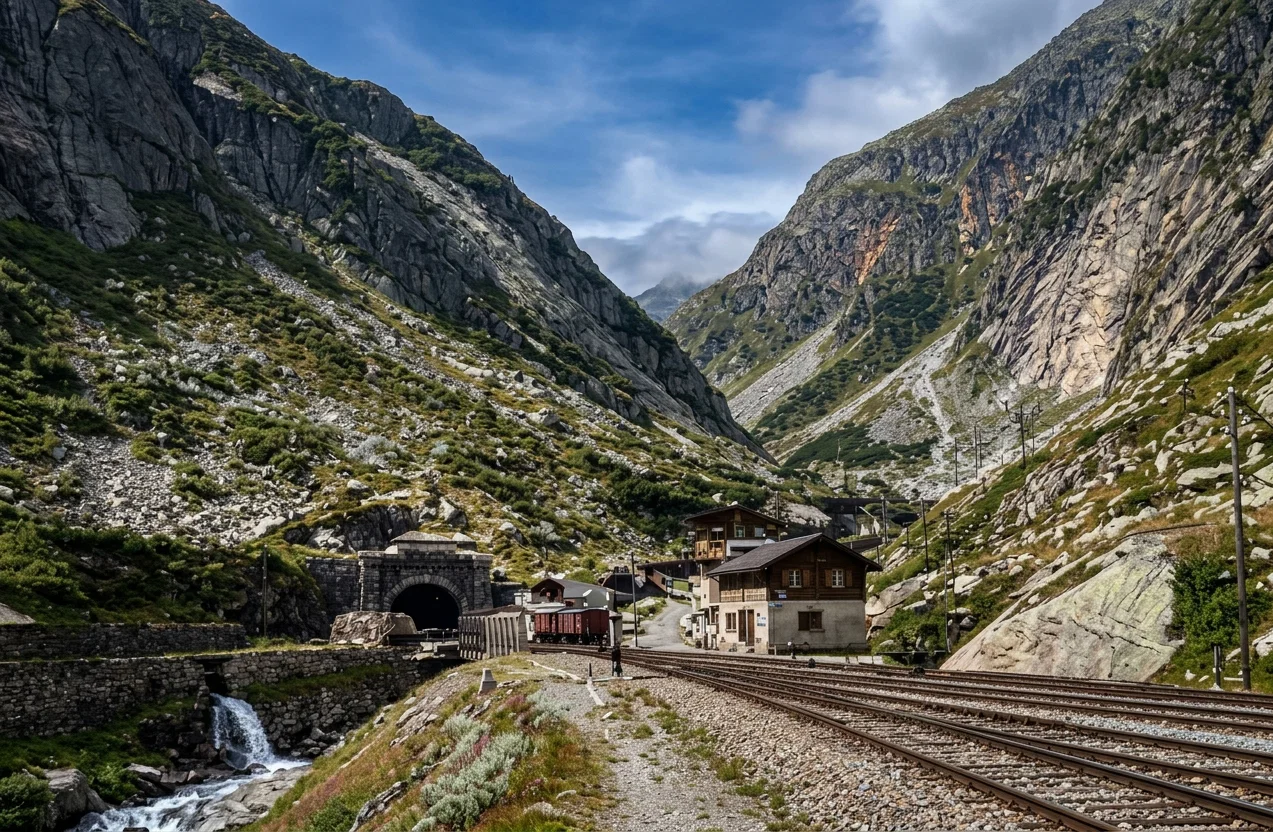
ENTRANCE TO TUNNEL, ST. GOTTHARD PASS
It was recommended that the union conference collect the necessary means to assist in publishing a new edition of “Christ’s Object Lessons,” and that all in the field be encouraged to sell at least five copies of this book per capita, for the support of the school. Arrangements were made to employ teachers in the different languages, in order to help the foreign brethren in their school work. It was voted to establish a small bath room in the city of Cassel, and headquarters for nurses in Berlin, as soon as the means and laborers can be secured.
For the further development of the work in the Austro-Hungarian and Balkan States mission, it was recommended that the territory be divided into the Balkan mission, the Hungarian mission, and the Austrian mission. For this same reason, it was recommended that the Rhenish-Prussian field be separated from the West German Conference.
Besides encouraging the development of different phases of the work in their own field, plans were laid at the German Union Conference to reach outside of the German empire into some of its colonies, which are practically mission fields; and it was recommended that steps be taken to secure permission from the German government to begin work in German East Africa as soon as the proper men and means can be secured.
In connection with the Friedensau meeting, a number of sessions of the European General Conference Committee were held. The visiting brethren from America were present, in these councils, and took an active part. As they had just been visiting different parts of the field and studying the situation and the needs and openings, their counsel was valuable.
The financial problems confronting the European field were thoroughly canvassed, and the committee representing the respective local union fields made a careful estimate of the probable income and expenses of each conference or mission for the coming year, and requests were forwarded to the Mission Board for appropriations to cover these amounts.
The enterprises to be thus aided are the Scandinavian Union Conference, Oriental mission, German Union Conference, British Union Conference, the mission building in Copenhagen, International Tract Society in Helsingfors, Finland; the Finnish paper, a health food factory in Skodsborg, a sanitarium in the British field, the training school in London for Christian workers, and the mission to be opened in German East Africa.
The treasurer’s report submitted at this meeting showed the total receipts of the General Conference during the nine months ending June 30, 1902, to be $1,561.36; paid out for general expenses, $1,237.20; with a net gain of $324.16.
Several actions were taken recommending the importation of additional laborers in the near future. Among these were an experienced laborer for the Italian mission field, a suitable man for Spain at once, a man and his wife for Portugal, a man to develop the publishing work in the French-Latin field, a superintendent for the Turkish mission field, and suitable medical help for Egypt. Help was also requested for Denmark, the German Union Conference, Scotland, Ireland, Wales, and England. Request was also made for a missionary physician in the French field.
Several recommendations were passed tending to strengthen the publishing interests. The medical work received consideration, and it was recommended that a small health paper and some tracts be published in the Arabic language, and that the French medical work be transferred from Basel to some proper place16in the French field, and that treatment rooms be established as the way opens in several of the large cities of Germany.
In view of the vast population of the British field, its importance as a missionary center, and the rapid development of the work, it was recommended that the British Conference be reorganized as follows: That Ireland, Scotland, and Wales constitute separate mission fields; that England be divided into two conferences, known as the North England and the South England Conference, and that a British Union Conference be organized to take the general oversight of the entire field.
The British Conference
AN ENGLISH VILLAGE STREET
Following the Friedensau gathering and the good experience of our people there, came the annual meeting of the British Conference, which was held in Leeds, Aug. 1–8, 1902. A good spirit prevailed, and the business passed off harmoniously.
Among the different subjects considered was the sale of “Christ’s Object Lessons,” which is to be vigorously pushed, to assist in establishing the school in London. Steps were taken to unify and strengthen the canvassing work in this field. The Sabbath schools were also encouraged to liberality in giving for the new mission fields, the Sabbath-school donations being recognized as mission funds.
A recommendation was passed expressing appreciation for the generosity of the conferences in the States that had so kindly supplied canvassers and paid their transportation to the British field, and asking that at least ten more canvassers as good as those who had already been sent to the field be selected and sent over on the same generous terms as the first party.
The treasurer’s report for the year showed that the total receipts of the conference were £3,000, while the expenditures amounted to £455 in excess of this, the deficit being met by appropriations from the Mission Board through the European General Conference. The book sales for the same time amounted to £1,486.
The work in Europe has certainly advanced rapidly, and the Lord is going out before his people. While the future is to us unknown, yet we go forward with a firm trust in the overruling power of God, and a belief in the conquering might of truth, which is bound to triumph in the end. There is reason for nothing but the best of courage concerning the cause in this field.
Other Conferences in Europe
By GUY DAIL
GUY DAIL,
Cor. Sec. European General Conference
The annual meeting of the Central European Conference was held in Geneva, Switzerland, during the first five days of July. The general attendance was quite good, and crowds from the outside came on the grounds evening after evening to hear the word. In view of the difficulties attendant upon managing so large a field as that embraced in the territory of the French-Latin Union Conference, it was decided more thoroughly to organize it, and divide it into one conference and three mission fields, as follows: The French-speaking part of Switzerland will compose the French-Swiss Conference; France and the French-speaking part of Belgium, the French mission; Italy and Spain will be organized as separate mission fields, as soon as circumstances permit.
To provide for the support of this field, the greater part of which is mission territory, it was recommended that the funds be drawn from the tithe of the tithe of the local conferences, the tithe of the mission fields, the Sabbath-school offerings, and all the general offerings and appropriations made by the Mission Board through the European General Conference. All these conferences and missions will pay a tithe to the European General Conference. The money to begin the work in these new missions will be drawn from the proceeds of the sale of the Basel property, of which sixty per cent will go to the French-Latin field, and forty per cent to the German Union Conference. Of the sixty per cent going to the French-Latin field, fifteen per cent will go to the French-Swiss Conference, and forty-five per cent to the Latin mission field, which is composed of Italy, France, French-speaking Belgium, Spain, Portugal, and Algeria.
Arrangements were made by which Les Signes des Temps will be better adapted to the needs of the French people, as well as to the wants of French Switzerland. This will be accomplished by devoting two or three pages to local matters concerning France in the French edition, this being replaced by the same number of pages of local Swiss matters in the Swiss edition.
Africa and the Closing Message
THE providence which kept the great heart of the continent of Africa veiled until the closing message was due to the world must impress every thoughtful mind with the work yet intrusted to us, which must precede the coming of our Lord.
The Primary Duty of the Church
“LET it not be forgotten that the work of missions is the primary and paramount duty of the church. It stands in the first rank of all the tasks we have to fulfill. It is not an accident, nor an incident; it is the very essence of New Testament Christianity.”
Christ Has Come; Christ Will Come
“We have a double witness to bear in the midst of this as of every generation. One half of the witness stretches backward to the cross, and proclaims, ‘Christ has come;’ the other reaches onward to the throne, and proclaims, ‘Christ will come.’ Between these two high, uplifted piers swings the chain of the world’s history, which closes with the return, to judge and to save, of the Lord who came to die, and has gone to prepare a place for us.”