Love for self, sympathy for self, activity for self, do not produce life or the sense of life. No vivid or exalted sense of individual being can ever fill the heart of man until he escape from the curse of self-involvement, and spread his being over all the world.—Stopford A. Brooke.
First-Fruits From German East Africa
By GUY DAIL
GUY DAIL
Our mission to German East Africa was opened in the autumn of 1903 by Elder W. Ehlers and Brother Enns, in the Pare Mountains. We now have three stations there,—at Kihuiro, Friedenstal, and Vuasu. Brother and Sister Ohme, Brother and Sister Langholf, Brother Enns, Brother Kotz, Brother Sander, and Sister Eiholtz are laboring in this field.
The people were rude savages when the mission was begun among them. They had no written language. They had none of the arts of civilization. They were without God, and without hope in the world. Our missionaries came; they settled among these heathen people; they opened schools; they taught them the gospel; they labored to sow the seed, watering it with their tears, trusting God to give the increase. bands of heathenism were strong, and often it seemed a hopeless task to attempt to break them. Satan was never at rest, for he did not desire to lose any of his subjects. He inflamed the relatives of those who were disposed to listen to the gospel. He circulated lies among the native huts, to stir up the people against the missionaries and their work. He made their heathen rites and ceremonies, their dances and incantations, appear very pleasing and desirable to them. And yet, April 4, 1908, six natives were baptized. Brother Kotz writes as follows, freely translated:—
“Eight candidates for baptism presented themselves for examination Friday evening. Two of these were advised to wait for a time, as they seemed to need more instruction in the principles of the Scriptures, although we do not doubt their sincerity, and we hope they may be ready for baptism in three months. Sabbath, we baptized six young men,—one, Davidi Mazumba, of Friedenstal; and five of Kihuiro: Abirahamu Salimu, Yohana Kajembe, Anderea Senamwaye, Filipo Mbago, and Lazaro Omali.
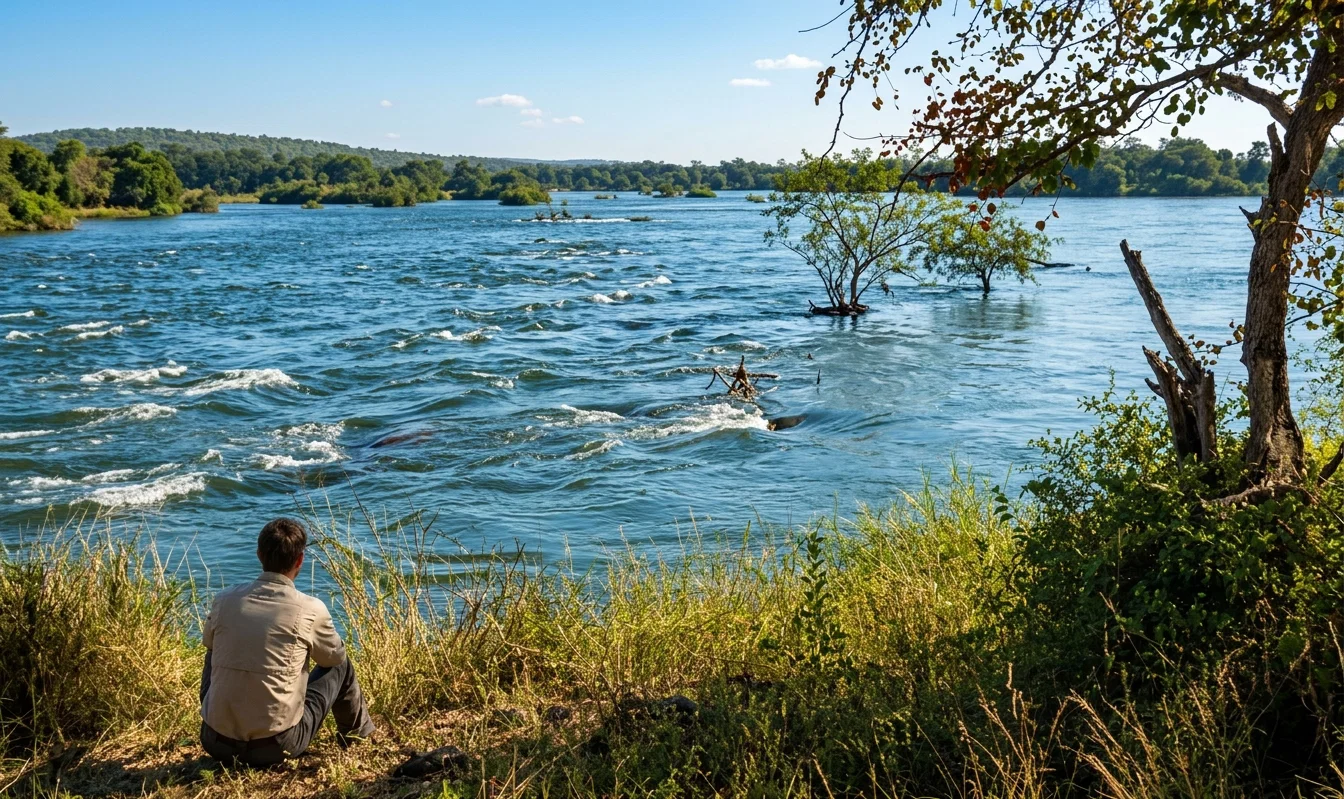
THE ZAMBESI RIVER ABOVE THE FALLS
“The chapel was nicely decorated with palms. We had an interesting meeting, where I first called attention to the saving power of the gospel, as revealed in Rom. 1:19, and once more explained to them the meaning of baptism. Then all proceeded to the neighboring Sasseni River. On the way some of the women sought to persuade one of the candidates not to be baptized, crying aloud that the child would be lost. But we replied, ‘Not lost, but saved.’ However, they still insisted that this was no salvation.
“We had pitched a tent on the river bank, and the pupils sang, ‘Come, Holy Spirit,’ in the native tongue. Several hundred persons had assembled on both sides of the stream to witness the awful things that they had heard would take place at the baptism. Then Brother Ohme baptized the six young men in the river. Each of us could but say in our heart: ‘O taste and see that the Lord is good.’
“The ceremony made a deep impression14upon those who were present,—upon the heathen as well as upon the Mohammedans,—and it will now be seen that the many evil reports about baptism were groundless. ‘Whoever is baptized, and then sins, must die;’ ‘those that are baptized must eat serpents and crows;’ ‘you will be bewitched;’ ‘they will take you off with them to Germany;’ and many more such foolish things were told the candidates for baptism, to intimidate them, so that they would draw back. . . . In the evening we had the Lord’s supper, and celebrated the ordinances together.”
We are glad for this good report from German East Africa. We desire to thank all our brethren and sisters who have remembered our missionaries in this heathen land, either by their gifts, or in prayer, and we hope many more souls may yet be gathered out from among the sons of Ham, in the Dark Continent.
Hamburg, Germany.
Annual Meeting in Chile
N. Z. TOWN
FEBRUARY 4, Elder J. W. Westphal and the writer left Buenos Aires en route for Chile, he to attend the annual meeting to be held in Santiago, February 22-28, and I to audit the conference and tract society books. We had an enjoyable, although at times rather exciting, trip over the Andes, arriving at our destination on the morning of the sixth. We were cordially received at the home of Brother Wm. Steele in Espejo, where our brethren in Chile have established their printing plant and conference office. We found the workers in Chile full of courage, and pushing the good work ahead vigorously.
Chile was fortunate this year in having its general meeting just before the South American Union Conference in Argentina, as the delegates from Bolivia, Ecuador, and Peru must pass through Chile on their way. When we arrived in Santiago we found Brother Ed. W. Thomann and wife already there from Bolivia, and soon after Brother F. L. Perry from Peru, and Brother G. W. Casebeer from Ecuador arrived. All these brethren rendered valuable help in the meeting. The Lord blessed in the deliberations of the conference, and there was perfect harmony throughout.
Recommendations were passed that we express our gratitude to God for his blessing on the work during the past year; that students be encouraged to attend the school in Pua; that the canvassers imitate the self-denial and devotion of those who led out in this branch of the work in these fields; that the South American Union be asked to supply a good general agent for the book work in Chile; that efforts be made to get every family and believer in Chile to subscribe for the Revista Adventista; that new converts be well instructed in all points of the faith before being admitted as church-members; that our people be faithful in the payment of tithes; that the brethren help to pay the indebtedness of the printing plant; that the school building fund be increased; that each local church start a poor fund, and that a tithe of these funds be paid to the conference for a general poor fund; and that the Chile Conference put its laborers at the disposal of the South American Union Conference.
The brethren took a lively interest in the discussion of these recommendations. When they came to those in regard to helping the printing plant and the school, about two thousand dollars, paper, was given and promised for these enterprises. The spirit as well as the letter of the last recommendation, was very much appreciated in the Union meeting, when calls came in for workers from other fields. In answer to these calls Chile gave up two of her best canvassers, one for Bolivia and one for Ecuador.
The yearly report of the president showed an increase of seventy-two members during the year, and also a gain in the tithe of fourteen hundred dollars, paper. Elder F. H. Westphal was elected president for the coming year, and Brother Steele secretary and treasurer. At the close of the meeting seventeen souls were baptized.
Personally I received rich blessings in this my first trip to Chile. It does one good to become acquainted with the work and workers in other fields, and to learn how they meet and overcome the difficulties by the way. The work in Chile has suffered serious losses through earthquake and fire, but it is now going ahead stronger than ever.
Itinerating Among the Santals, India
By W. A. BARLOW
W. A. BARLOW
From the point of view of locality, three spheres of the missionary’s influence may be recognized: (1) the central station, with its church, training-schools, dispensary, and perhaps hospital; (2) “the regions round about,”—the district extending for a distance of four or five miles on every side of the station, with villages whose schools may be superintended from headquarters, and which the evangelists can visit regularly at all seasons, returning to their homes in the evening; (3) “the regions beyond,” where may be a few outstations, which the missionary visits as often as he can. The last is the sphere of the itinerating missionary. Early in the cold season, perhaps in November, in two bullock-carts he packs a tent or two and some simple remedies for the sick and a good supply of the Scriptures and of tracts for sale and free circulation, and sends them off on a ten- or twelve-mile march to the first encampment. There a spot is chosen where a few shady trees will serve as a kitchen and stable, and where there is a convenient supply of water, and the tents are pitched. Here the missionary and his co-workers (Santal preachers and others) remain till they have visited all the villages within reach. This may mean two or three days or a week or more, according to whether it is a district where villages are plentiful. The mornings are probably devoted to medical and other work, and the afternoons to village preaching. The Santals are themselves a healthy people, but news of a medical missionary—or daktar sahib—draws a crowd from far and near, of every race, creed, and class. In a thickly populated district, the camp may be besieged from morning to night by a multitude of the sick and suffering. They are often a pitiful sight, victims of lifelong starvation or disease, who come in the vain hope that a few doses of medicine will relieve their sufferings.
On the other hand the doctor’s heart is often cheered by finding cases where the proper treatment does untold good. It is astonishing how much misery may be relieved, in any village in India, by the proper use of the simple treatments. In camp, dispensing to the sick, the missionary is the object of attack; in the villages he assumes the offensive. Most Santal villages consist of one long, straggling street, each hut being surrounded by a cultivated plot. There are no back closets to explore, no stairs to climb. Each house is surrounded by a courtyard, with something like the sanctity attached to a bedroom in a European establishment. We may visit a few houses to intimate our arrival; or if the village is small,—and a village here is anything from a single house upward,—we may go literally from house to house. But as a rule our meetings are held in the street, the favorite gathering place being the marghi thar, or village temple, with its raised floor and thatched roof; or the village smithy; or the oil-press, which, like the smithy, is nearly always at the foot of a fine, shady tree. A bed is almost invariably provided, as an act of courtesy, for the sahib to sit on. The preaching is chiefly conversational, and the people are as a rule eager to talk about everything except the one thing we have come to speak about. Often a hymn is sung, and it is always appreciated, especially if set to one of their own tunes. Sick ones are seen and prescribed for, the people are invited to come to camp for further information, and a move is made to the next village. In this way three or four villages may be visited in an afternoon.
It is not an uncommon thing to find a whole village apparently deserted. The men are away hunting, and in their absence the women are hiding. But the men, on their return in the evening, hear all about the visit of the preachers, and however indifferent they are to religion, they are pleased to know that they are not being neglected. Almost any day a Santal will present himself at the station dispensary, and introduce himself as belonging to “the village you visited during the former camping season;” perhaps he will say, “you visited our village a day just after the rice harvest; it was full moon, and we were all away hunting—don’t you remember?” On the strength of that visit one, or two, or three years before, he expects you to take a particular interest in his case, and to prescribe the very best treatments or simple remedies. On returning to camp, there is probably a small crowd of sick to attend to. Sometimes a magic-lantern meeting is held after sunset under a shady tree, and in all cases evening service (worship) with our native Christian helpers and others who may attend. This brings the day’s work to a close.
In the delightful Indian cold season, when the earth has not quite lost the freshness of the rainy season, camp life is in ordinary circumstances an exceedingly pleasant one. The daily change of scene, the variety of work, the active outdoor exercise, the sense of elbow room, of freedom, and unconventionality, and the abundant opportunities of doing good every day and all day long,—these are stimulating to mind and body alike. The occasional discomforts which have to be endured when the weather is bad, or a bivouac has to be made on the bosom of mother earth, would be lightly thought of if they occurred in the course of a picnic at home.
The routine of camp work is occasionally varied by a visit to a country fair or weekly market, where crowds of villagers gather to sell their produce or to exchange it for cloth, salt, oil, ornaments, brass vessels or other commodities. These markets, where buying and selling are the order of the day, and a good deal of money is in circulation, afford our best opportunities for selling the Scriptures and other religious books and tracts.
Such is the general outline of a Santal missionary’s work. Of course it varies greatly according to circumstances. Under the pressure of necessity, or owing to special gifts and opportunities, one man’s work may develop more particularly in one direction and less in another. But all the work here described is represented at the mission stations.
Babalmohol, Simultala, E. I. R.
West Africa
By D. C. BABCOCK
D. C. BABCOCK
ON the morning of Oct. 14, 1907, my wife and I arrived at our home in Sierra Leone, after an absence down the coast of more than two months. The trip proved quite a help to us healthwise, and we were thus prepared to go forward with renewed vigor in the Master’s work. Although Brother L. W. Browne’s health has been somewhat impaired during our absence, yet we could see good results from the efforts put forth by the workers in this part of the field.
On the Sabbath after our arrival our little schoolroom was well filled by our brethren and sisters. Among them were some new faces; this brought joy to us.
Our third baptism in this field occurred on the morning of November 3, at Freetown, when twelve precious souls went down into the watery grave. The morning was bright and clear, and all seemed happy as one after another walked down into the crystal stream, to arise to walk in newness of life. The presence of God’s Holy Spirit was decidedly manifest. A large crowd of natives were gathered on the shore, and appeared to be deeply impressed by the occasion. These additions to our little company increased our membership to thirty-one.
On the morning of October 16, Brother Browne and the writer boarded the train for Waterloo. A limited amount of our literature had been sold among the people of this town; but aside from that,15nothing had ever been done to advance the message in this town of more than three thousand souls. On our arrival we at once began looking for an opening for our work. We visited several churchmen, who gave us good promises, but these all came to naught.
The following week Brother Browne returned, and through the kindness of Mr. Faulkner, the district commissioner, he secured the town market, a spacious room not now used, in which to hold a series of meetings. The first of November, Brother and Sister R. P. Dauphin and Brother E. F. Thompson accompanied Elder Browne to Waterloo, and in a short time an excellent interest was manifest.
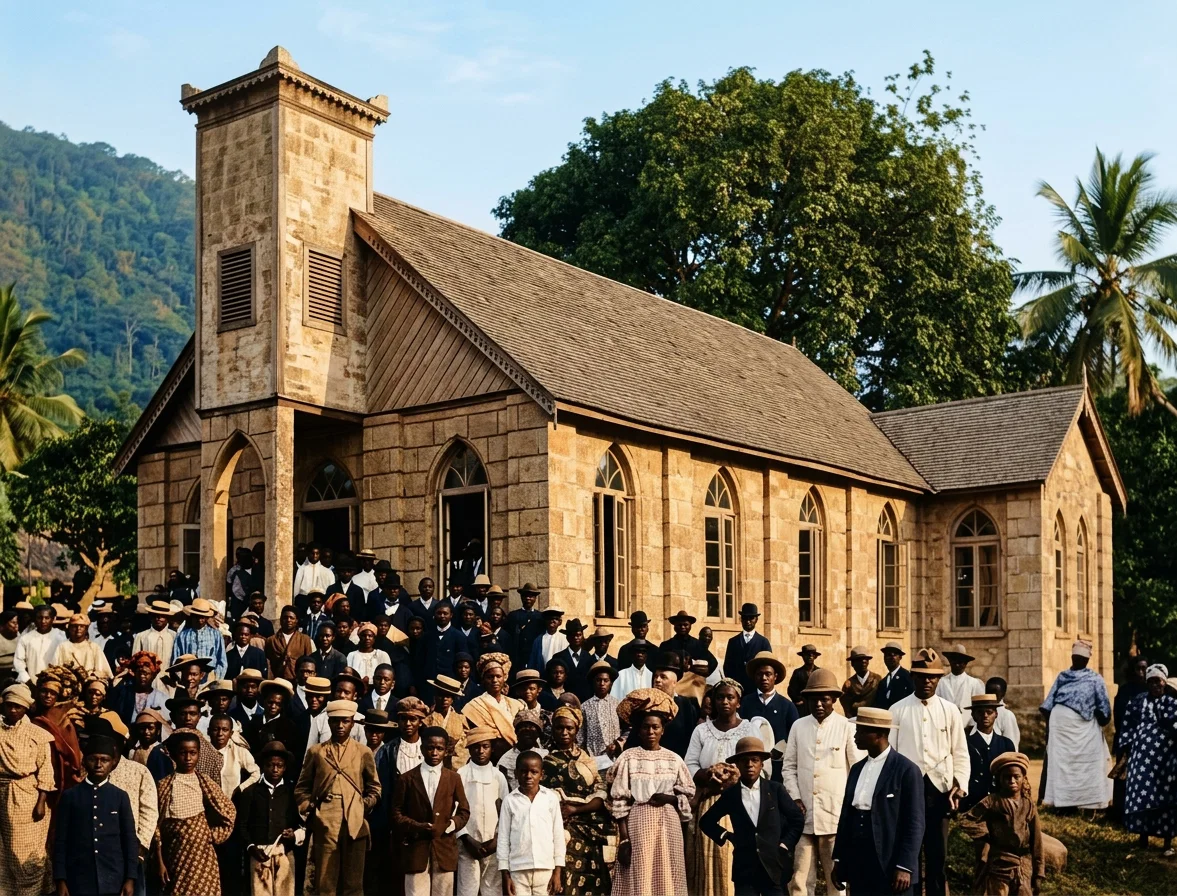
THE CHURCH BUILDING DEDICATED AT SIERRA LEONE
The meetings continued to grow in interest; and when the writer first visited them, the house was full to overflowing, with many unable to get in. A bitter opposition soon arose, and the minister of the leading church disfellowshipped several of his members for attending the meetings at the market.
On Sunday, March 14, our first baptism took place. There was quite a strong antipathy shown by some church people and a company of natives who gathered on the shore. While the first two or three were baptized, good order was maintained; by that time some commotion was seen, and while in the water with a candidate, I turned to those causing the disturbance, and said, ‘You may laugh now, but when the judgments of God begin to fall upon you, your laughter will be turned to weeping.’ From that moment everything was quiet, and we continued our work until twelve earnest souls were buried with their Lord in baptism. Others besides those baptized are obeying the truth.
On Wednesday evening, April 1, a meeting was called to consider the building of a church. A lively interest was taken, and plans were laid to begin work very soon.
Our first church building in West Africa was completed in February, but owing to some circumstances the dedication was postponed until March 29. Much interest was shown in this event, not only by our own people, but by many not obeying the message, and everything possible was done to make the occasion a success.
For weeks before the dedication our dear people met from time to time, earnestly pleading to God for his Holy Spirit, and its directing care in all preparations. Long before the hour appointed for the doors to be opened, the people began to come; and by the time the services began, every inch of seating room was occupied. We had borrowed one hundred chairs from the city hall, and twenty-five were brought from dwelling-houses near by; yet the aisles were filled to overflowing. Outside there were hundreds who could not get in.
On the platform were prominent lawyers and city councilmen. The speaker had only a space one by two feet. For more than an hour in that packed condition the people listened to an answer to the question, ‘Why are we here?’ comprehending the rise and advancement of this message in all parts of the world. The people were much surprised to hear of the magnitude of our work.
Feeling that we should not be selfish in our services, I visited a leading minister in the city, and gave him an invitation to occupy the chair on the occasion, to which he heartily consented. He has charge of several churches in the city, and when our bills were posted, and the minister’s name appeared, such a storm of opposition came down upon him that he declined the position accepted. The Honorable T. J. Thompson, B. L., was invited to fill the vacancy, and his earnest, appealing address will long be remembered by the people, especially by Seventh-day Adventists. Among the many statements made, he said, holding the Bible high in one hand, ‘Sunday is not found in this book.’ He eulogized Seventh-day Adventists as missionaries, and said, ‘If other missionaries had been as earnest and faithful as Seventh-day Adventists, we would see a different state of things in Africa.’
The singing by the choir, comprised of our schoolboys and girls, was highly appreciated by the people, and marks another advance step in our school work, bringing it prominently before the public.
Let me appeal here again for help for our school work. Our burdens are increasing, and we must have help. While we have not in the least pushed ourselves to the front on the question of education, the public expect everything from us from an educational standpoint, and why should they not?
Nearly thirty dollars was received on our balance of indebtedness, but there yet remains a little over two hundred fifty dollars to be met. If our dear people can assist us, even in small amounts, to liquidate this balance, it will be much appreciated by the brethren and sisters in Freetown, Sierra Leone.
The dedication of this new, neat building, the first Seventh-day Adventist church in all West Africa, marks an advanced step. While we have no haughty pride in the edifice, we do praise the Lord that we have a place of worship to which we can invite the public.
Sierra Leone.
A Century of Missions
1800 — The foreign missionary societies numbered seven.
1900 — They numbered over 500.
1800 — The income of seven societies amounted to about $50,000.
1900 — The income was over $15,000,000.
1800 — The number of native communicants enrolled in Protestant mission churches was 7,000.
1900 — There are now 1,500,000 native communicants.
1800 — The adherents of Protestant churches in heathen lands were estimated at 15,000.
1900 — They numbered 3,500,000.
1800 — Not one unmarried woman missionary in all heathen lands.
1900 — There are at least 2,575.
1800 — Medical missions were unknown.
1900 — There are now more than 500 medical missionaries, one fourth of this number being women.
1800 — There were no patients treated by Christian physicians.
1900 — There are now over 200,000 patients under treatment in hospitals and dispensaries.
1800 — Only one fifth of the human family had the Bible in languages they could read.
1900 — Nine tenths of the people of the world have the Word of God in languages and dialects known to them.— The Missionary Helper.
Newfoundland
By C. H. KESLAKE
In my last report I gave an account of my visit to Englee, on what is known as the French, or Treaty, shore. Soon after my return to St. John's, a mass-meeting of the Newfoundland Lord's Day Alliance, presided over by the Anglican bishops of Newfoundland, was held. The principal speaker was the Rev. Dr. Curtis of the Methodist Church here. While the claim has been made that the aim of Sunday laws is to secure to “the poor workingman” one day in seven for rest, this speaker made it very clear that the true basis of such proposed legislation is religion. Try as they will, they can not hide this feature of the movement,—the cloven hoof, as it were, will protrude itself.
The managers of this mass-meeting were very much disconcerted, and withal incensed, when they learned that a copy of a protest which had been prepared by the writer especially for distribution at this meeting had been placed in the hands of practically all who were present.
During the winter months little or nothing had been heard of the Alliance, but of late it has been revealed that it is by no means moribund. Quietly the Alliance people are working in the dark, perfecting their plans and extending their influence. It has been made very plain to us that local organizations of the Lord's Day Alliance can be effected, and no one on the outside be the wiser, until the announcement of such fact is made through the press.
Through the Plaindealer, a semi-weekly paper which has the largest circulation of any paper in the island, especially in the outparts, I have been privileged to set before the people the true principles of religious and civil liberty. This has aroused the anger of the advocates of Sunday-keeping. Led on by a Methodist clergyman, numerous letters, attacking in the most shameless manner Seventh-day Adventists, have appeared in one of the evening papers. But not in a single instance have they attempted to discuss the merits of Sunday legislation. Stung to the quick by the exposure of this fact, one writer under a nom de plume, asking why any one, especially the president of the Alliance, the aforesaid Dr. Curtis, should try to justify their work, said, “The voice of the Lord's Day Alliance is the voice of the masses.” “The people demand that the Lord's day be maintained, and what other can a government do but ratify the will of the people?” To this I replied, “The voice of the leaders of religious thought (the Lord's Day Alliance, if you please) of Christ's day was the voice of the masses. The people demanded that Christ be crucified, and what other could a government (Pilate, in this instance) do but ratify the will of the people? O, fatal parallel!”
Lately a most bitter attack has been made upon me by Dr. W. Grenfell, who is well known for his medical work in Labrador, in regard to my visit to Englee last fall. Not having received any word during the winter from the friends there, of whom I made mention in my last report, we could not understand why the doctor should be so bitter. But a few days after the doctor's letter appeared in print, I received a letter, written six weeks before (it had to come overland by dog team and courier), from one of the sisters there, in which she told the glad news that two others, her own husband, and the husband of the other sister, had accepted the Sabbath, and that another man was, at the time the letter was written, expected soon to take his stand. Just at this time the doctor had visited the place and thus learned of the situation. It mattered not that these friends believed that they were walking in the advancing light of God, or as in the case of one of them, that Christ for the first time had been found, although the good doctor failed to mention these facts, the fact that Sunday was being desecrated(?) was an unpardonable offense, so heinous that it must be heralded all over the island that I was a man to be shunned.
It is a source of satisfaction, however, a cause for profound gratitude to God, that the seed of truth has sprung up so quickly in Englee. In less than seven months, with only two weeks of personal labor, as much fruit has developed there as has been seen in Twillingate after years of labor. This is not to reflect upon the work or workers in Twillingate by any means. The most discouraging conditions have had to be faced in this latter place, and in one sense it may be considered a cause for wonderment that we have had any fruit there at all. At present, however, we have a little company of five or six believers in Twillingate, two or three of these having accepted the truth during this present winter. A recent letter from Brother Johnston informs me that there is now a representative of the Sabbath truth in Morton's Harbor, eight miles from Twillingate, where a few sermons had been preached. In that place determined efforts have been made to keep the truth from entering, but God knows where his jewels are. The only hall in that place has been refused us. I learn, however, that Brother George Hadder of Twillingate is fitting up a small building that he owns in Morton's Harbor, in which meetings may be held. This brother has for years helped liberally with his means to spread the truth. And now he is rejoicing in the truth himself. Praise the Lord!
The work in St. John's has made some advancement. Within the past three weeks six converts, won to the truth during the winter, have been baptized, and we expect others to go forward soon.
To-morrow I expect to leave by the boat for Twillingate. I have received an urgent invitation to visit Englee, but I can not see my way clear to go there until after June. I hope to go then. We are of good courage in the Lord. Pray for the work here.
C. H. KESLAKE.
South Carolina
By H. B. GALLION
The last message of mercy is going in South Carolina. Thousands of books and papers are being sold, and the truths they contain are molding the minds of the people. The canvassing work is rapidly advancing, and the large books are finding a ready sale. When it is realized that throughout the entire State, very few have ever heard of a Seventh-day Adventist, and that thirty-one of its forty-one counties have never been worked with our literature, the urgent need of more laborers will appeal with peculiar force to those who desire to engage in this work. As some of our workers have gone out with “Daniel and the Revelation,” they have experienced some of God’s richest blessings. People are asking for just such a book now. We need workers, also, for “Great Controversy.” A wonderful reward awaits the one who carries these books to the people. Brethren, words are feeble to describe the needs of this State. Other States in the South are needy, and we pray that each may receive more laborers. The conditions in our Southern States will not always be so favorable as now. That which we fail to do now will have to be done under trying difficulties a little while from now. We17would especially urge our brethren from the Northern States, who may contemplate coming to this field, to come with a large supply of adaptability, that they leave the largest share of the North on the northern side of the Mason and Dixon line, and come here to push the work earnestly while the day lasts. For such laborers we have a most promising field.
Write to Elder R. T. Nash, Campobello, S. C., or to W. C. Rahn, Spartanburg, S. C. H. B. GALLION.
Among the Kaffirs
By R. Moko
[Elder W. S. Hyatt, the president of the South African Union Conference, sends the following copy of a letter written to him by Brother R. Moko, who is laboring among the natives in the north-east part of Cape Colony.—Ed.]
“I could not reply to your letter before seeing the man you wrote me about, Brother William Kobe. I found the poor man in the same struggle as we left him. He kept the Sabbath a little time, and then gave it up because of his family. I have stayed there a time to encourage himself and family. I went to see the enduna (chief) and explained to him the work I am doing. As he can read and write, I gave him a few tracts in Kaffir, and he promised to call his people together to tell them of our teachings; and if they approve he will write to you to come and put up a school. He told me it is no use to talk to the people about religious matters, as they were wrongly taught and would not understand. I have had studies with them nearly every day. Brother Kobe is an intelligent reader but can not read much in English.
“I would say what is wanted in the Transkei is a school. Many wish to learn and to know God. I have been in the Transkei since last year sowing the truth, and now the people who can read can see that they were wrongly taught. I do not talk of the great mass of the uneducated natives who are crying day and night to be taught. I really do not know how to express their cry, as it is very sad. My prayer is that the Lord will answer these poor ignorant natives. I am glad to write you that the Lord has ever been with me since being in the Transkei; he has taken better care of me than when at home. I am learning new lessons every day from him, for which I am very thankful. Remember me before the throne of grace.
“Yours in the Lord,
“R. Moko.”
Florida as a Mission Field
By C. V. Achenbach
As to climate and products, Florida is like a great tropical island. It is cooled by delightful sea-breezes from the Gulf, making the climate remarkably equable and healthful; and the State is a favorable winter resort, both for tourists and invalids. Even in the southernmost portions the summer heat is not extreme. The range between the mean summer and winter temperature is only about twenty degrees.
Florida furnishes abundantly the rich fruits and products of the tropics. Large areas are devoted to orange orchards, while lemons, limes, grapes, pineapples, bananas, figs, pears, guavas, etc., grow with equal luxuriance. Cocoanuts are also grown in the sub-tropical region. Horticulture is one of the most profitable pursuits, and of late years market gardening has assumed considerable proportions in many parts of the State. An abundance of fruits and vegetables may be had fresh every month in the year.
Among the industries of Florida is a large business in the production of pine and other lumber and live-oak timber for ship-building. The preparation of naval stores such as turpentine, tar, resin, and pitch, employs many hands; all along the coast there are valuable fisheries, and the inland waters also teem with fish. The evaporation of salt, the production of cottonseed-oil and meal, the manufacture of fertilizers, and sponge and coral fisheries, are among the profitable industries.
It is very evident, therefore, that Florida is a good field for self-supporting missionary work. Its resources are such that quite an amount of money is brought into the State. Hundreds of thousands of dollars are left here every year by the tourists.
It has been demonstrated that Florida is an excellent field for the canvassing work. The spirit of prophecy speaks very plainly in regard to our relation to the Southern field: “There is no more fruitful field than the South.” “Instead of a few, why should not many go forth to labor in this long-neglected field?” “As a people claiming to be proclaiming the last message of mercy to the world, we can not consistently neglect the Southern field.” We are also told by the spirit of prophecy that, “There is no higher work than evangelistic canvassing.” “Many of our canvassers, if truly converted and consecrated, can accomplish more in this line than in any other in bringing the truth for this time before the people.” “All who desire an opportunity for true ministry, and who will give themselves unreservedly to God, will find in the canvassing work opportunities to speak upon many things pertaining to the future, immortal life.”
We wish to correspond with any who feel a burden to take up self-supporting missionary work in Florida, especially in the canvassing work. Such may address me at Orlando, Fla.
C. V. Achenbach.Field Missionary Agent.
A Good Word for “The Christian Record”
By Frank Irwin
[The following letter from a reader of The Christian Record, our paper for the blind, printed at College View, Neb., is of interest as showing the esteem in which this periodical is held. Through no other direct channel can those deprived of sight receive the good news of this message.—ED.]
“I wish again to express my appreciation of the good I derive from reading the Record, and thank you who have it in charge for the good selections of literature I find therein. I can only express my unfeigned thanks for the benefit I gain from its pages, especially those devoted to religious subjects.
“In this month’s issue, I am very much interested in the article on ‘The Seven Last Plagues.’ It seems to me that most of the clergy are ignorant on the book of Revelation, and generally remain silent on its chapters, never touching very satisfactorily upon any of the passages contained in this mysterious book. However, it does seem to my mind that there is more light in that book than the ordinary person or preacher seems to see. . . .
“I once interrogated my pastor on the hidden meanings of this wonderful book, and he informed me that St. John wrote a great deal in figurative expressions to save the church of his day from unnecessary persecutions. By that he means that the unbelieving world could not understand his writings; but the Christians could; but if they could understand his writings in that day, why not we also of to-day, who are faithful, or at least trying to do our duty in the name of our Master and Saviour, Jesus Christ?”
“I am well posted on the churches in general, and especially the Roman Church, having read and heard lectures and sermons by priests, as I have often played the organ in several of their churches in this community, and I have many acquaintances and some good friends of that persuasion. I also notice that among them there is too much dependence upon their priests, and they don’t seem to enjoy the free light of the gospel as we do. I feel pretty sure that there is no Roman Catholic at the head of, or even in charge of, this magazine. I am not writing what I have observed through any ill feeling or prejudice; but I do feel sorry for some of my devoted and simple-minded Catholic friends. . . .
“In the eighth chapter of Revelation is the beginning of a record concerning seven last woes, which were dealt out as each angel sounded a trumpet. It would be a good idea if some one well learned in the Bible would explain something about these woes. ‘The first angel sounded, and there followed hail and fire mingled with blood,’ etc.
“Trusting my letter will receive due consideration, and thanking you for your patience in reading it, I remain,