REV. PAUL DWORKOWICZ, a Protestant missionary among the Jews, has lately visited Italy, and writes as follows: "There are at present 7,000 Jews living in Rome, where they have five synagogues and three rabbis. The celebrated and notorious Ghetto of Rome, where the Jews languished for more than a thousand years, and were subjected to great persecution, exists no longer. With the temporal power of the pope the Ghetto fell. Now in its stead lies a waste and open place. Only the synagogues remain. The Jews are now permitted to live where they like in Rome. There are 366 Roman Catholic churches in Rome. Each church is dedicated to a different saint, so that every pious Catholic visiting a different church each day can, within a year, worship all 366 saints and implore their intercession. Under papal rule, evangelical divine service was barely tolerated at the embassies of the Protestant powers; now in Rome there are 16 evangelical churches and chapels exercising their privilege openly and freely. In Turin there are 4,000 Jews; in Milan 3,000 Jews; in Florence are 6,000 Jews. The Jews in Florence are not as accessible and susceptible as their brethren in Turin and Milan. They prefer to rank first as Italians, and secondly as Jews." Mission work among the Jews is being prosecuted successfully in Europe.—Gospel in All Lands.
OUR WORK AND WORKERS.
By Editor
THE church in Washington, D. C., has organized two mission Sunday schools in that city during the year.
A SCHOOL for canvassers is to be held at Des Moines, Iowa, beginning January 19, to continue ten weeks.
DR. O. G. PLACE and wife arrived in Rome, N. Y., November 22, to spend about a week visiting friends prior to their departure for India, to engage in medical missionary work.
THE Atlantic Record says that Brother H. W. Herrell and an assistant manager, together with a trained nurse from Battle Creek Sanitarium, are about to begin Christian help work in Brooklyn, N. Y.
THE International Religious Liberty Association has requested the several conferences in the United States to coöperate in sending the American Sentinel to members of Congress and of state Legislatures during the winter.
THE brethren in England are to be favored with the help of Elders J. N. Loughborough and H. P. Holser during the month of January, at the end of which time they will start for America, to attend the General Conference at Lincoln, Neb.
THE American Sentinel (29 Bond Street, N. Y.) of November 26 should have a wide circulation. The leading article shows a parallel between the church and state principles which led up to the French Revolution and the church and state movement of to-day. Another important article is entitled "National Reform at the National Capital." The whole issue presents a striking view of the great contest now progressing between religious liberty and church and state union. Price $1.00 per 100.
LAST VOYAGE OF THE PITCAIRN
A NEW building 36x40 feet, has been erected for the primary department of Mt. Vernon (Ohio) Academy. On this building is a bell, 606 pounds net, 36 inches in diameter, which is designed for the benefit of the entire school. It will also ring the hours of beginning and closing the Sabbath.
THE annual session of the Atlantic Conference, held last month, elected the following officers: President, J. E. Jayne; Secretary, S. B. Horton; Treasurer, T. A. Kilgore; Corresponding Secretary, Charles D. Zirkle; State Agent, U. P. Long; Secretary and Treasurer of Tract and Missionary Department, T. A. Kilgore.
ELDER A. E. PLACE reports the baptism of eleven persons at Rochester, N. Y., one a Jew. There are now nineteen in the city who observe the Sabbath of the Lord, and it is expected that a church will shortly be organized. Elder Place also notes the baptism of two at Tonawanda, and the organization of a church of twelve members.
ELDER J. H. MORRISON, who has been confined by sickness at the Battle Creek Sanitarium for several weeks, has so far recovered as to be able to walk out. This will be hailed as good news by his friends and colaborers everywhere, as the cause can hardly spare the services of its leading workers, especially members of the General Conference Committee.
LAST VOYAGE OF THE PITCAIRN.
AT the missionary meeting of the Oakland Church, on the 2d inst., the principal feature was the account of the last voyage of the Pitcairn as related by Captain Graham. Leaving San Francisco May 19, the vessel went direct to Pitcairn Island; thence to Tahiti, where they found the work progressing very encouragingly. The next call was at Rurutu, in the Austral group, where Brother and Sister Stringer were found getting along quite well. Thence the party went to Rarotonga, where Dr. Caldwell and wife and Elder Rice and wife are kept busy, and are of good cheer. Calls were also made at some small islands which had not before been visited. From Rarotonga they sailed to Samoa, and found Dr. Braught and company busily engaged in erecting a sanitarium. The doctor has been quite successful in the treatment of disease, which has attracted a number of patients from other islands many miles away. The next stopping place was Tongatabu, where Brother Butz and wife and Sisters Sarah and Maria Young were left to begin work. Levuka, Fiji, was next visited, and Elder Cole and Elder Fulton and their wives were found to be getting along quite well with their work. From this point the voyage was over entirely new ground, going westward about five hundred miles to the central islands of the New Hebrides. In this group there are twelve large and as many smaller islands, with a population of about sixty thousand. Missionaries report that this is a hard field, as the natives do not want Christianity. The party went to an island where there were no missionaries, and expected to find no civilization among the natives. Yet, after entering a nice harbor, they found a number of white traders, some large plantations, and steamer connection with Australia.
From New Hebrides the party sailed northward as far as the Marshall Islands, stopping at various points and interviewing the missionaries and traders. At one place they found Catholic missionaries, who were operating in the characteristic manner, that is, by getting as many boys as possible under their control. These, while being taught to work, are also instructed in the Catholic religion, and will in time become missionaries. One great difficulty in this newly-traversed field is that nearly every small island, and on the larger islands every village, has its peculiar dialect, different from the others. At one point a number of natives came to the ship in canoes, and were very anxious to trade their trinkets for tobacco. It was with difficulty that they could be made to believe that there was no tobacco on the ship. Captain Graham displayed a number of articles of native dress, which were remarkable both for their crudity and scantiness. He also displayed a large bow and arrows, also some specimens of native money,—all going to show that the people in these "regions beyond" were considerably behind those of the South Sea Islands in the matter of civilization. But Christ died for them all, and they are all included in the great commission, "Go ye into all the world, and preach the Gospel to every creature." Every voyage of our little ship is a fresh appeal for more means to carry on the work,—more ships, more men and women, more self-denial, more consecration, more faith in the last message.
Lesson XIII.—Sabbath, December 26, 1896.
SIGHT TO THOSE WHO ARE BLIND; BLINDNESS TO THOSE WHO SEE.
26 "They said therefore unto him, What did he to thee? how opened he thine eyes? He answered them, I told you even now, and ye did not hear; wherefore would ye hear it again? 28 would ye also become his disciples? And they reviled him, and said, Thou art his disciple; but we are disciples of 29 Moses. We know that God hath spoken unto Moses; but as for this man, we know not whence he is. The man answered and said unto them, Why, herein is the marvel, that ye know not whence he is; and yet he opened mine eyes. 31 We know that God heareth not sinners; but if any man be a worshiper of God, and do his will, him he heareth. 32 Since the world began it was never heard that any one 33 opened the eyes of a man born blind. If this man were not 34 from God, he could do nothing. They answered and said unto him, Thou wast altogether born in sins, and dost thou teach us? And they cast him out.
35 "Jesus heard that they had cast him out; and finding him, he said, Dost thou believe on the Son of God? He answered and said, And who is he, Lord, that I may believe on him? Jesus saith unto him, Thou hast both seen him, and he 38 is that speaketh with thee. And he 39 said, Lord, I believe. And he worshiped him. And Jesus said, For judgment 40 came I into this world, that they which see not may see; and that they which 41 see may become blind. Those of the Pharisees which were with him heard these things, and said unto him, Are we also blind? Jesus said unto them, If ye were blind, ye would have no sin; but now ye say, We see; your sin remaineth."
QUESTIONS.
What further inquiries did the Jews make of the man born blind?
What reference did he make to their former discussion of the matter?
What inquiry did he make of them?
What did they declare concerning him? What did they claim for themselves?
What did the man regard as a remarkable circumstance?
What admitted truth did he state concerning a man's relation to God?
Was the miracle which had been performed upon him an ordinary one?
What conclusion did he arrive at?
In what way did they meet his convincing argument?
What did they do to him?
Who heard that they had cast him out? What did he ask him?
What response did the man make to this question?
How did Jesus then declare himself to him?
How did the man receive this declaration?
How did Jesus say that his coming into the world would affect the blind? How would it affect those who had sight?
Who were listening to this teaching?
What did it lead them to ask?
How did Jesus reply to their inquiry?
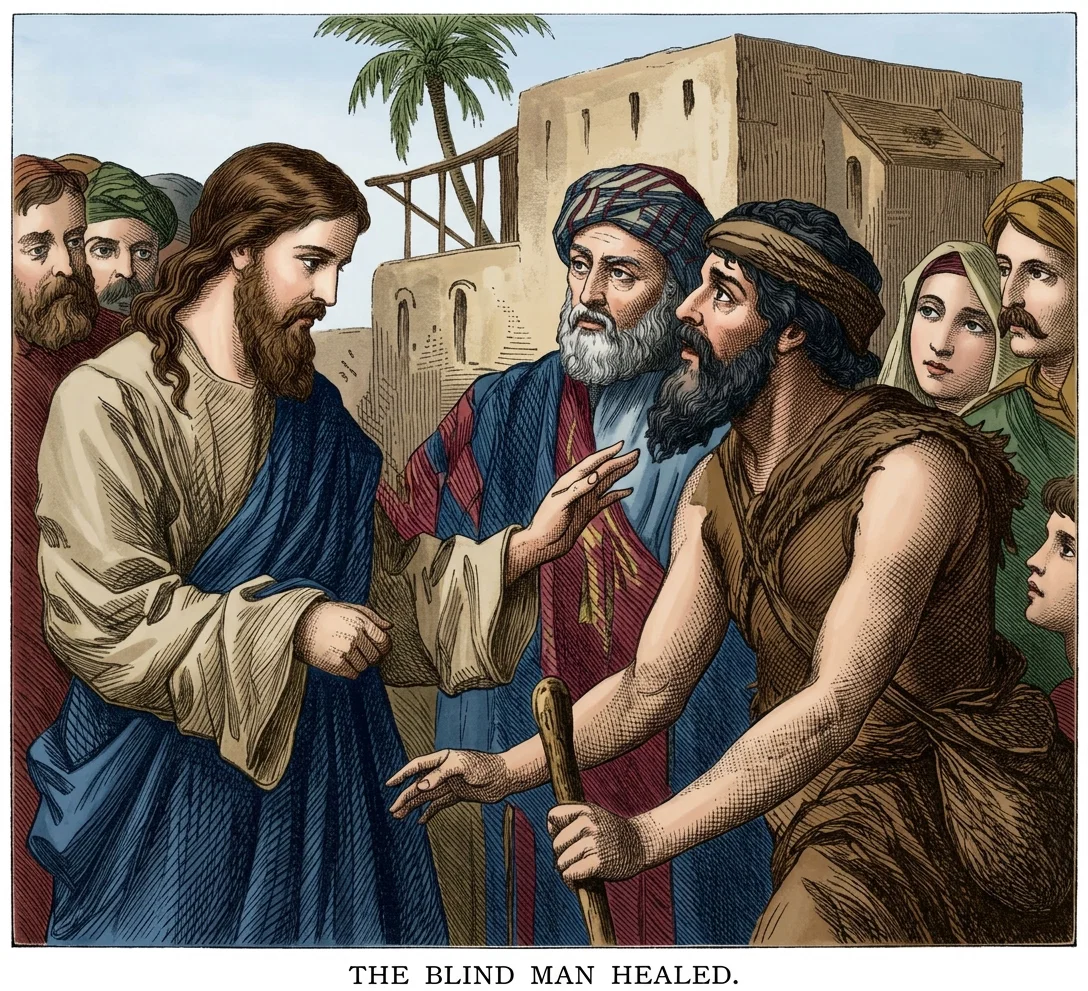
THE BLIND MAN HEALED.
NOTES.
1. It is perfectly evident even to the man whose case is being investigated, that the Pharisees are not repeating their inquiries in order to obtain more complete information. They are simply quibbling. Their continued nagging stirs up the man to ask them the question which above all others would exasperate them: "Are ye, too, wishing to become his disciples? But they reviled him, and said, Thou art a disciple of that one, but we are Moses' disciples." (Rotherham.) A disciple of that one, as if putting him far from them in disdain. A disciple is a learner, and unintentionally the Pharisees were speaking in praise of the man whom they despised. They prided themselves upon being followers of Moses, but their treatment of Jesus proved their claim a false one. Chapter 5: 46. They were right in thinking that God spake to Moses (Ex. 33: 11), but it was God in his Son who spoke, and not Moses. Although Moses was dead, yet God still lived, and had they really known him, they would have recognized that he was speaking to them "in his Son." Heb. 1: 2, R. V.
2. How these Jews contradict themselves! A little while ago they rejected Jesus because they felt too well acquainted with him (chapter 6: 41, 42), but now they reject him because they "know not from whence he is." The logic of the beggar was better than that of the Pharisees. He is not a theologian by profession, but light seems to have come into his mind as well as into his eyes. His experience illustrates a truth already taught to the Jews. Chapter 7: 17. "He does not know much, but he knows this [How is it that they do not know it?] that such a miracle is an answer to prayer, and that the prayer of the wicked is not answered."
3. The case is no ordinary one. The miracle is a "notable" one, and induces an irresistible conviction that the doer is "of God." But this the Pharisees have decided beforehand not to admit, and so no weight of evidence can compel them to change their view. Their very decision has shut out the light which would enable them to reach a right conclusion. It is the light from the sun shining into the eye which enables us to see the sun itself, and if one deliberately closes his eyes, it is no wonder if he does not see the sun. But there is still one course open to the Pharisees, and, like a dishonest lawyer when the evidence is all against him, they can abuse the witness, and this they proceed to do. They now admit what they had been inclined to deny, that he had been born blind, by taunting him with it as a proof that he was evidently a child of sin; and, with a self-sufficiency which they seem to regard as enough to settle the whole question, they scornfully inquire, "Dost thou teach us?"
4. "There are men in such repute as leaders of opinion, and so accustomed to teach rather than to learn, and to receive homage rather than to give it, that scarcely any greater humiliation could be required of them than to publicly profess themselves followers of Christ." It was the application of this principle which prevented the Pharisees from receiving instruction from the beggar. They did not have power over his mind, and so could not cast the truth out of it, as they gladly would have done if possible, but they did have power over his connection with the outward forms of worship, "and they cast him out."
5. "But Jesus heard of his punishment, and sought him out, and declared to him more fully who he himself was. He thus gave to the man assurance of a friendship outweighing in value what he had lost. He made him feel that, though cut off from the fellowship of the visible church, he was made a member of the true commonwealth of men—numbered among those who are united in friendship, and in work, and in destiny, to him who heads the real work of God, and promotes the abiding interests of men. And such is ever the reward of those who make sacrifices for Christ, who lose employment or friends by too boldly confessing their indebtedness to him. They will themselves tell you that Christ makes up to them for their losses by imparting clearer knowledge of himself, by making them conscious that they are remembered by him, and by giving them a conscience void of offense, and a spirit superior to worldly misfortunes."
6. "The blind man now saw, because he knew he was blind, and trusted that Christ could give him sight; the Pharisees were stone blind to the world Christ opened to them and carried in his person, because they thought that already they had all the knowledge they required. And wherever Christ comes, men thus form themselves round him in two groups, blind and seeing. 'For judgment,'—for testing and dividing men,—he is come. Nothing goes more searchingly into a man's character than Christ's offer to be to him the Light of life, to be his Leader to a perfect life. This offer discloses what the man is content with, and what he really sighs for."
Suggestions for Further Study.
What kind of sinners does God refuse to hear? To what kind does he lend a listening ear? Compare Ps. 66: 18; Dan. 9: 3, 23.
What connection did the Jews make in their teaching between poverty, or physical blemish and suffering, and sin?
What is taught in the statement that Jesus found him?
What is the measure of responsibility in God's sight?
LESSON XIII.—SUNDAY, DECEMBER 27, 1896.
REVIEW.
Golden Text: "Let us hear the conclusion of the whole matter: Fear God, and keep his commandments; for this is the whole duty of man." Eccl. 12:13.
NOTE.—This review of the quarter's lessons is a general view of the life of Solomon as a whole. It is a view of a life the influence of which has had its effects upon the ages. The great facts of his life should be kept in mind, and the lessons connected with them be taken to heart. The following is a summary of the
Facts of His Life and Their Lessons.
1. He was born at Jerusalem, son of David and13Bathsheba, about B.C. 1035. He had a noble and Godfearing father.
2. He was made king at the age of 20, B.C. 1015. As he was young and inexperienced, he sought God earnestly. In answer to the Lord's instruction to ask what he should give him, Solomon humbly and wisely asked for wisdom and knowledge, that he might lead the people. This God gave him. This was about three years after his reign began.
3. During the next seven and one-half years Solomon subdued his enemies, organized his kingdom, built and dedicated the temple of the Lord. During this period God greatly blessed his single-hearted devotedness.
4. From B.C. 1004 to 995 he built great palaces, fortresses, aqueducts, gardens, and established commerce.
5. From B.C. 995 to 985 Solomon was visited by "the queen of Sheba," wrote the Proverbs, poems, natural history. He lived in great and expensive luxury, compelled labor, levied oppressive taxes, and was warned of God in it all.
6. From B.C. 985 to 975 is the period of the decline of his wonderful career. He committed the evil of multiplying wives, many of whom were idolatrous, and who still desired to worship their idols. This worship of his favorite wives Solomon favored, so far as to build them shrines or altars. Among the false gods thus honored were "Chemosh, Molech, and Ashtaroth." An idol shrine was built on Olivet. Syria and Edom revolted. Jeroboam rebelled.
7. Solomon died (B.C. 975) repentant, if we ascribe to his authorship the Ecclesiastes, of which we have no doubt.
8. The lesson, the sum of all of the lessons of his life, is summed up in Eccl. 12:13, 14: "Fear God, and keep his commandments; for this is the whole duty of man. For God shall bring every work into judgment, with every secret thing, whether it be good, or whether it be evil." Here is the lesson of his life—of all lives. God's moral law embraces all duty. By that law he will judge every soul. If we keep it with all the heart, we shall "have boldness in the day of judgment." By the grace of God through Jesus Christ we may keep his every commandment.
Another lesson we may learn from Solomon is that great riches, great honor, great power, even great worldly knowledge, will never save a man from sin or sinning. It is only the mystery of God, the grace of God through Christ, that can redeem, regenerate, save, keep. Obedience to God is worth more than all earth besides.
FOREIGN.
Study to Show Thyself Approved
"Study to show thyself approved unto God."
Take Heed Unto Thyself
"Take heed unto thyself; and unto the doctrine;" "that thy profiting may appear to all."
FOREIGN
—Gen. Porforio Diaz has been elected president of Mexico for the sixth term, having served since 1876.
—Poor Egypt has to pay the expense of the recent Anglo-Egyptian expedition to Dongola, which was really for the advancement of British influence in Africa.
—The Italian Chamber of Deputies, at the request of Premier di Rudini, have passed a vote of confidence in the government's colonial policy. The vote was favorable, being 184 to 26.
—The Canadians who immigrated to Brazil last summer are imploring their home government for relief, and for assistance to return home. They are suffering for food and clothing, and can not get employment except on terms a little short of slavery.
—The commander of a German cruiser at Manila, Philippine Islands, telegraphs to his government that the Spanish situation is critical. The action of the Spanish troops is confined to the defense of Cavite and Manila, which are under constant menace by the rebellious natives.
—The Cuban Junta in New York announce definite information regarding the reported capture by the insurgents, after a siege of twelve days, of the town of Guaymaro, in the district of Camaguey. The place was garrisoned by 295 soldiers. All the officers were paroled, but the men were set to work on Cuban plantations. The patriots captured $21,000 in money, 500 machetes, 200 Manser rifles, 1,250 rounds of ammunition, 6 mule loads of medicines, and a large quantity of clothing and other much-needed stores.
—It is stated in trade circles that Austria and Australia each require 100,000 tons of American wheat, owing to crop deficiencies at home.
—A fire in the mercantile district of Sparks Street, Ottawa, Ont., on the 3d inst., damaged merchandise and buildings to the extent of $400,000.
—The Cuban Junta at New York have received news confirming the rumor that General Sanchez, inspector-general of the insurgent forces, was killed in battle November 20.
—The Uruguayan troops are said to be suffering defeat at the hands of insurgents. Correspondents report the defeat of a large cavalry force, and the death of the leader, Major Rodrigues. Another defeat was accompanied by the death of the government commander, Colonel Alcoba.
—A Brussels despatch says that the count of Flanders, brother of King Leopold, and his son, were recently the objects of a hostile demonstration at Dolnain, on the German frontier, where they were shooting. The peasants objected to Prussian beaters accompanying the royal party.
—The Italian consul at Zanzibar reports that the captain and six other officers of the Italian warships Volturno and Staffet have been killed by the Somalis at Magadoxo, and 100 men wounded. Magadoxo is a town of 4,000 inhabitants on the Somali coast, within the Italian protectorate.
—A despatch from Bitlis, Turkey, dated the 1st inst., says: "Bitlis appeals on behalf of 2,000 orphans and 500 widows, many of them from distant homes, where husbands, fathers, and brothers were killed before their eyes amid dreadful atrocities. They wander in the streets, begging for food and clothing."
—Advices by way of Kingston, Jamaica, state that a disastrous cyclone passed over the Windward and Leeward Islands last week, being especially severe on the islands of St. Vincent and Montserrat. Extensive floods were caused by the storm, and many plantations were ruined. Many persons who lived near the watercourses were drowned, seventy-five deaths being reported on Montserrat alone.
—Late advices from Cuba state that the Spanish troops at San Jose de las Lajas, twenty miles from Havana, have gone over to the insurgents. Many of the citizens accompanied the troops, carrying ammunition. Great excitement was caused at Havana, and fresh troops were sent to occupy the garrison. Before they arrived, anarchy reigned, and on arrival, the soldiers shot down many of the people in the streets.
—The Turkish special tribunal, at Constantinople, has sentenced the Armenian bishop in Hassekein to death. The bishop was condemned to death because during the recent riots in Constantinople a loaded revolver was found in his house. The bishop was absent from home at the time, and upon this ground an appeal was taken against the judgment of the special tribunal. France, however, has interfered, and prevented the carrying out of the tribunal's judgment.
DOMESTIC.
-Advices from Pierre, S. D., report heavy losses of stock as a result of severe storms.
-The North Carolina Baptist Association has adopted a resolution opposing state aid by taxation to higher education.
-The house of Samuel Henderson, near Conway, Ark., was burned on the 30th ult., and five of his children perished in the flames.
-A submarine telegraph cable has just been laid between New York City and the island of Haiti, and has been opened to the public.
-The pulpits of sixty-eight churches in St. Louis were occupied on Sunday, November 15, by delegates to the W. C. T. U. Convention.
-The Salvation Army is preparing to give a Christmas dinner to the needy in every town on the Pacific Coast where there is a branch.
-Advices from Helena, Mont., state that there is much apprehension in regard to the cattle industry this winter, on account of the severity of the weather.
-The pope has appointed Rev. Dr. Thomas J. Conaty, of Worcester, Mass., to succeed Bishop Keane as rector of the Catholic University at Washington, D. C.
-Atlanta, Ga., reports a severe snowstorm on the 2d inst. The fall of snow lasted five hours, leaving four inches on the ground, badly impeding the street-car service.
-On the 19th ult., a mob destroyed eight of the ten toll-gates leading into Versailles, Ky., and the owners were warned that they would be killed if they collected any more toll.
-The Peninsular Car Works at Detroit have again shut down, it is said, indefinitely, leaving 1,500 men out of employment. The works had been reopened but six weeks.
-In New York City, on the 30th ult., a commission merchant was held up on a street-car and robbed of $3,000. One of the robbers was captured, but the others escaped with the booty.
-The Indiana State Miners' Convention has voted to continue the strike, and an effort is being made to unite with Illinois miners in securing uniformity of prices in the two states.
-Severe earthquake shocks were experienced in southern Illinois on the 1st inst. At Cairo and Anna, buildings rocked and people fled from them in terror. The vibrations lasted ten seconds.
-The General Missionary Committee of the M. E. Church has appropriated $46,573 for work among the white people of the south, and $43,545 for "colored work." The appropriation for Japan is $48,576.
-It has been discovered that the prohibitory cigarette law of Iowa can not be enforced because it interferes with the interstate commerce law. Shipments of cigarettes are now received, and sold in the original five-cent packages.
-November 3 (election day) seems to be regarded somewhat in the light of a new era. Many events are noted with reference to that date; for instance, since November 3 there have been eighteen prominent bank failures in the United States.
-A temple dedicated to Confucius is soon to be dedicated by Chinese residents of Chicago, and a missionary campaign is to be begun against Christianity. Wong Chin Foo, a Chinese editor of that city, is to be the high priest of the temple.
-The strike of the employees of the Tudor Iron Works at St. Louis, which has been in progress for two years, has been declared off. The proprietors have acceded to the demands of the strikers for increased wages, and 800 men have been set to work.
-Bishop Keane, who was asked to resign the rectorship of the Catholic University at Washington, has been honored with a position at Rome as member of the propaganda. Papal cunning knows how to dispose of American liberalism to the best advantage.
-A secret conference of distillers is said to be in session at Chicago, and they have baffled all efforts of reporters to find out what is being contemplated. With the proverbial influence of the rum power with the press (second only to that of the Roman Church), it is presumable that the reporters are not hard to baffle in this particular case.
-With a capital of $100,000, the Circle de la Nobleza has been incorporated under the laws of New Jersey. The object is to secure wealthy American wives for impecunious titled foreigners. Notwithstanding the influences of an education in a land whose boast is Republican simplicity, human nature seems to have a penchant for the glitter of nobility.
-The Standard Oil Company is going into the iron and steel manufacturing business; so says a Chicago despatch. Land has been purchased in that city for a $10,000,000 plant. Mr. Rockefeller (who is practically the Standard Company) has mines of his own in the Mesaba region, from which the ore will be brought to the plant in his own ships. Thus there is promise of a gigantic opposition to the Carnegie works near Pittsburg.
-The Supreme Court has ruled that there is neither law nor treaty to hinder mercantile pursuits with any part of the Spanish domain; and therefore this government may not interfere with unarmed vessels carrying arms and ammunition to Cuba. On the strength of this ruling, the owners of vessels heretofore called filibusterers are now openly preparing to send out cargoes, one of them, Mr. Bans, owner of the Three Friends, even demands of the government that his vessel be protected from Spanish interference.
-The Chinese laborers at Riverside, Cal., are having trouble. On the night of the 30th ult., the Fay Packing House, in which were eight Chinese, was broken open by masked men, who ordered the laborers to pack up and leave. Their goods were piled into a wagon, and the terrified men were escorted several miles from the city and left, with orders not to return. They returned the next morning, however, and determined to remain. A notice was left at the packing house warning the proprietor not to employ any more Chinamen.
-Complete returns show the following political complexion of the House of Representatives of the next Congress: Republicans, 205; Democrats, 134; Populists, 18. Of the Republicans five favor free coinage of silver, and two Democrats are for the gold standard. On the money question the House stands for the gold standard, 202; for free silver, 155. It is supposed that there will be an extra session of the new Congress soon after Mr. McKinley's inauguration. The present Congress is composed of 252 Republicans, 92 Democrats, 10 Populists, and 2 vacancies.
-Referring to the death sentence of a boy of nineteen years, in New Jersey, for murder, the Christian Work says: "They would not have done that in Rome, in the time of Augustus. The Romans would not have inflicted capital punishment upon one of less years than twenty-five. Yet, if we mistake not, a boy of sixteen was hanged in Georgia a few years ago." If it be true that Rome under pagan rulers would not inflict the death penalty upon any one under twenty-five, there was a decided change when the Papacy gained14the ascendency; for under that system neither age nor sex was regarded when the charge of "heresy" was sustained. And hanging would have been mercy as compared with the tortures that were inflicted upon young and old alike. Yet an apostolic delegate has promised that "what the pope has done for other countries, he will do for the United States." And no doubt the promise will be fulfilled, for it is here that the "image to the beast" (Revelation 13) is to do its cruel work.
-The first Armenian Baptist Church in the United States has just been organized at the Armenian Colony in Fresno County, Cal. The pastor is Rev. A. J. Melchonian, M. D., who left Armenia, with his family, when the recent troubles with the Turks broke out, and most of the colony are Armenian refugees. A woman who saw her husband murdered by Turkish soldiers and fled from her home with three children, arrived in this city last week, and was sent on to the Fresno Colony by State Missionary Latourette, of the Baptist Church.
-Ice gorges in the Chippewa River, Wis., have caused great damage to property by flooding the country. A despatch dated December 1 says that for eighteen miles the country below Round Hill is submerged. Several families were driven from their homes by the forming of a gorge at Plum Island. Scantily dressed, they waded through the ice and water to a high place on the railroad, from which point they were rescued by a relief train. Several were badly frozen. Many thousands of cattle have been drowned. Great damage to property is reported at Chippewa Falls.
CYCLONE WASHER.
BATTLE CREEK, Mich., Nov. 9, 1896.
This is to certify that I have in use in my home one of the Cyclone Washers manufactured by Coon Bros., of this city, and it gives the best of satisfaction. M. E. KELLOGG,
Editor of the "Youth's Instructor."
ISOM, Brooks Co., Ga., Oct. 5, 1896.—
MESSRS. COON BROS., Battle Creek, Mich.
Gentlemen: I received the machine all right. Have given it a trial, and like it splendidly. I am now ready to take the agency. Yours truly,
I. T. MERCHANTS.