I LEFT home April 8, for a general meeting of the Russian Union Committee, at Riga. This gave me a day before the opening of the meeting to talk over the general situation with Elder J. T. Boettcher, and that evening I had the privilege of talking to an overcrowded house. The doors had to be closed some time before the beginning of the service, because there was no more room.
The president of the East German Union arrived the next morning. All the committee members, even those from Trans-Caucasia, were present, and the week was well spent in Bible studies, instruction meetings, audits, councils, and public services. It was so arranged that at noon and evening we took our meals with our brethren in the city, and they as well as we enjoyed the privilege of becoming better acquainted with one another.
The report for the past year was very encouraging. The Russian Union showed a gross gain of 794 members. The net gain was 526, making an average of about eight members for each worker employed. The gain in tithes and offerings was $7,000; and we were very happy when we found that this great field, with a population of 115,000,000, and about the size of the United States minus the Pacific Coast, had been able to do all this work with a tithe of $25,000, without any appropriation whatever.
I proposed to the committee some divisions of the field, and I was glad to see with what enthusiasm the brethren received the suggestion, though it meant quite a number of changes for them personally. In the redivision of Russia, two new conferences were created. The Baltic Conference, which only a short time ago gave up the Union District,12was again divided, forming the Baltic and Neva Conferences. By taking some adjoining territory from the large Middle Russian field, the Baltic and Neva Conferences each still retains 6,000,000 people within its territory. The Neva Conference includes St. Petersburg and the country round about.
The South Russian Conference was divided, and its name changed, as before long we shall have a South Russian Union. The Asof Conference, about the Sea of Asof, has about 10,000,000 people; and the other part will be called the Black Sea Mission. The Little Russian Mission field was changed into a conference. It has a population of 14,000,000. The West Russian Mission was divided into two almost equal parts,—the Polish Mission, with 11,600,000 people, and the West Russian Mission, with 10,500,000. From the Middle Russian field, which hitherto had some 60,000,000, the Arctic Mission was separated, being nearly as large as Alaska, but having a population of 9,000,000; while the Middle Russian is still nearly as large as Texas, with a population of over 28,000,000. This now makes six conferences and six mission fields in the Russian Union.
In order to supply new fields, and to change the workers somewhat, Elder Daniel Isaak was appointed to the Neva Conference, Elder K. A. Reifschneider to the Asof, Elder J. Sprohge to the Caucasian, Elder H. Schmitz to the Polish Mission, Elder K. Schamkow to the Arctic, and Elder D. P. Gaede to the Black Sea Mission, while Elder J. T. Boettcher looks after the Union District and the Black Sea Conference for the present. Matters were so arranged that in due time we can easily divide this large union into a North and South Russian Union, the North retaining about 71,000,000 people, and the South about 44,000,000.
As we are not able to hold any regular conference meeting at the present time, a great deal of the business for the whole union had to be done during the eight days. We were pleased with the unity among the workers, and that the business was transacted with perfect harmony.
In Riga itself we have three good churches, with three hundred members. Our brethren and sisters and many friends appreciated the word spoken to them nearly every night.
The publishing work is onward; and the canvassing work, in spite of many difficulties, is still advancing. What we need is more good, consecrated native workers, who, knowing the language and customs of the people, would be able to present the gospel to their own countrymen.
The prospects for future growth were never brighter than they are at present. Though the obstacles are great and many, and thus far we as a people have not been able to have any institutional work in this great country, yet the very fact that to-day there are nearly 5,000 believers in this mighty empire shows what may be done by the power of God through the simple preaching of the gospel, and that under the greatest restraint.
As some of our brethren are getting into difficulty again for the simple preaching and teaching of God's truth, let us remember them especially in our prayers, that God may give them wisdom, and that he may bring to naught all devices to hinder their work.
Barotseland Mission, South Africa
By R. C. Porter
R. C. PORTER
Arriving at midnight after a train ride of two and one-half days from Bulawayo, I was pleased to meet Brother J. R. Campbell and two of the mission boys, who were awaiting my arrival. With a cart and six oxen we set out for the mission, reaching it at 4:30 in the morning, where we were given a hearty welcome by Brother and Sister W. H. Anderson, Sister Campbell, and the students who remained to work during the vacation.
Brother Campbell has become very proficient in the native language. He speaks it most accurately, and with as much ease and fluency as the best linguist among the natives. He is very successful in visiting the out-schools and in doing evangelistic work, as well as in his work at the main station.
On Sunday afternoon, April 7, at 5 P. M., Elder and Sister Anderson and the writer, with three native boys, a span of eight Barotse oxen, a large two-wheeled English cart, and a riding mule, left the main station for a visit to some of the out-schools of this mission. We carried with us our camping effects and food for a week's outing.
The first trek was about six miles. We then stopped for the night in a clump of bushes near a railway cottage, about a mile from Monza Siding. The fore part of the night was dark, as the moon did not rise until about 11 P. M. No sooner had we halted to outspan than our faithful watch-dog rushed a short distance into the darkness behind us, barking furiously, thus informing us that some wild animal was following us in close pursuit. Brother Anderson immediately directed the driver to crack the whip in that direction. This was done with much skill a half dozen times, and the clear ringing snap sounded on the still night air with such a warning as to check any further advances. The native boys proceeded to outspan, and I walked a few rods in advance into the darkness, viewing as best I could the surroundings in that direction. As I returned, the dog came rushing by me, barking as fiercely as before, and we knew that the pursuing animal had not been frightened away by the cracking of the whip, but was stalking us.
Our lantern was lighted, and our native attendants gathered some dry branches and limbs of trees, and started two camp-fires as a protection from attack by the unknown wild beast.
Our simple evening meal was soon over, and all prepared to retire early, as we had planned to start at three o'clock in the morning in order to drive while it was cool, it being exceedingly hot during the day. The oxen were tied to their trek-chains, one end of which was fastened to a tree near the cart, forming a circle. The mule was tied inside this circle, as lions have a special fondness for donkey or mule meat. Elder and Sister Anderson put down their bed in the cart; a duck-covered, folding, mosquito-proof cot was placed on the ground beside the cart for my comfort (and I wish to recommend this excellent device to all who travel in mosquito districts); the native boys threw their blankets down by the fire in American Indian style, wrapping themselves up in them; and we were just dozing off to sleep when the oxen suddenly jumped to their feet and gazed into the darkness, by which we knew that some animal was coming dangerously near our camp. The native boys soon revived the camp-fires, the oxen became quiet, and we were all fast asleep. At different times during the night the oxen suddenly jumped to their feet, warning us of approaching danger. Knowing that such conduct on their part was rarely seen unless a leopard or lion was approaching, we concluded that it was one of these that had awaited an opportunity for attack after the camp-fires had ceased to reveal their approach. When the moon arose, it in part supplied the protection afforded by a camp-fire, and with a careless presumption, the result of familiarity with such experiences on trek, our camp-fires were allowed to die out, and we slept.
About three o'clock in the morning we were awakened by the proverbial Dutch morning salute on trek, "Opstaan, koffie drink, inspan, trek," from our superintendent. The English of the expression is, "Get up, drink your coffee, yoke up, and drive on." As we were not to breakfast until we had made a drive, we were soon on our way. The romance of trekking across country through the veldt, with grass eight feet high, and through the bush with no road but a native foot-path, crossing bridgeless drifts where the cart suddenly drops from two to four feet with a bump, then nearly upsets by running one wheel over an ant-heap, with the crack of the whip and the yell of the native driver ringing out in the night air to frighten away the wild beasts which may be crouching for their prey along the path, — this is very interesting to one taking the first trip; but the romance soon wears off in actual mission life, and it becomes wearing labor.
The constant strain of alertness for the possible happenings, which often are not imaginary, wears on the nerves; and but for the extreme heat of the day, all this night experience would be willingly exchanged for day traveling. The natives do not travel through the lion-infested section of the country by night except as they accompany white men.
The Day of God
Ever more swiftly year by year, the world rushes on to the goal of the day of God.
Love Crowned the Years
"Let us give thanks," the old man said
In earnest tones and low,
As reverently he bowed his head,
White as the winter's snow.
And yet his dainties were but few,
Yea, coarse and hard his fare;
The straits of life he better knew
Than any gathered there.
His home was but a humble cot
Of earthly comforts bare;
But though the praise of men was not,
The smile of God was there.
The poor man richer was than all,
God's love was all his cheer;
'Twas this that made his cup so full;
'Twas love that crowned his year.
— Selected.
Keepers Not at Home
By Aunt Maria
"WELL, now, I am almost discouraged," said gentle Mrs. Williams, loosening the ties of her wrap as she sank into the easy chair that Mrs. Gordon, her oldest daughter, had drawn to a bright spot near the window as she saw her mother coming home.
"Elsie, please bring grandma a glass of fresh water. You really look tired, mother; tell us what you have been doing; we do not often see you almost discouraged," sympathized Mrs. Gordon.
"Well, it is so; I am almost discouraged. You remember Sister Jones and I promised to sell twenty-five copies of that special number. It is so good! and we thought the women in this neighborhood would be glad to get the good, practical help it would be to them in their homes. Sister Jones has had the rheumatism so she could not get out, and I have been trying to dispose of the whole lot. Only twenty-five, that ought not to take long, I thought.
"Monday I started out in the morning. Being wash-day, I expected to find everybody at home, and knew it would take only a few minutes to tell each one about the paper. As no one answered at the side doors, I rang the front-door bells, but still no one answered. At next to the last house a woman came across to the fence and said her sister lived there, but wouldn't be home till nearly six o'clock, and asked if I would like to leave word for her. I explained my errand, and sold a paper to the woman. She said most of the women in that neighborhood had gone down-town to the Monday sale. Wednesday afternoon there was a big game at the baseball park, so I had a similar experience that day.
"I found three or four women at home on Thursday, and these bought readily. To-day is remnant day, and every one had gone to the sales, I was told.
"It is not that I care so much about the papers, Cassy,"—and the eyes that once were described as dancing brown grew very serious,—"but I fell to thinking about those women's homes. Why, Cassy, when you five were little ones together, before baby Eddy was taken away, our little home duties kept us all as busy as bees. You were only fourteen, and I depended on your help so much, but even then I had scarcely time to make my weekly visit to mother, and get down-town to do the necessary buying for the family.
"As I say, I fell to thinking about those women's homes, and the words of Paul came to me, 'Teach the young women to be . . . discreet, . . . keepers at home.' There were those beautiful houses, well furnished and tastefully arranged, with the blue smoke curling up from the chimneys, all so homelike, but no 'keepers at home.' What would the children do when they came home from school at lunch time? Did the husbands carry pails or get quick lunches down-town? At five o'clock children were still playing in the street before the closed houses. Some boys were quarreling over their game of ball. One little fellow was covered with mud, and his nose was bleeding. 'He knocked me down 'cause I didn't catch the fly,' the little fellow said when I asked him what was the matter. I asked him where he lived, and he said, 'In that cement house with the brown shingles,' pointing to a house I knew was still without its keeper. It made me feel sad, Cassy, to see that little fellow crying in the street, and know his sister was too busy with the other girls even to ask what ailed him. What wonder if that mother, coming home at six o'clock to hurry up supper, should feel nervous on finding things in this state.
"When your father was with us, Cassy, I liked to have the meal all ready when he came home from the office at night. It seemed to smooth the worry out of his face when we all gathered about the table, and he thanked God for the health of the family, and asked him to bless the food and the hands that had prepared it. It rested me, too, and soothed my nerves. I was glad that the dish I prepared to his liking seemed to suit his taste so well." The gray locks rested back against the easy chair, and the slender hands crept together in the gentle mother's lap as the eyes closed in reverie.
"Teach the young women to be sober, to love their husbands, to love their children, to be discreet, chaste, keepers at home," were the words still ringing in the loving heart, mingled with the sacred memories of wifehood and motherhood. "Maybe there is something for us older women to do," mused the "aged" one, as for the first time her mind caught the words. "Teach the young women."
Takoma Park, D. C.
The Home
THE ideal home is not self-centered. It is a center of service. So far as circumstances will permit, the old-time ideals of hospitality should be maintained. In wise and uplifting ways the home should be shared. It is a good practise to invite young people who are away from home. It relieves loneliness, discouragement, and temptation. Remember, it is—
“Not what we give but what we share.
The gift without the giver is bare.”
“The home is the bulwark of civilization.” Within the extreme limits of wealth and poverty a home may be good or bad irrespective of social position or property. Our homes are what we choose to make them. It is a question of what we admit and what we keep out of them. Our best selves and the best that we have to give should go into the home. The home life, to a large degree, determines the character of children. The home tends to make us all better or worse. Thus the home becomes the chief factor in determining the character of the community and the nation. The trend of our times is away from the home into the countless amusements and interests of modern life. But home life at its best should be strongly maintained and cherished. It should not be narrow nor selfish, however; and from it should develop and overflow steadily lives enriched for service and blessing.—Selected.
The Bible and Health
Dr. J. S. Martin, health officer in a Western city, says that the Bible is the best text-book on sanitation, on the cause and treatment of disease, and on how to maintain constant good health. He testifies that he finds in the Bible 275 verses which speak of contagious diseases and how to treat them; 108 verses on the disposal of filth; 57 verses on quarantine; 16 verses on gluttony and diseases resulting from it, with their penalties; licentious uncleanness, 27 verses; venereal diseases, 30 verses; defilement and how to treat it, 123 verses; ablutions, or washings, 65 verses; purification, 60 verses; and rest enjoined, 39 verses.
Summing up, he says: "I find 285 verses in the Old Testament and 240 in the New relating to disease and sickness, and their causes, treatment, and prevention." He is reported to have said that "God never created a direct law of man's nature that would necessarily produce sickness, under any circumstance in life."
— Christian Advocate.
Come To-Day
By Edward J. Urquhart
THIS eve when gathering shadows
Shall follow the setting sun,
And the stars in the tranquil heavens
Declare that the day is done,
How many hearts that are beating
So warm with the flow of life,
Will pass with the passing sunshine
Away from the world's mad strife?
For to-day alone is certain,
Your morrow may never be;
The sun in its morning splendor
May fail to awaken thee.
But to-day, in accents tender,
The Spirit, the Bride, say Come;
For our Saviour over yonder
Is calling his children home.
While probation's door is open,
E'er the twilight shadows fall,
Why not bow in prayer to Jesus,
Why not give to him thine all?
Earth, with all its gold and glitter,
Soon, as chaff, will pass away;
Only he who hides in Jesus
Will be victor in that day.
Sacramento, Cal.
The Work Among the Colored People of Los Angeles
By Jennie L. Ireland
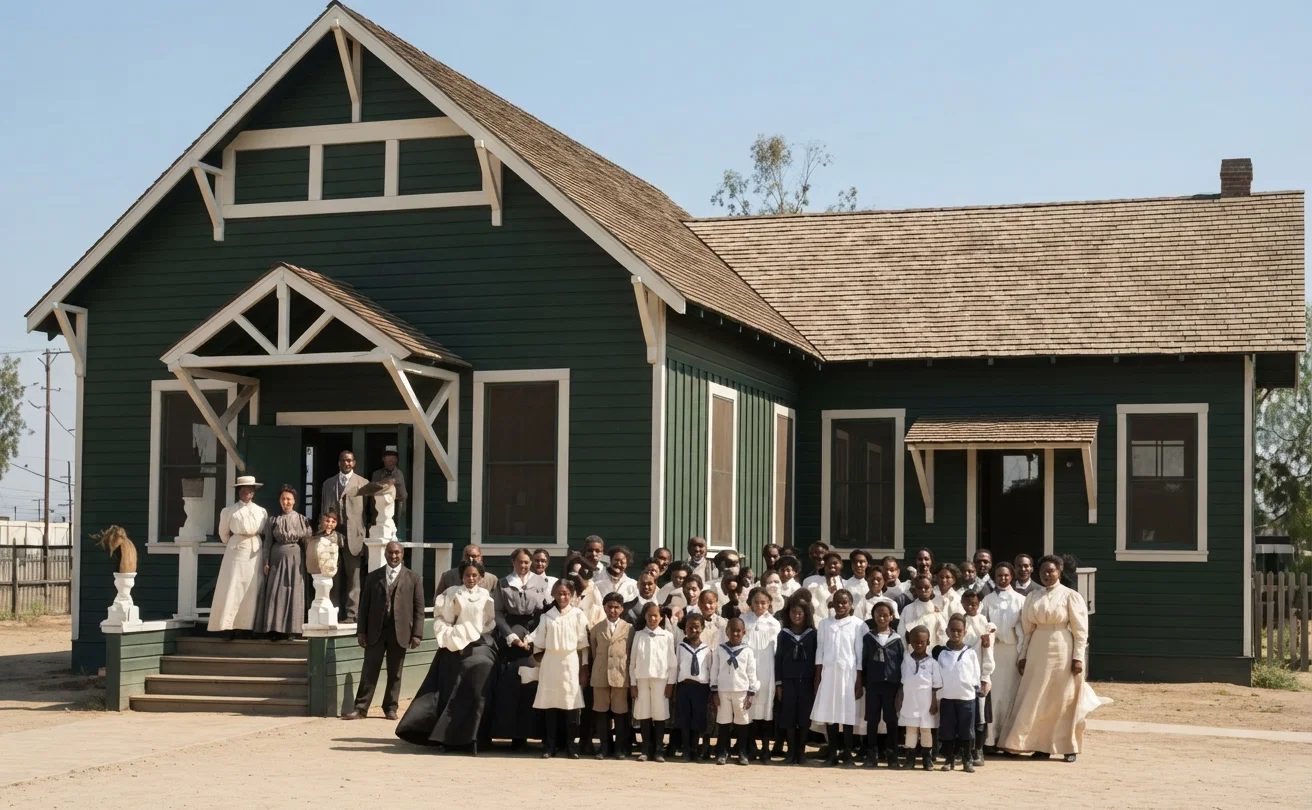
IN the year 1905, a Bible worker began teaching the truths of the message in the home of a colored family in this city. At the first reading two were in attendance. The next week three were present. As time passed by, the attendance grew to the number of eighteen or twenty. From this first class, three earnest, truth-loving women became fully established in the third angel's message. Their hearts were burdened for their people who had not heard this message, and soon many cottage meetings were being held in the afternoons and evenings. This work was carried on almost wholly through the efforts of these colored sisters. Two would go into a neighborhood and visit from house to house and work up a Bible class. Then the Bible worker would go with them to the appointed place of meeting, and a systematic course of study would be started. As new believers were added to the company, they would work up a new interest for other classes.15
As the work was thus growing, it became evident that we needed a church building, where these new believers could carry on regular church and Sabbath-school work. Request for such a building was placed before the conference committee, and also before the conference in session at the camp-meeting of 1906. It was voted that the conference secure a lot and put up a building, using as much of the lumber on the camp-ground as would be serviceable. A neat, plain room twenty-four by thirty-six feet, was ready for use in December, 1906, and was dedicated to the cause of the third angel's message by Elders G. W. Reaser and R. S. Owen. Regular Sabbath services and a mid-week prayer-meeting were established, and neither difficulties nor storms prevented these meetings at the appointed hour. The Sabbath services were always uplifting because of the presence of the Lord. The whole day was spent at the church, and the last service was a prayer-meeting. Those who attended these prayer-meetings know that victory after victory came to the work as a result of those prayers.
The number attending the Sabbath services grew, and by Aug. 1, 1908, a church of twenty-eight members was organized and fully officered. From that time, the church increased in numbers, in service, in experience, and in the knowledge and grace of Christ.
Since 1908, the children's divisions of the Sabbath-school have had their class exercises in the yard. At the close of 1911 the church decided to enlarge the building by adding a Sabbath-school room, sixteen by twenty feet, on the west side; and an addition, ten by twenty-four feet, on the rear, to make room for a pool, rostrum, and dressing-rooms.
The brethren of the church gave their time to the work Sundays for three months, and other days when out of regular work. They built the pool and chimney, assisted with the carpenter work, and did all the outside painting. The inside staining and varnishing were all done by the brethren and sisters.
Just as soon as the lumber for this work was unloaded on the church grounds, a new interest in what we were doing seemed awakened in many hearts that heretofore had been indifferent. Every Sabbath our seating capacity would be taxed to the limit. Others who were interested waited almost impatiently for the dedication service.
While the building was putting on the finishing touches, the church officers held weekly meetings for the purpose of getting everything in perfect order. These meetings were at first devoted to the study of the duties devolving upon the various officers. Study of the Word, heart-searching, and confessions cleared the way for the incoming of the Spirit of God.
Sabbath, May 25, Elder E. E. Andross came to the church to conduct the dedicatory service. About one hundred fifty were present to hear the solemn truths of this judgment hour. Following the prayer dedicating the work of our hands in the building to the Lord's cause, Elder Andross buried eleven persons in baptism in the new pool.
After an hour's intermission for lunch, services were continued. Two deacons were ordained to serve with the two already in service. Then followed the ordinances of the Lord's house. As many present had never seen the ordinance of humility, it was explained fully before the congregation separated to participate in it. There was present for the first time a Catholic sister. She engaged in this ordinance with us. An Episcopalian brother and his wife, and sisters from the Baptist and Methodist Churches, all felt that this ordinance was a part of the service required in the Lord's house, and gladly took part in it.
The meaning of the bread and wine was made plain, and an invitation extended to all who felt free in the Lord to partake with us. The Spirit of the blessed Master was present in a marked manner. When the ordinances were finished, Elder Andross said that if any one present desired to express words of praise, there was now opportunity. No time was lost in waiting for some one to speak. When the leader arose to close the meeting, six others arose with him, so the meeting continued until after six o'clock. Our hearts were full of joy and praise and gratitude for the way God had led in this work.
CHURCH FOR THE COLORED PEOPLE AT LOS ANGELES
To-day, our membership numbers sixty-eight. Of those present at the dedicatory service, five have taken their stand to keep the Sabbath, and others are studying to know the truth. The accompanying picture of the church was taken Sunday, May 26. Only a part of the membership was present. The attendance at Sabbath services is between ninety and one hundred. Truly this message is seeking out those who are hungering for truth, and rapidly preparing them for the soon-returning King of glory. JENNIE L. IRELAND.
Riga (Russia) Publishing Branch Closed
By J. T. Boettcher
A FEW days ago, while attending the annual meeting of the Siberian Union committee in Saratow, I received a telegram stating that, by a decision of the senate in St. Petersburg, our publishing branch in Riga was ordered closed. I had intended going on to Trans-Caucasia, but was obliged to return to Riga at once. Here I learned that the police had come with orders from the governor that an invoice be made of all our stock on hand. They returned for the same the next day, and the papers had to be signed by all our employees and returned to the governor; and they are held responsible that not another book shall leave the office.
This is a great blow to our work in Russia, and at present we do not know what the outcome will be. It was hard enough before to go out and sell our literature without the permission of the authorities. Those who did go had their books taken away from them more than once. It was hard to get people to engage in a work where they knew they were in danger every day that they went out, but it will be worse now. However, we believe the Lord will show us a way out. We take courage in looking at God's dealings with his people in times past. When the children of Israel were standing before the Red Sea, they did not know what to do, only to go forward. We can not believe that the Lord would have suffered our house here to be closed if he did not have something better for us.
To-morrow I expect to have an audience with the governor; he may give us time to dispose of our publications, and then we shall have to work through other channels. We are living in very trying times, and we hope all our people will pray for us.
J. T. BOETTCHER.
In Norway
By Guy Dail
THE twenty-sixth annual session of the Norway Conference was held in Bergen, May 7-12. Aside from the workers living in Norway, assistance was rendered by the visiting brethren, Elders J. T. Boettcher, J. C. Raft, C. C. Jensen, and Brethren Erik Arnesen and A. C. Christensen.
All seemed much pleased with the harmonious character of the business proceedings. A resolution for dividing the conference was considered, thoroughly discussed from the floor, and passed by the unanimous vote of the delegates. This action made it possible to organize the West Norway Conference, composed of the territory included in the counties of Romsdals, North Bergenhus, South Bergenhus, Stavanger, Lister, Mandal, and that part of Nedenes to the west of the river Lilletopdals and inside of the boundary formed by a line running in a southerly direction from that stream to the east side of the city of Lillesand.
This organization is to date from Jan. 1, 1912. Elder O. J. Olsen was chosen president of the West Norway Conference, and he will be assisted by two licentiates and two Bible workers. There is at present a membership of about three hundred in this field.
Elder N. C. Bergerson remains president of the mother conference, which will be known as the East Norway Conference. He will have a corps of three ordained ministers, two licentiates, and four Bible workers,—certainly none too many in view of the long stretch of territory reaching away up into Northland.
During the meeting the Lord was earnestly sought, and sin was put away. After Brother Boettcher's sermon Sabbath forenoon, about twenty-five responded to the invitation to identify themselves fully with us. The larger number of these regularly attended Brother Raft's lectures in Bergen last winter. Brother O. J. Olsen remains to bind off the work, and to baptize those who wish to unite with us. Sabbath afternoon Brother A. O. Naerem was ordained to the gospel ministry.
There was also a well-attended young people's meeting early Sabbath morning, and a nicely prepared program was rendered by members of various young people's societies represented at the conference.
There is evidence that our Norwegian brethren feel a deep interest in the cause of missions. Their Sabbath-school donations amounted to 155 kroner, and the special offering on Sunday was also for the regions beyond, 542 kroner being given.
The canvassing work last year was prosperous in Norway, the sales amounting to 11,000 kroner more than in 1910.
All the public meetings on Sunday were crowded. Brethren Boettcher and C. C. Jensen, who remained during the day, while Brother Raft and I came on to the Swedish meeting, report a remarkably good closing day, when the delegates of the West Norway Conference said final farewell to those from the mother field. May God continue to give success to his laborers and people in Norway. GUY DAIL.
Camp-Meeting at Spokane, Wash.
By Arthur Orville Tait
The camp-meeting held at Spokane, Wash., from May 27 to June 2, was marked by some very encouraging features. The attendance from without was good until the very last; and as the appointed time for the close of the meeting drew near, it became manifest that the interest was so great that some one must be left behind to carry it on; so Brethren F. A. Detamore and W. T. Hilgert, with a corps of workers, remained to carry on a series of meetings. The Spokane church will render special assistance, as there is quite a number of our people in that city.
The conditions that are obtaining throughout the world are becoming so marked that there is a deep interest to study the prophecies of the Bible which tell the meaning of these things. There were 115 tents on the ground, and about 700 persons in the encampment. Thirty-eight conversions during the meeting was one of the interesting results; and fifty-two persons in all, were baptized on the last Sunday of the camp-meeting proper. Over $4,000 was raised on the ground for foreign missions and the various local demands, only a small part of this, however, being reserved for the local work. Five tent companies went from the camp-meeting into the field to labor. The brethren in charge of the work there feel much encouraged because of the unmistakable evidences that the cause of God is going forward with strength and power.
A. O. TAIT.
Finland
By J. T. Boettcher
THE third annual meeting of the Finland Conference was held in the city of Tammerfors, May 22-26. Tammerfors, the most important industrial city of Finland, is beautifully situated on the Tampereenkoski, a waterfall that connects two lakes. Along the banks of the river are many linen, wool, and paper factories, taking advantage of the water-power of the rapids. Formerly the city had a special charter from Czar Alexander I, which permitted the importation of raw materials free of duty; this, however, was annulled in the year 1905. The streets are very wide, and everywhere full of stir and active business life.
Last winter Elder L. Muderspach, the conference president, held meetings here in a large hall, which were well attended. The conference meeting was held in the same hall. Some had already taken their stand for the truth, and it was hoped that this meeting would strengthen the interest. It seems, from present indications, that this will be the case.
Six churches and six groups of Sabbath-keepers were represented at this conference. The entire membership in this field is 211. During the year 1911, 27 were taken into the church by baptism, and 12 by vote. The greatest part of the harvest is still in the future. In Wieburg 30 have begun to keep the Sabbath.
The workers have been laboring mostly among the Finns. Four years ago the most of our people here were Swedes, but now the majority are Finns. Our workers have learned the language well, and can translate without difficulty from the German or English into the Finnish language.
The tithe, in comparison to the membership, was quite large, amounting to 12,861 marks, making 61 marks a member. The Sabbath-school collections amounted to 1,138.44 marks, the First-day offerings to 146.04 marks, the week of prayer offerings to 1,413.37 marks, and other gifts to 1,910.93 marks. There were 15 canvassers at work in this field, who sold books to the amount of 33,610.25 marks.
Elders J. C. Raft and E. J. Ahren, and the writer were in attendance from abroad. The Lord's Spirit was present in all our meetings. I could not stay until the close of the meeting, as pressing duties called me back to my own field. I believe the Lord will yet do a great work for Finland.
J. T. BOETTCHER.
Maritime Colporteurs
By E. R. Allen
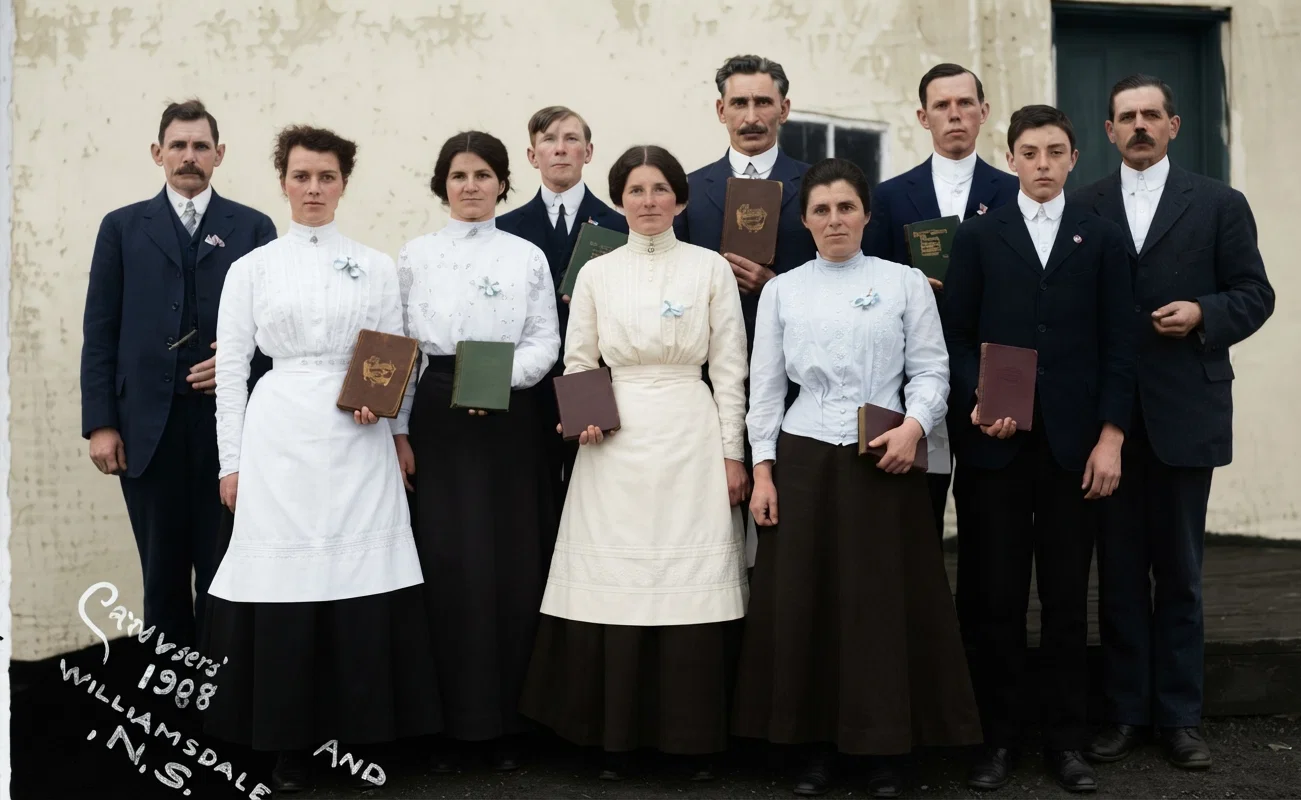
MARITIME COLPORTEURS
THE accompanying illustration shows the band of canvassers that went out from Williamsdale Academy, in Nova Scotia, this season. All are working for scholarships. Good reports of their work are already being received.
In the Maritime provinces it is frequently necessary to procure a license16to canvass for our books or magazines. At least five of those shown in the picture have been compelled to pay this fee. Against all difficulties, they press forward, and the Lord blesses the faithful ones.
A ten days' institute was held at the close of the school at Williamsdale. In this it was the privilege of the writer to assist the field agent, Geo. W. Miller. While the number of canvassers in the Maritime Conference is small this year, there is promise of a healthy growth next season. Our young people are awakening to the value of the scholarship arrangement, and also to the importance of the training to be had in meeting people and placing our good books in their homes.
An institute was also held at the Lornedale Academy, in Ontario. As this province has no field agent, I was alone there. The class at this place was larger than the one at Williamsdale, a canvassers' band having been kept up during a large part of the school year. About half a dozen from this school are already at work with good success, and a dozen or so more will enter the field after the camp-meeting.
While we have our share of difficulties in this field, they are not insurmountable, with the Lord's help. We are of good courage, and are pressing the battle against error with all our might.
E. R. ALLEN.
Southern Oregon Camp-Meeting
By W. F. Martin
This meeting was held, according to appointment, at Roseburg, May 9-19. The same grounds were used as last year. Elder C. W. Flaiz was present during most of the meeting, and took an active part in the preaching. The brethren and sisters appreciated his counsel and sermons very much. Elder A. O. Tait spent one day on the ground, and gave two good talks on the prophecies. Profs. E. C. Kellogg and M. E. Cady each spent a few days on the ground, and did good work for Christian education. These brethren, with the local laborers and the writer, did the preaching during the meeting. Brother W. R. Beatty was present a part of the time, and assisted in the book work on the ground. Although the strawberry festival was held in the city at the time of the meeting, the outside attendance was good, and a deep interest was manifested in the word spoken. Notwithstanding considerable work has been done in Roseburg, and last year the annual camp-meeting was held there, at no time in the past has there been so deep an interest as at present.
Those who camped on the ground earnestly sought the Lord, and as a result his presence was in the camp. From day to day God's people gained a deeper experience. At the close, it was the unanimous opinion that this was the best camp-meeting the people present had ever attended. This is as it should be. As we draw nearer the end, our meetings should grow better. There were forty family tents on the ground. The attendance at the Sabbath-school was 248. That was larger than last year. Liberal donations were made for all the needy causes presented.
At the close of the meeting, six were baptized. Elder F. S. Bunch was again chosen president. But few changes were made in any of the conference officers. The people went from the ground with excellent courage, and we are sure there is a good year ahead for the Southern Oregon Conference.