CLARENCE was very much out of sorts because his father had refused to give him twenty-five cents to go inside the tent of a variety-show that was flapping its wing-like awnings on the meadow back of the town.
“George Converse will go,” he said to himself: “and he always does everything he wants to, but then his father has plenty of money. Oh, dear! what won’t money do?”
“What, indeed? My little man, you are getting to ask that question early in life.” And Clarence was astonished and chagrined to find that he had been thinking aloud, and that Captain Arrin Clark, the richest man in the borough, had been listening.
“Money is a good thing to have,” said the good-natured Captain, slapping his pocket; “and I hope that when you grow up, you will earn a plenty of it in an honorable way; but I guess I shall have to tell you a little story that my father used to tell when I was a little lad like you.”
The Captain almost always had to tell a little story, but as they never were at all questionable stories, no one objected to listening to them; and as Clarence stopped and looked up into his fair, round face, the pucker smoothed itself out of his own brow, and the old man went on:—
“Once there was a very homely man by the name of Jotham, who, by hook and by crook, accumulated a great deal of money; and to make a display of it, he built himself an elegant house in a little country town where he was born, and over the front entrance he had printed in gilt letters: ‘What won’t money do in any place?’ One of his old neighbors, going along and seeing it, climbed up on the staging the painter had left, and wrote under it: ‘It won’t buy Jotham a handsome face.’ When the rich owner came to view his property, he found his own question answered in very plain words. Now, my little man, if you set yourself about it, you can think of plenty of things that you have that money will not buy.”
Clarence looked so puzzled that the Captain went on: “If money would buy your rosy cheeks, would not I buy them for my little granddaughter? If money would buy straight legs like yours, would Esquire Converse’s little boy go on crutches? There are plenty of things money won’t buy, my little man, and one is, the love of God and faith in a Saviour’s love; yet you may have both without money and without price. But here is a gold dollar to pay you for listening so politely. I don’t believe as sensible-looking a boy as you are will spend it to go in to a variety-show like that down in the back meadow; for common sense is another thing money won’t buy, and if any one has it, he would better use it.”
“My father has common sense,” said Clarence, as he went up the street holding the gold dollar between his thumb and finger in his pantaloons’ pocket, “and mother has the faith he was talking about. I think I have made out better in every way than I should, had father given me the twenty-five cents and allowed me to go to the show. I don’t believe I ever shall forget this talk.” And he never has.—Exchange.
WILLING CHARLIE.
LITTLE Charlie Weston had been working hard one winter’s day, and he came in at nightfall, and sat down by the stove in the dining-room to rest and warm his feet. “Now, mamma,” he said, “I don’t want to go out again to-night, no, not even for the President.”
Mamma laughingly replied that she did not believe the President would want him, and there was no need of his going out if he did not wish to do so.
Scarcely had she given this answer when Mr. Weston came in from business, and quickly exclaimed, “Charlie, I am glad you are here!”
“Why so, papa?”
“Because I want an errand done. Can you run down to Mr. Jackson’s store, and bring up a parcel I have left there?”
“Oh, don’t send the boy out to-night,” said mamma, “he is very tired.”
Charlie didn’t wait for his papa to say more, but looking up with a radiant face, he exclaimed, “I could never get tired of working for you, papa!” and cheerfully donned his hat and coat and started forth.
This was in Massachusetts, where the winters are cold indeed. The wind blew upon this particular night as if it were in a spiteful humor; but Charlie trudged along, whistling for company. He would not let a grumbling thought arise, for was he not working for papa, who always had worked for him?
The store was reached after a walk of a half-mile, and Charlie was glad of a place where he could warm his fingers and rest for a little time.
“Well, Charlie,” said Mr. Jackson, “you did not think it too cold to come after your skates, did you?”
“After my skates?” echoed Charlie; “what do you mean, sir?”
“Why, didn’t your papa tell you what he had done? He ordered a pair of skates for you, and said he would rather you would choose them for yourself, and if you did not come down to-night, I might consider the order good for nothing. And so I have been looking for you, and wondering whether I had made a sale or not.”
“Papa did not tell me what I was to bring home, but only that it was a parcel for him,” replied the delighted Charlie, as he proceeded to pick out a pair of skates from those the shop-keeper displayed.
He had been wishing for a new pair for weeks past, and here they were within his grasp at an unexpected moment.
After he had selected the skates, he was soon upon his homeward road, whistling more cheerily than before, and saying to himself that the night had grown warmer, while in reality the wind had grown still more spiteful.
When home was reached, and the skates had been duly admired, Charlie’s papa told him he had earned them by his ready obedience; had he been unwilling to go out in the cold, he would have lost them. “In this case,” said he, “obedience gains a quick reward.”
Do the dear children ever think that obedience is especially pleasing to the Lord? The Bible says, “This is well pleasing unto the Lord.” And though we may not, as in Charlie’s case, always see the immediate reward for each act of obedience to parents, we are assured by the Lord that it will be well with those who keep the fifth commandment.—The Child’s Paper.
A CHILD’S PRAYER.
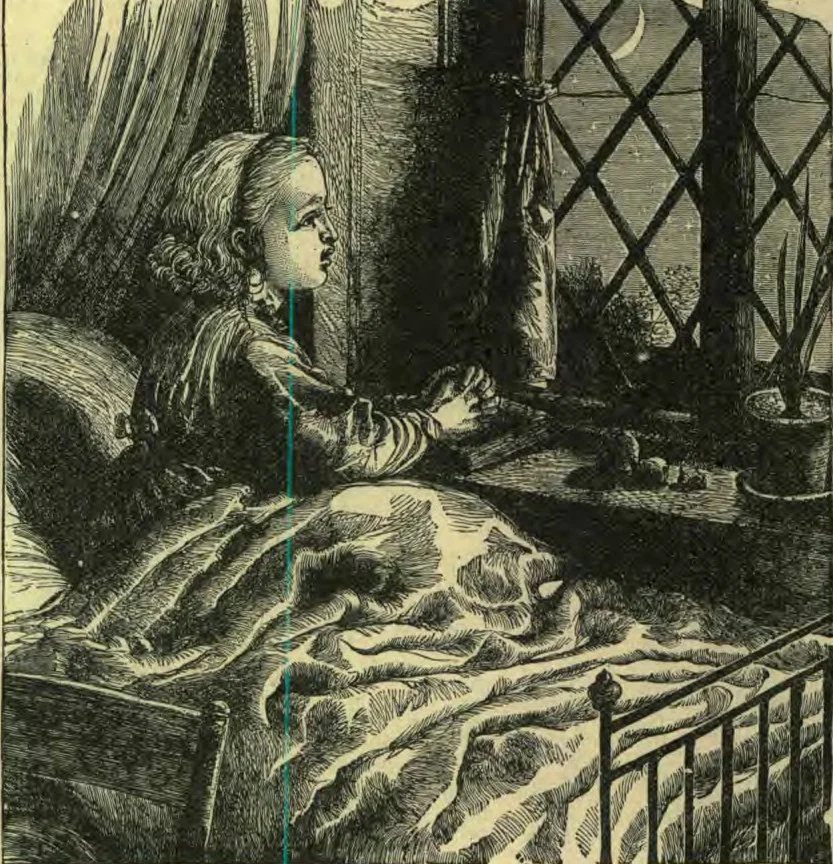
The day is gone, the night is come,
The night for quiet rest;
And every little bird has flown
Home to its downy nest.
The robin was the last to go;
Upon the leafless bough
He sang his evening hymn to God,
And he is silent now.
The bee is hushed within the hive;
Shut is the daisy’s eye;
The stars alone are peeping forth
From out the darkened sky.
No, not the stars alone; for God
Has heard what I have said;
His eye looks on his tender child
Within this little bed.
He kindly hears me thank him now
For all that he has given—
For friends, and books, and clothes, and food;
But most of all for heaven,
Where I shall go if I am good,
And try to do the right;
Where I shall meet all those I love
As angels pure and bright.
Letter Budget.
We have received a letter from Linn Co., Kan., written by Elmer F. Palmer. He says: “Dear Instructor family, I love to read your letters, and the Instructor. We attend Sabbath-school and meeting at Mound City, seven miles from our home. I am learning the last chapter of the Revelation. I think Isaiah 35 is a good chapter to learn. I am trying to live so as to meet you in the new earth.”
Yes, that is a good chapter to learn; and then, some of the psalms are so beautiful. But a lover of the Scriptures finds beauty all through this holy book.
Mabel Sanders writes from Mendocino Co., Cal. She says: “I wrote once to the Budget, but did not see it printed, so I will write again. I have five sisters. We all keep the Sabbath; but papa does not. We hope he may sometime. I will try to tell you something about our home life. I braid mats and piece quilts; I can sew on the machine too. Papa made a sled, and I haul wood with the mare. Her name is Flora. I harness her and drive. My oldest sister generally milks the cow, but she is sick now, and so I milk. I am twelve years old. I can cook, and eat as well. Papa drives stage. He goes by our house every night. I am trying to be a good girl, that I may enter in at the straight gate. I send much love to the Instructor family and the editors.”
Your help must be very acceptable, Mabel, you can do so many kinds of work. Do you know that many persons with poor digestion would be glad to say with you “I can eat as well as cook?” So be careful always to eat healthfully, that your appetite may keep natural.
David and Daniel Kivett write from Cass Co., Mo. They say: “As this is our first letter to the Budget, we fear we shall not be able to interest you. We go to Sabbath-school when it is not rainy or too cold. We could not go last Sabbath, for the thermometer was 21 degrees below zero, and the wind was blowing very hard. We all go in one wagon; five are grown persons, so you can guess there is quite a load of us,—nine in all. The Instructor class say we have better lessons than they. Our next lesson is ‘Jacob leaves home.’ A dear little neighbor friend went with us last Sabbath, and enjoyed it very much. She reads in the Instructor, and says she wants to write to the Budget. We enjoyed Christmas better than we ever did before. We all gave gifts to our Master. Our Sabbath-school is held at a private house three miles away. We have three goats. One of the old ones is a curiosity. He likes to have us play with him. He can stand upon his hind feet, and make a strange noise. His horns are five feet and three inches long from tip to tip. His wool is nearly eight inches long, and very white. We have a little brother named Samuel. We all want to be good boys, so we can have a home in the new earth.”
One of these little boys is eight years old, but the letter did not say which. It may be they are twins. You will all enjoy reading their good letter; and we want you to notice one thing particularly,—that they “enjoyed Christmas better than they ever did before.” Do you know why? Others have written the same thing, some who observed Christmas very much as these little boys did.
Georgie Emerson writes an interesting letter from Pope Co., Minn. He says: “I do not ever see any letters in the Instructor from here, so I thought I would write one. I was nine years old last August. I have three sisters older than I, and a little brother four years old. We all keep the Sabbath. My parents have kept it twelve years. Our church is only a few steps from our house. We have a good Sabbath-school. I am in Book No. 2. Mamma is my teacher. When I was just six years old, papa gave me a little pair of steers for being a good boy. I sold them this winter for fifty dollars. I paid five dollars tithe, paid for all the clothes I wanted this winter, and got another little pair of steers, and now I have some money of my own to give to the Sabbath-school, and to the missionary cause every fourth Sabbath. Last Sabbath was missionary day, and mamma had no money to give, so I gave some for her too. I have no day school to go to this winter, but I study at home. Before papa went to work in the cause, he told me to study every day, and then I should have an hour every day to drive my steers. He made a little yoke for them. On the nice days my little brother and I yoke them up and drive. While pa is gone, I have six horses and nine head of cattle to take care of, besides the kindling wood to cut. But my sisters are good to help me. I want to be a good boy, and meet the Instructor family in the earth made new.”
Georgie remembered his tithe, and we think he is a cheerful giver of the remainder. Do you know, dear boy, that if you take good care of the stock, and do all your home work well, it will be counted just the same as so much work done where papa works? In the long ago Bible times, you know, those persons who tarried by the stuff, received just as much as those who went to battle. So if you do work cheerfully in father's place, that he may serve the Master in another way, you are laying up treasure.