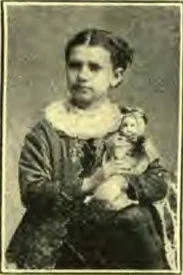
O DOLLY, dear! it rains again!
The sky is always crying!
And just as I had got your
clothes
Out on the line a-drying!
It’s rained most eve’y day this
week;
And yesterday, you ’member,
It poured all day a steady
stream;
It seems just like November!
And Tuesday when I went to ride,
And wore my Sunday bonnet,
When I got home, I counted more
Than thirteen spots upon it!
But mama says I love the buds
(And so I do — most dearly!),
And it’s the rain that brings them out;
And that I see quite clearly.
So, dolly, dear, I’ll wash again
To-morrow for my baby;
And then we’ll lift the mosses up,
And find some blossoms, maybe.
— Selected.
The Bear and the Umbrella
THERE is a cleared trail leading from the home of Mrs. Latham, Indian River, Florida, to the beach, half a mile away. It runs, according to St. Nicholas, through a jungle of cabbage palmetto, live oak, and saw palmetto. Mrs. Latham was returning from the beach alone one day, armed only with an umbrella.
When a quarter of a mile from the house, she heard the rustling of some animal coming toward her through the saw palmettos. Thinking it must be a raccoon, she quickly picked up a chunk of palmetto wood, and held it ready to strike the animal over the head the instant he emerged.
All at once, and with a mighty rustling, out stepped a big black bear within six feet of her. The surprise was mutual and profound. Naturally, Mrs. Latham was scared, but she stood her ground, and said nothing.
The bear rose on his hind legs to get a better look at her, making two or three feints in her direction with his paws. Feeling that she must do something, Mrs. Latham pointed her umbrella at the bear, and quickly opened and closed it two or three times.
“Woof!” said the bear. Turning about, he plunged into the palmettos and went crashing away, while Mrs. Latham ran homeward as fast as she could.—Pilgrim Visitor.
The Story of the Storm
By Belle V. Chisholm
SOME touching stories illustrating the compassion of shepherds for their flocks, as well as the devotion of dogs to their masters, even to the death, have come to us as a result of a blizzard in Montana. Nine lives are known to have been lost, five being those of sheep-herders, of whom three were scarcely more than boys not yet out of their teens. The position of their bodies when discovered indicates that they had stayed with their flocks to the last, dying in the attempt to save the sheep committed to their care.
William Candale, working for a company in the East, was found dead near the little village of Hearly Butte. Everything went to show that he had labored the night through trying to get his flock into camp, but without success. Conscious of the death that was impending, he returned to his tent some time after midnight, and there, with stiffening fingers, penciled a note that he pinned to the wall, saying that he was nearly exhausted, but was about to return to the sheep, which were drifting up the coulee. At daybreak he was found stretched on the snow, his lantern near him, and the sheep lying dead around him. Evidently he had used his last failing strength to save his flock. Of his two dogs, one remained to guard his body, and the other, still alive, was walking round and round among the dead sheep as if expecting them to awake from their long, last sleep.
Another young man remained with his flock until he managed to drive them into a sheltered spot where they would be safe. Blinded by the storm, he mistook the coulee where his cabin was built, and wandered up another. Realizing his mistake too late, he turned back, and fell within a few feet of his home and safety. The searching party found his dog stretched across his dead body. It was dead too, its love for its dead master having cost its life, since, if it had chosen, it could easily have kept itself warm by moving about.
Another very young boy was found with his arms crossed upon his breast. His faithful dog had followed his sheep into camp and driven them into shelter, and then returning to its master, met the rescue party, and conducted it to the shepherd. It was too late. The shepherd boy was dead, and the devoted dog, seeming to understand what had occurred, set up a low whining, and no amount of coaxing could induce it to leave the body to go in search of other lost shepherds.
Another shepherd was found buried in the snow, his beard and clothes and part of his boots having been eaten off by the sheep. One of his dogs kept watch by his side, and it was through its whining, low and pitiful, like a child's sobbing, that the searchers were directed to the spot where the dead master was buried out of sight in the snow. The other dog had followed the flock, and was found frozen to death among the sheep.
The fifth herder had just succeeded in getting his sheep into camp when he fell dead at the gate; there his dog was found watching between him and the flock, walking back and forth, and almost dead himself.
It is probable other shepherds lost their lives in the blizzards, as flocks of sheep without shepherds have been heard of from various points, some of them having returned shepherdless, and others were found dead in the snow, but no shepherds have returned without their sheep; but later their dead bodies will be found, and doubtless by the side of every shepherd will be found his faithful watch-dog.—Belle V. Chisholm.
A Farmer's Pledge
By A. L. Noble
“Hello, who are you?” asked one of Tom Mather’s reapers, of a seven-year-old boy.
“I am papa’s temperance pledge.”
“You are! Well, then, I have a mind to pitch you into the middle of next week, if it is you who are keeping us from having a comfortin’ drop of whisky and water,” said a reaper.
“Yes, it’s me,” laughed little Dick, in high glee; “and if you want to know where papa signed me, I’ll show you;” and the little boy pulled down the collar of his shirt, and showed a queer white scar on the shoulder, reaching up toward his throat.
“Yes, boys,” said Tom; “that little fellow is my pledge, and I signed him, though he does not know what that really means. When I bought this farm ten years ago, I did not know the taste of rum or whisky. Everybody took a little, as I found, in harvest times and when work was pressing, so I fell into the same way; a drop if the weather was very hot; a little if it was very cold; a long drink at noon if I was hard at work. I always kept cider in my cellar, all my workmen had it, and some way the farm began to run down, too. Summer before last, it was very hot, and I was not very well; had been having chills. When they came on, I thought nothing helped me more than a little—no, a great deal of whisky. One noon, in the fields, I was rather hungry, the dinner horn had not sounded, and I picked up my jug, and took a long pull. What with the heat and taking it on an empty stomach, the whisky flew to my head as never before. I cut the grain every way, the ground rising up and going down under me, and the farm shifted till the points of the compass were all wrong. You just saw that boy of mine? He is my only one, his mother’s idol, and—well, I would die for that boy any day. The little chap had taken his puppy and wandered off out where I was working. It was hot. He was only five years old, and what did he do but lie right down where the tall grain would shade him, and go to sleep,6the puppy cuddling down and doing the same. Well, the dizzier I got, the more recklessly I swung about, and suddenly I slashed out with that sharp steel, and—dear sakes alive! boys. Just you fancy it! The poor little puppy never yelped, his throat was cut so clean; and that boy of mine! One great gash down his soft, white flesh, right up to his tender little throat, but escaping it, for the puppy nestled there! I don’t know much about the rest of that day, until I heard the boy wouldn’t die. But when old Dr. Kinley said he might live, I just held him up to God in my arms, and I said: ‘Here, Lord, is my temperance pledge! I’ll never touch one drop of liquor while I live, and this boy, whose life has been spared, never shall either, if prayers and example and teaching can prevent.’ And so, boys, I can’t treat you, for I have signed my pledge in blood.”
There was no more murmuring after that.—A. L. Noble.
Home Talks
I WONDER whether there would be less work to do if Edward should hang up his hat instead of leaving it for Mary? If Mary should carry her shawl with her to the carriage instead of asking Edward to step back for it? If Anna would bring her book down-stairs instead of asking Alice to turn back to get it? If, when Lucy left the piano, she had shut it instead of mother's having to do it when bedtime came? If Alfred always closed the door after him, instead of his wife's having to get up? I remember how willing we are to do these little things for one another—but—I—just wonder!—Our Young Folks.
Making Paper Milk Bottles
ONE of the most serious objections to glass milk bottles is the difficulty in securing proper cleansing before they are refilled, with the accompanying possibility of spreading infection. Efforts to secure improvement in this detail of milk service have hitherto been unsuccessful, mainly because of failure to obtain a satisfactory substitute, says American Medicine. Recent investigations by Dr. A. H. Stewart, of the Bacteriologic Department, Philadelphia Bureau of Health, indicate that at last a very acceptable container has been found in what he designates as a single-service, paper milk bottle.
It is made of heavy spruce wood-fiber paper, conic in shape to facilitate nesting, and with an ingenious locking device to retain the bottom. An important feature of the bottle is its saturation with paraffin by being dipped in that substance at two hundred twelve degrees Fahrenheit, and then baked. This sterilizes the bottle, and prevents the milk from coming in contact with the paper itself, and adhering, as it does to the glass bottle. For shipment, the bottles are packed in nests of twenty, three nests being sealed in a sterile bag; the lids are also put up in sterile packages.
Bacteriologic tests with the sample bottles were exceedingly satisfactory; none were found to contain micro-organisms. Closed bottles were sent to several dairies near Philadelphia, a glass bottle and a paper bottle at each being filled from the same lot of milk. When received at the bureau, the glass bottles invariably showed slight leakage around the caps; the paper bottles did not. In every instance the milk in the paper bottle contained fewer bacteria than did that in the glass bottle, the average being a fourth as many as in the latter. Certified milk in the paper bottles kept sweet two days longer than that in glass bottles.
If these paper containers give such results in general use, the delivery of milk in cities bids fair to be revolutionized. They are light, tightly sealed, perfectly clean and sterile, and are to be used but once, thus doing away with all bottle washing in private houses and in milk depots. Their cost is such that they may be used without increasing the present price of milk to the consumer.—Search-Light.
Wood-Anemone
By Cornelia Snow
“THE starry, fragile windflower,
Poised above in airy grace,
Virgin white, suffused with blushes,
Shyly droops her lovely face.”
— Elaine Goodale.
The bright little wild flower called anemone, or windflower, takes its name from the Greek, and means shaken by the wind, because it grows in windy places, and blooms in the season of spring breezes. The Greeks had a tradition that “Anemos, the Wind, sent these flowers as heralds of his coming.”
Taking a stroll in April or May along some wooded hillside, you may discover these small, white, pink-tinted blossoms.
“Thou lookest up with meek, confiding eye
Upon the clouded smile of April’s face,
Unharmed though Winter stands uncertain by,
Eyeing with jealous glance each opening grace.”
The odorless flowers are solitary and terminal, having from four to seven petal-like sepals. The plants are usually less than nine inches in height. The leaves appear at the base; there are also three leaves on the delicate, slender flower stem, in a whorl below the flowers. These leaves are divided into five-toothed leaflets, resembling some relatives in the Crowfoot family.
In Europe scarlet and purple anemones are found. The peasants are said to hurry past a field of these flowers, believing that they poison the air. A species found in China is called the “death-flower,” and is often planted on graves.
The early, wild flowers of the woods linger but a short time, and whoever would make their acquaintance must search them out in shady dells and leafy forests. CORNELIA SNOW.
Usefulness Is the Badge of True Knighthood
“USEFULNESS is the badge of true knighthood.”
The Return of the Spring
By Sarah E. Sprague
IF you wait for the breath of the lilacs
To tell the return of the spring,
And must see the red breasts of the robin
To know the glad note he will sing;
If you hear not his song, clear and happy,
Inwoven with ev’ry warm breeze
That floats joyously up from the Southland
To bring the green back to the trees;
If you see not the hue of arbutus
In every pink-tinted cloud;
If you see not ’mid lingering snowdrifts,
That jonquils and crocuses crowd;
If you smell not the breath of the flowers
Ere yet they have started from earth;
If you feel not the sap when ascending,
And know not the violet’s birth;
If you see but the first pussy-willow
In silver-gray hoods that they wear,
And you feel not the thrill of your childhood,
The dropping of years and of care—
You will miss all the message of Spring-time
And hear not her footsteps advance
By the paths known of birds and of blossoms,
With sunbeams and youth all a-dance.
— Sarah E. Sprague.
The Lewis and Clark Exposition
By Mrs. L. F. Beaty
On the first of May, 1905, there opens in Portland, Oregon, an exposition which bids fair to be unique in its way, and different from the expositions other States have been holding. It is to be called the Lewis and Clark Exposition, after the two noted explorers, who, in the beginning of the nineteenth century, found a way to the great Northwest, and opened up that hitherto unknown country for exploration.
In the early part of the year 1803 Congress appointed Capt. William Clark and Meriwether Lewis to conduct an expedition to the head waters of the Missouri River, and thence across the country to the Pacific Coast. Setting out late in the year with only twenty-eight men, Lewis and Clark spent the winter at the mouth of the Missouri River, as the weather was too severe to admit of their traveling on ice-bound rivers.
In the spring of 1804 the party embarked in open boats, and during the summer ascended the Missouri as far as forty-seven degrees twenty-one minutes north latitude, and passed the second winter among the Indians inhabiting that region. Early in the summer of 1805 they ascended the Missouri as far as the tributary which they named the Jefferson River, and which they followed to its source in what is now the State of Montana. They then procured from the Shoshone Indians a guide and horses, and pushed on until they reached a tributary of the Columbia River, on which they embarked in boats, reaching the mouth of the Columbia River on the fifteenth of November. They spent a winter of hardships and privation, and made the return trip to the Mississippi the next summer, reaching there in September, 1806, almost three years after they left.
All of the exploring party were given liberal grants of land, Lewis himself being appointed governor of the new territory of Missouri; but unfortunately he was subject to severe fits of melancholy, and the contrast between his duties as governor and the active life he had led was so great as to cause his mind to become unbalanced, and while on his way to Washington he committed suicide near the city of Nashville, Tenn., October, 1809.
It is right that the great exposition to be held in the far Northwest should be named after the men who, in spite of dangers from hostile Indians and wild animals of the unexplored forests of that Western wild, pushed on and on until the waters of the Pacific lay stretched before their gaze.— Mrs. L. F. Beaty.
Jesus the Creator
By Emma S. Newcomer
1. Who was associated with the Father in the beginning?
“In the beginning was the Word, and the Word was with God, and the Word was God. The same was in the beginning with God.” John 1: 1, 2.
2. How may we know this Word was Jesus?
“And the Word was made flesh, and dwelt among us (and we beheld his glory, the glory as of the only begotten of the Father), full of grace and truth.” John 1: 14.
3. What part did Jesus perform in the creation of the world?
“He was in the world, and the world was made by him, and the world knew him not.” John 1: 10.
4. Who worked with Jesus in the creation?
“And to make all men see what is the fellowship of the mystery, which from the beginning of the world hath been hid in God, who created all things by Jesus Christ.” Eph. 3: 9.
5. What did he create besides the earth and the things upon it?
“For by him were all things created, that are in heaven, and that are in earth, visible and invisible, whether they be thrones, or dominions, or principalities, or powers: all things were created by him, and for him.” Col. 1: 16.
EMMA S. NEWCOMER.
VI—Ministration of Good Angels
(May 6)
MEMORY VERSE: “The angel of the Lord encampeth round about them that fear him, and delivereth them.” Ps. 34:7.
Questions
1. Where are the angels? How many did John see? Rev. 5:11.
2. What does Paul say of their number? Heb. 12:22. What does the psalmist say? Ps. 68:17.
MEMORY VERSE: “Thy word have I hid in mine heart, that I might not sin against thee.” Ps. 119:11.
“Then was Jesus led up of the Spirit into the wilderness to be tempted of the devil. And when he had fasted forty days and forty nights, he was afterward an hungered. And when the tempter came to him, he said, If thou be the Son of God, command that these stones be made bread. But he answered and said, It is written, Man shall not live by bread alone, but by every word that proceedeth out of the mouth of God.
“Then the devil taketh him up into the holy city, and setteth him on a pinnacle of the temple, and saith unto him, If thou be the Son of God, cast thyself down: for it is written, He shall give his angels charge concerning thee: and in their hands they shall bear thee up, lest at any time thou dash thy foot against a stone. Jesus said unto him, It is written again, Thou shalt not tempt the Lord thy God.
“Again, the devil taketh him up into an exceeding high mountain, and showeth him all the kingdoms of the world, and the glory of them.”
“And the devil said unto him, All this power will I give thee, and the glory of them: for that is delivered unto me; and to whomsoever I will I give it. If thou therefore wilt worship me, all shall be thine.”
“Then saith Jesus unto him, Get thee hence, Satan: for it is written, Thou shalt worship the Lord thy God, and him only shalt thou serve.”
“And when the devil had ended all the temptation, he departed from him for a season.” “And, behold, angels came and ministered unto him.”
One day about this time, as Jesus passed a place where John and two of his disciples were standing, John exclaimed: “Behold the Lamb of God!”
“And the two disciples heard him speak, and they followed Jesus. . . . One of the two which heard John speak, and followed him, was Andrew, Simon Peter’s brother. He first findeth his own brother Simon, and saith unto him, We have found the Messias, which is, being interpreted, the Christ. . . .
“The day following Jesus would go forth into Galilee, and findeth Philip, and saith unto him, Follow me. Now Philip was of Bethsaida, the city of Andrew and Peter. Philip findeth Nathanael, and saith unto him, We have found him, of whom Moses in the law, and the prophets, did write, Jesus of Nazareth, the son of Joseph. And Nathanael said unto him, Can there any good thing come out of Nazareth? Philip saith unto him, Come and see.
“Jesus saw Nathanael coming to him, and saith of him, Behold an Israelite indeed, in whom is no guile! Nathanael saith unto him, Whence knowest thou me? Jesus answered and said unto him, Before that Philip called thee, when thou wast under the fig-tree, I saw thee. Nathanael answered and saith unto him, Rabbi, thou art the Son of God; thou art the King of Israel. Jesus answered and said unto him, Because I said unto thee, I saw thee under the fig tree, believest thou? thou shalt see greater things than these. And he saith unto him, Verily, verily, I say unto you, Hereafter ye shall see heaven open, and the angels of God ascending and descending upon the Son of man.”
Questions
1. What words had been spoken by a voice from heaven when Jesus was baptized? Immediately after his baptism, where did Jesus go? What happened to him there? Why was it necessary for Jesus to be tempted? Read Heb. 2:18.
2. How many days did Jesus fast? When they were ended, who came to him? What were his first words to the Son of God? What do they show? What did he tell Jesus to do? Why was this a temptation to him? Tell how Jesus met this temptation. How is his example a help to all who are tempted to indulge appetite?
3. Where was Jesus then taken? What did Satan again say? What did he tell Jesus to do? What promise did he repeat? With what words did Jesus rebuke the tempter? Why can we not expect God to protect us if we go rashly into known danger?
4. To what place was Jesus next taken? What were shown him there? What glowing promise did Satan make? But what must Jesus do? Repeat the words with which Jesus met this crowning temptation.
5. How did the Son of God meet every temptation? Can Satan bring any temptation to any one that can not be met in the same way? But what must those do who overcome? Memory Verse.
6. When the temptation was ended, who came and ministered to Jesus? Do you think he had any help that you do not have? Do angels still “minister” to men? Read Heb. 1:14.
7. Whom did Jesus pass one day not long after this? What did John exclaim when he saw him? Who heard him? What did they immediately do? To whom did Andrew hasten with the good news? What did he say?
8. Tell how Philip was called. What did he do at once? What did Nathanael ask? What did Philip urge?
9. What did Jesus say when he saw Nathanael coming? Tell how this man was convinced that Jesus was indeed the Son of God. What did Nathanael say? What gentle rebuke did Jesus give him? What did he say Nathanael should hereafter see?
Being Thankful
“God is so good to me!” exclaimed Mary, the housemaid, with shining, happy face, one morning.
“Why what has happened?” asked her mistress. “Have you been left a legacy? You surely look as if something wonderfully good had come to you.”
“Well, you know last night,” replied Mary. “I stayed up late to finish my ironing, and when I took the iron off the stove the last time, I was that tired that I didn’t notice the handle wasn’t on right, and the flat-iron dropped right down within an inch of my foot. Think of what a narrow escape, ma’am. Think of where I would have been if it had fallen on my foot. And here I am this morning strong and well and able to work. Oughtn’t I to be thankful for God’s mercy, ma’am?”
Her mistress was silent; then she spoke softly. “Your thankfulness and gratitude, Mary, are a lesson to me. If more people were like you, it would be a different world. Most of us are ready to bemoan if an accident happens to us, but few of us think of giving thanks for an escape.”—Selected.
Advice Versus Assistance
“THERE are few men who do not love better to give advice than to give assistance.”
A Kind Word Is Never Thrown Away
By Arthur Helps
Wise sayings often fall on barren ground; but a kind word is never thrown away.—Arthur Helps.
Messages and Vetoes
By Editor
THE message of the president at the opening of a session of Congress is always an important document. It is awaited with interest not merely by Congress itself, but by the whole country. Frequently it causes earnest discussion in other countries.
The Constitution requires the president from time to time to “give to Congress information of the state of the Union, and recommend to its consideration such measures as he shall judge necessary and expedient.”
Washington and John Adams obeyed this mandate of the Constitution by delivering oral addresses. The democratic Jefferson set the precedent of written communications, and all of his successors have followed this precedent.
It has thus come about that an American president never enters either house of Congress for the purpose of influencing its action, nor has he any official representative in the Capitol, although certain senators and congressmen may be identified with his policies. His only recognized means of initiating legislation is by a message; even in that he does not submit specific laws. Lincoln once sent the draft of a bill with a brief message asking for its passage, but a debate at once arose as to the president’s right to submit bills, and the example has not been followed.
But the president finds it easy enough to let Congress know what he desires. The cabinet officers are frequently public men of long experience and large personal followings, and they are expected to support the recommendations of their chief.
The importance of a message may lie in the information it conveys, no less than in its recommendations. This is particularly true of messages in regard to foreign affairs. The famous message concerning the Venezuelan boundary commanded the attention of the world for both reasons. An obscure situation was explained, and a policy was announced in which two continents were intensely interested.
The provisions of the Constitution regarding the president’s veto are very general. When a bill is presented to the president, “if he approve, he shall sign it, but if not, he shall return it, with his objections.” Taken literally, this clause justifies the president in exercising a perfectly free judgment upon every act submitted to him.
But taken in connection with the first sentence of the Constitution, “All legislative powers herein granted shall be vested in a Congress of the United States, which shall consist of a Senate and House of Representatives;” there is reason for a more limited conception of the veto power.
While Congress is in session, if in ten days the president neither signs nor vetoes the bill which is passed, the bill becomes a law without his signature. The effect is precisely the same as if he had signed it.
Presidents have at times used this method to emphasize the fact that they were not satisfied with a measure which they were yet unwilling to veto.
Early presidents were sparing in the use of the veto power. They signed bills which they did not in the fullest sense of the word “approve,” because they held that they had not the right to employ the constitutional privilege for the purpose of reviewing the acts of Congress. When they returned bills, they did so because they regarded the measures as unconstitutional; what seemed merely inexpedient they signed.
The first president to transgress this rule when great measures were at stake was Mr. Tyler. His practise was roundly condemned by the Whigs, who regarded Mr. Tyler as a political traitor, and the Democrats, on the other hand, stood up as advocates of the “constitutional veto.”
The more free interpretation of the president’s right and duty grew gradually but steadily in favor, at least with the presidents themselves, and is now universally accepted. Each president has to decide questions for himself under the responsibility of his oath of office.
The veto power has, on the whole, been a useful and conservative instrument; and so long as the people are vigilant, it can never be an engine of oppression. It may delay, but can not prevent, what the people wish to have accomplished.—Editor of Youth’s Companion.
Ordering Basket Material from South Lancaster Academy
It has been suggested that it would be well for the basket makers to order material by the pound from the academy at South Lancaster, Massachusetts.
Reading Circle Membership Drive for 1905
THE Reading Circle now numbers more than one hundred readers; but the editor would like at least two hundred names before giving the list in the INSTRUCTOR. Are there not others who can find time and inclination to read five books of worth during the year 1905?
Annual National Expenditures on Liquor, Tobacco, and Missions
“THE annual expenditures in the United States for various objects during the year 1904 are stated as follows: Liquor, $1,200,000,000; tobacco, $600,000,000; jewelry, $450,000,000; dress, $250,000,000; church expenses, $125,000,000; home missions, $12,000,000; and foreign missions, $5,000,000. Here are figures that ought to make every professed Christian blush for shame. The amounts spent for liquor and tobacco are truly staggering.” It is to be hoped that Christians have had no part in making these figures.
The Cost of Firing Cannon
MODERN naval warfare, says Leslie’s Weekly, is one of the most costly things that can be imagined, and a combat between two fleets means the expenditure of vast sums of money.
Some idea of the high cost can be arrived at by taking a Japanese warship like the “Kasuga” or “Nysshin” and calculating the number of shots she would discharge, say, at Port Arthur.
The first-named ship carries four cannon, which cost $30,000 each. One of these guns can fire two shots a minute, and every shot cost $400; thus in five minutes these four cannon can discharge forty bombs at a cost of $16,000. The smaller cannon cost $18,000, and every shot they fire means an expenditure of seventy dollars. They are very rapid, and it is estimated that in five minutes the twelve cannon could discharge shot to the value of nearly $35,000.—Selected.
A Mother's Love: Verses of Devotion
“OVER my heart in the days that are flown
No love like a mother's love ever has shone;
No other worship abides and endures
Faithful, unselfish, and patient like yours.”