Review and Herald Publishing Company · Battle Creek, Mich. · December 5, 1901
YOUNG PEOPLE'S SOCIETY OF SEVENTH-DAY ADVENTISTS
Ever since the last General Conference, the Young People's Work has been the subject of most careful consideration by the committee appointed to have the oversight of that work. The instruction given by the spirit of prophecy has been faithfully studied. In some of these Testimonies, reference is made to the work of similar societies connected with popular churches. As further light upon these statements, we were told that it is the spirit and energy, and the far-reaching efforts in behalf of all classes of people and all lines of Christian work, that are worthy of our imitation, rather than the plan of their organization.
It seemed quite clear that the plans for our work should not follow the idea of an organization wholly separate from the church, or independent of it, but rather that it should bear the relation of a department to the church work. The following extracts from the Testimonies on this subject, furnish the basis of the organization that is recommended:—
"Young men and young women, can not you form companies, and as soldiers of Christ enlist in the work, putting all your tact and skill and talent into the Master's service, that you may save souls from ruin? Let there be companies organized in every church to do this work. Will the young men and young women who really love Jesus organize themselves as workers, not only for those who profess to be Sabbath-keepers, but for those who are not of our faith?"
"Let young men and women and children go to work in the name of Jesus. Let them unite together upon some plan and order of action. Can not you form a band of workers, and have set times to pray together, and ask the Lord to give you his grace, and put forth united action? You should consult with men who love and fear God, and who have had an experience in the work, that under the movings of the Spirit of God, you may form plans and develop methods by which you can work in earnest for certain results."
It is certain that here is a definite call to our young people to do a certain work. The success of this movement requires that they commit themselves definitely to it. It is a call to activity,—a call for burden-bearers. While the meetings of the young people are for the unconverted as well as for the converted, and a part of the work of members is to secure the attendance at these meetings of all who could be benefited by them, there should be a clear enrollment of those whose hearts respond to the call that is made, and who are willing to enlist in active service.
The following plan of organization is recommended by the committee:—
Young People's Society of Seventh-day Adventists
OBJECT.— Association for Bible study and mutual encouragement in every good work.
MEMBERS. — Young people who love Jesus and desire to engage in active service in his cause may be members. Membership implies the duty of faithfulness in all that tends to promote the object of the Society.
MANAGEMENT.—The church and Sabbath-school officers shall form an Advisory Committee to act with the officers elected by the Young People's Society, in arranging for the meetings and work of the Society.
OFFICERS.—The officers of each Society shall be a leader, an assistant, a secretary, and a treasurer. If desired, one person may be elected both secretary and treasurer. In large companies, where divisions of the Society are necessary, department officers may be elected as may be necessary.
TERM OF OFFICE AND MANNER OF ELECTION.—The terms of office shall not be for a longer period than six months. Two weeks before the expiration of the term, a Nominating Committee shall be appointed to bring before the Society at the next meeting nominations for officers for the ensuing term. This Committee shall be expected to counsel with the elder of the church and the superintendent of the Sabbath-school, in making up its report, so that in all things the work of the Society may be under the guidance of the church with which it is associated.
REPORTING.—The Secretary of the local society shall report to the State Secretary of the Young People's Department, who shall, in turn, report to the Corresponding Secretary of the Sabbath-school Department of the General Conference.
This plan guards carefully the relationship of the Young People's Society to the church with which it is connected, and is flexible enough to be adapted to the needs of large or small companies.
A Membership Card has also been provided. The conditions of membership are as simple as the statements used in the Testimonies quoted. It is to the young people "who really love Jesus" that this call is made. They are asked to "organize themselves as workers, not only for those who profess to be Sabbath-keepers, but for those not of our faith." Those signing the Membership Card simply identify themselves with the company who love Jesus, and desire to work for him. The one signing the Card should retain it, and a complete list of the members should be kept in the secretary's book. Or two sets of cards may be used, those signed being kept by the secretary, and duplicates issued to the members.
IN THE CAUSE OF MISSIONS
By William Ambrose Spicer
THE young people have just now a splendid opportunity to do good service in the cause of missions. The annual offering for the mission fields will be taken up during the week of prayer, December 21–28. The development of the work demands the largest offering in the history of our people. All of us must do our part.
The young people may have no great financial resources; but there378are many ways of earning and saving the littles that swell the sum total. And of one thing, moreover, our youth have an abundance. They can throw into this cause all their enthusiasm and earnestness. This will influence others to do and to give.
Our workers in every field will be watching the reports from the annual offering, to learn if advance moves can be made. More than this, Heaven will be watching to see if we really mean to act on the motto of this Young People’s work, “The Advent Message to all the world in this generation.” Do we mean it?—Certainly we do. To this grand cause we are ready to devote every interest of our lives, and life itself, if God calls for it. Talk about ways by which the youth and children can join the older members in making this annual offering a grand success because of the spirit of devotion and sacrifice represented in it. Begin now to plan for it.
W. A. SPICER,
Sec. Mission Board.
Membership Card
By Mrs. L. Flora Plummer
No.
Young People's Society of Seventh-day Adventists
Motto.—“For the love of Christ constraineth us.”
Aim.—The Advent Message to all the world in this generation.
Loving the Lord Jesus, and desiring to be of service in his cause, I associate myself with the Young People's Society, to take an active part in its work, and, by the grace of Christ, to do what I can to help others, and to send the gospel of the kingdom to all peoples, at home and abroad.
Dated
Name
Address
It is very encouraging to know that quite a number of societies have been organized, and many of these are doing excellent work. Now that a definite recommendation is made as to a simple form of organization, none need hesitate from lack of information as to how to proceed.
The Membership Cards may be obtained, postpaid, at a cost of one cent a card. These cards have the form of organization printed on the back. The secretary of each society should order a supply. Address the writer at 705 Northwestern Building, Minneapolis, Minn.
MRS. L. FLORA PLUMMER.
Cor. Sec. S. S. Dept. Gen. Conf.
THE YOUNG PEOPLE'S WORK AT COLLEGE PLACE, WASHINGTON
By Claude Conard
The Young People's work at College Place is still on the aggressive. During the summer, while school was not in session, the attendance at the meetings was necessarily smaller, but a good interest was maintained throughout. As so many of the active young people were students at the college, it was almost feared that when school closed, there would be very few left to carry forward the work; but every one was agreeably surprised at the success of the effort put forth by these few; and the beginning of another school year found all ready to take an advanced step.
By a backward glance over the summer's work, we are forcibly reminded of the statement in a recent Testimony, that success in the cause of God does not depend upon numbers, but rather upon a firm trust in his power to guide and save. And truly God has been with the young people of College Place during the last few months.
Most of those who remain here during the summer are kept very busy, and get little opportunity to do outside work; but some have found time for occasional missionary visits, and have been greatly blessed in ministering to both the spiritual and physical needs of those who know not Christ. Several have been actively engaged in the canvassing work in the conference, and the rest of us have been doubly blessed in reading their reports, and praying that they might be sustained in the trials that we knew were theirs to encounter. A number of these canvassers have now returned to their studies in the college, and we are glad to hear their cheering testimonies of courage in the Master's service.
A good interest was manifested in the studies from “Steps to Christ” during the summer months. Many, although they had read the book before, some of them several times, expressed themselves as being greatly benefited by the lessons as they were presented from week to week.
Since the new studies have been introduced, we have taken them up as outlined in the INSTRUCTOR, and have found them very helpful. Our plan is to have some one appointed each evening to conduct a lesson on the topic given. This study is usually followed by a prayer and social meeting. The social service has always been a strong feature in our work here, as we believe the Lord is well pleased to have us “speak often to each other” of the hope we have in him.
Last Friday evening, October 11, after a brief study on the lesson subject, the meeting was changed to a missionary service, and several of the members gave interesting three-minute talks on different foreign fields and their need of help. A short season of prayer was followed by the usual social meeting, in which a good number of those present spoke to the effect that their only aim in life was to be workers in the Master's vineyard. “Anywhere, dear Saviour, to work for thee,” seemed to be the tenor of their testimonies.
The next day, after the morning preaching service, a number of the active members met in one of the college recitation rooms for a special consecration meeting. Several of these meetings were held last year, and proved a source of strength to those who took advantage of them. At this meeting, after reading a short paragraph on consecration from the Testimonies, a number took part in an earnest sentence-prayer service, asking God in a few words for the present special needs; then every young person in the room bore testimony to a renewal of determination to give all to God, and be a worker together with him. It was a blessed occasion.
There is an excellent class of young people in attendance at the college this year. They take an active part in the missionary meeting, and a number are regular attendants at the weekly church prayer-meeting, which has never been the case in years past. A continuous effort is made to enlist the interest of the older members of the church and school in behalf of the Young People's work, and we are glad that both young and old are seeing more need of co-operation along this line.
Of course there are perplexing things to meet each day, but we have no discouraging report to bring. “If God be for us, who can be against us?”
CLAUDE CONARD.
MISSIONARY STUDY
Why the Spirit Is Given
(December 8–14)
1. WHAT work has been committed to the church of the last generation? Matt. 24:14.
2. How extensively will the third angel’s message be preached? Rev. 14:6–9.
3. In what way alone can this message be given effectually? 1 Cor. 2:4, 5.
4. To how many is the Spirit promised? Acts 2:32, 39.
5. In what encouraging words has the Lord reiterated this promise to us? Note 1.
6. Then, primarily, for what purpose is the Spirit given? Acts 1:8; note 2.
7. Then why has God been expressly calling our attention to the need of the Holy Spirit at this time? Note 3.
NOTES
1. “Just prior to leaving his disciples for the heavenly courts, Jesus encouraged them with the promise of the Holy Spirit. This promise belongs as much to us as it did to them. . . . This promised blessing, if claimed by faith, would bring all other blessings in its train, and it is to be given liberally to the people of God. . . . The power of God awaits their [the church’s] demand and reception. A harvest of joy will be reaped by those who sow the holy seeds of truth. ‘He that goeth forth and weepeth, bearing precious seed, shall doubtless come again with rejoicing, bringing his sheaves with him.’ . . . He who is endowed with the Holy Spirit has great capabilities of heart and intellect, with strength of will and purpose that is unconquerable.” — Mrs. E. G. White.
2. “Ye shall be witnesses unto me.” This gift prepares for service. “The promised gift of the Holy Ghost was first formally given in connection with the command to testify to all nations. Standing with his disciples just before his translation, Jesus said to them: ‘But ye shall receive power, after that the Holy Ghost is come upon you: and ye shall be witnesses unto me both in Jerusalem, and in all Judea, and in Samaria, and unto the uttermost parts of the earth.’ In this declaration there is both a promise and a command. The promise is an endowment of power; the command is that the gospel be preached unto the uttermost parts of the earth.”
3. From these texts it is plain that the message, “Receive ye the Holy Spirit,” is intended to prepare God’s people for the last service, both in the home land and in the more needy regions beyond. Without it all our efforts are vain. And yet we have reached the time when the work is to go speedily in the demonstration of the Spirit and of power. Now, just now, is the acceptable time individually to seek that preparation which will fit us as young people to occupy the place God would have us occupy in these momentous times.
HOW SHALL WE KNOW?
How shall we know that what we say
Or what we sing
Brings peace to souls that go their way
In suffering?
We know because the gentle word
And grateful song
Have soothed us when, with hope deferred,
The way seemed long.
How shall we know that kindly thought
Or breathed prayer
Is balm to souls whose paths are fraught
With ceaseless care?
We know because our darkest days
Unbidden shine
With cheering gleams — reflected rays
Of light divine.
Go thou, then, forth with song, with cheer;
Go forth with prayer;
For souls bowed down with woe and fear
Are everywhere;
And not one thought nor act of love
Or tenderness
But will return a homing dove
Your soul to bless.
— Christian Work.
SUGGESTIVE PROGRAM
By E. H.
Opening Exercises.—Missionary hymn, and missionary prayer service. Fifteen minutes.
Bible Study.—Why the Spirit Is Given. Twenty minutes.
Field Study.—Fifteen minutes.
(a) Palestine—Beginning; difficulties; progress; the Lord’s providences.
(b) The Women of India—Their number; condition; opportunities; privileges and needs.
(c) Russia—Needs of field; nationalities represented; calls for help.
(d) Matabeleland—Describe the school and its success; opportunity to open new stations; what has been done.
(e) Map Exercise—Locate different points mentioned, giving in one sentence some fact concerning the work in each place. Let several take part in this exercise.
Social Meeting and Closing.—Ten minutes.
Note.—As the week of prayer so soon follows this service, when for a few days the attention of all will be turned to the regions beyond, the prayer service to-day might be devoted to seeking God that his people may take the advanced step he would have them take at that time; that his light and truth may be carried speedily to all the nations; that means to advance the work may be forthcoming; and that men, whom God has called, may be chosen for the needy fields; and in seeking him that our own hearts may be fitted for this service.
The study is based upon the December number of the Missionary Magazine. Every one should have access to this journal.
E. H.
Threads of Gold in the Pattern of Life
LITTLE self-denials, little honesties, little passing words of sympathy, little nameless acts of kindness, little silent victories over favorite temptations,— these are the threads of gold, which, when woven together, gleam out so brightly in the pattern of life that God approves.— F. W. Farrar.
THE REWARD OF FAITHFUL TOIL
By Ellen G. White
LET the youth remember that the indolent forfeit the invaluable experience gained by a faithful performance of the daily duties of life. He who is indolent and willingly ignorant, places in his pathway that which will always be an obstruction. He refuses the culture that comes from honest toil. By failing to put forth a helping hand in behalf of humanity, he robs God. His career is very different from the career which God marked out for him; for to despise useful employment encourages the lower tastes, and effectually paralyzes the most useful energies of the being.
Not a few, but thousands, of human beings exist only to consume the benefits which God in his mercy bestows on them. They forget to bring the Lord gratitude offerings for the riches he has intrusted to them in giving them the fruit of the earth. They forget that God desires them, by trading wisely on the talents lent them, to be producers as well as consumers. If they had a realization of the work the Lord desires them to do as his helping hand, they would not feel it a privilege to shun all responsibility and be waited on.
Real happiness is found only in being good and doing good. The purest, highest enjoyment comes to those who faithfully fulfill their appointed duties. No honest work is degrading. It is ignoble sloth which leads human beings to look down on the simple, every-day duties of life. The refusal to perform these duties causes a mental and moral deficiency, which will one day be keenly felt. At some time in the life of the slothful his deformity will stand out clearly defined. Over his life-record is written the words, A consumer, but not a producer.
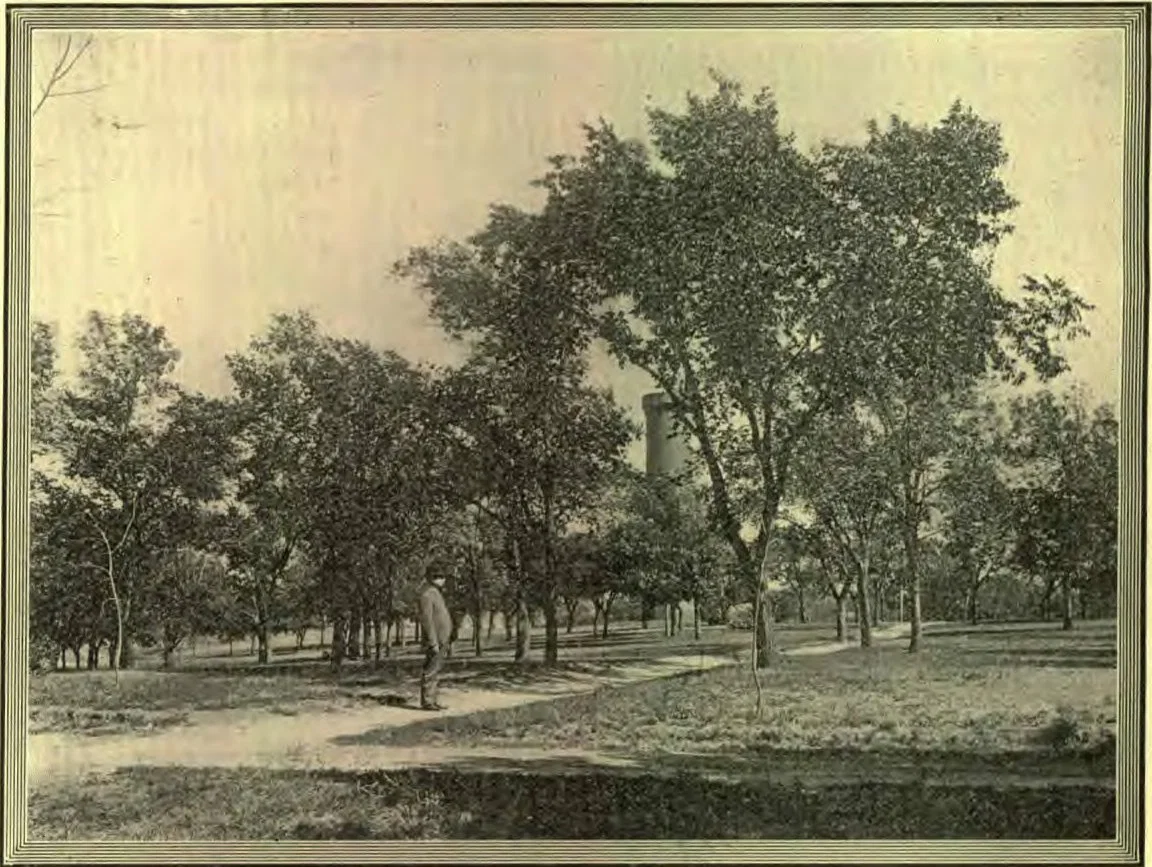
VIEW IN CITY PARK, LINCOLN
From all the vocations of life, useful spiritual lessons may be learned. Those who till the soil may, as they work, study the meaning of the words, “Ye are God’s husbandry.” In the human heart the seeds of truth are to be sown, that the life may bear the beautiful fruit of the Spirit. God’s impress on the mind is to mold it into graceful symmetry. The crude energies, both physical and mental, are to be trained for the Master’s service.
The youth who is studying for a physician has before him the very highest example, even the example of him who left heaven to live on this earth a man among men. To all Christ has given the work of ministry. He is the King of glory, yet he declared, “The Son of man came not to be ministered unto, but to minister.” He is the Majesty of heaven, yet he willingly consented to come to this earth to do the work laid upon him by his Father. He has ennobled labor. That he might set us an example of industry, he worked with his hands at the carpenter’s trade. From a very early age, he acted his part in sustaining the family. He realized that he was a part of the family firm, and willingly bore his share of the burdens.
Children and youth should take pleasure in making lighter the cares of father and mother, showing an unselfish interest in the home. As they cheerfully lift the burdens that fall to their share, they are receiving a training which will fit them for positions of trust and usefulness. Each year they are to make steady advancement, gradually but surely laying aside the inexperience of boyhood and girlhood for the experience of manhood and womanhood. In the faithful performance of the simple duties of the home, boys and girls lay the foundation for mental, moral, and spiritual excellence.
Remember, dear young friends, that each day, each hour, each moment, you are weaving the web of your own destiny. Each time the shuttle is thrown, there is drawn into the web a thread which either mars or beautifies the pattern. If you are careless and indolent, you spoil the life which God designed should be bright and beautiful. If you choose to follow your own inclinations, unchristlike habits will bind you with bands of steel. And as you walk away from Christ, your example will be followed by many who, because of your wrong course, will never enjoy the glories of heaven. But if you make brave efforts to overcome selfishness, allowing no opportunity to pass for helping those around you, the light of your example will guide others to the cross. Mrs. E. G. White.
HOW HE WON
The principal of a school in which boys were prepared for college one day received a message from a lawyer living in the same town, requesting him to call at his office, as he wished to have a talk with him.380
Arrived at the office, the lawyer stated that he had in his gift a scholarship entitling a boy to a four years’ course in a certain college, and that he wished to bestow it where it would be best used. “Therefore,” he continued, “I have concluded to let you decide which boy of your school most deserves it.”
“That is a hard question,” replied the teacher, thoughtfully. “Two of my pupils — Charles Hart and Henry Strong — will complete the course of study in my school this year. Both desire a collegiate education, and neither is able to obtain it without assistance. They are so nearly equal that I can not tell which is the better scholar.”
“How is it as to deportment?”
“One boy does not more scrupulously observe all the rules of the school than the other,” was the answer.
“Well,” said the lawyer, “if at the end of the year one boy has not gone ahead of the other, send them to me, and I will decide.”
As before, at the closing examinations the boys stood equal in attainments. They were directed to call at the lawyer’s office, no information being given as to the object of the visit.
Two intelligent, well-bred boys they seemed, and the lawyer was beginning to wonder greatly how he should make a decision between them. Just then the door opened, and an elderly lady of peculiar appearance entered. She was well known as being of unsettled mind and possessed of the idea that she had been deprived of a large fortune which was justly hers. As a consequence, she was in the habit of visiting lawyers’ offices carrying in her hands a package of papers which she wished examined. She was a familiar visitor to this office, where she was always received with respect.
This morning, seeing that the lawyer was already occupied with others, she seated herself to await his leisure. Unfortunately, the chair she selected was broken, and had been set aside.
The result was that she fell in a rather awkward manner, scattering her papers about the floor. The lawyer looked with a quick eye at the boys, before moving himself, to see what they would do.
Charles Hart, after an amused survey of the fall, turned aside to laugh.
Henry Strong sprang to the woman’s side and lifted her to her feet. Then, carefully gathering up the papers, he politely handed them to her. Her profuse and rambling thanks served only to increase Charles’s amusement.
After the lady had told her customary story, to which the lawyer listened with every appearance of attention, he escorted her to the door, and she departed.
Then he returned to the boys, and, after expressing pleasure at having formed their acquaintance, dismissed them. The next day the teacher was informed of the occurrence, and told that the scholarship would be given to Henry Strong. “No one,” said the lawyer, “so well deserves to be fitted for a position of honor and influence as he who feels it his duty to help the humblest and the lowliest.”—Selected.
THE NEBRASKA CAMP-MEETING
By David Paulson
In the older geographies, the larger part of Nebraska was marked off as a section of the Great American Desert; but the enterprising settler has demonstrated that the so-called “desert” can bud and blossom as the rose. It is true that Nebraska, in common with other States far removed from large bodies of water, is liable to periods of drought. During the last season, the State suffered seriously from this cause, the later crops being almost a failure.
Several of our important institutions are situated within the borders of Nebraska. One of the largest schools in the denomination has its headquarters at College View, a suburb of Lincoln, the capital; and in close proximity to this school is the Nebraska Sanitarium. These two enterprises have grown up side by side, both being organized at practically the same time. A city mission has been in operation in Lincoln for several years, also a health café, where wholesome and palatable food may always be secured at moderate cost.
The camp-meeting this year was held in a city park. While camping on this spot, so luxuriously supplied with timber, one could scarcely make himself believe that he was in the heart of the great prairie country. An attractive corner of this park is shown in the accompanying picture. One impressive feature of this camp-meeting was the unusually large number of mature young people in attendance. They presented excellent material for various missionary operations if they will only sincerely dedicate themselves to God.
The meeting was more or less broken into by unusually severe thunderstorms. One evening the large pavilion was blown to the ground, and only prompt attention in lowering it prevented a repetition of the disaster the following evening. Water fell in torrents, and hundreds of the campers became more or less wet; but a general spirit of good cheer was manifested on the part of all.
As a matter of fact, there are very many persons to whom it is in reality a far more serious matter to attempt to digest the average Christmas dinner than it would be to become soaking wet in a rain-storm. There were no serious cases of illness brought to my attention as a result of this experience, while it frequently happens that a large percentage of those who have feasted unreasonably are compelled to call a physician the following day. The majority of persons have not yet advanced sufficiently in civilization and Christian growth to endure hardness for the Lord as cheerfully as they will sacrifice themselves for the gratification of appetite. DAVID PAULSON, M. D.
LOVE OF JESUS
By Mrs. P. Alderman
None have told, nor ever can,
All of dark Gethsemane,—
How was wrought the wondrous plan
Of redemption, full and free.
None can tell the story here;
We shall know it by and by;
When the shadows disappear,
Understand love’s mystery.
We shall see the wounded hands,
And the sorely piercèd side;
Hills of light, and glory land,
Ne’er the shameful cross can hide.
Love, redemption’s corner-stone,
All the structure grand completes.
Jesus’ love will be our song
When we walk the golden streets.
MRS. P. ALDERMAN.
DIVISION I—GEOLOGY
By O. C. Godsmark
Chapter XII — Rivers, Lakes, and Inland Seas
§ 116. Rivers are only the channels through which the waters of the earth return to their home in the sea. By the process of evaporation a body of water comprising no fewer than 13,140 cubic miles, is annually drawn up from the lakes and oceans. This water, in the form of clouds, is carried inland by the air currents; falls in the form of rain, hail, sleet, and snow; and is returned by the streams and rivers to its original home. Much of it soaks into the hills and upper table-lands, and again gushes forth from the lower strata of soil in the form of springs.
§ 117. The streams partake largely of the chemical nature of the soil through which they pass, forming in some places very remarkable combinations. Salt rivers and streams are known in nearly all parts of the world, especially in Australia and the Argentine Republic. These usually have their rise in salt springs. Eastern Oregon has her alkaline streams, while the Rio de Vinagre of Central America is, as its name indicates, a river of vinegar, made sour by the sulphuric acid it contains. The Orange River of South Africa is decidedly poisonous in parts of its course, so much so that animal life can not be sustained therein. In Algeria there is a river of real ink, formed by the union of two streams, one of which contains iron in solution, and the other, gallic acid, drawn from the large peat-beds drained by the river. Streams containing sulphur and petroleum are very common. Thus you see that when we speak of heat being produced within the earth by the washing together of various chemicals, which, in turn, set on fire the beds of coal and deposits of oil and gas, we refer merely to matters of common occurrence, which we might have understood before, had we but opened our eyes to the workings of nature.
§ 118. It is estimated that the combined rivers of the earth empty, daily, thirty-six cubic miles, or 165,597,696,000 tons, of water into the various oceans, lakes, and seas. Some streams are very rapid in their movement, making five or six miles’ progress within an hour’s time. An ordinarily swift stream will flow two miles an hour. The River Nile, save at the time of its overflow, is scarcely more than a strip of stagnant water, having a fall of but six inches in a thousand miles, as compared with the level of the sea.
§ 119. Were it not for the centrifugal force produced by the rotation of the earth, the Nile as well as the Mississippi would drain off the very waters into which it now flows, in place of feeding them; that is, it would actually flow in the opposite direction. The mouths of these rivers, as well as many others that flow toward the equator, are actually much farther from the center of the earth than are their sources. Should the earth’s present rate of rotation be materially reduced, many of the rivers that now flow toward the equator would cease to flow, or, rather, would flow in the opposite direction. On the other hand, should the present rate of speed be materially increased, many streams and rivers that now flow toward the poles would reverse the direction of their present movement. See “Early Writings,” page 145.
§ 120. In proof of the statement that the rivers flowing into the various oceans, seas, and gulfs near the equator are farther from the earth’s center than their sources, notice how the waters in these great bodies are actually piled up, by the whirling motion of the earth, along the line of the equator. That this is so can be readily seen by comparing the sea-level at these places with the bodies of water in the same locality that are not directly connected with the oceans themselves. For instance, the Black Sea, being connected directly with the Mediterranean, and thus with the ocean, has its waters crowded up to a height of eighty-three and one-half feet above its nearest neighbor, the Caspian Sea, which, being inland, is not thus influenced. Approaching still nearer the equator, we find the waters of the Mediterranean standing fully 1,388 feet higher than the near-by Red Sea, which, like the Caspian Sea, is not connected with an ocean.
§ 121. Our inland waters, such as springs, lakes, and inland seas, besides being of all degrees of saltness, and containing various minerals differing one from another, present a most difficult problem, and one seemingly impossible for the wisdom of man satisfactorily to explain; namely, the difference of elevation of the waters upon the globe. It is a common saying that water will find its level. The term “level” to the scientist means more than merely being at right angles to a perpendicular line. For small measurements, that definition will do; but when considering a body the size of our earth, it is altogether too meager. For all the waters of the earth to be “level,” they must all be the same distance from the earth’s center.
§ 122. We all know that the surface of the earth is exceedingly porous, and that water, in streams large and small, flows freely among the rocks beneath its soil. Why, we ask, does not the whole mass settle to one common level, all being the same distance from the earth’s center? True it is that the atmosphere is continually transporting millions of tons of water from the oceans and seas, lifting it to the higher elevations, also that the rotation of the earth causes many rivers actually to flow up-hill; but this does not explain the problem. Speaking of the waters of this earth, David says, in Ps. 104: 8, “They go up by the mountains; they go down by the valleys unto the place which thou hast founded for them.” We all understand how it is they go down by the valleys; but who can explain how it is they go up by the mountains? Why does the water go up in place of down on the inside of the mountain? The fact is that a spring will actually gush out of the top of a high mountain, and then, of course, “go down by the valleys” on the outside of the mountain. But how did it get up there in the first place? This occurs in places where there are no higher mountains within hundreds of miles, showing that the answer to this question, as given in our geographies, is incorrect.
§ 123. Upon this same point we ask, Why do the waters in our inland seas remain for centuries with such a difference in their altitude? The Great Salt Lake has an altitude of 4,280 feet above sea-level; Yellowstone Lake has an altitude of 7,740 feet; while Shoshone Lake is 7,870 feet high, being one and three-fourths’ miles above the level of the Dead Sea. Were it not for the porosity of the earth, we could easily account for this difference; but when we consider how easily the water seeps and runs, even in streams, through the soil beneath the actual surface of the earth, we are simply left without an answer to our question.
QUESTIONS
Explain the travels of the waters upon our globe. Explain the philosophy of mineral springs and rivers. Why does the River Nile flow in the direction it does? Explain why, although it has a fall of six inches as compared with the level of the sea, that is not an actual fall. How can you prove that these rivers that empty into the ocean near the equator actually flow up-hill? State definitely how each of the principal rivers of our globe would be changed should the present speed of our earth’s rotation be either increased or diminished, describing each river separately.
DR. O. C. GODSMARK.
2005 Magazine St., Louisville, Ky.
COMPANIONSHIP WORTH WHILE
DOING God's will is an introduction to the best society on earth. “He is my brother,” says Jesus. Stop and take that in. Say it over to yourself. “My brother Jesus.” But more, even, than that. “He is my sister,” says Jesus. That adds something more. But more still. “He is my mother,” said Jesus. Can more be said? What “brother,” “sister,” “mother,” means to me, nay, more, what they meant to Jesus, I mean to him. The tenderness that went out from the cross to Mary, when he said to John, “Behold thy mother,” and to Mary, “Behold thy son,” goes out to me. The gentle hand that stroked the dark hair of Mary is on my head. That is companionship worth while.—Robert E. Speer, in S. S. Times.