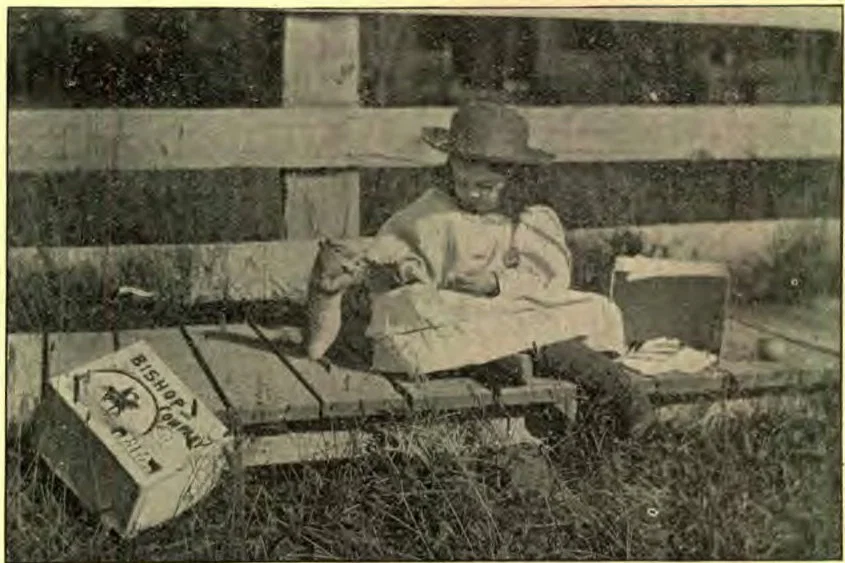
See this little girl feeding the squirrel with crackers! Dora Salem is her name, and she is five years old. She had a hard time to tame this little creature, but she did, and two baby ones besides. It all happened in this way: Dora’s parents went away out West to live, and chose a place near the woods. In their back-yard a sidewalk had to be built, and when Papa Salem made it, he built it over an old stump which was the home of a squirrel, though he did not know it then.
One sunshiny morning when Dora sat on the sidewalk, holding her doll and swinging her legs, all of a sudden she saw what she thought was a big rat, peeping out and looking around. She was afraid to stir at first, but soon she ran into the house to tell mama. When Dora told what she had seen, her mama said, “We will watch for it from the window.”
After a little while it came out again, and this time it sat back on its haunches and began to crack a nut which it held in its hands. The color of the little animal was a ruddy brown on the back, and a grayish white on the under portions of the body. “Oh! what a pretty bushy tail!” said Dora.
“Why, Dora,” said her mama, “that is not a rat, but a cunning little squirrel, which would not hurt you. Just see it nibbling.”
“O mama!” said Dora, “let’s call it Nibby, and try to tame it.”
“Very well, Dora, treat it kindly, and it may prove your friend.”
So every morning Dora brought out some crackers and nuts, and scattered them all around the home of the little squirrel, taking care never to go too near. One day what do you think she saw?—Two cunning little baby squirrels just peeped out from under the sidewalk, and quickly drew back out of sight.
Afterward, Nibby came out, and walked right up on the sidewalk toward Dora, and began eating out of her hand, as you see in the picture. Ever after that, they were great friends, and Nibby would follow her all around the back-yard, just as a little pet puppy might do. She would even come to the kitchen door, sit on her haunches, and wait patiently for Dora to come out.
Captain Salem was greatly interested in his little daughter’s pet. He told Dora all about the habits of the squirrel,—how it can climb to a great height, and jump from branch to branch. When it is afraid, it makes its way toward the trunk of a tree.
One day Dora and her father examined the stump under the sidewalk where Nibby made her home, and found a very neat nest, made of leaves, moss, and grass, in the hollow trunk, where it was well hidden from view.
The captain told Dora that the squirrel’s babies come to her during the middle of summer, and that she cares for them until the next spring; after that they must look out for themselves. When the fall comes on, the squirrel always provides a storehouse of food for the coming winter. Usually this place is filled with nuts, acorns, and seeds.
Summer had nearly passed, and Dora was helping mama prepare a winter box with young plants, to be left in the dining-room. One day she said to her papa, “I have just one thing against our Nibby, she nibbles at the young flowers mama is starting for us in the window box.” Although she felt sorry, Dora did not tell how she had slapped the little creature for this, and that the squirrel had not been seen since morning. The next day the squirrel was still missing. Search had been made everywhere for the pet, but it could not be found. The two baby squirrels were seen running in and out of their home at the382stump of the old tree under the sidewalk, but Nibby was gone.
The third day’s absence brought tears to Dora’s eyes, and she confided to her father all about the whipping she gave poor Nibby, who had not been seen since. She felt sure Nibby would never come back to them, but in this she was mistaken; for, to her great joy, her father found Nibby in the barn, cracking a lot of nuts which had been gathered for the winter nights. Dora took her pet up in her arms, and somehow they quickly became friends again.
As they walked to the house, Dora’s papa said, “My dear little girl will remember, after this, always to be kind and gentle to animals, for their feelings may be easily hurt.”
Dora hung down her curly head, and pressed her cheek against her father’s brown hand. He thought he felt something very like a tear, and although neither spoke, they both understood.
THE LOST MAPLE
“On the border of the wood it beckoned where he stood,
That very young and tiny maple-tree;
It was scarcely one year old, and its leaves were red and gold,
And he said, “I think I’ll take it home with me.”
But while he went to play, they softly blew away—
That pair of red and yellow leaves. And then,
As it wasn’t very big, it looked just like a twig,
So he never found his maple-tree again.”
TWO REASONS
“Papa growls like a bear to-day, ’Cause the wind is east, I know; And Fred is mad as a hornet, ’cause His grades at school were low; And Sister Marjory mourns like a dove, ’Cause Johnnie’s gone off to the war; And Baby snarls like a poodle dog, Nobody knows what for; And my dearest dolly has lost an eye,— Her sawdust is running out, too,— But I must be merry as merry can be,” Said dear little Mollie Loo, “For we couldn’t stand another cross beast In this criss-cross-crankum Zoo.
“Papa is gay as a lark to-day, For the air is clear and cool; And Fred is blithe as a cricket, ’cause He had the best grades in school; And Marjory sings like a nightingale, ’Cause Johnnie is ordered home; And Baby is meek as a kitten, ’cause A cunnin’ new tooth has come; But I’m in compound fractions now, And they’re snarly as snarly can be,” Says dear little, brave little Mollie Loo, “Yet I must be cheerful, you see, For we must not have a single cross beast In this happy menagerie.”
— Sunday School Times.
BOB AND FRISKY
By Floyd Bralliar
Bob and Frisky are two pet squirrels belonging to two of my little neighbors. They were taken from the nest before their eyes were open, and fed on warm milk from a spoon until they learned to drink. Then they lapped it like a dog. They were greedy little fellows, and grew very fast. Soon they were old enough to care for themselves.
Bob has only one eye. When he was a baby, the little boy got in a hurry to see his eyes, and tried to open one of them, but only succeeded in putting it out.
Bob and Frisky sometimes find it hard to agree in everything, and for a long time she would whip him a dozen times a day. Now he is stronger than she, and is “paying her back,” as the children say. If she goes into the nest, he will chase her out immediately, and even in the night he will sometimes get out of humor, and make her go off to the other part of the cage, and sleep alone. They have a very cozy nest built in a box in the top of their cage, but they fight so much every day that they have to carry the leaves for their bed back every evening before they can go to sleep.
Sometimes they get tired, and lie down flat on their backs, sleeping for an hour or two with their legs spread out, and their long tails lying flat on the floor. One would never think that they were alive. I have seen one of them, making a jump for a limb, lose his foothold, and then pass it off as if he intended to do just that. I have even seen them lie in all sorts of absurd positions rather than let any one know that they had missed their hold. One day Frisky had a nut which she was afraid Bob would take from her, and it was amusing to see her hide her face behind a cup of water, imagining that she was out of sight. At times the two would play by the hour, jumping back and forth over each other like two acrobats tumbling.
They are not strict health reformers; for they like jelly or preserves better than anything else. If given a buttered bun spread with jelly, they will first eat the jelly, then the butter, then the brown crust; but the rest they always throw away. A squirrel likes butter almost as well as does a blue jay. But of course nuts are the stock food of squirrels. It is amusing to see one take a hickory-nut in his hands,—for a squirrel is as handy with his fingers as a monkey,—and gnaw his way into a nut in a surprisingly short time. His teeth are very sharp, and he will gnaw his way into a nut in a surprisingly short time. Squirrels like corn, too, but will eat only the germ unless forced to by hunger. If obliged to live on a starchy diet for a while, squirrels will eat eggs or even meat. This is doubtless the reason they are sometimes accused of robbing birds’ nests.
DORA AND NIBBY
In the spring, squirrels eat the buds of trees, especially buds of the elm tree. They will even resort to leaves of roots when nothing else can be had.
Bob and Frisky are very tame, and enjoy getting out of their cage for a scamper through the trees, but always come back to the children. They sometimes romp and play with the children like dogs. They are in good health, and I hope that they will learn not to quarrel so much as they grow older. FLOYD BRALLIAR.
The Fern Baby
We all know the grown-up ferns, regarded by many people as among the most beautiful objects with which nature decorates the shaded cliffs and the borders of streams and ponds; but how many have ever seen a baby fern? Out under the oaks and maples are multitudes of their children, springing up among the fallen leaves where the trees have sown the seed; but under the ferns it is rare to find any fern children. It is as if nature reasoned that plants so beautiful in leaf would not need flowers, and therefore gave them none. But without some kind of flower we can have no seed, and we must have seed to raise a new crop of plants. Since the ferns do not bear flowers, their method of getting new plants once seemed very mysterious. In former times the people never found out how it was done, and to the end of their days ascribed many singular powers to this fern-seed.
While ferns do not bear true seeds, they must, of course, produce something that answers the purpose of seeds. These substitutes are found on the backs of the grown fern-leaves in many kinds, and appear like small dots or lines. Many people fancy them to be tiny bugs, without stopping to consider that no bugs would be arranged so regularly on all parts of the leaf. By placing a single dot under a magnifier, we may see at once that it is a cluster of tiny stalked globes. Within these globes are a great many still smaller one-celled bodies called spores, too small to be properly seen without a compound microscope.
When the spores are ripe, the globes open, and, with a sudden spring, scatter them upon the wind to shift for themselves. Each is capable of producing a new plant; but if all did so, there would doubtless be more ferns than other plants; for a single fern produces millions of spores every season. Many, however, fall upon unfavorable ground, and a host of tiny insects eat others. Those that escape and find a suitable place soon begin to grow by putting forth a tiny green thread that broadens into a heart-shaped green scale no larger than one's little-finger nail. This is as near as the fern ever comes to producing a flower. After a while a tiny frond appears at the notch in the scale, and later others follow, until the new fern is well started in life. It usually takes several months to get as far as the first frond, and often several years before the fern is completely grown up. This seems a long while when compared with many of our garden plants, which come to full size from seed in a few months.
The green scales from which the young fern plants grow are so small as seldom to be noticed out of doors, but it is a simple matter to grow them in the house, and experiment with them at one's leisure. All that is needed is a saucer or pan, a piece of clear glass, and a few handfuls of sand. To obtain spores one has only to collect fruited fern-leaves and place them between papers. The globes will very soon discharge the spores, which will appear on the paper as a fine powder. Before sowing the spores it is best to bake the sand, to destroy the seeds of other plants, as otherwise they might grow before the ferns, and choke them out, just as the weeds overrun neglected gardens. After the sand has been placed in the pan or saucer, it should be thoroughly moistened, and the spores carefully scattered upon it. The saucer is then covered with the glass, and set in a shady place. It must be kept moist, and prevented from getting chilled. In a few weeks a green film will appear on the sand, and the green scales slowly grow larger, and then one by one the young fronds will appear.—St. Nicholas.
RAISING THE WIDOW’S SON
By W. S. Sadler
INTRODUCTION
Preceding Events.— This miracle immediately followed the healing of the centurion’s servant.
The Bible Story of the Miracle.— “And it came to pass the day after, that he went into a city called Nain; and many of his disciples went with him, and much people. Now when he came nigh to the gate of the city, behold, there was a dead man carried out, the only son of his mother, and she was a widow: and much people of the city was with her. And when the Lord saw her, he had compassion on her, and said unto her, Weep not. And he came and touched the bier: and they that bare him stood still. And he said, Young man, I say unto thee, Arise. And he that was dead sat up, and began to speak. And he delivered him to his mother. And there came a fear on all: and they glorified God, saying, That a great prophet is risen up among us; and, That God hath visited his people. And this rumor of him went forth throughout all Judea, and throughout all the region round about.” Luke 7: 11–16.
Place.— Nain, just outside the city.
Circumstances.— Christ was just entering the city,—“coming down,” as the record would indicate, from Capernaum, where, the day before, he had healed the centurion’s servant. The funeral train was passing out of the city to the burying-ground. They met—the Prince of Life, and death’s captive. The Master spoke the word fraught with life-giving power; and the young man was immediately raised from the dead, and restored to his sorrowing mother.
Great Lesson.— “I am the resurrection, and the life.”
STUDY OF THE MIRACLE
When He Came Nigh to the Gate of the City.— This miracle was performed at Nain, twenty-five miles from Capernaum. As the Master climbed the roadway leading to the gate of the city, he met the funeral train of the widowed mother’s only son. What a spectacle at the gate of the city!—the procession of Death and the procession of Life! The funeral train is passing down the incline toward the tombs, while he who is the resurrection and the life leads his little band up the hill, and away from the tombs. Here they meet, and death is swallowed up in life. Thus we have a glimpse of that glad hour when the dead in Christ shall hear his voice, and come forth from their graves, shouting, “O death, where is thy sting? O grave, where is thy victory?”
When the Lord Saw Her, He Had Compassion.— Usually, when Christ had worked wonderful miracles of healing, either the sick person or his friends had asked for assistance. It was not so in this case. Unsolicited, Jesus stepped forward, and called the young man forth from death’s embrace. It would appear that the Lord raised this young man to life largely because of the compassion he had on his mother. It is written that “when the Lord saw her, he had compassion on her, and said unto her, Weep not.” It was after speaking these comforting words to the sorrowing widow, that he bade the young man “arise.” Who can tell how many wanderers, dead in trespasses and sins, have been called out of darkness into light,—raised as it were from the dead, because of the sorrowing heart and faithful prayers of a godly mother?383
Weep Not.— The widow of Nain was sorrowful of heart and broken in spirit, because she had lost her son; and to-day, throughout the length and breadth of the land, we may find praying mothers, whose hearts are full of grief as they think of their wandering children. The widow of Nain is only a type of a vast army of mothers and widows who mourn their sons and daughters who are away from Christ, dead to noble aspirations and true impulses. This mother at Nain wept in sorrow because she had been deprived of the companionship and help of her son; and to-day many a godly woman with tears beseeches God to spare the prodigal son, while in her heart she sorrows almost as one who has been forever robbed of his companionship, knowing well that unless a change comes, his sinful life will lead him farther and farther from the narrow path of the righteous, till they are separated for eternity.
He Delivered Him to His Mother.— The weeping mother and the mourning friends were alike powerless to help him who was in the grasp of death, but it took only one word from the Prince of Life to bring back the young man from the dead, and place him again by the side of his mother in the land of the living. Parents, friends, and others may work earnestly and perseveringly for a loved one who is dead in trespasses and sins; they may weep, mourn, and pray; but unless the procession somewhere can meet Jesus, the Life-giver, there is no hope of salvation. Let us seek to point the wandering and erring upward to the “Lamb of God, which taketh away the sin of the world.” Let us encourage them to look and live; to call upon God in their depths of sin, and receive in response the life-giving message, “Arise!”
Who would not like to know how this young man spent his life after his resurrection? Would it not seem that so wonderful an experience would have brought him very near to God, and led him to live a most exemplary life? The answer to this question may be found all around us to-day,—found in the cold and indifferent experience of many a soul whom the Life-giver has raised from death in trespasses and sins, but who has used his life and liberty only as an occasion for additional sin. W. S. SADLER.
WHAT'S TO HINDER?
By Frank Walcott Hutt
What's to hinder, when a boy
Once makes up his mind
That the surest travelers
Never look behind?
When a boy discovers that
All our noblest men
Kept a steadfast goal in sight,—
What's to hinder then?
What's to hinder, when a boy
Climbs each ladder-round,—
Since a prize is seldom won
At a single bound?
When a boy sets out to win,
Like our truest men,
Step by step, and day by day,
What's to hinder then?
FRANK WALCOTT HUTT.
THE MOUSE
By W. S. Chapman
Both the mouse and the rat are members—and typical ones at that—of the Murinae, a family that contains about two hundred and fifty species, grouped into no fewer than eighteen distinct classes. These, however, are so nearly alike that, except for scientific purposes, the name “mouse” or “rat” is a sufficient designation.
The Muridae, or rat family, of the order Rodentia, are divided into ten sub-families, the Murinae forming the largest of these subdivisions. The next nearest division is the hamsters, a small migratory rodent peculiar to Europe, and distinguished for having large pouches under each cheek.
Primarily, the Murinae are divided into the Mures, as the common rat, and the Sigmodontes, as the rice-rat of America. The main distinction is the size and shape of the molar teeth.
The Mures are found only in Europe, while the Sigmodontes, with the exception of four genera, peculiar to Madagascar, belong in America. It is believed, however, that the original ancestors of the Murinae, and possibly the Muridae, were the Sigmodontes, which, being of more slender build, and less robust than the Mures, gradually succumbed to their superior strength, and were exterminated. Madagascar, being an island, was protected from the incursions of the Mures, and thus their original type was preserved.
W. S. CHAPMAN.
Cultivating the Divine Nature Within
By D. L. Moody
We hear nowadays so much about “culture.” Culture’s all right when you have something to cultivate. If I should plant a watch, I wouldn’t get any little watches, would I? Why? — Because the seed of life is not there. But let me plant some peas or potatoes, and I shall get a crop. Don’t let any man or woman rest short of being born of the Spirit of God. Don’t cultivate a dead and corrupt thing. First, make sure you have the divine nature; then cultivate it. — D. L. Moody.
23. What does he do as our cases come up? Rev. 12:10.
24. Even though we are guilty of that which Satan accuses us, what is our Advocate able to do for us? Jude 24.
25. What part have we to act in this? Luke 18:7; note .
26. In the days just before the coming of Christ, what great work is going on in heaven? Rev. 14:7. Who sits as the great Judge at this time? Dan. 7:9, 10. What lawyer pleads for us? 1 John 2:1. Who appears against us? Rev. 12:10.
27. At what time, then, are God’s people crying day and night?
28. With what question did Christ conclude the parable? What does this question show as to the number of those who are found praying when Jesus comes?
PARAGRAPHS FROM THE LESSON HELP
The widow’s prayer, “Avenge me”—“do me justice”—“of mine adversary,” represents the prayer of God’s children. Satan is their great adversary. He is the “accuser of our brethren,” who accuses them before God day and night. He is continually working to misrepresent and accuse, to deceive and destroy the people of God. And it is for deliverance from the power of Satan and his agents that in this parable Christ teaches his disciples to pray.—Page 166.
The Lord’s people can not, of themselves, answer the charges of Satan. As they look to themselves, they are ready to despair. But they appeal to the divine Advocate. They plead the merits of the Redeemer. God can be “just, and the justifier of him which believeth in Jesus.” With confidence the Lord’s children cry unto him to silence the accusations of Satan, and bring to naught his devices. “Do me justice of mine adversary,” they pray; and with the mighty argument of the cross, Christ silences the bold accuser.—Pages 168, 169.
The character of the judge in the parable, who feared not God nor regarded man, was presented by Christ to show the kind of judgment that was then being executed, and that would soon be witnessed at his trial. He desires his people in all time to realize how little dependence can be placed on earthly rulers or judges in the day of adversity. Often the elect people of God have to stand before men in official positions, who do not make the word of God their guide and counselor, but who follow their own unconsecrated, undisciplined impulses.—Page 171.
Humble Lives Can Shed God's Light
By Phillips Brooks
THERE is no life so humble, that, if it be true and genuinely human and obedient to God, it may not hope to shed some of his light. There is no light so meager that the greatest and wisest of us can afford to despise it. We can not know at what moment it may flash forth with the life of God.—Phillips Brooks.
HERE IT IS
Karr’s Portable Tabernacle
Just what you want for a Church or a Church School
Steel frame, sheet-iron roof, wooden siding, all in sections, and easy to move
One third the Price of a Regular Building
Good for Summer and Winter. Any size
Send for Circular—
J. C. KARR & CO.,
1020 EAST RAVENSWOOD PARK
CHICAGO, ILL.
GRAND TRUNK R'Y. SYSTEM.
By W. C. Cunliffe
Taking Effect June 2, 1901.
Trains leave Battle Creek.
WEST-BOUND.
No. 9, Mail and Express, to Chicago ........................ 12.15 P. M.
No. 7, Limited Express, to Chicago .......................... 7.00 A. M.
No. 1, Chicago Express, to Chicago .......................... 9.23 A. M.
No. 3, Lehigh Valley Express, to Chicago .................... 3.50 P. M.
No. 5, International Express ................................ 2.17 A. M.
No. 75, Mixed, to South Bend ................................ 7.30 A. M.
Nos. 9 and 75, daily, except Sunday.
Nos. 1, 3, 5, and 7, daily.
EAST-BOUND.
No. 10, Mail and Express, East and Detroit .................. 3.45 P. M.
No. 5, Limited Express, East and Detroit .................... 4.50 P. M.
No. 4, Lehigh Express, East and Canada ...................... 8.22 P. M.
No. 6, Atlantic Express, East and Detroit ................... 2.10 A. M.
No. 2, Express, East and Detroit ............................ 7.00 A. M.
No. 74, Mixed (starts from Nichols yard) .................... 7.15 A. M.
Nos. 10 and 74, daily, except Sunday.
Nos. 4, 6, 8, and 2, daily.
W. C. CUNLIFFE, Agent,
BATTLE CREEK.
Ladies Wanted for Sofa Pillow Work
LADIES WANTED to work on SOFA PILLOWS. Materials furnished. Steady work guaranteed; experience unnecessary. Send stamped envelope to Miss S. McGee, Needle Work Dept., Ideal Co., Chicago, Ill.
THE INSTITUTE AT BERRIEN SPRINGS
NOVEMBER 15-18 it was the writer's privilege to attend the Institute of educational secretaries and Sabbath-school workers at Berrien Springs, Mich. The meeting was called in the interests of church- and Sabbath-school work, and to consider matters of importance in connection with the incorporation of the Sabbath-School Worker into our general educational magazine, the Advocate of Christian Education.
Though a small gathering, those present all felt that they enjoyed a rare privilege in meeting together in an informal way to talk over these matters, and to receive instruction. Professor Prescott, Elder Warren, and Dr. Paulson each spoke one evening to a well-filled house, many of the townspeople being present.
Among the subjects considered in the meetings of the Institute were the following: The essential qualifications of church-school teachers; graded Bible study for church schools; the duty of searching out young people who have ability to become teachers and business men in our various schools, and laying plans by which they may receive the necessary training; importance of connecting medical missionary work with the church schools; Young People's work, and Correspondence Study Department; Sabbath-school work — how to make it educational; study-books for church schools; a system of examinations for church and intermediate schools; church-school libraries — how to create and maintain them; etc. While it would be too much to say that all these questions were forever settled, it was good to see the earnestness, willingness to learn, and general spirit of consecration manifested by those present.
One matter of special interest to our young people was that of taking examinations. It has been decided that those, at least, who enter the college at Berrien Springs shall pass a fair examination before taking work in advance of that previously done in either church or preparatory school. “One ought not to forget his grammar overnight,” was the way one teacher expressed it. Every pupil in the church and preparatory schools to-day should study so diligently the common branches that he would be willing to be examined in them every month if such a test were required. Those who are studying faithfully to do this now are those who, in a short time, will be able to do acceptable work in some department of the cause.
The Correspondence Study Department mentioned in connection with the Young People's work will be an interesting feature of that work during the coming year. Since the Institute the Educational Department of the General Conference has approved of the plan outlined then, and has asked the faculty of the college at Berrien Springs to plan for the work, arrange a regular course of study, etc., etc. Those who have this work in charge hope to be ready by the first of the year to offer something definite to the young people who wish to take up a course of home study. The work will be graded, definite, and thorough. Examinations at regular intervals will be given, and thus the subjects well fixed in mind. It is hoped that this plan of home study will enable hundreds of our young people who, for various reasons, are not able to go away from home to attend one of our schools, to take a preparatory course that will fit them to enter a training-school along with those who have taken the studies in the regular way. Of course hard study will be required, but as only one subject will be taken up at a time, the student will be free to give all his time to that, and do his best work on it. More will be said about this Correspondence Study in early numbers of the INSTRUCTOR.
We were glad to see how comfortably the school is situated for its winter's work, and to notice the good feeling of courage and making the best of things that prevails with both teachers and students. The latter are a bright, earnest company, and nearly every one is in the school for a definite purpose — to enter some special branch of the Lord's work.
Through the kindness of Brother Christiansen we were able to pay a hasty visit to the college farm. He and his family are living there now, and under his supervision, the work of preparation for winter, and of clearing out the weeds and underbrush, is going forward. A drive around the place gave opportunity for observing the most beautiful outlooks over river and island and lowland; the knoll where it is hoped to begin the work of erecting buildings for the school next year; and the vineyards and berry and fruit orchards, the care of which, it is thought, will enable many an earnest student to help pay his way through school.
Altogether, the three days spent at the Institute were a blessing to those who were there, and it is hoped that the effects of the meeting will be far-reaching in their influence for good.
FOR EVERY DAY OF THE WEEK
SUNDAY:
Let there be many windows to your soul, that all the glory of the universe may beautify it.—Wilcox.
MONDAY:
“Every life, even the lowliest, which fulfills the divine thought for it, adds its little measure to the joy and treasure of other lives.”
TUESDAY:
More dear in the sight of God and his angels than any other conquest is the conquest of self, which each man with the help of heaven can secure for himself.—Dean Stanley.
WEDNESDAY:
I look to thee in every need,
And never look in vain;
I feel thy strong and tender love,
And all is well again:
The thought of thee is mightier far
Than sin and pain and sorrow are.
—Samuel Longfellow.
THURSDAY:
You must be sure of two things—you must love your work, and not be always looking over the edge of it, wanting your play to begin; . . . you must not be ashamed of your work, and wanting to be doing something else.—George Eliot.
FRIDAY:
“Education means a drawing out, and it is truly a ‘higher education’ if it draws one out of small prejudices, small prides, small desires, and small purposes, and leads one into the lofty life of large views, large tolerance, large aims, and large service.”
SABBATH:
“Hold thou me up, and I shall be safe.” Ps. 119:117.
Young People's Work Department This Week
By Editor
Two pages are given to the Young People's Work Department this week; but matters of unusual importance are introduced, and we are sure all will agree that it is space well bestowed. We would commend a careful reading of the different articles.
Kept by Jesus Through Each Tempted Hour
Has the power of Jesus “kept” you during the tempted hours of one long day from your besetting sin? Have you felt, in just one instant’s uplifted prayer for strength, the divine help sent swift to your need? Then know that the same Power that hears your lightest call for reinforcements in your battle,—the same love that kept you this day,—will give you the victory all the days as they come—will so keep you, so watch over you every moment, that at last you may be among the shining number who will be presented faultless before the throne of God.
The Reward of Faithful Toil
In the article on “The Reward of Faithful Toil,” by Mrs. E. G. White, page 379, there occurs this statement: “If they had a realization of the work the Lord desires them to do as his helping hand, they would not feel it a privilege to shun all responsibility, and be waited on.” Is it not a wonderful and beautiful thought that we may be as helping hands to Jesus in doing his own work in the earth?
FOR THE INDIA MISSION FUND
Mrs. W. A. Turner, of Bryant, Colo., sends a draft for $4.08 for the India Mission Fund. Three boys,—Peter, Christian, and Lewis Peterson,—of Houston, Minn., in renewing their own subscription, also send seventy-five cents for the Mission Fund. H. B. Wilson, of Bauer, Mich., sends fifty-five cents for the same purpose. Thus the fund grows. We are indeed glad to acknowledge these gifts.
In this connection we might say that the Congregational Society has lately ordered three additional copies of the INSTRUCTOR for the club it is sending to India.