The Youth’s Instructor, Vol. 37, No. 30.

A HIDDEN FLOWER

The Youth’s Instructor

Jul 24, 1889

S. D. A. Publishing Association · Battle Creek, Mich. · Jul 24, 1889

A HIDDEN FLOWER.

(To the lonely ones.)
Far up where the rocks were bleak and wild, There dwelt a beautiful forest child,— A delicate flower, that caught from the light A heart of gold and petals of white,— A glad, simple flower, that offered up The praise of its Maker. From its pure cup Poured its incense of love, and to and fro The winds went wafting it far below.
The breezes repeated the flower's song, As they hasten away through the busy throng: "Take this to the sick one, lingering long; Take this to the heart that is dyed with wrong: Perchance the breath of my life may be A gentle pleading of God through me." Ah! little the flower wist, though, then Of the power that breathed from her life to men.
And one day a woman, with worn, sweet face, Climbed to the flower's high, hidden place; And she stooped to bless, with both smile and tear, The little flower in the mountain drear. Her life was as feeble, almost as lone, As the delicate flower in its bed of stone; But she praised the Lord that his love had left A sign of his care for the frail in the cleft.
Out in the silence in paths unknown, How many a flower blooms on alone! How many a life God hath set apart To influence men with a mightier art Than is known to earth,—an art that's given To patient and lowly hearts from Heaven; For further than mortals ever know The prayers of the humble and loving go.
Angels carry their deeds afar, Till their fame is spread to the utmost star; And the lonely lives, though unknown to men, May be written fair by immortal pen; And in heaven only we'll know the power That God can make of a hidden flower.
FANNIE BOLTON.

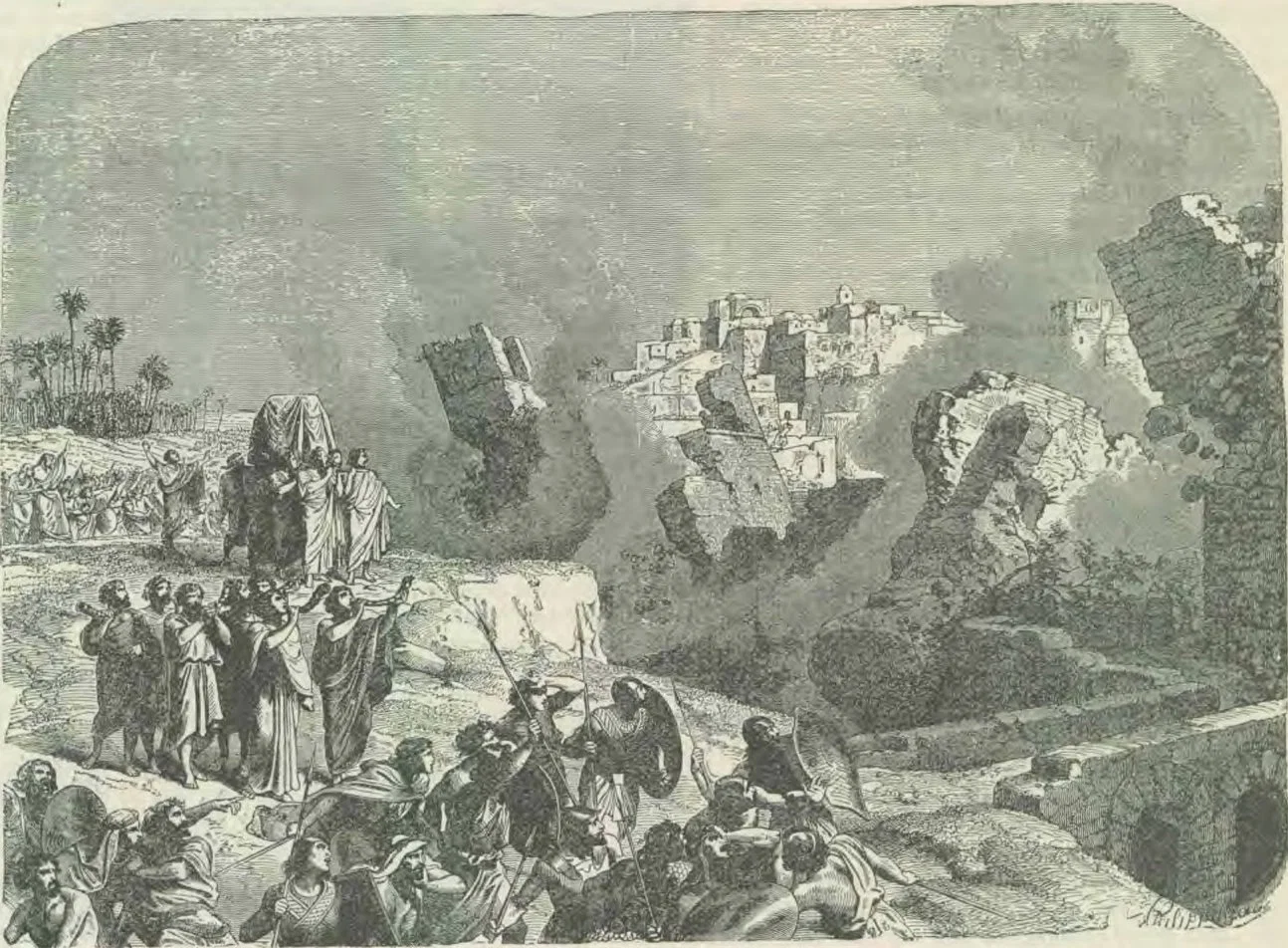
THE TAKING OF JERICHO.

AFTER the death of Moses, Joshua was appointed leader of Israel in his stead. “And Joshua, the son of Nun, was full of the spirit of wisdom; for Moses had laid his hand upon him, and the children of Israel hearkened unto him, and did as the Lord commanded Moses.”
The Lord by Moses had brought Israel up near to Jordan at a point “over against Jericho,” and now he commanded Joshua to take all the people and go over to possess the land he had given them. Accordingly Joshua sent officers all through the camp, ordering them to prepare food to take with them; for “in three days they should pass over Jordan.”
While this preparation was being made, he sent two men as spies into Canaan, to ascertain what difficulties lay in the way of their entering upon their inheritance. The spies went directly to the city of Jericho, it being the nearest city, and they stopped at an inn kept by a woman named Rahab.
Word soon reached the ears of the king of Jericho that there were spies in the city from among the Israelites, and he commanded that the city gates should be closed at once, lest the spies should make their escape. The king also learned at whose inn they were stopping, and he sent to have Rahab deliver them up; for the people feared the Israelites. They had heard of the mighty works their God had wrought for them in delivering them from Egyptian bondage, and now the fact that spies from among them had entered Jericho, the king felt quite sure foreboded no good to themselves. He wished them delivered up that he might destroy them, thinking thereby to intimidate their leaders, and put an end to their encroachments upon his domains.
Not so Rahab! What she had learned of God's dealings with the Israelites had convinced her that they worshiped the true God, and that nothing would prosper in the hands of any who should think to oppose his work. Therefore, instead of giving the spies into the hands of the king, she hid them among the stalks of flax that she had spread upon her flat roof to dry.
Rahab admitted to the officers that two strangers had been at her house; but she said they went out about the time of the shutting of the gates; she did not know from whence they were, neither whither they had gone. She gave the officers permission to search her house, to see for themselves that the men were not secreted therein. She advised them to pursue after them quickly, and very probably they could overtake them.
In this Rahab told that which was false; but we must remember that she was a heathen woman, just then beginning to get a little light of the true God. She had faith to believe the spies were God's servants, and she felt that she was responsible for their lives. God does not countenance lying in any one, and he can always overrule events to his own glory, without the practice of deception on the part of his people. No doubt Rahab learned this afterward.
After the officers had gone in pursuit of the spies, Rahab went up on to the roof of her house, which was built upon the city wall, and acknowledged to the men her belief in the Israelite's God, and that she believed Jericho would soon be delivered into their hands. And for the kindness she had shown them, she wished that when that event did occur, they would remember her and her father's house. They then covenanted together,—she to keep their secret, and they to deliver her, with her relatives, when they should come into possession of the city.
Rahab instructed the spies to go at once and hide themselves in a mountain near by, until the officers should return from pursuing after them. The gates of the city being closed, she let the spies down from a window over the wall, by a scarlet cord; the same cord to be fastened in her window, that no mistake might be made as to which was her dwelling, in the confusion of destroying the city.
The spies followed Rahab's directions, returning to Joshua at the proper time, telling him all they had learned of Canaan. Then, at Joshua's request, the people all went to the bank of the Jordan, where they remained three days in making preparations to cross the river. The Lord was going to perform a great miracle for them, and it was necessary that they should be cleanly in person and penitent at heart before he could meet them. They therefore spent the three days in washing their clothing, and in humbling their hearts and seeking pardon for their sins.
The time for passing over the river having arrived, the priests carried the ark before the people, and as soon as their feet dipped into the water, the water parted before them, and they went on dry ground to the middle of the stream. In this position they remained while the people all passed over into the promised land. Then the priests followed, the waters closing as soon as they had passed out.
Having reached Canaan, the children of Israel first encamped at a place which they named Gilgal, in the eastern part of Jericho. Here, as Joshua was one day walking around the city, probably wondering how they should attack it, there appeared to him a very wonderful person, who introduced himself as the “Captain of the Lord's host.” He had come to encourage Joshua, and to show him how he was to conquer his enemies.
Now Joshua understood that the people of Jericho had closed the city gates, so that none could go out or come in; but the angel who appeared to him instructed him how he could take it. “All these men of war, or soldiers,” he said, “should march around the city every day for six days; and some of the priests should carry the ark around with them. Seven more priests should go before the ark, and blow on trumpets made of rams' horns. But on the seventh day, the children of Israel should march around Jericho seven times, and the priests should blow on trumpets. When the men of Israel should hear a long blast on the trumpets, they were all to give a great shout, and the Lord said the wall of the city should fall down flat, so that they could go up into the city.”
The people did as the Lord commanded, and the result was the fall of Jericho, as was predicted. They remembered their promise to Rahab and her relatives, because she entertained the spies, and ever after she lived with the Israelites.
Rahab chose “that good part” when she cast her lot with the people of God; for with the exception of herself and relatives, every inhabitant of the city was burned alive. So it will be with the inhabitants of the earth in a little while,—all who do not link themselves with the truth which is to ripen the harvest of the earth, will be destroyed. Shall any of us be so unwise as to be caught in the snare Satan has set for the people of this time? Arise, O sleeper, and make your salvation sure. M. J. C.

GOOD MANNERS.

“I LIKE Cousin Amy ever so much,” said Florence Kimball to her mother, “but I do wish she had better manners.”
Mrs. Kimball looked up in mild surprise.
“That is very strange, Florence,” she said, quietly. “Since Amy came here on a visit, two weeks ago, I have been watching her very closely, and I think I never saw a more amiable girl.”
“So she is, mother—so she is!” exclaimed Florence, hastily. “She is very gentle, and so obliging; and I don’t believe she could say a cross word if she tried.”
“I thought you said she was ill-mannered,” said Mrs. Kimball, with a smile.
“Not ill-mannered, mother, but—well, I’ll tell you what I mean. The other day we went to the matinée with brother George, you know, and we had seats just back of the Marshall girls. I introduced Amy, and—would you believe it?—she never said a word during the performance! We all talked and talked about everything that girls talk about, and Amy sat there looking right at the play.”
“I wonder she was not turned out by the usher for creating a disturbance,” remarked Mrs. Kimball, with a sly twinkle in her eyes. “Were the Marshall girls offended?”
“Not really offended, but they thought it very strange, and so did I. So different from most girls.”
“Very different,” replied Mrs. Kimball dryly.
“Well?”
“And then, yesterday, we called to see Mary Chew, and Mary showed us a book of etchings, and when she asked Amy’s opinion, she told her that they were not very good.”
“Amy knows,” observed Mrs. Kimball quietly. “She has wonderful judgment in art matters.”
“Oh, I know she knows; but she shouldn’t have said so.”
“But Mary asked her opinion as a critic.”
“To be sure she did, but that makes no difference. And then Amy is so precise in keeping her engagements. If she says three o’clock, she insists upon being there to the minute—as if anybody expected that.”
“My daughter,” said Mrs. Kimball, gravely, “Amy has manners that all girls would do well to imitate. She is gentle and kind, and at the same time frank; she talks very little, but when she speaks, she talks sense; she never gives advice except when asked, and then she speaks the truth. These are admirable traits.”
“But, mother—”
“Her lack of social polish? I was coming to that. You must remember she has had no mother since the age of eight; her father is an artist, who cares nothing for society. Therefore Amy knows very little about etiquette. But her manners, Florence, are very good. Don’t you think yourself that if people had less superficial polish, and more truthfulness, promptness, and amiability, the world would be better?”
“Yes, mother,” admitted Florence, humbly, “I think it would.”—Golden Days.

OUR SABBATH-SCHOOL MISSION FIELD.

At the last session of the General Sabbath-school Association, it was voted to send the Sabbath-school donations for the last half of this year to the Hamburg mission. As the time has now arrived when these offerings are to begin to flow in, it is fitting that something should be written concerning that important mission-field. How many readers of the INSTRUCTOR can tell just where Hamburg is? As might be expected, few know. If you have it at hand, please get your atlas, and turn to the map of Germany. Now look away up in the northern part of that vast empire, right where that long strip of land reaching down from Denmark divides the North Sea from the Baltic, and connects with Germany. Notice that right at the point of that connection on the west, a large river which flows from the southeast, discharges its waters into the North Sea. Going back on the course of that river about ninety miles from its mouth, we find the city of Hamburg situated on the north or right bank of the Elbe River, or rather on an arm of that stream, at a point where two other rivers join it.
The city of Hamburg is now one of the finest cities and seaports of the old world. But before it became so, it passed through many changes, some of which brought to its inhabitants positive hardships. The history of the famous city is something as follows: Away back more than a thousand years ago, a block house, or castle, was built on the spot for the defense of the inhabitants of that part of the country against their Slavonic neighbors on the East. Of course a little hamlet, or village, followed, with a monastery and school. Soon after, Norman pirates came down upon the place, and burned the entire village. After being rebuilt, the town was harassed for a hundred years by the Danes from the North, and the Slavonians from the East. At the beginning of the sixteenth century, the Danish king claimed the city as a part of his kingdom. His claim was rejected by the courts of the German empire, but this did not satisfy the claimants. In the eighteenth century, Christian V., the Danish king, attempted to take Hamburg by threatening war, but was induced to give up his claim upon the payment 280,000 rix dollars, or about 225,000 dollars of American money.
In 1803 the town was again obliged to pay about 425,000 dollars, this time to the estate of Hanover, situated on the opposite side of the Elbe River, and at that time controlled by French troops. But notwithstanding this heavy payment of money, three years later the city was obliged to receive a portion of the French army within its walls, and suffer the hardships of a change of government, as well as that of maintaining the French soldiers. In 1810 it became a part of the French empire, and continued such until early in 1813, when the Russians drove out the French. A little over two months afterward, the French returned, recaptured the town, forced from the inhabitants a contribution of over 9,000,000 dollars, stole from their banks 7,506,956 marks banco, nearly 3,000,000 dollars more, and after banishing from the city over 20,000 of its inhabitants amid the cold of a northern winter, compelled the remainder to work at the fortifications which were designed to keep them in subjection to the French.
In 1815 that part of the country of which the city of Hamburg is the center, became an independent State of the German Empire. In 1842 a fire destroyed 4,219 buildings, and rendered homeless 20,000 people, from which disaster it recovered in a remarkably short time, showing the energy and business enterprise of its people. The present population of the city and its suburbs is nearly half a million souls.
The present city forms a semi-circle on the river, which is lined with elegant buildings and fine wharves, beautifully ornamented with shade trees. The harbor is an excellent one, affording room for 1,000 vessels, great and small. At all times during the day, boats and small steamers in great variety may be seen moving in every direction, which makes the harbor look like a thing of life.
Some of the public buildings of Hamburg are worthy of mention. One, called the Bourse, really a merchant's exchange, is daily thronged between the hours of one and three by business men. This building has a commercial library of 40,000 volumes. Another place of popular resort is the Johanneum, a public library of 250,000 volumes, and 5,000 manuscripts. Besides these, there are bank buildings, fine churches, elegant residences, and delightful promenades, winding among the beautiful trees and shrubs of the public parks.
The people of Hamburg are descended from a hardy race. It is generally supposed that all the Germanic races, at some far distant period, came from Asia across the Ural and Caucasus Mountains into the northwest of Russia, and from thence were scattered throughout the German Empire. Tacitus, the Roman historian, says of their early settlements: “That none of the several peoples in Germany live together in cities, is abundantly known; nay, that amongst them, none of their dwellings are suffered to be contiguous. They settle apart and distinct, just as a fountain, or a field, or a wood happens to invite them. They build their villages not in the manner of the Romans, with houses joining each other. Every man has a vacant space around his own, either for security against fire, or because they know not the art of building.”
With reference to their personal appearance, he says: “They resemble none but themselves. With eyes stern and blue, yellow hair, and huge bodies, the same make and form is found in all. For their covering they all wear a mantle, a sort of loose shirt, fastened with a clasp, or, for the want of it, a thorn. As far as this reached not, they were naked. The dress of the women differed not from that of the men, save that they were ordinarily attired in linen embroidered with purple, using no sleeves, so that all their arms were bare.”
The women shared all the hardships with the men. It was the custom, even, for the families of soldiers to accompany them to battle, in order to witness the bravery of those who were near to them by the ties of nature. When a relative was wounded in battle, these faithful women remained by them to dress their wounds and care for their wants. Such hardships could not fail to develop a brave, stout-hearted people. And such is the German race to-day. In this direction they want nothing, but their spiritual needs appeal to our sympathies and to our means. It is expected that our Sabbath-schools during the half year in which their contributions are to go to the Hamburg mission will be very liberal, because of the thought which may be constantly present, of the great opportunity before them for spreading the truth, not only among the good people of Hamburg, but also to surrounding nations, by the vessels sailing from that port. J. O. C.

WATCHING A PHILOSOPHER.

When Sir Isaac Newton went to live in Leicester Place, his next-door neighbor was a widow lady, who was much puzzled by the little she observed of the philosopher. One of the fellows of the Royal Society of London called upon her one day, when, among other domestic news, she mentioned that some one had come to reside in the adjoining house, who, she felt sure, was a poor crazy gentleman.
“He diverts himself,” she said, “in the oddest way imaginable. Every morning, when the sun shines so brightly that we are obliged to draw the window-blinds, he takes his seat in front of a tub of soapsuds, and occupies himself for hours, blowing soap-bubbles through a common clay pipe, and intently watches them till they burst. He is doubtless now at his favorite amusement,” she added. “Do come and look at him.”
The gentlemen smiled, and then went upstairs, when, after looking through the window into the adjoining yard, he turned and said:—
“My dear madam, the person whom you suppose to be a poor lunatic is no other than the great Sir Isaac Newton, studying the refraction of light upon thin plates, a phenomenon which is beautifully exhibited upon the surface of a common soap-bubble.”
This anecdote serves as an excellent moral not to ridicule what we do not understand, but gently and industriously to gather wisdom from every circumstance around us.—Selected.

FIRST LESSON OF CYRUS.

It is said that when Cyrus, king of Persia, was asked what was the first thing he learned, he replied, “To tell the truth.”
Truth is one of the most valuable qualities that adorn the mind. He who is not possessed of it, let his rank and situation be what they may, will forever be despicable in the eyes of the wise and the good.—Selected.

The Value of Cheerful and Good-Humored People

Persons who are always cheerful and good-humored are very useful in the world; they maintain peace and happiness, and spread a thankful temper among all who live around them.

MARGIE'S VERSE.

Margie Hall was nearly nine years old; she had bright blue eyes, long, sunny hair that curled about her shoulders, and such a merry laugh it made everybody feel happy just to hear Margie laugh.
Margie lived with her papa and mamma in a cozy little house, not far from the mills, where her papa worked all day to earn money to buy food and clothes for Margie and her little brother and sister younger than she. The Hall's didn't keep help, and Margie often helped her mamma with the work. Mrs. Hall wanted Margie to learn how to do all kinds of house-work and sewing, so that she could do for herself when she grew to be a woman and had a home of her own, or if she should have to take care of herself.
Margie was always willing to help, and loved to bake and get supper for papa; but she had one habit that caused her much trouble, and made her mamma very sad,—sometimes she was very apt to slight little things, especially if she was in a hurry to go and play; often she left the dishes half wiped, and then they were sticky; or if she swept up the kitchen for her mamma, she would leave dust under the table and stove and behind the door. “Nobody will see it,” she would say.
One morning Margie's papa called her earlier than usual to help him; for her mamma was sick, and could not get up. How glad Margie was she had learned how to wash dishes and tidy up the rooms! She felt quite important left in sole charge of the house, the children, and her sick mamma.
“You'll see how near like mamma I can do things,” she said to her papa, as he kissed them all good-by. Charging the younger ones to “be good and mind Margie and not to bother mamma,” he left them for the day, while he went to the mill.
“The first part of the work Margie did up very nicely. She made a cup of tea and toasted a slice of bread for mamma, which her mamma said was “as good as she could make.” Then she told Margie she might take the children out under the trees as soon as she finished her work, and if the house was still, perhaps she could get a nap, and then feel better.
Now came Margie's great temptation. She was in a great hurry to be out under the leafy trees. “I won't scour the knives this time; mamma won't see 'em, and I'll do it after dinner,” she thought, putting them away half-wiped. Now she must brush up, and then she'd be all through. It didn't take her long to brush up in the middle of the room, push the scattered playthings into one corner, promising herself to put them up before any one came. Putting on her sun-hat, and taking a little book she had lately received for a birthday present, she was soon out under the trees, playing tag with the little ones.
For some reason she soon tired of play, so she took out her book to read. It was a pretty book, with a blue cover almost the color of Margie's eyes, while the gold letters matched her hair; her aunty, who was a missionary way off in China, had sent her the book, and written she wanted Margie to read one verse every day. “I guess I'll read the one for my birthday first,” thought Margie, who was anxious to please her aunty whom she had never seen, but had heard much about, and thought she must be just the “bestest woman, next to mamma, that ever lived.” She turned the leaves until she came to the verse for May 30. That was her birthday, and the verse was marked; these were the words: “Whatsoever thy hand findeth to do, do it with thy might!” In fine print under it were these lines:—
“He who sweeps a room as to his God, Maketh it and the act sublime.”
What could it mean? Was just doing little things working for God? Margie had been taught to love Jesus, and she wanted to serve him, but she never had thought doing little things was working for him. What if God knew how she slighted her work that day! She wasn't at all sure what the verse meant, but the thoughts of the unscoured knives and the untidy, half-swept kitchen worried her. She would ask mamma, anyway!
Margie tiptoed into the darkened room. Mamma was asleep; she must wait. She took a look at the kitchen.
“Pretty dirty under that stove and the table,” something said so plainly Margie almost thought some one spoke.
“I don't believe that's what the verse means,” said another voice.
“Better be on the safe side. It isn't doing things with your might to leave them this way,” said the first voice.
“I'm going to sweep, anyway,” said Margie, taking up her broom, and carefully brushing up every speck of dust; then she got out the knives and scoured them. “There, I feel better, anyway,” said Margie, as she went out to play again, and she had a jolly time playing hide-and-seek.
When her mamma wakened, she felt much better, and was quite willing to explain the verse to Margie. She told her “whatsoever” meant anything we had to do, no matter how small a matter, and “doing it with all thy might” meant doing it just as well as one could, whether it was learning lessons, doing dishes, being kind, or going as a missionary like aunty.
Margie never forgot her verse, and when she was tempted to slight things as of little consequence, she would think “whatsoever.”
Thus she grew up beloved and trusted, because she was faithful in small things.—Daughters of America.

AND SO THEY GUESSED THEY LIKED EVERYTHING.

Just as soon as the rain was over, Willie and Millie ran out into the garden.
Willie and Millie were brother and sister. They would have been twins if they had been given to their mamma in the same year; for their birthdays came on the same day in the same month. But while Willie's was June 15, 1882, Millie's was June 15, 1883. So you see Willie was just one year older than Millie.
The garden was quite wet, for it had been raining hard, and the plot of ground that the gardener had been spading and planting the day before was very soft. In fact, it was mud. Willie slipped off the board-walk into this mud, and Millie slipped after him. They scrambled quickly out, but their shoes were a sight to behold.
“Oh! I hate mud,” said Willie. “Oh! I hate mud, too,” said Millie, when, to their great surprise, many soft little voices called out: “But you must not hate it. It gives food and drink to the seeds that are planted in it, and this food and drink will make them so strong that they will grow into pretty green plants. And the pretty green plants will bear hundreds of lovely flowers.”
“Well, then, I don't hate the mud; I like it,” said Willie.
“And I don't hate the mud, and I like it, too,” said Millie.
Then they went skipping along the walk to the well at the other end of the garden. Here they met a toad. He was a big speckled fellow, with bright eyes.
“Oh, I hate toads,” said Willie.
“Oh, I hate toads, too,” said Millie.
The toad sat up on his hind legs, and looked at them sharply. “That's not right,” he said, “for toads do a great deal of good in the garden. They catch and eat many insects that would destroy the plants and flowers if they were let alone.”
“Well, then, I don't hate toads; I like them,” said Willie.
“And I don't hate toads, and I like them, too,” said Millie.
The toad hopped away, and a big earth-worm wriggled out of the place where it had been sitting, and dragged itself past the children.
“Oh, I hate earth-worms,” said Willie, stepping quickly back from it.
“Oh, I hate earth-worms, too,” said Millie.
The earth-worm stopped, and turned its head toward them. “You shouldn't hate earth-worms,” it said, “for they are of the greatest use. If it were not for them, none of the green things could grow. They travel through the ground, breaking the soil, and loosening it as they go, so that the tiny plants that spring from the seeds may be able to make their way up to the sunshine.”
“Well, then, I don't hate earth-worms; I like them,” said Willie.
“And I don't hate earth-worms, and I like them, too,” said Millie.
“And I guess,” Willie went on, “I guess I like everything.”
“And I guess,” said Millie, “I guess I like everything, too.”—Margaret Eytinge.

ENOUGH FOR ALL.

PINKIE sat up in the little white bed, and rubbed her eyes. She had never slept in that little bed before, nor in that room, and she was not quite sure where she was. So she rubbed her eyes again, and stuck one little fat forefinger into her mouth, and looked around. Then she remembered that last night she came from her home among the brick walls of the city, to visit her auntie, in the country. So she pulled her finger out of her mouth, and said, “Oh, my! I’m so glad.” For near her bed was a window, and outside the window was a tree, and again Pinkie said, “I’m so glad!” Trees did not grow by her window at home, and never in all her little life had she wakened in such a pretty place.
Then she spoke up a little louder, and said to the tree, “Are you a cherry tree?” and the branches of the tree nodded and beckoned and said, softly, “Come and see!” So she scrambled out of bed, and ran with little, pink, bare feet, and climbed up into the broad window-sill, and tucking her pink toes into her white gown, she was ready to talk with the tree. The tree had whispered, “Come, and see!” So she said, “Now, Mr. Tree, tell me, are you a cherry tree?” The tree nodded with his dark, green, glossy leaves, and said, “Look sharp! What do you see?” She looked again, and there they were, ever and ever so many beautiful red cherries. She was so glad that she almost jumped out of the window for joy. And she wanted the cherries so, that she almost cried. But she was brave, if she was little, and she said, “I will not cry; I will wait till auntie picks them for me.”
A papa bird hopped out on the branch of the tree near her, and began to sing a sweet song. He sang:
“Beautiful day, beautiful day! Little girl, little girl, God our Father, God our Father, He is good, he is good!”
Pinkie caught her breath, and sang, too, very softly, “God, our Father, he is good!” Birdie sang so sweetly she wished he would sing all day. But he stopped, and hopping down the branch, began to eat the cherries.
“Oh, dear!” cried Pinkie, “He is eating up the cherries, and my auntie won’t have any left to give to me.” Then birdie stopped, and, cocking his head on one side, sang again:—
“Plenty! plenty-e! Plenty! plenty-e!”
“Are you sure there’s plenty?” almost sobbed Pinkie. “Is there enough for you and me?” “Enough for all! enough for all!” trilled birdie.
“Enough for you, Enough for me! Enough for my wife, And birdies three! Enough for all, all, all, all, all, all, all! Twitter, twitter, twitter, twitter, Trall, trall, trall!”
“Oh, where’s your wife and babies three?” cried Pinkie, quite comforted. Birdie stopped singing and fluttered over to another branch with a cherry in his bill. There Pinkie saw him feed the dear mamma bird with the cherry, and fly back and forth with more. Then they both went to work busily to feed their babies.
Pinkie could keep still no longer, but jumping down, ran to her auntie’s bed, and awakening her, called, “Auntie, auntie, come and see the birdies in the cherry tree!”
Auntie ran softly with her to the window, and they watched them eat their breakfast. They sat very still and only whispered, for they would not, for anything, frighten their dear little friends. Then auntie and Pinkie dressed and went to their breakfast, and the little girl told her cousins all that the papa bird had said.
“Yes,” said auntie, “that is true. There always has been enough for all. Your mamma and I used to eat cherries from that tree when we were little girls. Johnnie is now up in the tree picking cherries for us. We will soon have some.”
“Let us go now!” said all the little folks. So auntie brought a bowl for Johnnie to pour the cherries into, and she fed them to all the little ones.—The Kindergarten.

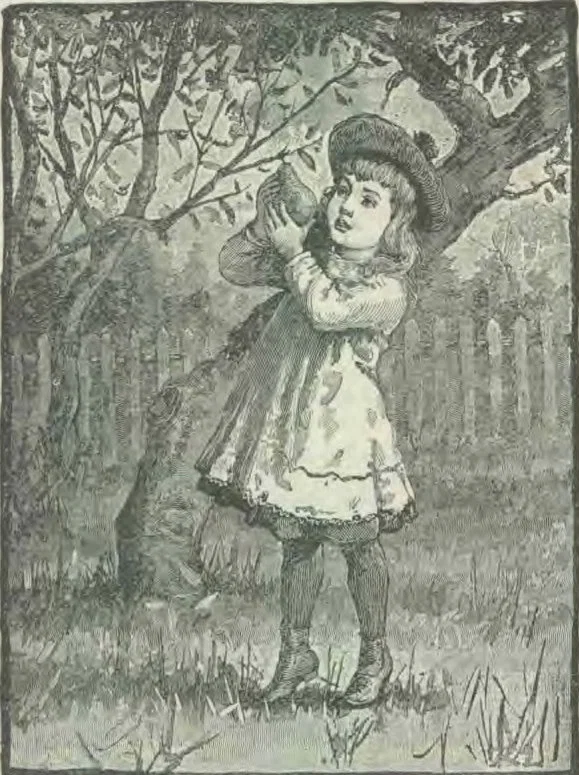
WILLIE AND THE PEAR.

LITTLE Willie stood under the pear-tree old; The fruit was all glowing with russet and gold, Hanging temptingly low: how he longed for a bite, Though he knew if he took one it wouldn't be right!
Said he, "I don't see why my father should say, 'Don't touch the old pear-tree, Willie, to-day;' I shouldn't have thought—now they're hanging so low— When I asked just for one, he should answer me 'No.'
"He would never find out if I took but just one, And they do look so good, shining out in the sun; There are dozens and dozens, and he wouldn't miss So paltry a thing as a pear like this."
He stretched forth his hand, but a low, mournful strain, Came wandering dreamily over his brain; In his bosom a beautiful harp had long laid That the angel of conscience quite frequently played.
And he sung, "Little Willie, beware, oh, beware! Your father has gone, but your Maker is there; How sad you would feel if you heard the Lord say, 'This dear little boy stole a pear to-day!'"
Then Willie turned round, and, as still as a mouse, Crept slowly and carefully into the house; In his own little chamber he knelt down to pray That the Lord would forgive him, and please not to say, "Little Willie almost stole a pear to-day."
—Selected.
Continue reading: TITHES AND OFFERINGS