The Youth’s Instructor, Vol. 49, No. 14.

LOST IN OREGON CAVE

The Youth’s Instructor

Mar 14, 1901

Review and Herald Publishing Company · Battle Creek, Mich. · Mar 14, 1901

LOST IN OREGON CAVE
(Concluded)
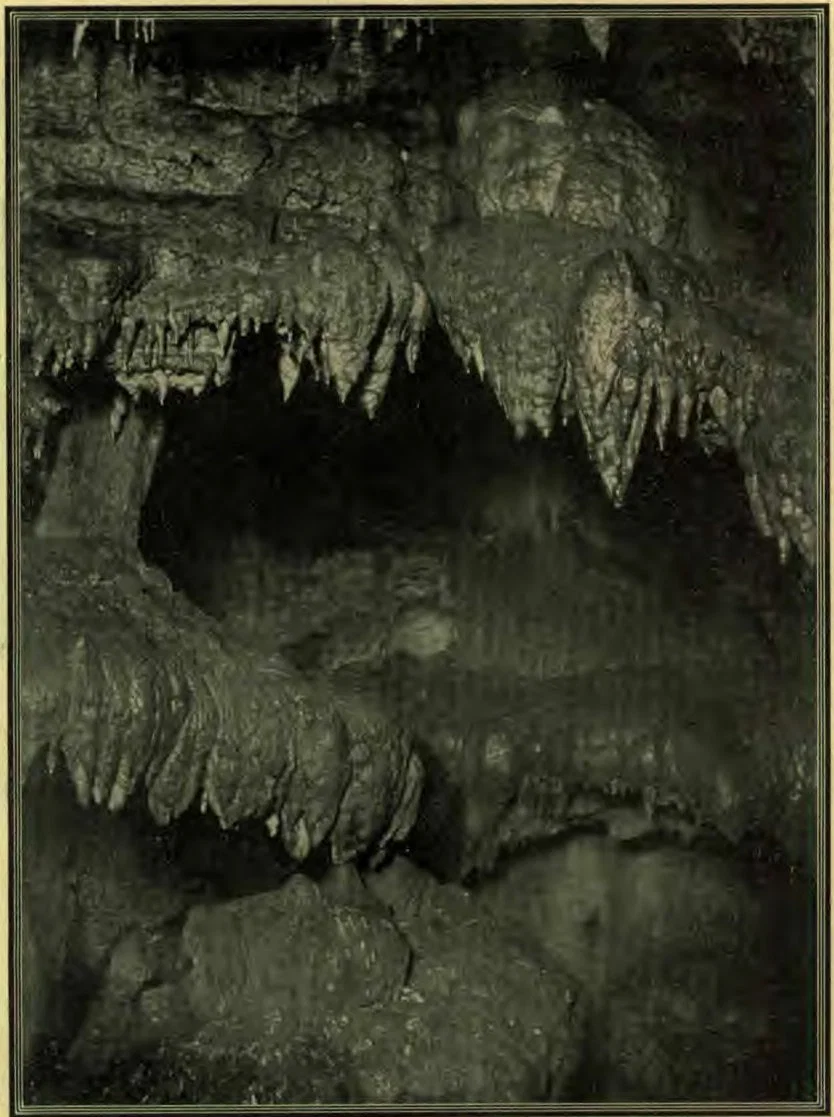
I SUPPOSED I knew the way perfectly; for I had been careful to notice all the peculiarities of the different chambers and passages through which I had passed. So I confidently climbed over the big boulders that covered the floor of the Ghost Chamber, passed between two pillars, and entered a low, arched passage, from the ceiling of which hung many small stalactites. At every step I recognized some peculiar formation that I had made a mental note of on the way in. But suddenly I came to a solid limestone wall, which effectually blocked my way. Thinking that I had missed the main passage a few feet back, I retraced my steps, and turned into several of the many openings near by. But they all looked strange to me, so I went back to the ladder leading to Floral Hall, and started again. The second attempt ended as had the first, at the solid limestone wall. So far I was not in the least frightened, but I was provoked to think that I should lose my way in that dirty little hole—for I had such a contempt for the “Great Oregon Cave” that I could bring myself to call it nothing else.
Again I went back to the Ghost Chamber, but this time turned aside at what seemed the most likely place to make a mistake. In a few minutes I found myself hopelessly lost in a labyrinth of passages that seemed to lead around and around, with no avenue of escape. Four and one-half hours later I had a profound respect for all caverns in general, and for the Oregon Cave in particular; for it took me just that time to find a way out of that dismal Ghost Chamber.
ALONG THE TRAIL
ALONG THE TRAIL
At first I was terribly frightened. I hurried through the large passages, crawled through the low ones, and squeezed through narrow openings. I scrambled over big boulders, crept cautiously into dark pits, and struggled up slippery limestone walls. I wet my feet in pools of water, daubed my clothes in banks of mud, and scratched my hands on the sharp edges of broken stalactites. Several times I tried to retrace my steps, but I had crossed and recrossed my tracks so often that it was quite impossible to follow my footprints by the dim light of a candle.
In my haste and anxiety I neglected to protect my candle, and a drop of water fell upon the flame, extinguishing it. While I was feeling for a match to relight it, I wondered if my supply had become damp, for I carried them in an outside coat pocket. As if in answer to my fear, the first one would not ignite. I knew that it would be practically impossible to find my way out of that place without a light; and that I might be there for days, or even weeks, before any one would come to my rescue. I had been frightened before, but now my heart seemed to stand still with terror. But just then there came into my mind one of the precious promises of God: “Fear thou not; for I am with thee: be not dismayed; for I am thy God.” In a moment my fear was gone; for I realized that after all it was not such a terrible thing to be lost in a cave when God was there.
The second match burned, and I relighted my candle, held it above my head, and peered into the darkness. I thought I saw the dim outline of a ladder; and as I made my way toward it, hoping that it might lead to the main passage, I found that I was back at my starting-place at the end of the Ghost Chamber. That ladder led to Floral Hall!
I no longer had a particle of fear, so I sat down to rest, and think the matter over. Then I did what I should have done in the first place—I took my trouble to the Lord, putting him in remembrance of some of his promises, and asking him to direct me in finding the way out.
One of my candles was nearly burned out, so I lighted another, and began a methodical search for the passage. I started at the ladder, and, always keeping the wall at my right, followed it around through every little side-chamber and passage that I came to until I reached the ladder from the opposite side. My method had failed; still, I tried it again, though with no better success.
My second candle had burned quite low by that time, and things were beginning to look serious. I realized that I might never see daylight again, so I sat down and wrote two or three notes to some of my friends, and then mapped out a route by which I could go in the dark from a place where the water did not drip to a pool of water, and back again. I had made up my mind that when my last candle was exhausted, I would take my stand there, and wait for the Lord to deliver me in whatever way he saw fit.
But as long as my light lasted, I thought it was my duty to continue the search, though my heart was no longer in it. After wandering around rather aimlessly for a while, I sat down to think of all the circumstances that had led me to that position, and of the Lord’s dealings with me all through my life. Someway I could not believe that it was his will that I should die alone in that cave, nor even endanger my health by remaining in such a cold, damp place until some one should come to my rescue. So I knelt again, and asked the Lord to reveal his purpose in allowing me to lose my way. As I prayed, I seemed to see an angel come down, and take me by the hand to lead me from the cave. When I rose to my feet, I saw only the weird shadows that the dim and flickering light of my candle cast on the great blocks of stone which roofed and walled and floored my gloomy prison; but I knew the angel was there, and that he would deliver me. “The angel of the Lord encampeth round about them that fear him, and delivereth them.”
IN FLORAL HALL
IN FLORAL HALL
I started back over the same way by which, all along, I had been so sure I entered the chamber—over this boulder, around to the left of that, and in between the next two; past the pillars, into the low, arched passage, and up to the limestone wall. But there I stopped, and was about to turn back when I noticed that the flame of my candle leaned toward that wall! That was the sign for which I had long been looking; for I knew that in the main passage there was a strong breeze blowing outward. Wondering if there was not some crack or crevice in the wall through which the air found its way to the main passage, I stepped up to the wall to examine it more closely, and almost stumbled into a hole at its base. As I peered into that hole, I saw the top of the ladder up which I had climbed to enter the Ghost Chamber!
From that point I had no trouble in finding my way back to the entrance of the cave, where I supplied myself with more candles, returning with my camera to photograph some of the more interesting formations. It was late before I finished; but that of course made no difference, for day and night are all one in the cave.
Next morning I started out over the Kirbyville trail, and found it much better than that by which I had entered the cañon. But the road to Grant’s Pass from Kirbyville was dusty and hilly; and when I reached the former place, after an absence of a week, I was for once in my life heartily glad to be out of the mountains. J. EDGAR ROSS.

THE BROOK FROM THE HILLS

The brook from the hills, In the sweet summer-time, Trickles through the long grass In the shade of the pine; Bubbles over the stones, Where the reeds over-tip; Through patches of sun, Where dragon-flies flit; Through lily-stem wickets And arrow-head thickets, It gurgles and trills, This brook from the hills. Laughing and singing through all the long day, Among rocks and rushes that lie in the way,— Working, but laughing and singing in glee, “This is the way to get down to the sea!”
The brook from the hills, In the cold winter-tide, Feels the touch of the frost Where the lily-buds died. With a thick crystal plate Pressed down on its head, It scarcely can creep Along its dark bed; But though its face freezes, In cold winter breezes, No obstacle stills This brook from the hills. Fainter its voice, but the echoes still play Under the ice in a summer-time way, Working, and singing, till spring sets it free, “This is the way to get down to the sea!”
MINNIE ROSILLA STEVENS.

A SNOW-STORM ON THE MOUNTAINS

I HAVE just been out to witness for the first time a snow-storm on the mountains. Over to the southwest the Greenhorns rise to a height of about eleven thousand feet, while now their lofty peaks and far down their craggy sides are enveloped in dark, misty clouds, like great winding-sheets. The tops of the giant hills are already white with snow, though to the north the sun is pouring over the brown and richly tinted rock a flood of glorious light. Still the storm goes on. Over toward the northeast lies Cripple Creek, and ever and anon we hear the muffled boom! boom! of the miners’ dynamite as they wrest the precious secrets from the hills.
As I look on the scene of wondrous beauty and magnificent grandeur, before which the proudest monuments of man seem weak and puny, and watch the great white wings of the storm as they beat and twist themselves about on the distant pinnacles above us, I think of the time when “Mount Sinai was altogether on a smoke,” and I almost expect to see the white tents of Israel on the plains below.
MRS. L. D. AVERY-STUTTLE.

YIDDISH

Yiddish originated in Germany nearly one hundred years before the discovery of the New World by Columbus. Its foundation is the German language, but it has gathered to itself words from so many other tongues that it is often called “Judeo-German,” or Jargon. We are interested in it, and anxious to learn all we can about it, because it is spoken by Jews all over the world. Yiddish has spread, says Mr. Leo Weiner, over Bohemia, Poland, Russia, and England; and the hundreds of thousands of Polish and Russian Jews who come to America speak in no other tongue, and all their books are written in this curious language.
Should you open one of these books, you would think, at the first glimpse you had of its pages, that it was a German volume; for you would see mutter for “mother,” stein for “stone,” kind for “child,” liebe for “love,” and morgenstern for “morning-star;” but on looking closer, you would see many unfamiliar words, with an unfamiliar orthography, and would know that you had been deceived.
But it was not of this that we sat down to write, but of the possibilities for good that lie in the Yiddish tongue, with which Mr. Weiner is endeavoring to acquaint us in his book, “The History of Yiddish Literature in the Nineteenth Century.”
For more than a hundred years, Christians have been trying to reach the Jews with the gospel. Wedded still to the law and the ritual of Moses, this people have steadfastly refused to see in the Christ of the New Testament the Messiah of the prophets—would they ever see? Would the most persistent and prayerful efforts put forth for their salvation be crowned with success?
The answer was at first but a feeble, stammering, “Yes,” scarcely heard, and almost unnoted. Missionaries went forth to try the experiment. A few Jews here and there were converted; the work grew in magnitude, and became more and more successful; but still there were those who persisted in saying that the Jewish heart could never be reached with the gospel. As if in answer to these opposers of Jewish missions, Yiddish sprang suddenly into prominence as a means of doing a thousandfold more for the Jews than had ever yet been done. The Jews do not know their own Scriptures as we once supposed they did. To many of them Hebrew has become a dead language; and the Holy Book, in the tongue that they knew, was too costly for a poor man to buy.
Marcus Bergmann, a Jewish Christian missionary of London, England, thought of all this. He knew that if his people could have the Bible, a wonderful reformation would follow, in God’s own good time, and that from reading the Old Testament they would come to accept the New. It must be translated into the Yiddish dialect—but who would do this work? He waited, hoping that God would raise up some one to translate his precious word into Yiddish, that it might be read by Jews all over the earth. No one appeared; if the work was to be done, he must do it himself. It seemed like a Herculean task, but it was begun.
Helpers volunteered, who asked no pay for their services, and money to pay publishers’ and printers’ bills came from unexpected sources. At first only portions of the Blessed Book were translated into the strange tongue, and sent out from the press; then cheap but beautiful copies of the whole Bible appeared, and were received by the Jews with gratitude and joy.
Even the heart of Bergmann’s father was melted, and he wrote his son a letter full of thankfulness over the great work he had accomplished for his people, though still deploring his apostasy from Judaism.
The Yiddish New Testament followed the Old. The result was surprising, even to the translator. The book was received and read with avidity, both on the Continent and in England and America. Arrangements were made by the London missionaries to have Bibles and Testaments and tracts circulated among the Jews by the tens of thousands of copies. What the result has been, we do not know; but we are sure that God has a purpose in all this, and that that purpose will be carried out.
This Yiddish language has not evolved by chance, but has sprung up in accordance with God’s will, that through its agency his long-blinded people may learn that Jesus of Nazareth is indeed their Messiah and King, and that he is soon to come, in power and great glory, to save those who believe in and obey him.
MRS. S. ROXANA WINCE.

HOW SMILES GROW

THEY say ’tis the showers of April That bring the flowers of May, And the darkest time is always Before the break of day.
I know not how rain and darkness Can bring forth flowers and light, But I know that the God of nature Has ordered all things right.
So let us remember our lesson, When sorrows descend like rain, While we watch and wait for morning, Through the dreary night of pain.
A happier time will follow The saddest, dreariest years; For we never really learn to smile Till we’ve had our share of tears.
— Selected.

GINSENG

Ginseng, of which we hear so much since the trouble began in China, is the aromatic root of an herb of the genus Aralia, and in China is a very celebrated medicine. The Chinese view it in an almost sacred light, believing it to be a panacea for all the ills of the flesh, and that it will, in a majority of cases, revive and prolong life in the feeble and aged. European chemists and practitioners, however, have failed to find any valuable medicinal virtue in the plant.
Ginseng roots of the finest quality are found near Manchuria, in China, and are an imperial monopoly. The Korean ginseng comes next, and the American ranks third in value. Cultivated ginseng is not regarded by the Chinese as equal to the wild roots; but the demand so far exceeds the supply that the price rose in the United States from fifty-two cents a pound in 1858 to more than three dollars a pound in 1893. The value of the ginseng exported annually from this country now exceeds one million dollars.
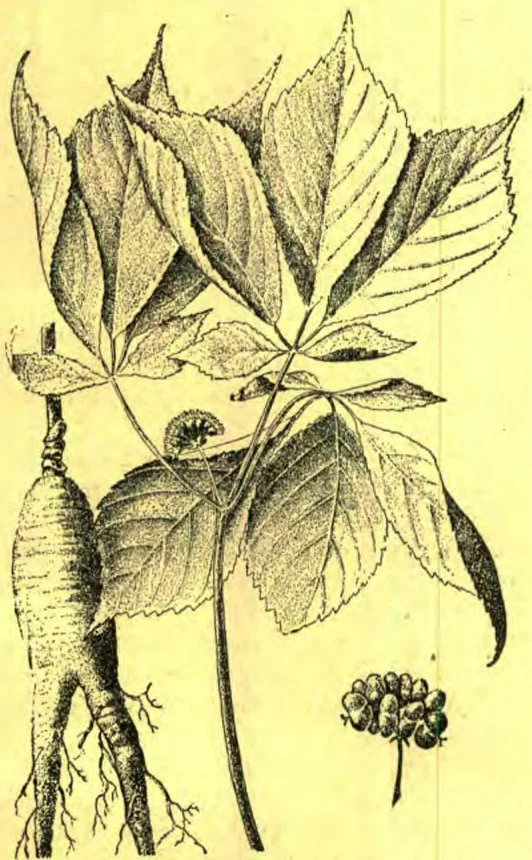
The root of the plant forks near the surface of the ground into two prongs, and assumes much the shape and contour of a man. A great deal of its imagined value is due to its appearance; and the nearer the root resembles a human being, the more valuable it becomes. Native ginseng is in China worth its weight in silver, and often in gold. Skillful workmen manipulate the native root coming from Manchuria to increase its resemblance to the human body, and these pieces become priceless. The name “ginseng” means “man-plant,” and a root with limbs entire is supposed by the credulous Chinese to be at least two hundred years old, and is worth from two hundred and eighty to five hundred and sixty dollars.
GINSENG — ROOT, PLANT, AND SEED
The root, when gathered, is thoroughly washed in several waters, and well scrubbed with a brush. It is then again washed and dried by steam; this gives it a white appearance. On drying, it becomes transparent. After washing and cleaning the roots, the natives lay them on sticks over the fumes of boiling millet, which imparts to them a golden-yellow hue, highly prized by the Chinese. The dried roots are carefully guarded against dust and dampness, else they rot or become wormy. To show how important the Chinese dealers in ginseng regard this, I quote from Lockhart’s description of his visit to a ginseng merchant:—
“Opening the outer box, the merchant removed several paper parcels, which appeared to fill the box. Under them, however, was a second box, or perhaps two small boxes, which, when taken out, showed the bottom of the large box and all the intervening space filled with more paper parcels. These parcels, he explained, contained quicklime, for the purpose of absorbing any moisture, and keeping the boxes quite dry, the lime being packed in paper for the sake of cleanliness. The smaller box, which held the ginseng, was lined with sheet-lead. The ginseng itself, inclosed in silk wrappers, was kept in little silk-covered boxes. Taking up a piece, he would dilate upon the merits of the drug, and the cures it had effected, at the same time requesting his visitor not to breathe upon nor handle it. The covering of the root, according to its quality, was silk, either embroidered or plain, cotton cloth, or paper.”
In China, ginseng is often given as a present to a friend, with a small, beautifully finished double kettle, in which the root is prepared. The inner kettle is made of silver, the only metal used in contact with the ginseng when cooking. The decoction is drunk as a tea. The root is often used pulverized, the dose being from sixty to eighty grains. W. S. CHAPMAN.

NOT LOSS, BUT EXCHANGE

I WENT, not long ago, to visit a friend who is afflicted with an incurable malady. For ten years she has been unable to leave her room; for five, her only change has been from her bed to an invalid-chair. I remembered her as a brilliant, beautiful girl, ambitious in the right sense of the word, with the prospect of an exceptionally happy and useful life. As I sat beside her, holding her twisted fingers in mine, and looking into her pale face, marked with lines of suffering, the pity of it all swept me like a wave, and yielding to an unwise impulse, I exclaimed: “Margaret, how can you possibly bear it? Everything has been taken from you!”
“No, no!” she answered, with the quick smile which she had never lost. “You are mistaken. Nothing has been taken.”
I could only look my questioning surprise.
“Let me tell you a little story,” she went on.
“A good while ago, before I was ill, I attended one of the summer assemblies which have since become so numerous. A beautiful, sturdy baby boy, less than two years old, used to run about the aisles of the great tent in which the public meetings were held. One afternoon, in the midst of one of the most entertaining and valuable lectures on the program, while the audience sat listening with strained ears, that not a word might be lost, the little fellow possessed himself of a hammer which some workman had mislaid, and began to pound in noisy delight upon one of the oaken supports of the tent. His father rose hastily and went to him. I supposed the hammer would be instantly taken from the child, and awaited with nervous dread the aggrieved outcry certain to follow. But the father did nothing of the kind. Without speaking a word, he picked up a little stick and began to dig in the soft earth. Directly the baby ceased pounding, and, with the hammer still grasped in his chubby hand, curiously surveyed the new sort of employment. A moment later his little face broke into smiles; and, dropping the hammer, he took the stick from his father's hand, and went on with the digging in quiet contentment.”
“It was a very little incident, but I have never forgotten it. It has illustrated for me the whole course of my life. I have not been wrenched rudely from a single one of the outward activities which used to be so dear to me. God has unfailingly given me so much in other ways, that I have seemed to resign almost voluntarily each good thing for a better. I have had in my quiet room such peace and rest in him, such visions of his love, such insight into the perplexing questions of his providence, as never came to me when I was going about working and striving.”
“I used to have an almost feverish desire to be useful, helpful to others, yet I was often at great loss how to reach them intelligently. Now, suffering, if I may use the hard name, has given me the key to many hearts. People come to me here whom I should have passed ignorantly or shrinkingly on the crowded paths of busy life. They admit me to the priceless treasure of their confidence, and to some, at least, I can not doubt that I am given a message.”
“I used, too, to have an unreasoning fear of death. Life—mere physical life—was so strong and glad in me that the very thought of its possible cessation struck a nameless horror to my heart. I love life still, the real life, more than ever. It is an infinite gift. But I see now so plainly what a different thing it is from the mere force, marvelous though that may be, which sends the blood warm from the heart to tingle through the active limbs,—how it may endure after that has ceased; and, though we fall asleep, that life in us will cause us to come forth in triumph when he speaks the word.”
“You remember how the Master said, ‘I am come that they might have life, and that they might have it more abundantly.’ Do you not understand now why I said that nothing had been taken from me? I have only exchanged the old for the ‘more abundant’ life.”—Young People’s Weekly.

Growing in Grace Through Prayer

No man ever yet asked to be, as the days pass by, more noble and sweet and pure and heavenly-minded, no man ever yet prayed that the evil spirits of hatred and pride and passion and worldliness might be cast out of his soul—without his petition being granted and granted to the letter. And with all other gifts God then gives us his own self besides. He makes us know him and love him and live in him.—F. W. Farrar.

DANGEROUS TO TAMPER WITH ERROR

When we pray, “Lead us not into temptation,” we should be careful that we do not willfully and knowingly go into temptation. The Lord warned the children of Israel to keep away from the borders of Egypt. We should not endeavor to see how near to wrong we can come, and yet be right. Rather, we should encamp high upon the plain of truth, as far as possible from every border of error. Again and again have I seen the spirit of adventuresome curiosity result in the shipwreck of the faith and confidence of some once earnest soul.
I will mention a few cases, the first that of a young man in training for usefulness. He was getting along well with his work, and we believed he would become a useful worker in the cause of God. Then appeared in his life a disposition to tamper with error, to look upon forbidden fruit; and the way having been prepared by numerous little digressions, when a noted infidel lecturer came to the city, this young man decided to go and hear him. Interested friends admonished him to stay away, but to no purpose; he had made up his mind to go, and he went. He reasoned like this: “If I have the truth, if I am right and he is wrong, he can do me no harm.” From about this time, this brother’s experience began to turn. Defeat instead of victory attended him. This was several years ago, and still his experience is most unsatisfactory. He has drifted entirely out of the Lord’s work, and has lost the missionary spirit, together with his intense desire to be useful to God and to his fellow men.
Dear reader, it is dangerous to tamper with wrong, or to compromise with evil. One sound apple will not make a barrel of decayed ones good, but one rotten apple will eventually ruin a barrel of sound fruit. Please read Haggai 2: 12, 13: “If one bear holy flesh in the skirt of his garment, and with his skirt do touch bread, or pottage, or wine, or oil, or any meat, shall it be holy? And the priests answered and said, No. Then said Haggai, If one that is unclean by a dead body touch any of these, shall it be unclean? And the priests answered and said, It shall be unclean.” From this scripture we learn that a holy person coming in contact with one who is unholy does not necessarily make the unrighteous man righteous. On the other hand, when the righteous associate with the unrighteous, there is an ever-present danger of their becoming unholy.
A young woman, an earnest Christian, was induced by a worldly friend to attend some spiritualistic meetings. At first she laughed at what she saw and heard; but she became more and more absorbed in these things, and erelong even the entreaties of her friends failed to keep her away from these gatherings. The result proved most disastrous to her Christian experience; and she has struggled along in darkness, and sometimes despair, ever since.
The Lord has told us to separate ourselves from these things,—to come out from the world, and be separate,—and every Christian young man and young woman will do well to take heed. The Lord knew the danger of these things when he admonished us to hold ourselves aloof from their blighting influence.
A young sister who was an active worker went to spend the summer with an infidel family. Though warned of the dangers she would meet, she was inclined to make light of her friends’ anxiety for her welfare. But she had been in this home only a short time when she was induced to read a book by an infidel author. She never found her way back into the Lord’s work. Infidelity, skepticism, and doubt, with much sorrow and sadness, have been her portion from that day to this. Again and again have her former friends sought to lead her back into the pathway of light, but each and every time they have failed.
It is a dangerous thing to trifle with light; and in nearly every case the results are disastrous to those who presume to put forth their hand, and touch that which God has warned men to leave alone. Many other illustrations of the blighting influence of Christian science, Spiritualism, and other phases of latter-day errors might be given. The Lord has bidden his people, like Lot, to flee to the mountain—to tarry not in all the plain. He has warned us not even to look behind us. The experience of Lot’s wife is an object-lesson and a warning to every young man and woman to press onward and upward toward the mark of our high calling in Christ Jesus, and not be allured into any of the by-paths of curiosity, amusement, or adventure.
Let us keep the energies of mind and body so fully occupied in getting truth and giving truth, that there will be no time in which the enemy, finding us unoccupied, shall tempt us to tamper with error and experiment with unrighteousness.
W. S. SADLER.
1926 Wabash Ave., Chicago.

BEREAN LIBRARY STUDY

Revelation 15; “Thoughts on the Revelation,” Pages 638–640
(March 17–23)
The prophet speaks of the angels with the seven last plagues as a “sign great and marvelous:” he knew that it was an unmistakable evidence that the Lord was indeed near at hand, that probation had closed forever, and the people of God were sealed.
The Last Plagues.—The wickedness of man has brought many plagues upon the earth, but they have all been mingled with mercy. They were given as a warning, and those who heeded them were saved. The last plagues contain no mixture; “for in them is filled up the wrath of God.” When they are poured out, there are none to be saved, for every case has been decided. “Already a few drops of God’s wrath have fallen upon the earth; but when the seven last plagues shall be poured out without mixture into the cup of his indignation, then it will be forever too late to repent and find shelter. No atoning blood will then wash away the stains of sin.” It is impossible for the plagues to be poured out while Jesus officiates in the heavenly sanctuary; “but as his work there is finished, and his intercession closes, there is nothing to stay the wrath of God, and it breaks with fury upon the shelterless head of the guilty sinner.”—“Early Writings,” last part, page 141. The seven last plagues will not be poured out until the work of the gospel is finished, and every case has been decided for eternity.
Song of Moses.—Moses and Israel were encompassed by seemingly insurmountable barriers,—the Red Sea before, the enemy behind, and the mountains on either side,—but in one night deliverance came. Moses had a comparatively weak company, composed of men used to slavery, but not to war, and helpless women and children. In swift pursuit were trained warriors. But God opened the sea before his people, and destroyed the host of Pharaoh in the midst of the sea. After their deliverance Moses, with the Spirit of God resting upon him, led the people in the following triumphant song of praise (Ex. 15: 1–16, R. V.):—
“I will sing unto Jehovah, for he hath triumphed gloriously: The horse and his rider hath he thrown into the sea. The Lord is my strength and song, And he is become my salvation: This is my God, and I will praise him; My father’s God, and I will exalt him. The Lord is a man of war: Jehovah is his name. Pharaoh’s chariots and his host hath he cast into the sea: And his chosen captains are sunk in the Red Sea. The deeps cover them: They went down into the depths like a stone. Thy right hand, O Lord, is glorious in power, Thy right hand, O Lord, dasheth in pieces the enemy. . . . Who is like unto thee, O Lord, among the gods? Who is like thee, glorious in holiness, Fearful in praises, doing wonders? . . . Thou in thy mercy hast led the people which thou hast redeemed: Thou hast guided them in thy strength to thy holy habitation. The peoples have heard, they tremble: . . . Terror and dread falleth upon them; By the greatness of thine arm they are as still as a stone; Till thy people pass over, O Lord, Till the people pass over which thou hast purchased. Thou shalt bring them in, and plant them in the mountain of thine inheritance, The place, O Lord, which thou hast made for thee to dwell in.”
“That song does not belong to the Jewish people alone. It points forward to the destruction of all the foes of righteousness, and the final victory of the Israel of God. The prophet of Patmos beholds the white-robed multitudes that ‘have gotten the victory,’ standing on the ‘sea of glass mingled with fire,’ having the harps of God; ‘and they sing the song of Moses the servant of God, and the song of the Lamb.’”
No Man in the Temple.—From the study of the fifth chapter of Revelation, we learned that the four beasts and the four and twenty elders were those who had been redeemed “out of every kindred, and tongue, and people, and nation.” They are of the family of Adam. “The man Christ Jesus” is also one of this family. When the seven last plagues are poured out, “no man was able to enter into the temple, till the seven plagues of the seven angels were fulfilled.” This would exclude “the man Christ Jesus,” and the four and twenty elders, who were officiating with him. God the Father will be left in the temple during the outpouring of the seven last plagues; and from the temple he will speak, during the time of the seventh plague, the words, “It is done.”

SHORT-LIVED SUCCESS

“Success in the short run is often the devil’s ambush. Gamblers let beginners win at first, but get everything they have at last. Temptation allures, charms, fascinates, at first. It must seem more than worth while, and, as a rule, it does seem so. “This is a great success,” we say. Then we get suspicious, and try to back out, only to find the enemy in our rear. “Tricked!” “Trapped!” we cry. Then we must cut our way out the best we can, or surrender, foot and horse. Nothing that is wrong can be successful in the end. Any seeming victory at the expense of principle is certain defeat at the last.”

All Whose Lives Are Hid with Christ

ALL whose lives are hid with Christ in God will be delivered in the day of trouble.
Continue reading: THE BROWN CREEPER