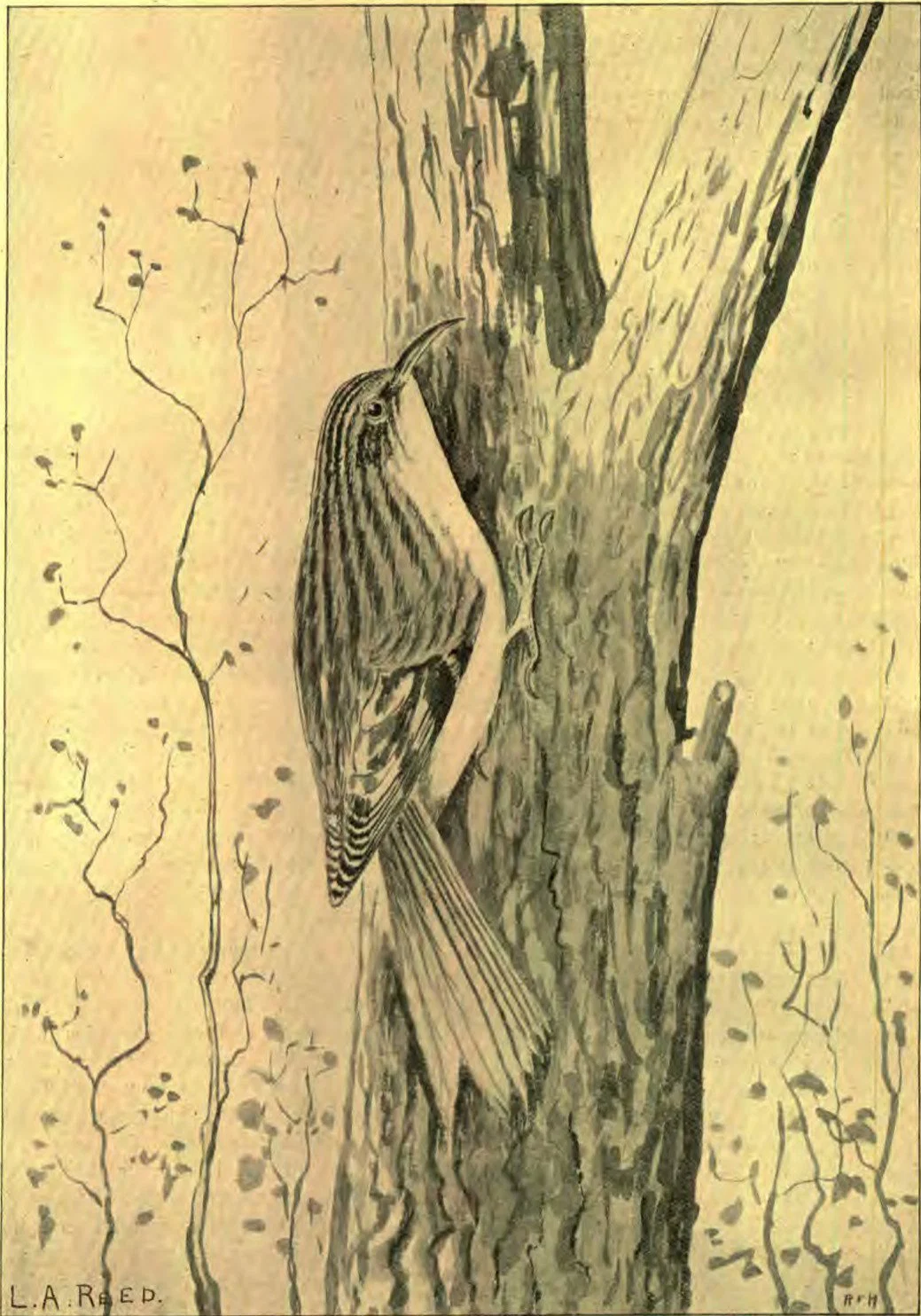
You should be on the lookout these days for the little Brown Creeper. It is possible to find him any day in winter; for he is a northern bird, breeding in summer-time from the northern limits of the United States far north into Canada; in the winter he may be found anywhere from Canada to the Gulf of Mexico. But from the middle of March to the last of April, the little creatures are on the move northward, traveling in such numbers that they may be seen almost any day, busy at work on the bark of some insect-ridden tree.
The story of the Brown Creeper can be told in a very few words,—he is unobtrusive, and very industrious.
He is unobtrusive because of two things. While he is with us, he never sings; and he is so nearly the color of the bark upon which he works that if he remained quiet, we should certainly pass him by unnoticed. But he does not remain quiet. Remember, his other characteristic is that of being very industrious. Some persons can hardly bear to watch the little fellow—he tires them with his unabating zeal.
My acquaintance with the bird was begun one day in March,—next to the last day in the month. I was out hunting birds with my field-glass. I had read more or less about this little bird, and recognized it the moment I saw it. I wrote in my note-book as follows: Saw a Brown Creeper on the trunk of a large maple, which allowed me to come very close, merely moving by a corkscrew movement around on the farther side of the trunk, but not stopping for a moment his picking at the bark. Used his bristle-ended tail frequently to brace himself, but often did not seem to need it. Even turned head downward on the bark for a fraction of a second, but never moved in that direction.
Keeping in mind the two characteristics of the Brown Creeper,—its unobtrusive ways and color, and its great industry,—let us see what others who have studied the bird have to say about it:—
“The facts in the case will doubtless show that the patient, plodding Brown Creeper is searching for the insects, eggs, and larvae which are hidden in crevices in the bark; but after watching him for several minutes, one becomes impressed with the thought that he has lost the only thing in the world he ever cared for, and that his one object in life is to find it. Ignoring you completely, with scarcely a pause, he winds his way, in a preoccupied, near-sighted manner, up a tree-trunk. Having finally reached the top of his spiral staircase, one might suppose he would rest long enough to survey his surroundings; but, like a bit of loosened bark, he drops off to the base of the nearest tree, and resumes his never-ending task. He has no time to waste in words; but occasionally, without stopping in his rounds, he utters a few squeaky notes, which are about as likely to attract attention as he is himself.”—Frank M. Chapman.
THE BROWN CREEPER
“An inoffensive but wearisome little fellow is a brown-clad denizen of all our woods in winter; . . . namely, the Brown Creeper, almost invariably seen on the trunks of trees whose bark is somewhat rough. He is a little over five inches long, white beneath, and finely marked with various shades of brown and white above. On first acquaintance he makes no particular impression other than that of being a neatly clad and busy little body; but in course of time he becomes really irritating to the feelings, from his exasperatingly conscientious but cold-blooded diligence, which makes you feel as if you ought to admire it on moral grounds; but you can not. The Brown Creeper is a virtuous drudge, without animation or variation. There is an air about him, as he silently climbs tree after tree, that makes his work seem as soulless as it is incessant. When you have seen him a minute, you have seen him a year; and seeing one is seeing a thousand.”
“He starts near the bottom of a tree, crawls up just about so fast and so far, and then flies to the bottom of another, only to repeat the program. By close application to business (and nothing but sickness can stop him), I find he can do a tree in just about fifty seconds, or seventy-two trees in an hour; and in the twenty-four hours (as far as I know, he works nights and every day in the week) seventeen hundred and twenty-eight trees. If he would only sing or chirp at his work, or flutter his wings, or turn his head occasionally, it would change the impression marvelously. Only now and then you hear a faint sip, that cheers neither himself nor the spectator, and has a drearily mechanical and conscientious sound. Every other bird I have seen will at times show joy or sorrow or fear by its manner of song, but the Creeper has only one aim and one ambition, and no time for sentiment. . . . It is nothing but climb, climb, climb, and never getting there.”—H. E. Parkhurst.
“As a tree-creeper we know the Brown Creeper, and as nothing else. If he ever happens elsewhere than on a tree-trunk, it must be by accident. I once found one that had evidently been blown into the room through an open window during a storm. Its effort to creep over the wall was not a success; and when it finally sank to the floor, its claws took such a hold upon the carpet that I could not dislodge it without injury. Any attempt to touch it was resented by vicious thrusts of its beak, which I found quite equal to piercing the skin.”—Dr. C. C. Abbott.
Those who have studied the bird in the nesting season describe the song of the little fellow as exquisitely pure and tender, now rising, now falling, and “dying away in an indescribably plaintive cadence, like the soft sigh of the wind among the pine boughs.” L. A. REED.
BIRD FORAGERS
AMONG the natural guardians of the trees are the woodpeckers, which gather their food as they creep round the trunks and branches. They have two toes before and two behind for climbing, and may usually be seen clinging erect on tree trunks; but rarely, if ever, with head downward, like the nuthatches and titmice. As the food of the woodpeckers86is nearly as abundant in winter as in summer, they are seldom migratory. They never forage in flocks, like some of the granivorous birds whose food is more plentiful, but scatter out over wide areas, and thus better their fare. They bear the same relation to other birds that take their food from trees, as snipes and woodcocks bear to thrushes and quails; that is, they bore into the wood as the snipe bores into the earth, while thrushes and quails seek the insects that crawl on the surface of the ground.
Besides these there are a few birds that take part of their food from trees and the rest from the ground. The thrushes do not refuse an insect or grub that is crawling upon a tree, but they forage chiefly upon the surface of the ground. The blackbirds are also guardians of the soil, and apparently are far more industrious than the thrushes. However, a little observation will correct this delusion. The common robin hunts his food in a listless, unconcerned way that is very deceptive. He hops about the field with his bill inclined upward, apparently oblivious to any object in view; then he makes two or three more hops, and again pauses with his bill turned upward in listless unconcern. But presently there is a quick dart and a vigorous pecking upon the ground; and if you are near enough, you will see him pulling out a cutworm or devouring a nest of insects which are gathered in a cluster.
On the other hand, blackbirds seldom hold up their heads, but march along with their bills turned downward, as if entirely devoted to their task. They never seem to be idle, except when a flock of them are making a garrulous noise upon a tree. If a blackbird looks upward, it is only by a sudden movement; he does not stop. After watching a blackbird and a robin ten minutes in the same field, one would suppose that the blackbird had collected twice as much food as the robin during that time. But this would not be true. The robin is probably endowed with a greater reach of sight than the blackbird, and while hopping about with his head erect, his vision comprehends a wider space. He not only watches for a sight of his prey, but also for marks upon vegetation that denote the place of its concealment. The omnivorous blackbird hunts the soil for everything that is nutritious, and picks up small seeds that require a close examination of the ground. Blackbirds of all species walk. They do not hop, like the robins.
Some species of the foragers do their work in compact assemblages. This habit renders the snow buntings extremely attractive. Their food is not distributed in separate morsels like that of robins and woodpeckers. It consists of the seeds of grasses and of composite plants, which are often scattered very evenly over a wide surface. When a flock of fifty or more settle down in a field, each one fares as well as if he were alone, during the short time he remains on the spot. Insect feeders find it for the most part profitable to scatter and keep separate, because their food is sparsely distributed. This is not true of the birds which frequent the salt marshes that are overflowed by the tide. Their food consists of insects and worms, which are evenly scattered and abundant. Hence sandpipers, and some other species, forage in flocks, though they live exclusively upon an animal diet.
It is difficult to estimate the usefulness of this systematic army of foragers. It matters not in what stage of its existence the insect is destroyed; it is still demonstrable that these minute creatures can not be kept in check unless they are attacked in all stages. Man can not by artificial means appreciably check their multiplication or their ravages. Birds are their only effectual destroyers.—Selected.
“WHAT we have may be counted as wealth as long as we own it. When it begins to own us, it is the measure of our poverty.”
THE FIRST ROBIN
Oh, the first robin’s song, when the sky is blue,
And the air is sweet with the breath of spring,
And the world, like the children’s hearts, is new,
And joy and beauty are on the wing!
Then, as we listen, we also sing
A song of gladness, and love, and praise;
For we are at rest in the love of our King,
And he will take care of us through “all the
days.”
— Selected.
NATURE'S WONDER STORIES
By Minnie Rosilla Stevens
The Fall of the Crystal Palace
HUNDREDS and hundreds of miles away, in the far north, there is a country that has only one day and one night in its whole year, each of them six months long. To us this would seem like a very dreary place, as cold winds sweep across the great plains during the hours of the long, long night; but when the day comes, and the sun shines over the scene, it is very beautiful. Everything sparkles as if covered with millions of diamonds, which flash so brilliantly in the sunshine that the eyes are blinded with their dazzling splendor.
This is the home country of a power which we will call King Cold, who has ruled there for hundreds of years. But in spite of his great age, he seems as strong as ever. He rules his kingdom without regard for the likes or dislikes of his subjects, who suffer instant and merciless punishment for the least violation of any of his laws. And not satisfied with his despotic reign in his own country, each year the old king takes a journey to the south, and then woe betide every tender thing that does not seek a shelter from his cruel advance. Killing, destroying, injuring, and imprisoning, he passes over the land, finally settling down for a time in the subdued territory, to rule it in the same harsh way that he rules at home.
One year, as the shadows of the long night began to creep across his glittering realm, old King Cold prepared to set out on his usual raid in the south. With all his forces he marched along, conquering wherever he went. He shut people up in their houses, and sheep and cattle in their stalls, while he destroyed the pastures, and laid waste the fields. Many poor wild creatures were killed outright, while his favorite servant, the Northwind, laughed and danced on after her master, in search of other victims.
As he continued his march, old King Cold came to a little grove near the foot of a long hill. A clear brook flowed through the cool shade; flowers bloomed on the banks; thick grass covered the ground; and tall trees mingled their branches overhead. It was a lovely spot; but its beauty could not save it from the ravages of King Cold, who at once set about to despoil the place.
First he killed all the flowers; then he shriveled the green grass, and stripped the leaves from the trees, tossing them far away; and while doing all this, he had fashioned a thick crystal plate, which was fastened down securely above the little brook, in spite of its loud murmurs.
Presently, a gentle rain began to fall; and as old King Cold breathed upon the rain, it turned hard and clear, like glass, upon the wet trees, dry grass, and dead flowers. Then the old king breathed still more deeply upon the tiny drops, even before they reached the earth; and as they fell, they were changed to bits of delicate white substance, which collected in soft, fluffy heaps on the crystal-covered trees and bushes and grasses of the little grove.
When morning dawned, everything was very still and cold; but as the sun peeped over the eastern hills, and shone upon the grove, the tree trunks rose like crystal columns; the sparkling branches, with their feathery festoons, mingled in a vaulted roof of exquisite beauty; a sparkling carpet of purest white was spread over the earth; and the whole structure glittered like a castle of glass adorned with thousands and thousands of precious stones of every tint, size, and shape, and of such brilliancy that the eye could scarcely bear the sight.
Thus in the little grove old King Cold had built himself a palace, where he lingered for a time. But at last the beautiful Queen Spring, who lived far away in the south, decided to take a journey north, drive old King Cold away, and give relief to the many tender things he had injured and oppressed. King Cold seemed securely seated upon his glittering throne in the crystal palace; but as Spring drew quietly near, and gently breathed upon its shining walls, a crackling and crashing sound was heard, and King Cold was obliged to vacate the crystal palace, lest it tumble down about his ears.
After that there was a battle between the Cold and the warm and gentle air of Spring; sometimes Cold gained the victory, but at last he was driven farther and farther north, and Spring, with her warm-hearted servant, the Southwind, soon cleared away all traces of the crystal palace. Set free from its prison, the little brook bounded joyously away toward the river, singing and gurgling with happiness; fresh flowers sprang up where the others had died; the grass turned green again; the trees put out new leaves; and soon the little grove was even lovelier than before.
Thus Spring drove old King Cold away, and accomplished more by gentleness than he had by force and bluster. So kindness will always vanquish cruelty. MINNIE ROSILLA STEVENS.
CAN YOU DUST?
A SHABBILY dressed young man applied to the manager of a large department store for employment. “What can you do?” asked the manager. “Most anything,” answered the applicant. “Can you dust?” “Yes, indeed.” “Then why don’t you begin on your hat?” The fellow hadn’t thought of that. “Can you clean leather goods?” “Oh, yes.” “Then it’s carelessness on your part that your shoes are not clean.” The fellow hadn’t thought of that, either. “Well, can you scrub?” “Yes, indeed,” was the reply. “Then I can give you something to do. Go out and try your strength on that collar you have on. But don’t come back.”87
While a neat attire is not always an index to good character and ability, the fact remains that of two applicants the business man will always employ the neatly dressed, attractive looking boy rather than one who is careless in his appearance.
The reason is obvious. The boy who is particular in regard to the details of his dress will be careful in his work, and thus command the respect and confidence of his employer.
To be well dressed is not to have expended a great deal of money on your clothes; on the contrary, if your garments are neat in appearance, and whole,—if your collar is clean, your necktie neatly fastened, your shoes polished, and your trousers carefully pressed,—the care and thought displayed in these small matters will more truly reflect character than the richness of the material of your clothes.
Muddy shoes can reflect nothing! Neatness and cleanliness are important recommendations, and are within the reach of every boy seeking work.—Selected.
“TALKING IN THEIR SLEEP”
By Edith M. Thomas
“You think I’m dead,”
The apple-tree said,
“Because I have never a leaf to show;
Because I stoop,
And my branches droop,
And the dull-gray mosses over me grow!
But I’m all alive in trunk and shoot;
The buds of next May
I fold away—
But I pity the withered grass at my root.”
“You think I’m dead,”
The quick grass said,
“Because I have parted with stem and blade!
But under the ground
I am safe and sound,
With the snow’s thick blanket over me laid;
I’m all alive, and ready to shoot
Should the spring of the year
Come dancing here—
But I pity the flowers without branch or root.”
“You think I’m dead,”
A soft voice said,
“Because not a branch nor root I own!
I never have died,
But close I hide
In a plumy seed that the wind has sown;
Patiently I wait through the long winter hours;
You will see me again—
I shall laugh at you then
Out of the eyes of a hundred flowers.”
—Edith M. Thomas, in St. Nicholas.
SELF-PRONOUNCING S.S. Teachers' Reference Bible
By Editor
Contains the Celebrated Teachers' Helps,
Comprising nearly 400 pages. Also a complete series of fifteen new maps.
DESCRIPTION
Imperial Seal Binding, Tuck Edges, known as “Divinity Circuit,” Rounded Corners, Full Red Under Gilt Edges.
We offer this Bible, postpaid, for only six new yearly subscriptions at 75 cents; or twelve new six months' subscriptions at 40 cents.
We will also send it, postpaid, with the INSTRUCTOR one year for $2.25. For 20 cents extra we will stamp your name in gold upon the cover. Address—
THE YOUTH’S INSTRUCTOR,
Battle Creek, Mich.
Easy Steps in the Bible Story
By Adelaide Bee Cooper
By Adelaide Bee Cooper, Editor of the Youth’s Instructor
Introduction by Elder S. N. Haskell, contains the Bible stories from Creation to the Giving of the Law. It is the first of a series of books for children, to cover the entire Bible narrative. The second Book of the series is now in preparation.
The early Bible stories never lose their beauty, freshness, and charm. They bring new inspiration to those advanced in years, and are read with pleasure and eager delight by youth and children. The principles revealed in the lives of the early Bible characters will, if instilled into the minds of the young, make an indelible impression for good, that neither time nor later associations can erase. Mothers, read them to your children.
WILL BEAR READING MORE THAN ONCE
That best of all Bible books for children—“Easy Steps in the Bible Story”—gains the unqualified approval of the children themselves; and that is the best possible testimony in its favor. They are glad to read it more than once. And the book will bear reading more than once: that is its strength.—Elder A. T. Jones, in Review and Herald, Jan. 8, 1901.
OAKLAND, CAL., Jan. 17, 1901.
REVIEW AND HERALD PUB. CO.,
BATTLE CREEK, MICH.
Gentlemen: I am pleased with the author’s success in briefly touching the salient points in the long period covered by “Easy Steps in the Bible Story,” and connecting them in such a way as to lead the minds of the little folks along with increasing interest. I hope thousands of children will be provided with this book.
ELDER A. G. DANIELLS.
The book contains 160 pages, table of contents, and list of illustrations. Our artist has prepared 150 beautiful pen-drawings, illustrating the text of the book. It also contains many full-page illustrations. Beautiful cover design. Two styles of binding.
PAPER COVERS, - 25 CENTS
CLOTH, - - 50 CENTS
Order of your Tract Society; the
Review and Herald Pub. Co., Battle Creek, Mich., or the Pacific Press Pub. Co., Oakland, Cal.
5. What did the Lord assure Joshua he had done? V. 2; note .
6. What part were Joshua and his men of war to take? For how long? V. 3; note .
7. How many priests were to go before the ark? What were they to bear? What was to be done on the seventh day? V. 4.
8. What were the people to do when the trumpet was sounded? What would then occur? V. 5.
9. What orders were then given to the priests and people? Vs. 6, 7.
10. How were Joshua’s instructions carried out? Vs. 8, 9.
11. Before going out, what had Joshua commanded? V. 10.
12. What was done the first day? V. 11.
13. What were the order and work of the first six days? Vs. 12–14; note .
14. On the seventh day what was done? V. 15.
15. As they passed round the seventh time, and the priests sounded the trumpets, what did Joshua command? V. 16.
16. What wonderful work was done when they shouted? V. 20; note .
17. Of all the inhabitants of Jericho, who alone were spared? V. 23.
NOTES
GRAND TRUNK R'Y. SYSTEM.
By W. C. Cunliffe
Taking Effect Dec. 16, 1900.
Trains leave Battle Creek.
WEST-BOUND.
No. 2, Mail and Express, to Chicago. 12.15 P. M.
No. 1, Chicago Express, to Chicago. 8.30 A. M.
No. 3, Lehigh Valley Express, to Chicago. 3.50 P. M.
No. 5, International Express. 2.17 A. M.
No. 75, Mixed, to South Bend. 8.30 A. M.
Nos. 9 and 75, daily, except Sunday.
Nos. 1, 3, and 5, daily.
EAST-BOUND.
No. 8, Mail and Express, East and Detroit. 3.45 P. M.
No. 4, Lehigh Express, East and Canada. 8.29 P. M.
No. 6, Atlantic Express, East and Detroit. 2.10 A. M.
No. 2, Express, East and Detroit. 6.50 A. M.
No. 74, Mixed starts from Nichols yard. 7.15 A. M.
Nos. 8 and 74, daily, except Sunday.
Nos. 4, 6 and 2, daily.
W. C. CUNLIFFE, Agent,
BATTLE CREEK
WITNESSING FOR CHRIST
To confess Christ is one of the first duties of the Christian. “Believe,” “confess,”—these are the primary steps in the experience of those who accept him. And what is it to witness for Christ? Surely it is not telling what we think about Jesus, nor what we have heard that he has done for some one else; neither is it repeating the words of others, nor confessing our sins to our friends or to our brethren and sisters in the church. The testimony of a witness in court is of value only as it tells what he himself knows. So with the Christian—to confess Christ truly is to tell what he has done for us—to witness to his power in our own lives to give victory over temptation and sin. Such confession is not a mere form of words; it is not simply “speaking in meeting:” it is the live spark of a vital experience that will kindle in other hearts a desire to know Him who has saved us, and washed us in his own blood.
WHILE it is the duty and privilege of all to believe and be saved, and to testify to others of this glorious fact, it is true that every one who lives on the earth, whether he now accepts or rejects the power that would save him, will some day confess Christ. But some will make the confession too late. For in that great day when, at the name of Jesus, every knee shall bow, and every tongue shall testify that Jesus Christ is Lord, it will be too late for those who have not made their peace with him. But now—to-day—all who will may accept and confess him, and may know what it is to have his keeping power in the life.
CONFESSION is a sign of our loyalty to our Master, and binds us closer to his cause. “I am not ashamed of the gospel of Christ,” wrote Paul, in the early days of the Christian church; and from his day to ours there have never lacked men and women, young people, and even children, who, like him, were not ashamed of their faith, but confessed it publicly, when to do so meant the loss of everything dearest in this world, and often even of life itself.
From the earliest times in the history of God’s people there have been those who bore a faithful witness to him. There were Caleb and Joshua, who declared their faith in the power of God to bring his people safely into the land of Canaan, even when the angry multitude would have stoned them; nearly a thousand years later three young Hebrew captives in a foreign land, “who stood before the king,” refused to obey his wicked command to bow down to a great golden image set up in the plain of Dura, notwithstanding the penalty was that those who did not fall down and worship should in “the same hour” be cast alive into a fiery furnace; and a little later we read how Daniel, the chief ruler under the king of Babylon, and a member of the king’s household, continued to pray three times a day in his open window, according to his usual custom, when the decree had been signed by the king himself that whosoever should ask anything of any god or man save the king for thirty days should be cast into the den of lions. These men were all loyal to God, and he delivered them. They were not ashamed of their faith, nor afraid of any injury or ridicule that men could inflict; therefore he “is not ashamed to call them brethren,” nor “to be called their God.”
How different was their belief, and how much more inspiring their example, than that of those who, “among the chief rulers” in the time of Jesus’ trial and death, “believed on him; but because of the Pharisees they did not confess him, lest they should be put out of the synagogue”!
CONFESSION brings strength to the individual, as well as help to those who hear him. A minister of the gospel tells of a man who, seven years before, was “an outcast, friendless, hopeless, the slave of drink. But last night I heard him say,” he declares, “that immediately on his conversion he began confessing his Saviour; and during all those seven years he has never failed, even in any mixed company, to acknowledge himself a Christian. Drink is under his feet, health is in his nerve and eye, hope is in his heart, and heaven is his sure goal.” But would this bright experience have been his if he had, after the first two or three times, ceased to tell of what the Lord was doing for him? How many sad cases of backsliding give the answer!
THE words of Jesus to the man out of whom had been cast a legion of evil spirits contain a hint as to where we should testify for Christ. In his gratitude and joy the healed man wanted to go with Jesus, to follow him wherever he went; but the Master had another work for him. “Go home to thy friends,” he commanded, “and tell them how great things the Lord hath done for thee.” At home, among those who had known him all his life, the change that had taken place in this man would bear the most glorious witness to the power of God. And the confessing, the witnessing, that does not begin at home is of little value. Of course it need not, it will not, end there. The gospel is to go to every nation, and it will be carried by human agents; but it is those who are most faithful in confessing Christ in the place where they are, who will be able to witness most acceptably for him elsewhere.
SOMETIMES we hear persons say that they can confess Christ by their lives—that there is no need that they should speak for him. The life does testify—and so loudly, too, that lip-service without the accompanying testimony of good works is worse than useless. But the two will be found working harmoniously together in the life of every Christian. If the life is upright, and the heart full of love to God and to his children, the tongue will not be slow to speak his praise. “Let us offer the sacrifice of praise to God continually, that is, the fruit of our lips giving thanks to his name. But to do good and to communicate forget not: for with such sacrifices God is well pleased.”
CONFESSION strengthens the hope of the Christian, and brings him near to God; for “whosoever shall confess that Jesus is the Son of God, God dwelleth in him, and he in God.” It helps to conquer temptation: the Christian who yields himself completely to Christ, and makes his confession very definite, will escape many temptations that harass the half-hearted. And it glorifies God; for “whoso offereth praise,” he declares, “glorifieth me.”
“Whosoever therefore shall confess me before men, him will I confess also before my Father which is in heaven.”
FOR EVERY DAY OF THE WEEK
Sunday:
“Watch the thoughts. Thoughts make impulses, and impulses make deeds.”
Monday:
First. If you don’t like a thing, try with all your might to make it as you do like it. Second. If you can’t possibly make it as you like it, stop thinking about it; let it go.—Helen Hunt Jackson.
Tuesday:
“They greatly dare who greatly trust. If our faith were greater, our deeds would be larger. The reason so few of us do not attempt great things for God, is simply because we do not trust him enough.”
Wednesday:
God wants us to live by the day. Enough for the day is all we are to ask. God does not promise supplies in advance. If we have only bread for to-day, and are doing our duty faithfully, we may trust him till to-morrow for to-morrow’s food.—J. R. Miller.
Thursday:
“Have you had a kindness shown?
Pass it on!
’Twas not given for you alone—
Pass it on!
Let it travel down the years,
Let it wipe another’s tears,
Till in heaven the deed appears—
Pass it on!”
Friday:
Your souls are a picture-gallery. Let their walls be hung with all things sweet and perfect—the thought of God, the image of Christ, the lives of God’s saints, the aspirations of good and great men, the memories of golden deeds.—Archdeacon Farrar.
Sabbath:
“The very God of peace sanctify you wholly; and I pray God your whole spirit and soul and body be preserved blameless unto the coming of our Lord Jesus Christ.” 1 Thess. 5:23.
IMPORTANT ANNOUNCEMENT
BEGINNING with the next quarter, the youth’s divisions in our Sabbath-schools will study the subject of the Sanctuary, the same as the senior division, continuing the study for two quarters. This is an important subject, and one that most deeply concerns all who live in the world to-day. We hope that the librarians, or those who have the matter in charge, will see that their youth’s division is supplied, on Sabbath, March 23, with papers bearing the date of March 28, and containing the first lesson on the Sanctuary, to be recited on the first Sabbath in April. It is important that not a lesson be missed in this study, in order that the youth may gain a connected idea of the subject as a whole. If your club has been cut off, or is about to expire, kindly see to the matter of renewing it at once.