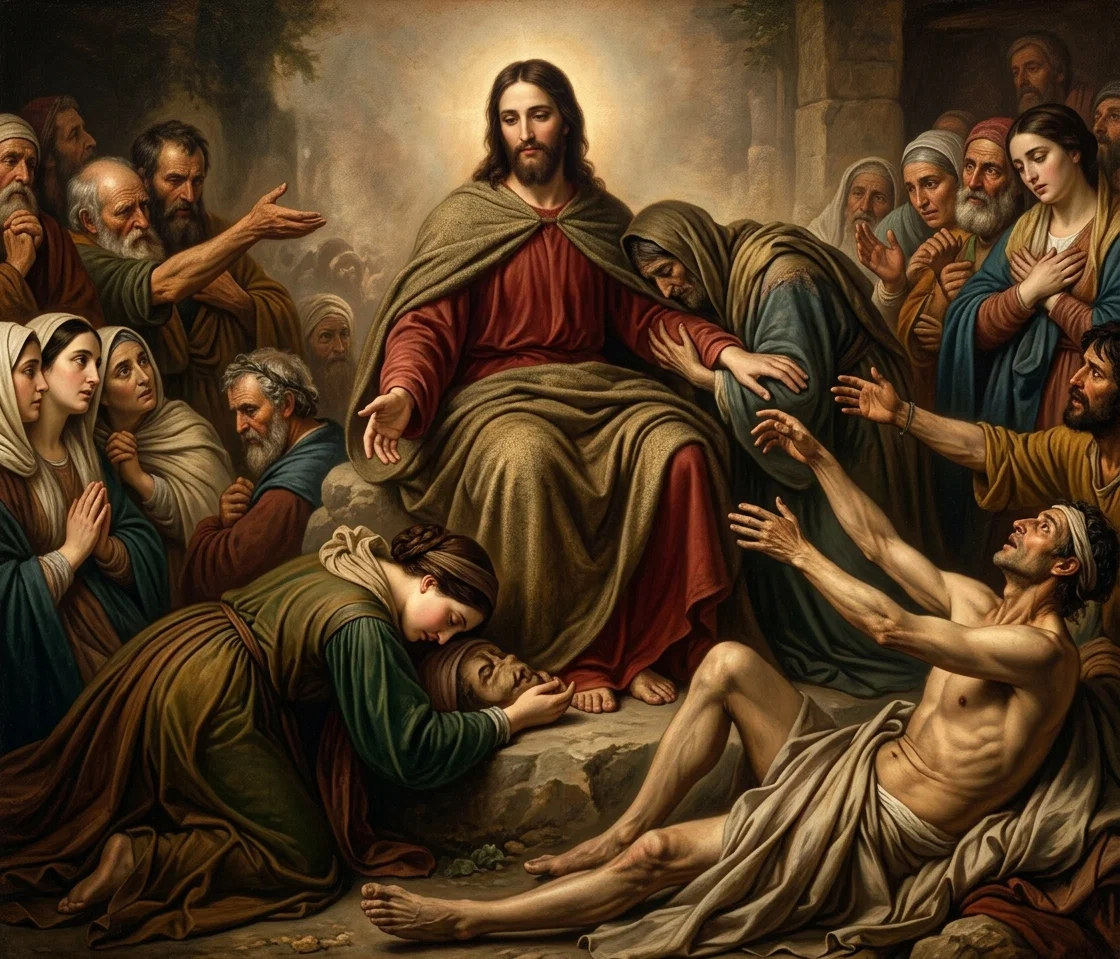
“They sought even to touch him, for in his very touch there was healing.”
THE DIVINE TEACHER.
By Augusta W. Heald
After making the circuit of Galilee our Lord came again to Nazareth, his early home, and on the Sabbath day he entered into the synagog, according to his custom. When he stood up to read, the book of Isaiah was handed to him. He opened the book and read: “The Spirit of the Lord is upon me, because he hath anointed me to preach the Gospel to the poor; he hath sent me to heal the broken-hearted, to preach deliverance to the captives, and recovering of sight to the blind, to set at liberty them that are bruised, to preach the acceptable year of the Lord. And he closed the book, and he gave it again to the minister, and sat down,” saying, “This day is this scripture fulfilled in your ears.” Luke 4:17–21.
As the divine Teacher continued his discourse in the synagog, every eye was fastened upon him, and all “wondered at the gracious words” which fell from the lips of Him who “spake as never man spake.”
And yet there were some who thought in their hearts: “If thou be the Christ why not do here some of the mighty works done in Capernaum? But no, you are Joseph’s son, and yourself a carpenter; your brothers and sisters are all well known to us; they are of a lowly class. You are no prophet.”
Jesus, looking within the heart, saw this evil spirit of unbelief in the proud Pharisees, and said to them, “No prophet is accepted in his own country.” Elias was sent to a widow in Sidon rather than to any in Israel, and altho there were many lepers in Israel, no one was cleansed save Naaman, the Syrian. Luke 4:25–27. Upon hearing these words all in the synagog were enraged, and they laid hold on Jesus and “thrust him out of the city” (Luke 4:29), and led him to the brow of the hill on which their city was built, intending to hurl him headlong; but Jesus hid himself from their sight, and passing through their midst, went his way.
Again as the great Physician and divine Teacher stood among his disciples, a great multitude of people drew near, both to hear and to obtain healing for their diseases. They sought even to touch him, for in his very touch there was healing.
Having relieved the sufferers around him, the sacred Teacher sought to minister to their hungry souls. With what wondrous joy must the poor, the destitute, and the despised have listened to these gracious words! “Blessed be ye poor; for yours is the kingdom of God. Blessed are ye that hunger now; for ye shall be filled. Blessed are ye that weep now; for ye shall laugh. Blessed are ye, when men shall hate you, and when they shall separate you from their company, and shall reproach you, and cast out your name as evil, for the Son of man’s sake. Rejoice ye in that day, and leap for joy; for, behold, your reward is great in heaven; for in the like manner did their fathers unto the prophets.” Luke 6:20–23.
Here also were the rich, wholly satisfied with the good things of earth. To while away an idle hour or to see some new thing was the one aim of their existence; and so they had come out to hear the new Prophet of Nazareth. Did not a tremor of dread touch their indolent hearts as these words of terrible import rang out upon the free air? “Wo unto you that are rich! for ye have received your consolation. Wo unto you that are full! for ye shall hunger. Wo unto you that laugh now! for ye shall mourn and weep. Wo unto you, when all men shall speak well of you! for so did their fathers to the false prophets.” Luke 6:24–26.
Centuries before, the prophets of Israel had poured out their denunciations upon luxurious sinners; said Amos, the herdman of Tekoa, “Wo to them that are at ease in Zion.” Amos 6:1. Isaiah had declared the Word of the Lord: “Behold, my servants shall eat, but ye shall be hungry; behold, my servants shall drink, but ye shall be thirsty; behold, my servants shall rejoice, but ye shall be ashamed; behold, my servants shall sing for joy of heart, but ye shall cry for sorrow . . . and shall howl for vexation of spirit.” Isa. 65:13, 14. Thus did the preaching of the Lord Jesus accord with the prophetic Word.
“How sweetly flowed the Gospel sound
From lips of gentleness and grace,
When listening thousands gathered round,
And joy and gladness filled the place!”
AUGUSTA W. HEALD.
SALVATION IN THE WORD.
By M. E. K.
To Timothy, his “own son in the faith,” the apostle Paul expresses himself in these words: “Take heed unto thyself, and unto the doctrine; continue in them; for in doing this thou shalt both save thyself, and them that hear thee.” 1 Tim. 4:16.
The line of thought of which these words express a part, evidently begins in the thirteenth verse: “Till I come, give attendance to reading, to exhortation, to doctrine. Neglect not the gift that is in thee, which was given thee by prophecy, with the laying on of the hands of the presbytery. Meditate upon these things; give thyself wholly to them; that thy profiting may appear to all.”
Reading, exhortation, and doctrine are the things to which Paul would direct the mind of Timothy, his faithful disciple. By reading is evidently meant the reading and study of the Scriptures. Timothy was a student of the Word of God. “From a child” he had “known the Holy Scriptures,” which Paul assures him are able to make him “wise unto salvation.” The great source of wisdom was open to him, and the Spirit of God was his to enlighten his mind to an understanding of the Word, as it is for every one who earnestly desires to know the will of God, not for speculative purposes or theological disputes, but that he may do it.
In that Word Timothy was to find the doctrine. He was not to find it in notes, commentaries, glossaries, or opinions of it, even from the wisest and best of men, but he was to find it in the Word itself. Says the psalmist, “Thy Word is a lamp unto my feet, and a light unto my path.” What was the right way for Timothy is the right way for every one. “All Scripture is given by inspiration of God, and is profitable for doctrine, for reproof, for correction, for instruction in righteousness; that the man of God may be perfect, thoroughly furnished unto all good works.” 2 Tim. 3:16, 17.
Do we want doctrine,—a doctrine free from the errors, traditions, prejudices, mistakes, foolishness, and foibles of men? The Scriptures486are the place to look for such doctrine. Do we need reproof? and who does not? The Scriptures will furnish the truest, kindest, and most helpful reproof that can be found. As wayward sons, are we in need of correction? The Scripture correction has in it that element of love, which is so lacking in human corrections, which makes the correction for our good.
Do we need instruction in righteousness,—in right doing, right living? In the Scriptures may be found the law of righteousness. There, too, we learn of Christ, whose righteousness is imputed to us by faith, so that we and the law of righteousness may be in harmony.
Do we want to be perfect, thoroughly furnished unto all good works? We must go to the Scriptures. We need to come into contact through that Word with the perfect God-man—Christ, the Saviour of the world, or we can never be perfect. Good works can only come through faith in him whom the Scriptures reveal, Jesus of Nazareth. For all these things, so necessary for happiness here and our eternal salvation, we must go to the Scriptures. There an abundant supply may be obtained.
Having studied the Scriptures, and become wise unto salvation, what was Timothy next to do? Was he to be idle, keeping to himself the fruits of the study, and the gifts which were given him of God, “with the laying on of the hands of the presbytery”?—No; he was to exhort others, teaching and imparting to them as far as possible what he had learned, referring them to the Scriptures as the source of his wisdom. He was not to do for others what they could do for themselves; but he was to direct them into the same green fields of truth wherein he had fed, that they might eat and be filled, and so be able to direct others to do the same. This was what Paul wished for Timothy; it is what Christ wishes for every one of his children; it is what they must do if they fulfil the object for which he has called them out of darkness into his marvelous light.
In order to do this work properly, Timothy was exhorted to take heed. He was to take heed to the doctrine, that it be clearly drawn from the Scriptures. Then it would be the truth, with no mixture of error. It would be powerful. “The Word of God is quick [living] and powerful.” It makes those who receive it perfect, “that the man of God may be perfect.” It leads to good works, “unto all good works.” Those who receive it are saved. “Receive with meekness the engrafted Word, which is able to save your souls.” James 1:21.
There was also a personal message to Timothy: “Thyself and the . . . doctrine.” Not only was he to go to the Scriptures for doctrine, but he must make that seeking for light a personal matter. He was to search the Scriptures first of all for the benefit of Timothy. He was not to study the Scriptures to make him mighty, to confound the unbelieving Jews, or to convince the darkened Gentiles that Jesus was the Saviour of the world, and that he could and would save them if they would receive him. All that would come as a natural consequence of his own spiritual enlightenment when once he himself had received the divine illumination. This must be obtained first. So it was said, “Take heed unto thyself, and unto the doctrine; continue in them; for in doing this thou shalt both save thyself, and them that hear thee.”
A principle is here revealed that should never be lost sight of by any one who hopes to be instrumental in the salvation of souls. A saved sinner is the only properly authorized person to carry the news of the salvation of God through the Gospel to those who are not saved.
Ordination to the ministry may not be sufficient evidence that one can rightly point sinners to the “Lamb of God, which taketh away the sin of the world.” If the “laying on of the hands of the presbytery” is not accompanied by the unction of the Holy Spirit, there to abide upon the person set apart, if there is not a manifestation of that Spirit who once said, “Separate me Barnabas and Saul for the work whereunto I have called them,” then there is no certain evidence that the one upon whom hands have been laid is a saved man, or that he may be the means of saving others. If one has received the doctrine, studying first and taking it first for himself, until he knows the doctrine,—knows from a personal experience its saving power,—then he is able to point out to others the same saving power, and help them to receive what he has already received. Said the psalmist: “Restore unto me the joy of thy salvation; and uphold me with thy free Spirit. Then will I teach transgressors thy ways; and sinners shall be converted unto thee.”
M. E. K.
FULNESS AND IMPORTANCE OF THE BIBLE.
By A. T. Pierson
BY A. T. PIERSON, D.D.
The unique position of the Word of God lies in this, that it claims to be, and justifies the claim to be, the one Book which God has given to man as a revelation of his will. Claiming plenary inspiration, and complete adaptation to man’s wants, it is at once, as James teaches, the perfect mirror of character; as David teaches, the perfect medicine for the soul; as Paul teaches, the perfect mold of holy manhood (Rom. 6:17, Greek); and, as all inspired writers agree, the miracle-worker which transforms the heart and life.
We must remember, moreover, that there is a reason, and a very special one, for giving to this authoritative Word of God a present exaltation in our daily life of study, which had been in previous centuries impossible. How few of us appreciate the difference between ancient and modern times, in the facilities for individual Bible reading and searching! Contrast the remote days of Ezra—when copies of the sacred books were so rare that all the multitude could hope to do would be to hear passages read and expounded, and when such privileges brought overwhelming joy. Nehemiah 8. Or think of Luther’s day, only three and a half centuries since, when the Bible was found only in convents and public sanctuaries, and even there was chained to a pillar as a rare and costly treasure.
Finely, indeed, does Ruskin remind us in his lecture, “Sesame—Of King’s Treasuries”—how books introduce us to the company of the wise, and great, and good, at whose doors we otherwise so often wait vainly for admittance. What shall we then say of the supreme honor and privilege of Bible study, since this is the “open sesame”—the mystic watchword which opens the door to the true King’s treasuries? By this devout search into the Word of God we actually unlock the secret chambers of God, and find that “where the Word of a King is, there is power.” Eccl. 8:4. Here are the most marvelous wonders bursting on our astonished eyes. The Bible is God’s palace, and it has palatial apartments, indeed. There is one—the very sanctuary of the Word—where the living oracles are heard; another, where the complex mirrors reflect all our past and present, and even forecast our future history; yet others which are chambers of peace, whose windows look out on the heavenly hills, and the very atmosphere of which is rest. The Bible has its picture galleries, with portraits of holy men and women, and, above all, the very image of the Son of God; it has its museum with the unfolding mysteries of God, and the curious relics of antiquity for instruction and admonition; there is also a banquet hall for the refreshment of all believers, where babes may find milk, and the strong man, meat and honey. And in one of these glorious rooms we may find the crown jewels, which are there in store for God’s crowned kings in the day of Christ’s coming.
Neglect of the Scriptures is in a sense a sin that hath no forgiveness; for it implies irreparable damage to spiritual life and forfeiture of spiritual blessing. No repentance and reformation can ever restore the years which this cankerworm of indifference to the Word of God has eaten. What an insult to the royal Spirit, Author, who puts in our hand the key to his treasure chambers! What a sign of apathy and lethargy of soul, when even the carnal ambition to be wise and great, and move in the society of the wise and great, actuates us more than the aspiration to be wise and great in God’s eyes, and abide in his companionship! Do Bible possessors realize that they have a chance to enjoy a university education in the school of God, that the Word of God is itself life and light, a passport to heavenly society, free to all alike, as children of the King?—Missionary Review.
THE LIFE OF CHRIST RECEIVED THROUGH FAITH.
By Wm. Covert
The unbroken flow of life from God to man was ordained to pass through the channel of faith. But when unbelief entered the mind, the channel was clogged, and the vital current shut away, and death took the place, and reigned where once life had supremely ruled. The Saviour bears this testimony: “He that believeth not is condemned already, because he hath not believed in the name of the only-begotten Son of God.” John 3:18. Jesus, in speaking of the effect of the Holy Spirit upon man, said it convinces “of sin, because they believe not on me.” John 16:9. One thought in the last-quoted text shows that the Spirit of God enables the sinner to see that unbelief has severed his connection with the spring of life, and placed him in the current of death.
The principle is thus stated by Paul, “To be carnally minded is death; but to be spiritually minded is life and peace.” Rom. 8:6. The truth herein shown is that man’s condition as related to life, is maintained through the attitude of his mind. If in his mind he receives and retains the truths of Christ, then in them he has life. But if through his mind he rejects Christ, he is at the same time rejecting eternal life.
The exercise of unbelief toward Christ is but the fermentation of sin,—the actual product thrown off by the working power of the father of lies. It is the false testimony which Satan bears against the love of God. This startling announcement is made upon the subject, “He that believeth not God hath made him a liar; because he believeth not the record that God gave of his Son.” 1 John 5:10. God can not lie (1 Sam. 15:29; Titus 1:2), and when man disputes the Word of God, man is himself telling a grievous falsehood. He is not only telling a lie, but if he continues thus, he actually becomes the embodiment of falsehood, a veritable incarnation of deception.
But some men will ask, “What good things can be accomplished by faith?” The answer is,7“All things.” Faith is to the mind of man what the stem is to the growing fruit, or the rootlets to the living plant. Faith is the pipe of life through which vital connection with God is maintained. Paul says, “We have access by faith into this grace wherein we stand, and rejoice in hope of the glory of God” (Rom. 5:2), or, as stated in another place, “Nevertheless I live; yet not I, but Christ liveth in me; and the life which I now live in the flesh I live by the faith of the Son of God, who loved me, and gave himself for me.” Gal. 2:20.
As truly as the electric current is placed upon the wire through its actual contact with the dynamo, so surely is man vitalized with new life when his mind through faith comes into living touch with the mind of God. See those cars standing helpless upon the track. The wires are properly arranged above and beneath; but it is powerless to move because an enemy down the line has cut off the connection between the motor and its source of life. Thus the vehicle is left dead upon the road. Such incidents do occur, and those who have been thus placed at a disadvantage can appreciate the inconveniences connected therewith. Just as severing the wire checks the electric flow, and stops the moving car, so does unbelief shut off from man the power and life of God, and leave him dead and helpless in his sins.
Satan a Destroyer.
It was Satan’s studied effort and strong desire to cut man away from his hold on the Lord. His first malicious stroke was therefore aimed at the cord of faith, because upon faith everything depended. Understanding came through faith. Joy grew up in faith. Obedience was but the fruit of faith. Faith gave hope. Courage was born of faith. Wisdom flourished in faith. Peace and love were twin sisters of faith. Industry and vigilance dwelt side by side in faith. Victory was in faith, and the works of God were all made to exist and abound through faith. That he might extinguish all these, Satan purposed to destroy faith. He knew that unbelief in the mind of man would nullify all that is good and true, and finally put out all there is of the light of life. Therefore it is written, “The god of this world [Satan] hath blinded the minds of them which believe not, lest the light of the glorious Gospel of Christ, who is the image of God, should shine unto them.” 2 Cor. 4:4.
This dreadful darkness with an ever increasing density will prevail as long as unbelief remains; and with this darkness, death and destruction will stalk abroad, even at noonday, and like a legion of demons will it spread pestilence. Satan’s power has always been negative. By Satan nothing has ever been created, nor anything kept. Through him nothing either good or noble has at any time been upheld. Not one cause of worth has he ever carried forward. His nature and his work are to kill, to tear down, and to destroy.
The Lord Builds Up and Beautifies.
The Lord’s work is to bring into being, to give form and beauty, to sustain and make happy. His nature is positive, to keep, and all his works are manifestations of love. “The Lord is good to all; and his tender mercies are over all his works.” Ps. 145:9. The Lord is just what man needs. “God is love,” and it is only necessary for him to be known in order that he may give to man eternal life. “This is life eternal, that they might know thee the only true God, and Jesus Christ, whom thou hast sent.” John 17:3. This knowledge, and with it life, must reach man through faith. It can come in no other way. “Without faith it is impossible to please him; for he that cometh to God must believe that he is, and that he is a rewarder of them that diligently seek him.” Heb. 11:6.
God speaks to man not only in his written Word, the Bible, but all nature announces the presence of his love, his wisdom, and his power. Those who have never learned to read in books, neither have been situated so as to hear the instruction of a Gospel missionary, may, notwithstanding all these unfavorable circumstances, study him in all the universe. Paul spoke of God to the heathen worshipers at Lystra, and said, “He left not himself without witness, in that he did good, and gave us rain from heaven, and fruitful seasons, filling our hearts with food and gladness.” Those pagans had just witnessed the impartation of new life to a poor cripple who exercised faith in Christ, and they were attributing to the apostles the power that had done this miracle. The circumstances enabled Paul to teach them an important truth regarding the significance of nature as proclaiming the perpetual presence and manifestation of God’s power and love everywhere.
If man would but properly exercise his senses he need not be ignorant as to the true source of all things. In all life’s surroundings God may be seen through his works. Every shower of rain, the great beauty and variety in the growing crops, the coming and the going of the fruitful seasons, the multitude of kinds and conditions in the animal kingdom—everything, individually or collectively studied, bears witness to the same gracious truth before quoted, that God “is,” and that he is a “rewarder” of those who seek him. The worshipers of Jupiter and Mercury then listening to the apostle were accountable to God for the manner in which they received or rejected the message which was on that occasion delivered to them. So it is with every people on the earth. These witnesses regarding the existence and character of God are ever kept before their eyes, in heathen lands as well as in the more enlightened portions of the world.
Every grain of wheat in that large field has been severally endowed with life from the Lord for the benefit of mankind, and both the reaper and the eater should understand this lesson. But often they do not. Blindly and wickedly they partake of the bounties of nature without even a thought of the One who in love supplies all their needs. Of the treatment which the Lord receives from the unthankful and thoughtless, he says: “Hear, O heavens, and give ear, O earth; for the Lord hath spoken, I have nourished and brought up children, and they have rebelled against me. The ox knoweth his owner, and the ass his master’s crib; but . . . my people doth not consider.” Isa. 1:2, 3. Less appreciative or thankful for the Creator’s benefits are many of the human family than is the ox for the privilege of eating at his master’s crib.
The Lord speaks of the migratory birds having understanding superior to those men who turned away from the wisdom and light of life. The birds have retained the wisdom of instinct, which their progenitors possessed ages ago, while man has retrograded and gone into heathen darkness. In calling man’s attention to this lamentable condition, the following language is used: “Yea, the stork in the heaven knoweth her appointed times; and the turtle and the crane and the swallow observe the time of their coming; but my people know not the judgment of the Lord.” Jer. 8:7.
O faithless man, made a little lower than angels, created to have dominion over the beasts and the birds, why have you fallen so low, in many cases even lower than the creatures of your charge? To you are these words addressed: “Lift up your eyes on high, and behold who hath created these things [the stars above], that bringeth out their hosts by number; he calleth them all by names by the greatness of his might, for that he is strong in power; not one faileth.” Isa. 40:26. In the beginning of this world man’s vision was unclouded by sin, and many were the reasons for believing. With the eyes creation gave him, much was plain to his view which can now be seen only by the aid of the telescope or the microscope. As he now looks into the heavens through the telescope, he should not praise himself for constructing the instrument, but, instead, let him adopt the language of David where he exclaims, “The heavens declare the glory of God, and the firmament showeth his handiwork.” The person who can do no more than to discover and note down in a book a few of the wonderful things which the Creator is doing, has but little reason for taking glory to himself on account of the discovery. WM. COVERT.
(Concluded next week.)
WHO SHALL BE ABLE TO STAND?
By J. E. Evans
To be ready for the Saviour's return should be the first work of all who desire a home in the mansions he has gone to prepare. To all such the second coming of Christ will be a joyous event. They will say, “Lo, this is our God; we have waited for him; . . . we will be glad and rejoice in his salvation.” But to all who are not prepared that day will come “as a thief in the night;” and in consternation they will exclaim, “Mountains and rocks fall on us, and hide us from the face of him that sitteth on the throne, and from the wrath of the Lamb; for the great day of his wrath is come, and who shall be able to stand?”
This question should be considered now. Time and opportunity are now being given, and all may accept the gracious offer of pardon and righteousness. The call is being given, “The heavens declare the glory of God; and the firmament showeth his handiwork. Day unto day uttereth speech, and night unto night showeth knowledge.” By audible voices and the silent voices of nature the wonderful mercy and works of God are shown. “Have they not all heard?”
Perhaps you, dear reader, have studied to answer the above question. What shall the answer be? We are sometimes led to think that this or that person will be able to stand; but as for me? Such thoughts are not of heavenly origin. God would have his children confident. Their confidence will not be born of presumption, but of a living faith. The way of faith is revealed in the Scriptures, and he who studies them with a heart reaching out after God will soon become acquainted with the power by which he will be enabled to stand. If we “look for him,” we should also look for those things which are to make us “like him.” For “the fire shall try every man's work of what sort it is.” Therefore, “let every man take heed how he buildeth.” “Wherefore let him that thinketh he standeth take heed lest he fall.” 1 Cor. 10:12.
“But who may abide the day of his coming? and who shall stand when he appeareth?” Mal. 3:2. “He that hath clean hands, and a pure heart; who hath not lifted up his soul unto vanity, nor sworn deceitfully.” Ps. 24:4.
“He that walketh uprightly, and worketh righteousness, and speaketh the truth in his heart. He that backbiteth not with his tongue, nor doeth evil to his neighbor, nor taketh up a reproach against his neighbor. . . . He that sweareth to his own hurt, and8changeth not. He that putteth not out his money to usury, nor taketh reward against the innocent. He that doeth these things shall never be moved.” Psalm 15.
“And besides this, giving all diligence, add to your faith virtue; and to virtue, knowledge; add to knowledge, temperance; and to temperance, patience; and to patience, godliness; and to godliness, brotherly kindness; and to brotherly kindness, charity. . . . For if ye do these things, ye shall never fall; for so an entrance shall be ministered unto you abundantly into the everlasting kingdom of our Lord and Saviour Jesus Christ.” 2 Peter 1: 5-11.
“Therefore whosoever heareth these sayings of mine, and doeth them, I will liken him unto a wise man, which built his house upon a rock; and the rain descended, and the floods came, and the winds blew, and beat upon that house; and it fell not; for it was founded upon a rock.” Matt. 7: 24, 25.
The Son of God existed with the Father in glory, before the world was, before his humiliation, and Christ prays that that glory may be restored. It was by the Son that God created the world. Col. 1: 13–17; I Cor. 8: 6; John 1: 1–3. It is a perversion of language to apply “before the world was” to Christ’s baptism. The goings forth of Him who was born in Bethlehem “have been from of old, from everlasting.” Micah 5: 2. Compare Matt. 2: 6. Matt. 3: 17 and 17: 5 are simply records of God’s approval upon the work and mission of his Son.
No. 610. Trust in God and Life Insurance.
WILL you please give us light on 1 Tim. 5: 8? If I provide the best I can, and trust in God for our daily bread, will I fulfil Matt. 6: 25–33? Or must I carry life insurance to comply with 1 Tim. 5: 8? D. M. R.
One is not dependent on life insurance or any other similar scheme to fulfil God’s Word. The Lord wants his children to be “not slothful in business,” to “provide things honest in the sight of all” (Rom. 12: 11, 17), “to work with your own hands” (I Thess. 4: 11, 12; 2 Thess. 3: 8–10); and yet he does not desire them to have anxious thought for the morrow, to continually be borrowing trouble, over what we shall eat, drink, or wear. “Seek first the kingdom of God and his righteousness.” This means to live his Word, and God will care for the rest.
No. 611. The King of the North.
How do some that claim Turkey to be the king of the north make out such from the eleventh chapter of Daniel? and why are they so positive? O. F.
We have not space in this department for an explanation of Daniel 11. For that view see “Thoughts on Daniel and the Revelation,” by U. Smith. We suppose they are thus positive because they believe themselves to be right, tho positiveness is not proof.
PLEASE explain Rom. 14: 5, and part of verse 6. Does the passage have reference to the seventh-day Sabbath? J. D.
Evidently not. It was with reference to days connected with meats and drinks. One man esteemed these days above others, another man esteemed them to be like all other common days. The apostle would not have them judging or condemning each other; for every man must give an account to God. Verse 12. Neither would the expression “every day” include the Sabbath; for the same Spirit uses the same term when the Sabbath is excepted: “The people shall go out and gather a certain rate every day.” Ex. 16: 4. But the seventh day was excepted. Verses 25, 26. It is an eternal truth that “the seventh day is the Sabbath of the Lord thy God.” Ex. 20: 10. But to man he has given “the six working days.” Eze. 46: 1.
“Under the law” means under the condemnation of the law. “Under grace” means just the opposite, a condition in which the sin has been removed by the free grace of God. “Sin is the transgression of the law.” I John 3: 4; Rom. 7: 7. He who transgresses any law is condemned by that law: sin has dominion over him. He is a slave to sin, condemned by the law which holds over him the dread sentence of death. “Know ye not, that to whom ye yield yourselves servants to obey, his servants ye are to whom ye obey; whether of sin unto death, or of obedience unto righteousness.” Rom. 6: 16. This text and the connection (Rom. 6: 6–18) certainly show that “under grace”—under the favor of God—is the opposite of “under sin,” under the transgression and condemnation of the law. The same truth is told from the other side in Gal. 5: 18: “If ye be led of the Spirit, ye are not under the law.” Why—Because those who walk after the Spirit fulfil “the righteousness of the law” (Rom. 8: 4), and against “the fruits of the Spirit” “there is no law” (Gal. 5: 23), because the law is kept in those fruits. To be “under grace,” then, is to be by the favor of God free from sin and keeping his law; and to be under the law is to be walking in transgression, condemned by the law.
The verse reads as follows: “Wherefore, my brethren, ye also are become dead to the law by the body of Christ; that ye should be married to another, even to him who is raised from the dead, that we should bring forth fruit unto God.” “Dead to the law” is dead to its condemnation. The law condemns all to death, because all have transgressed its holy precepts. Eze. 18: 4; Rom. 6: 23. But “Christ died for our sins,” in our behalf. I Cor. 15: 3. When we by faith accept Christ’s death as our death by turning from our sins, we are no longer condemned; the law has no claim upon him who is dead, and by faith in Christ we are reckoned dead, “that the body of sin might be destroyed, that henceforth we should not serve sin. For he that is dead is freed from sin.” Rom. 6: 7. Rom. 7: 4 merely states this again, “Ye also are become dead to the law”—dead to its condemnation—“by the body of Christ; that ye should be married to another, even to him who is raised from the dead, that we should bring forth fruit unto God.” Christ lives his life, the same life he lived on the earth, over again in us. Gal. 2: 20. If we by faith truly die his death, we will also live his life, gladly obedient to all the Father’s law.
No. 615. Council of Laodicea.
WHAT was the composition in number of Greek and Roman bishops of the Council of Laodicea, held in 364, and which church would be held responsible for the action of that council, the Greek or the Roman branch of the Catholic or Universal Church, as it was then? E. K.
1. There was no Greek Church as such till centuries later. Frequently the bishops are spoken of as Eastern and Western, the former including those of Asia Minor, and later of Western Europe, the latter those more or less subject to the influence of the see of Rome.
2. Of the composition of the Council of Laodicea we do not know. The year in which it was held is a matter of debate among scholars, but there is general agreement that it was held between A.D. 343 and 381. We have generally given it in A.D. 364 according to Heylyn.
3. But we know much about that council nevertheless; for every one of its sixty canons have come down to us in the original language.
4. Furthermore, many of the canons are identical in substance with those of the general Council of Nicea, held under the supervision of Constantine, himself a cruel monster, and more than half pagan. The Council of Nicea was held in Asia Minor, as was that of Laodicea, was afterward ratified at Constantinople, but was distinctly Roman in influence.
5. Apostasy had taken possession of the church in the fourth century in many places, tho greater in some respects in the Western churches than the Eastern. Roman influence was dominant.
6. The 29th canon reads: “Christians shall not Judaize and be idle on Saturday [a Roman name for that day], but shall work on that day; but the Lord’s day they shall certainly honor, and as being Christians, shall if possible do no work on that day. If, however, they are found Judaizing, they shall be shut out from Christ.” And yet canon 16 recognizes Saturday as a day of assembly, for it provides: “On Saturday the Gospels and other portions of the Scriptures shall be read aloud.”
7. The sad departure from the mercy of God and the simplicity of his worship is indicated by many of the canons. For instance, canon 6 forbids a heretic, so long as he is a heretic, to set foot in the house of God; canon 20, that a deacon may not sit in the presence of a priest unless the priest bids him, etc. These, like other records of the first centuries, reveal the constant exaltation of man, and the perversion of the truth of God. For further and fuller information see “History of Church Councils,” by Hefele.