The Youth’s Instructor, Vol. 30, No. 22.

MAGNA CHARTA ISLAND

The Youth’s Instructor

May 31, 1882

S. D. A. Publishing Association · Battle Creek, Mich. · May 31, 1882

MAGNA CHARTA ISLAND.
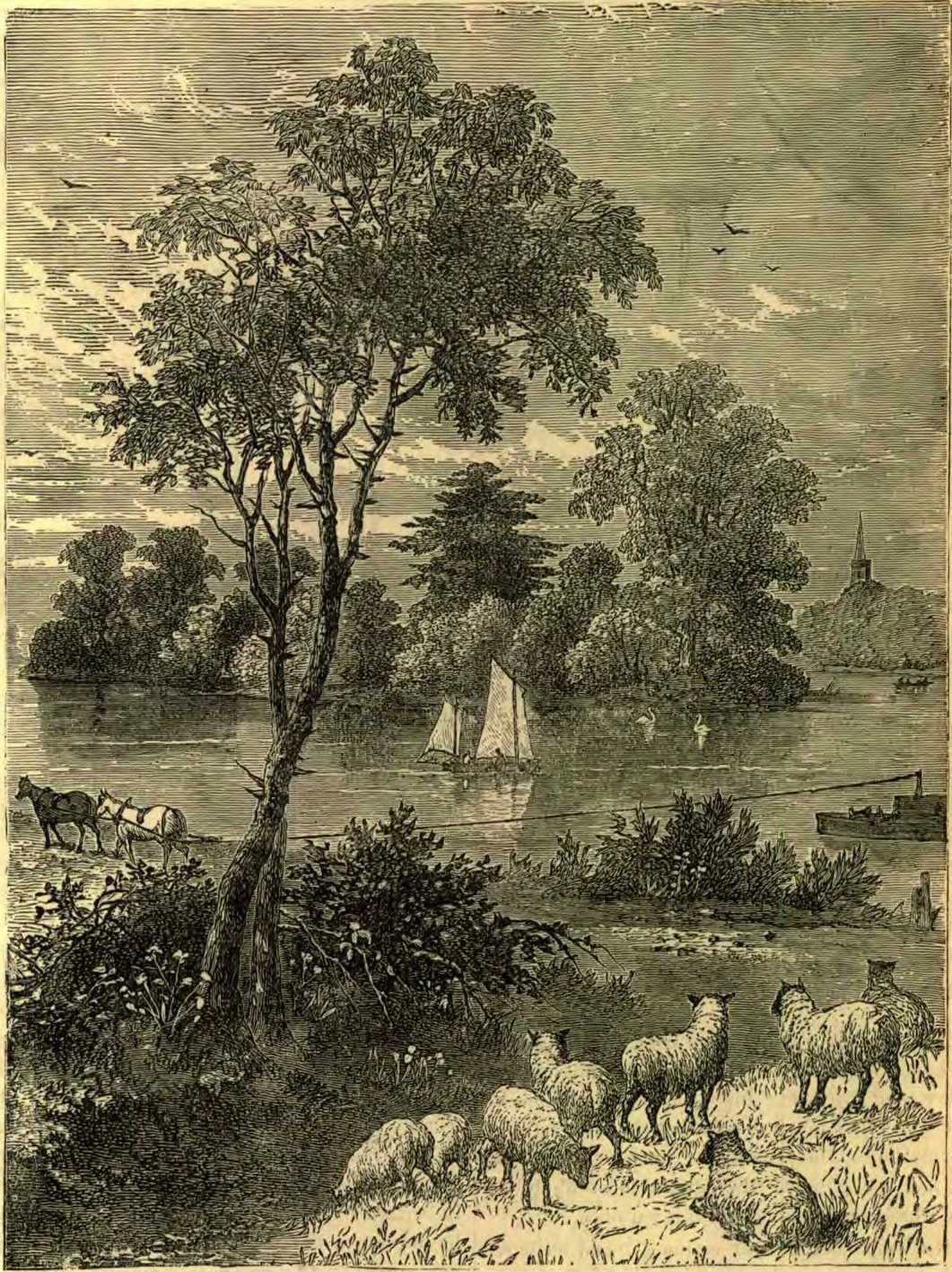
The view presented in the picture is that of an island in the Thames River, England, near Windsor Castle. It is noted for an important event that happened there many hundred years ago, and is still visited by most travelers who pass through England. John I., who was king of England in the thirteenth century, was a very cruel man, and oppressed his subjects so severely that the nobles raised an army to fight against him, and finally succeeded in capturing the city of London. After defeating the king’s forces several times, they wrote out a paper, which they called a charter, granting certain liberties to the people, and then sent word to the king that, if he would sign it, they would stop fighting and go back to their homes. The king knew that he was beaten, at least for the time being, and promised to grant their request. Both armies then advanced to the River Thames, the king’s forces on one side and those of his nobles on the other, with the island, shown in the picture, between them. The king, accompanied by some of his ministers, rowed over from his side of the river to the island, while some of the nobles came from the opposite side, and there, in the presence of the opposing armies on either hand, the king placed his name to the charter, on the fifteenth day of June, 1215. A small hut now stands on the island, within which is the stone whereon it is said the paper was placed for the king’s signature.
Hastings.
Hastings.
Though the king, after signing the charter, hired foreign soldiers to come and help him subdue his rebellious subjects, yet he died before he accomplished his object, and his successors, for many years, were obliged to place their names to the same paper. This charter is as much reverenced by the English as the Declaration of Independence is by the Americans, and is considered the foundation stone of British liberty. It is always referred to as the Magna Charta, or Great Charter, and the island where it was signed is called Magna Charta Island. It was originally written in the Latin language, and a copy can be seen at the present day in the British museum. S. C. S.

IN THE LIGHT OF THE HOME WINDOWS.

“O MAMMA, General Miller has returned from England, and there is to be a torchlight procession and a celebration and a ’lumination and fireworks. Can we go and see them?” asked Minnie Ruggles, rushing with her two brothers and her one sister in from school one lovely September afternoon.
“O mamma!” clamored all the children, “do say yes. All the scholars are going, and there is to be great fun. You will take us, won’t you, mamma, dear?”
“It will be a fine sight, as well as a very pretty compliment to General Miller, and you shall see it, of course; but I hardly think it will be necessary for us to go down town,” replied mamma. “The procession will pass here, we will illuminate our house, and you can hear the music and see the fireworks from the Park.”
The children were not quite satisfied with this arrangement. Some of their young friends were going down upon the main street, where there was to be a platform erected on Parade Square near the band stand; and they had been sure their mother would take them down there, so as to be near the music.
They knew there would be no use in teasing, after she had made up her mind; and they went about assisting mamma and John, putting candles in the windows and Chinese lanterns in the shrubbery in the front yard, with rather dissatisfied expressions on their fair young faces.
It was a splendid procession; and as it filed by the Ruggles’ house, headed by the famous Colt’s Band from Hartford, the men and boys keeping perfect time with the music, the children on the piazza with their mother were almost wild with delight, and were very eager and persistent in their requests that they might be allowed to join the quite nondescript party of young and old that followed in the rear.
“By no means,” said their mother. “But you may go out now to the Park, and remember what I tell you. Keep where the light from our windows will shine upon you.”
The children obeyed, but they did not at all like mamma’s restrictions. “Mother means to do what is right always, and thinks she knows what’s best for us at all times,” said Harry, the eldest of the children. “But it is absurd for her to suppose she can always keep her boys within the light of the home windows. But how beautifully the band plays!”
Suddenly, however, the music ceased in a painful discord and jangle in the middle of the spirited march, and loud shouts and cries of affright came from the direction of Parade Square. Something dreadful had happened.
It was not long before the news came to the children that the grand stand had fallen with a terrible crash. It was crowded, to begin with; and when the long procession reached the square, the rabble that had followed it broke from its rear, and climbed up and crowded on the outside. That forced those already sitting on the outer seats to press nearer the center, until the slender props underneath gave way, and the hastily built stand went down with a great crash. Many of the men, women, and children were injured, some seriously so.
“How lucky for us that we kept in the light of the home windows!” said Harry, running to his mother and throwing his arms about her neck. “We were very much dissatisfied that you refused to let us follow the procession; but we can see now that, had we gone to the square, most likely we should have been among the injured ones.”
“Remember this,” said mamma, “and let it remind you that you have a home and a Father in heaven, and that while you obey him and keep in the light of his love and approbation, you will always be safe from present and future harm.”
—Mrs. Annie A. Preston.

AN IDYL OF SPRING.

ACROSS the half-clad branches The softened sunlight falls, Its mellow glory slanting Through stately forest halls. The amber green of spring-time Folds over barren sprays, Above its faint bloom floating A dream of summer days, And like an angel’s blessing The passing wind’s rich psalm Swells through the breathless silence, And dies away in calm.
Beneath our feet are peeping The heralds of the spring, Wind-flower and daisy lifting Their starry blossoming. They whisper of the summer, Of fair June’s perfect day; The grace of incompleteness Is thine, beloved May. Thine is the tender promise Of coming leaf and bloom, And thine the rare heart choral Of earth and heaven in tune.
Now fainter falls the sunlight; Within the western sky The crimson sunset roses Bloom out, and fade, and die. Around us, gray and gloomy, The forest shadows fall; From branch to branch the song-birds Pipe low their good-night call; And still the beauty lingers Within the deepening shade; And still the great wind organ By angel hands is played.—H. M. Hastings.

THE DEVIL-FISH.

The ill-shapen monster in the cut is well called a devil-fish, not only on account of its hideous appearance, but by reason of the many accounts given by sailors of their terrible attacks on the “toilers of the sea.” Its more proper name, however, is the Octopus, meaning the eight-footed; though it is also known by the names of Cuttle-fish, Squid, and others. With the picture before you, it will hardly be necessary to describe its appearance, and indeed it would be difficult to attempt it. Perhaps the most striking feature is its great, staring eyes, which are said to be larger than those of any known animal. Those of one captured on the Atlantic coast measured eight inches in diameter. Its arms, of which you will notice there are eight, are furnished with little round fleshy cups with shell-like edges; these fasten to any object coming within their reach, and there suck and cling so tightly that no victim can escape the monster’s clasp until its arms are cut off. Some kinds have besides these arms long feelers called tentacles, about three times the length of the body of the fish. The mouth is of extraordinary size, and furnished with several rows of teeth. It is not seen in the picture, but is situated in the center of the body, and the food is brought to it by the thick muscular arms. Its mode of traveling is very curious, and very different from what one would expect from its appearance. Instead of using its arms to help itself along, it breathes in large quantities of water through its gills, and then by a sudden and tremendous exertion of the muscles it spurts it out of a tube near the head; this course drives the unwieldy monster backward like an arrow through the water, dragging its arms and tentacles behind.
These creatures are usually found in deep water, sometimes floating on the surface, but often hidden among the rocks on the bottom. Their color is usually blackish above, and white beneath, though it will readily change to appear like the objects around them. When on the watch for prey, they lie with arms at rest, and tentacles floating about, having much the appearance of sea-weeds. But let an unwary fish draw near, hoping to obtain food from the treacherous stalk, and it will instantly be dragged down within reach of the terrible arms, which fold themselves about it, and draw it to the central mouth—and all is over.
It is difficult to determine the size of these creatures, because, living as they do in deep water, it is impossible to capture or study the larger specimens. Many marvelous stories are told by sailors of their lying upon the surface of the ocean, presenting the appearance of small islands, and of their attacking small ships, encircling their arms around the masts, and dragging the vessel with all its crew to the depths below. But how much credit can be given to these tales is not known with certainty. Some of the smaller specimens, however, have been driven ashore along the Atlantic coast, one of which, taken near the entrance of Delaware Bay, in 1823, was so heavy as to require three pair of oxen, a horse, and several men, to bring it on shore. It was estimated to weigh about five tons, and measured seventeen and one-fourth feet long, and eighteen feet wide. The mouth was two and three-fourths feet wide, and the distance between the eyes was a little over four feet.
Many naturalists contend that the devil-fish, though powerful and hideous, is a timid and harmless creature, avoiding rather than attacking man; but when attacked, defending itself with vigor. During gales of wind or in places where there is a strong current, the fishermen drive them into shallow water, where they are unable to extricate themselves, and large quantities of oil are then taken from their livers. Thus we see that all the creation of God can in some way, great or small, be made to serve the purpose of man.
C. H. G.

Christ as Flower, River, and Sun

CHRIST is a flower, but he fadeth not; he is a river, but he is never dry; he is a sun, but he knoweth no eclipse; he is all in all, but he is something more than all.—Spurgeon.

Among the Hills.

The fair young May, gliding with dewy feet O'er rock and wood and glen, how beautiful! The sunny skies bend o'er to kiss the hills, And rugged heights that melt into the pearl And azure of the clouds, blush into bloom. Adown the slopes and vales a tremor thrills; A wave of light and color, tint on tint, Breaks o'er the bare brown woods, and fills the dell, And eddies round the giant rocks, where flecks Of snow and gold and blue and amethyst Mark where the footsteps of the May have passed. In sunny glades, beneath the tender green Of budding leaves shot through with amber light, The pink azaleas hide, and on the slopes The thorn and dogwood toss their crests of foam Upon an emerald sea. Down the steep gorge The gurgling brook goes singing to the main, And bird and bee and blossom blend in one Glad song, The Spring is Here!—Selected.

Love of Christ Imparted to the Heart

As we turn water into a dry pump when we desire to obtain more, so we must have the love of Christ imparted to the heart before we can feel any uprisings of delight in him.

A PLACE FOR EVERYTHING.

Always have a place for your own things, and take time to put them in it. Hang your hat upon its proper nail, and pile your books and slate in their own corner on the table. Some children can never find their pencils and pens, and are going about begging and borrowing. It is “lend me this, please,” or “have you seen that?” from morning to night. Now it is often inconvenient to lend, yet your friends do not want to appear disobliging, and they give what you ask them for, with many doubts and fears. They know that those who are so careless as to lose their own possessions will not be very safe holders of those of other people. A verse in the Bible says that the borrower is servant to the lender. You will find out the meaning of that verse if you ever let borrowing become a habit.
A boy can save his mother much work and many steps by simply taking care of those things in the house which belong to him, and never letting them lie around in a promiscuous manner. A little girl can be a very great help by determining to keep her own room and her own closet in nice order. A little care every day is better than confusion for a fortnight, and then a grand “clearing up.”—Selected.

SCENES IN THE LIFE OF CHRIST.

LESSON 71.—THE JEWS ATTEMPT TO STONE JESUS.

At one time, some of those who were present while Jesus was teaching, told him of the Galileans whom Pilate killed, and whose blood he mingled with the blood of the sacrifices that they offered in the Temple. When Jesus heard this, he said, “Suppose ye that these Galileans were sinners above all the Galileans, because they suffered such things? I tell you, Nay: but, except ye repent, ye shall all likewise perish. Or those eighteen upon whom the tower of Siloam fell, and slew them, think ye that they were sinners above all men that dwell in Jerusalem? I tell you, Nay: but, except ye repent, ye shall all likewise perish.” So when we see evil coming upon people around us, we must not think that we are spared because we are better than they, but we should have sympathy for those who are in distress, and thank God for his mercy toward us. We have all sinned, and deserve to suffer for it; and unless we repent, and seek forgiveness, we shall surely be cut off, and perish among the evil-doers.
Then Jesus gave them a parable, to show that God requires that we should not only repent of our sins, but that we should bear fruit to the glory of God. He said, “A certain man had a fig-tree planted in his vineyard, and he came and sought fruit thereon, and found none. Then said he unto the dresser of his vineyard, Behold, these three years I come seeking fruit on this tree, and find none: cut it down; why cumbereth it the ground?” Then the dresser of the vineyard said, “Lord, let it alone this year also, till I shall dig about it and dung it: and if it bear fruit, well; and if not, then after that, thou shalt cut it down.” So, likewise, we must do good. We must be useful in the world. We must set a good example. We must always be on the side of right, always be doing something to help on the cause of God on the earth.
One Sabbath as Jesus was teaching in a synagogue, there was present a woman that had had an infirmity eighteen years, and was so bowed together that she could not possibly straighten herself up. When Jesus saw her, he called to her, and said, “Woman, thou art loosed from thine infirmity.” Then he laid his hand on her, and she was made well immediately, and “glorified God.” Now the ruler of the synagogue was very angry because Jesus had healed the woman on the Sabbath, and said to the people, “There are six days in which men ought to work: in them, therefore, come and be healed, and not on the Sabbath-day.” But Jesus said to him, “Thou hypocrite, doth not each one of you on the Sabbath loose his ox or his ass from the stall, and lead him away to watering? and ought not this woman, being a daughter of Abraham, whom Satan hath bound, lo, these eighteen years, be loosed from this bond on the Sabbath-day?” Then his adversaries were ashamed, and all the people rejoiced because Jesus had done such glorious things.
In the time of our Saviour, the Jews held a feast which they called the Feast of Dedication. This feast was held in the month of December. A few months before his death, Jesus attended this feast, and as the weather was bad, he took shelter under what was called Solomon’s Porch. While he was walking under this porch, the Jews gathered about him, and said, “How long dost thou make us to doubt? If thou be the Christ, tell us plainly.” Then Jesus said, “I told you, and ye believed not: the works that I do in my Father’s name, they bear witness of me.” He also told them that the reason why they did not believe on him was because they were not of his sheep; that is, they did not have a gentle spirit, and were not willing to follow him, and obey his voice. He said, “My sheep hear my voice, and I know them, and they follow me: and I give unto them eternal life; and they shall never perish, neither shall any man pluck them out of my hand.” Since his Father, who had given him the sheep, was all-powerful, no man was able to take them from him; for, said he, “I and my Father are one.” Upon this, the Jews took up stones to stone him. But Jesus asked them for which of his good works they stoned him. Then they said, “For a good work we stone thee not, but for blasphemy; and because that thou, being a man, makest thyself God.”

QUESTIONS.

  1. What frightful story of cruelty was told to Jesus by some who had been listening to his teaching? Luke 13:1.
  2. When Jesus had heard the story, what question did he ask?
  3. Who answered the question?
  4. What did he say?
  5. What further question did he then ask?
  6. How did he answer that?
  7. What should we learn from this?
  8. How should we feel toward those who are in distress?
  9. When we witness the sufferings of others, how should it make us feel toward God?
  10. Why do we all deserve to suffer?
  11. What will be our doom if we do not repent, and learn to obey God?
  12. For what purpose did Jesus then give them a parable?
  13. How is the parable introduced?
  14. When the owner of the vineyard found no fruit on the tree, what did he say to the man who took care of the vineyard?
  15. What plea did the vine-dresser make?
  16. What should this teach us?
  17. What must be our character if we would be accepted of God?
  18. What afflicted person was present one Sabbath-day as Jesus was teaching in a synagogue?
  19. What was the nature of her infirmity?
  20. What did Jesus say to her when he saw her?
  21. What did he then do?
  22. What change immediately took place in the woman?
  23. What made the ruler of the synagogue angry?
  24. What did he say to the people?
  25. How did Jesus rebuke him?
  26. How did this make the enemies of Jesus feel?
  27. What did the people do?
  28. What feast did the Jews hold in the month of December?
  29. When did Jesus attend this feast?
  30. What question did the Jews ask him, as he was walking in Solomon’s Porch?
  31. How did Jesus answer them?
  32. What did he say was the reason why they would not believe on him?
  33. What did he say about his sheep?
  34. Why is no man able to pluck them out of his hand?
  35. How did the Jews manifest their indignation when Jesus said, “I and my Father are one”?
  36. What question did he then ask them?
  37. What reply did they make?

NEW-TESTAMENT HISTORY.

LESSON 34.—THE WICKED HUSBANDMEN.

“And in the morning, as they passed by, they saw the fig-tree dried up from the roots. And Peter calling to remembrance saith unto him, Master, behold, the fig-tree which thou cursedst is withered away. And Jesus answering saith unto them, Have faith in God. For verily I say unto you, That whosoever shall say unto this mountain, Be thou removed, and be thou cast into the sea; and shall not doubt in his heart, but shall believe that those things which he saith shall come to pass; he shall have whatsoever he saith. Therefore I say unto you, What things soever ye desire, when ye pray, believe that ye receive them, and ye shall have them. And when ye stand praying, forgive, if ye have aught against any; that your Father also which is in heaven may forgive you your trespasses. But if ye do not forgive, neither will your Father which is in heaven forgive your trespasses.”
“And it came to pass, that on one of those days, as he taught the people in the temple, and preached the gospel, the chief priests and the scribes came upon him with the elders, and spake unto him, saying, Tell us by what authority doest thou these things? or who is he that gave thee this authority? And he answered and said unto them, I will also ask you one thing; and answer me; The baptism of John, was it from heaven, or of men? And they reasoned with themselves, saying, If we shall say, From heaven; he will say, Why then believed ye him not? But if we say, Of men; all the people will stone us: for they be persuaded that John was a prophet. And they answered, that they could not tell whence it was. And Jesus said unto them, Neither tell I you by what authority I do these things.”
“But what think ye? A certain man had two sons; and he came to the first, and said, Son, go work to-day in my vineyard. He answered and said, I will not; but afterward he repented, and went. And he came to the second, and said likewise. And he answered and said, I go, sir; and went not. Whether of them twain did the will of his father? They say unto him, The first. Jesus saith unto them, Verily I say unto you, That the publicans and the harlots go into the kingdom of God before you. For John came unto you in the way of righteousness, and ye believed him not; but the publicans and the harlots believed him: and ye, when ye had seen it, repented not afterward, that ye might believe him.”
“Hear another parable: There was a certain householder, which planted a vineyard, and hedged it round about, and digged a winepress in it, and built a tower, and let it out to husbandmen, and went into a far country; and when the time of the fruit drew near, he sent his servants to the husbandmen, that they might receive the fruits of it. And the husbandmen took his servants, and beat one, and killed another, and stoned another. Again, he sent other servants more than the first; and they did unto them likewise. But last of all he sent unto them his son, saying, They will reverence my son. But when the husbandmen saw the son, they said among themselves, This is the heir; come, let us kill him, and let us seize on his inheritance. And they caught him, and cast him out of the vineyard, and slew him. When the lord therefore of the vineyard cometh, what will he do unto these husbandmen? They say unto him, He will miserably destroy those wicked men, and will let out his vineyard unto other husbandmen, which shall render him the fruits in their seasons. Jesus saith unto them, Did ye never read in the scriptures, The stone which the builders rejected, the same is become the head of the corner: this is the Lord’s doing, and it is marvelous in our eyes? Therefore say I unto you, The kingdom of God shall be taken from you, and given to a nation bringing forth the fruits thereof. And whosoever shall fall on this stone shall be broken; but on whomsoever it shall fall, it will grind him to powder. And when the chief priests and Pharisees had heard his parables, they perceived that he spake of them. But when they sought to lay hands on him, they feared the multitude, because they took him for a prophet.”

QUESTIONS.

1. On Tuesday morning, as they were going from Bethany up to Jerusalem, what did the disciples notice? Mark 11:20.
2. What did Peter say?
3. What admonition did Jesus give him? Verse 22.
4. What did Jesus say in regard to the power of faith? Verse 23.
5. What encouraging promise did he make? Verse 24.
6. What is it necessary for us to do in order that our sins may be forgiven? Verses 25, 26.
7. What question did the scribes and chief priests ask Jesus one day, as he was teaching the people in the temple? Luke 20:1, 2; Matt. 21:23; Mark 11:27, 28.
8. What reply did Jesus make? Luke 20:3, 4.
9. How did the chief priests and scribes reason among themselves? Verses 5, 6.
10. What answer did they finally give?
11. What did Jesus then say to them?
12. What parable did Jesus relate concerning a father and his two sons? Matt. 21:28–30.
13. What question did Jesus ask concerning these two sons?
14. What answer was given to this question?
15. What application of the parable did our Lord make? Verse 31.
16. How did he make it appear that there were publicans and harlots who were more worthy of the kingdom of God than these unbelieving priests? Verse 32.
17. By what parable did our Lord then illustrate the ingratitude and selfishness of mankind?
18. What is the householder represented as doing? Verse 33.
19. What did he do with his vineyard after he had thoroughly fitted it up?
20. When the time of fruit drew near, what measures did he take to secure his rightful share of the products of the vineyard?
21. How were these servants treated by the husbandmen?
22. How did they persevere in their wicked course?
23. What did the householder finally do as a last resort?
24. What did the husbandmen say among themselves when they saw the son of the householder?
25. How did they carry out their evil designs?
26. After relating the parable, what question did Jesus ask?
27. How did the priests and scribes answer this question?
28. What question did Jesus then ask them?
29. What further remark did he make concerning this stone? Luke 20:18.
30. What announcement did Jesus then make to these proud Jewish teachers? Matt. 21:43.
31. When the priests and Pharisees heard these parables, what did they perceive?
32. What did they seek to do?
33. How were they prevented from carrying out their foul designs?

THE LITTLE CROSS-BEARER.

If any man will come after me, let him deny himself, and take up his cross, and follow me,” said the teacher. Through the half-opened window came warm sweet breaths of early spring, while gay little sunbeams danced into the Sabbath-school room through the clefts of the blinds, now gilding the top of Effie’s feather, now sparkling into Jeannie’s bright eyes when she moved, now kissing little Grace’s golden hair, or, rippling over the superintendent’s dark old desk, made a sort of Jacob’s ladder with golden rounds. Outside, where the sunbeams had their own way, no blinds to shut them out, nor leaves enough on the trees to make a shadow, everything seemed to rejoice in its own brightness and life, and the birds were greeting the coming spring in their own joyous way. “Let him deny himself, and take up his cross,” said the teacher again.
“Take up his cross!” Jeannie wondered how often the teacher said that during the half-hour, and thought how pretty Effie’s feather would look if only it could keep its tip of sunshine, and how sweet it was out doors, and why Miss Barnes kept saying that; and she was just going to steal a sly look at the clock, when one of the merry sunbeams fell on Miss Barnes’s face, and Jeannie saw with surprise there were tears in her eyes. “My little girls,” she was saying, “you all want to follow the dear Lord Jesus,—to be his children. And to each one of you he gives some cross to carry,—something either to do or bear for his sake. You may not know just now what it is, but if you are in earnest about following him, you will find out what it is; and do not turn away from it, and think ‘This I cannot do,’ but remember his words: ‘Take up thy cross, and follow me.’” Then the bell rang, and soon after, the children came trooping out of the doorway to greet the robins and the sunbeams. But Jeannie did not heed them now; deep in her heart had fallen the words, “Take up thy cross, take up thy cross.” What did it mean for her? “I’m sure I haven’t got any trials to bear,” she thought. “Perhaps if I had to wear a calico dress with a big patch on it to Sabbath-school, as Katrine Miller does, why, that would be a real cross,—or holes in my shoes;” and she glanced down with satisfaction at her pretty dress and tidy boots. “And I don’t have to work in the mill, and I haven’t got a sick mother, nor lost any little brother, nor nothing. There can’t be any cross for me, any way.”
Sabbath evening was always the most delightful time of all the week at Jeannie’s home, for then papa was at leisure, and the children were allowed to sit up longer than usual, and have him all to themselves.
“Jeannie,” said Rob that evening, in a pause in one of papa’s most delightful stories of when he was a little boy, “I do wish you would sometimes let me sit by papa; you will always get one side of him, and Dottie the other, and I can only sit in front of him and look at his old boot.”
“It isn’t old at all,” laughed Jeannie, “and it’s beautiful, black, and shiny; besides, you can sit in a higher chair, and then you needn’t look at it at all!”
“Well!” said Rob ruefully, “you’ve sat there every Sabbath evening always, and I’m the youngest, and you ought to sometimes give up to me.”
“No,” answered Jeannie, “boys ought to give up to girls, and besides”—“Take up thy cross!”
What brought a flush of color over the little girl’s face, as she jumped from her chair saying, “Here, Rob, take it; I believe I have sat here long enough”? Was that a cross? Such an easy thing to do! The color deepened in her face, as she thought, “I am ashamed to call that a cross, just to give up a chair; I would rather do something harder for Christ’s sake.” But the interest in papa’s story brought other thoughts, and the Sabbath-school lesson was again forgotten.
But the next morning! Why does “get up” time always come so soon to the childish sleeper after the “good nights” are said! Jeannie had just turned over for a little more sleep when the familiar voice called her in the morning. She wouldn’t hear it quite yet, just a minute longer in her soft little nest; so she slipped again into her dream. Was mamma calling again? It must be a mistake; she would wake up soon, but not—quite—ye-e-e-t! “Jeannie, Jeannie, do get up!” called mamma; “you are always so late to breakfast.” “Take up thy cross, take up thy cross,” seemed whispered in Jeannie’s ear as she bounded out of bed, now quite awake. Was that a cross, getting up when mamma called in the morning? “I think I understand about it now,” said Jeannie, while dressing herself. “I haven’t any patches to wear, or great trials of any kind, but it’s just doing little disagreeable things that I ought to do, and doing them cheerfully for Christ’s sake, that is to be my cross. It is such a little cross to carry for him, but perhaps he will be pleased if I do everything cheerfully.” Before she left her room she prayed, “Dear Lord Jesus, I am only a little girl, but I want to be one of thy dear children; teach me what my cross is, and then help me to carry it. I know there isn’t much for me to do, but please accept of just what little I can do, for Christ’s sake. Amen.”—S. S. Times.

TELLING MOTHER.

A CLUSTER of young girls stood about the door of the school-room one afternoon, when a little girl joined them, and asked what they were doing.
“I am telling the girls a secret, Kate, and will let you know, if you will promise not to tell any one,” was the reply.
“I won’t tell any one but my mother,” replied Kate. “I tell her everything, for she is my best friend.”
“No, not even your mother, no one in the world.”
“Well, then I cannot hear it; for what I cannot tell my mother is not fit for me to hear.”
After speaking these words, Kate walked away slowly, and perhaps sadly, yet with a quiet conscience; and if she continues to act on that principle, I am sure she will become a virtuous and useful woman. No child of a pious mother will be likely to take a sinful course, if Kate’s reply is taken for a rule of conduct. If you have no mother, do as the disciples did; go and tell Jesus.
“Blessed is the man that walketh not in the counsel of the ungodly, nor standeth in the way of sinners, nor sitteth in the seat of the scornful; but his delight is in the law of the Lord; and in his law doth he meditate day and night.”—Young Pilgrim.

THE SONG OF THE BEES.

FLYING out, flying in, Circling the hive with ceaseless din, Now abroad, now at home, Busy through wood and field we roam. Here in the lily-cup, there in the clover, Gather we sweets the meadow over. Food to our young we carefully take; Pollen we bring, and wax we make; A band of us shapes each tiny cell, Another follows, completing it well.
Working all, working ever, Suffering idlers among us never; Never pausing to take our ease: Oh, busy are we, the honey-bees!

LETTER BUDGET.

Fannie H. Branstetter writes a nice little letter from Summer Shade, Kentucky. She says: “To-day is Easter, and I thought I would like to write to you. My little brothers and I have had a fine time coloring eggs to-day. We have a nice little Sabbath-school of nine members. Last Sabbath seven of them were perfect in their lessons. Papa is the teacher. My brothers’ names are Cecil and Orlando. They are eight and three years old. They are studying Bible Lessons No. 1. We have taken the INSTRUCTOR four years. It seems as though the last one is always the best. I wish everybody would take it, and try to be good. I am trying to be good, so I can go home with Jesus when he comes. My love to all who may read this.”
Earl L. Burroughs writes from Custer, Colorado. He says: “I have been keeping the Sabbath over a year, with my parents and three sisters. Our church, Texas Creek, has over thirty members. Eld. Jones comes and preaches to us once in awhile. Eld. Stover lives near, and preaches nearly every Sabbath. We live eight miles from the church, and cannot always go in the winter. I like to read the INSTRUCTOR and get the lessons. I take my papers to school, and give them to my friends and school-mates. I am eleven years old.”
Eva Reed writes from Lyons, Kansas. She says: “I see other children are writing to you, so I thought I would. We live out West on the prairies, and go two miles to Sabbath-school every week. Our superintendent is a lady, Mrs. Lamberson. My teacher’s name is William Dimond. We all like him. I will be twelve years old in June; I have no brothers and sisters. My papa and mamma began keeping the Sabbath about three months ago, and they now believe it is the true day to keep.”
Sarah E. Peters writes from Bishop, Jewell Co., Kansas. She says: “My aunt sends me the INSTRUCTOR. It is the best child’s paper I ever read. I have three sisters and four brothers, but there are only three of us at home. One of my brothers has been gone two years. He is in Utah. We that are at home keep the Sabbath with our parents.”

MAY

Skies are glowing in gold and blue, What did the brave birds say? Plenty of sunshine to come, they knew, In the pleasant month of May!
She calls a breeze from the South to blow, And breathe on the boughs so bare, And straight they are laden with rosy snow, And there's honey and spice in the air!
Oh, the glad, green leaves! Oh, the happy wind! Oh, delicate fragrance and balm! Storm and tumult are left behind In a rapture of golden calm.
From dewy morning to starry night The birds sing sweet and strong, That the radiant sky is filled with light, That the days are fair and long;
That bees are drowsy about the hive— Earth is so warm and gay! And 'tis joy enough to be alive In the beautiful month of May! —Celia Thaxter.

You have reached the end of this edition.

The Youth’s Instructor · May 31, 1882