The Youth's Instructor, Vol. LIII, No. 26

Korean Sketches

The Youth's Instructor

June 27, 1905

Review and Herald Publishing Assn. · Washington, D. C. · June 27, 1905

Korean Sketches

The Gospel in Korea
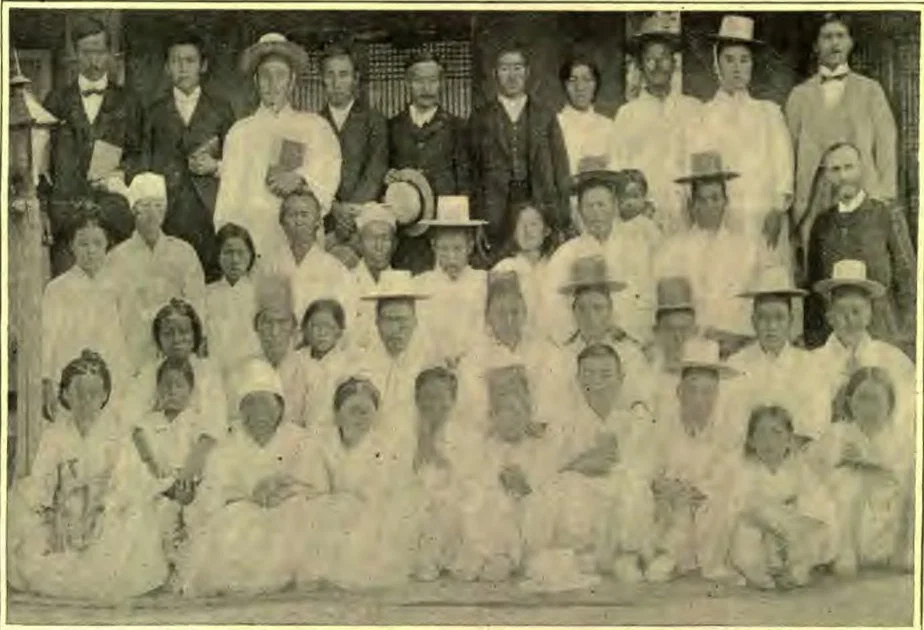
It is said that Christianity first found its way into Korea in 1777, by the sending to that country of certain Jesuit writings in Chinese from Peking. From the very first, the new ideas spread rapidly, although the government was very determined in its opposition. Many were tortured and exiled; and the persecution continued till 1787. Four years later the first foreign missionary entered the country.
A GROUP OF KOREAN BELIEVERS
The work of Protestant missionaries in Korea is much more recent, dating back only about twenty or twenty-five years. But during this time the progress of the work has been quite remarkable. Various missionary societies of America and Europe have entered the field, and many thousands of the people have professed Christianity. As a rule the Korean people have laid aside their opposition to foreign innovations, so that the gospel may be freely proclaimed. There are also no laws to interfere with missionary work.
The missionary society of the Church of England began work in Korea in 1891. Bishop Corfe was the pioneer in this undertaking. Upon his arrival in Seoul, he wrote: “There are a large number of foreigners in Seoul,—chiefly Americans, and these mostly missionaries,—Presbyterian, Episcopal Methodist, and a few nonconformists from Canada, working on independent lines.”
Since that time many more missionaries have entered the field, and every year new workers are being sent out. A large number still make their homes at Seoul; but many other places, on the coast and in the interior, have been entered.
The missionaries in Korea have undertaken various phases of Christian work,—evangelical, educational, and medical. Churches, schools, and hospitals have been established in various places. I can speak, from personal observation, only of the work established at Pyeng Yang, the ancient capital. The Methodists have several missionaries resident here; also a substantial brick church, and a well-built hospital, with physician’s residence. All these buildings are within the city walls, but are pleasantly located on high ground. Just outside the walls, west of the city, the Presbyterians have purchased quite a piece of ground. Here are located the residences of the missionaries, also church, school, and hospital buildings. There are also a number of church buildings in the city. We saw one quite large church, just recently erected. The Presbyterians have their work well established, and their communicants are said to number over four thousand in this place alone. The work of the Methodists is more recent, and their churches are mostly located in the country round about.
We often hear the Korean Christians spoken of in terms of commendation; and our brief stay among them confirmed these reports. As a rule, they are teachable, and readily receive the truths presented to them. Further, they seem to possess the true missionary spirit, and so are very active and earnest in communicating what they learn to others. Also, in spite of their poverty, they do remarkably well in supporting their work. It seems to be a rule for the native congregations to build their own meeting-houses. Those we visited had been so built, without any aid from mission funds. This way of doing cultivates a spirit of self-reliance that is wholesome.
The story of the entrance of the third angel’s message into Korea has already appeared in the Review and Herald, but may be briefly summed up here. Last summer two Korean believers, while in Kobe, Japan, came in contact with our workers there, accepted the truth, and were baptized. One of these went on his way to Hawaii, where he is faithfully living out the truth, but hopes soon to return to his native country and teach his countrymen. The other, while on his way back to Korea, communicated his new-found faith to a fellow passenger, who gladly accepted it, and upon his arrival at Chinnampo began to publish it among his friends and neighbors. Soon quite a company began to observe the Sabbath; and these sent an earnest plea for help to our workers in Japan. So Brother H. Kuniya went and labored among them, and a few weeks later the writer joined him. As a result, seventy-one were baptized, and four small churches were organized. Many others were interested, and fifty or more of these began to observe the Sabbath, but needed more instruction before being received as members. Since our return we have been informed that others have received the truth, and have begun to obey it. And now these Korean believers are anxiously waiting for help,—for some one to come and help carry forward the work thus begun. Though you may not be able to respond to this call, you can at least unite with us and them in prayer that they may not have long to wait. F. W. FIELD. Tokyo, Japan.

A Life of Faith and Works—George Muller

The Orphanages
THE first formal step in the work of opening an orphan house, a work over which Mr. Muller had been especially exercised for some time, was taken in the last month of 1835. Three days after this event, Mr. Muller was forcibly impressed by a passage in the psalms,—
“OPEN THY MOUTH WIDE, AND I WILL FILL IT.” Ps. 81:10.
This text became one of his life mottoes. He believed the Lord meant what he said; so with new confidence in God he began to pray for money and helpers for the establishment of an orphans’ home. He asked for land, for five thousand dollars, and for suitable assistants. Mr. Muller had already conceived the idea of erecting the orphanage not only as a temporal and spiritual benefit to needy children, but as a memorial of God’s willingness to hear and answer prayer; to show to all the world that it is not a vain thing to trust in the Lord. In order that the power of prayer might be more clearly manifested, he conscientiously avoided in all his work saying anything that would directly or indirectly be an appeal to the people for help. However great the strait they were in, he nor his helpers were not, even when questioned, to disclose the need, but could tell it only to the Lord.
Mr. Muller, when in prayer for the orphans, always kept before the Lord the fact that they were His orphans, and of course he would provide for them; for had not the Lord said that he was “a father of the fatherless”? Mr. Muller was but thirty years of age when he began his orphan work.
“So soon as the enterprise was launched,” says Dr. Pierson, “the Lord’s power and will to provide began at once and increasingly to appear; and, from this point on, the journal is one long record of man’s faith and supplication and of God’s faithfulness and interposition.” Gifts of money began to come in, also letters from those who voluntarily offered their services. One letter received from a brother and sister read as follows:—
“We propose ourselves for the service of the intended orphan house, if you think us qualified for it; also to give up all the furniture, etc., which the Lord has given us, for its use; and to do this without receiving any salary whatever; believing that, if it be the will of the Lord to employ us, he will supply all our need.”
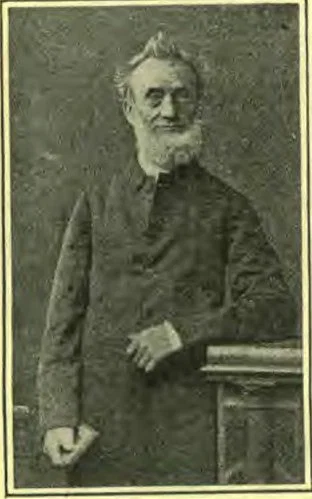
GEORGE MULLER
GEORGE MULLER
On the day appointed for the opening of the institution everything was in readiness, save the orphans. Not one application had been received. Mr. Muller felt greatly humiliated when he remembered that he had never once asked the Lord to send them children. He had gotten all he had asked for, but no more. Therefore he fell upon his face before the Lord in prayer. It is needless to say that in time the Lord sent the children; for as the work grew, more than two thousand were cared for in one year.
The Lord marvelously provided for his servants, but he sometimes allowed them to come into close places. A gentleman and lady at one time were being shown through the orphan houses by one of the matrons. The lady remarked: “Of course you can not carry on these institutions without a good stock of funds?” and the gentleman added, “Have you a good stock?” The answer was, “Our funds are deposited in a bank which can not break.” This reply deeply impressed the lady, also the gentleman, who took twenty-five dollars from his pocket and handed the matron—an acceptable gift as there was not one penny in hand. Time and again gifts came at the opportune moment. Sometimes, but very rarely, meals had to be delayed, perhaps for a half-hour, because of a lack of supplies. The Lord did not see fit always to keep his servants under such financial embarrassment; for sometimes there was sufficient money in the treasury to supply all their needs for months. The second orphan house early became a necessity, and through faith materialized in due time, and in 1843 Mr. Muller felt led to open the fourth orphan house, the third having been opened nearly six years before. The work kept steadily growing. No one but the Lord was apprised of his purpose. He prayed much to know whether it was the Lord’s will. He would say, “Lord, if thou hast no need of another orphan house, I have none.” While this work was marvelously growing, we must not forget that the same thing was true of the many other lines of work that Mr. Muller was conducting. More missionaries were being sent out, more schools established, and more Bibles distributed.
Mr. Muller became convinced after much prayer that it was according to the Lord’s will that advance steps be taken. The playgrounds were becoming inadequate, the residents objected to the noise of the children at play, the location of the rented houses was unfavorable for proper sanitary conditions, and ground was desired for cultivation by the boys. These were some of the things that led Mr. Muller to purpose the building of a new orphan house.
This idea involved an outlay of about seventy-five thousand dollars, for site and building, with an additional expense of one third as much more every year. Dr. Pierson says, “No man so poor as George Muller, if at the same time sane, would ever have thought of such a gigantic scheme, much less have undertaken to work it out, if his faith and hope were not fixed on God.” George Muller knew whom he trusted.
On the thirty-sixth day after specific prayer had been offered for this new building, a gift of five thousand dollars was received. Three days after, a Christian architect in London, unknown to Mr. Muller, offered to draft the plans for the building and to superintend its erection gratuitously. Seventeen days later two hundred fifty dollars more came. On each of two occasions ten thousand dollars was received, and at another time a gift of fifteen thousand. Not for two years after Mr. Muller began to pray was everything in readiness to begin. He then had nearly fifty thousand dollars on hand. A beautiful location was providentially secured, and a good substantial brick building, capable of accommodating three hundred persons, was erected. Hardly was this completed, before the work demanded a second building. This was erected in the same way as the first. The money must be in hand before the building was begun; so prayer was resorted to. One donation brought Mr. Muller about four hundred and five thousand dollars, thirty thousand of which was used for the erection of a second orphanage. The work grew until five handsome, well-built, commodious houses, having cost nearly five million dollars, stood on Ashley Down, and more than two thousand orphans were being cared for annually. Interest in the orphan work did not center in its financial prosperity; but God marvelously blessed the work in the conversion and development of those in the Homes. Many strong Christian laborers were given to the world by the orphanage work.

Missionary Journeys

When George Muller, five times during the first eight years that followed his conversion, had offered himself as a foreign missionary, God had blocked his way; now, at the age of sixty-five, he was about to permit him to be a missionary to the world. Mr. Muller traveled extensively in Europe, America, Asia, Africa, and Australia, everywhere preaching the gospel with power to large audiences. These missionary journeys were productive of much good, and would in themselves have sufficed for an ordinary life-work. The last six years of Mr. Muller’s life were spent at Bristol, in quiet, but not in idleness; for even on the night of his death he assisted in the usual orphanage prayer-meeting. He died at the age of ninety-three, and hearts grieved all over the world. Mr. Muller seemed to grow in grace all the years of his Christian life, which was a constant repetition of the psalmist’s words, “O, fear the Lord, ye his saints; for there is no want to them that fear him.”
Mr. James Wright, the son-in-law of Mr. Muller, continues the work of the Scriptural Knowledge Institution and the Orphanages on the same basis as that upon which they were founded and conducted by George Muller.

Old Bedford Jail

ONE dismal day in November, 1660, a man, not middle-aged, was brought to the old Bedford jail, thrust into a dungeon, and left. He had no idea whether he must stay for life, be banished, or hanged. He was brought several times to trial, threatened, reviled, and then offered full freedom on terms that he could not accept. Who was this now famous prisoner of old Bedford jail? He had been a very wicked young fellow, yet no one had complained of him when, as he says, he “took delight in all manner of vice;” but as soon as he was converted, changed his whole course of conduct, and woke up to find the Bible a new and wonderful book, he began to be noticed.
In those days of intolerance no one but a regularly ordained clergyman or priest might publicly teach from the Scriptures or preach. It made no difference that this man's hearers left off drinking, swearing, and rioting, or that he himself was a kind neighbor, a good husband, and the father of little children. The day he was flung into prison, he knew that poverty and distress must come on them.
Bedford people that day thought that John Bunyan was now to be as useless a man as any in England. But it came to him to write a little book that children and humble working people could understand. He was allowed a cell with a dim light, paper, ink, and quills.
The story of “The Pilgrim’s Progress” was finished, and stole quietly out into the world. Better days then came for Bunyan, and he was free again, restored to his family, and allowed to teach as he pleased.
To his surprise, edition after edition of his book was sold, and before he died, it was read all over England and Scotland, and was translated into French and Dutch.
If you were to go to Bedford to-day, you would not see the old jail. It has perished with time, but the great oaken door of John Bunyan’s cell would be shown you. When men shut him to silence and uselessness two hundred thirty years ago, God shut him up to grow in holiness, to get ready a help for millions of people all over the world. His written book has been more widely read than any other book except the Bible, and translated into almost every known language. It is by men of judgment declared to be a classic.—Annette L. Noble, in Morning Star.

“I Can Not Get Away From God”

Not many years since, a coachman was living in a gentleman’s family near London. He had good wages, a kind master, and a comfortable place; but there was one thing which troubled and annoyed him; it was that his old mother lived in a village close by, and from her he had constant visits. You may wonder that this was such a trouble to him. But the reason was, that, whenever she came, she spoke to him about Christ and the salvation of his soul.
“Mother,” he at last said, “I can not stand this any longer. Unless you drop that subject altogether, I shall give up my place and go out of your reach, where I shall hear no more of such cant.”
“My son,” said his mother, “as long as I have a tongue, I shall never cease to speak to you about the Lord, and to the Lord about you.”
The young coachman was as good as his word. He wrote to a friend in the Highlands of Scotland, and asked him to find him a place in that part of the world. He knew that his mother could not write and could not follow him; and though he was sorry to lose a good place, he said to himself, “Anything for a quiet life.”
His friend soon got him a place in a gentleman’s stable, and he did not hide from his mother that he was glad and thankful to get out of her way.
You may think it was a pity she thus drove him to a distance. Would it not have been wiser to say less, and thus not lose the opportunity of putting in a word in season? But she believed, in her simplicity, that she was to keep to the directions given her in the Word of God—that she was to be instant, not in season only, but also out of season.
The coachman was ordered to drive out the carriage and pair, the first day after his arrival in Scotland. His master did not get into the carriage with the rest of the party, but said he meant to go on the box beside the footman.
“He wishes to see how I drive,” thought the coachman, who was quite prepared to give satisfaction. Scarcely had they driven from the door when the master spoke to the coachman for the first time. He said, “Tell me if you are saved.”
Had the Lord come to the coachman direct from heaven, it could scarcely have struck him with greater consternation. He simply felt terrified.
“God has followed me to Scotland,” he said to himself. “I could get away from my mother, but I can not get away from God!”
And at that moment he knew what Adam must have felt when he went to hide himself from the presence of God behind the trees of the garden. He could make no answer to his master, and scarcely could he drive the horses, for he trembled from head to foot.
His master went on to speak of Christ, and again he heard the old, old story so often told him by his mother. But this time it sounded new. It had become a real thing to him. It did not seem then to be glad tidings of great joy, but a message of terror and condemnation. He felt that it was Christ, the Son of God, whom he had rejected and despised. He felt, for the first time, that he was a lost sinner. By the time the drive was over, he was so ill from the terrible fear that had come upon him that he could do nothing else. For some days he could not leave his bed; but they were blessed days to him. His master came to speak to him, to read the Word of God, and to pray; and soon the love and grace of the Saviour he had rejected became a reality to him, as the terror of the Lord had been at first.
He saw there was mercy for the scoffer and despiser, and he saw that the blood of Christ is the answer before God even for such sin as his had been; and he now felt in his soul the sweetness of those blessed words, “We love him because he first loved us.”
He saw that Christ had borne his punishment, and that he who had tried to harden his heart against God and his own mother, was now without spot or stain in the sight of God, who so loved him as to give for him his only Son. The first letter he wrote to his mother contained the joyful tidings: “God has followed me to Scotland, and has saved my soul!”
“Whither shall I go from thy Spirit? or whither shall I flee from thy presence? If I ascend up into heaven, thou art there: if I make my bed in hell, behold thou art there. If I take the wings of the morning, and dwell in the uttermost parts of the sea, even there shall thy hand lead me, and thy right hand shall hold me.”—Watchword.

MINNIE ROSILLA STEVENS

Crossings

THERE'S never a stream on a rural road That can not be safely passed; A ferry may ply between shore and shore, Or a bridge o'er the tide be cast: The shallow spots show a fording place, Or of stepping-stones a row; Or a mossy log, joining bank to bank, May a safe transition show.
And so with the streams in the way of life; A smile arches floods of wrath; A prayer sends a boat o'er a tide of grief; Or hope lays a trusty path: While shallows found in the fiercest streams Of despair or doubt or woe, In the sunny light of a love flows out, And the fording places show.

MINNIE ROSILLA STEVENS

Beauty of Manners

The Greeks believed that any violation of good taste or breach of courtesy was morally vicious. They kept beauty and goodness together. That which was uncouth and forbidding could not be good to a Greek. To him manners and morals were one. What we call blemishes or defects he called vices. It is our habit to separate morality and esthetics, and to place immeasurably more emphasis on the former than on the latter. In this we are in danger of going too far. We certainly do go too far whenever we so minimize the value of decorous behavior as to lead any one to think that it is a matter of comparative insignificance. Rude and boorish people may have in them a streak of piety, but they are saints only in the rough. The full-statured saint is beautiful in all his ways. He does not offend delicate ears by boisterous or ill-mannered speech, nor does he shock refined hearts by ill-considered and clownish action. There is no reason why a Christian should be disagreeable, nor have we any right to think that the Lord will hold him guiltless who constantly irritates by eccentric behavior those with whom he deals. The psalmist felt it desirable that men should worship the Lord in the beauty of holiness, and equally desirable is it that they should inject that same beauty into their daily intercourse with their fellow men. The Christian is bound to be a gentleman, for he professes to be a follower of Jesus, of whom the poet Dekker says:—
“The best of men That e’er wore earth about him was a sufferer; A soft, meek, patient, humble, tranquil spirit, The first true gentleman that ever breathed.”
—The Wellspring.

Working With the Heart

“He who works with his heart will always have work for his hands.”

Health and Good Humor

“HEALTH and good humor,” said Massillon, “are to the human body like sunshine to vegetation.”

Gratitude Prepares the Heart for Spiritual Truth

As we impart the blessings of this life, gratitude in the recipient prepares the heart to receive spiritual truth, and a harvest is produced unto life everlasting.—Mrs. E. G. White.

Great Service Lies in Seeking God's Will

“No service in itself is small, Nor great though earth it fill; But that is small which seeks its own, And great which seeks God's will.”

Best Treatise on Etiquette

“Love doth not behave itself unseemly.”
THE most valuable treatise on etiquette ever penned is the precious instruction given by the Saviour, with the utterance of the Holy Spirit through the apostle Paul,—words that should be ineffaceably written in the memory of every human being, young or old:—
“Love suffereth long, and is kind; Love envieth not; Love vaunteth not itself, Is not puffed up, Doth not behave itself unseemly, Seeketh not its own, Is not provoked, Taketh not account of evil; Rejoiceth not in unrighteousness, But rejoiceth with the truth; Beareth all things, Believeth all things, Hopeth all things, Endureth all things. Love never faileth.”
—Mrs. E. G. White.

Things One Ought to Do

WHY don't you answer your friend's letter at once? It will have double value if written promptly, and will take no more time than by and by.
Why don't you make the promised visit to that invalid? She is looking for you day after day, and “hope deferred maketh the heart sick.”
Why don't you send away that little gift you've been planning to send? Mere kind intentions never accomplish any good.
Why don't you speak out the encouraging words that you have in your thoughts? Unless you express them, they are of no use to others.
Why don't you try to share the burden of that sorrowful one who works beside you? Is it because you are growing selfish? Why don't you take more pains to be self-sacrificing and loving in the every-day home life? Time is rapidly passing. Your dear ones will not be with you always.
Why don't you create around you an atmosphere of happiness and helpfulness, so that all who come in touch with you may be made better?—Selected.

The Sunshine Man

“THERE'S the dearest little old gentleman,” says James Buckham, “who goes into town every morning on the half-past-eight train. I don't know his name, and yet I know him better than anybody else in town. He just radiates cheerfulness as far as you can see him. There is always a smile on his face, and I never heard him open his mouth except to say something kind, courteous, or good natured. Everybody bows to him, even strangers, and he bows to everybody, yet never with the slightest hint of presumption or familiarity. If the weather is fine, his jolly compliments make it seem finer; and if it is raining, the merry way in which he speaks of it is as good as a rainbow. Everybody who goes in on the eight-thirty train, knows the ‘sunshine man’; it's his train. You just hurry up a little, and I'll show you the sunshine man this morning. It's foggy and cold, but if one look at him doesn't cheer you up so that you'll want to whistle, then I'm no judge of human nature.”

Hints to Letter-Writers

THE pleasure gained from writing a letter is doubled by receiving a prompt and complete answer.
A friend writes and asks for the address of some one. The friend is polite enough to say, “Answer at your convenience,” but she wants it right away, or she would not have written for it, and when “your convenience” means a fortnight, she can perhaps just as well go without the information she is seeking.
To answer a letter, and not answer the questions it contains, is nothing less than rudeness. Answer the questions first, visit later.
To write of some enclosure, and then to seal and send the letter without the enclosure, is excused only by sending it in another envelope by the next mail.
Lack of material is the cause of many broken promises and many unanswered letters. It costs little to keep on hand a box of stationery, a box of pen points, and a bottle of ink.—Selected.

Enduring Hardness

It is pleasant to contemplate the joys of the Christian life; yet it is necessary to know of its trials. The call to join the army of the Lord is to every creature involved in the great controversy between good and evil. There is no excuse why every one who hears the call may not take his stand upon the right side and become a good soldier. No deceptive promise is held out; he is assured at the outset that “life is not a parade-ground, but a battle-field,” that “each day is a battle and a march,” that the church of Christ must still fight on against seen and unseen foes. Thus were the early Christians assured that “all who will live godly shall suffer persecution,” and that it is through much tribulation that we enter the kingdom. So it is clearly understood by each new recruit of the Lord’s forces that he has entered upon a real and life-long conflict, which is never to cease for a day or a moment until he has finished his course, and fought his good fight, and has his victor’s crown assured.
To know that there is no way to overcome an obstacle but to meet it squarely, gives strength to meet it. Should any feel like drawing back because he learns that there is hardness in the way, that is of itself a strong reason why he should enter the service, for it is in the service that courage and endurance are acquired. Through exercise all good qualities are strengthened.
Endurance is an evidence of patience. To endure is an evidence that our faith is growing. There is a satisfaction in enduring that brings real happiness, so much so that it draws forth the exclamation, “Behold, we count them happy that endure.” We may be happy when enduring the most severe struggles, if we are good soldiers of Christ Jesus. And there is hope in endurance, for as we endure the hard race with the footmen to-day, it cheers us to think that we are becoming strong to run against the horsemen to-morrow.
Every day of life is meant to teach us endurance. Much of our unhappiness is because of our failure to endure the tests with which our wise Teacher suffers us to be tried that we may learn to endure. When we learn the lesson, then comes the happiness. If God counts those happy who endure, then they have the only real happiness. It pays to endure. We should be glad that we may.
We are weak, and naturally seek for ease, and shrink from trial. If we must endure, how shall we? The answer is in the Bible, the Christian’s manual of arms. As we study it, we shall become strong in the grace that is in Christ Jesus, and shall rejoice to endure, as a strong man rejoices to run a race. It is said that Moses endured “as seeing Him who is invisible.” So we see that it was his faith that helped him to endure. This is further explained by the statement that “it is the continual sense of Christ’s presence that gives power.” Here is the great secret. We can endure anything when we realize the presence of the Lord, and that his eye is upon us, and his approving smile upon every effort made for the glory of his name.
The hardest battle of the long struggle is the closing one. The battle is on, and we are learning what it is to endure a little hardness. It must increase in intensity. The participants in the struggle are selected from the weakest generation, and the remnant are a people small and weak, but not helpless. Our faith sees the army of angels upon the hillsides, and while men wonder, we may glorify the Captain of that army which is the invisible part of ours, by advancing at the word of command in the face of everything that the enemy presents.
But we must have strength to endure, and unless we eat the Word that is the source of all strength, we shall have no life in us. And we must pray more earnestly and unceasingly. This is the breath of the soul, we are told, and was the means by which our Example overcame. Then the third great essential is work. “Seeing we have this ministry,” said Paul, “we faint not.” It is in unselfish service that self with all its weakness is forgotten, and our own souls are saved by the exertions to save our fellows.
The thought that we must endure should not make us sad. We endure to express our love for him who has endured so much for us. By the help of the Lord we may endure anything. Of all the trials that may trouble us, we may say, “None of these things move me, neither count I my life dear unto myself, so that I might finish my course with joy.” It is the great joy at the finishing of the course that makes present hardness endurable. Even when there seems to be no glory in the battle, we must endure. We should remember that Christ considers us as soldiers always on duty. There is no place in his service that is mean. Men may despise us, Satan may seek by every means to discourage, but we are still the soldiers of Jesus Christ. Eternal results are wrapped up in the small affairs of the most obscure life. We are not walking in a vain show. We are in a real contest. And while of ourselves we are nothing, we are of great value in the sight of God. Let us think of him. We do not need to care for anything but to please him. This is the way of peace, this is the way of victory. Thinking of his greatness, we forget our littleness. The vastness of the heavenly makes the earthly things seem small, and the thought of eternity will make this life appear as it really is, but a “vapor, that appeareth for a little time,” in which we may endure that which a loving Father sees to be necessary to fit us to have a part in his eternal kingdom. SAMUEL TRUMP.

Origin of the Railway Mail

Suggested by a Dry-Goods Box Rigged up to Accommodate the Pony Express
AN officer of a great railway system found a memorandum which is the basis of what follows:—
“This memorandum,” he said, “dates back to the genesis of the railway mail. The man who made the first step in this wonderful improvement was, I think, the Democratic postmaster in St. Joseph, Missouri, at the breaking out of the Civil War. He was appointed by Buchanan.
“The Pony Express, which was also started from St. Joseph, suggested to the postmaster a crude arrangement from which was evolved our present railway system. The postmaster found it necessary to arrange his mail so that it could be handled quickly on the arrival and departure of the Pony Express rider.
“He rigged up a lot of pigeonholes in an old dry-goods box, and put it where he could have the mail at the ends of his fingers. Each pigeonhole was labeled with the name of a post-office.
“Soon after this arrangement, a similar one was fitted up in the baggage-car of a railroad train, and the man in charge distributed his mail for towns along the line by putting it into the pigeonholes in a pine box.
“Crude as that was, it facilitated business. It was the cue for the inventive genius who improved upon it, and, of course, his improvements have been improved upon until we have now the best railway-mail system in the world.
“All this has been brought about within the recollection of men who are not yet old. From one man who experimented with it the service has grown so that it now requires a force of twenty-five thousand men.”—New York Sun.

Wise Counsel

THE “Quiet Hour” of the Christian Endeavor Society has brought rich blessings to those members who have faithfully kept it. It will bring strength to all who will observe it. Mrs. E. G. White says in “Education:” “Let the youth follow the Saviour’s example in finding at dawn and twilight a quiet season for communion with their Father in heaven.” Why should not our Young People’s Societies regard this suggestion?

The Undimmed Vision

LET thine eye be single, And no earth-born vision mingle With thy pure ideal; Then will its undimmed light Make all within thee bright, And all around thee real. But if thine eye be double, Black care will rise to trouble And veil that light. Then blindly wilt thou grope, Cheated of faith and hope By phantoms of the night. —From the German.

JULY STUDY OF THE FIELD

The Latin Union Conference

OPENING EXERCISES:—

Singing.
Scripture reading: Isaiah 59.
Prayer.
Singing.

BEGINNINGS IN THE LATIN UNION FIELD (“Historical Sketches”).

FIELD STUDY:—

The Latin Union Field (introduction to Elder Wilkinson’s report), Review, June 8.
France.
Italy. (See also Review May 11 and April 13.)
Spain.
Algeria and Tunis.
French Belgium.
French Switzerland.

SINGING.

LATE REPORTS FROM THIS FIELD: Portugal (Review, May 4 and 11), France (Review, May 11), Spain (Review, April 27).

CLOSING EXERCISES.

Notes

The study this month is based on the report rendered at the General Conference by Elder B. G. Wilkinson. Where the Society is large enough, each country mentioned could be assigned to a different person; the one presenting it weaving in other interesting facts concerning these fields, which he can gather from back numbers of the Review and the General Conference Bulletin. If possible, use a map, pointing out the different countries as they are mentioned.
“Historical Sketches” furnishes ample material for an outline of the early days in this field, which might be presented by the leader. Where a Society does not have access to this book, an interesting program may be arranged without this number. E. H.
Continue reading: The Boy Inside the Clothes