“My boy, come here a moment, I want to see how you look.” Ralph stepped into the library, where his Aunt Anna was sitting. He was generally rather afraid of her keen eyes, but just now he was ready for school, and knew that, for once, his tie was straight, his shoes tied, and his clothes were above reproach.
Aunt Anna held him off at arm’s length, and looked him over carefully. “Well, you really are beautifully neat!” she exclaimed, laughing, “but oh, dear! it won’t last long. I know you’ll come home looking like a little scarecrow.”
The keeping of his clothes tidy was the problem of Ralph’s life. “I can’t help it,” he said, desperately; “things just get dirty themselves.”
Aunt Anna laughed again. “Run and show yourself to your mother,” she said, “she won’t know you.”
Ralph found his mother in the sewing room. “Good-by, dearie,” she said, “keep your clothes tidy, son.”
“Oh, dear, that’s what everybody’s always saying to me,” groaned Ralph, “I don’t know why I always get things into a muss.”
His mother looked into the boy’s troubled face. She knew he did try sometimes to keep himself tidy. “Well, dear,” she said, gently, “you know I would like very much if you could learn to be more careful, but there’s something far more important. Keep the boy inside the clothes clean and honest, and mother won’t mind so very much.”
Ralph ran off, feeling much comforted. He really intended to make a special effort this time to come home from school looking respectable. But, as usual, he forgot all about his clothes before he reached the schoolhouse. They were called to his mind very suddenly, however, just before recess. Ralph’s geography was torn; his books, like his clothes, were generally out of repair. Ted Hammond, who sat opposite, offered him his book, and in reaching for it Ralph upset Ted’s ink bottle. He did not notice the fact at the moment, and swept his arm through the black stream, sending it spattering over his new tie and his spotless suit.
Ralph hung his head in shame, as the giggles passed up and down the rows of spectators. He was thinking that Aunt Anna would say it was just as she expected; and his mother would be disappointed again.
But he forgot all about his trouble at recess and his condition was not at all improved by the playtime. Ralph lived some distance from the school, and did not go home at noon; so by the time the hour for closing school drew near, the tidy, spotless boy who had set out from home, was quite what his Aunt Anna would have called “a little scarecrow.”
In the middle of the afternoon the room received a joyful surprise. Mr. Evans, the principal, walked unexpectedly into their midst. Mr. Evans had a big sailing yacht on the river, and had long been promising the boys of Ralph’s grade a trip. Every one sat up very straight as he entered; the time had surely come.
“Well, boys,” he said, his eyes twinkling at the sight of their eager faces. “I think it’s time for that sail down the river, don’t you?”
“Yes, sir,” came like one great voice from twenty throats. Mr. Evans laughed. “The breeze is just favorable to-day, and Miss Wilson says you may come at half-past three; so you see that will give you a little holiday, too. You have a grammar lesson yet, and your teacher says all those who are perfect may come with me, and all those who are not must stay and study. Now, do your best, because I want every one of you.”
Ralph’s heart sank as the principal left the room, and he could not join the joyful applause. Next to keeping himself tidy, grammar was his worst difficulty. He felt there would be very little chance for him.
Miss Wilson was already assigning the lesson; there were four rules to be written out. He sat and chewed his pen in despair. Try as he would, only one rule would come into his head; and he sat staring fiercely at his blank sheet of paper.
Ted Hammond was watching him. Grammar was as easy for Ted as playing football, and he finished his four rules in about four minutes, and handed them to Miss Wilson. Suddenly he seized another piece of paper, and scribbled upon it rapidly. Miss Wilson passed down the aisle, collecting papers. When her back was turned, Ted shoved the sheet upon Ralph’s desk. Ralph opened it. There were the four rules written in Ted’s sprawling hand, and underneath was written, “Copy these quick, or you’ll miss the sail.” Ralph’s heart leaped. What a chance! He had almost given up hope: now he reached for his pen; but, as he did so, his eye caught sight of the inky streaks on his sleeve. He looked down on his soiled clothes, and his mother’s parting words came to him, “Keep the boy inside the clothes clean and honest.” Certainly he was a disreputable looking object on the outside, and now he was going to make matters far worse by soiling his character. It wouldn’t be “clean and honest” to copy those rules; and yet, oh, how he did want to go on that sail!
He struggled for just a moment; then he took his pen and wrote across the paper, “No, thanks, it would be sneaky.” When Ted received the paper, he stared. “You’re a big silly,” he whispered, as the bell rang, and the successful ones passed out.
As they clattered joyfully down the stairs, poor Ralph sat struggling with his lesson, and thinking how much better the breezy sail would be than the hot schoolroom. He was beginning to feel that doing right was a very hard thing.
Matters did not improve when he reached home. “O Ralph Rogers!” Aunt Anna gasped, “was there ever such an untidy boy? Just look at him!” she cried to Ralph’s mother, who had just entered.
Mrs. Rogers looked down at her inky, muddy son gravely. She had hoped that Ralph would really try to be tidy this time.
“Perhaps the boy inside the clothes is all right, though,” she said, encouragingly. Ralph looked up at her gratefully; he did not tell of his honest deed, but he felt a thrill of gladness that he was not ashamed to look into his mother’s eyes.
But a wonderful surprise awaited him next morning. As he ran down-stairs neat and tidy once more, he found his mother and aunt waiting for him in the hall. Mrs. Rogers held in her hand a piece of paper that somehow looked familiar to Ralph. She kissed him with tears in her eyes. “Look, dear,” she said, “Miss Wilson called with this. She found it on the schoolroom floor. I am very proud of you, Ralph!”
Ralph’s face grew hot, but his heart swelled with happiness. What a good thing it was to be honest, after all! There was his written refusal to do wrong.
“And, Ralphie,” cried his aunt, “Miss Wilson told Mr. Evans you had lost the sail for the sake of your honor, and he is going to take you on the yacht this afternoon. And you may come home looking like a little tramp if you like,” she added, laughing, “and Aunt Anna won’t scold you one little bit; but be honest, Ralph, whether you are ever rewarded by men or not. God, who notes every act, will see to the reward by and by.”—Margaret Graham, in Youth’s Evangelist.
Some Queer Animals
By Alice May Douglas
WILLIE was wiping off the blackboard with a sponge.
“I’d like to know what a sponge is,” said Jennie.
“Let’s ask the teacher,” said May. “She knows, of course.”
“That is a sponge,” said Miss Williams, who had overheard the question.
“Yes, I know it is a sponge, because I have seen mama use them. But what is a sponge?” asked Jennie, bashfully.
“Not a great deal is known about the origin of sponges,” said Miss Williams. “It used to be thought that sponges belonged to a family of animals that became extinct; that is, they stopped living and growing a long time ago, the same as the big animals that some scientific men have found buried deep in the earth.”
“But sponges aren’t animals, are they?” asked May. “They don’t have any feet or mouth or—or anything like animals have.”
“Yes. They are classed as animals by those who have studied such things very deeply,” said Miss Williams. “But they are so different from all other animals that they make a family by themselves.”
“Well, that’s a queer-looking thing to ever have been an animal,” said Willie, holding up the sponge.
“The living matter is removed long before we see the sponges,” said Miss Williams, “and it is only the skeleton that comes to us in the shape of the sponge that we use for so many different purposes.”
“Where do these queer animals live?” asked Jennie.
“Under water,” answered Miss Williams.6
“But there are not any in the lake back of the schoolhouse,” said Willie.
“No, there may not be any there, though there are sponges found in many of the rivers and lakes of America, as well as in Europe, Asia, and Africa, but none in Australia. But the sponges in common use are found in salt water. The softest and best sponges, the variety that brings the highest price, is the Turkey or Levant sponge. This, with several other varieties, is found along the coast and around the islands of the Mediterranean Sea. Several kinds of bath sponges are found along the northern coast of Cuba, though not so plentifully as in other places, on the coast of Australia and in the North Pacific and South Atlantic and Indian Oceans, so you see the people in almost all parts of the world can get sponges.”
“How do they live in the water, Miss Williams?” asked May. “Do they swim around, like fish, or do they live in shells, like oysters and lobsters?”
“They are attached to rocks and other objects at the bottom of the sea.”
“How do people fish them up?” asked Willie.
“Different means are used, according to the depth of the water and the people who use them. In the Mediterranean several men go out in a boat. While part of the crew remain in the boat, others take a large stone in their arms and jump overboard with it. It causes them to sink to the bottom in the same way that a sinker of lead causes your fishing-lines to sink. The divers, as they are called, have a rope tied to the stone; and when they want to come up, they pull on the rope, and the men in the boat pull them up. A diver can not stay under water more than three minutes, and there are very few who can stay as long as that. When he reaches the bottom, he pulls the sponges off the rocks within reach as quickly as he can, and puts them into a net that is tied about his waist. In other places, where the water is shallow, they are loosened and hooked up with a harpoon. This is a sort of three-lined fork with a long handle attached. Sometimes when one is not long enough, two are lashed together. There is generally but one man in the boat, with a boy to steer, and a stone, which has been dipped in oil, is thrown a yard or so ahead. The oil, scattering over the water, makes the surface smooth, so that the sponges can be seen. In Greece the sponge fishermen use a piece of zinc, round and hollow, like a piece of stovepipe, and with a piece of thick glass filling one end. They place this in the water by the side of the boat, the end with the glass in it beneath the surface of the water. By looking through this they can see the bottom through a great many feet of water. In very deep water the sponges are brought up by dredges. These are usually iron frames about six yards wide and one yard high. At the back of this frame is fastened a net of camel’s hair cords about as large as one’s finger. The dredge is drawn along the bottom by chains attached to a schooner, or sailing vessel. It scrapes the sponges from the bottom, and into the net.”
FIG. 1
“I did not know, sponges were so interesting,” said Willie. “I would like to read a book about them.”
“That is a wise plan,” responded Miss Williams; “and I will promise to have a lesson upon them in school some day.”
“Good!” said the children, and Miss Williams was assured of three interested pupils whenever it came time to have the promised study.—Alice May Douglas, in The Children’s Visitor.
Fearless and Honest
A Scotch lad arrived at Euston, the brightest, yet the loneliest, passenger by the London and Northwestern Company's Express. He was barely fourteen, had not a friend in London, and had only a sovereign in his pocket. “Well, Sandy,” said a fellow passenger, who had befriended him during the journey from Glasgow, “don't you wish that you were safe now with your mother in Scotland?”
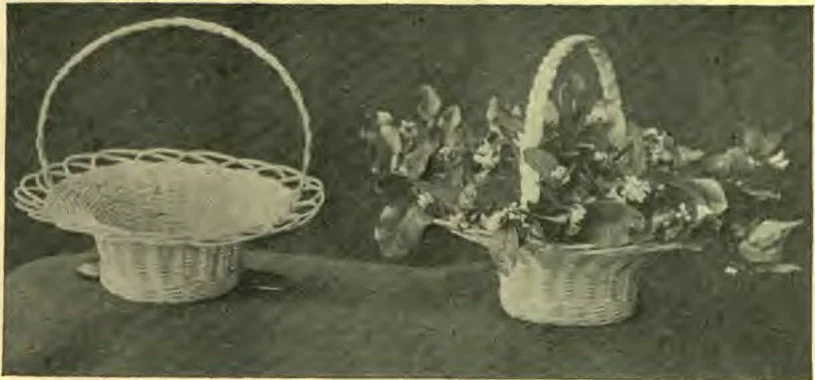
FLOWER BASKET FILLED WITH TRAILING ARBUTUS
“No,” said the boy, “I promised her, when I left, that I would be fearless and honest. I have her fortune to make as well as my own, and I must have good courage.”
“Well, laddie, what can you do?” asked a kind voice behind him.
“I can be loyal and true to any one who will give me something to do,” was the quick response.
A well-known lawyer, whose experience with applicants for clerkships in his office had been unfavorable, was passing at the moment.
Sandy's fearless face caught his eye. The honest, manly ring in Sandy's voice touched his faithful Scotch heart.
“Tell me your story,” he said, kindly.
It was soon told. Sandy's mother had been left a widow, with little money, and a child to bring up. She had worked for him as long as she could, but when her health failed, she had bought his ticket to London, and had given him what little money she could spare.
“Go and make your fortune,” she said. “Be fearless and honest, and don't forget your mother, who can not work for you any longer.”
Having heard this story, the lawyer engaged Sandy as an office boy.
“I'll give you a chance,” he said, “to show what there is in you. Write to your mother to-day that you have found a friend who will stand by you as long as you are fearless and honest.”
Sandy became a favorite at once in the office. Many of the clients who entered the office paused to have a word with him.
He attended evening classes, and became an expert penman and accountant. He was rapidly promoted, until he was his patron's confidential clerk.
After sharing his earnings with his mother, he went to Scotland, and brought her back with him.
By and by he studied law, and when he began to practise at the bar, his fearlessness commanded respect, and his honesty inspired confidence. Juries liked to hear him speak; they instinctively trusted him.
His mother had impressed her high courage and sincerity upon him. His success was mainly due to her.—Scottish American.
Flower-Basket, Model No. 9
By E. M. F. Long
Flower-Basket
Model No. 9
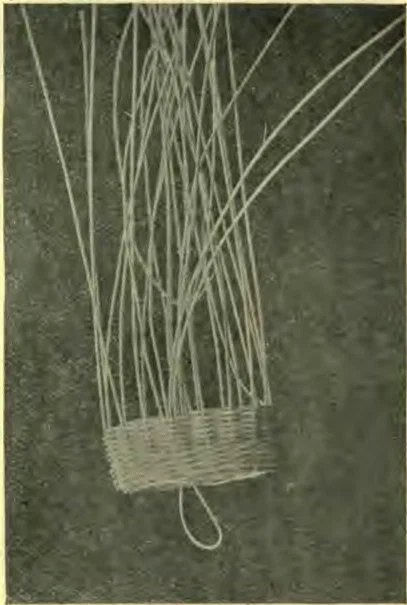
MATERIAL, reeds Nos. 2, 3, and 4. Base, three and one-half inches in diameter. Spokes of No. 4 reeds, weavers of No. 2. Nineteen stakes of No. 3 reeds, each twelve inches long. Pinch and bend up sharply. Weavers of No. 2. Five rows of triple twist, the first being very tight of course. One inch of single weaving. Stakes should be perfectly straight up to this point. The handle must now be made before the weaving is carried any further. Take a two-yard piece of No. 2 reed; starting at the bottom, pass the ends, one at either side of a spoke, up through upsetting, and single weaving. Fig. 1. Pull the reed up till the loop fits tightly around the spoke.
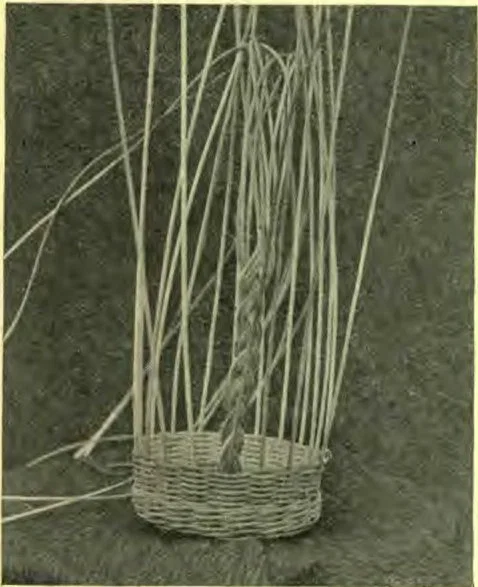
Take seven one-yard lengths of No. 2 reed, and insert down through single weaving beside the double reed already in. With these nine reeds make a three-strand braid, using three reeds to each strand. Leave the stake on the outside of the braid. Fig. 2. When the braid is as long as desired for the handle, pass two of the reeds down through single weaving and upsetting, around opposite spoke from the first one used, and up again through the upsetting. This firmly secures the handle. Cut the remaining seven reeds just long enough to reach into the upsetting, and insert them beside the other two. This completes the handle.
FIG. 2
Now bend stakes and handle straight outward, and continue single weaving about one and three-fourths inches. The handle must be woven in along with the stake, keeping the stake on the outside.
Bind off same as the base, by passing weaver under last row of weaving at each downward stroke last time around. Cut the stakes to a uniform length, six inches. Make border same as on the first work-basket. E. M. F. LONG.
Honesty and Independence Worth More Than Fortune
LET fortune do her worst, whatever she makes us lose, so long as she never makes us lose our honesty and our independence.—Alexander Pope.
German Experts Urge Abolishing Afternoon School Lessons
“AFTER examining sixteen thousand school children, three German medical experts have urged the abolition of afternoon lessons, as they exhaust the vitality of the scholars.”
MEMORY VERSE: “And he said to the woman, Thy faith hath saved thee; go in peace.” Luke 7:50.
“And the disciples of John showed him of all these things. And John calling unto him two of his disciples sent them to Jesus, saying, Art thou he that should come? or look we for another? When the men were come unto him, they said, John Baptist hath sent us unto thee, saying, Art thou he that should come? or look we for another? And in that same hour he cured many of their infirmities and plagues, and of evil spirits; and unto many that were blind he gave sight. Then Jesus answering said unto them, Go your way, and tell John what things ye have seen and heard; how that the blind see, the lame walk, the lepers are cleansed, the deaf hear, the dead are raised, to the poor the gospel is preached. And blessed is he, whosoever shall not be offended in me.”
“And when the messengers of John were departed, he began to speak unto the people concerning John, What went ye out into the wilderness for to see? A reed shaken with the wind? But what went ye out for to see? A man clothed in soft raiment? Behold, they which are gorgeously apparelled, and live delicately, are in kings' courts. But what went ye out for to see? A prophet? Yea, I say unto you, and much more than a prophet. This is he, of whom it is written, Behold, I send my messenger before thy face, which shall prepare thy way before thee. For I say unto you, Among those that are born of women there is not a greater prophet than John the Baptist: but he that is least in the kingdom of God is greater than he.”
“And all the people that heard him, and the publicans, justified God, being baptized with the baptism of John. But the Pharisees and lawyers rejected the counsel of God against themselves, being not baptized of him. . . .”
“And one of the Pharisees desired him that he would eat with him. And he went into the Pharisee’s house, and sat down to meat. And, behold, a woman in the city, which was a sinner, when she knew that Jesus sat at meat in the Pharisee’s house, brought an alabaster box of ointment, and stood at his feet behind him weeping, and began to wash his feet with tears, and did wipe them with the hairs of her head, and kissed his feet, and anointed them with the ointment.”
“Now when the Pharisee which had bidden him saw it, he spake within himself, saying, This man, if he were a prophet, would have known who and what manner of woman this is that toucheth him: for she is a sinner. And Jesus answering said unto him, Simon, I have somewhat to say unto thee. And he saith, Master, say on. There was a certain creditor which had two debtors: the one owed five hundred pence, and the other fifty. And when they had nothing to pay, he frankly forgave them both. Tell me therefore, which of them will love him most? Simon answered and said, I suppose that he, to whom he forgave most. And he said unto him, Thou hast rightly judged.”
“And he turned to the woman, and said unto Simon, Seest thou this woman? I entered into thine house, thou gavest me no water for my feet: but she hath washed my feet with tears, and wiped them with the hairs of her head. Thou gavest me no kiss: but this woman since the time I came in hath not ceased to kiss my feet. My head with oil thou didst not anoint: but this woman hath anointed my feet with ointment. Wherefore I say unto thee, Her sins, which are many, are forgiven; for she loved much: but to whom little is forgiven, the same loveth little. And he said unto her, Thy sins are forgiven. And they that sat at meat with him began to say within themselves, Who is this that forgiveth sins also? And he said to the woman, Thy faith hath saved thee; go in peace.”
Questions
1. What news was brought to John? Where was John at this time? Matt. 11:2. Where did John send two of his disciples? What questions did they ask Jesus?
2. While the disciples of John were with Jesus, what wonderful things did they see? What did Jesus then tell them to say to John? How did this answer John’s question? Upon whom does Jesus pronounce a special blessing?
3. When the messengers of John had gone away, of whom did Jesus speak to the people? What did he ask them? What great work had John been raised up to do? Who were baptized at this time? Who rejected the counsel of God?
4. What man invited Jesus to his house to eat? Who heard that Jesus was there? What did she bring to the house of Simon? Why did she weep when she came into the presence of Jesus? What did she do?
5. What did the Pharisee who had invited Jesus to the house think when he saw this? Did he speak his thoughts aloud? But what did Jesus know? How did he speak to Simon? How did Simon answer?
6. Relate the parable of the debtors. What question did Jesus ask Simon when he had told the little story? Give the Pharisee’s answer.
7. What opportunity had Simon had to show love for Jesus in his own home? What courtesies would he have shown to a guest whom he really wished to honor? Yet what had he not done? How had the woman’s course been an example to the proud Pharisee? What had she shown by her acts? What had Simon as plainly shown by his neglect?
8. What did Jesus now say to the woman? What question at once arose in the minds of those present? What did Jesus again say to the woman in the hearing of all?
“Who is like unto the Lord our God, who dwelleth on high,
Who humbleth himself to behold the things that
are in heaven, and in the earth!”
The Wondrous Cross
ISAAC WATTS, of Southampton, England, is called the father of English hymnody, preceding Charles Wesley in point of time, and probably surpassing him in the sustained quality and popularity of his work. He was an Independent, or Congregational, preacher, debarred from the universities for his religious views, and hindered in his work by infirmities and illness. He began the versification of the Psalms when he was eighteen years of age, and he published the complete work when he was forty-five. He also wrote a great deal of other religious poetry; all the great collections show more of his hymns than of any other writer’s. He is also the writer of the sublime hymn, “The Wondrous Cross.” Some authorities consider it the finest hymn in the English language, while the rest place it second only to Toplady’s “Rock of Ages.” There are four great hymns which are printed in more collections, translated into more tongues, and used in more congregations than any others; they are: “The Wondrous Cross,” “Rock of Ages,” “Jesus, Lover of My Soul,” and “Coronation.” These four were written within the space of one hundred years, the one by Watts being the first of them.
“When I survey the wondrous cross,
On which the Prince of Glory died,
My richest gain I count but loss,
And pour contempt on all my pride.
“Forbid it, Lord! that I should boast,
Save in the death of Christ, my God,
All the vain things that charm me most
I sacrifice them to his blood.
“See, from his head, his hands, his feet,
Sorrow and love flow mingled down;
Did e’er such love and sorrow meet,
Or thorns compose so rich a crown?”
“Were the whole realm of nature mine,
That were a present far too small;
Love so amazing, so divine,
Demands my soul, my life, my all.”
— Selected.
II—The Church Indicted
(July 8)
MEMORY VERSE: “Ye have robbed me.” Mal. 3:9. “Return unto me, and I will return unto you, saith the Lord of hosts.” Mal. 3:7.
Questions
What time in the history of God’s people is represented by the Laodicean church? Note 1.
What does the term signify? Note 2.
Is the Laodicean church, as a body, prepared to meet their Lord? Rev. 3:13–17.
What are they counseled to do? Verse 18.
What message is sent to the church existing just before the coming of the Lord? Mal. 3:5, 7, 8; note 3.
Who sends this message? Verse 7.
Why are these cursed? Verse 8.
What message of hope is held out to these transgressors? Verses 10, 11.
When this message is heeded, how will the world look upon God’s people? Verse 12.
What sin stands at the head of those mentioned as prevalent in the last days? 2 Tim. 3:2; note 4.
What are those who love God enjoined to seek first? Matt. 6:33.
If they fail to do this, how much good will they derive from their accumulated gold? Zeph. 1:14, 17, 18.
What does God promise to do for his remnant people? Micah 7:18
Describe the loyal church which comes forth to meet her Lord with every stain of selfishness removed. Rev. 12:17; 14:1, 4, 5, 12.
Notes
The Letter Box
NEW BEDFORD, MASS., April 9, 1905.
DEAR EDITOR: I live on an island in the middle of the Acushnet River. I have one brother and a sister. I go to Sabbath-school every Sabbath; it is about two miles from my home. It is on Willow Street. My teacher’s name is Miss Annie Carter. I like her very much. There are nine in our class. I get the INSTRUCTOR, and like it very much. I expect to be baptized in the spring. There is no church-school here, so I have to go to public school. I would like to have some of the INSTRUCTOR children write to me.
GERTRUDE E. WOOD.
CASS CITY, MICH., April 8, 1905.
DEAR EDITOR: I thought I would write to the YOUTH’S INSTRUCTOR, as I have never written before. The INSTRUCTOR visits our house weekly. I like to read the nice stories on the Children’s Page. I wish some of the INSTRUCTOR readers would write to me. As this is my first letter, I hope it will be printed. Mother and I are Sabbath-keepers, but my father is not. We have no Sabbath-school, for every one here keeps Sunday. I have my lessons in the INSTRUCTOR every Sabbath. I am thirteen years old, and live in the country. I am trying to be a Christian.
LIZZIE PARKER.
ANTELOPE, O. T., April 13, 1905.
DEAR EDITOR: As I have never written to the INSTRUCTOR, I thought I would write now.
I am twelve years old. I have two little brothers younger than I, and all of us keep the Sabbath with our papa and mama.
I enjoy reading the INSTRUCTOR very much. In fact, I do not see how I could get along without it. I especially like the science stories and field letters. I have a missionary garden planted this year.
I have been to school only two years, and that was at Keene, Texas, when I was six and seven. Sister Giddings was my teacher there.
I study at home, and I want to get a good education, and fit myself for some work for Jesus.
We may have a church-school here some day. There are twenty-one children in our company. There is a church organized here, with thirty-two members.
I would like some of the INSTRUCTOR readers to write to me. I want to be a good boy, and have a home in the earth made new.
FRED PALMER.
CALDWELL, IDAHO, April 13, 1905.
DEAR EDITOR: I have often thought of writing to you to tell you of my appreciation of the INSTRUCTOR. I have had it every Sabbath since I could remember, and to say I enjoy it, would be but a mild statement. I feel as if I were well acquainted with you, and were writing to a friend; your talks are so good and homelike.
I have a piece of poetry that I composed when I was thirteen years old, which I would like to see published if possible. I don’t care about this letter being published, but if the poetry is acceptable, I may write again.
We have a small place of ten acres, one and one-half miles from town, also some chickens, a cow, and a calf. We also have two lots in town.
MAUD BIRD.
MORRISVILLE, VT., April 11, 1905.
DEAR EDITOR: As I have seen only one letter from the “Old Green Mountain State” since I have taken the INSTRUCTOR, I thought that I would write one.
I have joined the Reading Circle. My choice of books is, “Christ’s Object Lessons,” “Christ Our Saviour,” “The Two Republics,” “Bible Readings,” “Things Foretold,” “Making Home Happy,” and of course the Bible, for it is my favorite book.
I am thirteen years old, and was baptized at camp-meeting last year by Elder T. H. Purdon, at Hardwick, Vermont.
My father is dead, but mama is living. I have a pair of bantams and a kitten for pets.
Louise Crampton said she wasn’t going to take the INSTRUCTOR any longer, but I do not see how she can part with it. I like Mr. Robe’s and Mrs. Loper’s articles very much, also all the rest.
I would like to ask Mr. Robe if germs work more in summer than in winter. Please do not print this if it will crowd any other out.
WINNIE YOUNG.
Lessons of Star, Flower, and Leaf
ALL down the ages the Lord has spoken to his people through object-lessons. It seems to be his favorite way of imparting truth, of revealing his will. The fire of Abel's altar taught the lesson of perfect obedience; the flaming sword at the gate of Eden told of the enmity between sin and righteousness; the lamb upon the altar of sacrifice pointed to the Lamb of God that taketh away the sin of the world; the tabernacle with its furnishings and service disclosed the whole story of heavenly ministration for man. Again and again has God sought to reveal objectively his love for the world. Before the foundation of the earth, the whole plan of salvation was laid, and even then so much did it mean to the Father and Son that when the earth and all upon it were spoken into existence, the Saviour made every created thing to reveal some part of this story of infinite love. He meant for man to find continual delight and strength in reading these hidden lessons. Star, flower, leaf, and rock each had its own secret to reveal to those who would inquire. And heaven meant to give man power to read new lessons continually; but sin threw a dark veil over the whole face of nature, and man seemed to lose sight of the fact that God had spoken to him through the things about him. But the Saviour partially lifted the veil when he was on the earth, and gave man a glimpse of nature's hidden truths. He himself spent much time in reading the lessons which his own hand had written in earth, sea, and sky.
Man may have misinterpreted many of these lessons, he may have made the fatal mistake of calling the created the Creator; but God does not desire that man should shut his eyes and ears to these manifold messages in nature because some have read them incorrectly. Many men have read wrong lessons from the Bible; but God intends that man should still reverently go to this fount for a true knowledge of spiritual things. And he bids him still to seek to read the precious lessons in the created works. God will cause the scales to drop from the eyes of those who heed his admonition: “Lift up your eyes on high, and behold who hath created these things, that bringeth out their host by number.”
The stars tell of God's unfailing power, the rainbow of his unforgotten promise, the sun of the Light which lighteth every man that cometh into the world, the flower of God's loving thought, the water of the Water of Life that is offered freely to every thirsty soul.
Galileo, the great philosopher, when asked if he believed in the existence of a supreme Being, pointed to a straw lying upon the floor, and said that from the structure of that trifling object, he would infer with certainty the existence of an intelligent Creator. And every blade of grass echoes the same truth. A thoughtful study of the grass will reveal other lessons our Father meant it should teach us. “Speak to the earth,” said Job, “and it shall teach thee.” The grass is equally able to instruct. It will bear “uninjured summer's heat and winter's frost; it will rise elastic from the heavy footstep and the cumbrous snow-wreath; it will speedily re-form the parts that have been broken off or injured; it will wave with the wind, and stand upright under rain and hail; it unites elegance with strength, slenderness with beauty and usefulness.” It is therefore a fit symbol of the Christian's relation to adverse and favorable circumstances, for the child of God is the same whether exalted to heaven or crushed to earth.
(To be concluded)
“Too High for Me”
By Mary Martin Morse
WHERE twilight was folding its wings to sleep,
Sat a little boy on his mother's knee;
His bright face glowed with a coaxing light,
As he said, “Moon and stars, come down to me.”
But the moon sailed on, the stars hung high,
And soon his mistake he seemed to see;
With extended hands and palms held up,
“Moon and stars, please do come down to me.”
But “please” did not bring the treasures down,
So clasping his hands on his little knee,
The philosopher, sighing, sweetly said,
“O, the moon and stars are too high for me!”
Alas for the sorrow of later years,
If the wish of our hearts always came true!
But that wisdom gives, and that love denies,
Is by far the safest for me and you.
Let the moon and stars still swing aloft,
It is well our “please” can not bring them near;
The hand holds them that is holding us,
And sleeping or waking, we need not fear.
MARY MARTIN MORSE.
Be Resolute and Great in Small Things
IN life's small things be resolute and great,
To keep thy muscle trained. Knowest thou when
Fate
Thy measure takes, or when she'll say to thee,
“I find thee worthy; do this deed for me?”