The Youth’s Instructor, Vol. 49, No. 4.

JUTIGALPA TO TEGUCIGALPA

The Youth’s Instructor

Jan 24, 1901

Review and Herald Publishing Company · Battle Creek, Mich. · Jan 24, 1901

JUTIGALPA TO TEGUCIGALPA
Ten thousand cattle from Olancho were on their way to the coast when we left Jutigalpa, and yet there seemed to be plenty left.
Everywhere the guava bushes, almost trees, were hanging heavy with fruit. Outwardly the guava resembles the apple, but the greenish skin is separated from the seeds by only a thin layer of pulp. The inner part, a pink mass of soft seeds and pulp, is delicately flavored, and makes a delicious jelly, much loved by the Spanish palate, though we saw none made in Honduras, the delicacy being imported from Cuba. The guava shrubs spread out their branches, giving shade for the cattle, which eat all the fruit they can reach.
The valleys—veritable parks, these valleys!—are covered with a short grass, which has the appearance of being neatly shaven by a lawn-mower. There is just enough roll in the prairie to suggest spots in Central Park, New York, or Washington Park, Chicago; but one looks in vain for graveled walks, stone pavements, or the haze of a city's smoke overhead. These are God's parks. No human hand has planted the shrubs, builded the mountains that rise on either hand, or directed the streams that dash, in ribbons of foam, down their rocky sides.
Sometimes travelers are met, always mounted on mules or horses, and always greeting us with a hearty, Buenos dias. Usually a moso, or footman, leads the caravan, the pack-mule following, with two cowhide trunks balanced high, one on either side of the pack-saddle. Then comes the señora, mounted on a saddle with a back-rest—the palace-car of Honduras. She is dressed in a long riding habit, and carries a large parasol, the well-trained mule following the trail without much attention from the rider. In fact, there is a perfect division of labor between the mule and its rider,—the mule keeping the trail and its footing, while the rider gives her attention to keeping her seat and avoiding overhanging branches.
The men in the party are provided with machetes slung in sheaths at the belt, and balanced with heavy revolvers. These strong native knives are useful in cutting away overhanging branches and vines, which might otherwise brush one from the saddle.
One hot day we met a woman carrying a monkey on her lap: both chatted pleasantly, and then passed on. At another time a mail-carrier with a week's accumulated correspondence of the third city in the republic, done up in a packet about as large as a music roll, overtook us, and kept us company for several hours. His blue hatband (blue and white are the colors of the republic) bore the words, in letters of white, “Correos de Honduras.” His cotton trousers were rolled above the calves of his dark-skinned legs. Leather sandals were fastened with thongs to his feet. He had a springing step, which he kept up all day. In the afternoon he quickened his pace, and left us, with our mules, two leagues behind.
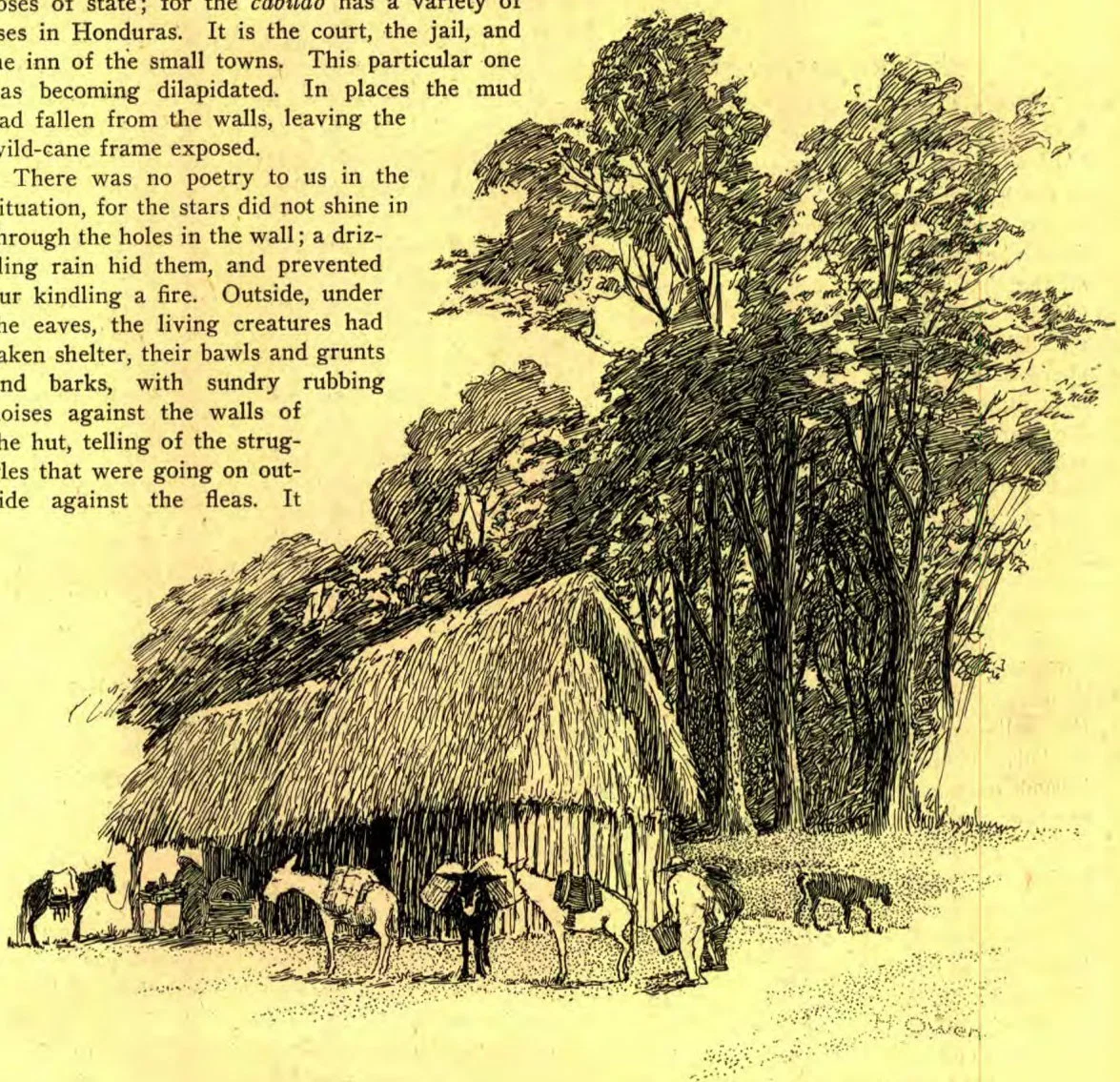
A THATCHED HUT. THE PACK-MULES ARE A PART OF OUR CARAVAN
At night we came to a village of mud huts, with thatched roofs, and were shown to the cabildo by the villagers. Several calves, which had settled for the night, reluctantly gave up their places for us; and we made our beds on the large cedar tables that had served the purposes of state; for the cabildo has a variety of uses in Honduras. It is the court, the jail, and the inn of the small towns. This particular one was becoming dilapidated. In places the mud had fallen from the walls, leaving the wild-cane frame exposed.
There was no poetry to us in the situation, for the stars did not shine in through the holes in the wall; a drizzling rain hid them, and prevented our kindling a fire. Outside, under the eaves, the living creatures had taken shelter, their bawls and grunts and barks, with sundry rubbing noises against the walls of the hut, telling of the struggles that were going on outside against the fleas. It was nearly morning before the trouble ceased, and we could distinguish the sound of the rain upon the roof—a noise that is not a patter, as the thatch deadens the sound of the falling drops.
Morning is always welcome to travelers in Central America; and the change from night to day comes more quickly than it does farther north. For breakfast the village afforded a few eggs and some sel-sel—a vegetable preparation, done up in leaves, which will defy the most ravenous appetite. We tried roasting it, but the change was not for the better.
Breakfast over, we took to our saddles. Occasionally Indians would pass, loaded with pelts, and carrying long blow-pipes. The women had the burden of their babies added to that of their packs; but Honduras is not a populous country, and many a league of uninterrupted wilderness was passed, where the sign of human habitation, no matter how humble, would have been welcome indeed.
We often forget that all nations of the earth are “of one blood;” but let one travel through the wilds of a strange country till night falls; let him watch the unfamiliar stars come out in the unfamiliar heavens, and see the light of the moon streaming down through trees of strange form; let him hear the sound of the coyote calling to his mate, and the half-human voice of the baboon filling the air with a babel of sound—and he will be prepared to welcome as streaming from the windows of those near of kin the uncertain gleams of light coming through the pole walls of a native hut. The sound of hands shaping tortillas, and of voices bidding us welcome in Hondurasian Spanish, are like music in our ears; and the dark-skinned faces of our host and hostess appear little darker than our own by the light of the fogong. Truly, we are all brethren.
H. A. OWEN.

Why Waiting for Perfect Circumstances Fails

For truth is ever the fitting time; who waits till circumstances completely favor his undertaking, will never accomplish anything.—Luther.

THE CHRISTIAN PATHWAY

To be a Christian means to possess the attributes of Christ’s character, to have a heart imbued with love for God, to delight to honor God, to reach earnestly after heavenly attainments. It means to render to God grateful songs of praise from a heart swelling with gratitude, to appreciate all that has its origin in God and heaven. The Christian loves what God loves. A heart filled with Christian love is lifted far above the atmosphere of selfishness. It lives in a pure, bright, holy atmosphere. The love that God puts into the heart is a love dictated by holy impulses, sustained by a sense of duty, and cherished by a resolute will. In the soul where this love is cherished, virtue will grow like a tree in a well-cultivated garden.
To be a Christian means to possess the Christian graces, to bear fruit unto righteousness, even the fruits of the Spirit,—“love, joy, peace, long-suffering, gentleness, goodness, faith, meekness, temperance.” To be a Christian means to practice religion in the home. Where is it more needed? Home influence, all-powerful for good, is such only as it is carefully cherished. It can not bear the blast of rudeness or neglect without receiving a wound which can with difficulty be healed.
The motives and tastes of the Christian are entirely opposite to those of the worldling. It is impossible to be in harmony with Christ and with the world at the same time. But among the people of God, the love of the world has been increasing to an alarming extent. We feel alarmed as we see so many who profess to accept Christ going on from day to day the same as before. Too often believers act in such a way that unbelievers have no cause to think that they are living any nearer Christ than they themselves. Their conversation is flippant, their actions are unlike Christ. Many who take upon themselves baptismal vows do not live these vows even for one day. They have not come out from the world. They do not know what it means to hold communion with God. We fear that many youth have stopped short of genuine conversion. By their actions they testify that they have no part with Christ,—that they are only pretenders.
“Ye shall know them by their fruits.” A genuine change of heart carries its evidence with it. The life of the one who is truly converted is separate and distinct from the life of the worldling. Instead of being absorbed in worldly pleasure, the Christian hungers and thirsts for the bread of life and the water of salvation. He is more anxious to learn the way of the Lord, and to secure his favor, than to please himself or those who are not in harmony with God.
“Enter ye in at the strait gate. . . . Strait is the gate, and narrow is the way, which leadeth unto life, and few there be that find it.” When Christ spoke these words, many of his hearers were convinced of his doctrine, but they needed to be aroused to greater earnestness in regard to their eternal welfare. They had come to the place where two roads met, the wrong one apparently the most attractive. They had good desires, but they were not wholly decided to serve God. They followed the Saviour “afar off.” The world’s Redeemer saw their peril, and sought to rouse them to a realization of their danger. He longed to see them making an entire surrender to God. It pained him to see them living in a state of indecision.
His voice was raised in earnest entreaty in their behalf. “Wide is the gate, and broad is the way, that leadeth to destruction,” he said, “and many there be which go in thereat.” This road is wide; and in it the pleasure-lovers and the proud will find abundant room. The selfish, the covetous, the hypocrite, the sons and daughters of levity, the unthankful and unholy, will find the broad road well suited to their taste.
To walk in the narrow road requires earnest, self-denying effort. It is because of the straitness of this way that so few find it. Many seek to enter, but fail because of lack of earnestness. And in the end they step into the broad road, failing to see that the narrow way has joys that would compensate for any trials.
Some who have entered the broad road hear God’s voice calling to them, “Enter ye in at the strait gate,” and make a decided stand, determined to proceed no farther in the broad road. Through repentance and faith in Christ they enter the strait gate. They realize that all self-indulgence must be given up, that pride must be humbled, and self crucified. They see that they must lay aside every weight, and the sin that so easily besets them. They must urge their way through every obstacle, denying self, lifting the cross, resisting temptation, grasping all the help that God has placed within their reach. In deed and in truth they must accept the Saviour. They must press their way along the narrow path of self-sacrifice; for it is the path of salvation. Although the voices of pleasure-lovers invite them to carelessness and selfish enjoyment, they must turn neither to the right hand nor to the left.
MRS. E. G. WHITE.

THE MORNING-GLORY THAT CLIMBED

Last fall I bought some morning-glory seed from a suburban garden. The seed was gathered from vines that were uncommonly beautiful in the size and variety of color of the blossoms. This spring my plants came up in due season, and gave vigorous promise of being as choice as the parent vines had been. But mine is a city yard, shut in on four sides; and the summer months passed without one flower on the vines. They were riotous climbers, however. They would go up. And up they went, clear to the roof of the two-story house. Those outreaching fingers laid hold on everything they could find. When strings gave out, they turned to posts and water-spouts,—anything that led up!
The beauty of the little garden below faded before the autumn winds. One gray day I turned from its spoiled beauty to look at my ambitious vines, and lo! a vision of loveliness that made me exclaim with delight. There, tossing in the morning breeze, were hundreds of blossoms of every morning-glory hue,—white blushing into pink, and pink deepening into royal purples. All through the chill fall days the flowers did not fail. The grayer the sky, the chillier the wind, the lovelier and more numerous the “glories,”—not morning-glories only, but all-day and all-night glories, with vigor enough to withstand sun and chill, wind and rain and drought. Every day, as I received the beautiful benediction of my victorious vines, voices whispered in my ear: So you must climb! So must every soul climb, “till we all come . . . unto a perfect man, unto the measure of the stature of the fullness of Christ.”
It was pleasant in the garden below. There was companionship there. The wind and the rain were not so fierce down by the fences. But oh, above! What light, what life, what liberty of room, what grace of flower, what perfection of fruit!
Climb! Climb! CLIMB! “Lay hold on eternal life, whereunto thou art also called.” God has put the climb into us. Environment is the trellis. The rougher the better for laying hold of. By the things that shut us in we must get up and out. By string, by stick, by stone; by rusty nail or hidden crevices; by everything that is on the way and in the way! Who—what—shall separate us from the love of Christ? Nay, in all these things we are more than conquerors through him that loved us!—Ada Melville Shaw.

FIRST STEPS IN DISHONESTY AND CRIME

Not long ago I met a young man who had just been released from serving a prison sentence for burglary. He seemed anxious to lead an honest life and to do right; and as is our custom in all such cases, I at once began to question him about his childhood and early training, with a view of ascertaining the cause of his downfall and subsequent criminal career.
When I had finished talking with him, and saw how cunningly the devil had ensnared his soul, I thought to myself, How many boys and girls, young men and young women, have I seen taking the same steps that proved so disastrous to this young man! A bit of this prisoner's early experience may serve either to warn some readers of the INSTRUCTOR or to prepare them to warn some of their associates, who may be taking the first steps in the path of dishonesty, which leads down to the highway of crime. Here is part of his story:—
“My mother and father were Christians. I was taught to read the Bible and pray when young; and each evening, as I said my prayers with my mother, I little dreamed that I should some day break that mother's heart, disgrace my father, and find myself behind prison bars, serving a sentence for burglary. How did it happen? Ah! during those years behind the bars I thought it all out. I can tell just where it began. One afternoon when I was not more than seven years old, I had been playing for several hours, and went into the house, and asked mother for something to eat. She gave me some bread and butter. I asked her if I could not have a cooky. She said, ‘Yes,’ and gave me one. Then I wanted two; and when I was denied the second one, the thought flashed through my mind that I could get it anyway. A few moments later I stole into the kitchen, climbed upon a chair, and seized a handful of cookies. I shall never forget the impression that came over me as I stepped out of the kitchen with those stolen cookies. Something told me that I ought to go to mother, and tell her what I had done; but this I refused to do; and oh, I now see what a mistake I made!
“From that day on, my mother knew but few of my mistakes and wrongs. I carefully covered them up, and hid them from her. From time to time this stealing of cookies, cakes, and other things was repeated. I think it must have gone on for a year or two. At last I was old enough to take the garden stuff around to the neighbors in summer, and sell it. There was a certain top in the toy store that cost five cents, and this I decided to have. Instead of asking father for the money, one day I kept back five cents from the vegetable money, and with this I bought the top.
“I got in the habit of keeping back five cents very often; so one day when one of my companions suggested that we buy a box of cigarettes, of course I had the money. It was stolen money,—money that I did not have to account for to my parents,—money in every way suited to buying cigarettes. I bought the cigarettes, and smoked them. Then I bought more; and the more I bought, the more money I had to steal. This experience went on until I became a young man, although I had the esteem of my associates, the confidence of my parents, and the respect of my employers. At last I was led into gambling. I lost heavily; and in order to sustain these losses, I began regularly to take money from my employer. In the meantime I had begun to drink; and one night when half drunk and wholly fascinated with a game of chance, I bet—and lost —a thousand dollars of my employer's money. There was nothing left for me but to flee the country. I was caught, tried, and found guilty. Now I have served my sentence; and if there is a way to make a dishonest man honest, I want to know it.”
Dear reader, the last part of this experience is sad to contemplate; but the first part—the “little foxes” that ruined this vine of honor, virtue, and manhood—seemed very small when they first appeared in this boy's experience. Let us carefully examine ourselves, to see if there are any little foxes nibbling away at the vines of our character, which, if not suppressed, will one day prove the ruin of our usefulness, and of all our hopes in this life and in the life to come.
W. S. SADLER.
1926 Wabash Ave., Chicago, Ill.

O HAPPY HEART

O HAPPY heart! thy path is bright With cheerful glow of heavenly light; Across the vistas far away Come streams of glad, effulgent day.
The rest, the peaceful rest and calm That soothe the heart like flowing psalm, The light, the glory light divine, O happy heart! are always thine.
The tides of care—what should they be, O happy, trusting heart! to thee? What should thy spirit burden down, Thou heir to mansion, robe, and crown?
Why should an earthly care beget A heart of anxious strife and fret? Does not the tiny sparrow feed On food apportioned to his need?
O happy heart! thy way is bright With cheerful glow of heavenly light. Look upward; this thy joy shall be: Thy Heavenly Father cares for thee.
B. F. M. SOURS.

A LITTLE LEAK

THIS is the story of a leak that was only a little one. But there is no knowing where a “little” thing stops, when it comes to results, as you will see.
It was in a small pipe in the third-floor bathroom of a big house in New York. The pipe brought the water into the stationary wash-bowl, and was nickel-plated, so that it looked very nice indeed. Nobody suspected that it leaked; for the crack was such a tiny one that only a drop oozed through now and then. So the family that owned the big house went away to the seashore, and locked up the house, and left the pipe to itself, not dreaming what mischief it was up to.
The leak opened a little bit more the week after they left, so that the drops came faster. Another week, and it was just a trifle larger still. Two weeks more, and an old colored woman who was taking care of the house next door, went and complained to the police that a very queer thing was happening. The water was trickling through the cellar wall from the closed house. She thought something must be the matter; and she had heard, besides, sounds of something falling, every now and then, next door. The police came around, and found water oozing into the cellars on both sides, but could not get into the house that was closed, because they had no keys. So they telegraphed to the owner, and asked him to come home, and find out what was the matter.
He came home. And then he found out what a little leak can do. All the rear rooms on the two lower floors were in ruins. The ceiling of the dining-room (which was just below the third-story bathroom) had fallen, covering all the fine hardwood floor, laid new that spring, with soaked plaster, and broken laths, and water. The handsome tapestries on the wall were soaked and dripping, and had fallen down in places. The carved furniture, with its beautiful covering, had been ruined by the plaster dropping upon it, and the water in which it stood. The rooms below were no better—ceilings fallen, floors ruined, and streams of water trickling down the walls. The water in the cellar was a foot deep. Everywhere was rain and damage; and above, in the bathroom, the water was still trickling, in a little stream, from the opening in the pipe, now about an inch long.
Fifteen hundred dollars’ worth of damage, it was reckoned, came from that “little” leak. A ruinous thing like that has no little or big about it; it is just ruinous, and that is all. Yet sometimes we forget this, especially when it is not a house or property that is in question, but our very own souls instead. And we excuse a “little” profanity, or a “little” bad temper, or a “little” untruth, or a “little” evil thinking or doing, and feel, as long as our sins are small and hidden, we are safe. So we need the obvious lesson of the little leak—isn’t it so?—the ruin it made, the damage it did, the day of discovery that came at last, as it always comes.—Selected.

AT THE PAN-AMERICAN EXPOSITION

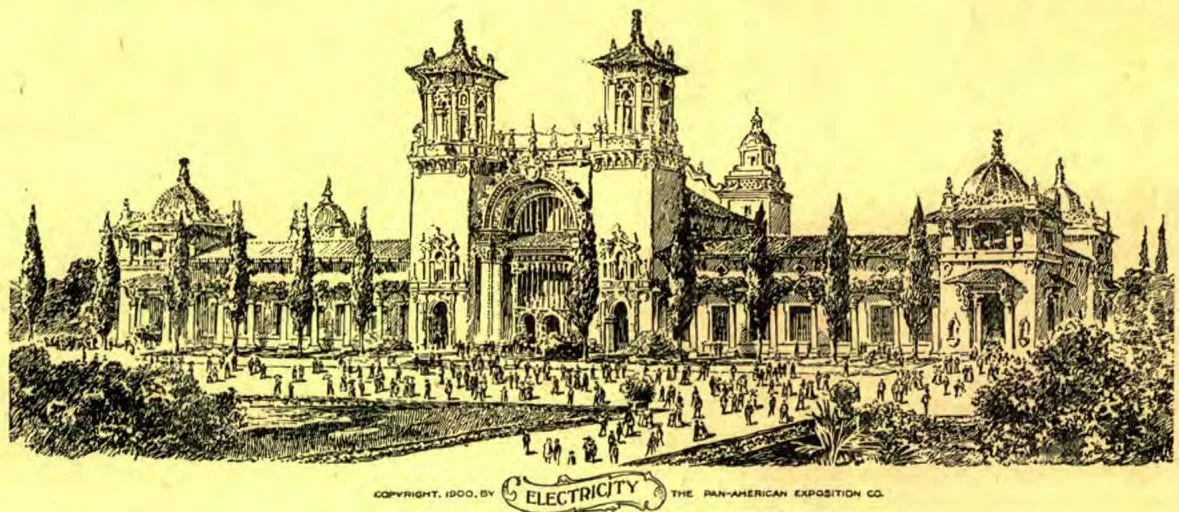
BUFFALO has been called “The Electric City,” and it is only fitting that this wonderful force should be a prominent feature of the coming exhibition.
ELECTRIC TOWER, PAN-AMERICAN EXPOSITION—BUFFALO
The electrical power furnished, as is all the running power of the Pan-American Exposition, by Niagara Falls, offers a greater opportunity for esthetic experiments than has ever before been possible anywhere. The lighting for night effects is being studied by a well-known electrical expert. A wonderful canal, with innumerable grottos and caverns, in which are the most charming electrical effects, will wind its way throughout the grounds.
The electrical tower is to be treated as focusing point for flash-lights and for reflections of every color from the illuminated fountains beneath; all these lights will, in turn, be reflected to the spectators in the great central courts, and mirrored up from the bright lagoon. The general lines of the building, as well as its picturesque features, such as towers and domes, will all be outlined by incandescent lamps, while the most unique effect of all will be the huge lighted globe of jeweled glass three hundred and fifty feet in the air, on top of the electrical tower, on which North and South America will be visibly outlined.
The Ethnology Building will be one of the most beautiful in external construction of any on the grounds. The massive eagles, eight in number, each weighing more than three tons, which are to ornament its massive dome, are regarded as the handsomest pieces of staff in the city. They were modeled by John Fredericks, and each required about two tons of clay.
ETHNOLOGY.
ETHNOLOGY.

Bringing Sunshine Into the Home

“WHEN you come into a house, bring sunshine with you.”

HOW WATCH JEWELS ARE MADE

One day not long ago the writer had the pleasure of visiting one of Switzerland’s largest watch-jewel factories.
These “jewels” are made from rubies obtained, for the most part, from India, being sorted out from those stones fit to be polished as precious stones. They are dark-red and pinkish in color, the former being two or three times as valuable as the latter. A double handful of the cheapest rubies is worth from three to five hundred dollars, when the stones are in the rough; but when ready for shipment, they are worth three thousand dollars a pound. The stones are first sawed into tiny square slabs by an expert, who rejects all worthless pieces. The saw is a copper disc, armed with diamond dust. Diamond dust is valued at from twenty to thirty dollars a carat, the price having increased enormously since the Transvaal war.
The next operation is to polish the sides of those stones that have been cut, and grind them flat and even. This is performed quickly on the side of a whirling disc, moistened with a dark, creamy liquid containing diamond dust. After being polished, the stones are rinsed in water, and then sent to the machines that shape the jewels.
The operation of piercing a hole in a small jewel is one of extreme delicacy. The drill is diamond-pointed. It remains still, while the stone, imbedded in wax or shellac, revolves with great rapidity; the drill is thrust mechanically against it, piercing it slowly. Great care is necessary, that the drill pierce the stone at right angles to its surface. One worker at the time of my visit had to melt and remelt his wax several times, and try it with instruments of precision, before it was just right. The employer explained that the reason for this was that the man was somewhat excited because we were watching him so closely; usually he fixed a stone at one “heat.”
After this the stone is subjected to a turning process, whereby all the rough corners are knocked off, and it takes the form of a watch-jewel—flat on the back, with concave face, in the center of which an oil cavity is scooped out. It is then polished on the face and axis by being fixed to a rapidly revolving lathe, and ground smooth with very fine diamond dust.
When they have gone through these processes, the jewels shine with a luster that is almost wholly absent in the rough stones. They are then critically examined by experts, armed with lenses; and if the least inaccuracy is detected in a jewel, it is sent back to the maker for repair. If irreparable, it immediately loses its value, and is consigned to the “waste-box,” where it is utilized for various trinkets.
We saw two forms of rough diamond, also sapphires, which are used to make phonograph styles, compass points, etc. This factory makes many of the styles used by the Edison Phonograph Company.
As we saw a ruby in the rough increase tenfold in value under the skillful touch of the mechanic, we thought of the Master, who polishes the human soul, a living ruby in the rough, until the rough corners of unlovely habits are worn off. The diamond dust of the sword of the Spirit—the word of God—cuts its way into the hard and stony heart, and smooths the character until it comes forth from the process not only polished externally, but, like the ruby, the same all the way through,—sincere, faultless, ready for a place in the spiritual temple,—as ready to make peace in the church of Christ as the ruby is to diminish friction in the delicate axis of the watch.
P. A. DE FOREST.

WORTH MORE THAN GOLD

“He was so good to his mother!”
This was a high tribute, and I listened for the rest.
“I never heard him speak a cross or impatient word to her. Everything she wanted him to do he was ready to do, without question. You know she was not very strong, and he seemed always ready to do all he could to save her from becoming tired or anxious. Most boys like to drive fast when on the road with a spirited horse; but when they were out together, if the road was rough, and his mother would say, ‘Not quite so fast, Willie, please,’ he would at once bring the horse to a slower pace. Always just so good and true to her.”
And why not? Is there any reason why every boy and girl should not be kind, patient, and true to father and mother? Who in the world ever has done or ever can do for us what they have? And yet it must be said that many are not thus thoughtful of their parents. So often that the heart wearies of listening, we hear from the lips of young men and women harsh and unfeeling words, which must sting and linger long in the memory of the parents to whom they are addressed. Often these words spring thoughtlessly up, not from the heart, but from the quick impulse of impatience. Still, they hurt just as much as if they had their inspiration in deeper fountains.
Can you think of any higher tribute than that which the mother of our lad Willie bestowed upon her boy when she said: “I have no unkind words to remember from him. He always trusted his mother. Now, when he is gone, this is very pleasant for me to think about.”
A young friend of mine once said to me: “I tell mother everything. She’s my chum.”
I knew this was so. He and his mother were comrades. If he wrote a letter, he brought it to her to read. If he received one, she enjoyed the best portions with him.
No young man can ask for a higher tribute than that which his own mother bestows upon him in return for whole-hearted devotion to her. Society can do much for him. The world of business has many successes in waiting for him if he earns them. He will feel his heart swell within him as these, one after another, come to him. But they will never bring the joy to him that his mother’s words carry.—Selected.

DICTIONARIES

In its proper sense a dictionary is a book containing the words of a language, with explanations of their meaning, arranged alphabetically, or in some other order. To be in reality a dictionary, a book must contain a large number of words. If the collection is a small one, the book should be called a “vocabulary.” A mere alphabetical arrangement of the words of a book, with references to the places where they occur, is termed an “index.” When the index is amplified, and the phrases are given in which the words occur, it is called a “concordance.”
Dictionaries were originally books of reference explaining the words of a language; but as time passed, and sciences, trades, professions, and arts multiplied, separate dictionaries for each came into use. Thus we now have dictionaries of biography and history, general and special; of geographies of the whole world, and of special countries, or even small towns and villages; of castles, monasteries, and other buildings; of philosophy, mathematics, natural history, zoology, botany; of birds, trees, plants, flowers; of chemistry, geology, and mineralogy; of architecture, painting, music; of medicine, surgery, anatomy, pathology, physiology; of diplomacy; of law—canon, civil, statutory, and criminal; of political and social science; of agriculture, rural economy, and gardening; of commerce, navigation, horsemanship, and the manual arts; and scores of others, together with dictionaries of the arts and sciences, and including within themselves every branch of knowledge, under the name of “encyclopedias.” W. S. CHAPMAN.

SUNRISE

Now in the Day’s blue porch Look, and behold Dawn’s newly kindled torch,— A flame of gold!
O’er the sea and land It shines as fair As when at first His hand Lighted it there.
— Selected.

A LONG LIFETIME OF WORK

An Englishwoman who lives near Bedford, one of the rural centers of the pillow-lace industry, has been ninety-five years at her trade. She was born in the year 1800, and has worked at lace-making since she was four years old. In her young days it was a paying trade, the women often earning more at the pillow than their husbands earned at the plow. Mrs. Berrington’s parents were not so poor as some of their neighbors; but her father, being a prudent and thrifty man, insisted on putting the child early to work, deeming it best that she should have something to fall back upon if any mishap should overtake him. So at the age of four she was set to work at the pillow, and for ninety-five years has worked regularly at her craft.
Those who have not seen this variety of lace can have no idea of the hundreds of thousands of turns, crosses, and twists that must be given the thread in making a few yards of the pattern. Even now old Nancy, as she is familiarly called, can follow an intricate pattern with ease, and without the aid of spectacles.
Many people call to see an old lady in her hundredth year at work at lace-making, and samples of her lace have traveled far. In her younger days such lace as she makes brought fifty cents a yard; now she sells it for twelve.
Mrs. Berrington’s labors have not affected her health. When she was ninety-eight years old, she walked home from Bedford, a distance of three miles, because the carrier, on whose cart the country people depend in going to and fro, “dawdled about” too long for her.
Even now she is firm of foot, and thinks nothing of climbing over the fence that encloses her garden, in order to pick flowers for a visitor. Her eyesight is good, and she has hardly a gray hair in her head.—Youth’s Companion.

THE WAITING GARDEN

THINK not to walk this earthly way, From youth's sweet dawn to closing day, Through flowery paths, and never see The garden of Gethsemane.
Though bright the morning overhead, And fair the road your feet are led, Though life seems like an opening rose Whose every leaf new charms disclose,—
Yet, as you gaily pass along, Pray God to make your spirit strong For that sure day when you will be Alone in dark Gethsemane.
Your goal is yonder gleaming height; Press on! — in climbing lies delight; Exult in all the hope of youth; It is your right, but mark this truth:
Though mind and body glow with strength, Yet comes that certain day at length, That hour in sad Gethsemane, No mortal may escape or flee.
The grandest heights we oft attain By treading avenues of pain; And ere our Father's face we see, We die with Christ on Calvary.
— Ella Wheeler Wilcox.

AWFUL

THERE is a little maiden Who has an awful time; She has to hurry awfully To get to school at nine.
She has an awful teacher, Her tasks are awful hard; Her playmates all are awful rough When playing in the yard.
She has an awful kitty, That often shows her claws; A dog who jumps upon her dress With awful muddy paws.
She has a baby sister With an awful little nose, With awful cunning dimples, And awful little toes.
She has two little brothers, And they are awful boys; With their awful drums and trumpets They make an awful noise.
Do come, I pray thee, Common Sense, And this small maid defend; Or else, I fear, her awful life Will have an awful end.
— Toronto Globe.
Continue reading: TWO ABUSED WORDS