Last evening I was strolling through Dictionary Hall, noting the faultless arrangement of the inmates, who were named Words. And I could not help thinking aloud as I saw what a great number of them there were: “Surely no one need be at a loss for suitable Words for any and every occasion! How different is our case from that of the tribe of Indians who have but three hundred words at their command!”
I happened to be in Corridor A at the time, and was just about to call Admire to help me in expressing my feelings, when I heard a deep groan, which came from a room far down the corridor. Hastening forward (for I feared some poor Word was hurt, or perhaps killed, as not infrequently happens), I came to a door standing ajar, just as the inmate of the room uttered another groan. Receiving no answer to a hurried knock, I entered, and found a strange-looking Word standing with his back toward me. “Sir,” said I, “who are you? and what is your trouble?”
He turned toward me a dejected countenance, which seemed familiar, yet I was unable to name him.
“I do not wonder,” he replied, “that you ask who I am. Sometimes I scarcely know who I am myself. My name is Awfully. You would hardly believe it, would you? I look like one of those little pink-and-white wax figures in a clothier’s store, don’t I? Well, I’ve had to wear ‘awfully tight’ shoes, ‘awfully pretty’ gowns, and ‘awfully sweet’ bonnets. I’ve chewed ‘awfully nice’ gum; I’ve eaten ‘awfully tender’ pie-crust. The babies I’ve seen were ‘awfully cute,’ and the jokes I’ve heard were ‘awfully funny.’ Sometimes I wish I’d never been born. Look at this portrait; you would not think it was I, would you?”
I looked, and there was a noble-looking Word, in the prime of life. His stature was majestic; his garb simple; and in his dark, serious eyes, lifted toward a flame-streaked thunder-cloud, was a look of awe.
“I was looking at it when you came in,” he went on, “and I groaned to think how changed I am. Every Word has his portrait painted, and hung in his room when first he comes to live in Dictionary Hall. Some of us have changed little, or not at all; but many of us, through abuse, become so unlike our former selves as to be scarcely recognizable. I have living in Corridor P a cousin who has suffered as severely as myself; you may know her; her name is Perfectly.”
A NEW DAY
“I have a slight acquaintance with her,” I answered; “but as I have seldom required her services, we have not often met.”
Awfully gave me a grateful look. “I see,” said he, “that you are one who calls Words out only on legitimate service. So used, we remain young and strong for generations. But if you would see a wreck, go and call on Perfectly.”
So, bidding him “Good night,” for I saw he was wearied by a hard day’s work, I left his room, and took the elevator to the third floor. Turning into Corridor P, I was soon at Perfectly’s door. Finding it locked, I decided she must have retired, and was on the point of leaving when I was jostled by a befrilled and befrizzled Word, who seemed half asleep.
“I beg your pardon, madam,” said she. “I am so tired I can scarcely see which way I am going;” and she put out her hand, and unlocked the door of Perfectly’s room. I was astonished! Could this be Perfectly? That she must be was evident; for no Word ever carried the key of any room but his own.
“Madam,” said I, “I have just come from the room of Awfully, and it is at his request I came to call on you.”
“You are very welcome,” she answered. “We Words are much called away from home, but it is seldom we have visitors.” And with that she led me into her room, and requested me to be seated.
My sorrow must have been expressed in my face; for she immediately said: “I see you are disappointed in me, and I do not wonder. I am almost worn out. See how frayed my garments have become! I have tried to repair them, but the best I could do was to baste on some tawdry flounces. My cheeks are so faded I’ve taken to painting; and my hair has become so thin and gray that I wear a wig. I am far from being the Word I was when I first came to live in the Hall.” Then she showed me the portrait of a beautiful Word, with calm eyes, hair smoothly brushed back from a broad forehead; and dress of snowy white, falling in ample folds from throat to hem. “I’ve taken ‘perfectly grand’ rides on merry-go-rounds, heard ‘perfectly awful’ singing, and30tasted ‘perfectly dreadful’ candy. To-night I was just about to retire when I was hurriedly called by one young lady who saw a ‘perfectly horrid’ spider, and another who had found a ‘perfectly lovely’ new way to do her hair.”
Perfectly sighed deeply; I was sorry for her, but what could I do? Not daring to hold out a ray of hope, I left her with a sad “Good night.” The Corridors were deserted; Dictionary Hall was at rest for the night. But this morning I lay the cases of these two unfortunates before you: can any of my readers do anything to relieve Awfully and Perfectly?
AUNT BETTY.
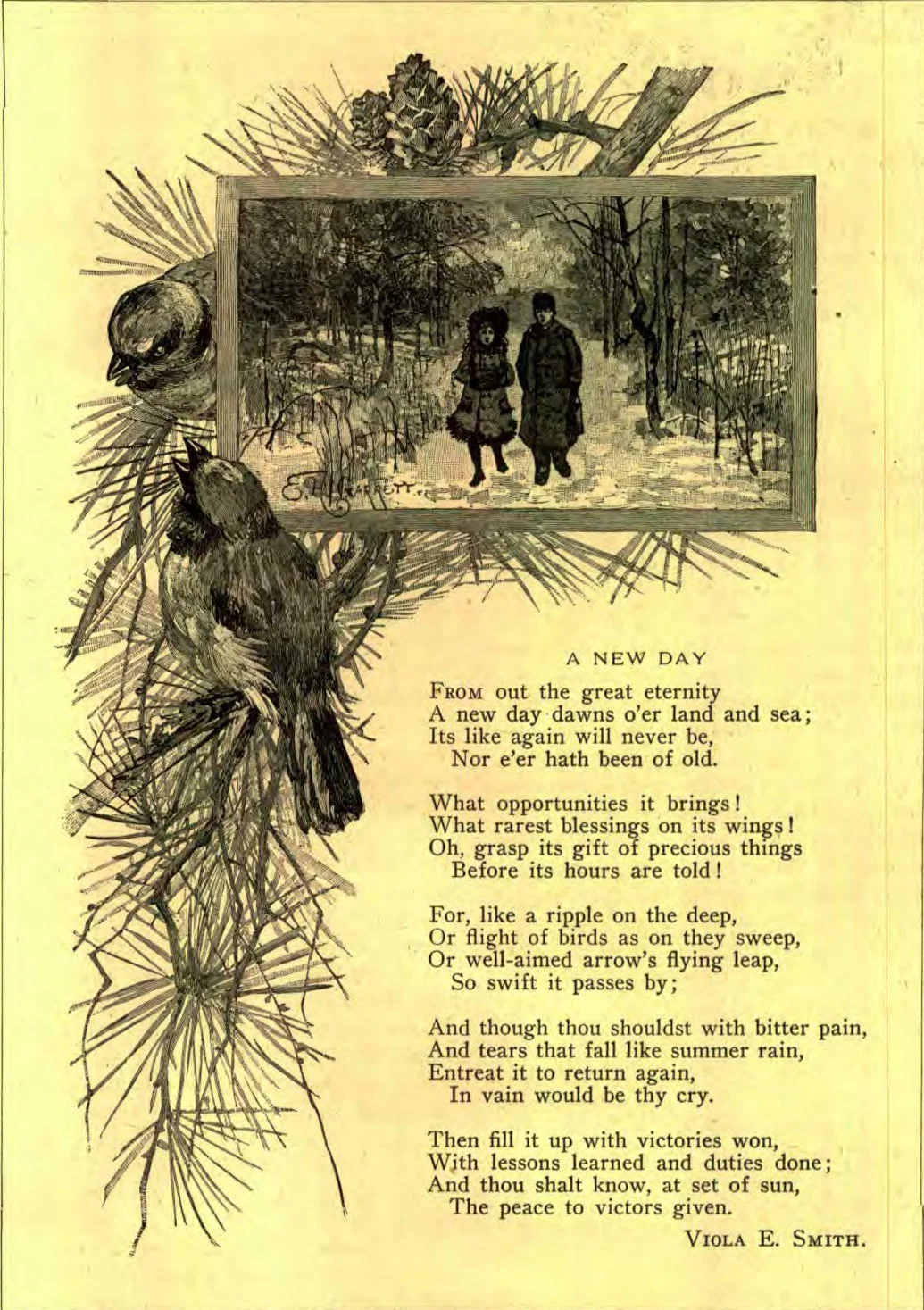
A NEW DAY
By Viola E. Smith
From out the great eternity
A new day dawns o’er land and sea;
Its like again will never be,
Nor e’er hath been of old.
What opportunities it brings!
What rarest blessings on its wings!
Oh, grasp its gift of precious things
Before its hours are told!
For, like a ripple on the deep,
Or flight of birds as on they sweep,
Or well-aimed arrow’s flying leap,
So swift it passes by;
And though thou shouldst with bitter pain,
And tears that fall like summer rain,
Entreat it to return again,
In vain would be thy cry.
Then fill it up with victories won,
With lessons learned and duties done;
And thou shalt know, at set of sun,
The peace to victors given.
Viola E. Smith.
BEREAN LIBRARY STUDY
Revelation 12; “Thoughts on the Revelation,” Pages 509-519
(January 27 to February 2)
Introduction.—The twelfth chapter of Revelation represents the church under the symbol of a woman standing at the threshold of the new era. The Jewish economy was passing away. The time was near when the Saviour was to pronounce the mournful words: “Behold, your house is left unto you desolate.” The Jewish economy is fitly represented by the moon, which shines only with a borrowed light. There was light, and it came from the Sun of Righteousness. “The whole Jewish economy is a compacted prophecy of the gospel. It is the gospel in figures. It is the gospel veiled.”
The Child.—There were a few faithful souls who, like Anna, were looking for redemption in Jerusalem. They knew that the time for the Messiah’s advent had fully come. They longed for the Saviour, and recognized him in the Child that was caught up to God and his throne. Only one person has ever shared the throne of the Father, and that is Christ. Rev. 3:21. The Child is further identified by ruling all nations with a rod of iron. This honor belongs to the only begotten Son of God. Ps. 2:7-9.
Who Sought to Destroy the Child Jesus.—In the second chapter of Matthew we are told that the Roman ruler sought to destroy the Saviour soon after his birth. “For a truth against thy holy child Jesus, whom thou hast anointed, both Herod, and Pontius Pilate, with the Gentiles, and the people of Israel, were gathered together.” Acts 4:27. “The dragon is said to be Satan; he it was that moved upon Herod to put the Saviour to death. But the chief agent of Satan in making war upon Christ and his people during the first centuries of the Christian era was the Roman Empire, in which paganism was the prevailing religion. Thus while the dragon, primarily, represents Satan, it is, in a secondary sense, a symbol of pagan Rome.”—“Great Controversy,” Vol. IV, page 438.
War in Heaven.—When surrounded by temptations, some are inclined to think that if they were differently situated, were surrounded by good persons, they would not be so sorely tempted. Let such remember that Satan began his work in the courts of heaven; and that a large number of the angels of heaven, who dwelt in the light of the glory of God, listened to his temptations, and were cast out of heaven with him. Our safety does not depend upon our surroundings, but upon our giving a decided NO to all the temptations the enemy may present.
The First Fall of Satan.—“Satan was once an honored angel in heaven, next to Christ. His countenance, like those of the other angels, was mild and expressive of happiness. His forehead was high and broad, showing great intelligence. His form was perfect; his bearing noble and majestic. But when God said to his Son, ‘Let us make man in our image,’ Satan was jealous of Jesus. He wished to be consulted concerning the formation of man, and because he was not, he was filled with envy, jealousy, and hatred. . . . Some of the angels sympathized with Satan in his rebellion, and others strongly contended for the honor and wisdom of God in giving authority to his Son. There was contention among the angels. Satan and his sympathizers were striving to reform the government of God. They wished to look into his unsearchable wisdom, and ascertain his purpose in exalting Jesus, and endowing him with such unlimited power and command. They rebelled against the authority of the Son. All the heavenly host were summoned to appear before the Father to have each case decided. It was there determined that Satan should be expelled from heaven, with all the angels that had joined him in the rebellion. Then there was war in heaven. Angels were engaged in the battle; Satan wished to conquer the Son of God, and those who were submissive to his will. But the good and true angels prevailed, and Satan, with his followers, was driven from heaven.”—“Early Writings” (last part), pages 17, 18.
Second Fall of Satan.—Although cast out of heaven, Satan could still meet in council at the gate of heaven with the sons of God, representatives of other worlds. He had usurped Adam’s position, and stood as the prince of the world. He represented the earth (Job 1:7), but he had only accusations against the servants of God. John 1:9-11. When Christ died upon the cross, voices were heard in heaven saying, “Now is come salvation, and strength, and the kingdom of our God, and the power of his Christ: for the accuser of our brethren is cast down, which accused them before our God day and night.” “Satan saw that his disguise was torn away. His administration was laid open before the unfallen angels and before the heavenly universe. He had revealed himself as a murderer. By shedding the blood of the Son of God, he uprooted himself from the sympathies of the heavenly beings. Henceforth his work was restricted. Whatever attitude he might assume, he could no longer await the angels as they came from the heavenly courts, and before them accuse Christ’s brethren of being clothed with the garments of blackness, and the defilement of sin. The last link of sympathy between Satan and the heavenly world was broken.”—“Desire of Ages,” page 761. Satan was no longer allowed to represent the earth in the councils of God. There was now a representative from among the sons of men, the sinless second Adam, the Man Christ Jesus. Instead of bringing accusations against humanity, he pleads his blood in their behalf.
The Remnant.—Persecution will continue as long as God can be glorified. Some lives may be sacrificed for the truth before probation closes; but after probation ceases, no lives will be sacrificed. Satan will then attempt to slay the wicked; but “angels of God shield the saints,” and Satan will be powerless to harm them. God will deliver his people out of his hands, and Satan will be cast down the third time, confined to this earth in its desolate condition, and finally brought to ashes upon the face of the earth.
NOTES AND COMMENTS
By Augustin J. S. Bourdeau
The Australian Commonwealth.—The new year will see Australia a confederated commonwealth. Melbourne will be the capital of the six colonies thus united. The area of Australia is about equal to that of this country.
Let Him Alone.—The editor of Our Dumb Animals gives the following wholesome advice to his readers: “If a man has a quarrelsome temper, let him alone. He will soon meet some one who will fight him. A man may fight duels all his life, if he is disposed to quarrel. And the same is true of nations.”
Children and Colors.—Matrons of infant asylums, according to the Nursery, “say that a young infant will be cross all day if dressed in a gray frock, but contented and happy if dressed in a bright-red frock. Children from two to four are much less affected by the color of their dress. It is commonly observed in kindergartens that the younger children prefer the red playthings, while the older children prefer the blue.” Is it not possible that there is a scientific reason for this?
Chinese the Discoverers of America.—Mr. Wu Ting Fang, the Chinese minister at Washington, said recently that he regarded it as “an established fact that the Chinese are the discoverers of America. He asserted that all his information on the subject led him to feel certain that the ancestors of his own people landed in America in centuries past, built temples, and left such traces of their handicraft as to render absolutely beyond denial the assumption that they were on the western hemisphere hundreds of years before Columbus or Amerigo Vespucci.” It will be remembered that Minister Wu is a well-educated man, having been graduated from an English university, and from one other.
The American Hall of Fame.—Not long ago Miss Helen Gould gave one hundred thousand dollars to the University of New York for the establishment of “an adjunct to the University, to be known as the Hall of Fame, in which should be inscribed on marble tablets the names of the most distinguished Americans.” A committee of one hundred persons, composed of noted public men, college presidents, authors, and editors, was selected to choose, by ballot, the famous Americans. The instructions to the committee were that no living man should be chosen; no personage of the past who had not been dead at least ten years; and only native-born Americans were to be eligible. Any person receiving fifty-one votes under the foregoing rules was to be declared elected. Ninety-seven ballots were cast. George Washington received one vote from each elector—ninety-seven in all. Abraham Lincoln and Daniel Webster each received ninety-six votes. The list of personages chosen, beginning with the one who received the highest number of votes, and ending with the lowest, is as follows: George Washington, Abraham Lincoln, Daniel Webster, Benjamin Franklin, U. S. Grant, John Marshall, Thomas Jefferson, Ralph Waldo Emerson, Henry W. Longfellow, Washington Irving, Johnathan Edwards, David G. Farragut, Samuel F. B. Morse, Henry Clay, George Peabody, Nathaniel Hawthorne, Robert E. Lee, Peter Cooper, Horace Mann, Henry Ward Beecher, Eli Whitney, James Kent, Joseph Story, John Adams, William Ellery Channing, John James Audubon, William Morris Hunt, Gilbert Stuart, and Asa Gray. Five other names, which may be added to these by special action,31are: William Cullen Bryant, John C. Calhoun, and Andrew Jackson, who received forty-nine votes each; and John Quincy Adams and James Madison, who received forty-eight votes each. It seems that “the original intention was to inscribe fifty names on the tablets when the building of the Hall of Fame is finished. Accordingly, another ballot will be taken, in all probability, to complete the list; and after that, five names will be added every five years, until one hundred and fifty tablets have been filled.” Many persons are dissatisfied because the names of the heroes they particularly worship were not included in these lists. AUGUSTIN J. S. BOURDEAU.
1. During the march through the wilderness, who became envious of Moses and Aaron? Num. 16: 1, 3; note 1.
2. How many leading men did they get to join them in their evil course? V. 2.
3. Of what did they accuse Moses and Aaron? V. 3; note 2.
4. How was Moses affected by their words? V. 4.
5. In what way did Moses answer their accusation? V. 5; note 3.
6. What did he tell them to do on the morrow? Vs. 6, 7.
7. With what words did he reprove them? Vs. 8-11.
8. When Moses called for Korah, Dathan, and Abiram, what message did they return to him? Vs. 12-14; note 4.
9. How did Moses regard their words? V. 15.
10. What request did Moses again make? Vs. 16, 17.
11. How fully were his suggestions carried out? V. 18; note 5.
12. How many were still influenced to continue with Korah in his rebellion? What occurred as they were gathered together? V. 19.
13. What command did the Lord now give to Moses and Aaron? Why? Vs. 20, 21.
14. What plea did Moses and Aaron make in behalf of the people? V. 22.
15. What did the Lord then tell Moses to do? Vs. 23, 24.
16. What command from the Lord did Moses now give to the congregation? With what result? Vs. 25-27; note 6.
17. When the separation had been made, what statements did Moses make? Vs. 28-30.
18. In what striking manner did the Lord punish those who had rebelled? Vs. 31-33.
NOTES
1. Korah was a Levite, a cousin of Moses and Aaron; Dathan and Abiram were leading men of the family of Reuben, the eldest son of Jacob.
2. Korah did not at first openly rebel, but whispered his discontent among the people. Little by little, however, the evil spread, and one by one the people joined in the rebellion. Finally, because of the large number who sympathized with him, Korah really thought that he must be doing the Lord's work, and that God was with him. He therefore grew courageous in the wrong, and boldly charged faithful Moses with selfishness and sin. It does not take jealousy long to deceive people into the worst of wrongs, and to lead them to call evil good, and good evil. Korah's own selfishness appeared to him as righteousness, while the faithfulness of Moses was regarded as all wrong. Jealousy is one of the worst forms of selfishness; for it not only wrongs others, but soon destroys the one who cherishes it.
3. Moses did as every child of God should do when falsely accused; he trusted to the Lord to show who was in the right. If Moses had attempted to prove his innocence, he would only have failed; for the people would have looked upon his efforts as evidence of a guilty conscience. It is always best to follow the Lord's word, which says: “Dearly beloved, avenge not yourselves, but rather give place unto wrath: for it is written, Vengeance is mine; I will repay, saith the Lord.”
4. Moses hoped to help Dathan and Abiram, and sent for them to come that he might reason with them, and lead them to see their wrong. But they not only refused to go to him, but took occasion to stir up the people still more against him. They pointed back to Egypt, where they had known only bondage and trouble, and called it a “land that floweth with milk and honey.” This shows how terribly deceptive sin is. It not only causes men to lose sight of heaven and the world to come,—the land that truly flows with milk and honey,—but it leads them to look back to Egypt,—the world—and see in it the very opposite of what it really is. Never let jealousy enter your heart.
5. Sin always blinds. Korah and those assembled with him were not priests, and therefore had no right to offer incense before the Lord; yet those two hundred and fifty men were so terribly blind that they dared to enter the court with their censers, and by so doing really invited the Lord to destroy them. Nadab and Abihu had been destroyed for daring to use common fire; and what must become of those who had no right to use the censer at all?
6. The Lord gave all due warning, and admonished them to separate themselves from the wicked and rebellious leaders. Those, therefore, who were with Korah when death came were those who had deliberately chosen the wrong. In the last days the Lord calls to all to come out of the world and be saved. If they do not obey, they are simply choosing to be lost. Are you obeying God's call? Are you out of Babylon? or are you going down to death and destruction in company with the wicked?
CONSCIENTIOUSNESS
By Maltbie D. Babcock
ALTHOUGH there is nothing so bad for conscience as trifling, there is nothing so good for conscience as trifles. Its certain discipline and development are related to the smallest things. Conscience, like gravitation, takes hold of atoms. Nothing is morally indifferent. Conscience must reign in manners as well as morals, in amusements as well as work. He only who is “faithful in that which is least,” is dependable in all the world.— Maltbie D. Babcock, D. D.
GRAND TRUNK R'Y. SYSTEM.
By W. C. Cunliffe
Taking Effect Dec. 16, 1900.
Trains leave Battle Creek.
WEST-BOUND.
No. 2, Mail and Express, to Chicago. — 12.15 P. M.
No. 1, Chicago Express, to Chicago. — 8.30 A. M.
No. 3, Lehigh Valley Express, to Chicago. — 3.50 P. M.
No. 5, International Express. — 2.17 A. M.
No. 75, Mixed, to South Bend. — 8.30 A. M.
Nos. 9 and 75, daily, except Sunday.
Nos. 1, 3, and 5, daily.
EAST-BOUND.
No. 8, Mail and Express, East and Detroit. — 3.45 P. M.
No. 4, Lehigh Express, East and Canada. — 8.22 P. M.
No. 6, Atlantic Express, East and Detroit. — 2.10 A. M.
No. 2, Express, East and Detroit. — 6.50 A. M.
No. 74, Mixed, starts from Nichols' yard. — 7.15 A. M.
Nos. 8 and 74, daily, except Sunday.
Nos. 4, 6, and 2, daily.
W. C. CUNLIFFE, Agent,
BATTLE CREEK.
A BEAUTIFUL NEW SUBSCRIPTION BOOK FOR THE CHILDREN
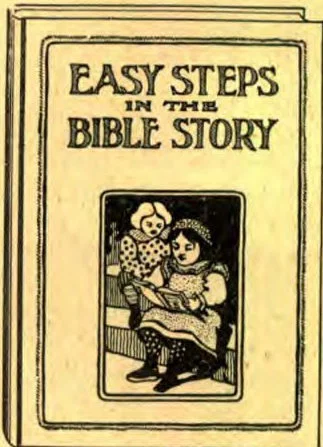
Easy Steps in the Bible Story
By ADELAIDE BEE COOPER
Introduction by ELDER STEPHEN N. HASKELL.
SOLD BY SUBSCRIPTION ONLY.
AGENTS WANTED IN EVERY CHURCH.
Profits go to General Conference Association.
The beautiful stories of the early Bible times never lose their charm. In Easy Steps in the Bible Story the author takes up the early Bible narratives in their natural order, drawing a lesson from each and showing their relation and bearing to present truth. This book will be read with interest and profit by all.
This book contains 160 pages, table of contents, and list of illustrations. Our artist has prepared 150 beautiful pen drawings, illustrating the text of the book. It also contains many full-page illustrations. Beautiful cover design. Two styles of binding.
PRICE, IN CLOTH, 50 CENTS.
The price brings the book within the reach of all. Ready for delivery. Order at once.
PRICE, IN PAPER, 25 CENTS.
For particulars address your tract society, or—
REVIEW AND HERALD PUB. CO., BATTLE CREEK, MICH.,
Or PACIFIC PRESS PUB. CO., Oakland, Cal.
NOTICE!
SOMETHING over a year ago a sister in Chicago wrote to the Editor of this paper, saying that her little boy had by his own efforts earned and saved twenty-five dollars, which he was anxious should be devoted to caring for some little child in India. At that time it did not seem possible to place the money in a way that would be satisfactory; but if this little boy still wishes to care for some poor child in that needy land, it can be arranged. It is a matter of regret that his name and address have been mislaid, and this notice is inserted in the hope that it may reach him, or some one familiar with the circumstances. Should it do so, please communicate with the Editor.
Thoughts from the Experience of Israel
In writing to the church at Corinth, Paul reminds them of the experiences of the children of Israel in their journey from Egypt to the promised land, and warns them against falling into the same sins. “Now all these things,” he concludes, “happened unto them for ensamples, and were written for our admonition.”
And since “these things” are written for our admonition and help, is it not important that we study them, and be admonished thereby?
In the experience of Israel before Mount Sinai there are many lessons that are especially applicable to us at this very time. The people had heard the laws of God, and, confident in their own strength, had affirmed their willingness and determination to keep them. They did not realize how weak they were—that they were promising to do what, in their own strength, would be an impossible thing. And so, at the first temptation they failed—as those who trust in their own strength will always fail: they yielded to sin, and broke their covenant with God. Only in the strength of Him who, as our Elder Brother, lived in the world, and perfectly kept God’s perfect law, could they, and can we, keep that law.
Moses was in the mount forty days and forty nights; and when the people saw that he did not come down, they began to be impatient to go forward on their journey. They were so anxious to reach the “land flowing with milk and honey” that they did not wish to wait for God to lead them there. In fact, they rejected him entirely, and spoke of Moses as “the man that brought us up out of the land of Egypt.” And as for Moses, they declared, we know not what has become of him. “Up, make us gods,” they demanded of Aaron, “which shall go before us.”
It is always a dangerous thing to look to any person instead of to God—to make flesh our arm of our mighty Deliverer for strength and salvation. This is a temptation that Satan has brought to men ever since sin first entered the world. He brought it to the Israelites at Mount Sinai, and led them to give to Moses all the credit for their deliverance from Egypt; then when he was out of their sight for a few days, they rejected him also, and trusted wholly in themselves. The same temptation comes to the children of God to-day. They are led to build all their hope on some person, giving to him the love and confidence that belong alone to God; and when the one on whose counsel and strength they lean for support is taken away, or himself, being only weak human flesh, is led into sin, their confidence is destroyed, and they fall into discouragement and doubt.
We are to love and honor those who bear responsibilities in the Lord’s work, and who live near to him; but never should we give them the place in our thoughts that belongs alone to God.
Israel sinned. We are familiar with the sad story of their worship of the golden calf, and of the punishment that came upon those who did not repent, and take a decided stand “on the Lord’s side.”
When the camp was cleansed, Moses prayed earnestly that the people might be forgiven; and his prayer at this time is one of the most beautiful recorded in the Bible—beautiful because it shows how unselfishly and tenderly Moses loved this rebellious and stubborn people, who not only rejected their heavenly Leader, but made Moses’ heart ache many times by their unkindness to him.
Yet—how he loved them! “Oh, this people have sinned a great sin,” he said, “and have made them gods of gold. Yet now,” he prayed, “if thou wilt forgive their sin—; and if not, blot me, I pray thee, out of thy book which thou hast written.” Not only was Moses willing to lay down his earthly life for the people; he would even give up his hope of eternal life, that their grievous sin might be pardoned. But the penalty of God’s broken law could not be paid by the life of any man, nor by one man for another, no matter how great his love and unselfishness: only the life of Him who gave men life at the first, could save them from the results of sin.
Sometimes young people think that because their parents fear the Lord, and pray earnestly that they may be saved,—because they would even be willing to give their lives that their children might be kept from harm and danger in this world, and receive pardon for their sins,—therefore they need not trouble greatly about knowing for themselves that they are accepted of God. “Oh, my folks are all right; I guess I’ll trust to them,” they say, sometimes in words and oftener by their actions. Such should think of the solemn meaning of the answer God gave to Moses’ prayer: “Whosoever hath sinned against me, him will I blot out of my book.” Before God’s broken law each must stand alone: those who repent will be forgiven; the names of all who continue in sin will be blotted from the book of life.
But “God is faithful;” he has freely offered forgiveness, mercy, and the white robe of Christ’s righteousness to all who will accept them. Happy indeed are they who make their peace with him!
FOR EVERY DAY OF THE WEEK
SUNDAY:
The way to make folks trusty is to begin to trust.—Mrs. A. D. T. Whitney.
MONDAY:
“Don’t wait for extraordinary opportunities; seize common occasions, and make them great.”
TUESDAY:
“Strength, as to skylark’s wing,
Comes from resistance long;
Comes from the songs we sing;
Comes from the suffered wrong.
The more we beat the tides,
The more we breast the winds,
Strength through our pulses glides,
Strength all our spirit binds.”
WEDNESDAY:
“Promptness, politeness, perseverance,—the young person who minds these three p’s will soon learn a fourth — prosperity.”
THURSDAY:
Never so fathomless a sea,
But through its depths there reacheth me
His still supporting hand;
Never so drear can desert be,
But there His love grows green for me
Amid the scorching sand.
—From the Swedish.
FRIDAY:
Make this world as true and as good as you can. And the best way for you to help on this end is to be yourself true and good. Live a real life, but cultivate the ideal, and remember that the highest ideal you dream out is far below the possible reality that God purposes for you.—Bishop Vincent.
SABBATH:
“Thou shalt love the Lord thy God with all thy heart, and with all thy soul, and with all thy mind, and with all thy strength: this is the first commandment.” Mark 12: 30.
Brother W. S. Sadler Offers Counsel to Young People
BROTHER W. S. SADLER will be glad to write to any of our young people who may be interested in the articles on “The Little Foxes That Spoil the Vines,” answering questions that may arise, and giving all the counsel and instruction in his power. His address is 1926 Wabash Ave., Chicago.
ARE YOU INTERESTED
By Editor
IN birds? If you are, you will be prepared to enjoy a series of articles on birds and their habits prepared for the INSTRUCTOR by Dr. L. A. Reed, with whose Nature Studies you are familiar; and if your interest has yet to be aroused in these fascinating little feathered friends of man, these articles will awaken it. The first three articles are on the Chickadee, the Slate-colored Junco, and the Blue Jay. Specially prepared drawings of the birds mentioned will add to the value of the series.
This is only one of the “good things” that the INSTRUCTOR will give to its readers during 1901. If you do not have the paper, let your subscription begin with the issue of January 31, in which the first of these bird articles will appear. If you can not afford to subscribe for a year, send forty cents for a six-months’ subscription, or twenty-five cents for four months.