The estimated wealth of the United States in 1893 was $72,000,000,000. Twenty millionaire families own one sixth of the wealth of the United States. In our day we behold “colossal fortunes rising like Alpine ranges alongside an ever-widening and deepening abyss of poverty.” But is there not a remedy for this state of affairs? Cannot political parties or labor organizations revolutionize this unfortunate condition? We are asked, Must the poor become poorer and the rich richer, until the nation shall go down, as other nations have done before her?
In answering these questions, let us study the causes that have brought about the wonderful opportunities of accumulating wealth. If we turn the wheels of time backward only one generation, even within the memory of men living to-day, we shall find it was a rare thing that a man was worth a million dollars. When it was said that John Jacob Astor was worth $100,000, men were astonished; but to-day we have about five thousand persons in the United States who are worth from one million dollars upward to a billion; and this has come about in one generation of men. The opportunities of accumulating have come as a result of certain laws worked out, and also as the result of unprecedented greed for gain. We are living in an age when the increase of knowledge and the transformation of methods in performing the daily routine of commerce, have wrought such a revolution that but few of the rising generation can appreciate the rapid change that has been brought about in seventy-five years. During the past fifty years, especially, the brain power of man has been stretched to its utmost tension to invent labor-saving machinery. To illustrate this, I will quote one extract from the Philadelphia Press of July, 1895: “The Hoe Company are now building a printing-press which will print, paste, fold, and count 96,000 eight-page papers in one hour. It may be noted that this new machine, operated by two men, will do the work of 10,000 pressmen, 10,000 roller boys, and 10,000 hand presses of the ancient type.” There is not space to present here the many improvements in the same line; but this will illustrate the fact that when one man can control and operate, by means of steam, iron, and electricity, the labor of 20,000 men, he has in his hand the capital-producing power of 20,000 workmen, and has through this means thrown out of employment nearly the same number of men.
Take the agricultural line of work, which is really the foundation of the prosperity of the nation, as an illustration of this thought. I will consider a few ways in which the farmer has been receiving, in years past, good returns for his labors—the raising and selling of horses, for instance. We go back just before the civil war, and find that most of our settled country was a network of stage-coaches. But few railroads were in operation at that time. This made a market for the farmer for his surplus horses. The war came on, and horses were bought at good prices. Following this, when the war was over, thousands of soldiers and young men went west, and settled up the prairies, which have become the fertile gardens of the United States. This kept up the price of horses. Rapidly following the period of the national struggle in the civil war, prosperity and good prices followed, cities sprang up in the West, the population in the cities in the East doubled, and street railways were built, which made a large demand for horses. But how is it to-day?—The stage-coach is relegated to the past; the horse street-car is a thing of the past; the demand for horses to take to the West to develop new farms is a thing of the past; and the time is come predicted in Isa. 2:7: “Their land also is full of silver and gold, neither is there any end of their treasures; their land is also full of horses, neither is there any end of their chariots.” This is so completely fulfilled that during the last year thousands of horses have been almost given away in the West,—horses that a few years since would have brought good prices. The farmer can no longer look to this source as a paying investment, from the fact that there will be little market in the future for horses, compared with the past. Steam, iron, and electricity have taken the place of the honest horse quite largely. Take another line of the products of the soil. In the past twenty-five years the United States has, at least, done her full share in feeding the millions of Europe with bread, to a good profit to the farmer; but to-day if we sell our wheat abroad, we must compete with the world, with cheap labor and with cheap land. The Middle and Eastern States are in no condition whatever to compete in the production of wheat with other more favorable locations and conditions. In the far West and Northwest the capitalist that owns vast territories can put in his steam gang plow, and with two men at a plow, can turn over one hundred acres of soil in twenty-four hours; he can put in his header and thresher, and cut, thresh, and have ready for market, in one day, with the aid of a few teams and four men, what he can produce upon sixty acres of ground. Thus the Western capitalist can produce wheat at twenty-five cents a bushel with as much profit as the ordinary Eastern farmer can raise it at $1 a bushel. So this line of agriculture, to the farmer, is practically a thing of the past in many localities. It is the same in many other lines that have formerly been a source of revenue and profit to the tiller of the soil; and to-day the capitalist that can control those hundreds of thousands of acres and the labor-saving machinery, has the advantage of accumulating farms and money, while the poor are left to cry and plead for employment; their houses sold out from over their heads, with no prospects of a betterment of the present state of affairs.
And the sad picture in this prophetic vision is presented by the prophet Isaiah in the 59th chapter and the 14th verse: “And judgment is turned away backward, and justice standeth afar off; for truth is fallen in the streets, and equity cannot enter”—that is, equality cannot enter. This and the other statements of the Bible which I have quoted, are all speaking of the last days, and the condition of things that would exist just before the coming of Christ.
It is a recognized fact that the rich control legislation as well as the finances of the country; and while political parties and other organizations may present before the people flattering promises that as soon as a change in the administration can be brought about, the distress of the people will be relieved, and a healthful financial state of affairs will be established, in all this the people are destined to be disappointed. This state of affairs is the natural fruit of the law of selfishness. While the poor man may condemn the rich man, if he was in the rich man’s place, he would do the same things that the rich man does, unless his heart was renewed by grace.
But is there no hope to the oppressed, who have been the wealth-producers of this country?—Yes, but it is not in organizations, labor unions, strikes, or political parties; but there is hope presented through the same prophetic word of God in these words: “Be patient therefore, brethren, unto the coming of the Lord. Behold, the husbandman waiteth for the precious fruit of the earth, and hath long patience for it, until he receive the early and latter rain. Be ye also patient; stablish your hearts; for the coming of the Lord draweth nigh.” Then our hope is not in man. Selfishness and wickedness will wax worse and worse, men hoarding to themselves riches; and the rust of these riches will be a witness against men in the day of God. But Christ Jesus, the King of glory, will soon come to set up his everlasting kingdom; and nothing but the ushering in of the kingdom of Christ, in all its glory, will remedy every social and financial evil. Then the subjects of that kingdom will be free men and women. “And there shall be no more death, neither sorrow, nor crying, neither shall there be any more pain; for the former things are passed away.” Glad day, when the battle for bread, when strife and selfishness, envy and hatred, sorrow and anguish, and the passions of men and time, will be past, and the eternal age of joy and gladness shall be ushered in! The signs of the present conflict between capital and labor, and the wanton expenditures to gratify the selfish pleasures of the rich, must soon have an end,—not by man’s methods, but by the reigning of Jesus Christ, the Prince of glory and the rightful King of earth.
Happiness Found in Working for God
— A PERSON who makes happiness the object of his life is pretty sure to be unhappy. If he lays himself out to be a worker with and for God, he is pretty sure to be happy, no matter how forbidding his surroundings may be.
LIBERTY IN THE CHURCH.
Religious liberty is a subject that cannot be too well understood. Its philosophy forms an interesting study, to which many people devote weeks and months. But it is a fact that the doctrines and arguments may become with us as household phrases; and as we scan history, we may be able to lay our finger on many violations and vindications of the principles of religious freedom, and yet we not be able to discern the practical workings of those principles in our own midst. While religious freedom toward the church is a very desirable state, religious liberty and equality in the church are even more so.
Liberty may be defined to be the free and untrammeled use of choice in everything that does not interfere with the rights of others. One of the most sacred of those rights is the right of private conscience and personal opinion. The legitimate object of church associations is to secure to the members the freest exercise of those rights. The purpose is sympathy rather than criticism; assistance rather than control; development rather than restraint. In no place should the Golden Rule be more fully exemplified than within the bounds of the church.
It is undoubtedly right for those who establish or compose the church to fix rules and regulations for the control of the church. It is proper to set up a standard of character, which each one will be expected to strive to reach. But instead of judging one another by that standard, or criticizing each other by our own standard, it behooves the members of Christ’s body to seek by a godly example, by kind and considerate brotherhood, to assist those who are striving to do right; to admonish those who are prone to do wrong; to bear with and instruct those who do not perceive the right way, as we understand it. If we would benefit people morally, we can only do it by an appeal to their hearts. To hew or stretch people to our measure is to do violence to every consideration of religious liberty.
INTERNATIONAL COMPLICATIONS.
The fitful nature of international relations is the special feature of our times in that direction. Distrust and jealousy are generally entertained. If friendship exists between two nations this week, it is because the peculiar shape of affairs gives them common interests in some issue that is at stake. When a little turn in affairs changes the issue, the relations of those nations are liable to be entirely changed.
In the present Transvaal difficulty we have the strange spectacle of Germany and France standing on the same side of the question. One week England and the United States are at variance over the Venezuelan matter; the next week the United States is approving of England’s course in South Africa. As for England, that country seems to have plenty of business on hand in upholding its policy in various parts of the earth, and yet keeping out of actual trouble with any great nation. It requires some artful statesmanship, but the nation is adept at that. In reference to the pursuance of the policy already adopted, Mr. Chamberlain, colonial secretary, declares it to be the purpose of the British government to pursue it in a straight line, whoever gets in the way.
Opportunity for Turkey and Russia.—The recent side issues that have taken the attention of the world from the horrible state of affairs in Armenia, have afforded to the two powers most interested an opportunity to prosecute their designs. The sultan pursues his helpless victims with relentless rage. The taste of blood seems to have aroused the old-time ferocity of the Moslems, and a “holy war” on all “infidels,” as those who are not Mohammedans are called, is feared. Jerusalem is said to be full of rough soldiery who are hardly kept in check. Beirut, too, is in a state of terror, which renders the safety of foreigners very precarious and uncertain. The sultan has a regard for other powers only while they hold the sword over his head. Russia keeps aloof from South American or African disputes. While others have been engaged there, Russia has been making more solid its position in China and the Levant. There is evidently more business than bluster in the Muscovite. In the great competitive struggle now going on between Old World nations, no one is more to be feared by the others than Russia.
A CHANGE OF SENTIMENT.
THE present effort to induce Congress to consent to a change in the national Constitution is not the first one. But since the agitation began, a marked change has come over popular sentiment in reference to it. At first the scheme was advocated by a few zealous individuals, while a great many people scouted the plan because it led directly to an infringement of religious liberty; because it was contrary to the genius of our institutions and the sentiment of the people; and because it was illogical, and undertook to establish a patent error.
Now it is received with favor. A popular vote would probably uphold the measure if it were placed before the people to-day. In Congress it is favored by many influential members. This action has been long anticipated by our people, who have recognized an amendment to the Constitution as the solution of all the difficulties which hinder this country in acting the part assigned to it in the prophecy. When God is acknowledged as the source of all authority in civil power, Jesus Christ as the ruler of nations, and his revealed will as of supreme authority in civil affairs, nothing stands in the way of enacting and enforcing the most radical religious laws. Their enforcement is sure to restrict or interfere with the rights of private conscience. Persecution will then be a consequence so natural that nothing can avert it.
THE NEW ASTONISHMENT.
Professor Rontgen, the Bavarian scientist, seems in a fair way to upset some of the cherished doctrines of physics, especially those which relate to opaque bodies. He boldly claims that there is no such thing as opaque matter, and the most surprising thing about it is that he is likely to prove it. He sends the rays of his new light through an aluminum plate one inch thick. Gold, lead, or zinc plates, however, resist his lens as yet, being much more compact than aluminum. He obtained a perfect photograph of a compass through two sets of books, each including several volumes. Sketches of these wonderful photographs are now being published. Others are experimenting successfully on the same lines.
Just what this new permeating principle is, is not clear to our savants. It is not light, some say; nor is it heat, say others. Others name it “radiant heat.” Others claim that while in light and heat the waves are transverse, in this case they are longitudinal, thus giving great penetrative power. Bones being more dense than other tissues, may be photographed inside the flesh. Coin can be photographed through the sides of a purse; and one of the newspaper sketches represents a bullet imbedded in the bone of a man’s ankle.
THE “ARMY.”
By T.
THE strength and reputation of the Salvation Army consist not in their extravagant performances and fantastic methods, but in the fact that they minister to the temporal and spiritual wants of the poorest and most wretched classes. No person is too low down for the workers of the Army to reach. Their “lads” and “lassies” gladly place themselves alongside the drunkard, the prisoner, the criminal, the prostitute, that they may thereby lift them up. Their agents stand at the gates of prisons and wait on the court rooms, hoping thus to save some outcast. And we say, God bless them for such a work!
The workers of the Army are poorly paid for hard work. They deny self, and brave reproach, danger, or whatever may come along. In these respects there is very much for other Christians to imitate. In the Christian Help work now being established among our people, we have these same elements of sacrifice and devotion, the same noble purposes in view. We hope and pray that the work may speed, until in all our churches there will be the same kind of work. There is an opportunity for us to lift up the fallen, to support the weak, and to aid those who need our help. Rescue work in connection with jails and hospitals in large cities, and in the low-down places of earth, will bring large returns of inestimable blessing.
The Organization of the Army.—There are other features of the Salvation Army that do not appear so commendable. In its organization it is an autocracy, a limited monarchy, in which the will and word of one man is supreme law, and from which there is no appeal. “God” and “General” are both spelled with big G’s. The despotism of military rule gives to the organization an undoubted title to the name “Army.” Property rights are vested in the “General,” and no man says that what he possesses is his own. At the word of command they fall on their knees or “fire a volley,” and no one thinks of hesitating. Unquestioning obedience places an unlimited power in the hands of one man. It is not so much the genius of the man as it is the astonishing self-assurance with which he commands the implicit obedience of so many devoted followers. Now, so long as that power is in the hands of a good man of wisdom, it may be an agent of great good. But there is danger, for that man cannot always live; and the world has had but one William Booth.
His recent action in commanding his son to relinquish the work in this country, and report to himself in London, may test the power that as yet has never been called in question. T.
THE WOMAN BEHIND THE MILL.
By T.
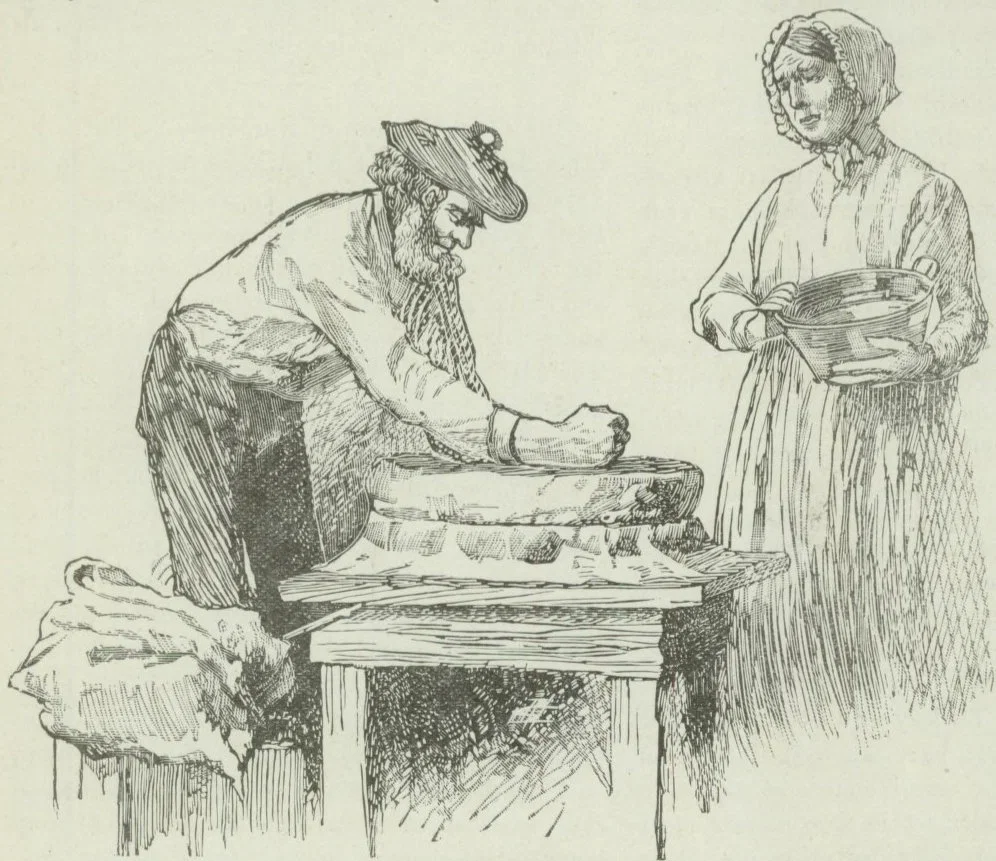
A FRONTIER MILL.
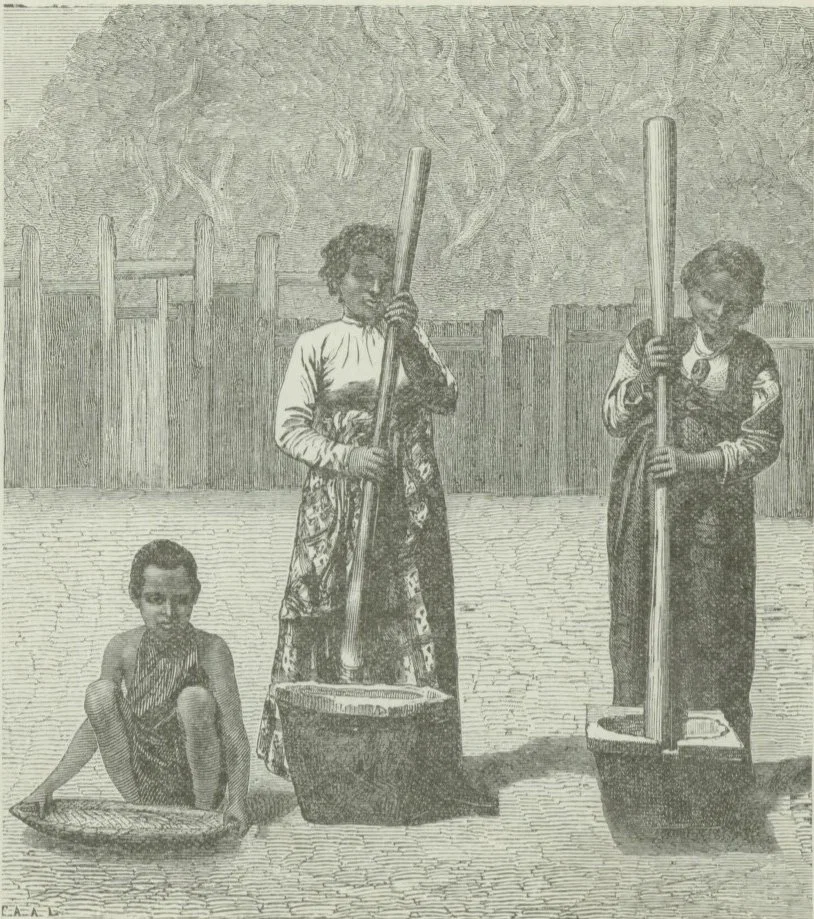
SEVERAL readers having inquired as to the best grades of flour and the different processes of milling, we have thought that a few talks on that subject might be of quite general interest. The grinding, or crushing, of grain is nearly coeval with the human race. The rude implements of our remotest ancestors have not been entirely discarded. The rough stone mortar and pestle is still in use in various savage or semisavage countries. An arrangement of a more convenient kind is shown in the second illustration, this being the variety in use in the South Sea Islands. The more civilized “mill,” consisting of two flat circular stones, the upper one of which is turned by hand, generally the hands of women, is now used by more people than in the Bible days when it was almost the only process known to Scripture. In semicivilized countries which have walked dreamily, half asleep, in the beaten ruts of all past ages, there has been no thought of releasing women from the thraldom of the mill. This primitive method was employed by the pioneers on our early frontiers, as shown in the accompanying picture.
In India many thousands of these “backaching” instruments of toil are in constant use. In the large cities are great warehouses in which many women earn a pittance by grinding the wheat and other grains into meal. The skill attained in this work is surprising. The grinding is done with great exactness, either coarse or fine as it is desired, and as evenly, apparently, as can be done with modern machinery.
The phrase, “The woman behind the mill,” is used in the Bible to indicate the lowest and humblest of servants. There are usually two women employed at the mill, one of whom manages the work, helps to turn the stone, and feeds in the grain through an opening in the upper stone. The other sits behind the mill, and simply turns — a laborious, monotonous, machine-like drudgery. The products of these mills are wholesome and acceptable food. They contain the entire grain, without sifting or separating, and for many ages meal or flour thus manufactured furnished the souls’ material for bread. Whatever of sifting or separating was required was done by hand sieves.
Next week we advance another step. T.
A Neglected Duty.
“Ma wants to know if you’ll let me and Clyde stay over here to-day, while she goes over to Niltonsburg as delegate to a big convention. She’ll be back by bedtime.”
It was not the first time that my neighbor, Mrs. Stimperson, had preferred a request of this kind. I was particularly busy that day, and it would be extremely inconvenient to have Clyde and his mischievous little Maggie around from nine in the morning until the same hour at night; but one never likes to offend a neighbor, and I told the children that they might stay.
“Are the other children at home?” I asked.
“Oh, no! Ma was afraid they’d burn the house down, or something. Myrtle’s gone to stay with Metta Dean at her house, and Harold is at Mrs. Warfield’s. Mrs. Warfield didn’t want to keep Harold, but she said she guessed she’d have to, when I told her ma had already gone, and the house was locked up.”
Only two weeks before this, Maggie and Harold Stimperson had arrived at my house, bearing the following note from their mother:—
“DEAR MRS. HOWLAND: I am going to ask you to allow Marguerite and Harold to be your little guests to-day, while I attend the annual meeting of the Home Improvement Society, of which I am secretary.
“It will be an all-day meeting, and I am so intensely interested in all the themes on the program that I will hardly reach home before night, but I shall feel quite easy about my darlings while they are in your loving care.
“Harold has a nap at half past two o’clock, and as I dislike any variation from fixed rules regarding my children, I hope, dear Mrs. Howland, that you will insist on his taking his nap, even if you have to use a little gentle force. Kindly disrobe him and put on his nightshirt, as his sleep will be more restful and beneficial.
“Marguerite has brought her books, and must devote at least four hours to study. Will you kindly see that she does this?
“Thanking you in advance for your kindness, I am, Sincerely yours, “ADELAIDE STIMPERSON.”
Mrs. Stimperson’s duties as a member of various clubs, having for their object the interests of the home, the spreading abroad of the gospel of progress, the cultivation of the mind and the general amelioration of the human race, left little time for the care of her own household.
There is a limit to even neighborly patience and kindness of this sort, and Miss Susan Ward felt that this limit had been reached when Myrtle and Clyde Stimperson arrived at her home one day when she was in the midst of what she called her “currant jell work.”
“Good morning, Miss Ward,” said Myrtle, cheerily. “We’ve come to stay all day.”
“You have, hey!”
“Yes,” replied Clyde, “and I’m awful glad you’re making jelly, for we can have the skimmings, can’t we?”
“What did your mother send you over here for?” demanded Miss Ward.
“She had to go to an all-day meeting of the Woman’s Progress Club,” replied Myrtle. “It tells all about it in the Herald.”
The Herald chanced to be lying on a table near Miss Ward, and she read this paragraph, with a little snort of indignation.
“At two o’clock Mrs. Adelaide Stimperson will read one of her delightful and scholarly papers entitled, ‘A Neglected Duty.’ It will treat of some of the neglected duties of wifehood and motherhood, and is certain to be useful and helpful to all who hear it.”
Miss Ward threw the paper down on the floor in a manner indicative of much suppressed feeling. She looked at the children. Buttons were missing from their shoes, and Clyde’s bare little knee peeped through a hole in his stocking. He had on a soiled collar, but no tie. He was only six years old, but he had evidently made his toilet entirely unassisted, and there were indications that he had all of a boy’s inborn abhorrence of soap and water.
Myrtle, who was ten, was quite as unkempt and as much in need of general repairs as her brother.
Miss Ward compressed her lips tightly; her black eyes flashed.
“I’ve a neglected duty of my own to perform, and I’ll perform it,” she said to herself. Then she said to Myrtle,—
“Where are the other children to-day?”
“Marguerite and Harold are over to Mrs. Little’s, and me and Clyde are here.”
“I see that you are,” said Miss Ward, grimly. “Poor little youngsters!” she added, “it isn’t their fault, after all.”
At a little before two that afternoon, Miss Susan Ward surprised a good many people in the town by appearing on the street with the little Stimpersons. They were exactly in the condition in which Miss Susan found them. There was not a clean face nor a clean pair of hands among them; not a garment was whole; not a head of hair was neatly combed; and a more surprising array of misfit and badly-made garments were never seen in one respectable family.
“Come along just as you are,” Miss Ward had said, grimly.
The meeting of the Woman’s Progressive Club was public that day, and there was a large attendance. It was two o’clock, and the president of the club had said,—
“The next number on the program will be given by Mrs. Adelaide Stimperson, who will read a paper on ‘A Neglected Duty.’”
“I guess they’ll see several neglected duties,” muttered Miss Ward, as she marched down the aisle to a front seat, with the little Stimpersons following her in Indian file.
“There’s our mama!” cried little Harold, as his mother came forward. “Here we are, mama! Miss Ward’s fetched us to hear you speak your piece.”
“I fetched them to help illustrate the paper,” said Miss Ward, boldly, as she directed the children to seats directly in front of the platform.
But the paper was not read. Its author turned pale and then crimson before saying,—
“I—I—beg your pardon, Mrs. President and ladies, but I must ask to be excused. Perhaps I could come in later on the program. There has evidently been some misunderstanding among my friends. My domestic duties require my immediate presence at home.”
Once outside the hall, with her family and Miss Ward, she asked indignantly,—
“What does this mean, Susan Ward?”
“It means,” calmly replied Susan Ward, “that some of your other friends and myself have concluded to remind you of a neglected duty or two of your own,—a duty that takes precedence of your duty to other mothers and to the world at large. Do you see the point?”—Abridged from the Household.
WERE I TO LEND NO HELPING HAND.
By Alice M. Avery-Harper
BY MRS. ALICE M. AVERY-HARPER.
(Vernon, Mich.)
Did I possess the restless sea
Or worlds which fill immensity,
And boundless stores of richest gold,
From out this wondrous wealth untold,
'T were naught, if I did not impart
To others, from a kindly heart,
In every time of need.
'T were vain for me aloud to pray,
Or look to Heaven another day,
If I should lend no helping hand
To friendless strangers in the land;
I could not rest at set of sun,
And leave my Master's work undone,
And pass the needy by.
If I were selfish or unkind,
Avoiding all who claim my care,
The crescent moon that rides on high,
Behind yon clouds so fleecy there,
Would mock my efforts, every one,
If I should leave His work undone,
And lend no helping hand.
The mighty sea, with boundless bed,
With mystic shore and fitful tide,
And pebbly shells and golden strand,
Would mock me still, were I to hide,
Forgetful some poor soul to save
With kindly hand this side the grave,
While journeying here below.
Were I no careless souls to save,
Who drift upon life's lonely sea;
Had I no cheer for those who crave,
For those who perish thoughtlessly;
No care for aught save for myself,
With hoarded store and love of pelf,
I could not claim God's care.
GENERAL PRINCIPLES.
By M. E. Steward
M. E. STEWARD.
(Battle Creek, Mich.)
A few plain principles may aid us in trying to beautify our houses. As a people, our standard is the highest; it is nothing short of holiness. Cleanliness is physical holiness. The civilization of a people has been estimated by the degree of their cleanliness. The savages live in filth; with uncleanly bodies and polluted lives, they feel at ease in their filthy huts. As civilization progresses, they become more cleanly in every way. Sanctification carries on the work, till the remnant people of God, who will soon be translated, are “without spot, or wrinkle, or any such thing.”
The best ground-work of home decoration is entire cleanliness. Without this, all attempts at decoration are more or less of an approach to the tattooing of a savage or the putting of pretty things on the smoke-begrimed walls of his hut. We admit there are some housewives, who, “more nice than wise,” spend much precious time in scouring and polishing articles which are already clean. In such a place neither visitors nor the inmates can feel at home. It may be a palace to be admired, but not a home to be enjoyed.
A soiled carpet, dingy windows, or dusty furniture detract to a great extent from all the beauty there is in a room. (By the way, windows are easily kept clean by using a chamois-skin instead of a cloth. Ten or fifteen cents will purchase a piece large enough. Wash the windows in warm water,—hot water will spoil the skin. Then rinse them; wring the chamois-skin, and wipe the glass. After this the glass may be polished by rubbing it with a newspaper; printer’s ink polishes.)
The prevailing color of an apartment is of importance. A predominance of gay colors soon tires the eye; it is like grouping the marvelous in writing, the effect of which is called “loud.” It is best to use neutral tints mostly; for nature does that by the color she gives her rocks, and by softening her landscapes in the distance with haze; or we may prefer the warmer shades of brown, like the colors of the ground.
When making a rag carpet, it is best not to have too many bright colors, unless there is a deficiency of other ornaments. Especially do not group together colors which do not harmonize, such as red and blue or green and blue. The different shades of red and brown harmonize with the greens; yellow and orange harmonize with blues, grays, and purples. As far as may be, have the remaining colors of carpet, wall-paper, etc., the same. If they are brown, and you hang blue curtains at the windows, the effect is not pleasing. Like flowers and bright birds in the Eden home, bright colors are cheery, and are in place here and there. These colors are very suitable for rugs. For all common rooms, rugs instead of carpets, with a clean floor, are always pretty, and are much more enjoyable than a carpet from which dust is constantly arising.
Use an artist’s eye in disposing of your furniture; that is, do not place the larger pieces all on one side of the room. Have the sides of the room balance each other. Consider every corner and every side of the room a little picture, and you may be better able to see where you can add to it or take from it, to make it prettier.
The custom of putting all the nice and lovely things into one room, and then reserving that room for company, is unwise. It deprives our own family of the pleasure and profit they are sure to receive from association with the beautiful, and which they need every day.
ARE HOUSE PLANTS HEALTHFUL?
By T.
A CORRESPONDENT (a man, probably) wants to know if it is conducive to health to sleep in a room half full of house plants.
By a singular and very wise provision of nature, plants thrive on those elements which the human system rejects. We breathe the air for the oxygen. We exhale carbon dioxid. Plants breathe, through their leaves, carbon dioxid, and exhale oxygen. Carbon dioxid is the waste material in man breathed out into the air. Oxygen is the life principle of the air for man. On the other hand, oxygen is the waste of plants, and carbon dioxid is their life. From these facts we would conclude that men and plants would both thrive in the same room. Of course this might be overdone, and the presence of a large quantity of pots of moist earth mingled with decaying vegetable matter, might render a room unwholesome; but this is not liable to occur if pains be taken in the care of the plants, and where there is a fire in the room. T.
CORN BREAD.
By Mrs. D. A. Fitch
BY MRS. D. A. FITCH.
(Sanitarium Cooking-school.)
Of all breads, there are probably none rendered so indigestible by the addition of sweets, alkalies, or yeast as are preparations from corn-meal. It is also often the case that insufficient baking renders a food already somewhat difficult of digestion, all the more so. It is also customary to eat corn bread hot with butter, or other fat, and the after-effects are more plainly realized than described. Corn itself contains all the fat necessary, without the addition of any more. Its great amount of fat is what renders it a better food for winter than for summer.
I give a recipe from “Science in the Kitchen,” for corn puffs, offering a few additional suggestions.
“Corn Puffs.— Mingle the yolk of one egg with one cupful of rich milk. Add to the liquid one cupful of flour, one-half cupful of fine yellow corn-meal, and one-fourth cupful of sugar, all of which have been previously well mixed together. Place the batter on ice for an hour, or until very cold. Then beat it vigorously five or ten minutes, till it is full of air bubbles. Stir in lightly the stiffly-beaten white of the egg, and put at once into heated irons. Bake in a moderately quick oven, thirty or forty minutes.”
Less sugar may be used, or it may be omitted entirely, and the bread will be lighter; also the newer the meal, the lighter the bread. If you have not ice, set the batter in the cellar, or some cool place. The term “heated irons” does not mean hot irons; but they should not be cold. There is no objection to extending the time of baking to one hour; this renders the puffs even more palatable, as well as more digestible.
The following is a good method of making corn bread with yeast:—
Raised Corn Bread.— Mix together one part of corn-meal and two parts of strong white flour,— flour containing a large amount of gluten;— sugar and salt to suit the taste, and twice the amount of yeast which would be used for a corresponding quantity of white bread. Use water at a temperature of 70°, and make a dough which can easily be kneaded on a board. Let it rise, and then turn it over in the dish. Let it rise, and turn it again. When risen once more, put it in the tin to rise for the oven.
The following is now a standard bread in the Sanitarium, and you will notice it contains no chemicals or yeast:—
Three cupfuls of thin cream; one cupful of corn-meal; one cupful of crystal wheat; one-half cupful of white flour; one-fourth cupful of sugar.
Heat the cream to boiling. Stir in, so as not to let it lump, the mixed meal, flour, sugar, and a pinch of salt if desired. Cool a little, and add the crystal wheat. Put the batter immediately into a basin, and steam three hours. Dry the bread in the oven a few minutes.