“O THE depth of the riches both of the wisdom and knowledge of God! how unsearchable are his judgments, and his ways past finding out!” Thus exclaims the inspired apostle after having set forth God’s just and equitable method of dealing both with the Jews and with the Gentiles. Surely with God are both wisdom and love. All his plans in formation and in execution display infinite wisdom.
This truth is strikingly illustrated in the proclamation and growth of the kingdom of God throughout the ages. Beginning with the earthly career of our Lord, the gospel of salvation in accordance with his commands has been extended from generation to generation, until to-day it is almost to earth’s remotest bounds.
The land of Palestine, one hundred and forty-four miles long by about forty miles wide, is a mere atom in comparison with the rest of the world; yet our divine Lord was content to spend his years within those narrow limits, and that, too, when he knew that across the seas and over the mountains his Father had millions of children whose needs were as great, and whose cry was as piteous, as those to whom he personally ministered. Jesus was neither ignorant of nor untouched by the sorrows of the great, wide world outside of the Holy Land, still he felt no call to go outside the fold of Israel during his earthly ministry, nor did this prevent him from saying, finally, ‘I have finished the work which thou gavest me to do.’
In Galilee and Judea were but small provinces, and Jesus touched only hundreds there, when he might have reached thousands had he gone to regions beyond; but such a course would have resulted in failure. He came to lay down his life in that religious soil upon which God had sent his richest spiritual blessings. With all their faults, the Jews had the greatest light, and furnished the best soil in which to plant the heavenly germ of God’s kingdom. Jesus’ supreme mission was to plant that germ—to be lifted upon his cross in Jerusalem, whence the power and fragrance of his life would be diffused to all the world. He could not go to those of the dispersion; he must go to Jerusalem, the world’s religious center, and there lay down his life.
Thus, as far as the earthly life of Jesus was concerned, Jerusalem was of more importance in the plan of God than was the whole Roman empire. But while this was the most important work to which Jesus could address himself, the work of his disciples was not to be confined to such geographically narrow limits. They were to begin at Jerusalem, where Jesus planted the cross and left his empty tomb, and thence push out into “all Judea, and in Samaria, and unto the uttermost part of the earth.” What a consistent and comprehensive plan! Begin at Jerusalem, where both Gethsemane and Golgotha attest his supreme love and triumphant death for16humanity. Fill that center with the teaching of the crucified and risen Christ; but that accomplished, no single land or people is to enjoy a gospel monopoly.
We all recognize that to be the Master’s plan of evangelistic operation. It is both equitable and practicable. The whole race is of one blood, and the gospel is intended as much for one people as for another, while the responsibility of this work rests upon those who know and love their Lord.
Each individual by special allotment of God has his own work to discharge; and it is no less true that each generation of Christians has its task to perform, which is in proportion to its light and opportunities. The correlative of present truth is present duty and responsibility. As we have great light, so we have a correspondingly great responsibility to bear witness to that light; and where God imposes duty, he also gives ability and opportunity to fulfil the same.
WHERE EVERY PROSPECT PLEASES AND ONLY MAN IS VILE
We believe, and for good reasons, that ours is the last generation, and just so surely must we believe that to us belongs the task of sending the gospel of the kingdom to the entire world. From the morning of Pentecost, when the circle of missionary operation was limited to the comparatively small city of Jerusalem, it has from generation to generation enlarged, until in this last generation it includes every nation, tongue, and people upon the face of the earth. For the disciples in their day to have left at once their small circle for the regions beyond would have been as great a mistake as for us to refuse to enter the great heathen nations accessible to us in our day.
It is right on this point that we shall make this world-wide opportunity either a stone of stumbling or a stepping-stone to a glorious triumph. It is not enough that we invade the Protestant world. That would be, figuratively, only Jerusalem; on beyond lie Samaria, the Catholic world; and still more remote the uttermost parts of the earth, the Mohammedan and the pagan worlds, teeming with their millions of humanity. This is our task; it calls for earnestness and glad consecration. It is the all-comprehending, the culminating, the crowning work of God’s church, and happy shall we be if we see and seize our opportunity. To the accomplishment of this all things in heaven and upon earth are ready and urgent. Our great King waits to bestow, and his angels stand ready to minister the needed grace; while upon earth both the time and the events are ripe for the fulfilment of this work. Who has wrought thus, and opened these great and effectual doors? There can be but one answer,—Jesus, who came and spoke unto them, saying, “All power is given unto me in heaven and in earth. Go ye therefore, and teach all nations.” Again, why has he opened these doors just now?—Because just now is the time they must be entered—it is God’s own arrangement. Whom does he call to enter these ripe, needy fields?—Manifestly the people whom he has called to a great light. Whom did he send at Pentecost?—Those who had been with him. It is the same to-day.
“Arise, shine; for thy light is come, and the glory of the Lord is risen upon thee. For, behold, the darkness shall cover the earth, and gross darkness the people; but the Lord shall arise upon thee, and his glory shall be seen upon thee. And the Gentiles shall come to thy light, and kings to the brightness of thy rising.”
Canton, China.
Mission Notes
During the last one hundred and twenty-seven years India has suffered from seventeen famines.
“China is far to the front in the thought of God and the missionary opportunity of to-day. From every side come indications of open doors and a marked change in the spirit of the people toward the missionaries. It is God's harvest time for China's millions.”
A most inspiring picture of progress in the Dark Continent is to be seen in a recent issue of the Christian Express (Lovedale), under the heading “African Gleanings.” These are a few of the nearly score of topics touched upon: “Italian Immigration to the Kongo,” “A Railroad from the White Nile to the Abyssinian Frontier,” “Rapid Progress with the Cape-to-Cairo Railway,” “Survey of the Southern Shore of Victoria Nyanza,” “Advance Southward of the French Trans-Sahara Railway,” etc.—Selected.
The members of a native Y. W. C. A. in Tung-cho, China, supported a Bible woman in Ceylon for sixteen years prior to the Boxer outbreak. Then the church and everything of value were destroyed, and the members were scattered in every direction, and were houseless and penniless. Recently these women sent their contribution as formerly, to their denominational board rooms in America, with an apology for being so late in sending it, as it was not easy to reach the scattered ones still alive, and expressing the hope “to do more in the years to come than in the past.”
The condition of the girls in Central Africa is touchingly described by Gertrude Ward, a missionary of the Universities' Mission, as follows: “Shall we teach them reading?—They have no literature or books of any kind. Writing?—They have no occasion to use it. Arithmetic?—They have no accounts to keep, and are not as a rule required to count higher than twenty. Sewing?—Their clothes are the loose draperies thrown gracefully around them, and they do not require a single stitch. Laundry work is unknown and unneeded, each person washing her own draperies in the river, and drying them in the sun; housework scarcely exists, the people's houses being little mud huts, to shelter them from wild beasts; they contain no furniture and few utensils, and the people live almost entirely in the open air.”
According to the Bible Society Record, the work of Bible distribution is still hampered in many countries professedly Christian. A special permit from the imperial government is necessary in Austria, and this is not always to be obtained. In Greece the government has forbidden the circulation of the Greek edition which is printed by the Bible Society; and in the French colonies of Tunis and Cochin China, Bible colporteurs are not allowed to work at all. Turkey has rendered it impossible to circulate the Bible in Albania, and Persia has closed her gates to all importation of the Scriptures in Persian. The public exercise of any other than the Roman Catholic religion is absolutely forbidden in Peru, and until quite recently the same rule has prevailed in Ecuador. Brazil is the only South American country in which the circulation of the Bible is looked upon with favor by the government.—Selected.
Cook Islands
By A. H. Piper
RARATONGA.—As we work among the people, we find many inquiring for the truth. We recently met an influential native from Aitutaki, who told us that he had read his Bible through three times to find the truth on the Sabbath question, and had failed to find evidence of the sanctity of Sunday, the first day of the week. He pressed us to promise that we would soon present the truth on this and other questions in his island. On this same island, Brother E. H. Gates and I spent a day on our way from the late general meeting at Tahiti. We had with us a parcel of tracts on the second advent, and everybody we met, from the leading chief downward, was most anxious to receive a copy. There must be no delay longer in entering this promising field. Several young people in Raratonga have lately attended our meetings, and have begun to observe the Sabbath. We hope that they will have courage to be publicly baptized. This ordinance is a great cross to the Maori.
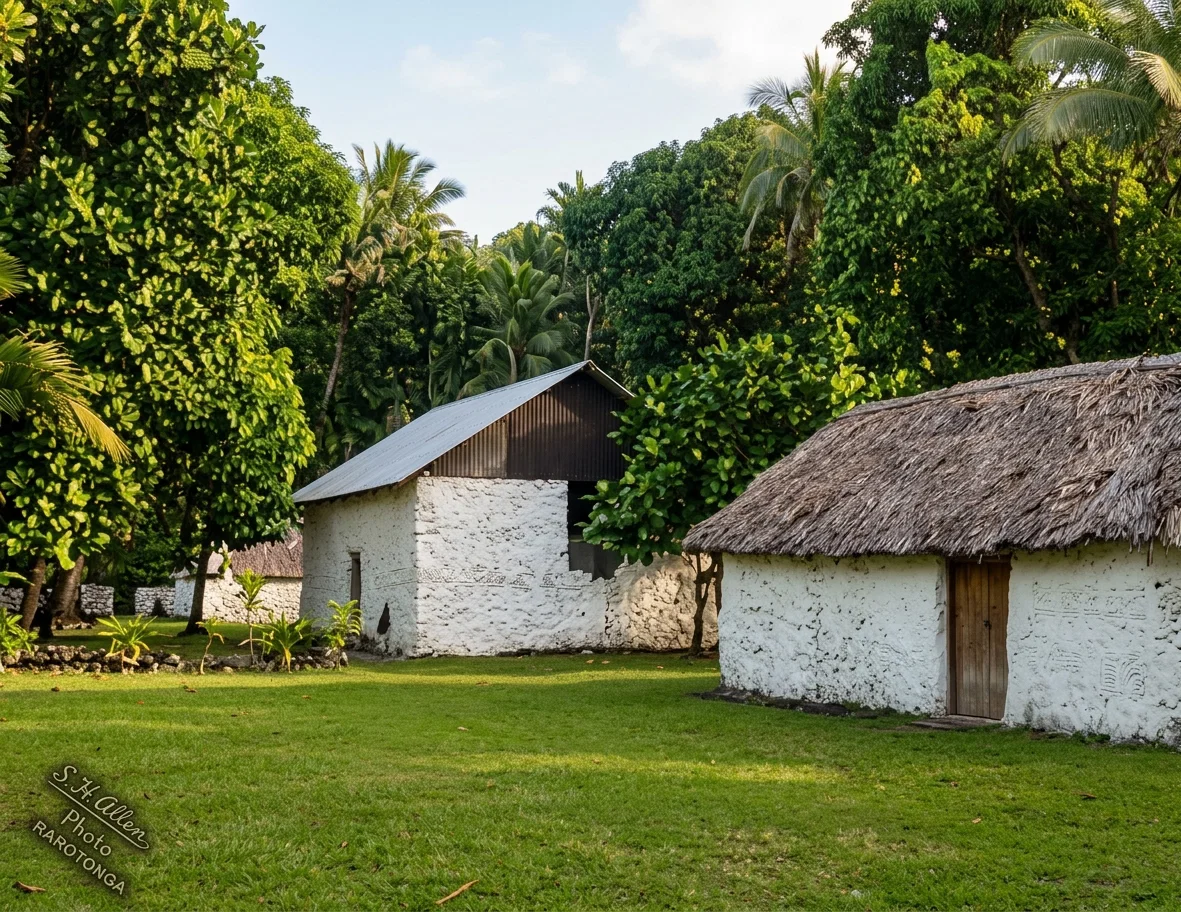
SCHOOL BUILDINGS, RARATONGA
Our church building at Titikaveka is slowly nearing completion. The native brethren devote much of their time to this enterprise, and it is a pleasure to note the interest they take in it. So far we have not spent a penny in wages.
The attendance at our boarding school is not so large as it was last year, but some of those attending give promise of future usefulness in the Lord’s work. We are very glad that we have such an institution; for it is doing a good work. We are sure that it would rejoice the hearts of the brethren in America, who gave of their means to help this enterprise, if they could step in and spend a day with us in our school work. The accompanying picture shows the main buildings.
On the third of last July we lost, by death, the first native of this group to accept present truth. Rata, for such was his name, was a good man, and lived up to all the light he had; he was an Adventist at heart. When first our workers came in contact with him, he was about as low in sin and degradation as any man could be; but after his conversion he was an example of the power of saving grace. During the long illness that preceded his death, we never heard him complain; and as we prayed with him, he, in his prayers, often told the Lord that he would like to be strong again, but that he was content to be, in Jesus’ keeping, well or sick. As we laid him to rest among the tombs of his heathen ancestors, we felt sure that on the resurrection morning, now almost due, we, if faithful, would meet our brother again to be “ever . . . with the Lord.”—
A. H. PIPER.
German Switzerland
By J. T. Boettcher
In the month of March, meetings were begun in Basel, and were continued until the middle of June. As a result eighteen persons accepted the truth. Some of them are already working for the Master,—one is a Bible worker, another a baker in our food department, one is a bookkeeper, and another is matron in the sanitarium. These meetings were helpful to the church-members; as they saw the new converts so full of zeal for the truth, their courage to work for the Master was revived.
During the month of June tent-meetings were conducted in a little country hamlet. It was hard to procure ground on which to pitch the tent. The pastor had warned the people against us, and they were all afraid of having their ground desecrated by our tents. The brethren went from house to house; and when they thought the bargain was closed, through the influence of some of the neighbors those controlling the land went back on their word. At last the sexton of the churchyard consented to let us have a spot of ground. We had the tent ready, and in a few hours it was up, but had we waited until the next day, he also would have backed out. We had handbills prepared, which were carried into the homes of the people.
The first night of the meeting about one hundred and fifty factory boys and girls came, and, judging from outward appearances, intended to make disturbance. They used indecent language, and sat down with their caps on their heads, and pipes in their mouths. We saw at once there was no use to try to preach to such a crowd, and lifted our hearts in silent prayer to God to give us the victory. We had no singing nor open prayer, but instead went right down among them, and told them why we had come to the town; it was simply to be a help both spiritually and physically to all of them,—the gospel included it all. We could see that the Lord worked upon their hearts. Many who were standing on the outside of the tent, came rushing in to hear what was being said, until at last the tent was full, and the best of order prevailed. We knew this was a victory for the truth of God, and from this time forward all our workers were treated with marked respect. The meetings were in the time of haying, but the tent was full every evening and on Sunday afternoons. The donations were more than the expenses during the time of the meetings. We were very thankful to see fifteen blood-bought souls take their stand for the truth of God. One of our workers still continues work there with a good interest.
We conducted two other tent-meetings in the same canton, where some success also followed. Most of the pastors are freethinkers, which means that the people are almost worse than infidels, and have no desire for the true religion.
This field is a great one, and has only two ordained ministers to do public work, with one young licentiate and two Bible workers. Soon after Brother David Voth was ordained, a call came for him to go to Germany. It was hard for us to let him go, but when the Lord calls men to go, no one must stand in the way. We pray that some other young man may feel a burden to come and take his place. Soon the laws in these countries will be such as to make it very hard for the truth to be proclaimed. Already it is hard to sell our books; for every canvasser has to pay one hundred and fifty francs a year for the privilege of taking orders. We are indeed glad that Jesus is soon coming to take his faithful children home.
J. T. BOETTCHER.
Mexico
By A. G. Bodwell
SAN LUIS POTOSI.— The work in this place was begun by canvassing for our Spanish paper. One of the first persons whom I canvassed was the governor. He treated me very courteously, but I failed to obtain his subscription. However, I secured a subscription from his secretary, and from the secretary of congress, and quite a number of subscriptions from other employees in the palace building. The leading merchants were then canvassed, and several millionaires subscribed for the paper. I had many precious experiences in canvassing among this people.18
One afternoon I entered a large commission house, and asked for the proprietor. He came forward, and after shaking hands with him, I began to canvass him, but as soon as he saw the nature of the paper, he remarked that he did not believe in God, or any such foolishness, and had no time to do anything but make money. I was in the act of leaving, as I was very tired, and did not feel as if I had strength enough to say anything more to him, when something seemed to say to me, Don’t go yet. I turned to him, and repeated his words, “You have no time to do anything but make money?” I told him that it seemed like a very foolish statement for a man of his education and standing to make. Then I gave him quite an animated discourse on the second coming of Christ, showing that the wealth of this world will be valueless then, but that clean hands and a pure heart will be of true worth. During the talk several of the clerks left their desks, and came forward to listen. An elderly gentleman asked me a number of questions regarding the nearness of Christ’s second coming. He subscribed for the paper without any urging, and the attitude of the proprietor also seemed to be much changed. This is only one of many instances where the Lord turned seeming defeat into victory.
About one hundred and twenty subscriptions were secured in the business part of town. I began to give Bible readings to some who were interested, and it was not long until I had two congregations to preach to in private houses. I preached to one congregation every Monday afternoon, and to the other every Wednesday and Sunday afternoons. The congregation that I spoke to every Sunday and Wednesday was as intelligent a company as I have seen anywhere in Mexico. There were usually from twenty to twenty-five present. They are not of the lower class, but are from the middle class. Two of the men are merchants, one man is a cigar maker, one young lady is a bookkeeper, another is taking the teachers’ normal course. The last Sunday I spoke for about one and one-half hours on the cleansing of the sanctuary, and had almost perfect attention. They all not only seemed to understand the subject, but to enjoy and appreciate it. There were two young ladies who select the songs before service, giving me a list of them, but at the close of the sermon they gave me a song on the mediatorial work of Christ, thus showing that they understood the subject. At the close of the service a merchant came forward, and said he had been taught that the law originated at Sinai, but that it was clear that the law was from the beginning. He asked other questions, which I explained. I regretted to leave, but I had received word to come to Mexico City to attend a board meeting. At the home where I held the other meetings the lady told me how the people were making fun of her and her companion for keeping the Sabbath, and working on Sunday, and of the Bible answers that they gave their neighbors. This was the first intimation that I had of their keeping the Sabbath.
The night before leaving, I had a talk with a man who sells mines and mining stocks. I had been laboring with him, and supplying him with literature, and he told me that there was no use to try to get around the fact that the seventh day of the week is the Sabbath, and that he was going to keep it. The morning that I left, a woman came to the place where I was stopping, and asked me for one of the tracts that I had written on the law and gospel. She had seen a copy where I had been holding Bible readings. She then asked me to visit them, and give them Bible readings. This I promised to do on my return from Mexico City. In order to reach this people, it will take steady, patient labor; but where are the consecrated workers? A. G. BODWELL.
C. D. LUDE
By C. D. LUDE
Argentina
DIAMANTE.—The school work here is progressing nicely. I have six classes daily. The students are all glad to learn more of the truth. Our program is much the same as at College View, but of course we lack the facilities possessed by that school. The bill of fare is purely vegetarian. Among the natives bread is a rare thing. Some of our canvassers have told me that for weeks and months they see no bread, only mate—a kind of tea—and meat; a few roots being cooked with it. But among the people there are many earnest souls who must be gathered out, and we are willing to labor earnestly to win them to the Master. We shall have a camp-meeting near Diamante in a few days, which I expect to attend Sabbath and Sunday.
If our people could but realize the needs of our foreign fields, they would manifest more interest in them. We have suffered some from the dampness in our needy home, but spring is coming on now, and it will be more pleasant. The outlook for a harvest is good this year. My time outside of school hours is spent in planting and gardening.
Our papers are welcome visitors. I shall be glad to tell more about this field later, through their columns.
C. D. LUDE
Porto Rico
By B. E. Connerly; Mrs. B. E. Connerly
Since our last report we have been as busy as the hot weather would permit, working with El Centinela de la Verdad and the books and tracts. A small degree of success has attended our efforts when measured by the financial returns, and the number of books sold; but we have succeeded in interesting a goodly number of people in our work.
Times are hard in Porto Rico. We never before witnessed such poverty as exists here, and the people, unused to work or to planning for themselves, are in a desperate condition, and know of no better way of righting things than to make the most bitter complaints against the present political administration. The papers take up and circulate these evil reports and complaints, and this makes matters worse.
In view of these conditions, we decided to publish a special number of our paper, in which we extolled labor, and published several articles on the resources of the island, and some of the simplest means of success here; also articles on the coming of Christ and the power of the gospel. This paper we sent everywhere, and the interest created was good. Many say it has had a soothing influence upon the troubled waters.
Our paper is gaining little by little, though many do not know what to think of it, as no paper of this kind was ever printed here before, and none expected it to prosper. I have been out in adjoining towns recently, and have been surprised at the success the Lord has given me, as my command of the Spanish language is so limited. When we received our second-class postal rate, it came as a token of good to those who were interested in our paper, and a number came to us, saying that they rejoiced to see this, as it was an evidence to them that our paper would not fail, as many others have. Many of the papers here run only three or four months. A superintendent of schools came to us, saying that he would assist us in any way possible, and do his best toward securing as subscribers for us all the teachers in his district. He said also that he never read anything so good in his life. We hope to see this man and a number of others yield to the power of the third angel's message.
When we consider that only seven months ago, when we published our first number, we could speak almost no Spanish, and could not depend upon one person in the island to subscribe, and then see how the Lord has prospered us in this place where Rome has ruled for three hundred years, we can but thank God, and take courage. We are only three among a million. We are now praying for a press.
MR. AND MRS. B. E. CONNERLY.
Northeastern Jamaica
By Hubert Fletcher
We are glad to report progress in the work in this field. We have about one hundred and forty baptized Sabbath-keepers. These are distributed among three organized churches and two companies. We had four church buildings; but three were destroyed in the recent cyclone which swept over this part of the island, causing much loss to life and property. Since, one has been rebuilt (the Johns Hall), and we are gathering materials for the others. Last week in my visit to Sherwood Forest plans were laid for the brethren to get out the rest of their materials. August 9 the Johns Hall church was organized, with a membership of fourteen, and the necessary officers were also elected.
I am kept very busy in the building and rebuilding of churches, general evangelical work, and holding meetings in new places. We have two new Sabbath-keepers at Fairfield, where I held meetings last year. These will unite with the Moore Park company. Two weeks ago a young man came to me after our meeting in the church at Swift River, and expressed his desire to unite with us. Our brethren at this place are doing a good work among the people of this and other districts with tracts and periodicals. One young brother is selling forty-eight copies of the Caribbean Watchman (our West Indian paper), and as a result reports of interests are coming from many places.
I am holding open-air meetings at Shrewsbury, five miles from Swift River. On Sunday our meeting was appointed to begin at 2 P. M. Our stand was near the Baptist meeting-house. On arriving, we found the minister opening a meeting for “enquirers,” so we attended,19after which the people brought the benches to our stand. Some sitting on the benches, others on the grass, in the open field under the canopy of heaven, to which they listened with rapt attention while we broke to them the bread of life. I could see on the faces of many a deep interest as the signs of Matthew 24 were presented. Several are earnestly inquiring after the truth, and I believe there are sheaves to be gathered there. We sow the seed, the Lord gives the increase. I rejoice for a part in this work. I can see the power of the message working on the hearts of the people. The harvest truly is great, but the laborers are few.
HUBERT FLETCHER.
East Michigan
By E. K. SLADE
It was my privilege to meet with the little company at Rives Junction, Sabbath, October 31, where Brethren H. A. Boylan and F. G. Lane have been laboring for the past few weeks. There were a few believers in this section when they took up the work there. Their labors have been blessed of God, and quite a number have indicated their determination to obey the truth. Six were baptized at that time. Eighteen, in all, have requested that a church be organized in that place. There is a good school in Rives Junction, and I believe that a good, active church may be organized there soon. E. K. SLADE.
G. W. ANGLEBARGER
By G. W. Anglebarger
Colorado
DENVER.— We have just closed a very successful series of tent-meetings in the city of Denver. Sixteen good souls have taken their stand for the truth. Some of this number were baptized last Sabbath. Others will be baptized next Sabbath. I have been assisted in this effort especially by Elder S. F. Svensson and Sister Celia Green. Elder Svensson helped in the speaking, and Sister Green in the visiting and Bible readings held in the homes of the people. Elder Grant Adkins and Brother Elmer Farnsworth also spoke a few times during the six weeks of our meetings. Their help was much appreciated. We praise the Lord for what he has wrought for us.
G. W. ANGLEBARGER
The Farmington (Nova Scotia) Industrial Academy
By Mrs. Geo. E. Price
On a very pretty hillside at the foot of the Cobequid Mountains stands our school home. As a place for a school of the prophets, it can scarcely be surpassed. It is about nine miles from the railway station (Oxford Junction).
The natural scenery here is grand; and when one is once on the ground, he feels shut in, surrounded by the handiwork of the great Creator. Looking southeast from the door of the home, a beautiful mountain may be seen, clothed with beech, birch, and maple, and sloping from the blue sky down to the edge of a deep ravine. This slope is gradual and graceful. The varied tints of the foliage of this season make the scene one of exquisite beauty. At the bottom of this ravine a brook babbles over the stones, flowing onward until it reaches a larger stream, where it is lost to view. A road runs parallel with the brook. Over a mile of this road is so sheltered with forest trees that in many places they form canopies overhead. This is a sheltered road for winter travel.
On this brook, and near the academy site, is a waterfall about fifteen or twenty feet in height. This, especially after a heavy rain, materially assists the brook in the soul-music of the forest.
The home, which serves the double purpose of schoolroom and boarding home for the present year, is a very bright spot. The glorious morning sun seems to concentrate its rays on the hillside where the building stands. There are some very devoted young people here, who we know will be a great help in making the school what it should be—a school for educating Christian workers. This is the first school of its kind in the Maritime Provinces, and we want it to be a success, and know it will be, if students and teachers work hand in hand, with the sole purpose of honoring God and bringing souls to a knowledge of the truth as it is in Jesus.
The formal opening of this school took place Oct. 6, 1903, but actual school work began a few days later. The industrial part of the work, so far, has consisted of work about the farm and on the buildings. This farm is especially adapted to fruit growing, the soil being of a light, sandy nature, and the land hilly. This mission-school farm is the gift of a brother who has been deeply interested in Christian education, and who has maintained a school in his own house for years. Pray for our work. We need your prayers and sympathies, and may have to call for even more substantial assistance from time to time. Those alone who have helped in pioneer work of this kind know the difficulties attending the establishing of the work, but our hearts are in this work, and we mean to do what we can to develop the missionary spirit of the school, for this is the spirit which should control all our institutions. MRS. GEO. E. PRICE.
The St. Helena (Cal.) Sanitarium
THE following interesting description of the sanitarium was written by a patient, E. A. Graham, a teacher from Cleveland, Ohio:—
“St. Helena Sanitarium certainly has one of the most delightful locations imaginable. Nestling, as it does, against the hillside, it commands an expansive sweep of the beautiful, cultivated valley below. Here one finds nature in her happiest moods. Those who love her in wooded haunts, may climb the hills and penetrate into the canyons, where she is very prodigal with her treasures.”
“I have found no place in California more conducive to rest and renewed vigor for body and mind than the St. Helena Sanitarium. It is situated right in the heart of nature, and those who are not strong enough to ramble over the hills and through the canyons, may enjoy the lovely outlook from the wide verandas of the main building.”
“One can scarcely imagine so complete a change from the turmoil and demands of city life. Here the tired heart and brain may rest, and gradually store up new vigor and strength for the burdens of life.”
“Added to the natural attractions of the place are the many comforts and conveniences of the sanitarium, and the devoted and efficient services of physicians and nurses for those who need special care and attention.”
Australia
[THE appended article is an extract from a private letter from Elder E. W. Farnsworth, of Australia, which was published in the Southwestern Union Record. Since it tells so much of what has been accomplished at the Avondale Industrial School in Australia, we believe it will be of interest to our readers.—Ed.]
Our school is in a prosperous year now. We have paid off seven thousand five hundred dollars of its indebtedness in the last year. We have about one hundred and thirty students, and they are a good class of pupils. The farm produces about all that the school needs for food, except the one item of flour. We raise all the fruits that you do in Texas, besides oranges and lemons; and we also raise about all the things that grow in the more northern States. We have one acre of tame blackberries, and the students gathered sixty-five bushels from them this year, and then told all the poor neighbors to come and get the rest; how many they carried away we do not know. They raised all the pears, peaches, apples, apricots, quinces, grapes, melons, squashes, pumpkins, sweet and Irish potatoes, corn and oats, that they could use, and some more than they needed. They had ten acres of oats which stood just about as high as my head, and I am not short. I should think it would yield at least eighty bushels to the acre. They will have nearly four hundred bushels of corn, and I suppose that it will be worth about one dollar a bushel. They have taken seven thousand pounds of honey from the one hundred and sixty-four stands of bees. The honey is worth from five to six cents a pound.
There is another thing about which I wish to tell you. You know we have had a terrible drought in many parts of Australia, and during the last two years it has been over nearly all of this continent. Over forty million sheep have perished, and how many thousands of cattle and horses I do not know, but hundreds of thousands of them; even the kangaroos and rabbits have died in unknown numbers. Well, in the midst of all this, our little farm where the school is situated, a little spot about five miles in extent, has been green; and the daily paper at Sydney said it was the only green spot in all New South Wales, which was the truth; and it might have said in Queensland, South Australia, and Victoria. As a result of this great drought the State governments are feeding,20and assisting in one way and another, thousands of people. The great apiarist, who lives not many miles from our school, and has three hundred stands of bees, did not take a pound of honey this year, and he told us that he would have to feed every stand he had to get through the winter, and you can well imagine that there are cattle and sheep all about our farm that are nothing but shadows. This is not only a picture of things about our school this year, but it was nearly as bad last year.
I do not mean that the school is getting rich, but what I do mean is that it is evident that the good hand of God is over us, and we rejoice. There are some things which make it difficult to describe the situation here in a brief letter. One item is this: When the school was located, most of the brethren were not in favor of the place. The soil looked barren and bad, and in comparison with the soil of the Western States of America, it was very poor indeed, and yet the angel of the Lord, who has been giving us counsel these many years, said that this was the place, and that the land would produce well if it was well cultivated; and so, on the strength of the counsel given, the school was located here; and when we put all this history together, it is a cause of great rejoicing to us.
I tell you, there is vitality, and life, and power in that blessed old promise, “I will rebuke the devourer for your sakes, and he shall not destroy the fruits of your ground.” “And I caused it to rain upon one city, and caused it not to rain upon another city: one piece was rained upon, and the piece whereupon it rained not withered.” Amos 4:7. I believe that we shall see more and more of these things as we get hold of more faith in God, and do those things that he commands us to do. We have been greatly encouraged by the tokens of God’s care over us in these respects.