Your ShelfYour Projects

Signs of the Times, Vol. 37, No. 18.

Question Corner
Earlier text: India in 1909

WANTED—A RIDER AGENT IN EACH TOWN

and district to ride and exhibit a sample Latest Model “Ranger” bicycle furnished by us. Our agents everywhere are making money fast. Write for full particulars and special offer at once.
NO MONEY REQUIRED until you receive and approve of your bicycle. We ship to anyone, anywhere in the U.S. without a cent deposit in advance, prepay freight, and allow TEN DAYS’ FREE TRIAL during which time you may ride the bicycle and put it to any test you wish. If you are then not perfectly satisfied or do not wish to keep the bicycle ship it back to us at our expense and you will not be out one cent.
FACTORY PRICES We furnish the highest grade bicycles it is possible to make at one small profit above actual factory cost. You save $10 to $25 middlemen’s profits by buying direct of us and have the manufacturer’s guarantee behind your bicycle. DO NOT BUY a bicycle or a pair of tires from anyone at any price until you receive our catalogues and learn our unheard of factory prices and remarkable special offers to rider agents.
YOU WILL BE ASTONISHED when you receive our beautiful catalogue and study our superb models at the wonderfully low prices we can make you this year. We sell the highest grade bicycles for less money than any other factory. We are satisfied with $1.00 profit above factory cost. BICYCLE DEALERS, you can sell our bicycles under your own name plate at our prices. Orders filled the day received.
SECOND HAND BICYCLES. We do not regularly handle second hand bicycles, but usually have a number on hand taken in trade by our Chicago retail stores. These we clear out promptly at prices ranging from $3 to $8 or $10. Descriptive bargain lists mailed free.
COASTER-BRAKES single wheels, imported roller chains and pedals, parts, repairs and equipment of all kinds at half the usual retail prices.

$8.50 HEDGETHORN PUNCTURE-PROOF $4.80 SELF-HEALING TIRES A SAMPLE PAIR TO INTRODUCE, ONLY

The regular retail price of these tires is $8.50 per pair, but to introduce we will sell you a sample pair for $4.80 (cash with order $4.55).
NO MORE TROUBLE FROM PUNCTURES
NAILS, Tacks or Glass will not let the air out. Sixty thousand pairs sold last year. Over two hundred thousand pairs now in use.
DESCRIPTION: Made in all sizes. It is lively and easy riding, very durable and lined inside with a special quality of rubber, which never becomes porous and which closes up small punctures without allowing the air to escape. We have hundreds of letters from satisfied customers stating that their tires have only been pumped up once or twice in a whole season. They weigh no more than an ordinary tire, the puncture resisting qualities being given by several layers of thin, specially prepared fabric on the tread. The regular price of these tires is $8.50 per pair, but for advertising purposes we are making a special factory price to the rider of only $4.80 per pair. All orders shipped same day letter is received. We ship C. O. D. on approval. You do not pay a cent until you have examined and found them strictly as represented. We will allow a cash discount of 5 per cent (thereby making the price $4.55 per pair) if you send FULL CASH WITH ORDER and enclose this advertisement. You run no risk in sending us an order as the tires may be returned at OUR expense if for any reason they are not satisfactory on examination. We are perfectly reliable and money sent to us is as safe as in a bank. If you order a pair of these tires, you will find that they will ride easier, run faster, wear better, last longer and look finer than any tire you have ever used or seen at any price. We know that you will be so well pleased that when you want a bicycle you will give us your order. We want you to send us a trial order at once, hence this remarkable tire offer.
Notice the thick rubber tread “A” and puncture strips “B” and “D,” also rim strip “H” to prevent rim cutting. This tire will outlast any other make—SOFT, ELASTIC and EASY RIDING.
IF YOU NEED TIRES Hedgethorn Puncture-Proof tires on approval and trial at our special introductory price quoted above; or write for our big Tire and Sundry Catalogue which describes and quotes all makes and kinds of tires at about half the usual prices.
DO NOT WAIT but write us a postal today. DO NOT THINK OF BUYING a bicycle or a pair of tires from anyone until you know the new and wonderful offers we are making. It only costs a postal to learn everything. Write it NOW.
J. L. MEAD CYCLE COMPANY, CHICAGO, ILL

THE BOY PUZZLE

A Picture Book for Mothers
By Rev. Joseph F. Flint
BUT this book is not written alone for mothers. Every father, in fact all who have an interest in the welfare of the boys of this nation will find a wealth of help and encouragement in this presentation of the boy question. The author goes to the bottom of things and shows very clearly where the trouble lies if your boy or your neighbor’s boy goes wrong.
As the hope of this Republic lies in our boys a careful reading of “The Boy Puzzle” will do much to help solve the difficulties that confront us.
217 Pages, beautifully bound in cloth, post-paid, 75 cents.
Pacific Press Publishing Association
Mountain View, Cal.
Portland, Ore.  Regina, Sask., Can.  Kansas City, Mo.

First Impressions of Japan

No doubt the trans-Pacific passengers remember with pleasure the thrill of excitement which is experienced when, after twelve days on the restless water, it is announced on board ship that land will soon be in sight.
First, perhaps a tiny sail will be visible on the horizon, and then another, and soon a hundred or more of Japanese fishing-boats will come into view. Then while we are busy watching these interesting sampans, some one has discovered land; but where? Not on the horizon; but high up in a bank of clouds looms the glorious Fujiyama, the Japanese sacred mountain, the source and center of their worship and art.
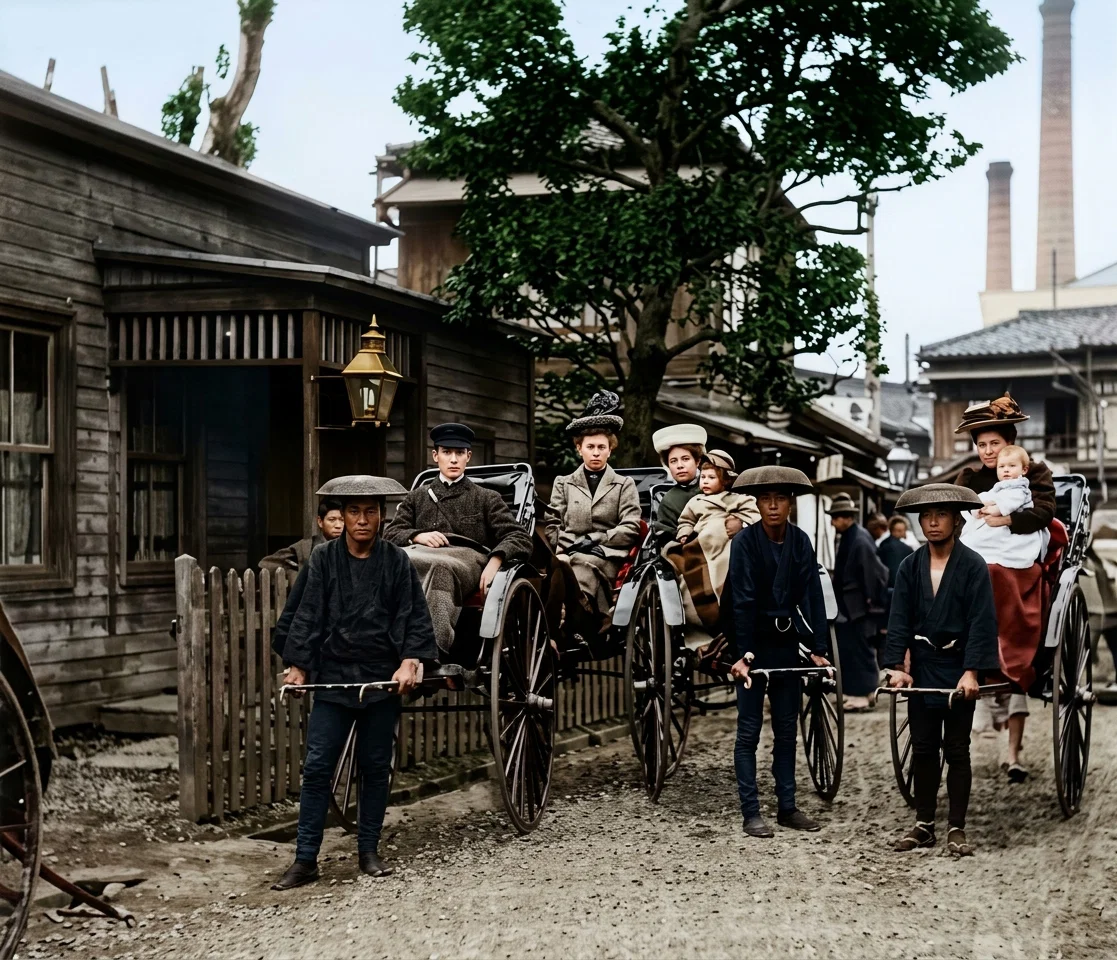
The picture of the 'rikisha men. Elder F. W. Field's house on the left. In the vehicles, naming from left, are Mr. Stafford, Mrs. Sparks, Mrs. Stafford and child, Mrs. Dr. Dunscomb and baby on the right. The picture was taken by Mr. Sparks, consequently he is not in the group.
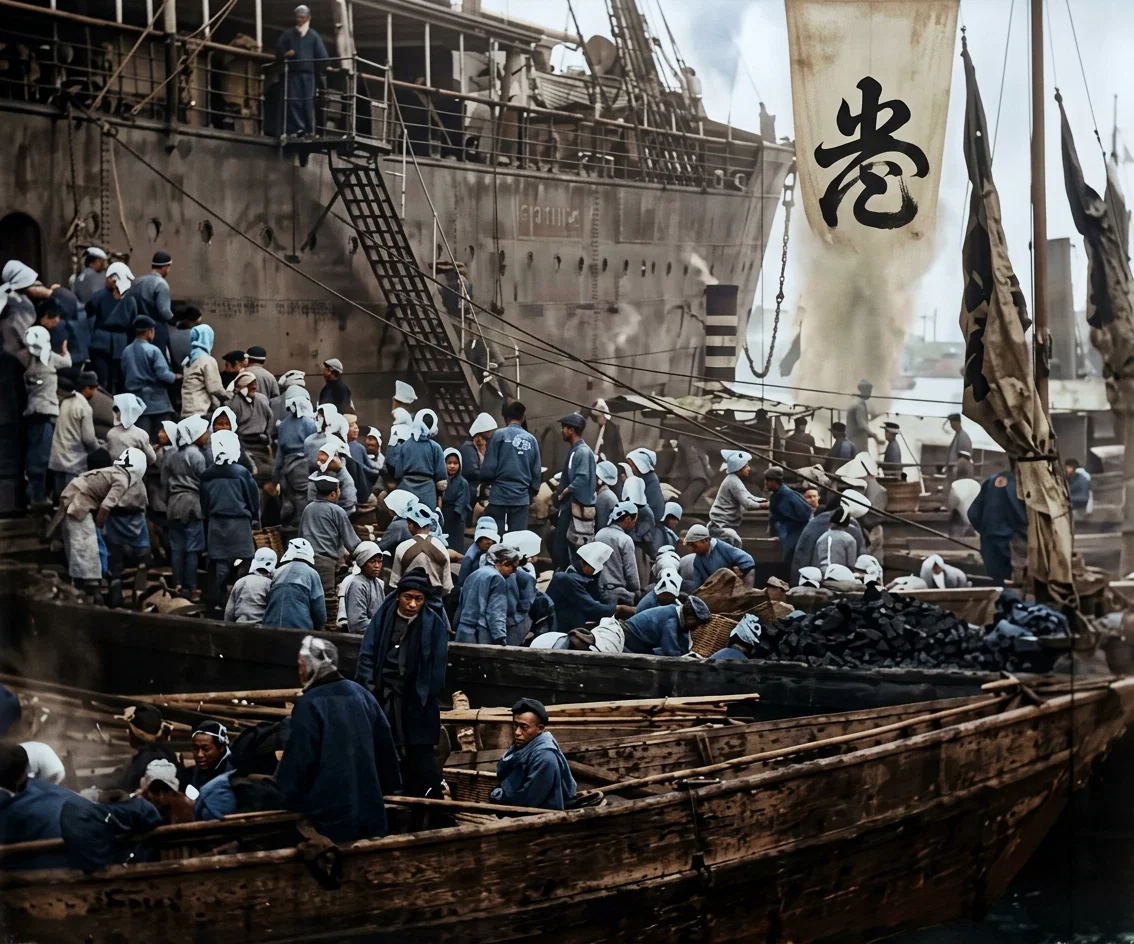
Coaling the China at Nagasaki, Japan, by hand, placing 4,500 tons of coal on the ship in 15 hours, while in coaling at San Francisco, it took the steam shovel 10 hours to deposit 650 tons. Reducing it to the same number of hours, the steam shovel placed 650 tons, the Japanese coolies 3,000 tons.
Every one goes ashore at Yokohama; and to the American traveler who is making his first visit, there are hundreds of new and novel sights. As soon as we landed we were besieged by jinrikisha men; and selecting the most desirable ones, we were taken to the Shimboshi station.
The first ride in a 'rikisha is one of the mile-posts of the Oriental traveler, and it is with mingled feelings of pity and admiration that we watch the little brown men running along with their heavy loads,—pity that a man should be doing the work of a beast of burden, and admiration for the sturdy way in which they keep up their trot for hours at a time.
No one knows how the foreigner feels, better than the 'rikisha man himself; and as a consequence, unless a person has been instructed beforehand, he will pay three or four times the proper price for his ride.
At Shimboshi station we took the little toy-like train, and after riding for an hour through beautiful gardens, rice fields, and small stations, we arrived at Tokyo, the capital of the Japanese nation. It is a large city, covering nearly thirty square miles, and having a population of almost two million.
We immediately set out to find the house of Brother F. W. Field, who has charge of all our work for the Japanese; and after being misdirected several times, we at last found the place. They are doing a splendid work, but are continually hampered for want of men and means.
As we had only a few hours to stay, we started out again to see as much of the city as possible. Tokyo being the capital city, here are located the imperial palace, the government buildings, and the imperial university. There are also a number of interesting parks and museums.
The day was dark and cloudy, therefore I was not able to take many pictures, but am sending a few which I took in Asakusa Park. Here is located a large temple; and as we saw the throngs of people bowing before these images of wood, that can do them no good, we longed to be able to talk with them, and tell them of the true God, who loves them and is ready to answer their prayers.
One image of a mother and child was supposed to cure sickness and disease; and there was a continual throng of cripples and sick, miserable people, longing for some ray of hope to lighten their way. They would rub their hands on the face of the idol and then on their own face and body, and go away expecting to be healed. This has been going on so long that the features on the face of the idol were completely worn off.
In the courtyard of the temple were many booths erected for displaying various wares, and a continual jangle of buying and selling was carried on. Many of the articles to sell were novelties and souvenirs to attract the tourist, as all travelers visit the temples.
The shopping district is very interesting; and in one large department store where we went, all the Japanese took off their shoes as they entered. Near the door were two or three coolies to check the shoes. As our shoes didn’t come off as easily as theirs, they provided a cloth covering with a rubber band to hold it on. Being furnished these, we entered the store, and inside were many beautiful and interesting wares. On the top floor was a dining-room, and we tried our hand at the chopsticks, much to the amusement of all the patrons.
Two characteristics made lasting impressions on my mind, and will always be connected with the Japanese people. The first is politeness. Of course it is a question just how much of this is sincere, and how much is the result of habit. Such a bowing and saluting one could not imagine unless he witnessed it. When acquaintances meet on the street, you would think they hadn’t seen each other for a year. When we entered a store, the proprietor bowed low; whenever we spoke, he bowed again; when we paid him, he bowed four or five times; and when we left the store, he again bowed.
The other point is the Japanese shoes. For the most part, these are made of wood, and the peculiar clattering of the wood against the pavement is one of the first things to attract the foreigner’s attention. Two straps or cords run from the center of the front of the shoe to the sides; and the stockings are made so that the great toe goes on one side of the center strap, and the other toes on the other side, so it gives the foot the appearance of a hoof divided in the center. The shoe itself is simply a flat piece of board with two cleats on the under side. These are ordinarily about one or two inches high, but on some of the shoes worn in muddy weather they are five or six inches high.
Leaving Yokohama the next day, a run of a day and a night brought us to Kobe. Here we hunted up Brother and Sister Herboltzheimer, former acquaintances of ours in Colorado, with whom we had a pleasant visit. Kobe seems to be a much cleaner city than Tokyo, and there were many beautiful foreign houses there.
The city slopes back from the water-front half way up the mountain, and I am sending a picture taken from the top. The view here was magnificent, and the photo does not do it justice.
The bubonic plague was prevalent here at the time, and the government was taking steps to eradicate it. We saw places in the infected district where the people were forced to move their goods right out into the middle of the street. The house or store would then be thoroly cleaned and disinfected, and whatever goods could not be fumigated would be burned up on the spot.
I think the most interesting sight in Kobe was the great Buddha, of which I am sending you a picture.
Between Kobe and Nagasaki is the world-famed Inland Sea. For one day, from eight in the morning till four in the afternoon, we went through places so narrow that it seemed as tho we could almost touch the shore. On each side were gardens and terraces stretching clear down to the water’s edge. We had to proceed very slowly, and the first officer stood by the anchor all the way. ready to drop it at a second’s notice if we struck.
We had a good pilot, however, and the next morning landed safely at Nagasaki.
At this place no one is allowed to come ashore with a camera, as it is a fortified harbor, and all pictures and postcards that are permitted to be sold have the background mutilated so it is impossible to see the shape of the hills around the city.
I hired a sampan and rode around the harbor, and by the utmost caution succeeded in taking two pictures. One is a partial view of Nagasaki, and the other is a monster crane, the second largest in the world, capable of lifting a large ship out of the water. I tried to get one of the shipyards where they were building three large battle-ships, but it was too dark and was not usable.
By far the most interesting sight at this place is a coaling ship, which is done entirely by coolie labor. Early in the morning the coolies come out, men, women, and children, and swarm around the boat like ants. They rig a ladder up to the bunkers, and pass the coal up in baskets like a bucket brigade. Working on both sides of the ship at the same time, it is almost unbelievable the amount of coal they can put on. They average ten tons an hour to every gang, and work two or three gangs at every port-hole. The record on the Manchuria at one time was 4,500 tons in fifteen hours as against 650 tons in ten hours in San Francisco with a steam shovel.
Leaving Nagasaki, the next day we found ourselves in the choppy, muddy waters of the Yellow Sea. It is easy to understand why it is called yellow after once getting a look at it. That night we anchored at the mouth of the Yang-tse River. The next morning we proceeded up the river to Woosung, where we anchored and took a launch twelve miles up the Whangpoo River to Shanghai. Here we found friends, and our journey ended. I will soon have some interesting reports and pictures to send from China.
F. E. STAFFORD.

A Word from India

It is impossible for those of us who are on the ground to describe the burden that is ours as we sense the inadequacy of our present meager force and slender resources to meet the solemn situation in India. [See article in Outlook department.]
Our daily prayer is that God will arouse those who should know the time, to awake to the responsibilities of the hour before it is too late.
We wish to thank the Signs and its readers for the gift of more than $70.00 for furnishing books to our Indian native libraries. Our Indian executive committee has voted its appreciation of this gift, and decided to use it in purchasing as many sets as possible of “The Conflict of the Ages,”—“Patriarchs and Prophets,” “Desire of Ages,” and “Great Controversy.” There are hundreds of native libraries in India, and we are grateful for the privilege of placing these precious volumes in a few of them.
GEORGE F. ENOCH.
Poona, India.

Our Solusi Mission

From our Solusi mission in South Africa Brother M. C. Sturdevant writes of the good work that God has been doing during the latter part of 1909. At the beginning it looked very discouraging indeed, having but forty boarding students in the school at the mission; but since that time the house has been more than full, and they are coming from native tribes all around. Our schools number seven now.
Some of the chiefs and parents have been bitter. At least they did not wish schools started in their kraals, or villages; but the young men and women said they would have to go to the teacher if the teacher could not come to them, and so the chiefs have opened up the way for out schools. A short time ago fathers were selling their girls for cows or trading them for wives, but this has been prohibited in Rhodesia, and the girls have found out that they can not be sold to a man against their will, and so now thirty-one promising girls are in the home.
There are only three white workers carrying on a mission farm of 300 acres in cultivation, a store, seven out schools, and the large mission school. Thirty-three were baptized in 1909. Surely help ought to be sent to Brother Sturdevant. May God bless these noble, self-sacrificing missionaries.

Wanted

A CONTINUOUS supply (post-paid and well wrapped) of SIGNS OF THE TIMES, Watchman, Instructor, Life and Health, and other magazines. Address Frank E. Wood, Paradise Valley Sanitarium, National City, Cal.
A. V. DYBERG, 220 Main Street, North Vallejo, Cal.
FOR use among intelligent Indian tribes copies of SIGNS OF THE TIMES. S. B. Taft, Box 674, Kiowa Agency, Anadarko, Okla.
J. GREGORY, Paradise Valley Sanitarium, National City, Cal.

IN THREE DAYS

SAN FRANCISCO

Overland Limited

TAKES YOU
To Chicago
ACROSS GREAT SALT LAKE
AND
HIGH SIERRA BY DAYLIGHT
Luxurious High-class Equipment
Electric Lighted Throughout
Pullman Drawing-room
Stateroom
Vestibuled Sleeping Cars
Careful and Attentive Dining Service
Parlor Observation Car with Library and Cafe
Ladies' Reading Room
Gentlemen's Smoking Room
Daily News Bulletins
Latest Papers and Magazines
SOUTHERN PACIFIC

High Pressure Steam Canner

Have just completed a High Pressure Steam Canner for home and market canning that cans everything so it keeps, without preservatives, in any climate. It is made of boiler steel of sufficient strength to stand more pressure than is ever required. The Process Kettle will last a life time with ordinary care. Requires about one fourth the time for cooking that is required by the hot-water canners or on a stove, therefore is a great time and fuel saver. Burns coal, wood, etc.
The smallest size can be used on a stove, and will cook a meal in a few minutes. This canner is very accurate; is provided with Steam Gage, Safety Valve, and Thermometer. Glass or tin cans can be used. Canning is a very interesting and profitable industry. You can realize more from a small piece of ground than the ordinary farmer does from a large farm. This canner is accurate; any one can do the finest canning from the beginning. There is a ready market for first-class canned goods everywhere. You can make the finest protose or meat substitute, for about six cents per pound, and fine canned beans. Fruits and vegetables canned with this High Pressure Steam Canner become very tender, but not mushy.
Corn is one of the hardest things to can. The large canning factories use 245 degrees F. for canning corn. With the many canners on the market, or on a stove, you can get only 212 degrees F., but with this canner you can get 255 degrees or more.
It is the only complete High Pressure Steam Canner for home and market canning, on the market. Capacity of from 400 to 20,000 cans per day.
This supplies a long-looked-for article.
This canner is fully guaranteed, and in simplicity, durability, and practical working, surpasses them all. Complete receipts and instructions with each canner.
The price is within the reach of all. Send for a circular. Agents wanted everywhere.
JETHRO KLOSS, M.E., St. Peter, Minn.

Life and Health

A PRACTICAL health journal, published with a view of meeting hygienic needs in every home; teaching how to care for the health and how to preserve life; prescribing simple home treatments to assist nature in throwing off diseases rather than adding more poison by using drugs or unnatural stimulants as remedies; teaching how to avoid disease as far as possible, how to manage in the home when sickness does come, and how to combat the disease by simple remedies which nature provides.
Send for sample copy and special rates to agents.
Price 10 cents per copy or $1.00 per year.
Address, LIFE & HEALTH, Takoma Park, D.C.

LIBERTY

THE OFFICIAL ORGAN OF
THE RELIGIOUS LIBERTY BUREAU
An illustrated, 48-page, quarterly magazine, published as an exponent and advocate of true religious liberty; defending Christianity and the rights of conscience; upholding the Bible as the infallible word of God; recognizing the church and state as ordained of Heaven for specific and distinct purposes, but vigorously protesting against the alliance of the church with the state in the attempt to advance religion and to promote the state.
Price 25 cents per year. Liberal terms to agents.
Address, LIBERTY, Takoma Park, D. C.

Hypnotism

A recent daily paper tells of a wonderful work that has been performed by hypnotism in changing a wicked, insane girl into a woman of good and steady habits. The article admits, however, that this is altogether different from most of the hypnotic experiments, and declares that in France in some of these experiments doctors have suggested to their subject to commit minor crimes by saying, “Go and steal Doctor So-and-So’s handkerchief,” or “Go and strangle the cat,” and the patients have obeyed. On this patient the suggestions were always made for good, and the patient formed the habit of doing them; and yet this of itself must be serious. God designed that the will of the human should be absolutely free, subject to no other power than God, and if subject to Him voluntarily so; but he who places his mind absolutely under the control of a fellow creature, weakens his will to that extent, and therefore loses the individuality which God designed that he should have. Hypnotism is a power which may be exercised simply by one human being over another, but we believe that it is largely exercised through the influence of the devil for evil and only evil. Our counsel is, Have nothing to do with it. Submit your will to no creature influence.

Principles of Service

Read the intensely practical article by Mrs. White, beginning on page 3, entitled, “Principles of Service.” That is what the soul needs to know — the underlying principle of right-doing.

Is Death the Lord’s Coming?

“Is Death the Lord’s Coming?”—This question is answered on page 9. Next week the question, “Is the Outpouring of the Spirit the Second Coming of Christ?” will be briefly considered.

Read the Next Page

We hope our busy men readers will not confine themselves to the one page eight of this issue. We wish to assure them that there are many other things in this issue worth reading. Anyway, read the next page.

Impulse versus Endurance.

Character is not measured by impulse, however great, but by endurance. Few there are indeed who do not have impulses to do good, and to do great good things; and many do individual deeds of daring, of benevolence, under impulse; the next impulse yielded to may be evil and selfish. It is the constant, steadfast life that counts. “We are made partakers of Christ, if we hold the beginning of our confidence steadfast unto the end.” “He that shall endure unto the end, the same shall be saved.” The meteor’s momentary glow or the lightning’s flash might be of a little benefit in a dark night, but we would greatly prefer the steady shining of a tallow candle.

Charles E. Hughes Appointed to Supreme Court

President Taft has appointed Governor Charles E. Hughes to the Supreme Court of the United States, to fill the vacancy caused by the death of Justice Brewer. Mr. Hughes is a strong, clean man. May he ever be guided by right principles.

“Reforming” the Calendar

A despatch from Rome in a San Francisco paper under date of April 23 says that the pope has become an ardent advocate of the proposed reform of the calendar, making an even number of weeks in the year, dropping out New Year's Day as a no-day in the calendar and bringing Easter always on April 7; the year always beginning on Monday. How this can be made to harmonize with the Christian religion regarding the Sabbath we do not know. The traditional church probably would need no Scripture for this. It could make its own laws; but how about true Protestant churches?

Higher Criticism

We begin in this issue a series of articles on “Higher Criticism” for which we bespeak a careful reading. Some of the phases of the subject covered are as follows:
  1. The Rise of Higher Criticism (in this issue);
  2. The Meaning of Higher Criticism;
  3. The Consistency of Higher Criticism;
  4. Higher Criticism and Inspiration;
  5. The Higher Critics and Christ;
  6. Higher Criticism and the Gospel;
  7. Higher Criticism and Archeology;
  8. Some Fruits of Higher Criticism;
  9. Higher Criticism — Whither?
These are not negative articles, but strong and positive, helpful and illuminating.
Each paper is independent, and the series will continue for the next three months. Would you not like to send the paper to a friend during that length of time?

Noah’s Ark Scientifically Built.

Prof. Geo. William Dickey, the designer of the battle-ship Oregon, has written an article on Noah’s ark in which he declares that the directions and proportions are marvelously correct. In fact, the proportions are not greatly different from the present “Dreadnoughts” with more room in the hold. He tells us also that the instruction for the building given in Genesis is what a ship-builder could follow without any difficulty. He also gives us the number of feet of lumber it would take to build a ship of that size—4,153,500 feet of lumber; and he declares that the cargo which the ship would hold would be just about what the ship itself was designed to carry. He says the ark was a vessel of such dimensions that the mere fact that it was built argues a very advanced knowledge and experience in the constructive art on the part of the contemporaries of Noah; further, that in 1609 a Dutchman by the name of Peter Jansen made a ship of the same proportion as Noah’s ark only smaller, at which every one laughed while he was building it, but after it was launched it proved to be superior to any of the other ships of the time, so that many other boats in the Dutch navy were built like it. They were called “Noah’s arks.”

Methodist University Honoring a Roman Catholic

In connection with the Roosevelt-Vatican incident and in view of the feeling of the Rev. Mr. Tipple in Rome against Roman Catholicism, we note the following which occurred in Denver April 11. Announcement was made that day that Denver University, a Methodist institution, will confer the degree of LL.D. upon Father William O’Ryan, a prominent figure among Colorado Catholics. The chancellor of the university, Henry A. Buchtel, was formerly governor of Colorado. Could you conceive of a Catholic university conferring such a degree upon a Protestant minister?

For Good Roads.

When a good draft horse in France can haul in one load 3,306 pounds a distance of 18½ miles, while on the average road in America the same horse could haul only about 800 or 900 pounds, the Agricultural Department of the Government thinks that it is about time for the Government to expend some of its money in experiments on the best kind of country roads, and a bill has been introduced in Congress by Mr. Bankhead for that purpose. It certainly would be well to spend some of the money that is spent for war, in the blessings of peace and prosperity to the country community.

Cocain

Cocain.— The Army and Navy Department of the Government is doing all in its power to prevent the enlistment of cocain users in either branch of the army; and they point out, in statements prepared for the examining physicians, certain signs by which the habit can be detected. The habit has spread rapidly of late. One of the great questions that faces thoughtful temperance men is this: Supposing that the absolute sale and manufacture of alcoholic drinks are abolished, have they not just as great foes to face in the indulgence of narcotics and stimulants equally injurious?

Frans Hals Portrait Sells for $137,000

The greatest price ever paid for a painting in America was for the portrait of a woman, by Frans Hals, sold recently in New York for $137,000. Sixty paintings were sold at the time, the aggregate amount at which they were sold being more than $500,000.

Wreck of the Minnehaha

In the wreck of the Atlantic transport Minnehaha off Scilly Islands, April 10, the natives reaped a harvest in the wreckage. Boxes of food, tea, and tobacco, thousands of novels, sewing-machines, clocks, pianos, and automobiles were among the spoil.

Every Plant Not Planted by God

If we plant religiously, why not plant surely? It is our Lord who declares, “Every plant which My heavenly Father hath not planted, shall be rooted up.”

Repairing and Cleaning Type-Writers

Among other good and interesting things, the Scientific American of April 16 has an excellent article on “How to Repair and Clean Type-writers.”

Forty Miners Entombed in Alabama

In an explosion in the Mingo coal mine, near Birmingham, Alabama, April 20, forty men were entombed, all of whom it is said will probably die.

You have reached the end of this edition.

Signs of the Times · May 10, 1910