Ceylon is now a Seventh-day Adventist missionary field; and because of its peculiar need, it should be one of the most interesting fields ever opened by the people who are representatives of the third angel's message. As I said in a previous article, Ceylon is called the “Eden of the East,” and by many it is believed to be the original Eden, or paradise, the garden of God. There is on the island a mountain peak called “Adam's Peak,” on which, engraved in the solid rock, is a human footprint believed by the Mohammedans to be the footprint of Adam, but by the Buddhists to be a footprint of Buddha. There may be no truth in either of these two cherished traditions, but there has been no mistake in calling this island the “Eden of the East;” for its beauty and grandeur are living monuments and memorials of the Edenic home of our first parents.
TALIPOT PALM IN FLOWER
Almost everywhere, as in the first Eden, you may see that which is pleasant to the eye, and good for food. And as the poet has said, “The gifts of God are strown with lavish kindness.” And yet there is to be seen here scenes both intensely sad and pathetic; for the people who live in such a paradise of light and glory walk in darkness and superstition.
The chief religion of the Singalese people is Buddhism. They are not only followers of Buddha, but many are worshipers of Buddha, and their temples of worship are scattered throughout the land. The life story of Buddha is strangely pathetic, and the religion of the his followers is correspondingly sad. He was born the son of a king in a city of northern India, about four or five centuries before Christ. Surrounded with every good that wealth could procure, he grew up into manhood, among all that was beautiful, in the palace of his father, the king.
Having never left the palace grounds, when he had grown to manhood, and after his marriage, he had an unconquerable desire to see the rest of his kingdom; and it was then, when going forth, that he for the first time looked upon deformity and death. In returning to his palace he tearfully said, “What have I to do with pleasure?” He sought the sacred books of the Hindu religion for a deliverance from all these things, but found none. Then, not being able or willing to live a life of pleasure with so much misery around him, he took a sorrowful leave of his wife and father, and in secrecy of the night left the palace. For six long years he led a lonely life among the hills, but one day while sitting beneath the “tree of wisdom,” he seemed to find what he had been seeking, and from that time he was known as Buddha, which means “the enlightened.”
What Buddha found is not known even by his followers, but he broke down that awful wall of caste which binds the Hindu devotee, declaring all men to be equal, receiving at the hand of a poor goat-herd a cup of milk. After this he returned home preaching salvation, called by Buddhists “the way.” There was nothing definite, however, in what he taught, and his religion was still full of sadness; for he had no hope, and was without God in the world. He did not preach any God, and perhaps because of this, Buddha himself is now, after many years, worshiped as a god in all the Buddhist temples.
Only last Sabbath a Buddhist procession passed down our street. They were going from one temple to another, carrying with them presents suitable for their idol deity. One poor devotee, under a vow, was bleeding from the cheeks and mouth. A large needle had been passed through each cheek and tongue, and then a wooden peg inserted. I never saw a more pitiable sight, and yet all the pain and suffering was faithfully endured in the hope that it would secure some favor from the gods. These scenes are of common occurrence, and many are the sights that make the heart sick.
Another point of significance in Buddhism is the place and interest which the serpent holds in the temple and worship. It is stated that each temple owns a live cobra, which is a most deadly serpent. The cobra, according to tradition, is thus treated because of its having once protected Buddha from the heat of the sun, by spreading its hood and forming a canopy above his head. An image of Buddha thus protected, was placed near our house while the procession passed. It suggested the motive power of Buddhism to be an overshadowing of that old serpent, the devil and Satan.
It is because these dear people are walking in “the way” of darkness and death, that God is sending a message of life and light to them. I think of all our people in the home countries, and wish they could see the need of the East. I am sure many loyal hearts would respond to this need, which can not be written in words, just as they have responded in times past. Many who can not come over to help us can send their means. It would be an investment that heaven would honor, and now the time has fully come for all who have means to put it into the cause. Soon it will be too late.
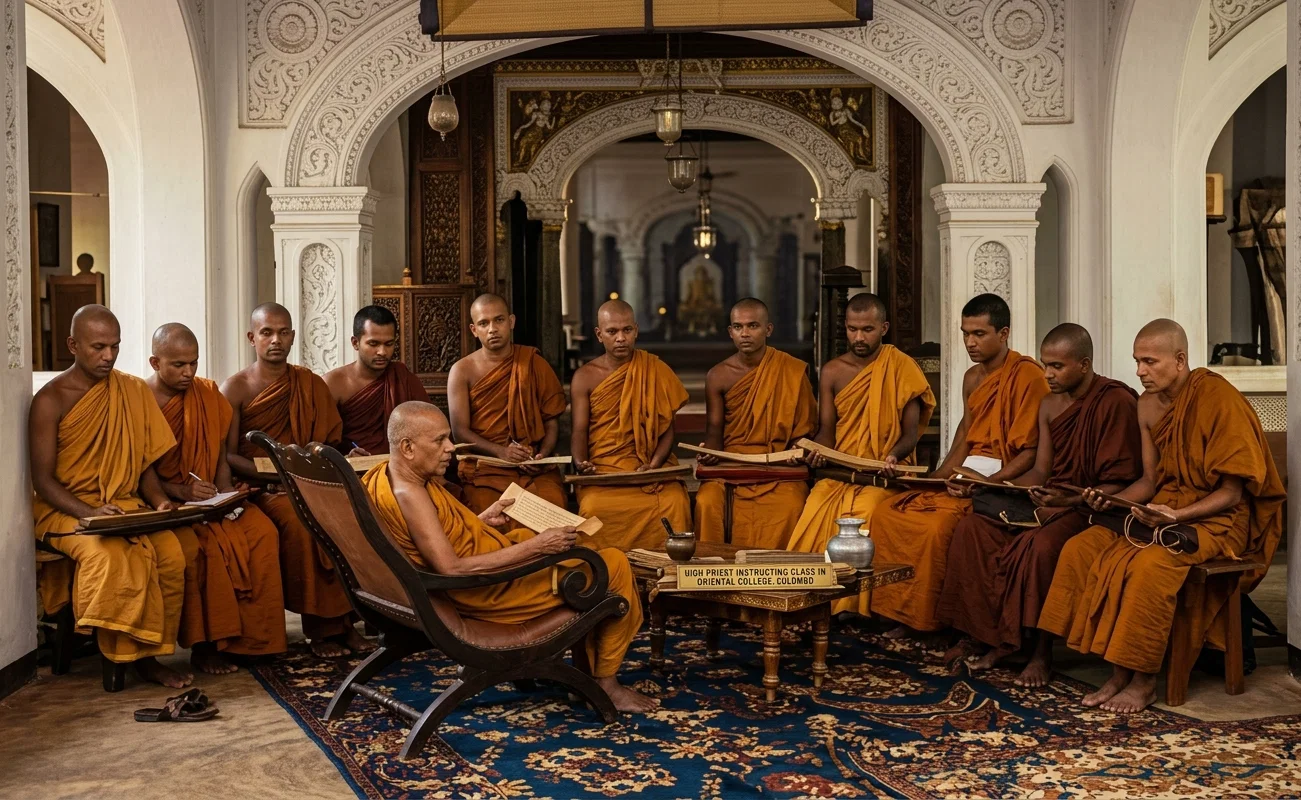
HIGH PRIEST INSTRUCTING CLASS IN ORIENTAL COLLEGE, COLOMBO
There has been a revival of Buddhism of late, and many schools of learning are now being opened. The accompanying13illustration will show you what the priests are doing. Books, as we know them, are still unknown or unused among the Buddhist students. They use the “ola book” made from the young fronds of the talipot palm.
The process of making this ola book is an interesting one. The young leaves of the talipot, or palmyra, palm are cut before they acquire the dark-green shade. They are then soaked in hot water or milk to preserve the flexibility, after which they are submitted to pressure to render their surface uniformly smooth. They are then cut into strips two or three inches in breadth, and from one to three feet long. These are pierced with two holes, one near each end, through which a cord is passed. The leaves thus strung together form an ola book. The writing is done with an iron stylus, which furrows the characters desired. These furrows then receive an application of charcoal and oil, which makes them easier to read, and also acts as a preservative against the inroads of insect life.
The accompanying illustration is a good picture of the royal talipot palm. Its straight, stately trunk rises to a height of sixty or seventy feet, but its crowning glory is its fan-like leaf. One leaf is sufficient for the hood of a carriage, and is even now carried over the heads of Kandian chiefs upon all state occasions. It blooms but once, and then dies. After living a life of from sixty to seventy years, it is said to gather up its strength in one supreme effort, bursting into a mass of bloom of great magnificence. When the flowers fade, the tree loses all its stately grandeur, and dies.
The palm branch has always been held in royal favor. These branches were waved before Christ as he entered the beloved city Jerusalem. And even now they are held over the heads of earthly monarchs. To this we have no objection, but we long to see the time when the characters of a false religion shall no more be engraved on the “ola page.” The glorious truth of a living Christ and a coming Christ has entered this land, and it will stay until a people, having been called out and sanctified by the truth, shall be translated from the “Eden of the East” into the paradise of God. Colombo.
The Present Outlook in Russia
By Ludwig Richard Conradi
L. R. CONRADI
While at present the eyes of the whole world are fixed upon the fierce struggle between Russia and Japan, I felt that our people would all be interested to learn how the truth is advancing in the czar’s mighty empire, and to read of the increased perplexities with which our Russian brethren must contend, on account of the war.
As to the third angel’s message, it certainly never was more prosperous in this interesting field than it is to-day.
Constant accessions to our numbers among the various nationalities in the north and south and east and west of this wonderful country, are reported.
As our brethren will remember, the Russian field has been divided into three parts: the South Russian Conference, among the German colonists; the North Russian Mission, to the Esthonians, Lettonians, and Germans in the Baltic provinces, and to the Poles and Germans in Poland and Wolhynia; and, lastly, the Middle Russian Mission, embracing the Russian-speaking people throughout the whole country.
For the quarter ending March 31, the North Russian Mission reports twenty-one additions, and a membership of three hundred and ninety-two, but since that time quite a number have united with us. The director writes me that for the second quarter of 1904, he thinks there will be a growth of about seventy. The message has gone somewhat more slowly among the Esthonians, but of late both our workers were in difficulty because of holding meetings, one of them getting into trouble simply because he had been reading the Bible in a private house. They were condemned to imprisonment and the payment of heavy fines. One of the brethren appealed to the senate. The following extracts from the senate’s rendering in the case, will show how the Lord has helped. These extracts are taken from Lutheran sources:—
“Prayer-meetings have been customary among our people for a long time. It has now happened that on a certain evening and in one and the same village, such prayer-meetings were held in various houses. In this, not only did the brethren of our faith distinguish themselves, but also the adherents of newer sects, as the Baptists, the (Seventh-day) Adventists, and others; until now the belief prevailed that all these prayer-meetings were directly contrary to the law, and therefore the participants were always attacked by the police, and the local justices of the peace fined those who had charge of such prayer-meetings, according to the charges brought in by the police. Nearly every justice of the peace has acted thus. Many so-called friends of education consider such meetings an unwarranted ‘apparition,’ and they find no other remedy against them than the mentioned police charges. And often whole columns have been written in our newspapers, invoking this police protection. Also our pastors, when they have seen that it is impossible to check the progress of some of the more recent sects with the sharp sword of the Spirit, have been placing their hopes upon the sword of the police. But while we would not consider whether such prayer-meetings are a desired ‘apparition,’ yet we would point out the fact that the villagers will continue to hold and take part in such meetings, as long as nothing better is offered them. But the assistance of the police is in no way desirable, for, on the one hand, it gives the sufferer the glory of a martyr in the eyes of many persons, and on the other hand, it is itself impossible to control religious movements through outward means. It is only when fanaticism has assumed harmful dimensions, and the public peace is endangered by it, that the aid of the police can be required, and police interference be justified. Thus far, such meetings, if not held in public meeting-halls, were considered contrary to the law, but lately several such cases were considered in the senate, and it has rendered its decision. Upon the twentieth of April, this year, it decided that all such prayer-meetings which might be classed among family gatherings, and where the people attending from without have received no public invitation, and where the time and place of the meeting have not been published,—all such gatherings are permitted according to the law.”
“One case is as follows: In the Weissenstein District the police wrote out charges, Oct. 5, 1903, stating that J. Jurickson, who lives there, had, although several times forbidden by the police, held a public prayer-meeting in his dwelling, as minister of his faith (the Seventh-day Adventist). This charge was given to the justice of the peace of District Two, with the request that he be proceeded against, according to paragraph 29, because he had not fulfilled the demands of the police, specified therein; but in the court, the accused pleaded ‘not guilty,’ declaring that indeed he held on October 4 a prayer-meeting, but that only Seventh-day Adventists had taken part in it. He considers such meetings not contrary to the law, because religious liberty to Christians of all confessions had been granted to all the subjects of the Russian empire, and sanctioned by his majesty. Because of this, he had asked neither the Lutheran consistory nor the Russian police for permission. The justice of the peace found that, according to the literal interpretation of said paragraph in the law, private prayer-meetings so far as they go outside the members of the family, could not be held in any other way but with the permission of the consistory, but such permission, the accused (as he himself admitted) did not possess. It could be further seen from the minutes of the police that such meetings had been forbidden by them to said Jurickson, and he had therefore transgressed paragraph 29 of the law. Upon all this evidence the said justice condemned Jurickson to a fine of twenty-five rubles, or seven days’ imprisonment. Jurickson appealed again, to a higher court, declaring that they had in no way proved him guilty of holding a public prayer-meeting, as he had simply met with a number of Adventists, with such of like faith, on certain days at certain services, and had in no way advertised it. Furthermore, the Evangelical Lutheran Consistory was not entitled to give him such permission, as the government was hindering no one in exercising his worship. He also stated that he had petitioned the14over-procurator of the Holy Synod to grant him such permission. For this reason he asked that the decision of the justice of the peace might be changed, and that the revision of this might be detained until the resolution of the synod could be received. But the justice would not reconsider the matter—he simply lowered his fine, claiming that it was not malicious intent, to five rubles or two days’ imprisonment. But as Jurickson appealed again, this time to the senate, the criminal department of the ruling senate, in its session of April 20, 1904, decided that the judgment of the justice of the peace, according to paragraph 1 of the criminal law, was to be entirely set aside, and the accused should be set free.”
We see from this that while the Lutheran synod, seeking to employ the force of the police, tried to stop our prayer-meetings, the senate itself, the highest court of appeal in all Russia, has certainly helped our brethren, and this decision will be of great use to our people when further difficulty threatens them.
Southern Russia
During the first quarter of 1904, the South Russian Conference had twelve additions, raising its membership to seven hundred and seventy-two, and since then quite a number have been baptized. Brother —— writes that from the fourteenth to the seventeenth of April he took in seven members, and May 1 he baptized one in the Black Sea. We learn that our brethren on the Volga have a good interest in the villages, from one hundred to one hundred and fifty being present at a time. They were lately able to baptize eight in this part of the country. Near the Caspian Sea and the Caucasus Brother —— took in fifteen members. We have recently sent three Friedensau nurses to work among the German colonists in this field, and they seem to be doing well.
Dr. Pampaian and his brother write me from Tiflis that there are many difficulties to be encountered in their efforts to get their work started. The physician’s examination for a state certificate must be passed in Russian, and his degree must be taken in St. Petersburg. How strict they are is shown by the fact that a physician holding a foreign certificate, did not receive a Russian certificate, though he had successfully treated the czar’s brother, and the reason assigned was that he did not know the Russian. It will probably take some time before they find the best way to make a start.
Middle Russian Field
Our leading brother here writes that in the Middle Russian, or native, field he has been able to take in fifty-three members in one place, thirty-two in another, and fifty-three in still another, and in yet another place twelve. The experience they have had is best shown by the following extracts from his letter:—
“A brother, after he had confessed his faith, was beaten to death. Another man, in consequence of the beatings he has received, has been sick for a long time. In another place, fifteen persons were converted by the labors of one worker, and it was not long before persecution arose. The people set themselves upon them like wild beasts, and they were terribly maltreated. One man had his beard pulled out. Some were so beaten they were hardly recognizable. One man was beaten until about half dead, and then put on a pile of straw, and had not some prevented it, the mob would have set fire to the straw and burned him alive. One father beat his son with a wet rope until he supposed the son to be dead. Some had their houses torn down, and all their property taken away, and as they had no home and no protection, they fled with maltreated bodies, and bleeding faces, not less than two hundred and fifty miles, where some of our people lived, who took them in. I was able to receive twelve members from among these. They rejoice in the Lord, and are glad they may suffer for Christ’s sake.”
“In one church they have had a great deal of trouble with the police. Some of the brethren were beaten; the clothes were torn off their backs. Their meeting was disturbed every Sabbath, although they met in the open fields; for wicked men sought them out, and tried to hinder their worship in every way. Their number continually increased; one year ago there were five brethren in this place, and to-day fifty are attending the meetings, but these gatherings must be held secretly, and in out-of-the-way places.”
“But how the Lord turns all these things for good is seen from the following experience: May 2 fourteen brethren were condemned to six days’ imprisonment, and in order to make their reproach worse, the police compelled them to march about sixty miles on foot, and their route lay through ten villages. As there was a sister with a nursing child in the company, it required five days for them to make the journey. While resting in these various villages, God’s Spirit moved upon the brethren to testify of their faith. Sometimes they had as many as three hundred hearers, who listened with the greatest interest. Undoubtedly many who otherwise might not have heard the message thus received a knowledge of it, and the good seed has been sown throughout that whole neighborhood, and the whole country is stirred in consequence. Joyfully they endured imprisonment, and as even there they were the means of converting others to the message, the officers let them out before their time had been served.”
Our brethren are guarded from Sabbath to Sabbath, so they can not meet together, and yet the truth is progressing, and in this short time the brother has taken in about one hundred and seventy. While we see the time of persecution is coming upon our people, yet the Lord’s ways are so wonderful that even these troublous times only increase the interest to hear.
As to the influence of the war, we have just learned that in one place five brethren were drafted, and upon stating their convictions, the officer told them if they would not serve, they would have to face the martial law. Soon the reserves in that district are to be called out, and a number more will have to go. We do not yet know what will be the fate of those who go to the front, but we do know that under any circumstances, they deserve our prayers. Should not we who yet have peace and prosperity arise and shine that the work may soon be finished? Let us not forget to pray for these dear brethren who are suffering for the truth’s sake. Truly we can say, ‘Here is the patience of the saints.’
Hamburg.
Mission Notes
DURING the period of eighty-one years, from the printing of Dr. Morrison’s Chinese New Testament in 1813, to 1894, the total circulation, including the Scriptures given away before the principle of selling was established, was about 5,500,000 volumes. In the last eight years, from 1894 to 1902, the circulation has been over 4,660,000 volumes, of which 51,000 were whole Bibles and 184,000 New Testaments. Of this number, all but about 100,000 were sold.
ANOTHER of our Japanese native Christians—Dr. Kawasaki—was summoned to his native province recently, to get ready for service on the medical staff with the army in Manchuria. The medical examiner thought he would not be able to endure the heavy work this would entail, so he was allowed to return. Although he is not very strong in appearance, our workers believe that his return was due more to the goodness of God in sparing him for the medical missionary work than to the natural clemency of the examiner.
LAST year, in the town of Kuankai, China, one of the Bible Society’s colporteurs found a family using a Testament which they had buried when they were forced to flee for their lives to the hills during the massacres. The father had left the book to his children, telling them exactly where it was buried, so that if he were killed (as he feared), his children should still be able to find the book again some day, and read about the true God. It was then thought that the missionaries would never be permitted to return again to the country; and by means of the Testament the father hoped that the children would be able to help keep alive the knowledge of God in their heathen land. Fortunately, the whole family managed to escape the Boxers, and the colporteur supplied them with more copies.
Illinois
By L. D. Santee
ALEDO.—Last Sabbath, Aug. 13, we preached three times to the Aledo church. After the second service, five were baptized, uniting with the church. This church has had no preaching for many months, but by their faithfulness they are gaining others. The Rockford church is the same. Two weeks ago we baptized two in that place. Faithfulness wins in the Lord's work, and these churches are faithful.
L. D. SANTEE.
British West Indies
By W. A. Sweaney
ARIMA, TRINIDAD.—After our good conference in Barbados, I spent two weeks at home, developing the work begun in the tent-meetings. I then accompanied Elder Haysmer to British Guiana, to assist in a counsel meeting with the laborers there, as they were hindered from attending the conference. We found them engaged in a tent-meeting at New Amsterdam, with a large attendance and deep interest.
British Guiana is a large, important, and promising field, and under proper effort in the book and paper work, should be a very fruitful and, ere long, self-supporting field. We spent a week there, in counsel with the workers. The Royal Mail boats stop at Barbados from Sabbath morning till Monday night; this gave me the privilege of spending a Sabbath and Sunday there, both going and coming. The interest in the message in Barbados is deep, and the work is onward. The church is too small to accommodate the increased interest resulting from the conference, so the hall in which the conference evening services were held has been secured for Sunday afternoon and evening each week. The conference and tract society headquarters have been established in a convenient location in the business part of Bridgetown. A stock of health foods, for which there is a growing demand, will also be added soon. We greatly rejoice in the prosperity of the cause in Barbados. To God be all the praise.
I now hope to remain in Arima long enough to develop and bind off the work here, which has been very much broken into by calls elsewhere. We are now face to face with the imperative necessity of a church building here. Our people are poor, and our own means limited, but the Lord, who has so wonderfully opened the way and led us hitherto, will also help us to accomplish this work. We shall unhesitatingly give to this enterprise, as we have to many others from time to time, all of our means and muscle, and we know God will make up to us, from some other source, what we lack.
With keenest interest we watch the work in other lands, especially that “most important” interest in Washington. We even manage, with all our needs here, to help each new or needy general enterprise a little, so that we may have an interest and a share in the results of all. We would not divert one dollar from greater enterprises or more needy fields, but if any, after doing his duty by other enterprises, feels able and disposed to scatter a few crumbs this way, we shall greatly appreciate it, and invest it in a needy and fruitful field. There are in Trinidad eight churches and companies (all greatly in need of labor just now), four unfinished buildings, besides the one we hope to build here; and nearly the whole island yet to be evangelized.
Elder Haysmer has been assigned to Barbados, and Brother Spencer to Tobago, leaving only Brother S. A. Wellman and myself here, and he is almost wholly confined to the office and Port of Spain. However, great as is our need, it is not so great as that of Europe, Asia, Africa, and South America. We thank God for almost perfect health, and we hope by his grace, to complete the work here by the time it is done elsewhere. Any one wishing to help us, may send means to the Mission Board, or directly to us by draft on New York, Chicago, or London, or by International postal order.
W. A. SWEANEY.
9 St. Joseph St., Arima, Trinidad.
Missouri
By R. C. Porter; Dr. Moran; A. D. Gilbert
St. Louis.—It may be of interest to the readers of the Review to know something of the way the missionary effort in St. Louis is being conducted during the time of the World's Fair. Our plan is not only to put the truth into the hands of those of various nationalities from abroad who visit our city this year, but to “sow beside all waters,” and thus reach the masses of this large city, as well as their visiting friends.
In order that all may have an opportunity to hear the third angel's message, we have districted the city, giving each worker a portion to be thoroughly canvassed with The Family Bible Teacher, also with other literature. House-to-house visits are being made, and reading-matter is offered to the people free of charge. Donations are accepted when they are freely given. Books are sold from time to time to interested readers. Where more than one family occupy the same house, or where there are several servants in a home, we see that all are supplied with reading-matter, as far as possible. Hotels are also visited, and tracts left on the desk by permission of the proprietor or the clerk in charge. In some hotels the elevator boy distributes the leaflets in the various rooms of the house, and in this way many of its patrons have an opportunity of hearing the truth.
Much still remains to be done before this city is thoroughly warned, as not more than one fourth of the homes have yet been visited by our workers, who are distributing about three thousand copies of The Family Bible Teacher daily, besides giving Bible readings, etc. The Lord has led in this work, and we already see indications of a harvest of precious souls for the Master's garner. The church-members are also at work with the Signs and The Family Bible Teacher, and the children are using the Life Boat with good success. All are of good courage, and we have every reason to praise God and go forward, ever looking to him who is our wisdom and strength. The workers in our home at present are Brother and Sister M. E. George, of St. Louis; Brother M. O. Douglass, of Kansas; Brother Albert Anderson, of Nebraska; Sister Lida B. Moore, of Colorado; Sister Mary L. Zener, of St. Louis; Brother S. J. Quantock, of Kansas City, Mo.; Sister M. S. Blaser, of St. Louis; and Brother A. D. Gilbert, formerly of England.
This home is open to receive visitors attending the fair who wish to stop with us while in the city. Our rates are as16follows: Lodging, 50 cents, each person; breakfast, 25 cents, each person; lunches will be put up for a moderate price when ordered. Those wishing to stop at the home should, before going, communicate with A. D. Gilbert, Cor. Blanche and Bellview Ave., Ellendale Sta., St. Louis, Mo. To reach our home, in front of Union Station take the Laclede Avenue car going west; at Sarah Street change to the Maplewood or Merrimac Hiland car going south, and get off at Bellview Avenue, then go north to the first house on the left-hand side of the road. Tents are pitched in the yard.
R. C. PORTER,
DR. MORAN,
A. D. GILBERT,
Committee.
Iowa
By C. E. Rentro
NORTH ENGLISH.—Since June 23 I have been laboring in this place in company with Brethren Ed. Swap and O. M. Kittle. We have enjoyed many pentecostal showers, and are praying that God may give us his power to reap the fruit of our labors.
As a direct result of our work here, five persons have signed the covenant. These, with several who had kept the Sabbath for a long time, and six who accepted the faith during my labors near here last winter, who signed the covenant also, number seventeen.
As my wife and I expect to leave soon for Europe, the other brethren remain to carry on the work, intending to pitch the tent in a town near by.
Some tell us that R. M. Kilgore held a course of lectures here a number of years ago. Pray for me, that I, as well as the company remaining, may hasten the coming of our Saviour.
C. E. RENTRO.
Wisconsin
By William Covert
IN company with Elder J. B. Locken, I held four meetings at Hines, Wis., August 13-15. I was agreeably surprised at finding a Sabbath-school of thirty-seven members in the place. A few living in the vicinity have lately accepted the truth, and others have moved into the neighborhood from different parts of the country.
Hines is a small station on the C. St. P. M. & O. R. R., between Superior and Spooner, in Douglas County. The newness of the country, the abundance of wood, and the cheapness of land attract settlers to the vicinity. It is a favorable place to find plenty of room. Though far to the north and limited in improvements, it is to be preferred to remaining in the cities. Good roads and public buildings will be provided in time.
We organized a church of sixteen members, and probably others will unite with them soon. A complement of officers was elected, but ordination was deferred until another time. A number of those who united with the church were recently baptized by Elder Swinson. This new organization adds sixteen to the membership of the Wisconsin Conference. We expect to see several other churches added to the list in the conference soon. Wm. COVERT.
Labors in Chicago
By W. S. Sadler
It is now six months since I left my field of labor in San Francisco, Cal., and returned east to connect with the medical missionary work in Chicago. This being my field of labor before going to California, I met many former acquaintances, and saw many evidences that our Heavenly Father's protecting care had been over the work. I was especially impressed with the fact that the influence of the Life Boat Mission had extended into a new strata of society. At the mission each night, one can count representatives of almost every class of society. Looking over the mission records, I found that thirty souls had accepted the truths of the third angel's message, been baptized, and were keeping the Sabbath, during the two and a half years I had been laboring on the Pacific coast.
I found Dr. Paulson and his workers, including the Life Boat force, moving to Hinsdale, a beautiful suburb of Chicago, where they have a most salubrious location for their sanitarium work.
Under the faithful labors of Brother Van Dorn and other mission workers, a goodly number of most promising converts were keeping the Sabbath, many of whom had been baptized, and united with our Chicago churches. After counseling with the brethren, we felt that the time had come to organize a Sabbath-keeping company in connection with the Life Boat Mission. Accordingly, on Sabbath, July 9, a company of twenty-two was organized. The writer was appointed leader of this company. Funds were raised to build a baptistery, which was put in during the following week, and the next Sabbath four candidates were baptized, three of whom were sisters. Two of these were married women with homes in the city, and all three of the women candidates belong to the better class of society, which is but another indication of how the work that was begun for the lowest classes of society has extended its influence and attracted the attention of truth-seeking souls throughout the city.
Regular Sabbath-school and preaching service are held each Sabbath with a good attendance, and there is every prospect of a strong work being established here, as there are a number of candidates who desire to be baptized, but are waiting to be more thoroughly instructed before taking this step.
We feel very thankful that the Lord is helping us to more fully gather the various threads of the work, and bind it into one harmonious whole. Mrs. Sadler and I are pursuing our medical studies as time and opportunity allow, while we put forth every effort to hold up this message of light in this darkened city.
W. S. SADLER.
Virginia Conference and Camp-Meeting
By A. M. Neff
The twenty-first session of the Virginia Conference convened at Stanleyton, Va., in connection with the camp-meeting, Aug. 5-14, 1904. There were present thirty-eight delegates, Elders A. G. Daniells, H. W. Cottrell, and S. G. Huntington, Prof. Frederick Griggs, Brother F. E. Painter, and all the conference laborers.
The treasurer's report showed an encouraging increase in the tithes and offerings during the past year. The report of the secretary showed seventeen organized churches, with a membership of three hundred and sixty-five, besides several companies and many isolated Sabbath-keepers. The report of the Sabbath-school Department was very encouraging. It showed a marked increase in both membership and donations.
The president, Elder R. D. Hottel, briefly reviewed the work in the State from the time the conference was organized in the spring of 1883, dwelling at some length upon the work of the past year, pointing out the unmistakable evidences of the leadings of the Spirit of God in the work. Recommendations were passed touching the various phases of the work, with broader plans for aggressive work.
The following officers were duly elected: President, R. D. Hottel; Secretary, A. M. Neff; Treasurer, O. F. Dart; Executive Committee, R. D. Hottel, A. C. Neff, F. L. Whitehead, O. F. Dart, C. W. Roat; secretary and treasurer of Tract Society Department, and secretary of the Sabbath-school Department, A. M. Neff; custodian of conference property, B. F. Purdham.
Ministerial credentials were granted to R. D. Hottel, A. C. Neff, H. W. Herrell, B. F. Purdham, T. H. Painter, M. S. Babcock, C. B. Rule, M. S. Wooding; missionary credentials to Mrs. M. A. Baker, Mrs. M. S. Wooding, and Mrs. Rebecca Clayborne.