HOW THE THIRD ANGEL'S MESSAGE WAS CARRIED TO PITCAIRN.
God has said in his word that the Third Angel's Message shall go to every nation, kindred, tongue, and people. Such a universal message must necessarily reach even the islands of the ocean, and engage the attention of the dwellers of these isolated spots of the earth. All parts must hear the warning cry.
The prophecies of the Old Testament uphold this sentiment. Isaiah, who has sometimes been denominated the “gospel prophet,” in referring to God's righteousness, which is found in his law, says: “My righteousness is near; my salvation is gone forth, and mine arms shall judge the people; the isles shall wait upon me, and on mine arm shall they trust.” Isa. 51:5. That is, the isles will trust in God, as they enter the Judgment. If all men are to be judged by the standard of God's law, as is stated (Eccl. 12:13, 14; Rom. 2:11-16), then it follows that those who trust in God through the ordeal of the Judgment, will know something of his law.
But the inspired penman speaks decidedly with reference to the work of Christ in the earth. “He shall not fail nor be discouraged, till he have set judgment in the earth; and the isles shall wait for his law.” Isa. 42:4. And how long they have waited! All these years that other parts of the earth have heard and rejoiced in his truth, these have waited—silently waited. But the decree has been uttered; the law of God must be given to them.
And when is this to be accomplished? We are told that the Lord is to set his hand the second time to recover the remnant of his people. Isa. 11:11. If the second time, it must be preceded by one other recovering of a remnant of his people. That was fully accomplished when he brought from Egyptian bondage his chosen people, the Israelites. But the second gathering of his people, brought to view in the scripture under consideration, is to be in the gospel day, after the “root of Jesse” has appeared, to be an ensign of the people. Verse 10. The gathering, too, is to be from all quarters of the earth, even “from the islands of the sea.” Have we not, as a people, believed for some years that this very work is going on? And if this is true, can the work close up before the islands have the103opportunity promised them in the sure word of God? Is it not reasonable to suppose that God would have them hear the truth as well as other parts of the world which are no more favorably situated? These questions have been repeated many times by some of our brethren living near the coast, as their opportunities have afforded them some knowledge of the situation. Some of these have done what missionary work they could by sending papers to these lonely parts. To some it would doubtless have seemed like casting “bread upon the waters” never to return. But the sure word of God has promised that all such shall be found after many days.
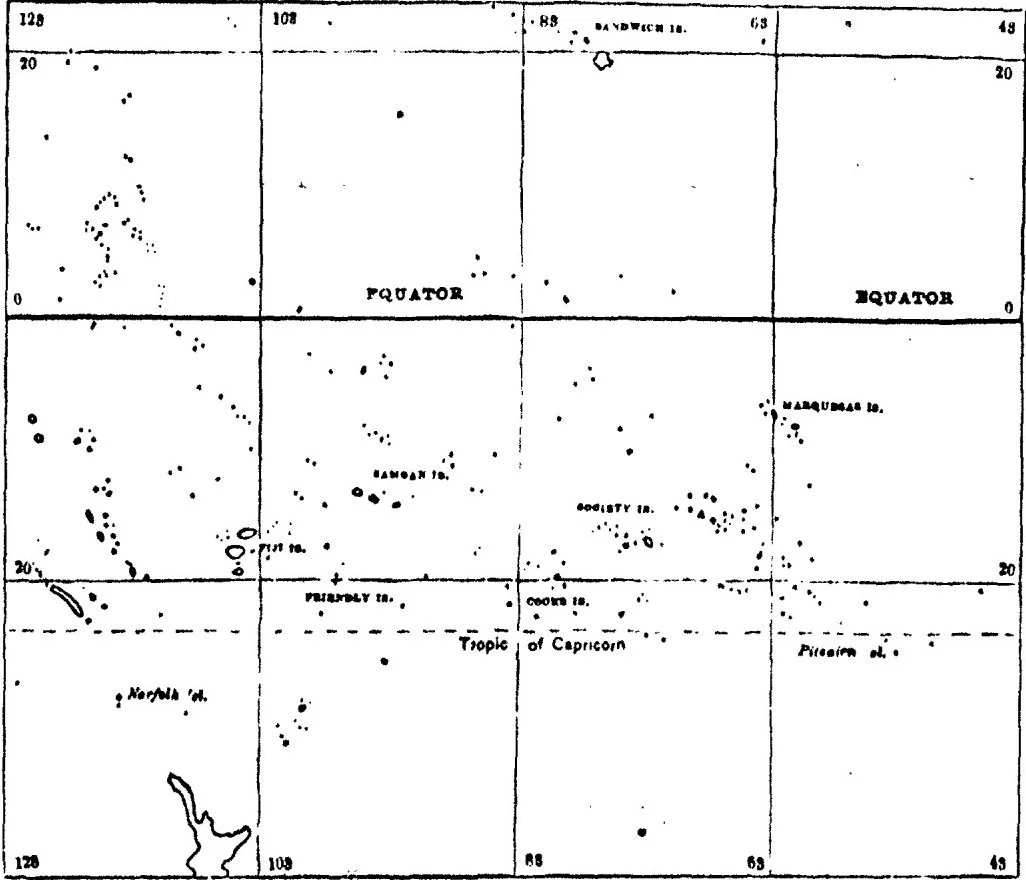
This case has proved no exception. Matters assumed such shape that Bro. J. I. Tay, of Oakland, Cal., resolved at all hazards to do something to connect ourselves more closely with these people, and see what could be done for them. When a youth, he had sailed in a ship commanded by his father. While on a voyage to Calcutta, he had found a small book giving a narrative of the mutiny of the “Bounty,” and the settlement of Pitcairn Island by the mutineers. Upon trying to determine just where to go, the thrilling story he had read so many years before came with vividness to his mind, and he resolved, if possible, to visit Pitcairn.
Map Showing Names and Positions of Islands in the Central Pacific Ocean.
Upon communicating his mind to some of the leading brethren, he was somewhat astonished to find them in sympathy with him. Encouraged by their counsels, he took a supply of publications, and set out on his mission. But how was he to reach his destination? There was no regular communication with Pitcairn, and the nearest point at which he could hope to touch was Tahiti. But it would cost too much to go as a passenger on the little packet running from San Francisco to that island. He accordingly engaged a place on board as carpenter, agreeing to work for his passage, provided they would not ask him to work Sabbaths. The bargain being made, he sailed from San Francisco in the barkentine, “Tropic Bird,” July 1, 1886. July 22, they arrived at the Marquesas Islands, where a short stay was made. Here some missionary work was done of an encouraging nature.
Sailing again July 29, the next day he reached Papiti, in the Island of Tahiti, where he met a man who had seen the Signs of the Times at another point in the island, where they had been regularly sent. Here a good many books were disposed of. But finding no more immediate work at that point, Bro. Tay began to inquire about getting to Pitcairn. He was told that he might have to wait a whole year, or even two, before an occasion would offer to go there, as it was only by chance that such an opportunity occurred. And even if such a time did come, it would be useless to go, as no one would be allowed to land and remain on Pitcairn. After remaining at Papiti five weeks, and almost losing hope of reaching Pitcairn, a British ship of war came into the harbor.
Learning that this vessel was on the way to Pitcairn, Bro. Tay resolved to go on it if possible. He accordingly applied to the English consul for permission, but was told by that officer that he had no authority in the matter, as he (Bro. Tay) was an American citizen. He, however, suggested that if the captain of the “Pelican” could be visited, perhaps the desired permission might be obtained.
Losing no time, Bro. Tay saw the captain, and stated his desire to go on his ship to Pitcairn. Upon being questioned as to his motive in desiring to make such a visit, Bro. Tay candidly told him about the message of truth he had for the people there. The captain listened quietly, and then said: “I cannot talk with you on this subject. My first lieutenant is our theologian; talk with him. If he thinks favorably of your project, you can go.” Then requesting Bro. Tay to make his statement and application in writing, he dismissed him.
As there was yet a week before the vessel sailed, Bro. Tay addressed a short note to the captain, stating the object of the International Tract and Missionary Society, of which he was an agent, and that he wished to visit Pitcairn to talk with the people there. At this point an unfavorable influence was brought to bear upon the captain by some on shore, to whom Bro. Tay had talked the truth; and the captain tried to dissuade him from the attempt. When told that there was no likelihood of his being allowed to land at the island, Bro. Tay replied that he would take all chances, and if carried by, would cheerfully stop at the next station at which the ship would touch.
The next ordeal was to talk with the lieutenant to whom the captain had referred. The missionary at the island had talked with the first officer beforehand, to prejudice him for the occasion. Bro. Tay and he talked together more than an hour, when the officer acknowledged the truthfulness of the positions held by us as a people, and finally said that he could go on the ship if he liked, though he felt certain that the people of Pitcairn would not permit him to land.
Going on board, all seemed to try to make Bro. Tay feel at home. His books were carefully stowed away, and on that very day, Sept. 16, the good ship lifted anchor, and bore away for Pitcairn, carrying the Third Angel's Message, toward the people of that isolated spot, who had waited so long for God's law. As soon as the ship was fairly at sea, all desired to talk about the truth every spare moment. On the passage, all the points of truth were canvassed, including our views of health reform, and the time passed away most pleasantly.
Arriving at Raratonga, one of the islands of Cook's Group, a message was sent from the captain to Bro. Tay, saying he could go ashore in the boat, if he wished. This privilege was used to the best advantage. Inquiring for the resident missionary, his house was pointed out, and a pleasant visit was enjoyed with him. Before leaving him, the gentleman purchased a number of our books, including “Great Controversy,” “The Atonement,” and “Thoughts on Daniel and the Revelation.” The next place at which the ship called was Aitutaki (pronounced t-loo-ta-kee), another island of Cook's Group. Here, also, some colportage work was done, and reading on present truth placed in the hands of the people. On this island all of the 1,800 natives have been Christianized, and are strict in keeping what they suppose to be Sunday; but is in reality the seventh day of the week, though they keep midnight time, as Sunday keepers do. This was accounted for when we learned that the missionaries to this island came from New Zealand, and evidently neglected to change their reckoning on crossing the day line.
On Oct. 18, 1886, the ship reached Pitcairn Island. When opposite Bounty Bay, two large boats were seen to come through the breakers. By the vigorous use of the oars, they soon pulled alongside the ship, and fifteen men came on deck. After they had cordially shaken the hands of all on board, arrangements were entered into for a visit on shore. At that moment Captain Hope said: “We have a man with us who would like to remain with you for a time on the island. If you do not want him to remain, I shall be pleased to have him accompany us to Coquimbo.” One of the number, who proved to be the magistrate of the island, said that individually, he had no objection to his remaining with them; but that their laws forbade such a thing. “We consider, however,” said the magistrate, “that the decision of the captain of an English man-of-war is of a higher court.” With these words, the matter was left for future consideration. J. O. CORLISS.
SENSITIVENESS
We have heard people talk about their sensitiveness sometimes as though it was a particularly meritorious quality, something to be proud of, indeed, until we have longed to undeceive them; for by sensitiveness they meant only that they were extremely quick to take offense, and uncommonly apt to fancy hidden meanings where none existed.
Such sensitiveness has other names, not quite so flattering to its possessors, such as touchiness, suspicious temper, and even self-conceit. Few people are more uncomfortable in every-day life than these sensitive ones; and too often they exhaust the patience and alienate the love of their best friends.
To be explaining or smoothing over is a wearisome task; and when we must stop to measure our words and adjust our phrases continually, the constraint becomes irritating as well as tiresome, and we feel like that Rhode Island woman who used to say of her son, “I don't know what to make of my Sammy; he is so sensible I don't know what on earth to do with him.”
A little good, wholesome self-restraint and homely common sense would greatly improve those “sensible” people, who seem to think the world revolves around them, and that everybody is thinking of them, or speaking of them, or intruding on them. When they learn the lesson of their own littleness, and find how small a place they occupy in the universe, they will be less self-conscious, and much more peaceable and comfortable.—Boston Christian.
DOING NOTHING.
PERHAPS those youths who are satisfied with “doing nothing” may see their mistake from the following anecdote:—
There was a boy in school once who was very lazy. He would sit on his seat all day and do nothing. He never made any noise nor disturbed any one. He never whispered nor got into any mischief. The master never caught him at any tricks.
One day as he sat still and quiet, the master came along and struck him a smart blow with a ferule. The boy jumped at the unexpected blow, and cried out, “I ain’t doing nothing!”
“That’s just it,” said the master; “I want you to do something.”
So with some people. They think, like this boy, that if they do nothing wicked, they are right. We must not only “cease to do evil,” but “learn to do well.”—Religious Intelligencer.
MANNERS BETWEEN BOYS.
THERE is a great deal of rudeness between boys in their intercourse and bearing with one another, that is not really intended as such, but is not, therefore, any the less to be disapproved. It is often simply the overflow of excessive high spirits. But the very best good-humor, unrestrained by proper bounds and limitations, may become the most positive incivility.
We often apologize for the coarseness of people by saying, “They mean well.” It is well if we can make such an apology for them; for if their rudeness is really intentional, they are not fit to be received into any worthy person's society. But they who mean well should also do well, and the ways of politeness are never so easily learned as in youth. The boy who is habitually coarse and rude in his bearing toward other boys, will be such as a man toward men, and all his life will never gain the reputation of being a gentleman.—Sel.
THE RIGHT KIND OF BOY.
If a boy is always ready for little deeds of kindness; if he is willing to give up his own plans to help along the plans of others; if he tells the truth though it may be against himself; if he obeys his parents cheerfully and promptly, even when the task is hard and disagreeable, it is easy for any one to see what that boy desires most. His wish is to do right, and such a wish is always granted, because the Holy Spirit is ever ready to lead the willing feet into the paths of righteousness.—Religious Intelligencer.
NEW YORK TRACT SOCIETY.
By J. V. Willson
Report for Quarter Ending Dec. 31, 1887.
No. of members
466
" reports returned
178
" members added
8
" dismissed
6
" missionary visits
604
" letters written
133
" received
36
" Bible readings held
68
" subscriptions obtained for periodicals
54
" pp. tracts and pamphlets distributed
35,989
" periodicals
2,714
Cash received on membership and donations, $68.46; on sales, $880.08; on periodicals, $259.01; on Australian Mission, $251.; on European Mission, $3.25; on English Mission, $58.; on Scandinavian Mission, $4.50; on city missions, $35.50; on Christmas offerings, $646.01; on I. T. and M. Society, $26.66; on twenty-thousand-dollar fund, $51.64.
Dixie, Nos. 1 and 2 failed to report; also the societies at West Monroe, Southwest Oswego, and Euclid.
J. V. WILLSON, Sec.
SPIRITUALISM AND SUICIDE.
A CORRESPONDENT sends us the following clipping from the Chicago Daily News of Feb. 3, which serves to illustrate one, though not the greatest, of the evil tendencies of modern Spiritualism, that of belittling the importance of this present life and inspiring its votaries with a longing to be freed from it which leads to great recklessness and even, as in the present instance, to actual suicide:—
“For over a year he spoke about wanting to die. He was a Spiritualist. He wanted to get out of the body; he believed he could live on the other side.” Thus spoke the widow of Dr. W. B. Farnham, the dentist, who died at his residence, 238 North Clark street, last evening, from a dose of tincture of aconite administered by his own hand.
Dr. Farnham was seventy-three years old, and for the last twenty years he practiced his profession in Chicago. Rumor had it that he was driven through despondency to commit suicide. Mrs. Farnham, his widow, said to-day that her husband never was despondent, and that when he decided to quit this world, he was hopeful and cheerful to the very last. There was some talk that financial difficulties perplexed him, but that was not true. He speculated for years on the Board of Trade, and lost everything; but he had an excellent practice, and was abundantly able to maintain his family. The latter consisted of a wife, possibly thirty-five years of age, and a son not yet fifteen.
Mrs. Farnham spoke freely of her husband's beliefs, his manner of life, and the circumstances attending his demise. While going up-stairs, Wednesday night, he fell and received a rather painful injury. To a man accustomed, as he was, to active habits, despite his advanced age, it was excessively irksome to be confined on a sick-bed. He looked at the matter from the stand-point of a Spiritualist. Death meant to him release from bodily ills. His belief in a future state was part of his religion, and to him this future state meant freedom from pain and worldly troubles. He was naturally impatient, and Mrs. Farnham said he had not the fortitude to endure pain. A way to escape this pain was contained in the bottle of aconite. After reflecting on the matter deliberately, he decided to “leave the flesh,” an expression he frequently made use of. He swallowed the poison, and he died; that was all there was to tell.
By further questioning it was learned that the unfortunate man had followed the advice of the spirits in speculating on the Board of Trade, and, as we are not surprised to learn, had lost most of his property thereby. How terrible the revelations which the final Judgment day will bring to this deluded victim of Satanic wiles! He will then realize, when too late, the infinite value of the life which, at the behest of Spiritualism, he so recklessly threw away.
There Are No Trifles in Life
By John Lascelles
—There are no trifles in the lives
Of men! for seeming trifles oft are powers
That act with potent force for weal or woe;
And what is great or small we know not now,
Or what shall lead to weal or what to woe;
But in our blindness this we surely know,
The happiest man is he who, doing right,
With child-like faith goes on, and, well content,
Leaves all the future in the hands of God.
—John Lascelles.
PROGRESS IN THE GENERAL CONFERENCE ASSOCIATION WORK.
By O. I. B.
Thinking the friends of the cause will be interested to learn concerning the progress which is being made in arranging the business of this Association to do the important work before it, we will again make a few statements concerning the subject. We say in brief, then, that the Association is now in full progress, doing business in its own offices, which are located on the second floor of the west REVIEW Office building. Bro. W. H. Edwards, the Assistant Secretary, is keeping the books, giving his whole time to the same. Since the first of the present year, all the accounts and business have been separated from the REVIEW AND HERALD accounts, with all the mission funds and everything under the special control of the General Conference. So now the REVIEW AND HERALD business is much simplified, as its work now relates almost wholly to publishing and matters of that character. This is as it should be.
We are endeavoring to systematize the complex business of the Association as much as consistent, so that we may have at our command, at any time, a complete record of the standing and condition of each foreign and city mission, and also the account of each laborer working in the employ of the General Conference. Careful inventories are to be taken of the property of every kind belonging to the General Conference in all our foreign and city missions, and the record of these is to be kept at our general office. Reports from our foreign missions each month were required by the General Conference at its session in 1886, as found on page 38 of Year Book:—
Resolved, That all our foreign missions be required to make a monthly itemized statement to the General Conference, of all receipts and expenditures.
The same is expected of our city missions. This matter was almost wholly neglected last year. But now that our business is being systematized, these reports are expected from every one of our missions. Our Secretary will furnish each of them a monthly report also of their standing from his books, so all mistakes can be corrected, and we may thus have a true account of the financial standing of each mission; and at the end of the year, a full report of the cost and present standing of each mission may be made to the General Conference. We have really not been in a condition to do this in the past; but our present efforts will lead to greater thoroughness and system. This is absolutely necessary as the cause enlarges and our missions become more numerous.
It is also very desirable that we should have more system in the reports from our laborers, many of whom now labor at so great a distance that we cannot get an opportunity to question them in regard to any statements hard to be understood, or to correct any errors. Hence the General Conference Committee have requested every minister in the employ of the General Conference, to report to the Assistant Secretary, Bro. Edwards, every quarter, so that we can have an understanding of their reports previous to each Conference, to help in the difficult work of auditing their accounts. This will be very important. Then when they make their annual report at the close of the fiscal year, we shall be able to have the matter well understood, and to save much time and perplexing labor. But we wish also to say that in every case where these General Conference laborers are in our missions, such as the British, Central European, or Scandinavian Mission, these reports should first pass through the hands of the managing boards of these Missions, and be examined by them the same as their annual reports have been examined heretofore. This will enable them also to understand the matter, and will possibly help us at the Central Office in Battle Creek, to understand them more easily.
We are much pleased that we are getting the Association already so far advanced in this work of arranging and systematizing these perplexing matters; but no doubt much patience and care will be necessary before everything is in perfect working order. We hope, however, if all parties try to assist us in this work, that by the end of the fiscal year, July 1, 1888, we shall have matters well in hand, running regularly and satisfactorily. Let all our foreign missions make earnest efforts to help us bring these good results about. They are as much interested to do so as any one; for it will help them to get their own interests attended to properly and expeditiously. All orders for money should go through the hands of, and be ordered by, the President, and countersigned by the Assistant Secretary, so that a proper record may be kept. If any have money to loan without interest, or at a very low rate, the Association could use it to good advantage just now. O. I. B.
THE WEEKLY DONATIONS.
By O. I. N.
We are glad to hear from different parts of the field, reports from our brethren that the plan of the General Conference to raise weekly donations for the support of the foreign mission work is being carried out; and we believe that every report which has been received hitherto, has spoken of it encouragingly. They represent that our brethren are taking hold of it very generally. We have hoped as much as this, and have seen no reason to doubt that our good and loyal brethren would feel such an interest in the progress of our foreign work that they would cheerfully accept the plan which is laid, and adopt it and try to carry it out. There never was more need of it. We have felt an exceedingly great interest and anxiety of mind in reference to the future of our foreign work. There were never so many encouraging evidences that the Lord was ready to help us in this important department of the cause as of late. The truth is making progress in many lands. The people are ready for it. The popular105clergy cannot restrain the work wherever it is carried on with intelligence and faith. But oh, how much we need to obtain laborers and means to sustain them!
We have questioned whether our people would show such an indifference to the success of the cause in foreign lands, that we should have to cut down our efforts and thus hinder the work. We have not been able to believe that such would be the case, but it surely will if our people do not take hold of the plans lately started. If they will generally give weekly donations as large as they are able to do without distressing themselves, we know that the situation will be relieved. Otherwise we see no way but to circumscribe our work, unless God raises up men and means especially for this purpose, beyond anything that we now have at our command; and we believe that he will do even this if our people are unfaithful, and that others will come up and take their crowns. But we shall hope that there will be seen a general unity of effort to step into the gap, and that means will be raised to assist us in this work. We call upon our people to aid in this manner. We plead with them not to allow our foreign mission work to drag. We urge them to pray for it, and then work to carry out their prayers. The truth will go to every land and every clime, and do its great work of warning the world of Christ's coming.
Something has been said in regard to missionary boxes in which to deposit these weekly donations until the end of the quarter. Several thousand of these boxes have been prepared at Battle Creek, and in some localities they are being given to those who pledge to give a weekly donation and deposit in the same until the end of the quarter, and then pay it over to the church treasurer. The General Conference Association furnishes these without cost to those who will pledge themselves to do this. The pledge is written on the side of the box, in blank left for the name. Of course this box is not necessary to those who do not desire it. If there are those who desire them, the officers of the different Conferences should send in the number of boxes they will wish, so that they can be furnished to the members who desire them. We wish to supply every one who will sign this pledge. They are to be obtained through the officers of the General Conference Association, Battle Creek, Mich. We will furnish them here free, and shall, of course, leave the cost of transportation to those who order them. O. I. N.
SUNDAY'S STRANGE ARGUMENT.
To the Sunday Institution must be accorded the palm for presenting more inconsistent and groundless arguments in its support than any other institution in the whole theological field. An association misnamed the International Sabbath Association (we say misnamed; for it is an association to uphold Sunday, but Sunday is not the Sabbath), has sent forth an Appeal to railroads to discontinue their traffic on the first day of the week. It is labeled, “No. 9 of the International Series,” and contains one chapter designed to sustain the Sunday institution on “Moral and Religious Considerations.” This chapter is headed, “Stand by the Moral Law;” and for the edification of the reader, we will quote the first two paragraphs. We ask him to give them a careful perusal, bearing in mind all the while that they are designed to be an argument for the first day of the week instead of the seventh, which the commandment enjoins:—
We take it for granted that you believe the Christian law of the Sabbath is still in force, that what was not dictated, nor inspired, but written by God himself, not among temporary ceremonial rites, but twice written on stone in the moral code called “The commandments” for all time and all men, that what was introduced with the word, REMEMBER, is not to be forgotten, and that what is as much the practical key-stone in the first table, as the injunction not to covet is in the second, is not to be pulled away by worldly-mindedness, sordid selfishness, commercial tyranny, or the loosest inferences.
Nor can we suppose for a moment that those of you who are members of the Church intend to impugn or stultify her ritual, by taking that to be no law which, as a law, she bids you pray God that you may keep, and for the breach of which, specifically, she teaches you to ask for mercy. How can you forget in daily life the oft-repeated words: “Lord, have mercy upon us, and incline our hearts to keep this law.”
This is a magnificent testimony for the extent and perpetuity of the moral law, and for the nature of the Sabbath commandment, which reposes in the very bosom of that law. But think of quoting that commandment in support of Sunday when it enjoins only the seventh day, and makes no allusion whatever to the first day of the week except as it is included in the six days on which we are commanded, or at least permitted, to work! Think of saying in reference to Sunday that God himself wrote it twice on stone! Is it possible that upon any other subject the intelligence of men could become so debauched?
The appeal to the ritual of the Episcopal Church, “Lord have mercy upon us, and incline our hearts to keep this law,” would be forcible if applied to the true Sabbath; but what can be said of it as applied to Sunday? A member of that church was once appealed to directly to answer how he could conscientiously repeat that prayer after repeating the fourth commandment, when the commandment enjoins the seventh day, and he knowing this was deliberately rejecting that day, and keeping the first day of the week, and intended to do so for the future. “Oh,” said he in reply, “we say that with a good deal of mental reservation!”
No institution can derive much support from “moral and religious considerations,” when those considerations, as applied to it, must be received with a “good deal of mental reservation.” The truth of God rests upon no such foundation. The true Sabbath could be urged on this ground; a human substitute cannot be thus supported.
Let us be glad and rejoice that the light is shining. The old adage that “truth crushed to earth will rise again,” is being verified in the holy and beneficent institution of the Sabbath of the Lord. Not all the theological rubbish which accumulated during 1600 years of apostasy has buried it beyond recovery. Not all the oppression of 1200 years of darkness and blood has crushed it into a hopeless grave. It is having a resurrection. The beams of its rising light are flashing the earth around. The glorious message on whose forefront it stands emblazoned, is fast gathering out a people in whose creed will be found no finger marks of the arch-deceiver, and on whose garments will flutter no rag of the trappings that belong to the mother of harlots.
The Meeting at St. Charles, Mich.
By O. I. B.
This meeting, held from Friday, Feb. 8, through the following Monday, was but thinly attended from abroad, there being comparatively few who came from a distance. St. Charles is one of the largest churches in this Conference, numbering at present not far from 130 members; but of course these are somewhat scattered. There was not at any time in the meeting anywhere near as many present as the membership. Bro. Van Horn was with me, and labored with his usual interest. A few of the people from the outside attended evenings, and listened with interest to the preaching. We cannot speak very encouragingly of the interest taken by our people, as it seemed to us at no time very great. During the closing portion of the meeting the interest seemed to increase somewhat, but on Monday, when most important questions were considered, there was perhaps at no time more than one third of the membership of the church present. Of course this did not seem to inspire those laboring with very much hope that the condition of the church would be permanently benefited, though we trust some who were present received instruction which may be profitable.
The lack of a general interest taken in our meeting at St. Charles, by the brethren and sisters in the district around, has brought before our minds a train of serious reflections. There were hundreds of Sabbathkeepers within a radius of only a day's drive with a good team, to say nothing of the railroad facilities, and the weather was fine and the sleighing excellent. So we have been led to inquire whether it is advisable to undertake to hold general meetings in the State of Michigan, when we are pressed with many cares and labors under which we can hardly bear up, if our brethren feel no greater interest than was here manifested. It looks indeed questionable. We have had it in our heart to do our utmost to help the work forward in this great Conference, and we still feel the same interest; but if our brethren do not attend where these meetings are appointed, we shall feel excused from making efforts largely in this direction. We shall decide this matter by a few other meetings of a similar character, whether there is really any special desire to hear the brethren who are pressed with many other cares, speak the words of truth to the people. It is a delight to speak to people who are hungry for the word of God, who long to obtain light and truth for the upbuilding of the precious cause of Christ, and listen with deep interest to it; but it draws very heavily on one's strength to labor in fields where there is but little interest. And when one is cumbered with many cares and responsibilities in other directions, and cannot make forcible impressions on the hearts of those in different parts of the field, is it best to work where you know there is little interest to hear?
We are free to confess that such reflections have been revolved in our minds many times since the close of the meeting at St. Charles. May God pity us as a people, and help us to sense the dangers of the times in which we live, and the necessity of earnestness and devotion. O. I. B.