The Youth’s Instructor, Vol. 37, No. 50.

IT IS TIME

The Youth’s Instructor

Dec 11, 1889

S. D. A. Publishing Association · Battle Creek, Mich. · Dec 11, 1889

IT IS TIME.

It is time to be brave; it is time to be true; It is time to be finding the thing you can do; It is time to put by the dream and the sigh, And work for the cause that is holy and high.
It is time to be kind; it is time to be sweet; To be scattering roses for somebody's feet. It is time to be sowing; it is time to be growing; It is time for the flowers of life to be blowing.
It is time to be lowly and humble of heart; It is time for the lilies of meekness to start; For the heart to be white, and the steps to be right. And the hands to be waving a garment of light. —Selected.

ST. AUGUSTINE.

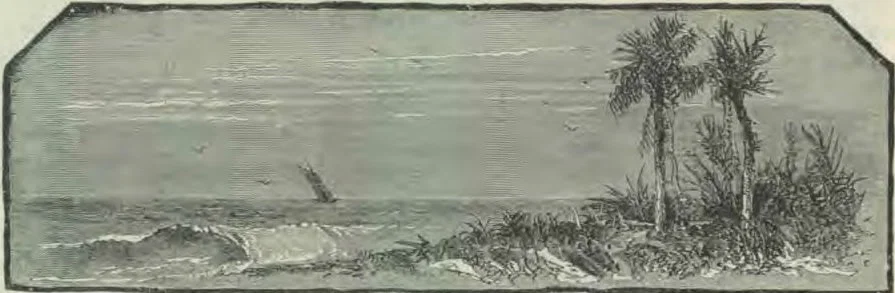
WASHED by the waters of the Gulf of Mexico on the south and west, and by the Atlantic Ocean on the east, there lies in the extreme southern part of the United States a most interesting region of country. Its peculiar shape—that of a long, narrow peninsula on the east, and a long, narrow stretch of territory from east to west on the north—gives it a greater extent of seacoast than any other division of the Union excepting Alaska.
Unless, as some claim, John and Sebastian Cabot's explorations in America in 1497 extended to this peninsula, it was first visited by an old Spaniard, one Juan Ponce de Leon, who sailed from Porto Rico for the Bahama Islands in 1512, in pursuit of a fountain whose waters would restore to the aged the bloom and vigor of youth.
Not realizing his expectations there, Leon, with his expedition, sailed in a northwesterly direction until he reached the eastern coast of the peninsula, where he landed at what is now St. Augustine, in the month of April, upon Easter Sunday. This day being called by the Spaniards Pascua Florida, and because he saw the land everywhere dotted with wild-flowers, he gave to the newly-formed territory the name of Florida.
Here Leon industriously pursued the same ignis fatuus,—the rejuvenating fountain, or the elixir of life,—suffering all kinds of hardships as he traveled southward by land and water the whole length of the peninsula on the east, even to the Tortugas Islands in the Gulf of Mexico. But after all his toil and perplexity, being unsuccessful in his Utopian enterprise, he returned to Spain a disappointed man.
Although Leon's hopes regarding the fountain were blasted, he did not yield to despondency, and we find that a few years afterward the king of Spain made him king of Florida, provided he would plant a colony there. This he undertook, bringing with him a party of emigrants to locate in these wilds, and to render such assistance as was needed to get possession of the territory.
The efforts of this expedition to subjugate the Indians was of short duration; for the men were soon driven back to their ships, and Leon received a wound from which he shortly afterwards died upon the island of Cuba, whither the expedition had fled.
During the years that immediately followed, the Spaniards made other unsuccessful attempts at subduing the Indians and gaining a foothold in the territory, until in 1565, they succeeded, under one Don Pedro Menendez, in founding St. Augustine. This occurred fifty-five years before the Pilgrims landed at Plymouth Rock, making this the oldest town in the United States.
But to accomplish his purpose, Menendez was guilty of the most fiendish cruelty. A party of Huguenots who had been given permission to come from France had planted a colony, building a fort near St. Augustine. During a heavy thunder shower, Menendez entered their fort on the land side, which they had left unguarded, thinking there was no danger from the enemy except by way of the sea, and there, while the occupants were peacefully sleeping, this monster murdered them in cold blood. A few made their escape to the woods.
However, retribution soon followed this diabolical act, and although Menendez escaped with his own life, and ruled St. Augustine some twelve years thereafter, many of his own men were as cruelly killed by the swords of the Spaniards or the clubs of the Indians.
And thus this ancient town, which was at the beginning baptized with the blood of martyrs, has been drenched with blood for three centuries; “for it has been watered with its own blood more than any other city, and its inhabitants have acknowledged more foreign rulers and various flags than any other city.”
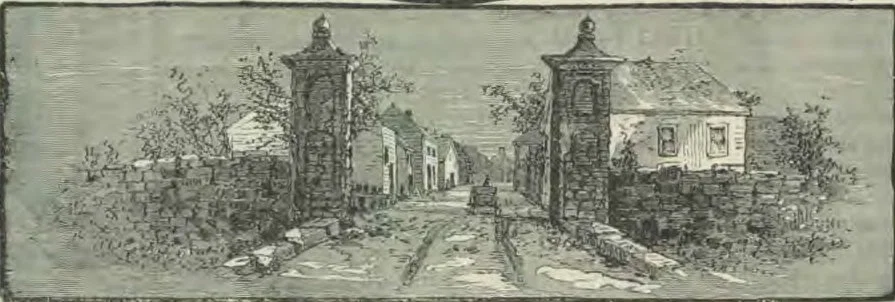
St. Augustine is built upon a narrow peninsula, formed by the Matanzas River on the east and the St. Sebastian on the south and west. It was built as a military town, and was protected on the north by a wall which stretched across the peninsula. This wall is now in ruins, but the old entrance through it, or the old famous City Gate, has been remarkably preserved. A view of it is given in the lower part of our engraving. “With its lofty, ornamented towers and sentry boxes, it is a picturesque and imposing edifice.” Between St. Augustine's harbor and the ocean lies the Anastasia Island, upon which is located a lighthouse.
One familiar with the city, after an extended acquaintance from personal observation, says that “its appearance is as quaint and peculiar as its history is bloody and remarkable. Nothing like it is seen in this country, and having been built by a people so entirely different in manners and customs than our own, it has been surrounded with an interest not shared by any other city in the land.” However, “the large influx of wealthy settlers from the North has greatly altered the character of the place within a few years, but the smart modern villas still have the air of foreign intruders, and the quaint, romantic old city retains at once its individuality and unlikeness to anything else in America.”
“Its principal building material is a unique conglomerate of fine shells and sand, known as coquina rock, found in large quantities on Anastasia Island. It is easily cut in blocks to be laid in courses, and is perhaps covered over with stucco.
“The streets are quite narrow; one which is nearly a mile long being but fifteen feet wide, and one on which a principal hotel stands being but twelve feet, while the widest is but twenty-five feet. An advantage of these narrow streets in this warm climate is, that they give shade, and increase the draft of air through them as through a flue. Indeed, some of the streets seem almost like a flue, rather than an open way; for many of the houses, with high roof and dormer windows, have, along their second stories, hanging balconies, which seem almost to touch each other over the narrow street; and the families sitting in these of a warm evening can chat confidentially, or even shake hands with their over-the-way neighbor.”
“The principal streets were formerly well paved or floored with shell concrete, portions of which are still to be seen above the shifting sand; and this flooring was so carefully swept, that the dark-eyed maids of old Castile, who then led in society here, could pass and repass without soiling their satin slippers. No rumbling wheels were permitted to crush the firm road-bed, or to whirl the dust into the airy verandas, where, in indolent repose, sat the Spanish dons and dames.”
“In the buildings of the town are some remains of elegance, as well as of much antiquity. The cathedral is unique, with its belfry in the form of a section of a bell-shaped pyramid, its chime of four bells in separate niches, and its clock, together forming a cross. The oldest of these bells is marked 1682.”
“The ‘Plaza de la Constitution’ is a fine public square in the center of the town, on which stand the ancient markets, and which is faced by the cathedral, the old palace, the convent, and other fine structures. In the center of the plaza stands a monument erected in 1812 in honor of the Spanish Liberal Constitution;” and “on the eastern side is a soldier's monument, erected in 1872 by the Ladies' Memorial Association in memory of those who gave their lives in defense of the Confederate States.”
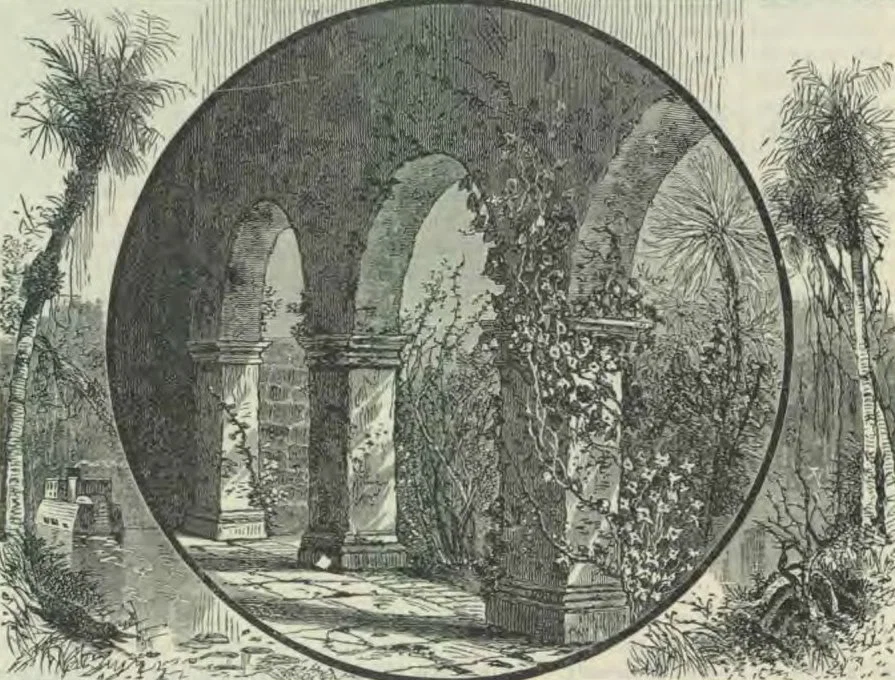
The most interesting features of old St. Augustine are “the Sea Wall and Ft. Marion. The wall is built of coquina, with a granite coping four feet wide, and is nearly a mile in length, protecting the entire ocean front of the city. It furnishes a delightful promenade, and is usually thronged on moonlight evenings. Near its south end are the old United States Barracks. At its north end, commanding the sea front, is old Ft. Marion, probably the most picturesque structure in America. Like the Sea Wall and most other edifices in St. Augustine, it is built of the coquina quarried on Anastasia Island, and the construction of it occupied one hundred and sixty-four years, having been commenced in 1592 and completed in 1756. The labor of building it was performed almost entirely by negro slaves, Indians, and prisoners of war; and every stone of it was cemented with the sweat of toiling sufferers.”
“While in the possession of the British, this was said to be the prettiest fort in the king's dominions; and with its esplanade, moats, barbicans, drawbridges, massive arched entrance, dark passages, vaulted casements, ornate sentry-boxes, frowning bastions, and mysterious dungeons—in which were found, in 1835, two skeletons in cages, victims probably of some inquisitorial cruelty—it is still a strangely attractive and interesting spot. For modern warfare it is quite useless, and not being kept up for military purposes, it is fast crumbling to decay.”
Much more of interest might be told of St. Augustine, the city so much visited by northern invalids; but its chief attractive feature is its nearly perfect climate the greater part of the year. Taken all together, it is a city that one reluctantly leaves after forming an extended acquaintance with it.
M. J. C.

Raisins: How Muscat Grapes Become Dried Raisins

Raisins.

I SUPPOSE about all the young readers of the INSTRUCTOR know what raisins are. They have no doubt often gone to the store, and bought their nickel's worth or dime's worth of this toothsome delicacy. But how many have seen them grow by the acre as luscious grapes before they were dried into raisins? Only a few, comparatively, I think; so I thought I would tell you something about it.
Out here in California the raisin grape grows to perfection. Not every kind of grape will make raisins. The “muscat” is the one used for this purpose. It is a rather white grape; at least it is not purple or black, like the grape used for wine.
Here in the San Joaquin (pronounced San-walk'-een) valley, where I live, both the wine and the raisin grape are grown to perfection. It needs a hot sun and a dry climate to make raisins. In this valley rain does not fall from May till September or October. The last two months named are the raisin months. The sun pours down its floods of light and heat, just what the raisin-maker needs to aid him in his business. The grapes are picked, and laid in long, shallow wooden trays, which are placed between the rows of vines in the vineyard. They are dried here, and should they get wet, as they sometimes do toward the end of the season, the raisins are injured if they cannot be dried by the fire.
When dried, they are taken to the “packing-house,” and packed into boxes such as you have seen in stores. They are sometimes put into the box in “clusters,” or bunches, and sometimes with the stems off. A machine called a “stemmer” takes the raisins, and frees them from the stem.
Boys, girls, and women work in the packing-house. As many as three hundred and more work in one house. They are paid so much a box for their work. There are the “sorters,” the “packers,” and the “facers.” The first separate the large and small raisins by means of a sieve. The second pack them in boxes and bags. The third place upon the surface of the raisins packed in each box, one layer of raisins made flat by the thumb and finger. These flattened raisins are placed nicely in rows, and the box is then ready to be nailed up and shipped to market. These boxes hold about twenty pounds each. Smaller boxes, containing raisins packed and faced with especial care, and handsomely decorated with illuminated paper, are called “cartoons.” These are used in the trade as samples.
The grape vineyards vary from a few acres up to hundreds of acres. For instance, Mr. Robt. Barton, of Fresno City, Fresno Co., has one of six hundred and forty acres. Think of it! A square mile of vineyard! Mr. A. B. Butler, Col. Forsyth, and others have each a large acreage of vines. This county is the raisin center of the world. Here the finest varieties are produced.
Raisins, as you might suppose, are quite cheap where grapes grow so plentifully. They can be bought from the packing houses before boxing at five cents a pound. Grape land brings large sums of money. It will surprise you when I tell you that some of it sells for a thousand dollars an acre. Land for this price is set out in good, well-bearing vines. Men who own large vineyards are very rich, their yearly profits being very great.
N. J. Bowers.

BRICK-TOP

“Brick-top! Brick-top!” cried the boys as the school let out.
The new boy, who, unfortunately for him, had to tell his name that day, “Tommy Brick, marm,” pulled his cap down over his ears in vain attempt to cover every lock of his hair. The fact that it was very red, together with his unusual name, had troubled him ever since he could remember, and he had dreaded the first day at the new school. His legs soon took him far away from his teasing companions, however, and soon he had reached a large brick house, standing somewhat back from the village street. Opening the iron gate, he ran up the steps, pushed the screen-door back, and walked in.
“How’s Naneen to-day?” he said. “Oh! I forgot; how do you do, Mrs. Dimon? Mother’s well—I always forget to say that and take off my cap,” added he, blushing.
“Go right up and see Naneen,” said Grandma Dimon pleasantly. “She’s had one of her bad spells to-day, but she’ll want to see you.”
Tommy tip-toed with his squeaky boots up the winding stairs.
“Hallo!” he said softly, as he came in where the little girl lay. “Do you like kittens, Naneen?”
“O Tommy!” was all she said, but looked with longing eyes at the huge pockets of his ulster.
“It’s too bad I couldn’t bring it with me. I thought of taking it in my pocket, but I had to go to school to-day. I’ll bring it over after supper.”
“I’m so glad. I have wanted a little kittie so much,” said Naneen.
“This one is all black, not a speck of white on it.”
“How nice!”
For a few minutes neither of the children spoke. Naneen was thinking of the much-loved kittie, for she loved it already. Tommy was thinking soberly about his first day at school.
“I wish I could change my name,” he said at last.
“What makes you want to change it?” asked Naneen.
“Why, you see—don’t you see—my hair, you know; and then ‘Brick’ is such a name, and the fellows call me names.”
“Well, I’d just as soon have my name ‘Brick’ as ‘Stone.’ There’s Jack Stone, his hair is as red as yours.”
“Is it, honest?” asked Tommy in grateful surprise.
“Of course it is.”
“But then, the fellows wouldn’t think of calling him ‘Stone-top.’”
Naneen thought a moment. “Do they—do they call you ‘Brick-top’?” she asked gently.
“Yes!” burst out Tommy.
“I wouldn’t care, anyway,” said Naneen sympathetically.
“Do you ever call any names back?”
“I haven’t yet. Mother told me not to mind ’em, and I try not to, but I’ve thought of lots and lots of names I could call them,” he added honestly.
“Of course, it’s easy enough to think of names to call anybody, but what good does it do? Would you feel a bit better now if you’d called back any amount of horrid names when they called you ‘Brick-top’?”
“No, I don’t think I would.”
“Then you see the trouble is if everybody called back names to whom names were called, it would be nothing but calling names all over the world, and just think how silly that would be?”
“There wouldn’t be much time left for anything else, I reckon,” said Tommy.
“I guess there wouldn’t. Why, Tommy, some of the best people in the world have been called names. I remembered hearing grandpa tell how Gen. Jackson was called ‘Old Hickory’ by the soldiers, and there’s your favorite, Gen. Grant. Grandpa was telling me a story the other day how he was called ‘Useless Grant’ just because his name was Ulysses! Supposing he’d got mad and called names back?”
“He was a hero, and knew too much.”
“Grandpa said when Gen. Grant heard that he was called that, he just laughed, and kept straight on doing brave things and being a great, good man until he died. He didn’t stop to call names, and so everybody loved and respected him.”
“That’s just like him,” said Tommy with decision, as he buttoned up his ulster. “I’m awful glad I haven’t called any names back, and I don’t mean to. I might have, though, if you hadn’t told me about ‘Old Hickory,’ and ‘Useless Grant.’ I’m so glad I’ve got you to tell things to, ’cause you seem to know just how a fellow feels,—and—and you have such excellent judgment!”
Tommy said the last few words with great importance, peculiar to him at times when he had relieved his feelings.
“It isn’t my judgment that makes the difference,” said Naneen with a bright smile; then in a gentle, tender voice the little girl added, “But Tommy, there’s a greater, grander Hero who was called cruel names—the worst and cruelest names—and yet He never called names back. It was so hard, too, for He was perfect, and so full of love for those who treated Him so.”
Tommy hastily brushed his chapped hand across his eyes.
“I know whom you mean, Naneen. It makes a fellow feel different when he thinks of him. He don’t feel like calling names any longer.” Then with a hearty “good by” the boy was gone.—Little Christian.

RICHES

“I just wish I were rich! I know what I’d do!” said a little boy one day, and he gave his head a knowing nod, as if he thought a great deal more than he chose to tell.
“Poor child,” I said, “you don’t know everything yet; you’ll be a great deal wiser when you are older.
“Let me tell you the story of the Duke of Brunswick and his diamonds. He had more than two million dollars’ worth of diamonds, and they made a prisoner of him. He never dared to leave home even for a night, lest some one should steal them. He lived in a house built so that he couldn’t take any comfort in it. It was much like a prison, it was made so thick and strong, with the doors and windows barred and bolted. A very thick, high wall was built outside the house all around it, and on the top of the wall was an iron railing tipped off with sharp points that would cut like a knife, and so contrived that if a person touched one of them, a chime of bells would instantly ring. This railing cost a great deal of money, what would seem a large fortune to us.
“He kept his diamonds in a safe built in a thick wall in his bedroom, where he could look at them whenever he wished. And his bed was placed against this wall, so that no thief could get at them without waking or killing him. The safe was very strong, made of stone and iron. If any one should try to pry it open, a number of guns would go off that would kill the person at once, and at the same time bells would be set ringing in every room in the house.
“He had but one window in his bedroom, and that so high up he could not see out, and no one could get in. The door was made of the stoutest iron, and no one could get in without understanding the very curious lock. Besides all this, he kept a case of pistols, all loaded, on his table.”
“What a room! What comfort could that man take, although he was so rich? Poor man! Poor rich man! He didn’t have half the enjoyment in life that you children have, who have no diamonds to take care of, and can run in and out and play as you have a mind to.
You see it is not money that makes a person happy. No, indeed. The Bible says: “Better is little with the fear of the Lord than great treasure and trouble therewith,” and that “godliness with contentment is great gain.” It tells us also to lay up for ourselves “treasures in heaven, where thieves do not break through and steal.”—The Child’s Paper.

The Adornment of a Good Deed

A good deed adorns him who performs it, while it pleases him who beholds it.

THE BOY WHO HELPS HIS MOTHER.

As I went down the street to-day, I saw a little lad Whose face was just the kind of face To make a person glad. It was so plump and rosy-cheeked, So cheerful and so bright, It made me think of apple-time, And filled me with delight.
I saw him busily at work, While, blithe as blackbird’s song, His merry, mellow whistle ran The pleasant street along. “O, that’s the kind of lad I like!” I thought as I passed by; “These busy, cheery, whistling boys Make grand men by-and-by.”
Just then a playmate came along. And leaned across the gate— A plan that promised lots of fun And frolic to relate. “The boys are waiting for us now, So hurry up!” he cried; My little whistler shook his head, And, “Can’t come,” he replied.
“Can’t come? Why not, I’d like to know?” “What hinders?” asked the other. “Why, don’t you see?” came the reply. “I’m busy helping mother. She’s lots to do, and so I like To help her all I can; So I’ve no time for fun just now,” Said this dear little man.
“I like to hear you talk like that,” I told the little lad; “Help mother all you can, and make Her kind heart light and glad.” It does me good to think of him, And know that there are others, Who, like this manly little boy, Take hold and help their mothers.
—Eben E. Rexford, in Golden Days.

THE TWO GOATS.

Toby had a brown and white goat, of which he was very fond. He had a little cart also, and used to drive out with his goat.
Tommy was Toby’s playmate, and lived not far away. He liked very much to ride after Toby’s goat.
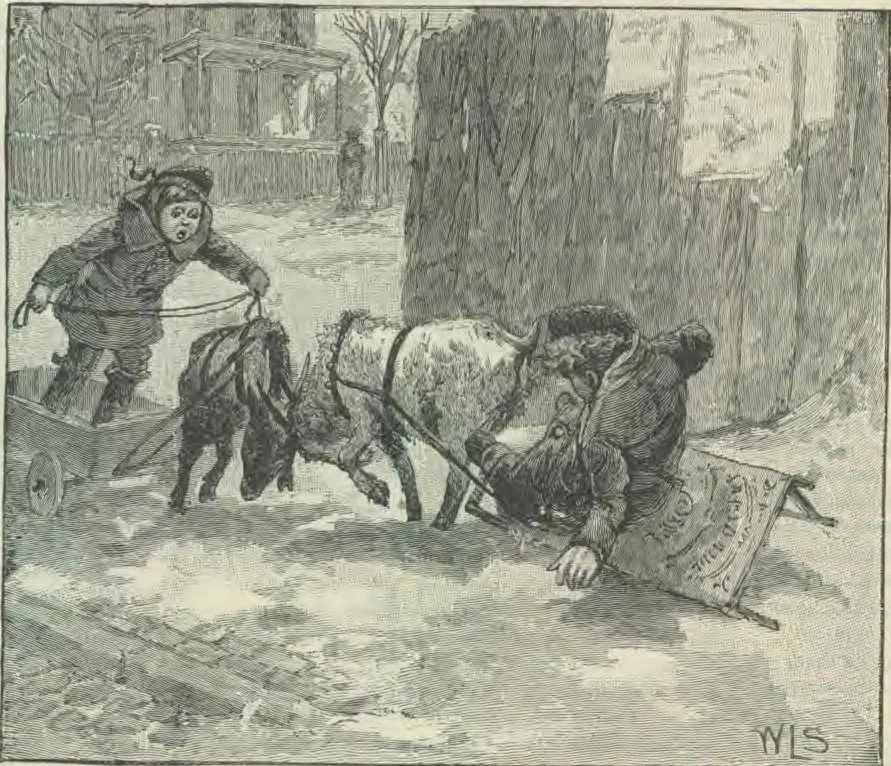
Tommy’s birthday came in December, and what do you think his papa gave him for a present? Why, it was a little goat; and this one was all white, and had black horns. It was called Snowball. Tommy was very happy, and thought he would go at once and make a call on Toby. There was snow upon the ground, and so Tommy put Snowball to his little red sled. He set out in fine style. Oh, how proud he was of his handsome team!
As Tommy turned the corner, he saw Toby coming in his goat cart. Toby shouted with surprise when he saw Tommy’s goat. The boys hurried to meet each other. The path was wide, and Tommy tried to turn out, and make room for Toby. But Snowball would not turn. He wanted to have his own way. Tommy pulled first one rein and then the other. It was of no use. Snowball went straight ahead.
“You must turn out, Toby,” shouted Tommy.
“I can’t,” answered Toby, “my goat will not mind me!”
In fact, both goats wanted to do as they pleased. They began to run, with their horns pointed out ahead.
“Whoa! whoa! whoa!” shouted the two boys. It was of no use. The goats would not obey.
Bump, they went against each other with all their might. Over went the sled. Over went the cart. Toby and Tommy tumbled headlong into the snow; but, after all, nobody was hurt.
It is a bad thing for goats and boys always to have their own way.—Penn Andineh.

LITTLE PUT-OFF.

“I THINK you would better study your lesson before you go to out play, Mollie”
“O, mamma, I want to play a little first.”
“Your lesson takes you only about fifteen minutes.”
“I want to go and play a little while with Carrie Brooks, mamma, and then I’ll come and study.”
“And you must not forget the reading of your chapter to grandma.”
“No, mamma, I’ll come very soon.”
“Carrie is not at home,” said Carrie’s mother. “She has gone over to Lulu Rand’s.”
“Then I think I’ll go and see Kitty Morton,” said Mollie to herself.
She thought of the unlearned lesson at home, but did not feel any more like going to it than she had before.
“Kitty is gone to Lulu Rand’s,” said Mrs. Morton. “How is it that you are not there? Lulu has a little party this afternoon.”
It was a great surprise to hear this. Lulu was her dearest friend. How could she be having a party, and she not invited? Very mournfully Mollie went home. If all the other girls had gone to Lulu’s, it was of no use going to see any of them. She lingered in the garden for awhile, and then went to grandma’s room.
“I have been waiting almost all the afternoon for the dear little eyes,” said grandma. And Mollie felt ashamed and sorry that she had not come sooner, when grandma could see to read very little for herself.
It was almost tea-time when she went downstairs, and tea was over before she went to look for her book to study the long-neglected spelling lesson.
“What’s this?” she said, as a note fell from it.
“It’s a note Lulu Rand gave me after dinner to give to you,” said her brother Jack. “I slipped it into your book, so you’d be sure to find it.”
Poor Mollie gave a woeful wail.
“It’s the invitation to Lulu’s party,” she said. “If I had studied my lesson at first, I could have gone. O, dear, I’ll never put off things again.”—Sydney Dayre.

A SPELLING BEE.

“I’m going to have a spelling-bee to-night,” said Uncle John, “and I’ll give a pair of skates to the boy that can best spell man.”
The children turned, and stared into each other’s eyes.
“Best spell man, Uncle John? Why, there’s only one way!” they cried.
“There are all sorts of ways,” replied Uncle John. “I’ll leave you to think of it awhile;” and he buttoned up his coat and went away.
“What does he mean?” asked Bob.
“I think it’s a joke,” said Harry thoughtfully; “and when Uncle John asks me, I’m going to say, Why, m-a-n, of course.”
“It’s a conundrum, I know,” said Jo, and he leaned his head on his hand, and settled down to think. Time went slowly to the puzzled boys, for all their fun that day. It seemed as if that after-supper time would never come; but it came at last, and Uncle John came too, with a shiny skate runner peeping out of his great coat pocket.
Uncle John did not delay; he sat down and looked straight into Harry’s eyes.
“Been a good boy to-day, Hal?”
“Yes, n-o,” said Harry, flushing. “I did something Aunt Mag told me not to do, because Ned Barnes dared me to. I can’t bear a boy to dare me. What’s that to do with spelling man,” he added, half to himself.
But Uncle John had turned to Bob.
“Had a good day, my boy?”
“Haven’t had fun enough,” answered Bobbie stoutly. “It’s all Jo’s fault, too. We boys wanted the pond to ourselves for one day, and we made up our minds that when the girls came, we’d clear them off. But Jo, he—”
“I think this is Jo’s to tell,” interrupted Uncle John. “How was it, boy?”
“Why,” said Jo, “I thought the girls had as much right on the pond as the boys. So I spoke to one or two of the bigger boys, and they thought so too, and we stopped it all. I thought it was mean to treat girls that way.”
There came a flash from Uncle John’s pocket; the next minute the skates were on Jo’s knee.
“The spelling-match is over,” said Uncle John, “and Jo has won the prize.”
Three bewildered faces mutely questioned him.
“Boys,” he answered gravely, “we’ve been spelling man, not in letters, but in acts. I told you there were different ways, and we’ve proved it here to-night. Think it over, boys, and see.”—The Child’s Paper.
Continue reading: ONE WAY OUT OF IT