Jesus was the Commander of heaven, one equal with God, and yet he condescended to lay aside his kingly crown, his royal robe, and clothed his divinity with humanity. The incarnation of Christ in human flesh is a mystery. He could have come to earth as one with a remarkable appearance, unlike the sons of men. His countenance could have shone with glory, and his form could have been of remarkable grace. He could have presented such an appearance as to charm the beholder; but this was not according to the plan devised in the courts of God. He was to bear the characteristics of the human family, and the Jewish race. In all respects the Son of God was to wear the same features as did other human beings. He was not to have such beauty of person as would make him singular among men. He was to manifest no wonderful charms by which to attract attention to himself. He came as a representative of the human family before heaven and earth. He was to stand as man’s substitute and surety. He was to live the life of humanity in such a way as to contradict the assertion that Satan had made that humanity was his everlasting possession, and that God himself could not take man out of his adversary’s hands.
Christ appeared upon the scene as a babe, as a child, having no extra advantages in the world. He came of poor parentage, he had no privileges that the poor have not known. He experienced the difficulties that the poor and lowly experience from babyhood to childhood, from youth to manhood. There is a mystery surrounding the birth of Christ that can not and need not be explained. Nearly two thousand years ago a voice strange and mysterious was heard in heaven, proceeding from the throne of God, and saying: “Sacrifice and offering thou wouldest not, but a body hast thou prepared me.” “Lo, I come; in the volume of the book it is5written of me, I delight to do thy will, O my God; yea, thy law is within my heart.” God manifest in the flesh came to our world, being justified in the Spirit, seen of angels, preached unto the gentiles, believed on in the world, received up into glory.
In contemplating the incarnation of Christ in humanity, we stand baffled before an unfathomable mystery, that the human mind can not comprehend. The more we reflect upon it, the more amazing does it appear. How wide is the contrast between the divinity of Christ and the helpless infant in Bethlehem’s manger! How can we span the distance between the mighty God and a helpless child? And yet the Creator of worlds, he in whom was the fulness of the Godhead bodily, was manifest in the helpless babe in the manger. Far higher than any of the angels, equal with the Father in dignity and glory, and yet wearing the garb of humanity! Divinity and humanity were mysteriously combined, and man and God became one. It is in this union that we find the hope of our fallen race. Looking upon Christ in humanity, we look upon God, and see in him the brightness of his glory, the express image of his person.
Christ lived the life of a toiler from his earliest years. In his youth he worked with his father at the carpenter’s trade, and thus honored all labor. Tho he was the King of glory, yet by his practice of following a humble employment, he rebuked idleness in every member of the human family, and dignified all labor as noble and Christlike. Those who indulge in idleness depart from the lesson that Christ has given in his example for all humanity. From childhood he was a pattern of obedience and industry. He was as a pleasant sunbeam in the home circle. Faithfully and cheerfully he acted his part in doing the humble duties that his lowly calling required. As the world’s Redeemer, he had chosen a most humble position. He had clothed his divinity with humanity in order that he might be able to reach humanity. He could sympathize with the poor; for he understood the inconveniences of poverty. He himself had shared the burdens of the lowly. The world’s Redeemer did not live a life of selfish ease and pleasure. He did not choose a position that would bring to him the praise and flattery of men. He knew by experience the hardships of those who toil for their living, and could comfort and encourage all humble workers. The record of the history of the humble labor of his life of burden bearing, is written for our admonition and comfort. Those who have a true conception of the life of Christ, can never feel that they must make a distinction between classes, and set up the wealthy as superior to the lowly poor. The King of glory lived a life of toil.
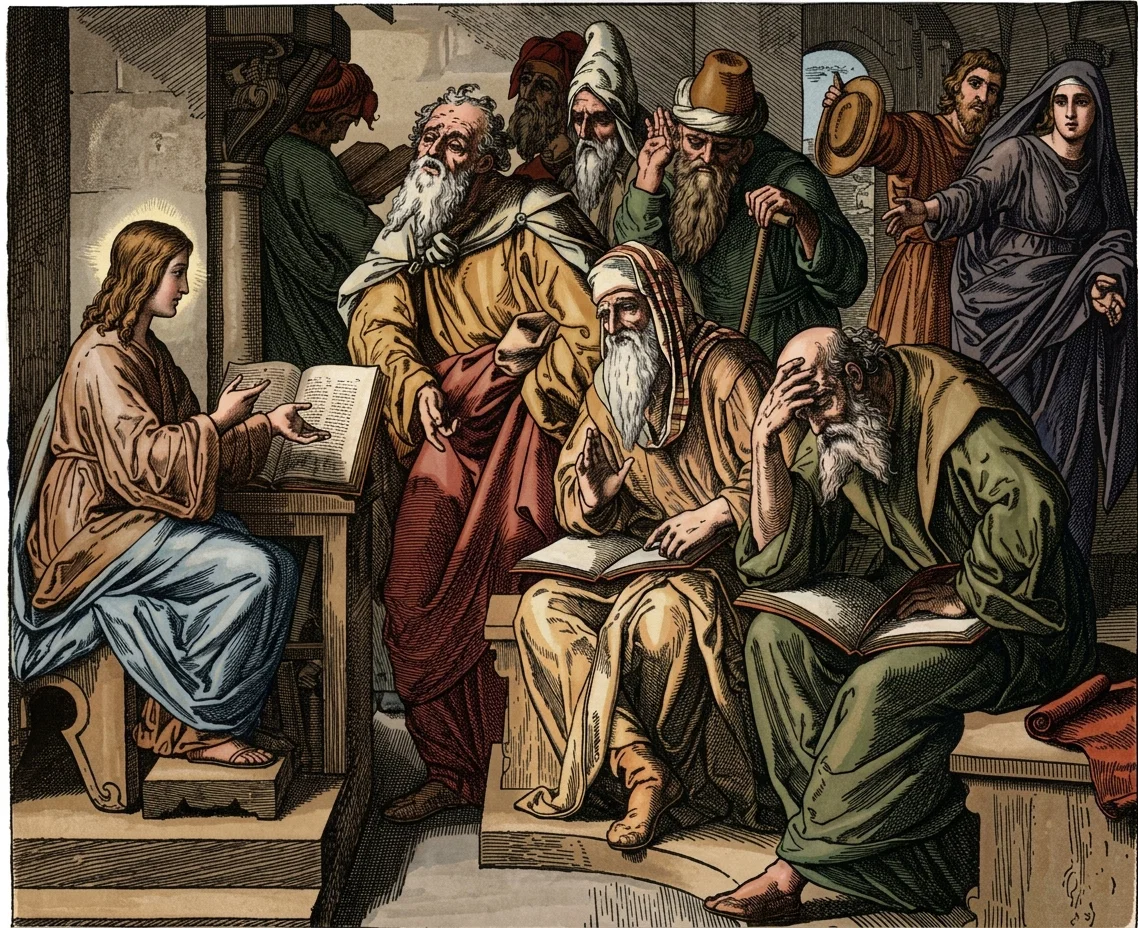
It is written of Jesus in childhood that “the child grew, and waxed strong in spirit, filled with wisdom; and the grace of God was upon him.” When only twelve years of age, he made manifest the fact that his mind was developing along spiritual lines. His parents went to Jerusalem every year to the feast of the Passover, and in his twelfth year Jesus accompanied them to the city. “And when they had fulfilled the days, as they returned, the child Jesus tarried behind in Jerusalem; and Joseph and his mother knew not of it. But they, supposing him to have been in the company, went a day’s journey; and they sought him among their kinsfolk and acquaintance; and when they found him not, they turned back again to Jerusalem, seeking him.” For three days they sought him anxiously; for they were awakened to a sense of the responsibility of the charge that God had placed upon them. “And it came to pass, that after three days they found him in the temple, sitting in the midst of the doctors, both hearing them, and asking them questions. And all that heard him were astonished at his understanding and answers.” His parents listened in amazement, as they heard his searching inquiries. Jesus was taking advantage of the providential occasion that had opened to him to diffuse light. He had led the rabbis and teachers to speak of the prophecies concerning the appearing of Messiah. They had presented their view of the matter, speaking of the wonderful elevation that this blessing would bring to the Jewish nation; but Jesus presented the prophecy of Isaiah, asking them the meaning of those scriptures that brought to view the humiliation, suffering, and death of the Son of God. Tho taking the attitude of a learner, Christ imparted light in every word he uttered. He interpreted the Scripture to the darkened mind of the rabbis, and gave them clear light in regard to the Lamb of God, that taketh away the sins of the world. The sharp, clear questions of the child learner brought a flood of light to their darkened understanding. The truth shone out as the clear shining of a light in a darkened place, as he received and imparted the knowledge of the plan of salvation.
It is plainly stated that Christ grew in knowledge. What a lesson is found in this incident in the life of Christ for all youth! If they shall diligently search the word of God, and through the Holy Spirit receive divine guidance, they will be able to impart light to others. By communicating the grace given them, new grace will be imparted from Heaven. The more the human agent communicates to others the riches of the grace of Christ, the more clear and vigorous will become his understanding, and the more richly will the grace of God abide in his own heart. If the youth will remain as humble as did the child Jesus, they will become channels of light.
The doctors and the wise men were amazed at the questions of the child Jesus, and, desiring to encourage such a student of the prophecies, they sought to draw out the knowledge he had obtained. Joseph and Mary were as much astonished, as they heard the wise answers of their Son, as were the learned men themselves. When there was a pause in the conversation, Mary, the mother of Jesus, approached her Son, and asked, “Son, why hast thou thus dealt with us? behold, thy father and I have sought thee sorrowing.” Divine light shone through humanity as Jesus lifted his right hand, and asked, “How is it that, ye sought me? wist ye not that I must be about my Father’s business? And they understood not the saying which he spake unto them.” They did not comprehend the true meaning of his words. But, tho he was the Son of God, he went down with his parents and came unto Nazareth, and was subject unto them. And, tho his mother did not understand at that time the meaning of his words, yet “she kept all these sayings in her heart.”
At the age of twelve the Holy Spirit was abiding upon Jesus, and he felt something of the burden of the mission for which he had come to our world. His soul was stirred into action. As one who would learn, he asked questions of no ordinary character, by which he flashed light into the minds of his hearers, and brought them to an understanding of the prophecies and the true mission and work of the Messiah they were expecting. The Jewish people were cherishing erroneous ideas. They were anticipating grand and wonderful things, hoping for their own personal exaltation above the nations of the earth at the Messiah’s appearing. They were looking for the glory that will attend the second coming of Christ, and overlooking the humiliation that would attend his first advent. But Jesus, in his questions about the prophecies of Isaiah that pointed to his first appearing, flashed light into the minds of those who were willing to receive the truth. He himself had given these prophecies before his incarnation in humanity, and as the Holy Spirit brought these things to his mind, and impressed him with regard to the great work that he was to accomplish, he imparted light and knowledge to those around him.
Tho he increased in knowledge, and the grace of God was upon him, yet he did not become lifted up in pride, or feel that he was above doing the most humble toil. He took his share of the burden, together with his father, mother, and brethren. He toiled to sustain the family, and shared in the work that would meet the expenses of the household.6Tho his wisdom had astonished the doctors, yet he meekly subjected himself to his human guardians, bore his part in the family burdens, and worked with his own hands as any toiler would work. It is stated of Jesus that (as he advanced in years) he “increased in wisdom and stature, and in favor with God and man.”
The knowledge he was daily obtaining of his wonderful mission did not disqualify him for performing the most humble duties. He cheerfully took up the work that devolves upon youth who dwell in humble households pressed by poverty. He understood the temptations of children; for he bore their sorrows and trials. Firm and steadfast was his purpose to do the right. Tho enticed to evil, he refused to depart in a single instance from the strictest truth and rectitude. He maintained perfect filial obedience; but his spotless life aroused the envy and jealousy of his brethren. His childhood and youth were anything but smooth and joyous. His brethren did not believe on him, and were annoyed because he did not in all things act as they did, and become one of them in the practice of evil. In his home life he was cheerful, but never boisterous. He ever maintained the attitude of a learner. He took great delight in nature, and God was his teacher.
Wonderful Knowledge.
By Ellet Joseph Waggoner
“By his knowledge shall my righteous servant justify many; for he shall bear their iniquities,” says the Lord. Isa. 53:11. Thus by forgiving sins he will build the walls of Jerusalem (Ps. 51:18), and restore her captive children. “O the depth of the riches both of the wisdom and knowledge of God! how unsearchable are his judgments, and his ways past finding out!” Let no one, therefore, presume to criticize God’s plan, or to reject it because he can not understand it. “For who hath known the mind of the Lord? or who hath been his counselor?” “For of him, and through him, and to him, are all things; to whom be glory forever. Amen.” E. J. W.
THE BEAUTIFUL CITY.
By A. R. Wilcox
BY A. R. WILCOX.
THERE'S a beautiful city up yonder, ’tis said,
Where the beams of God's glory forever are shed,
And the streets of pure gold that reflect to the sight
The image fair of the mansions of light.
And the walls are of jewels so rich and so rare
That the treasures of earth can nothing compare,
And the gates are of pearl—O, what glory and song
Will ascend to the Builder thro’ all the day long!
I can see life's pure stream that onward doth glide,
With the tree that blooms there in healing applied,
And the saints who have gather’d in the evergreen bowers,
With their harps strung to music far sweeter than ours.
O, the melody rich that fills with delight,
And that bears me away as on wings in its flight!
How it speaks of that land in the breath of the song,
And it tells of the city I’ve heard of so long!
GARDEN OF EDEN AND THE GOSPEL.
By S. N. H.
BY S. N. H.
“AND the Lord God planted a garden eastward in Eden; and there he put the man whom he had formed. And out of the ground made the Lord God to grow every tree that is pleasant to the sight, and good for food; the tree of life also in the midst of the garden, and the tree of knowledge of good and evil.” Gen. 2:8, 9.
Never until the mind is educated to believe what God has said, on the authority of God’s testimony alone, can we draw from the Scriptures the sweetness there is in them. The Lord never makes a mistake, so as to have to say, as man often does, “Had I known that such and such things would have happened, I would have done thus and so.” The wise man said: “The thing that hath been, it is that which shall be; and that which is done is that which shall be done; and there is no new thing under the sun. Is there anything whereof it may be said, See, this is new? it hath been already of old time, which was before us.” Eccl. 1:9, 10. Again, “I know that, whatsoever God doeth, it shall be forever; nothing can be put to it, nor anything taken from it; and God doeth it, that men should fear before him. That which hath been is now; and that which is to be hath already been; and God requireth that which is past.” Eccl. 3:14, 15.
In the Garden of Eden was taught the Gospel of Jesus Christ. If man had not partaken of the forbidden tree, then he never would have had the conflicts of life which have arisen in consequence of sin. Were not all of our unpleasant experiences with strife and evil undeveloped in the first transgression? It is transgression of God’s just requirements that forces us to drink the bitter draught of “the waters of Marah.” There is a remedy; for is there not in the Gospel everything “that is pleasant to the sight and good for food?” No human mind can fully comprehend the blessings there are in the Gospel. Look at this promise: “Eye hath not seen, nor ear heard, neither have entered into the heart of man, the things which God hath prepared for them that love him.” It is now by the agency of the Holy Spirit that we obtain a knowledge of these things. “But God hath revealed them unto us by his Spirit; for the Spirit searcheth all things, yea, the deep things of God. . . . But the natural man receiveth not the things of the Spirit of God; for they are foolishness unto him; neither can he know them, because they are spiritually discerned.” 1 Cor. 2:10–14.
In the garden of the Gospel is everything that is pleasant to the sight, and good for food; for “godliness is profitable unto all things, having promise of the life that now is, and of that which is to come.” 1 Tim. 4:8. “There is no man that hath left house, or brethren, or sisters, or father, or mother, or wife, or children, or lands, for my sake, and the Gospel’s, but he shall receive an hundred-fold now in this time, houses, and brethren, and sisters, and mothers, and children, and lands, with persecutions; and in the world to come eternal life.” Could any soul ask for more? Is there not embraced in the Gospel above all that we can ask or even think? Had Adam remained faithful, would he not have enjoyed all of these spiritual blessings? And was not, therefore, the Garden of Eden, with its rich, immortal, never-fading flowers, with everything pleasant to the sight and good for food, an object lesson of the Gospel of Jesus Christ?
Man was not to be an idler in the garden, for “the Lord God took the man, and put him into the Garden of Eden to dress it and to keep it.” Gen. 2:15. That home, beautified by the hand of God himself, was the dwelling of Adam and Eve. The blue heavens were its dome; the earth, carpeted with delicate flowers of every hue and color, was its floor; the leafy trees were its canopy, and the walls adorned by the Master artist, under the bowers of Adam’s own training. He could sit and receive the visits of angels, listening to their instruction with happy meditation. This beautiful garden was to be their home, their special residence. Nothing could add to their happiness only as they learned more and more of God as he revealed himself in nature. They could converse not only with the angels of God, but God himself could talk with them without any obscuring veil.
The Tree of Life
was in the midst of the garden, the glory of which surpassed all other trees. Its fruit, like apples of gold and silver, was designed to impart eternal life and perpetuate immortality. Its leaves contained healing properties. Altho no disease would have ever been known if sin had not ruined all, yet in the tree of life were salvation and properties that, had the holy pair continued obedient to God’s commandment, would have brought to them every blessing that a righteous man can receive in Christ Jesus. But man sinned. This made his relation to God of such a nature that he could not longer remain in the garden, to enjoy its blessings. For by a continual eating of the tree of life his existence would have been perpetuated, and he would thus have become an immortal sinner. “Therefore the Lord God sent him forth from the Garden of Eden, to till the ground from whence he was taken. So he drove out the man; and he placed at the east of the Garden of Eden cherubim, and a flaming sword which turned every way, to keep the way of the tree of life.” Gen. 3:22–24.
It was the life of Christ in the tree that gave it the qualities of life, health, and immortal vigor. It was because of this tree being in the garden that man was deprived of entering and partaking of it. The same life is in Christ still. The same life is in his word as he reveals himself thus to the human family. It became necessary that Christ should take the nature of man after man had sinned, and thus bring down to him in his sinful condition that life which was in the tree, so that man could take hold of mercy and blessings in him, be made as innocent in Christ as Adam was before he sinned, bear the same image of God that Adam bore, in order to again enter past the flaming swords, and enjoy the blessings found in the garden. The Lord is our strength and happiness. He becomes the great storehouse of blessings, from which the human agent may draw upon every occasion. He becomes a present help in every time of need.
Christ is to us the tree of life in the midst of the Paradise of God. His branches reach to the lower world, that the blessings contained in the tree of life, but lost by sin, and purchased by Christ for us, might be brought within our reach. From this tree we may pluck and eat, and then guide others to it, that they also may eat. The Holy Spirit is our Comforter, and Christ’s representative. He is ever present with us to present to us the mellow fruit from the tree of life. The office work of the Holy Spirit is to bring to our remembrance all things that Christ has spoken for our comfort, that we may have hope and a sweet sense of our forgiveness of sins. A rich current of praise and thanksgiving will flow from our soul; the sweet Spirit of Jesus will kindle in our heart grateful praise; our souls will be uplifted with a sense of security; and the unfailing, inexhaustible righteousness of Christ becomes our righteousness by faith. In the words of the prophet, “Wherefore do ye spend money for that which is not bread? and your labor for that which satisfieth not? hearken diligently unto me, and eat ye that which is good, and let your soul delight itself in fatness. Incline your ear, and come unto me; hear, and your soul shall live; and I will make an everlasting covenant with you, even the sure mercies of David.” Isa. 55:2, 3.
Praise
By H. More
PRAISE takes in, in its wide range, enjoyment of present, remembrance of past, and anticipation of future blessings. Prayer points the only way to heaven; praise is already there.—H. More.
Why the World Is Not Reformed
By Adam
ONE reason why the world is not reformed is because every man would have others make a beginning, and never thinks of himself.—Adam.
Preaching Christ Crucified
It is one thing to preach the crucifixion of Christ; it is another thing to preach “Christ crucified.”—United Presbyterian.
Qualities That Attract and Retain
We attract hearts by the qualities we display; we retain them by the qualities we possess.—Sword.
Religion Inspires Duty
“NOTHING can inspire religious duty or animation but religion.”
Success and Usefulness
“THE fool’s guerdon is success; the wise man’s usefulness.”
THOUGHTS FROM THE SEPTUAGINT.
By F. D. Starr
BY F. D. STARR.
The Apostasy.
The term “apostasy” has become quite familiar in religious parlance, and it is certainly not an unscriptural expression. Paul stated to the Thessalonians that before the coming of Christ, there would come the apostasia (apostasy). 2 Thess. 2:3. This word is rendered by the translators, “a falling away.” To get a more complete idea of the meaning of this word, and what it is to apostatize, we will notice some uses made of this term in the Septuagint.
In Num. 14:9 we read, “Only rebel not ye against the Lord,” etc. Also in verse 31, “They shall know the land which ye have despised.” Here the words rendered “rebel” and “despised” are translated in the Greek apostatai and apostete, both forms of the Greek word apostasia, meaning to apostatize. In Deut. 13:10 we find this statement: “He hath sought to thrust thee away from the Lord thy God.” Also verse 13 reads: “Certain men, the children of Belial, are gone out from among you, and hath withdrawn the inhabitants of their city, saying, Let us go and serve other gods, which ye have not known.” In these instances, the terms “thrust . . . away” and “withdrawn” are rendered in the Septuagint “apostatize.”
In Deut. 24:1–3 we read, “Let him write her a bill of divorcement.” This is called in the Greek biblion apostasion, the bill (or book) of apostasy. These words were quoted directly by our Lord, as recorded in Matt. 5:31; 19:7, and Mark 10:4.
From all these instances we get a good understanding of the meaning of the term “apostasy.” It signifies rebellion, withdrawal, turning away from, despising, and proving untrue, as a false-hearted companion toward one with whom lifelong union had been solemnly promised. Such has been the course of the professed church of Christ, as proven by her history since apostolic times; and, in fact, this course has been characteristic of the church for ages before the Christian era. How natural to apostatize or backslide!
Knowing His Own.
In 2 Tim. 2:19 we read: “The Lord knoweth them that are his. And, Let every one that nameth the name of Christ depart from iniquity.” It may not have occurred to the reader that Paul was here quoting Old Testament language, but a comparison of Num. 16:5, as rendered in the Septuagint, would very clearly indicate that such was the case. The account is concerning Korah and his company, how the earth opened her mouth and swallowed them up. The statement of the Authorized Version is, “Even to-morrow the Lord will show who are his, and who is holy; and will cause him to come near unto him; even him whom he hath chosen will he cause to come near unto him.” In the Septuagint, instead of “will show” or “make known,” we have the identical words used by Paul in the New Testament quotation rendered “knoweth them that are his.” God knoweth them that are his and them that are holy.”
If one will take the pains to see how many times the admonition was given to “separate,” “depart,” etc., from Korah and his company (verses 21, 24, 26), he will discover the application also of the command, “Depart from iniquity.” The apostle proceeds to speak of “vessels” (2 Tim. 2:20, 21), and their use in the service of God. Some were unto honor and some to dishonor. This reminds one that there were some vessels used by Korah and his company. Such a use was to be made of these vessels as would forever remind future generations of the dishonorable course of these rebellious men (Num. 16:37–40), and constitute a warning to us, that we might take such a course that in the “great house” of the Lord we may not be vessels that shall have an ignominious history as a memorial, but vessels unto honor. Based upon the awful consequences of the rebellion described in Numbers 16, the warning of Paul to “depart from iniquity,” and “the Lord knoweth them that are his,” has greatly augmented force.
“SATURDAY-KEEPERS” AND THE “LAW OF LIBERTY.”
By W. N. Glenn
BY W. N. GLENN.
A LITTLE tract, recently received, asks “Saturday-keepers” several questions, among which is a request for “one text proving that man under the Gospel will be judged by any other law than that of James 2:12.” In the first place, those who keep the Sabbath “according to the commandment” do not keep “Saturday.” The Sabbath of the Lord is the seventh day of the week according to God’s reckoning of time. “The evening and the morning were the first day,” the second day, and so on. See Genesis 1. All through the Bible this mode of reckoning the day is recognized. “From even unto even shall ye celebrate your Sabbath.” Saturday, as all the days at the present time, is reckoned from midnight to midnight; therefore Saturday can not be the Sabbath of the Lord. The Sabbath, or true seventh day of the week, must begin at sunset of the time now called Friday, and close at sunset of the period called Saturday. The bringing into the Christian church of the change of the days from God’s order, and the naming of them after heathen deities, was the work of that power spoken of in Dan. 7:25, of which the prophet said it should “think to change times and laws.” And the so-called change of the Sabbath from the seventh to the first day of the week was the work of the same power.
But as to the request for “one text proving that man under the Gospel will be judged by any other law than that of James 2:12,” we have only to say that we know of no such text. We know that men will be judged by the law referred to by James. He says, “So speak ye, and so do, as they that shall be judged by the law of liberty.” The one who threw out the challenge before quoted evidently is, like many others, laboring under the delusion that the “law of liberty” is not the Decalogue. But if he would read the verses immediately preceding the one cited, he would see that the reference is to the Decalogue, and can be to no other law. James says:—
“If ye fulfil the royal law according to the Scripture, Thou shalt love thy neighbor as thyself, ye do well; but if ye have respect to persons, ye commit sin, and are convinced of the law as transgressors. For whosoever shall keep the whole law, and yet offend in one point, he is guilty of all. For he that said, Do not commit adultery, said also, Do not kill. Now if thou commit no adultery, yet if thou kill, thou art become a transgressor of the law. So speak ye, and so do, as they that shall be judged by the law of liberty.”
Now we who observe the seventh-day Sabbath, “Saturday-keepers,” as the aforesaid critic is pleased to term us, are not anxious to find any other law than the “law of liberty” by which to be judged. There could be no other just law, and the Lord could not give any other than a just law; for he is a just God. Moreover, the Decalogue, as shown above, is the law of liberty,—perfect (Ps. 19:7), holy, just, and good (Rom. 7:12). It was by Christ’s perfect obedience to that law that he was able to give us liberty—not liberty from the obligation, which rests upon all, to keep the law, but liberty from the curse brought upon all through failure to keep it. It is by his obedience (righteousness) that he is able to help those who have faith in him to walk in his steps. He is “the way, the truth, and the life.” John 14:6. “The truth shall make you free.” Chap. 8:32. “If the Son therefore shall make you free, ye shall be free indeed.” Verse 36. “Stand fast therefore in the liberty wherewith Christ hath made us free, and be not entangled again with the yoke of bondage.” Gal. 5:1.
Let us see if we find what that means. Paul tells us that “whatsoever things were written aforetime were written for our learning” (Rom. 15:4), so we are safe in turning for information to what was written aforetime. Christ, who is in all things the word of God, accompanied the Israelites out of Egypt and through the wilderness to the promised land. See Ex. 14:19; 28:20–23; 33:14; 1 Cor. 10:4, 9. Now turn to Exodus 20: “And God spake all these words, saying, I am the Lord thy God, which have brought thee out of the land of Egypt, out of the house of bondage.” And immediately following is rehearsed the law of God, which had become well-nigh obliterated from their minds in their long, dark Egyptian bondage. They were delivered from Egyptian servitude that they might have liberty to serve God; in other words, that they might enjoy the freedom vouchsafed by the “law of liberty.”
The deliverance from Egyptian bondage was a type of the deliverance from sin (the “transgression of the law,” 1 John 3:4). To deliver one from the transgression of the law is to place him in harmony with the law. To deliver one from the curse of the law is to place him under the blessings of the law. To deliver one from the bondage of sin is to endow him with the liberty of righteousness. “Therefore being justified by faith, we have peace with God through our Lord Jesus Christ” (Rom. 5:1), and “great peace have they which love thy law” (Ps. 119:165).
I SHALL see the King in His beauty,
The eyes of my faith see Him now;
But then I shall see and be like Him,
With His image impressed on my brow.
I shall serve Him then without languor,
No darkness shall shadow my way,
Nor doubting my purpose shall hinder,
Nor ignorance lead me astray.
But, filled with the light of His presence,
My heart all aflame with His love,
Eternal ages of service
The rapture of heaven will prove.
O, who can fathom the glory
The ransomed believer shall know?
'Tis enough that “we shall be like Him,”
When into His presence we go.
I shall see the King in his beauty,
The eyes of my faith see Him now;
But then I shall see and be like Him,
With His image impressed on my brow.
—New York Observer.
THE GRAND AND BEAUTIFUL IN NATURE.
By A. Smith
BY A. SMITH.
God is the Creator of, and loves, the beautiful and sublime. All nature attests this attribute of divinity. When our infant world sprang into being, its majestic timber-crested mountains; its vine-clad hills, and vales of waving green and gold; its soft air, burdened with the aroma of vernal bloom; the shades and tintings of Edenic flora embosomed in foliage of green; its crystal springs, meandering streams, and expansions of lake and sea; the sweet songs and beautiful plumage of the birds of the air; the noble animals of every kind; and, as the crowning work of the Creator, man, the lord and ruler of the world, the most exalted of all animated nature, and woman, his companion and equal, the most beautiful,—when all these things were brought into existence, no wonder that angels rejoiced and sung as they beheld the wondrous scene. Job 38: 4–7.
No sin had touched with its virus the minutest point on the fair face of nature. And that world was a real, tangible world, its clay and sand and rock the same as that upon which we tread to-day. All animate nature ate and drank of material substances; they saw the beauties of nature, and tasted of its sweets as we do now. But their eyes were not so dim, their natural vigor so abated, nor their food so contaminated with the germs of disease and death, as ours.
Before me as I write is a bouquet of beautiful flowers, and an excellent landscape oil painting. I examine the flowers with a good magnifying glass, and no coarseness of texture or tinting is revealed by the closest scrutiny, but, rather, new depths of beauty not discovered by the unaided eye. Not so with the painting. Its beautiful perspectives fade away beneath the power of the lens into unsightly daubs of paint upon a rope-like canvas. God arranged the tintings and texture of the flowers, but man those of the canvas. As the flowers exceed in beauty and fineness of texture the oil painting, so the earth that was, as it came forth from the hand of the Creator, exceeded in glory and beauty that which now is. The prone and decaying trunks of once stately monarchs of the forest, the dead and dying branches of the standing trees, the fading flowers, the corrupting substances of once living animals, the air-burdened miasmatic exhalations of putrescent marshes, the stooping form of man, the waning beauty of woman, the silver locks crowding out the raven and the gold, the dimming eyes overflowing with tears welling up from grief-stricken hearts,—all, all attest the truth of the aphorism, “Decay is enstamped everywhere,” and justify the perspective inscription upon all nature—“Passing away.” Yet even now we behold in nature’s panorama glimpses of the glory that was, and pledges of that which is to be.
As Jesus sat upon the mount, and saw upon the bosom of the lake that laved its base, the lily, in its pure, snowy whiteness, and on its margin the fragrant pink oleander and the superb bright blue flowers of the thistle of Palestine, he directly taught that it was God who clothed them with their supernal glory, and that the care he manifested for them was indicative of the care he has for man, to whose happiness the flowers were created to minister; and, indirectly, that God will verify every promise of a regeneration of the pristine felicity of man and the glory of his first dominion.
When nature holds her breath in dread suspense at the approach of a storm; when the heavy clouds roll up in majestic billows from the horizon; when the blinding flash of lightning, as it traces its nerve of fire athwart the bosom of the storm, lights up the caverns of the cloudy mountains, and the succeeding deep-toned thunder reverberates from hill to hill, shaking the very earth,—
“Who forgets not,
At the tremendous tokens of God’s power,
Himself, and lays his pride and folly by?”
The coruscations of the wonderful aurora borealis, at times assuming forms and tintings of great beauty; the rainbow upon the bosom of the retreating storm, as well as the deep bass of the thunder, attest the majesty and power of the beneficent Creator.
When the sun with pencils of light and shade traces scenes of beauty on the evening sky, lighting up the mountain ranges of cumulus clouds, or clothing detached portions with the verdure of tropical islands in a limpid purple sea, and gilding flecks of the cirrus canopy like birds of bright plumage on the wing,—
“And we can almost think we gaze
Through op’ning vistas into heaven,”
we are led further to exclaim with the poet:—
“Those hues that make the sun’s decline
So grand, so beauteous, Lord, are thine.”