The Youth’s Instructor, Vol. 29, No. 10.

A SKETCH OF ANCIENT BABYLON

The Youth’s Instructor

Mar 9, 1881

S. D. A. Publishing Association · Battle Creek, Mich. · Mar 9, 1881

A SKETCH OF ANCIENT BABYLON.

BABYLON was a celebrated city of great antiquity, the capital of Chaldea and of the Babylonish empire. It was situated on the banks of the river Euphrates, and was founded by Nimrod shortly after the confusion of tongues at the building of the tower of Babel. (Gen. 10 : 10.) It was under Nebuchadnezzar, however, that Babylon became the seat of universal empire, and acquired that extent and magnificence which rendered it the wonder of the world.
The city stood on both sides of the river, which flowed through the middle. It was built in the form of a square, fifteen miles on each side, or sixty miles in circumference. There were fifty principal streets, twenty-five running each way; and these intersected each other so as to divide the city into 676 squares. These streets were each 150 feet wide and 15 miles in length. They were terminated at each end by massive gates of solid brass. There were twenty-five of these gates on each of the four sides of the city, thus making one hundred brazen gates in all. Three towers were erected at proper distances between each two of the gates; and these towers were ten feet higher than the wall, which was itself 350 feet in height and 87 feet in breadth. The whole number of towers was 250. Encompassing the city outside the wall, was a wide and deep ditch filled with water. From this ditch was taken the material from which the walls were made. This clay was made into huge blocks, which were cemented together to make the wall, and the whole soon became hard like brick. On each side of the river were also strong walls, with gates leading down to the water.
In the numerous squares into which the city was subdivided stood the houses, rising three and four stories in height and beautifully ornamented in almost every way imaginable.
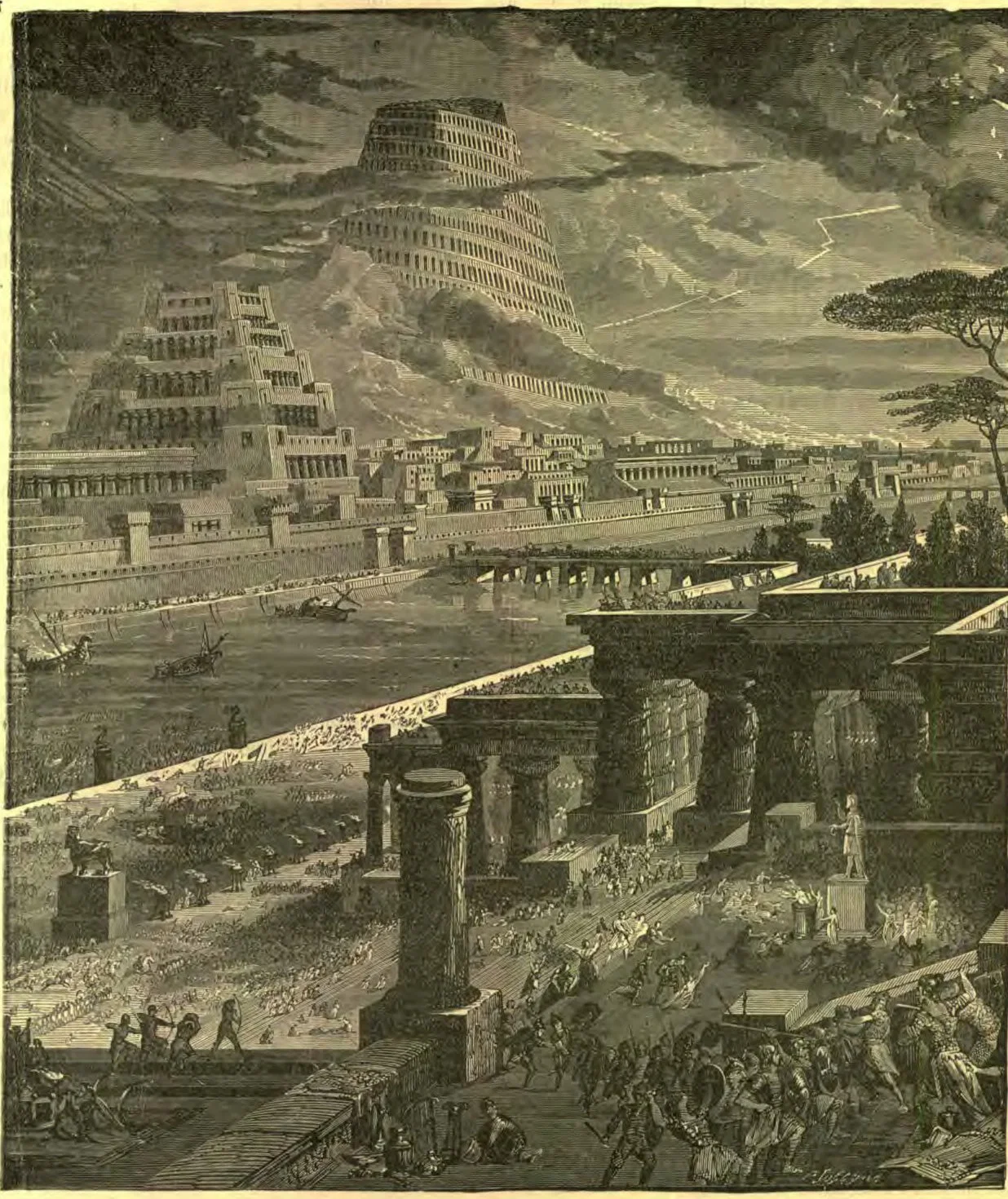
In the center of the city stood the temple of Belus, three miles in circumference. Its central tower, rising higher than the pyramids of Egypt, is supposed to have been the original tower of Babel built soon after the flood. The immense building in the center of the picture is designed to represent this temple.
Crossing the river was a magnificent bridge, connecting the two parts of the city, lying east and west of the river, which flowed north and south. This bridge is also plainly shown in the picture. At either end of the bridge was a palace, and the two buildings were connected with each other by a passage under the bed of the river. The old palace, the large building just this side of the tower of Belus, stood at the east end of the bridge, and was three and a half miles in circumference; the new palace, which stood on the west side of the river we cannot see. It was eight miles in circumference, and was surrounded with three walls, one within the other. The new palace was built by King Nebuchadnezzar, and in it Alexander the Great is said to have died.
Near this palace were the famous hanging gardens, another wonder of this royal city. They were constructed by Nebuchadnezzar to please his Median queen, Amytis, who, accustomed to the lofty hills and forests of her own country, could not be content with the level plain of Babylon. These gardens were raised on arches or piers, laid over with broad flat stones, and covered deeply with earth, and equaling in height the walls themselves. With their grottoes and castles, and full-grown forest trees, they seemed like the veritable mountains of beauty and verdure which they were designed to imitate. The terraces were also covered with plants and flowers of great delicacy, beauty, and fragrance; and in the upper terrace was an engine, or pump, by which water was drawn from the river to water the whole garden.
“The wealth of all nations was poured into the lap of this proud city. All that human ingenuity could accomplish, all that gold could buy, was lavished upon it. And when the sun, which nowhere shone clearer than in the pure atmosphere of that fair land, rose upon Babylon, it looked upon a scene of beauty and splendor such as it never beheld on this earth before, and never since has seen. Marble palaces reflected its dazzling light. Lofty monuments caught and flung over the city the sun’s rising splendors. Columns, domes, and towers grew radiant with the brightness of his beams. Princes of renown, with gorgeous retinues flashing with diamonds and gems, displayed their glory in the streets of the city. Wise men and philosophers adorned its society. Children, light-hearted and happy, mingled in the throngs of its public places, and made its parks and gardens ring with their merry glee. With mirth and music and song passed the gay hours in the proud city.”
And such was Babylon; but God had through his prophets declared that it should be laid low on account of the wickedness of its people,—that its temples should become heaps; that doleful creatures should dwell in its desolate places; that its gardens should become pools of water; and that it should be laid waste, and inhabited no more forever. Thus the proud city was doomed. But notwithstanding the word of God, the people continued in their boastful wickedness, defying both man and God. They thought they were perfectly safe within those massive walls, with a supply of provision for twenty years; but in one night, by the hand of Cyrus, God overturned that wicked government by giving its capital to the Medes and Persians.
And thus the works of man come to naught. But there is another city whose dimensions and magnificence far surpass those of Babylon—while that was 60 miles in circumference, this city will be 1500. It will have a wall of jasper, great and high, the foundation of which will be adorned with precious stones of twelve different kinds; and its twelve gates will be, not of brass, but of pearl—“each a several pearl.” Its streets will be of gold, its mansions of such excellent beauty as to astonish the beholder. Through the midst of this city will pass a beautiful stream, whose sparkling waters will never cease to flow. The tree of life, which drinks from the living waters, will ever bud and blossom, and render its fruit every month for those who shall gather “from one new moon to another.”
Reader, it is our privilege to be citizens of this glorious city, the New Jerusalem, which will endure forever, and whose builder and maker is God.
Wm. Ings.

A LITTLE SCHOOL-GIRL.

SHE stood at the gate—father, mother beside her— Warm lay the sunlight on vine and on tree; With tasks, long and careful, her parents had plied her, And laden with song-book and basket was she.
“Now bring all the praise for the lessons best learned, And the prize for the songs sung sweetest,” they said, “So joys shall await you at even, well earned, And blessings undreamed of be heaped on your head.”
She passed down the street where the deep shadows lay, And they turned to the garden behind the old grange; Their hope gave new voice to the light wind all day, And the fruit-covered walls had a glow that was strange.
She came when late flowers were folding to slumber, And she said, “Many triumphed, but I triumphed not; I sung out of time—false notes without number— And the tasks that you taught me so fondly, forgot.”
Then their arms they outstretched, one who wept to enfold, And they said, while she thought that the loss they bewailed, “Oh, child! if you won, of reward rich we told, But we said not a word of our love if you failed.”

THE LEFT-HAND GLOVE.

“I don’t know what to do with this glove,” said Mrs. Wells, as she was looking over closets and drawers. She held up a fur gauntlet nearly new. “It seems too good to throw away, and yet it is of no use. What a pity Mr. Wells lost the mate!”
“Why don’t you put it in with those things, mamma?” suggested Kitty, looking up from her tea-set.
“Those things” were a pile of partly worn garments Mrs. Wells had just laid aside as an intended contribution to the Home-Mission box.
“Why, Kitty, do you think an odd glove would do any better service out West, than here?”
“Some one might like it, mamma—perhaps some poor minister, who has to ride miles and miles over the prairies. He could hold the reins in his left hand you know, and keep the other in his pocket.”
“That’s quite an idea, Kitty,” laughed Mrs. Wells. “The glove won’t take up much room, any way. We’ll send it.”
It was a handsome glove, of dark, glossy fur, soft and warm, and long enough to cover the wrist. The pair had been expensive.
It went a long journey, by blue, winding rivers and fields of waving grain and golden corn, past hills and woods, through busy, bustling cities, and reached a part of the country where winter is long and severe. The mission box carried comfort and cheer to many a distant home.
“But what can we do with this odd glove?” questioned one of the ladies who unpacked.
“Why, don’t you remember?” said another, “There’s that poor minister, Mr. Gray, who lost his right hand a year ago.”
“That terrible accident! Oh, yes, I recollect.”
“This is a left-hand glove, and good as new. Let’s send it to him.”
The minister’s family were glad that night. There were little sacques and dresses, shoes and stockings, for the five children, and a shawl for mamma.
“And, O papa, see this!” shouted his little girl, holding up the gauntlet. “Now your hand won’t be all blue with cold. See what a beauty? There’s only one, and it’s left-hand. Isn’t it queer?”
The minister tried on the glove. It was just a fit. “Who would have thought it?” said he.
So the odd glove found its place, and had a mission in the world.—Christian Register.

THE COST OF CARELESSNESS.

How often do we hear as an excuse for some harm done or wrong committed, “I had no thought of causing any such trouble.” Certainly, “want of thought” draws after it evils, and leaves behind it a broad trail of cost and sorrow. We see the result of carelessness in all departments of life.
A nurse fell down stairs with an infant in her arms, and fifty years afterward there was a hump-back man creeping about the streets. A switch-tender opened the wrong switch, and the heavy train dashed into a great building that stood at the end of the short side-track; and lives were lost. An operator gave a careless touch to his instrument, and there was a terrible collision on the rail. A boy shot an arrow from his bow; it went whizzing away from the string, and a comrade is blind for the rest of his life. A young man pointed a gun, in sport, at his best friend, playfully saying that he would shoot him; and one noble youth was carried to his grave, and another goes through life with an awful shadow of memory hanging over him. A druggist’s clerk compounded the prescription in haste, and in an hour a sick girl was dying in terrible pain from poison.
There is a great deal of the same want of carefulness in ways whose consequences are not so manifest, yet are no less destructive. A man speaks light and careless words in a humorous mood, and while the laughter goes around, a heart is writhing in agony. The man did not mean to stab his friend, but he has made a wound which no after kindness can altogether heal. There is a manifold ministry of pain wrought by careless words.
A person’s name is mentioned in a certain circle, and the most inexcusable liberties taken in speaking of him, his character, his business, his acts. No one means to do him harm or injustice; yet, in the guise of confidence, words are uttered which are like so many stabs. There is no part of this life we are living, day by day, that is not vital with influence. We are evermore touching other lives, and our touch to-day may decide a destiny.
Our silent example, as well as our words and deeds, is vital, and throbbing with influence. There is need, therefore, for the most unwearying watchfulness over every act and word, lest in a moment of unheeding we start a train of consequences that may leave sorrow and ruin in its track forever.—S. S. Times.

Go Forth, Brave Heart

Go forth, brave heart, with purpose high, The world has need of labor; Go wipe the tear from sorrow's eye, And help and bless thy neighbor. Go forth, brave heart, be strong and bold, And nobly do thy duty; So shall thine eyes at last behold The King, in all his beauty.

KIND THOUGHTS.

LET us cherish a memory for pleasant things, And let all the others go; It is never by giving “tit for tat” That we touch the heart of a foe. It is not by dwelling on fancied wrongs That we feel their sting grow less, And malice once entering the heart is sure To crush out all tenderness.
Forgive, forget, though the wrong be great, And your heart be stricken sore; For thinking of trouble makes it worse, And its pain is all the more. Do kindly things to your neighbors, e’en Though they do not so to you; Though they be wrong, unjust, unkind, Keep your own heart ever true.
The heart is a garden; our thoughts the flowers That spring into fruitful life; Have care that in sowing there fall no seed From the weed of cruel strife. Oh! loving words are not hard to say, If the heart be loving too; And the kinder the thoughts you to others give, The kinder their thoughts of you.

HIDDEN AND SAFE.

ONE morning a teacher went as usual to the school-room, and found many vacant seats. Two little scholars lay at their homes cold in death, and others were very sick. A fatal disease had entered the village; and the few children present that morning at school gathered around the teacher, and said,—
“Oh! what shall we do? Do you think we shall be sick and die, too?”
She gently touched the bell, as a signal for silence, and observed, “Children, you are all afraid of this terrible disease. You mourn for the death of our dear little friends, and you fear that you may be taken also. I know of but one way to escape, and that is to hide.”
The children were bewildered; and the teacher went on. “I will read you about this hiding place,” and she read Psalm 91: “He that dwelleth in the secret place of the Most High shall abide under the shadow of the Almighty.”
All were hushed and composed by the sweet words of the psalmist, and the morning lessons went on as usual. At noon, a dear little girl sidled up to the desk, and said,—
“Teacher, are you not afraid of the diphtheria?”
“No, my child,” she answered.
“Well, wouldn’t you be, if you thought you would be sick and die?”
“No, my dear, I trust not.”
Looking at the teacher a moment with wondering eyes, her face lighted, as she said,—
“Oh, I know!—you are hidden under God’s wings. What a nice place to hide!”
Yes, this is the only true hiding place for old, for young; for rich, for poor,—for all.
Do any of you know of a safer or better?—Dr. Norton.

SCENES IN THE LIFE OF CHRIST.

LESSON 7.—NAZARETH AND THE PASSOVER.

A large part of the Holy Land is rocky and hilly, some parts being even mountainous, with deep rugged ravines and gorges that cannot easily be crossed. At the time we are writing about, the southern part of the country was called Judea; the middle part was called Samaria; and the northern part, Galilee. Judea, lying west of the Dead Sea, and extending a little farther north, is the most uneven and broken. Samaria is hilly, contains the mountains of Ephraim, and extends northward to the southern end of the Carmel range. The plain of Es-dra'-e-lon, in the southern part of Galilee, is the most fertile and beautiful part of the Holy Land. Jerusalem and Bethlehem were in Judea; but Nazareth was far to the north, among the hills of Galilee. It is situated on the lower slope of a hill, at the west end of a narrow plain about a mile long and one-fourth as wide. This beautiful valley is inclosed by a girdle of rounded hills, or low mountains, which shut out all the world besides. In this quiet, secluded place, our Lord spent his childhood and youth. Here he wandered over the meadows, beneath overhanging cliffs, and through the wild, rugged glens that were so numerous on all sides of the valley. These deep, winding glens, abounding, as they still do, in birds and flowers, must have been delightful retreats in childhood; and as Jesus grew older, they must have afforded him that solitude so agreeable to thoughtful minds. Here he could think of the great work he had to do upon the earth, and pray to his Heavenly Father for help in carrying it out.
The hill just back of the village was higher than the others, rising more than four hundred feet above the plain. From the top of this hill, one can see many miles over rolling plains, wooded hills, and fertile valleys. Upon this spot, Jesus must often have stood, gazing upon the snow-capped summit of Mount Hermon rising proudly in the northeast, or upon the blue waters of the Mediterranean lying far away to westward.
We cannot now tell just where the house of Joseph and Mary stood, but there is in the village a fountain from which all the people obtain their water, and to this spot, Jesus must often have come. Every year, Joseph and Mary went to Jerusalem to attend the passover. INSTRUCTOR No. 5 describes the route from Nazareth to Jerusalem, and it will be interesting to read the article again in connection with this lesson. This yearly journey must have been an occasion to which the children would look forward with great pleasure; for nearly all the people went, and as company after company joined, the procession must have been many miles in length before it reached Jerusalem.
The feast usually lasted eight days, and during this time many of the people had to camp out; for no lodging place could be found within the city for such a vast multitude of people. The Bible describes one of these visits as follows:—
“And when he was twelve years old, they went up to Jerusalem after the custom of the feast. And when they had fulfilled the days, as they returned, the child Jesus tarried behind in Jerusalem; and Joseph and his mother knew not of it. But they, supposing him to have been in the company, went a day’s journey; and they sought him among their kinsfolk and acquaintance. And when they found him not, they turned back again to Jerusalem, seeking him. And it came to pass, that after three days they found him in the temple, sitting in the midst of the doctors, both hearing them, and asking them questions. And all that heard him were astonished at his understanding and answers. And when they saw him, they were amazed; and his mother said unto him, Son, why hast thou thus dealt with us? behold, thy father and I have sought thee sorrowing. And he said unto them, How is it that ye sought me? wist ye not that I must be about my Father’s business? And they understood not the saying which he spake unto them. And he went down with them, and came to Nazareth, and was subject unto them; but his mother kept all these sayings in her heart.”

QUESTIONS.

  1. Describe the surface of the Holy Land.
  2. What was the southern part called? The middle part? The northern part?
  3. Which of these parts was most broken?
  4. How far north did Judea extend?
  5. Describe Samaria.
  6. What was the most fertile and beautiful part of the Holy Land?
  7. Where is this plain situated?
  8. Where are Jerusalem and Bethlehem?
  9. Where is Nazareth?
  10. How is it situated?
  11. Describe the beautiful valley in which our Lord spent his childhood and youth.
  12. What must he have done here?
  13. What must have been delightful retreats to him in childhood?
  14. As he grew to manhood, what did he probably do in these lonely places?
  15. Which of the surrounding hills was highest?
  16. What could be seen from the top of this hill?
  17. What does it seem probable that Jesus often did here?
  18. Can we now tell just where the house of Joseph and Mary stood?
  19. To what place do we know that Jesus must often have come?
  20. What must have been an occasion to which the children would look forward with pleasure?
  21. What would help to make the journey exciting?
  22. Where may we find a description of the route?
  23. How long did this feast commonly last?
  24. Why did the people have to camp out during this time?
  25. Which of these visits to Jerusalem is described in the Bible?
  26. Where does the story begin? Luke 2:41.
  27. How old was Jesus at the time of this passover?
  28. Tell how Joseph and Mary lost him.
  1. How did they come to go so far without finding that he was not in the company?
  2. What trouble did they have in finding him?
  3. What was he doing when they found him?
  4. What did the people think of his questions and answers?
  5. What did Mary say to him?
  6. What reply did he make?
  7. What did he afterward do? Verse 51.
Read the article entitled “Going to the Feast,” on next page.

LESSONS ON NEW-TESTAMENT HISTORY.

LESSON 20.—REVIEW.

  1. Where was Christ born?
  2. How had the place of his birth been foretold in prophecy?
  3. How was the news of his birth first published?
  4. How may we know that Joseph and Mary were poor?
  5. Who recognized Jesus as the Messiah when he was presented at the temple?
  6. On what errand did wise men come from the East?
  7. What plot did Herod then lay?
  8. By what providences did the Lord preserve the life of Jesus?
  9. Where was the early life of our Saviour spent?
  10. Where is this place situated?
  11. Describe it.
  12. How did Jesus astonish the learned doctors of the law when he was only twelve years of age?
  13. What is the next recorded event in the life of our Saviour?
  14. By whom was he baptized?
  15. Relate some of the circumstances of John’s birth, manner of life, and preaching.
  16. What miraculous circumstances attended Christ’s baptism?
  17. What terrible suffering and trials did he have to pass through soon after his baptism?
  18. Who were his first followers?
  19. What was his first miracle?
  20. How did he manifest miraculous power at the passover?
  21. What instruction did he give Nicodemus?
  22. How did he spend the next six or eight months after this passover?
  23. What befell John near the close of this period?
  24. Where did Jesus then go?
  25. Describe his work for the Samaritans at Sychar.
  26. What is Sychar now called?
  27. Where is it situated?
  28. Describe the situation.
  29. Where did Jesus next go preaching?
  30. What did he proclaim?
  31. Who came to him at Cana?
  1. Describe the interview and its result.
  2. How was our Lord treated at Nazareth?
  3. Where did he soon after take up his abode?
  4. Relate the circumstances connected with the calling of the fishermen.
  5. Tell what happened on the Sabbath.
  6. Give some account of our Lord’s second tour through Galilee.
  7. Describe the calling of Matthew, and the feast that followed.
  8. What important instruction was given at this feast?

OUR REPORTS.

FOR several reasons it has been thought best to omit the double number of the INSTRUCTOR for this quarter, and so we can print only the summary of reports from each State. We hope none will be discouraged because the reports of the individual schools are not printed, and feel as if it has been of no use for them to report. Remember that your school counts one in the summary of the State. The reports for the quarter ending with March we expect to print in full. We hope to have a good vigorous double number about the first of June, and want you all to take hold now to help make it so. If each school secretary and each State secretary is prompt in his work, the State reports need not come lingering along, as they have this time. Had they been here, they would have been printed several weeks ago.
The double number gives S. S. workers all over the land a chance to speak to one another through its columns. Write of what has been done in your State this winter, and of the present prospects of the work; or be free to write on any subject which may interest you. The Sabbath-school workers at Battle Creek do not want to monopolize the paper; but if others do not write, they must.
The extra cost of printing a double number is no small item; and we do not want to go to the expense, unless it shall be to some purpose. What are we going to do about this matter?—give up the system of reporting entirely? We must either do this, or all must take hold and make it a success. If part of the States report, all should do so. We cannot believe that the interest in Sabbath-school work is dying out; for we have reason to know that, in many places at least, the real interest in Bible study is deepening.
Shall we not every one put a hand to the work now, and take steps to make our next double number the strongest and best that has yet been printed? E. B.

GENERAL SUMMARY.

NAMES OF STATES. NAMES OF SECRETARIES. No. Schools Reported. Membership. Average Attendance. New Members Enrolled. Dropped from Record. Number Under 14. Number Over 20. Scholar Members. Number of Classes. Number of Members in First Division. Second Division. Third Division. Fourth Division. Keep Complete Records. No. Instructors Taken. Hold Teachers’ Meeting. Contributions Rec’d. Amount Sent State Association. Amount Sent General Association.
California E. A. Chapman 25 811 718 138 94 397 378 389 120 235 112 52 445 21 515 6 $135 53 $11 57 $1 15
Colorado W. E. Cornell 3 73 56 21 11 31 31 39 10 20 18 32 ... 2 46 ... $13 05 ... ...
Dakota M. M. Olsen ... ... ... ... ... ... ... ... ... ... ... ... ... ... ... ... ... ... ...
Indiana Mrs. M. V. Shrock 19 470 326 21 38 129 231 247 55 71 45 71 112 14 224 2 $21 48 $2 75 $27
Illinois Lizzie S. Campbell 37 790 512 46 60 251 399 463 90 174 98 52 347 ... 239 ... $25 81 $1 60 $16
Iowa Leroy T. Nicola ... ... ... ... ... ... ... ... ... ... ... ... ... ... ... ... ... ... ...
Kansas Mrs. Ada A. Dawson 27 759 439 48 84 274 334 14 89 150 110 159 232 ... 245 ... $12 80 $1 81 $80
Kentucky Lulu Osborn ... ... ... ... ... ... ... ... ... ... ... ... ... ... ... ... ... ... ...
Michigan Evangeline Bell 84 2847 1426 381 257 124 152 1090 364 175 121 340 100 76 1042 11 $180 80 $16 61 $10 00
Missouri D. C. Hunter 15 830 196 29 29 127 125 135 47 118 47 42 103 ... 146 ... $27 52 $3 33 $1 00
Maine Isadore A. Baker 7 181 137 12 7 43 98 ... 20 27 25 13 91 ... 74 ... $5 26 ... $0 80
Minnesota L. A. Curtis 46 1125 698 83 95 405 553 587 148 252 247 183 394 40 337 7 $24 82 $4 17 $91
North Pacific R. D. Benham 4 89 73 ... ... ... ... ... 14 ... ... ... ... ... ... 1 10 ... ...
New York Mrs. N. J. Walsworth 23 458 276 18 13 132 294 298 66 71 66 81 187 20 160 ... $31 71 $1 81 $20
New England Mrs. E. D. Robinson 19 410 278 32 29 107 240 213 54 83 78 ... 255 ... 231 ... $45 60 $5 06 $1 00
Nebraska Mary V. Burke 19 506 328 35 40 190 242 227 46 94 53 76 255 10 159 2 $14 01 $1 29 $12
Nevada ... ... ... ... ... ... ... ... ... ... ... ... ... ... ... ... ... ... ... ...
Ohio Mrs. Ida S. Gates 29 691 462 41 55 236 331 322 97 156 118 86 253 28 332 6 $53 51 $5 83 $60
Pennsylvania Mrs. F. C. Oviatt 20 418 248 45 6 146 114 191 66 101 87 50 187 18 146 5 $17 78 $2 08 $20
Texas T. T. Stevenson 7 226 120 8 17 22 55 12 80 54 23 24 77 ... 97 ... $10 42 $20 ...
Tennessee Mrs. Mary Remley ... ... ... ... ... ... ... ... ... ... ... ... ... ... ... ... ... ... ...
Vermont Frank S. Porter 17 407 228 34 13 105 223 202 58 60 65 ... 254 15 106 5 $20 98 $2 18 $25
Wisconsin Mrs. Nellie Taylor 50 1230 726 122 134 513 501 529 162 338 248 191 370 48 436 5 $48 89 $4 97 $50
Upper Columbia Adna Johns ... ... ... ... ... ... ... ... ... ... ... ... ... ... ... ... ... ... ...
Totals. 451 11821 7242 1114 982 3232 4102 4958 1536 2159 1561 1452 3662 296 4535 50 $689 52 $65 51 $16 86
EVA BELL, Secretary General Association.

KRA'S MISSIONARY GIFT.

Some years ago, a pleasant custom prevailed in the girls' school at one of our mission stations in Africa; this was the bringing in of offerings on the first Monday of each month toward the support of their own native minister. These children, who were just learning to love Jesus, were thus beginning to experience that it is blessed to give as well as to receive. They had not got so far, I fear, as to realize that the giving is more blessed than the receiving. It takes real Christians to do that, and these poor girls were just groping their way out of the darkness of heathenism into the beautiful gospel light.
On one particular Monday morning the teacher entered the school-room. Rows of smiling dark faces turned toward her, and a chorus of “Nahivio’s” (greeting to you) welcomed her to the day’s work. A hymn was sung, the morning prayer uttered, and then the lady passed around the room accepting the various offerings for the Saviour’s work. Some of the children owned small gardens, and these had brought cassava and sweet potatoes; several had cocoa-nut-trees, and smilingly pointed to piles of the great nuts on the floor beside them—cocoa-nuts still in their great green cases, which American children would hardly recognize, because these outside shells are generally stripped off before the fruit appears in our markets. Here and there a leaf of tobacco was laid upon the increasing hill of gifts, a yard of cloth, or a string of beads. The teacher’s platform, upon which the things were piled, began to look like a fruit-shop, or an agricultural fair on a small scale. Oranges and limes were not wanting, and how happy the teacher felt at seeing these proofs of willing self-denial on the part of her poor African children!
When at last she reached the corner where the A B C class had their low seats, the excitement increased, for the little people all wanted to talk at once about what they had brought, and receive the well-deserved praise. There was meantime a steady pull at the teacher’s dress.
“In a minute, Kra,” said she.
Now Kra was a boy, but he was a member of the girl’s school because, being only six years old, and blind, he needed more gentle care than he would get among the big strong boys on the other side of the yard.
“Now, Kra, what have you to give the Lord Jesus to-day?” and the lady took one small brown hand in hers, that the little fellow might “see her,” as he said.
Kra hung his head, and spoke low: “Kra no have cocoa-nut-tree; no have plantain, nor beads, nor cloth, nor nothing”—the confession came very slowly—“but Kra bring one pin to put in teacher’s shawl.”
Here the boy fumbled about his shirt till he found the precious big crooked pin, which he carefully laid in the hand he held. No one laughed. Indeed, to those children a pin was something precious; it was a foreign curiosity, and it made a fish-hook.
But the great thing was that, like the two mites of the widow in the gospel, that pin was Kra’s all, and he gave it to Christ. None of us, dear children, can do more than that; who will do as much?—Mrs. Emily Hartley.

THE DIFFERENCE.

As I was walking out one day, I saw two little girls drawing a baby carriage along the side-walk and busily chatting together. I watched them closely; for to tell the truth, I have a liking for little girls who appear well. These were neatly dressed and of about the same age, and at first I could see little difference between them.
By-and-by they came to a street-crossing. When they were about half way across the walk, a team came dashing along at a furious rate. One of the little girls saw it, and crying “Hurry!” she ran out of harm’s way herself, leaving the other in the same danger, with the baby carriage to draw. The little girl tugged away at it, and was soon across the street, where she was rejoined by her frightened and cowardly little companion.
Now I could see a great difference in the two girls. One was selfish, and thought only of taking care of herself; the other was unselfish and faithful enough to forget her own safety in caring for the helpless little child intrusted to her.
Children, which of these little girls would you like to imitate?
M. G.
Continue reading: GOING TO THE FEAST