The Youth’s Instructor, Vol. 38, No. 30.

AN UGLY BULB

The Youth’s Instructor

Jul 23, 1890

S. D. A. Publishing Association · Battle Creek, Mich. · Jul 23, 1890

AN UGLY BULB.
Among the pretty school-girls, Like flowers in a row, One little maid was weeping, With head bowed very low. They called her brown and homely, They called her stupid, dull; She seemed to have no talent, Nor was she beautiful.
A gentle, gray-haired teacher Came near, and softly said, "My dear one, what's the trouble?" And kindly stroked her head. And then she sobbed, heart-broken, "I'm such an ugly maid, No one will ever love me I'm very much afraid."
The teacher gently led her Into a room apart, Where lay some bulbs of lilies, With rough scales o'er their heart. "What ugly things these bulbs are! But take and plant one, dear, And see if some sweet lesson Will not unfold to cheer."
From day to day the maiden Bent o'er her bulb to see The tender leaves, like arrows, Shooting up feathery. And O! at last a cluster Of lilies, star-like, fair, Burst into snowy blossoms, And perfumed all the air.
And this is what she read there, In her white sheaf of flowers, That love can bring sweet blossoms From these poor souls of ours. That love hides self in loving: And all its lack of grace Is suddenly made glorious By what has filled its place.
The little homely maiden Smiled a glad smile of light, And her dear snowy lilies Taught her the lesson right; For from that day she loved all, And no one thought her dull, And people said, "How fair she is! How dear and beautiful!"
FANNIE BOLTON.
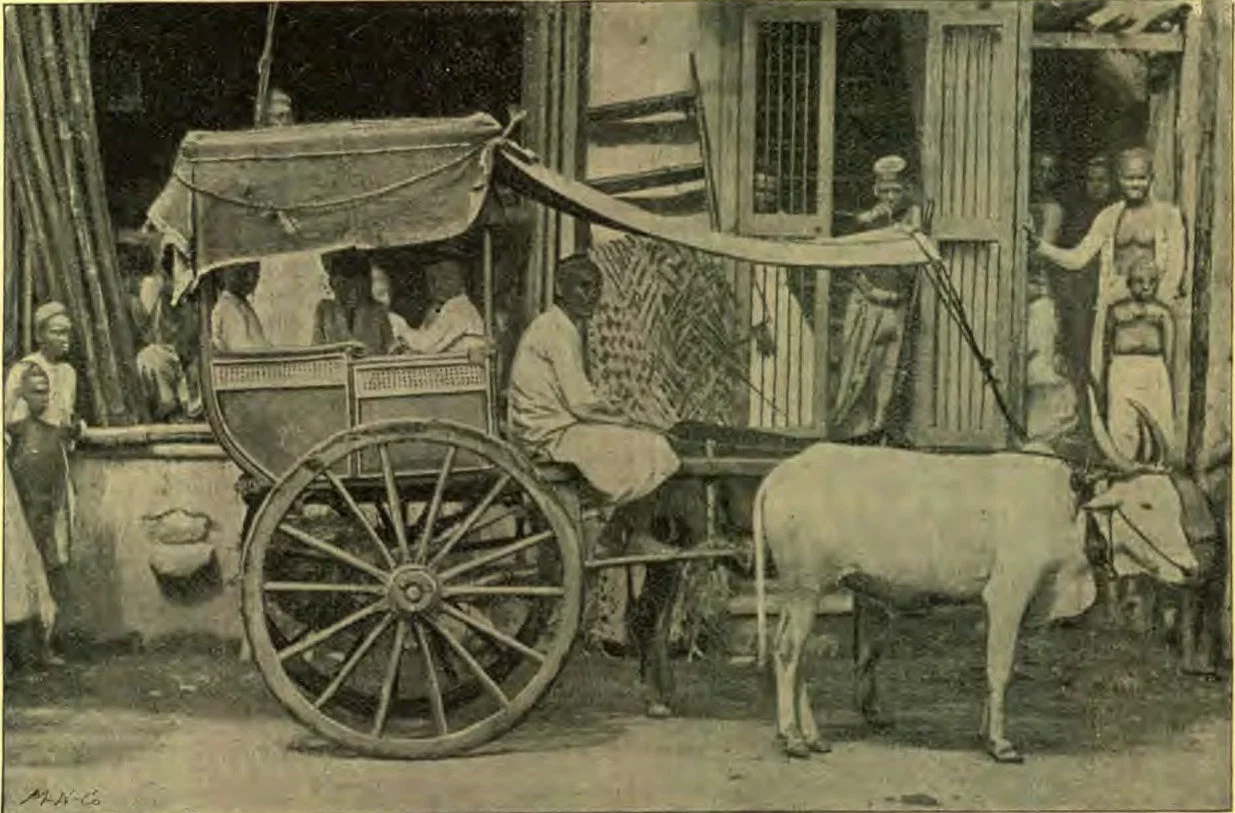
THE ENKA CART OF INDIA.

A STORY WITH A MORAL.

There was once a very elegant silver teapot, beautifully ornamented, and of graceful shape and design. It stood on a table near an open window; beside it stood two common earthenware cups.
Those who lived in this house went out to a hotel near by for their meals, so the teapot, not being needed for tea, had been filled with water for people to drink.
This the teapot did not like. It had much to say about being used for such a commonplace thing as water.
“I was not intended for the sort of work that the commonest tin pail can do,” she said to the cups; “I was made to hold choice teas from foreign lands; it is disgraceful to treat me in this way. I’m not going to endure it.”
“As to that,” would the cups reply, “we supposed you were made to do whatever your owner wished.”
“No, I was not,” the teapot would snappishly answer; “I was made to hold tea.”
After much grumbling, sometimes to the cups and sometimes to herself, the teapot declared one morning that the end had now come; she should certainly not stand there meekly, and pour out water for anybody who happened to want a drink, no, not for another hour.
“I’m brimful of water,” she said, “and I mean to stay so. Water is pleasant enough in itself, if people will let it alone. I like the feeling of it better than tea. It is cool and refreshing; I shall just keep it for myself. The idea of my being carried to the spring every few hours, as though I were a tin bucket or dipper! It is simply ridiculous! I wonder that I have endured it so long. After this you will see that no one short of a king, or at least a prince, will get a drink of water from me. I will not supply every one.”
“I do not feel so at all,” said one of the cups. “I like to be used. There is nothing that gives me greater pleasure than to be filled fresh and have a chance to sparkle for a few moments before the water is swallowed.”
“I think it very likely,” said the teapot, with a complacent smile. “The truth is, you are made of clay, and of course it is honor enough for such as you to serve everybody, even with water. But for me it is quite another matter; not another drop will I give.”
The cups looked troubled. “But we get our supplies from you,” one of them said timidly. “How are we to furnish water if you do not fill us?”
“That is your own lookout,” answered the teapot, flashing proudly in a sunbeam which just then struck her. “Somebody will carry you to the spring, perhaps. I’ll have nothing to do with it—I know that.”
She was true to her resolves. Half an hour afterwards a pretty girl tripped out on the piazza, and attempted to pour some water. She tipped the teapot until it almost lost its balance, but not a drop came. “How queer!” she said. “Are you empty?” and she lifted the lid and looked. “Why, no, you are full to the brim. Why don’t you give me some water?” She tried again, to no purpose. “Mean old thing!” she said at last, and seizing one of the cups ran to the spring, drank all she wished, then filled it again, and set it on the table. “That is for the next thirsty one,” she said, laughing.
The “next” proved to be some lovely birds, who flew down from the trees near the window, and dipped their bills into the full cup, then looked up to heaven, as though thanking God for water.
“Even the miserable birds come chirping around to be waited on by us,” said the teapot sharply; “they will get nothing from me from this time forth.”
“I enjoy it,” said the cup briskly.
It was surprising how many people were thirsty. Men, women, and children stopped at the table to be refreshed. Each of them trying the teapot in vain, exclaimed over it, scolded it a little, then carried the cup to the spring and filled it.
At night the teapot congratulated itself, and snarled at its neighbors:— “I’ve had one day of rest, at least, and haven’t been bumped and bruised at the spring, either. I have every drop of water left, and have felt cool and comfortable all day.”
The cups laughed gleefully. “We’ve had a good day,” they said; “we have given to every one who came, and we have as much as when we began the day; the world is richer because of us, and we are no poorer. We like our way best.”
The days passed smoothly after this, the teapot maintaining its dignity, and refusing to give a drop of water, until finally the people ceased trying to get any from it. They said its mouth was stopped up in some way, or its valve was out of order, and the cups were always so ready, and the spring so near at hand, it was just as well to have the water fresh.
So the teapot rested and sulked, and was more crisp than ever. At last one day came a determined person, who said, “How strange it is that the water does not pour from this nozzle! What can be the matter?” and she lifted the lid to examine. “Ah!” she said, “I don’t know who would want it to pour. How horridly it smells! Why, this is a disgrace. We cannot have such a smell as this here, the water has spoiled. Who would suppose that spring water would get so horrid just by standing unused a little while? It must be thrown away, and I don’t know but that the teapot will have to be also; there is a dreadful slimy mold formed all around the inside. I’m afraid it is spoiled.” Imagine what the teapot must have felt to hear such words as these!
At just this moment came a noble stranger. At least the teapot did not recognize him; but the cups did; they knew he was the real owner of the house and all its belongings, and of themselves as well. They knew he was a great and glorious person, and they felt mean and small in his presence. If only they were made of silver instead of common clay, what a joy it would be now to serve him!
But the teapot, silver though it was, and of rare workmanship, was not ready to serve him. It had disabled itself by hoarding its treasure.
The prince gave not a second glance at it. He lifted a cup to his lips and drank freely, then said to the lady standing by:— “Friend, I want to take these cups with me. I will have others placed here to do the same work these have done, but these I will cover with gold and set with diamonds, and give them a niche in my palace, because they have done their work well in this humble place. As for this silver dish, pray remove it out of sight; it is not a fit object for passers-by to look at.”
You think there was never such a teapot and such cups?
Oh! I know it, but what if there were—no, that isn’t it—what if there were people who acted just as we have pretended these senseless things did?
Are you and I quite sure that we have never seen or heard of any such?—Pansy.

ROUND THE WORLD.—20.

BRITISH SOCIAL LIFE IN INDIA.

To live in India and then to be suddenly transferred to the Western Continent, would seem almost like being moved to another world. The habits and customs of the upper circles of society of both places have literally nothing that is mutual, and the key to these differences lies in the fact that in one country the laborer works for a dollar and a half a month, and keeps himself, and in the other he expects thirty times that amount. Therefore in the latter country, people learn, and are willing, to do everything they possibly can for themselves, while in the former they will do nothing that any one else can do for them.
An ordinary city residence in India contains from twenty to thirty apartments, each of them being at least three times the size of what an American would term a large room. In order to be cool, the walls are of stone four feet in thickness, and outside, entirely circling the house, and running from the top story to the ground, are verandas about twenty feet wide, supported by huge columns on the outer edge. In the spaces between these are a kind of curtain called “chit,” made of narrow strips of bamboo lashed together, and covered with dark muslin, to soften the rays of the sun. Onto these verandas open the windows of the house proper, and in summer-time, when it is very hot, what are known as “khus khus tatties,” are placed in them. These are screens made of a sweet-scented grass, which is kept wetted, so that the wind, when it blows through them, will be cooled ere it enters the interior of the dwelling. In nearly all the rooms are punkas, kept in motion by two native pullers.
The number of servants kept by a family in ordinary circumstances is something wonderful. There are always one or two durwans, or door-keepers, who clear the way at the approach of a carriage, and take up the visitor’s cards; for the parlors are always on the second floor. These men will do nothing else but their own special work, although it does not occupy one-fourth of their time. For generations before them their forefathers have been durwans, and according to the castes of India, it would be a disgrace to them to do anything else.
Then there are the khitmatgars, whose duty it is to wait at table, or stand behind the master’s chair with an immense fan, the staff of which rests on the floor, and keep him cool. The bearers are another class, corresponding to the French “body man,” and the ladies’ maids here are called ayahs. Dress himself or herself, gentle persons cannot do, any more than they could put on wings and fly. At the customary hour of rising, the bearer or ayah appears with the chota-hazari, or small breakfast, which is eaten to impart strength to rise. Then the mosquito net is held up while the Sahib gets out of bed, and goes to the bathroom, which is always attached to every sleeping-room. Then he falls into an easy-chair, and there remains, allowing himself to be dressed by the dextrous hand of his bearer, with seemingly as much helplessness as an infant. Everything, even to the fastening of the collar-button, is left to the menial.
There is another man to look after the horse; he is called a sice; another to tend the garden, and, in fact, one for nearly every distinct duty that can possibly be connected with life. But each one does one thing, and only one thing. As a rule, the servants go about in their naked feet in the houses; they are not allowed to wear shoes, for fear of making a noise that would be irritating to the nerves of their employers.
Curious to say, the fashionable hours for calling are during the very hottest time of day, from 11 A. M. to 3 P. M. When the aristocracy, or even the native rajahs, go out riding in their carriages, they always have a coachman to drive, clad in the uniform of the house, with a huge turban on his head. Another man sits beside him, whose duty it is to jump down and soothe the horses should they become fractious. Behind the vehicle are two steps, and standing on them, clinging to a hand-rail, are two more footmen, who get off as a corner is neared, and run before to clear the way, and then spring up again, while the carriage is still in motion. Those in more limited circumstances drive in an “ehka” cart, a rather primitive vehicle.
At about five o’clock in the evening, people turn out for their drive in Calcutta, taking a tour round the Maidan, a large open space some two miles in length, in the city limits. From that they go to the banks of the Hoogly River, and spend the time driving up and down there, watching the ships sailing up and down, till dark, when the band begins to play in the Eden gardens, where the time is whiled away till nearly eight in the evening, when they return and eat their dinner, at an hour when most Americans are thinking about retiring. The word lunch is unknown in India, but the midday meal goes by the name of tiffin.
Such is life in the far East, luxuriant and easy, but devoid of that satisfaction which only honest toil can bring.
P. T. M.

A NOBLE YOUNG PRINCE.

Louis, the Duke of Burgundy, was the grandson of Louis XV., of France. If he had lived, he would have been king of France. He was a kind-hearted, thoughtful boy, and died at the early age of eleven years. The story which follows is one of many illustrating his true nobility of character:—
One day Louis was rushing helter-skelter down the stairs, when he suddenly fell and hurt his knee. He was so afraid of frightening his mother, and so anxious that none of the servants in charge of him should be blamed, that he told no one how much he was hurt.
He suffered a great deal for some time, and at last he was obliged to tell his mother about it. Then it was found that an abscess had formed in the knee. The doctors held a consultation, and the little prince was taken into the next room while they talked the matter over, and determined that an operation must be performed.
When the day which they had fixed, arrived, the prince’s tutor went to prepare him for it, as gently as he could.
“I hope you will be able to bear it quietly,” he said.
Louis smiled sadly.
“I knew all you have been telling me two months ago,” he said; “I heard what the surgeons said, but I did not mention it, for fear any one should think I was worried about it. Now the fatal day has come. Leave me alone for a quarter of an hour; then I shall be ready.”
When the time was up, the boy asked to see the instruments. Taking them in his hands, he said,—
“I can bear anything if only I may get well again, and comfort mamma.”
Chloroform was unknown in those days, and the operation would have been very hard for a man to bear, yet the little fellow only called out twice, and when it was all over, he found his reward in the tender embraces of his father and mother.
Then came weary months of pain and weakness, which tired the poor boy sadly, yet it was only when the pain was more than usually violent that he allowed himself to complain; and it was soon understood among his attendants that if the prince was particularly anxious about their health and comfort, it was a sign that he himself was suffering more.
“Dear Tourrolle,” he said one day to one of his favorite servants, “you do too much for me; you hurt yourself. Go out and get some fresh air. I will try to do without you for two or three hours.”
Night after night the poor little sufferer, not yet eleven years old, would lie awake in pain; yet he would not groan or cry out, lest he should wake the attendants who slept near him; and if he was obliged to ask for anything, it was in a tone of voice which could disturb no one.
At last the weary months of suffering came to an end, and the noble-hearted boy died, on February 22, 1861, with his arms around his mother’s neck.
There is one saying of his which well describes his life, and which may serve as a motto for all: “I cannot do much, but I will do all I can.”

ICE-MAKING

As the general knowledge of chemistry has increased, inventions have arisen for producing cold by artificial means, and there is consequently no longer any necessity for carrying ice from cold to warm climates. Almost every Southern town now has its ice factory, and the product of artificial freezing is superior to any but the clearest natural ice, frozen in the northern tier of States or in Canada, while its substance is pure as the distilled water from which it is made. Harper’s Weekly, from which the following facts are taken, says that the apparatus required for making artificial ice includes a powerful engine to drive the pumps, great iron retorts for holding the aqua ammonia, a long system of pipe coils, and extensive vats, to contain the ice-cans.
The process depends upon the capacity of a substance which is expanding after great condensation, to absorb heat. The substance used in this case is ammonia. Mixed with water, it is placed in one or more of the great cylinders, or retorts, which contain coils of pipe. Into these pipes steam is sent, heating the contents of the retort until the ammonia is separated from the water, and sent into another retort, where it is subjected to great pressure, under which it liquefies.
In another room, provided with double doors, and walls like those of a refrigerator, are several vats, in which are suspended cans of galvanized iron. Some of these cans are calculated to hold two hundred pounds of ice, and others are still larger. Between these cans pass lines of iron pipes, connected with the retorts outside, and the entire vat, in which cans and pipes are contained, is filled with brine.
In the great condensation to which the ammonia gas has been subjected to liquefy it, it has parted with all its heat, and the large pipes which carry it to the vat are so cold as to be covered with frost.
When ice is to be made, the cans are filled with distilled water, and covered with thick caps. The ammonia is then admitted to the coils running through the brine of the vat. As soon as the tremendous pressure is relieved, by turning the stop-cocks, the ammonia expands into gas, resumes the amount of heat with which it parted when undergoing condensation, and of course extracts it from the surrounding brine. This, in turn, extracts heat from the distilled water, which freezes, as the brine itself would do were it not saline, and kept in motion by means of pumps.
In a few hours, each can contains a mass of solid ice, and is then hoisted from the vat, dropped for a moment in warm water to loosen the ice, and upset. The block of ice slides out, and is either stored, or placed in front of a circular saw, and divided into smaller blocks.
After the ammonia gas has done its work, it is returned to a retort, conducted to its starting place, and reabsorbed by water. It can then be used over again, and this process goes on continuously, with some slight waste.

LET IT DRY.

FATHER GRAHAM, as everybody in the village called him, was one of the old-fashioned gentlemen, of whom there are so few left now. He was beloved by every one, and his influence in the little town was great, so good and so active was he. One bit of wisdom which he gave to a young friend is well worth noting.
A young man of the village had been badly insulted, and came to Father Graham full of angry indignation, declaring that he was going at once to demand an apology.
“My dear boy,” Father Graham said, “take a word of advice from an old man who loves peace. An insult is like mud; it will brush off much better when it is dry. Wait a little, till you and he are both cool, and the thing is easily mended. If you go now, it will only be to quarrel.”
It is pleasant to be able to add that the young man took his advice, and before the next day was done, the insulting person came to beg forgiveness.—Companion.

Cheerfulness: The Bright Weather of the Heart

CHEERFULNESS is an excellent wearing quality. It has been called the bright weather of the heart.

THE ALL-GIVER.

WHEN the fields are sweet with clover, When the robin sings with glee; When the skies are bright and cloudless, And this world is fair to see, Dost thou thank Him Who hast made all things for thee?
When the golden-rod is nodding By the wayside, slim and tall; When the purple asters blossom All along the garden wall, Dost thou heed them, Dost thou see His hand in all?
Every modest little blossom, Every bird upon the tree, Tells His love for all His children, Tells His love for you and me; Dost thou love Him Who has shown such love for thee? —Selected.

ABOUT CRABS.

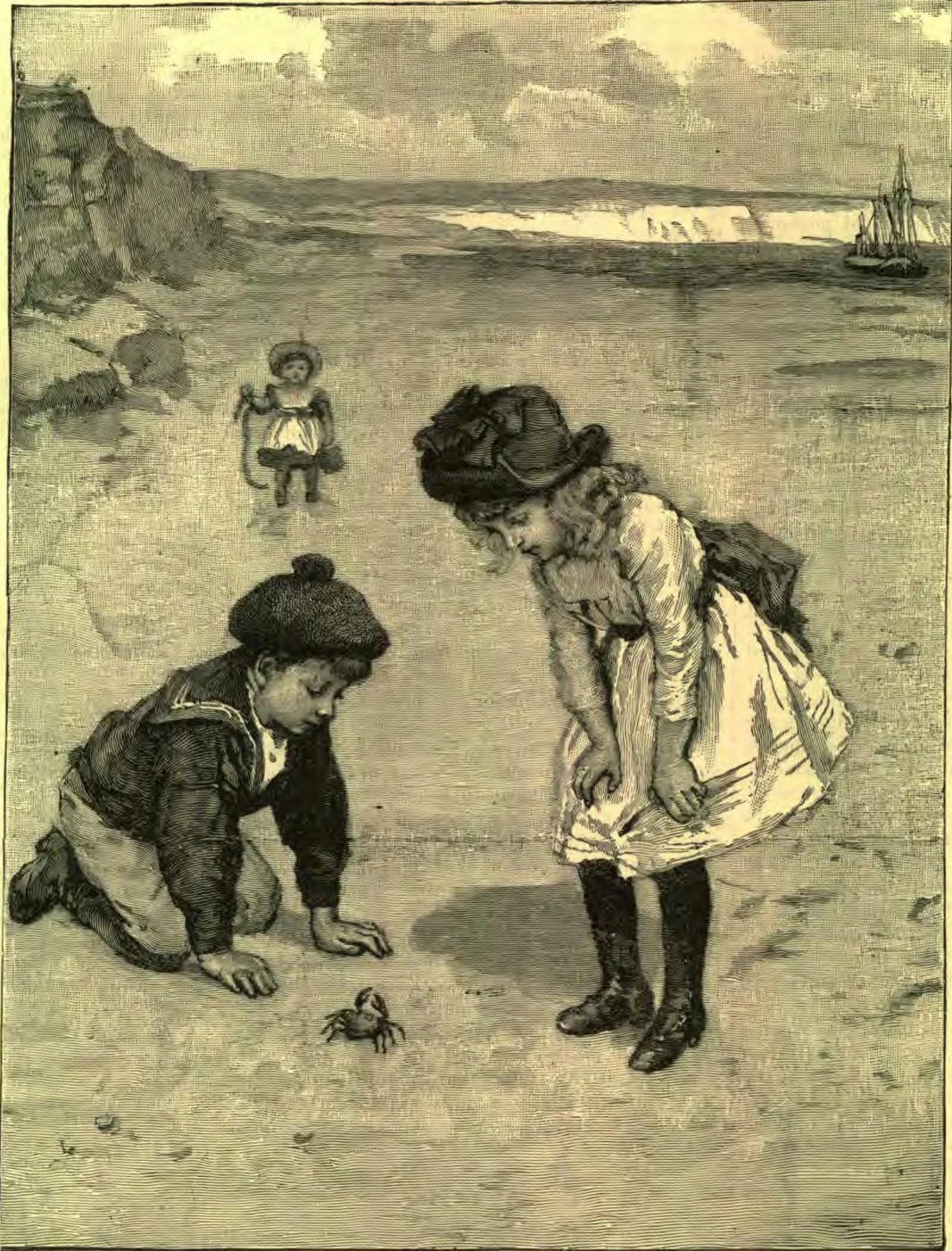
FRED and Rose visited the seashore one vacation. They had never seen so much water before. They loved to watch the waves and the clouds, and to see the ocean get angry in a storm. They also liked the sunshiny days. Then they could play in the white sand on the beach. They saw many strange things that had been washed up by the waves, and left on the sand when the tide went out.
One day they saw a queer thing crawling along. It had a hard shell and ugly claws.
“Let us call mamma,” said Rose, “and have her tell us what this is.” So they ran to find her.
Mamma came and looked at it. She said it was a crab. So the children had to be told about crabs.
“Crabs are hard-shelled creatures, as you see,” said mamma. “They are relatives to the lobster you had for dinner to-day. Their family name is Crustacea.”
Fred and Rose ran to write the name down in their Wonder Book; for they each kept a book in which they wrote out carefully all the new and wonderful things they learned about that vacation. It kept them busy on rainy days, and would be nice to read after they got home. They were anxious to have neat books to show to their papa, and so they took a great deal of pains to write well.
“Crabs do not like to live in cold water. Most of them live in warm seas,” mamma went on.
“There is one kind of crab that has no hard armor on the back part of his body. He cannot run, and he cannot swim. He is very helpless. He has to have a house to live in.
“He hunts around till he finds a shell that suits him. Perhaps there is a snail in the shell. But the crab draws it out and eats it. Then he walks into the snail’s house. His head and front legs are covered with armor, like those of other crabs. These he thrusts outside the shell. He lives in this shell until he grows so fat it pinches him; then he hunts around for a larger house.
“There are some crabs that cannot live in the water. The land crabs would die if they fell into the sea. They like to live in the shadow of a dark, damp forest.
“All crabs have little gills, by means of which they breathe. It is necessary that these gills should be kept wet.
“The land crab likes to take journeys. He cannot do it unless his gills are wet; for if they dried down, he could not breathe. Under the gills are little water-bags, which the crab fills up before he starts out, just as an engine might do.
“As he travels along, the water falls in little drops on the gills, and so he can breathe.”
“That is wonderful,” said Rose. “I will put that in my book, ’cause papa will want to know it.”
“I will tell you about one other kind of crab,” continued mamma, “and that will be as much as you can remember to write down.
“This other crab is called the cocoanut crab, because he lives on cocoanuts.
“The crab eats the nuts that fall to the ground. He hunts until he finds a nut that suits him. Then he tears away the husks with his strong pincers.
“You remember the three eyes in the end of the cocoanuts you buy at the grocery?”
“Yes,” said Fred, “that’s where you made the holes to let the milk out.”
“The cocoanut crab hammers away at these eyes until he makes an opening. Then he thrusts in his hind claws, which are smaller and weaker than his front ones, and scoops out a good dinner.”
“He builds a nest out of the fibers from the husks.”
“This crab grows so fat that he is considered a great delicacy to eat.”
“Now see who can write the best story about what I have told you, and about this crab that you have seen.” W. L. K.

LITTLE GIRLS AND LITTLE DUTIES.

“I wish the Bible said something about little girls,” small Mabel remarked, tapping a window-pane with impatient fingers one rainy afternoon, and glancing out disconsolately on a wet lawn. “It seems to me that little girls are never considered of much account, any way. God never used them in Bible times, and there is very little for them to do.”
Mamma was busily at work at a small sewing-table across the room. As she folded a hem in the soft cloth in hand, she replied:—
“I am surprised to hear a little girl who has lived in this world through nine summers make such an unwise remark.”
Mabel continued tapping the window-pane nervously. “I don’t think I have said anything but the truth, mamma,” she replied.
“Think what you said, Mabel. First, that little girls are not of much account. You say that God never used them in Bible times, and that there is very little for them to do at any time. I fear you have quite forgotten those three small words that, a few days since, papa told you were as good for you as for the President of the United States.”
“No, I haven’t, mamma. Papa wrote them in his plain hand for me, and I have them fastened over the dressing-table in my own room. ‘Do your duty.’ I cannot forget those simple words, of course.” Mabel’s lip curled a little.
“There is as much for you to do, then, as for our President.”
“Why, mamma!”
“I acknowledge that your duties and President Harrison’s differ considerably,” mamma said, smiling; “but all have duties allotted to them, and by the way they do them each will prove to God, if not to the world, which is more faithful than the other.”
“How funny!” Mabel exclaimed, turning toward her mother an interested face, and forgetting to tap the window as she turned.
“Then as to finding nothing in the Bible about little girls,” mamma continued, “that is a very wrong statement that I am surprised to hear you make. Have you forgotten about the little girl that waited on Naaman’s wife? We read about her in second Kings.” Yes, Mabel had forgotten. “Well, get your Bible, and let us see what that little maid found to do, and what came of her doing.”
Mabel brought her Bible, and with a bit of help from mamma, found the place, and read aloud the fifth chapter of second Kings.
“That little girl that was carried away captive from the land of Israel, and waited on Naaman’s wife, was used of God in accomplishing a great work, Mabel,” mamma said. “And she simply did what I trust you and the President of the United States are doing—her duty.”
“By reading over that Bible story we learn several things about that little Syrian girl. She had a warm, pitiful heart, I know, because she was sorry for that sick ruler. She must have been a truthful child, or that great man and his subjects would have paid no attention to her remark. She had done small duties in her humble sphere faithfully and well, I think, and so was used of God in the accomplishment of great things. There is another little maid that the Bible tells about, named Rhoda. You remember Rhoda?”
“Oh, yes! but I had forgotten her.”
“I think Rhoda must have been very happy when she ran in to tell the anxious, waiting throng that Peter knocked at the gate. Happy because she was doing her duty, Mabel; and just there was a very pleasant one appointed her. When little girls and large ones do the duties that fall to them cheerfully and well, I have noticed that very pleasant ones are appointed to them in course of time. It is time for you to prepare for school, Mabel. After school I would like to send a bowl of gruel by you to old Aunt Chloe, and some books and papers to poor lame Joe a little farther on. God has a vast amount of sunshine for little girls to carry to dreary places and saddened hearts, if only little girls were on the watch for them. Small duties, faithfully done, pave the way to better and brighter places, Mabel.—S. S. Advocate.”

Little Beams of Life's Sunshine

The sunshine of life is made up of very little beams that are bright all the time. To give up something, when giving up will prevent unhappiness; to yield, when persisting will chafe and fret others; to go a little around rather than come against another; to take an ill look and a cross word quietly rather than resent and return it,—these are the ways in which clouds and storms are kept off, and a pleasant and steady sunshine secured.

Where Is Christianity? Transposed Letters Riddle

“Pray tell me where is Christianity? Transpose the letters. It's in charity.”

THE POISON-SUMACHS.

I HAVE been thinking that one who urges his troop of boy friends to an indiscriminate quest among the woods, meadows, and copses, takes a great responsibility upon himself if he fails to caution them of the dangers which they are certain to meet. I do not speak of wild-cats or snakes, but of a much more sly and perilous foe, the poison-sumachs, which lurk in every corner, and seem to lie in wait for their victims by every wall, and in every thicket.
There is one page of botany which every dweller in the country should learn. The short chapter on the Rhus, or sumach, is easily committed to memory, and a few moment’s study will equip any boy to meet the dangerous tribe on their own ground, and give them a welcome or a wide berth, as they may deserve.
There are six species of sumach which are more or less common in the eastern United States. Of these but two are poisonous—the Rhus venenata and the Rhus toxicodendron. The first of these is a truly venomous plant, frequenting swamps and wet thickets, where its foliage blends with the alders and willows. It bears the popular names of poison-sumach, poison-dogwood, and poison-elder, and is a shrub varying from six to twenty-five feet in hight, with foliage consisting of about five pairs of opposite leaves and a terminal leaflet. To the ordinary observer it appears somewhat like the other sumachs, though on careful examination it will be seen to have a distinct, pert, mischievous, “all on end” look about it, caused by a peculiar upward inclination of the leaflets. Its swampy haunts should also serve in a measure to identify it; and though in the summer it might easily be encountered unawares, in the autumn it need never so waylay us; for, as Thoreau says, “it blazes its sins as scarlet,” in its haunts, and has a distinctly evil look.
The other poisonous species of Rhus toxicodendron would scarcely be considered a sumach at all by the ordinary observer. Its popular name of “poison-ivy,” being quite expressive of its peculiar habit of growth. The other common name of “poison-oak” applied to the same plant would seem to be rather inconsistent with the first, but the two are scarcely as inconsistent as they appear; for the Rhus toxicodendron masquerades in a variety of guises both as to foliage and manner of growth, the two extremes being so widely at variance as almost to entitle the forms to be considered as distinct species. Here, for instance, is a thick shrub, with somewhat oak-like leaflets, growing in the open meadow. Here a bramble-like screen creeping over the rocks. Here in the woods an ivy-like vine, its foliage concealing the trunk of the tree upon which it climbs, and with its brown, hairy, snake-like stem circling about the limbs to which it clings like a parasite. This singular hairy trunk has often been mentioned as a feature by which to identify the plant, but it is of little reliance. You will not find it in the bush in the meadow, nor in the slender sprays among the rocks; for there it often takes the form of a root, and is found underground.
One favorite haunt of the ivy is the stone wall; and another, the fence. In the latter haunt it often thrives very luxuriantly, enveloping the decaying post in the coils of its brown, shaggy trunk, and sending out smooth, bush-like branches from the summit, quite in the manner of the true European ivy, not as we see it in this country, where it usually clings close to its wall, but as it everywhere luxuriates among the castle and abbey ruins of the Old World. This last habit of the poison-ivy occasionally gives rise to a singular tree-like form. I recall one such specimen, which is possibly one hundred years old, and though no vestige of a fence now marks its neighborhood, it was doubtless once fostered on a fence-post which has become obliterated in decay.
But there need be no trouble in identifying the poison-ivy in any of its forms. The hairy trunk will often serve us, but there are two other features which are of much more value. First let us remember that its leaves are always grouped in threes, whatever the outlines of its more or less wavy margins. In some sections the plant is always called the “three-leafed ivy.” And this naturally leads me to a consideration of that other vine with similar habits, which is commonly known in the same localities as the “five-leaved ivy,” also called Virginia creeper and woodbine. This is one of our most beautiful native climbers. It is allied to the grape-vine, is perfectly harmless, and is the one plant that has to suffer from suspicion, being often destroyed under the impression that it is the “poison-ivy.”
Four things need to be committed to memory to insure safety against our poison sumachs:—
First. The three-leaved ivy is dangerous.
Second. The five-leaved is harmless.
Third. The poison-sumachs have white berries.
Fourth. No red-berried sumach is poisonous.
Both the poison-ivy and the poison-sumach, though unlike in appearance of foliage, have similar white berries growing in small, slender clusters from the axils of the leaves. In all other sumachs the berries are red, and in close bunches at the ends of the branches, and far from being dangerous, yield a frosty-looking acid, which is most agreeable to the taste, and wholesome withal. With these simple precepts fixed in the mind, no one need fear the dangers of the thickets.—W. H. Gibson, in Harper’s Young People.

A BABY POSTAGE-STAMP.

LETTERS which have recently arrived from Spain, says the Youth’s Companion, have borne a new postage-stamp, marked with the effigy of the king of Spain, Don Alfonso XIII. This fact in itself is nothing at all remarkable, since the postage-stamps of every monarchical country bear the portrait of its monarch.
But the fact that the king of Spain is little more than four years old, having been born May 17, 1886, and the further fact that the stamps of the kingdom have been marked with his effigy but a short time, make the circumstance an interesting one.
Never before, we believe, has a postage-stamp borne the portrait of a baby monarch. There have been many child potentates, but Don Alfonso XIII. is the first baby who has reigned over a European country since the introduction of the use of the postage-stamp.
To this generation, which considers the postage-stamp almost as much a necessity of life as food or raiment, it seems hard to believe that forty years have not yet gone by since postage-stamps came into general use in Europe and the United States.
No doubt this new baby-stamp of Spain will be sought for, at least for a time, by thousands of stamp-collectors, for its novelty. It is quite sure, however, to become common. But within a few years Don Alfonso, growing so old that he may fairly claim to be “quite a boy,” will need a new postage-stamp, and then perhaps another and another still, before he has become a man, so that people who preserve these stamps will possess a record in postage-stamps of a young king’s growth from babyhood to manhood.
The present stamp is quite a pretty one. It is printed in several colors, according to the denomination.—Selected.

STEP BY STEP.

A HUNDRED years ago there lived a little boy in Oxford, whose business it was to clean the boots of the students of the famous university there. He was poor, but bright and smart. This lad, whose name was George, grew rapidly in favor with the students. His prompt and hearty way of doing things, and his industrious habits and faithful deeds, won their admiration. They saw in him the promise of a noble man, and they proposed to teach him a little every day. Eager to learn, George accepted their proposal, and he soon surpassed his teachers by his rapid progress. “A boy who can blacken boots well can study well,” said one of the students. “Keen as a briar,” said another.
He went on, step by step, just as the song goes,—
“One step, and then another,”
until he became a man—a learned and eloquent man—who preached the gospel to admiring thousands. The little boot-black became the renowned pulpit orator, George Whitefield.—Selected.

Becoming Like Our Divine Friend Through Prayer

We know that friends who love each other become like each other; they catch the very tones of each other's voices; they exchange the very look of each other's countenances—features the most dissimilar acquire a strange likeness of expression. So it is with our souls, if we live in the habit of prayer, that is, of conversing and speaking with our Divine Friend.
Continue reading: Letter Budget